Steps in Research Process
Dr. Balamurugan M
Associate Professor
Department of MCA
Acharya Institute of Graduate Studies
Bengaluru
Research Process
 The research process is a roadmap for a researcher, and it gives an
overview of the researcher’s research journey.
 Research process consists of series of actions or steps necessary to
effectively carry out research and the desired sequencing of these
steps.
 The various steps involved in a research process are not mutually
exclusive; nor are they separate and distinct.
 They do not necessarily follow each other in any specific order and
the researcher has to be constantly anticipating at each step in the
research process the requirements of the subsequent steps.
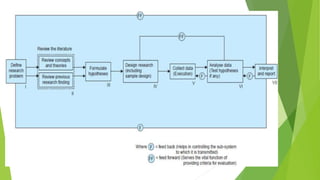
The following order concerning various steps provides a useful procedural
guideline regarding the research process:
1. formulating the research problem
2. extensive literature survey
3. developing the hypothesis
4. preparing the research design
5. determining sample design
6. collecting the data
7. execution of the project
8. analysis of data
9. hypothesis testing
10.generalizations and interpretation, and
11.preparation of the report or presentation of the results
1. Formulating the Research Problem
Formulation is the process of refining the research ideas into research
questions and objectives. Formulation means translating and
transforming the selected research problem/topic/idea into a
scientifically researchable question.
It is concerned with specifying exactly what the research problem is.
Essentially, two steps are involved in formulating research problems:
a) Understanding the problem thoroughly. The most important way of
understanding the problem is discussion with colleagues or persons
who are expert in knowledge or skill. The problem is also studied using
literature survey.
b) Expressing the problem in more specifies terms or, more
clear.
Problem definition or problem statement is a clear, precise and
concise statement of the question or issue that is to be investigated
with the goal of finding an answer or solution.
There are two ways of stating a problem:
• Posting question / questions
• Making declarative statement / statements
Hence, the steps involve in the process of defining the problem as
below:
1. Statement of the problem in a general way
2. Understanding the nature of problem
3. Surveying the available literature
4. Developing ideas through discussions
5. Rephrasing the research problem
The good research problem should meet the criteria of clear and
unambiguous, empirically possible to solve, should be able to verify
with facts, interesting to pursue finding the solution, and should be
able to check the availability of supervision.
2. Extensive literature survey:
Once the problem is formulated, a brief summary of it should be
written down. At this juncture the researcher should undertake
extensive literature survey connected with the problem.
For this purpose, the abstracting and indexing journals and published
or unpublished bibliographies are the first place to go to.
Academic journals, conference proceedings, government reports, books
etc., must be tapped depending on the nature of the problem. In this
process, it should be remembered that one source will lead to another.
The earlier studies, if any, which are similar to the study in and
should be carefully studied.
3. Development of working hypothesis
After extensive literature survey, researcher should state in clear
terms the working hypothesis or hypotheses.
Working hypothesis is tentative assumption made in order to draw
out and test its logical or empirical consequences.
In most types of research, the development of working hypothesis
plays an important role. Hypothesis should be very specific and
limited to the piece of research in hand because it has to be tested.
The role of the hypothesis is to guide the researchers by delimiting
the area of research and to keep them on the right track.
It sharpens researchers thinking and focuses attention on the more
important facets of the problem. It also indicates the type of data
required and the type of methods of data analysis to be used.
How does one go about developing working hypotheses? The
answer is by using the following approach:
a. Discussions with colleagues and experts about the problem, its
origin and the objectives in seeking a solution;
b. Examination of data and records, if available, concerning the
problem for possible trends, peculiarities and other clues;
c. Review of similar studies in the area or of the studies on similar
problems; and
d. Exploratory personal investigation which involves original field
interviews on a limited scale with interested parties and individuals
with a view to secure greater insight into the practical aspects of the
problem.
4. Preparing the Research design
The research problem having been formulated in clear cut terms, the
researcher will be required to prepare a research design, i.e., He/she
will have to state the conceptual structure within which research
would be conducted.
The function of research design is to provide for the collection of
relevant evidence with minimal expenditure of effort, time and
money. But how all these can be achieved depends mainly on the
research purpose.
Research purposes may be grouped into four categories,
i. Exploration,
ii. Description,
iii. Diagnosis, and
iv. Experimentation.
The suitable design will be one that minimizes bias and maximizes
the reliability of the data collected and analyses.
The preparation of the research design, appropriate for a particular
research problem, involves usually the consideration of the
following:
i. the means of obtaining the information;
ii. the availability and skills of the researcher and his staff (if any);
iii. explanation of the way in which selected means of obtaining
information will be organized and the reasoning leading to the
selection;
iv. the time available for research; and
v. the cost factor relating to research, i.e., the finance available for
the purpose.
5. Determining Sample Design
All the items under consideration in any field of inquiry constitute
‘universe’ or ‘population’.
A complete enumeration of all the items in the ‘population’ is known as
a census inquiry.
For instance, blood testing is done only on sample basis. Hence, quite
often we select only a few items from the universe for our study
purposes. The items so selected constitute what is technically called
sample.
The researcher must decide the way of selecting a sample or what is
popularly known as the sample design.
Samples can be either probability samples or nonprobability
samples.
With probability samples each element has a known probability of being
included in the sample but the non-probability samples do not allow
the researcher to determine this probability.
6. Collecting the data
In dealing with any real life problem it is often found that data at hand
are inadequate, and hence, it becomes necessary to collect data that
are appropriate.
There are several ways of collecting the appropriate data which
differ considerably in context of money costs, time and other resources
at the disposal of the researcher.
Primary data can be collected either through experiment or through
survey. If the researcher conducts an experiment, he/she observes
some quantitative measurements.
But in the case of a survey, data can be collected by any one or more
of the following ways:
i. By observation
ii. Through personal interview
iii. Through telephone interviews
iv. By mailing of questionnaires
v. Through schedules
The researcher should select one of these methods of collecting the
data taking into consideration the nature of investigation, objective
and scope of the inquiry, financial resources, available time and the
desired degree of accuracy.
7. Execution of the Project
Execution of the project is a very important step in the research
process. If the execution of the project proceeds on correct lines, the
data to be collected would be adequate and dependable.
The researcher should see that the project is executed in a
systematic manner and in time.
If the survey is to be conducted by means of structured questionnaires,
data can be readily machine processed.
In such a situation, questions as well as the possible answers may be
coded. If the data are to be collected through interviewers,
arrangements should be made for proper selection and training of the
interviewers.
The steps should be taken to ensure that the survey is under
statistical control so that the collected information is in accordance
with the pre-defined standard of accuracy.
If some of the respondents do not cooperate, some suitable methods
should be designed to tackle this problem.
One method of dealing with the non-response problem is to make a
list of the non-respondents and take a small sub-sample of them and
then with the help of experts vigorous efforts can be made for securing
response.
8. Analysis of data
After the data have been collected, the researcher turns to the task of
analyzing them. The analysis of data requires a number of closely
related operations such as categories to raw data through coding,
tabulation and then drawing statistical inferences.
Researcher should classify the raw data into some purposeful and
usable categories. Coding operation is usually done at this stage
through which the categories of data are transformed into symbols that
may be tabulated and counted.
Tabulation is a part of the technical procedure wherein the classified
data are put in the form of tables.
Analysis work after tabulation is generally based on the computation of
various percentages, coefficients, etc., by applying various well defined
statistical formulae. In brief, the researcher can analyze the collected
data with the help of various statistical measures.
9. Hypothesis-testing
After analyzing the data as stated above, the researcher is in a position
to test the hypotheses, if any, he/she had formulated earlier.
Do the facts support the hypotheses or they happen to be contrary?
This is the usual question which should be answered while testing
hypotheses.
Various tests, such as Chi square test, t-test, F-test, have been
developed by statisticians for the purpose. The hypotheses may be
tested through the use of one or more of such tests, depending upon
the nature and object of research inquiry.
Hypothesis -testing will result in either accepting the hypothesis or in
rejecting it.
10. Generalizations and interpretation
If a hypothesis is tested and upheld several times, it may be possible for
the researcher to arrive at generalization, i.e., to build a theory.
As a matter of fact, the real value of research lies in its ability to arrive
at certain generalizations. If the researcher had no hypothesis to start
with, he/she might seek to explain his/her findings on the basis of some
theory. It is known as interpretation.
11. Preparation of the report or the thesis
Finally, the researcher has to prepare the report of what has been done
by him. Writing of report must be done with great care keeping in view
the following: The layout of the report should be as follows:
i. the preliminary pages;
ii. the main text, and
iii. the end matter.
In its preliminary pages the report should carry title and date followed
by acknowledgement sand foreword. Then there should be a table of
contents followed by a list of tables and list of graphs and charts, if any,
given in the report.
The main text of the report should have the following parts:
• Introduction
• Summary of findings
• Main report
• Conclusion
At the end of the report, appendices should be enlisted in respect of all
technical data.
Bibliography, i.e., list of books, journals, reports, etc., consulted, should
also be given in the end.
Index should also be given specially in a published research report.
Report should be written in a concise and objective style in simple
language avoiding vague expressions such as ‘it seems,’ ‘there may be’
Charts and illustrations in the main report should be used only if they
present the information more clearly and forcibly.

Dr. Balamurugan_Research Process_Bala.pdf

  • 1.
    Steps in ResearchProcess Dr. Balamurugan M Associate Professor Department of MCA Acharya Institute of Graduate Studies Bengaluru
  • 2.
    Research Process  Theresearch process is a roadmap for a researcher, and it gives an overview of the researcher’s research journey.  Research process consists of series of actions or steps necessary to effectively carry out research and the desired sequencing of these steps.  The various steps involved in a research process are not mutually exclusive; nor are they separate and distinct.  They do not necessarily follow each other in any specific order and the researcher has to be constantly anticipating at each step in the research process the requirements of the subsequent steps.
  • 3.
    The following orderconcerning various steps provides a useful procedural guideline regarding the research process: 1. formulating the research problem 2. extensive literature survey 3. developing the hypothesis 4. preparing the research design 5. determining sample design 6. collecting the data 7. execution of the project 8. analysis of data 9. hypothesis testing 10.generalizations and interpretation, and 11.preparation of the report or presentation of the results
  • 5.
    1. Formulating theResearch Problem Formulation is the process of refining the research ideas into research questions and objectives. Formulation means translating and transforming the selected research problem/topic/idea into a scientifically researchable question. It is concerned with specifying exactly what the research problem is. Essentially, two steps are involved in formulating research problems: a) Understanding the problem thoroughly. The most important way of understanding the problem is discussion with colleagues or persons who are expert in knowledge or skill. The problem is also studied using literature survey.
  • 6.
    b) Expressing theproblem in more specifies terms or, more clear. Problem definition or problem statement is a clear, precise and concise statement of the question or issue that is to be investigated with the goal of finding an answer or solution. There are two ways of stating a problem: • Posting question / questions • Making declarative statement / statements
  • 7.
    Hence, the stepsinvolve in the process of defining the problem as below: 1. Statement of the problem in a general way 2. Understanding the nature of problem 3. Surveying the available literature 4. Developing ideas through discussions 5. Rephrasing the research problem The good research problem should meet the criteria of clear and unambiguous, empirically possible to solve, should be able to verify with facts, interesting to pursue finding the solution, and should be able to check the availability of supervision.
  • 8.
    2. Extensive literaturesurvey: Once the problem is formulated, a brief summary of it should be written down. At this juncture the researcher should undertake extensive literature survey connected with the problem. For this purpose, the abstracting and indexing journals and published or unpublished bibliographies are the first place to go to. Academic journals, conference proceedings, government reports, books etc., must be tapped depending on the nature of the problem. In this process, it should be remembered that one source will lead to another. The earlier studies, if any, which are similar to the study in and should be carefully studied.
  • 9.
    3. Development ofworking hypothesis After extensive literature survey, researcher should state in clear terms the working hypothesis or hypotheses. Working hypothesis is tentative assumption made in order to draw out and test its logical or empirical consequences. In most types of research, the development of working hypothesis plays an important role. Hypothesis should be very specific and limited to the piece of research in hand because it has to be tested.
  • 10.
    The role ofthe hypothesis is to guide the researchers by delimiting the area of research and to keep them on the right track. It sharpens researchers thinking and focuses attention on the more important facets of the problem. It also indicates the type of data required and the type of methods of data analysis to be used. How does one go about developing working hypotheses? The answer is by using the following approach: a. Discussions with colleagues and experts about the problem, its origin and the objectives in seeking a solution; b. Examination of data and records, if available, concerning the problem for possible trends, peculiarities and other clues;
  • 11.
    c. Review ofsimilar studies in the area or of the studies on similar problems; and d. Exploratory personal investigation which involves original field interviews on a limited scale with interested parties and individuals with a view to secure greater insight into the practical aspects of the problem. 4. Preparing the Research design The research problem having been formulated in clear cut terms, the researcher will be required to prepare a research design, i.e., He/she will have to state the conceptual structure within which research would be conducted.
  • 12.
    The function ofresearch design is to provide for the collection of relevant evidence with minimal expenditure of effort, time and money. But how all these can be achieved depends mainly on the research purpose. Research purposes may be grouped into four categories, i. Exploration, ii. Description, iii. Diagnosis, and iv. Experimentation. The suitable design will be one that minimizes bias and maximizes the reliability of the data collected and analyses.
  • 13.
    The preparation ofthe research design, appropriate for a particular research problem, involves usually the consideration of the following: i. the means of obtaining the information; ii. the availability and skills of the researcher and his staff (if any); iii. explanation of the way in which selected means of obtaining information will be organized and the reasoning leading to the selection; iv. the time available for research; and v. the cost factor relating to research, i.e., the finance available for the purpose.
  • 14.
    5. Determining SampleDesign All the items under consideration in any field of inquiry constitute ‘universe’ or ‘population’. A complete enumeration of all the items in the ‘population’ is known as a census inquiry. For instance, blood testing is done only on sample basis. Hence, quite often we select only a few items from the universe for our study purposes. The items so selected constitute what is technically called sample. The researcher must decide the way of selecting a sample or what is popularly known as the sample design.
  • 15.
    Samples can beeither probability samples or nonprobability samples. With probability samples each element has a known probability of being included in the sample but the non-probability samples do not allow the researcher to determine this probability. 6. Collecting the data In dealing with any real life problem it is often found that data at hand are inadequate, and hence, it becomes necessary to collect data that are appropriate. There are several ways of collecting the appropriate data which differ considerably in context of money costs, time and other resources at the disposal of the researcher.
  • 16.
    Primary data canbe collected either through experiment or through survey. If the researcher conducts an experiment, he/she observes some quantitative measurements. But in the case of a survey, data can be collected by any one or more of the following ways: i. By observation ii. Through personal interview iii. Through telephone interviews iv. By mailing of questionnaires v. Through schedules
  • 17.
    The researcher shouldselect one of these methods of collecting the data taking into consideration the nature of investigation, objective and scope of the inquiry, financial resources, available time and the desired degree of accuracy. 7. Execution of the Project Execution of the project is a very important step in the research process. If the execution of the project proceeds on correct lines, the data to be collected would be adequate and dependable. The researcher should see that the project is executed in a systematic manner and in time.
  • 18.
    If the surveyis to be conducted by means of structured questionnaires, data can be readily machine processed. In such a situation, questions as well as the possible answers may be coded. If the data are to be collected through interviewers, arrangements should be made for proper selection and training of the interviewers. The steps should be taken to ensure that the survey is under statistical control so that the collected information is in accordance with the pre-defined standard of accuracy.
  • 19.
    If some ofthe respondents do not cooperate, some suitable methods should be designed to tackle this problem. One method of dealing with the non-response problem is to make a list of the non-respondents and take a small sub-sample of them and then with the help of experts vigorous efforts can be made for securing response. 8. Analysis of data After the data have been collected, the researcher turns to the task of analyzing them. The analysis of data requires a number of closely related operations such as categories to raw data through coding, tabulation and then drawing statistical inferences.
  • 20.
    Researcher should classifythe raw data into some purposeful and usable categories. Coding operation is usually done at this stage through which the categories of data are transformed into symbols that may be tabulated and counted. Tabulation is a part of the technical procedure wherein the classified data are put in the form of tables. Analysis work after tabulation is generally based on the computation of various percentages, coefficients, etc., by applying various well defined statistical formulae. In brief, the researcher can analyze the collected data with the help of various statistical measures.
  • 21.
    9. Hypothesis-testing After analyzingthe data as stated above, the researcher is in a position to test the hypotheses, if any, he/she had formulated earlier. Do the facts support the hypotheses or they happen to be contrary? This is the usual question which should be answered while testing hypotheses. Various tests, such as Chi square test, t-test, F-test, have been developed by statisticians for the purpose. The hypotheses may be tested through the use of one or more of such tests, depending upon the nature and object of research inquiry.
  • 22.
    Hypothesis -testing willresult in either accepting the hypothesis or in rejecting it. 10. Generalizations and interpretation If a hypothesis is tested and upheld several times, it may be possible for the researcher to arrive at generalization, i.e., to build a theory. As a matter of fact, the real value of research lies in its ability to arrive at certain generalizations. If the researcher had no hypothesis to start with, he/she might seek to explain his/her findings on the basis of some theory. It is known as interpretation.
  • 23.
    11. Preparation ofthe report or the thesis Finally, the researcher has to prepare the report of what has been done by him. Writing of report must be done with great care keeping in view the following: The layout of the report should be as follows: i. the preliminary pages; ii. the main text, and iii. the end matter. In its preliminary pages the report should carry title and date followed by acknowledgement sand foreword. Then there should be a table of contents followed by a list of tables and list of graphs and charts, if any, given in the report.
  • 24.
    The main textof the report should have the following parts: • Introduction • Summary of findings • Main report • Conclusion At the end of the report, appendices should be enlisted in respect of all technical data. Bibliography, i.e., list of books, journals, reports, etc., consulted, should also be given in the end. Index should also be given specially in a published research report.
  • 25.
    Report should bewritten in a concise and objective style in simple language avoiding vague expressions such as ‘it seems,’ ‘there may be’ Charts and illustrations in the main report should be used only if they present the information more clearly and forcibly.