1
ISLAND
BIOGEOGRAPHY
2
CONTENT
Sl
no:
Title Page
no:
Introduction 3
1.0 Islands 5
2.0 The theory of island biogeography 7
2.1 Species- area relationship 12
2.2 Species- isolation relationship 13
2.3 The predictions of equilibrium theory
of island biogeography (ETIB):
14
2.4 Example for the theory of island
biogeography
16
2.5 Applications of the theory of island
biogeography
17
Conclusion 18
Reference 19
3
INTRODUCTION
The island is a naturally formed area of land, surrounded by water and
which is above water at high tide. It includes a lake surrounded by
desert, patches of woodland and mountain peaks. They are small
geographic units with definite boundaries and are closed
environments. Islands are used as models to demonstrate the
mechanism of biogeographic phenomena. The studies on islands
provided information’s about invasion, colonization patterns,
dispersal mechanisms, and extinction rates.
Biogeography is a branch of biology which deals with the geographic
distribution of plants, animals, and other organisms. Alfred Russel
Wallace is regarded as the father of biogeography due to his great
contributions to the study of geographic distribution of species.
Island biogeography is the study of patterns of distribution of species
on islands. Which is influenced by ecological and evolutionary
processes related to island characteristics such as isolation and area.
The theory of island biogeography is one of the major theories in
ecology. The theory was published in 1967 and was written by two
4
American biologists Robert MacArthur and Edward Wilson. It is also
known as MacArthur-Wilson theory. This theory is one of the most
important products of island studies. Island biogeography gives the
best evidence to support natural selection and the theory of evolution.
This theory helps to explain the richness and uniqueness of species
found in an isolated area.
Georg Forster was the first biologist who mentioned some features of
island biogeography. He noted that islands contain fewer species than
the mainland and the number species vary according to the size and
ecological diversity of the island. Another contributor Candolle
suggests that age, climate, and degree of isolation would affect its
diversity of organisms. Alfred Wallace was another contributor. He
mentioned that the origin of the island and its distance from the
mainland and from another island would affect the nature and
diversity of its biota.
The islands are considered as the most important natural experimental
laboratories since the time of Darwin. Eugene G. Munroe was the first
one who developed the concept that islands have an equilibrium
species number when he was studying the species area relationships
5
in this work distribution of butterflies in the West Indies. His ideas
were unrecognized by ecologists and biogeographers. Later, Frank W.
Preston made a great contribution to the development of island
biogeography. Robert H. MacArthur and Edward O. Wilson are the
two biologists who provided a complete theory with suitable
mathematical models “the theory of island biogeography”. This
theory was modified and elaborated by others and many studies have
been conducted inspired by it.
6
1.0. ISLANDS
Islands are small pieces of land surrounded by water and are smaller
than continents. They are seen in oceans, seas, rivers, and lakes. The
major difference between the island and continent is their size. Islands
are isolated lands; its isolation controls the species diversity. There
are six major types of islands:
1. Oceanic islands: they never had any connection with the
continent. These islands are either volcanic origin or are
constructed by corals. The climate, vegetation, and fauna are
different from the mainland. They have spare flora and fauna.
Eg : Bermuda, Galapagos islands
2. Continental islands: these islands were once part of the
continent and separated by a stretch of sea either by sinking or
by rise in the sea level. They situated close to their continent and
are geologically resemble each other.
Eg: Great Britain, Taiwan
7
3. Tidal islands: the existence of these islands depends on tidal
action. These islands are visible during the low tide and
submerged during the high tide.
Eg: Jindo and Mondo in South Korea.
4. Barrier islands: these are a constantly changing deposit of sand
that forms parallel to the mainland coast due to waves and tidal
action. They occur in chains and contain large number of
islands.
Eg: Great barrier island, New Zealand
5. Coral islands: these islands are formed from coral debris and
other organic matters.
Eg: Lakshadweep Island
6. Artificial island: they are islands made by people.
Eg: the Dubai waterfront
8
2.0. THE THEORY OF ISLAND BIOGEOGRAPHY
Island biogeography is the study of pattern in distribution of species
on islands as influenced by ecological and evolutionary processes
related to island characteristic such as isolation and area.The theory of
island biogeography predicts that the number of species on island is
dependent on two factors, immigration, and extinction.
Immigration: it is the movement of species from one place to another
(inward migration of species). The species immigrate to new islands
to meet their necessities. Immigration is also affected by the level of
isolation of the island. More isolated islands are harder for species to
live. Immigration is higher on nearby islands than the distant islands.
Extinction: it is the dying out of a species. It occurs because of
environmental and evolutionary factors. Extinction causes a reduction
in the number of species and biodiversity of an island. There are two
factors which affect the rate of extinction of an island: the size of the
land and degree of isolation. Smaller more isolated islands have a
higher rate of extinction than the larger and less isolated islands. The
extinction rate increases as the individuals from different species
9
compete for resources. The islands which are once part of a continent
were likely to contain organisms from the mainland. But in islands
which arisen independently like volcanic or coral atoll islands would
only contain organisms which are able to cross the stretch of sea.
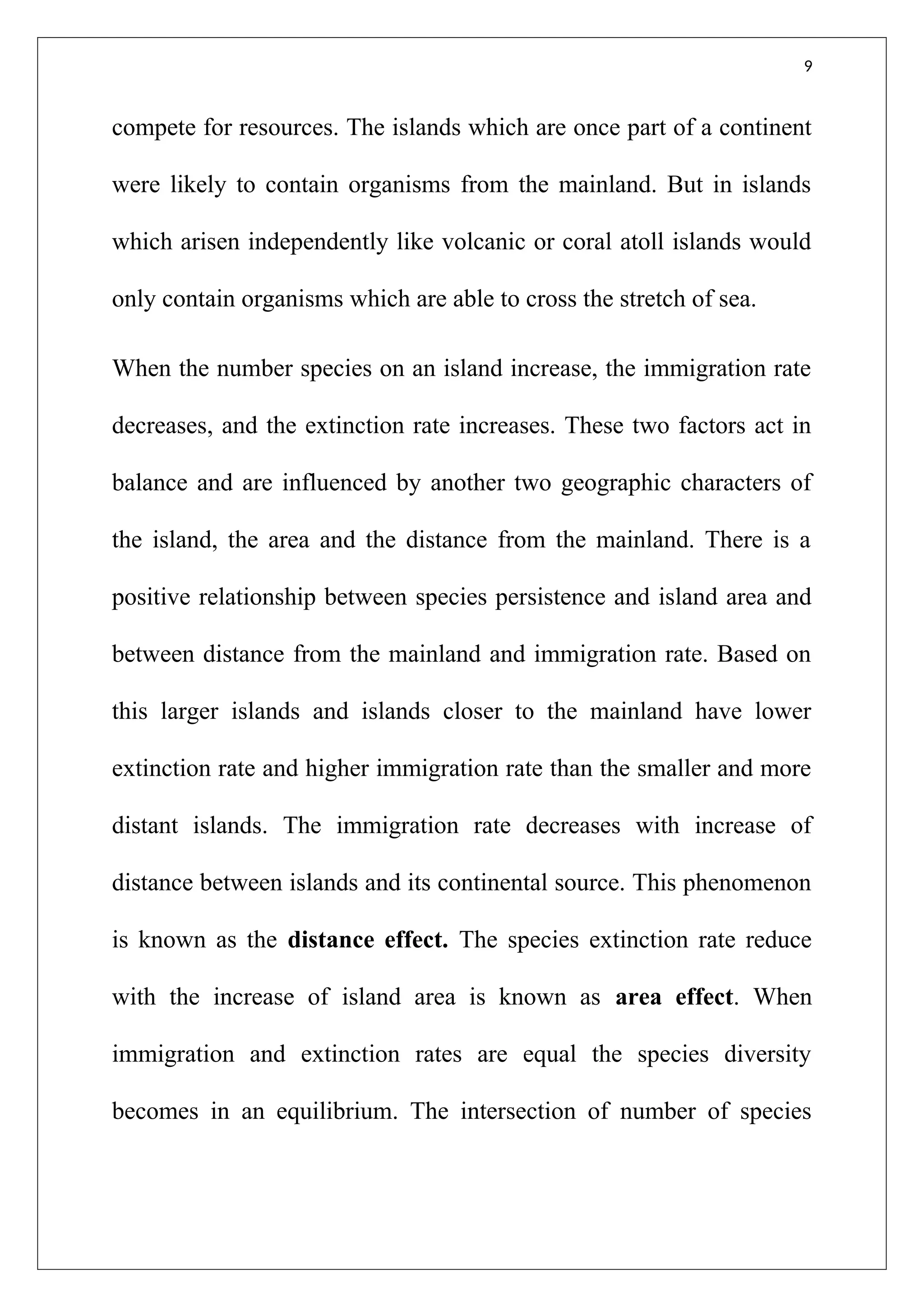
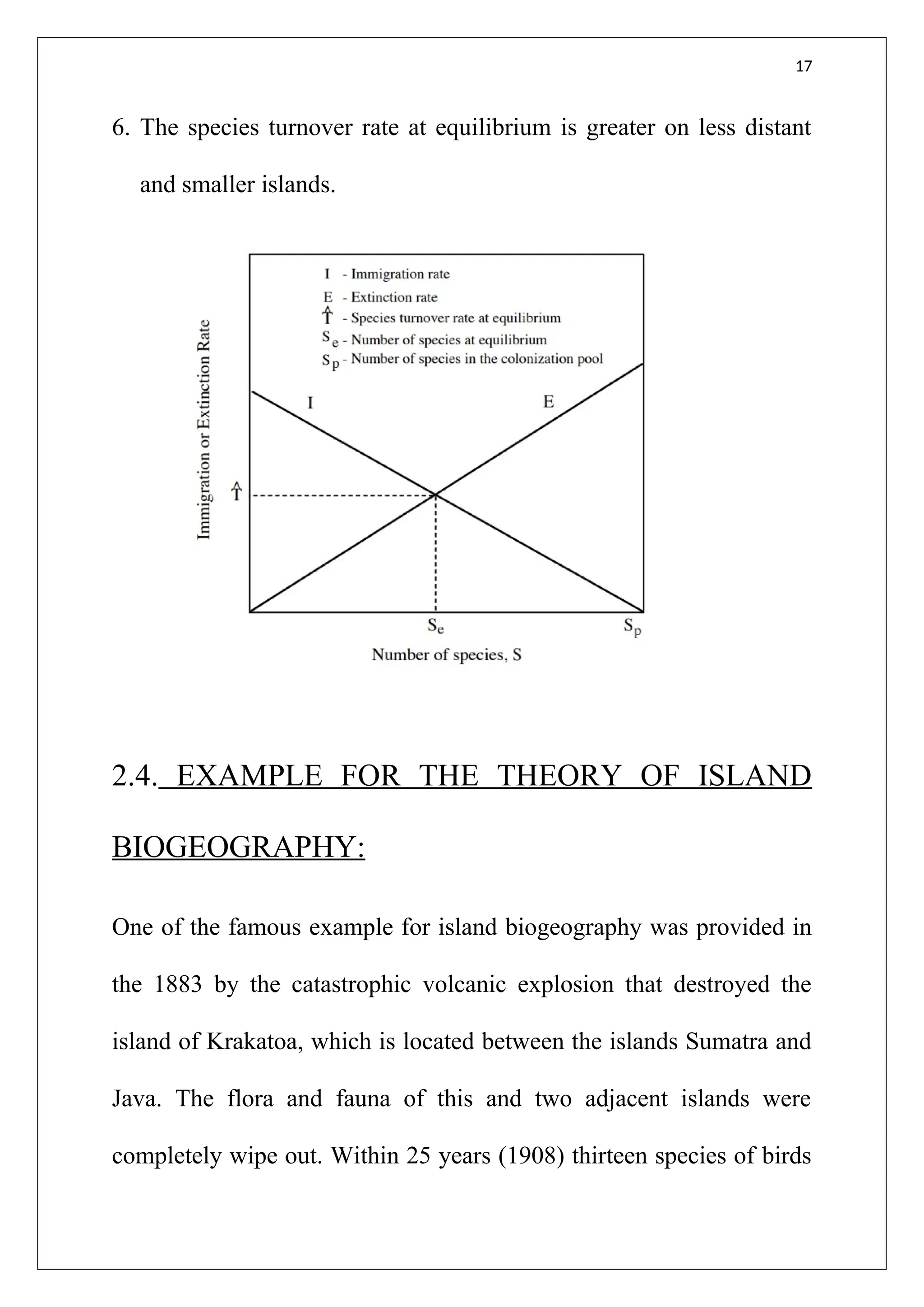
When the number species on an island increase, the immigration rate
decreases, and the extinction rate increases. These two factors act in
balance and are influenced by another two geographic characters of
the island, the area and the distance from the mainland. There is a
positive relationship between species persistence and island area and
between distance from the mainland and immigration rate. Based on
this larger islands and islands closer to the mainland have lower
extinction rate and higher immigration rate than the smaller and more
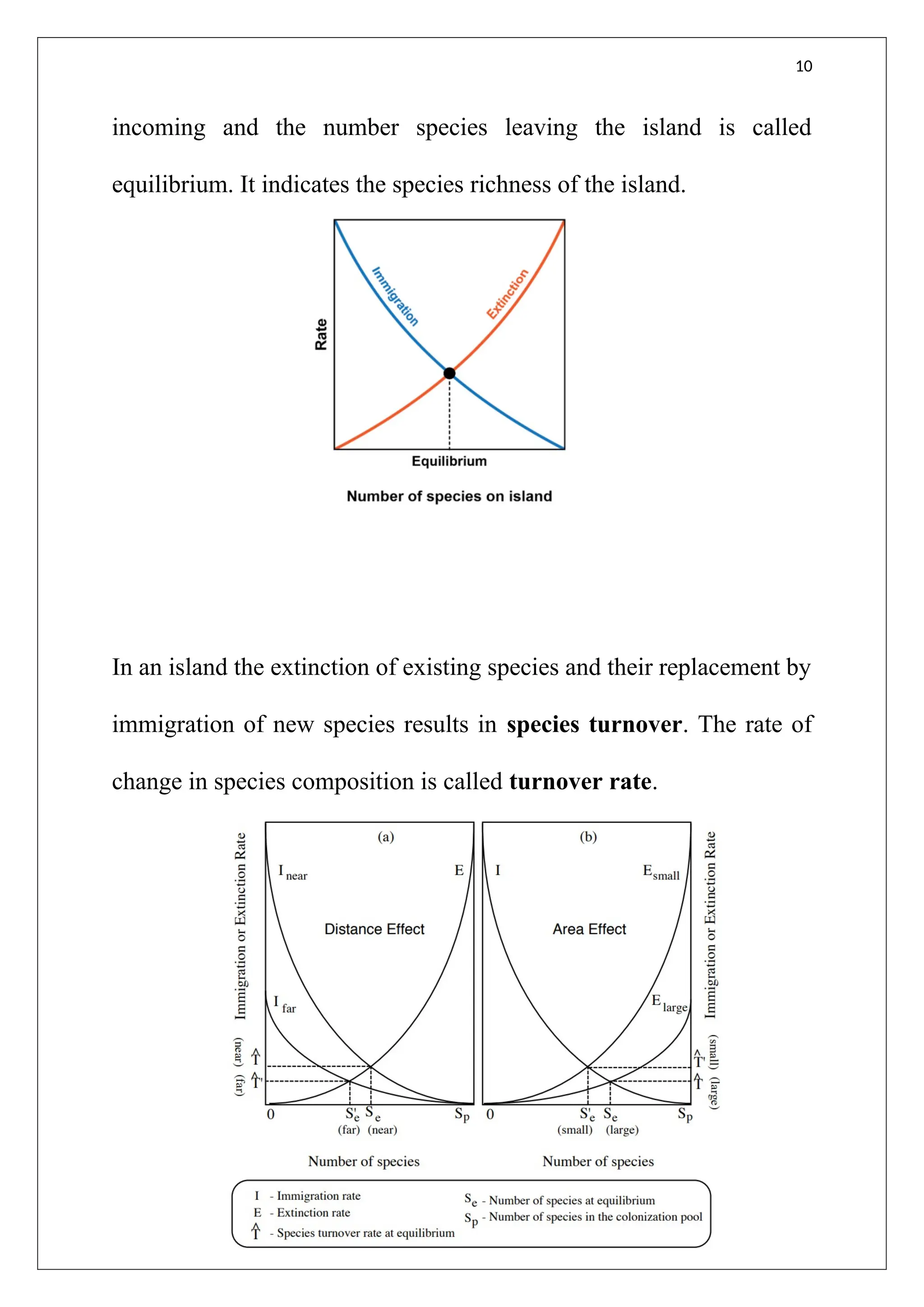
distant islands. The immigration rate decreases with increase of
distance between islands and its continental source. This phenomenon
is known as the distance effect. The species extinction rate reduce
with the increase of island area is known as area effect. When
immigration and extinction rates are equal the species diversity
becomes in an equilibrium. The intersection of number of species
10
incoming and the number species leaving the island is called
equilibrium. It indicates the species richness of the island.
In an island the extinction of existing species and their replacement by
immigration of new species results in species turnover. The rate of
change in species composition is called turnover rate.
11
According to the equilibrium theory of island biogeography, the
number of species in an island is determined by equilibrium between
species immigration and extinction. The rate of immigration of a new
species to an island decreases as the number of species on the island
increases. On the other hand, the species extinction rate increases as
the number of species present increases.
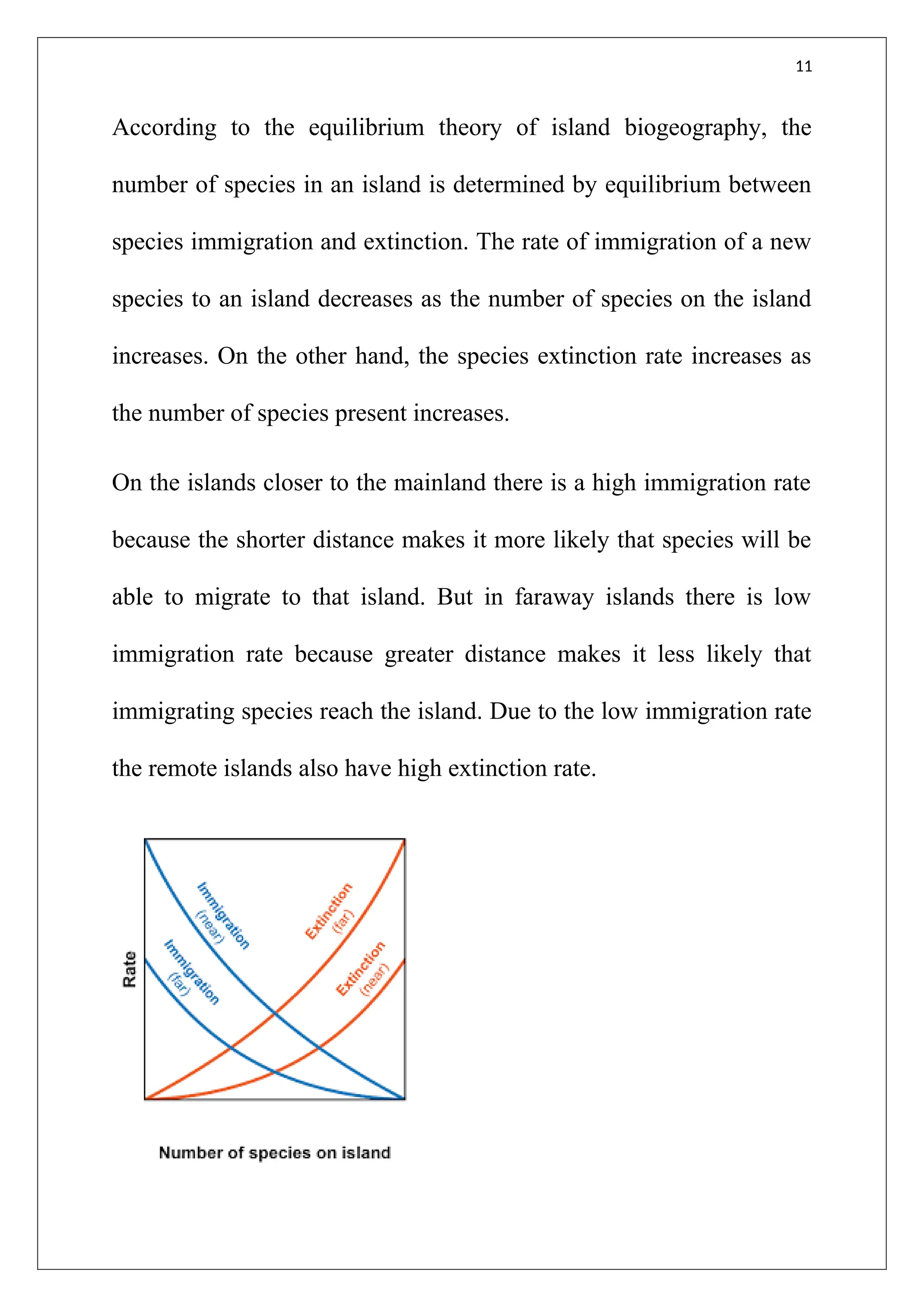
On the islands closer to the mainland there is a high immigration rate
because the shorter distance makes it more likely that species will be
able to migrate to that island. But in faraway islands there is low
immigration rate because greater distance makes it less likely that
immigrating species reach the island. Due to the low immigration rate
the remote islands also have high extinction rate.
12
In small islands immigration rate is low because of the small area.
The migrating species are less likely to arrive on the island. The
extinction rate is high because species that have driven off the island
will be less likely to remigrate. But in large islands immigration rate
is high because the greater area makes it more likely that the
migrating species will arrive the island and take up residence. The
extinction rate is low since the species that are driven off the island
are more likely to remigrate. The large islands have higher species
richness than the smaller islands.
13
2.1. SPECIES-AREA RELATIONSHIP
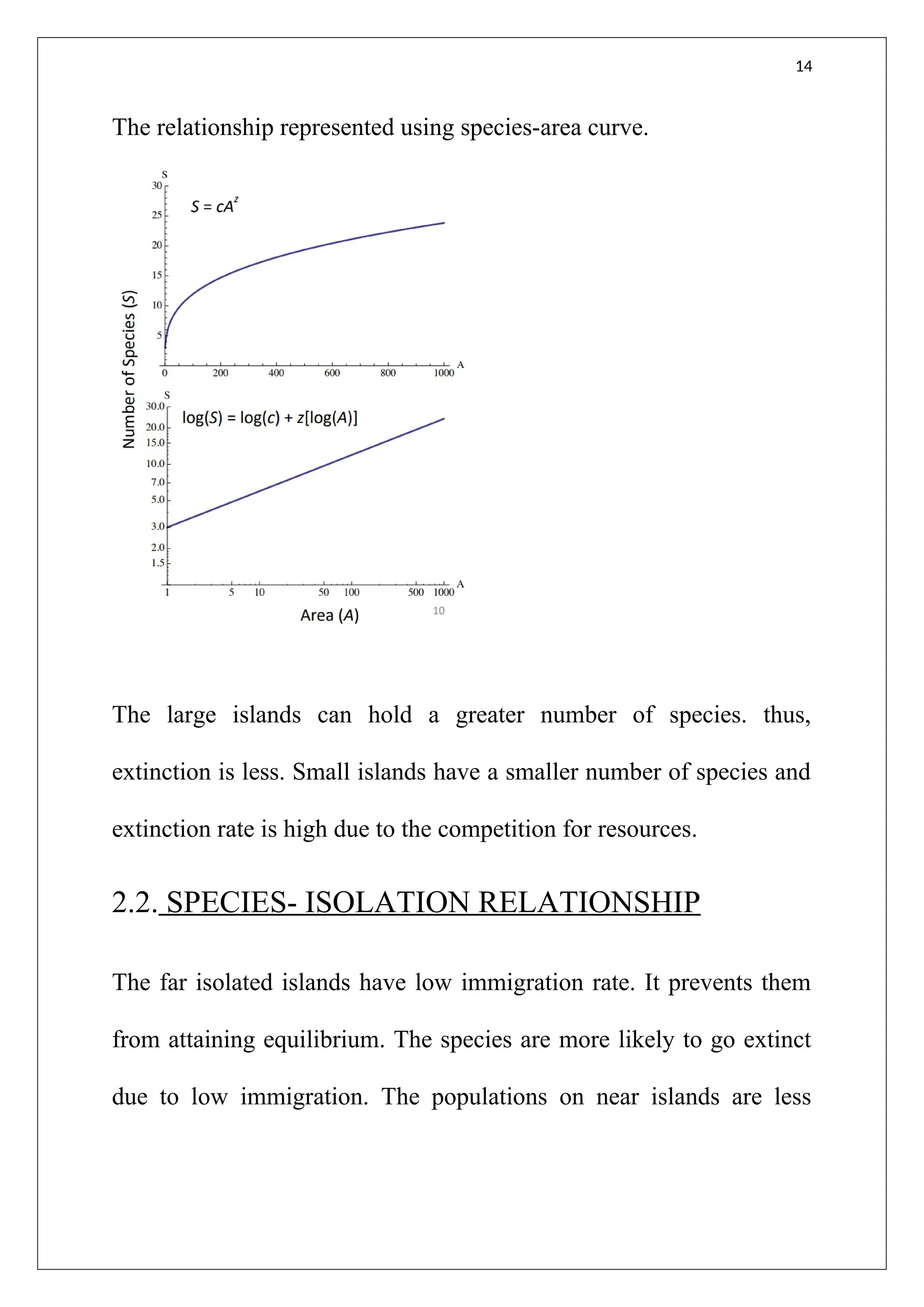
The number of species increases with increase in island area. The
species area curve mathematically expressed as,
S=c A
z
or log(S)= log(C) + z [log (A)]
Where, S= number of species, A= island area, c and z are positive
constants.
14
The relationship represented using species-area curve.
The large islands can hold a greater number of species. thus,
extinction is less. Small islands have a smaller number of species and
extinction rate is high due to the competition for resources.
2.2. SPECIES- ISOLATION RELATIONSHIP
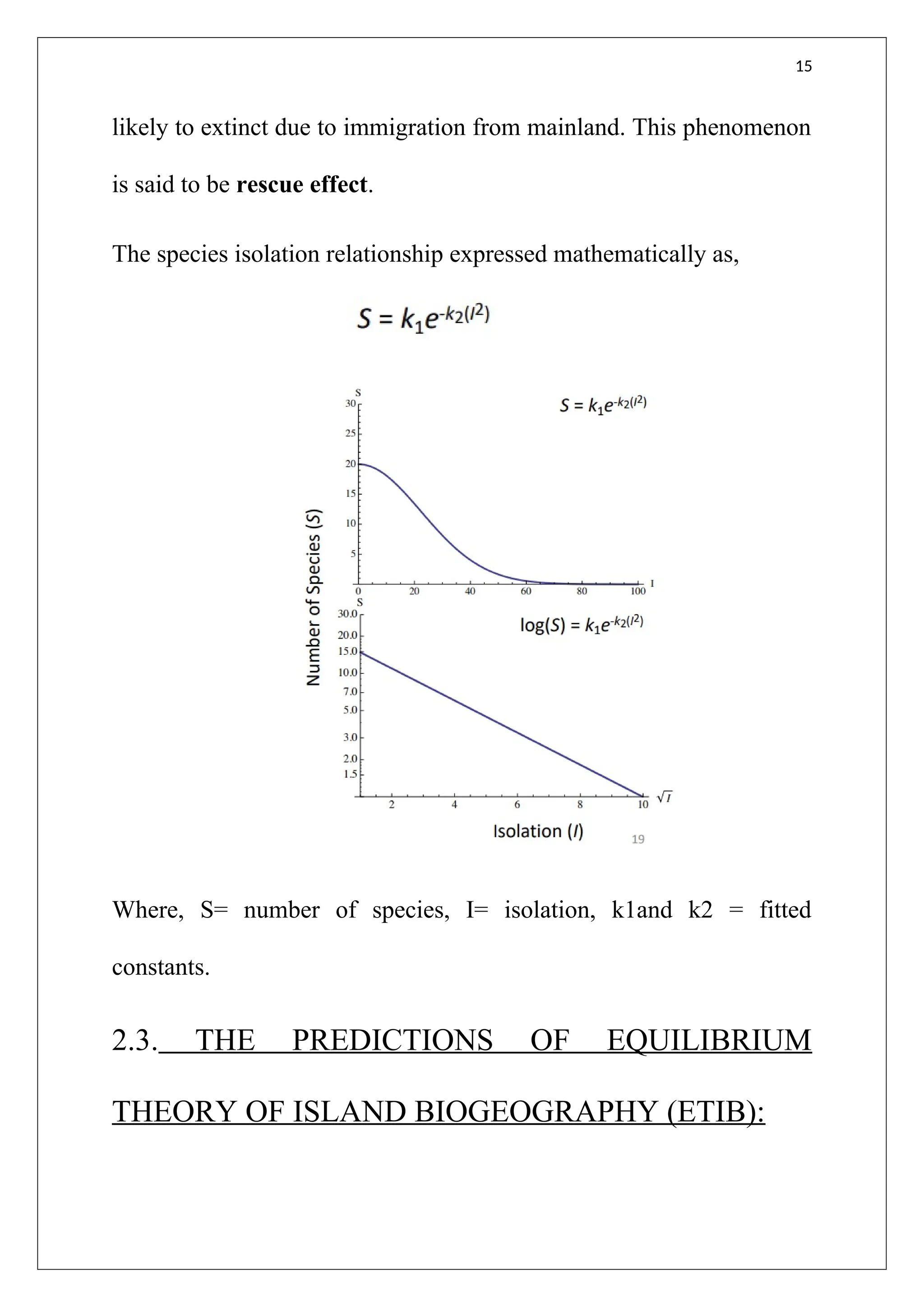
The far isolated islands have low immigration rate. It prevents them
from attaining equilibrium. The species are more likely to go extinct
due to low immigration. The populations on near islands are less
15
likely to extinct due to immigration from mainland. This phenomenon
is said to be rescue effect.
The species isolation relationship expressed mathematically as,
Where, S= number of species, I= isolation, k1and k2 = fitted
constants.
2.3. THE PREDICTIONS OF EQUILIBRIUM
THEORY OF ISLAND BIOGEOGRAPHY (ETIB):
16
There are several controversies for the ETIB. Based on this theory
there are some predictions.
1. A given island biota have an equilibrium, which is achieved when
the immigration and extinction rates are equal.
2. The distance between the islands and the continental biota affects
the immigration rate. And the extinction rate varies with the island
area.
3. In an island the immigration rate decreases and extinction rate
increases when the number of species already present increases.
4. The species richness at equilibrium decreases with island-
mainland distance and it is faster on smaller islands.
5. The species richness increases with island area and this increase is
more in more remote islands.
17
6. The species turnover rate at equilibrium is greater on less distant
and smaller islands.
2.4. EXAMPLE FOR THE THEORY OF ISLAND
BIOGEOGRAPHY:
One of the famous example for island biogeography was provided in
the 1883 by the catastrophic volcanic explosion that destroyed the
island of Krakatoa, which is located between the islands Sumatra and
Java. The flora and fauna of this and two adjacent islands were
completely wipe out. Within 25 years (1908) thirteen species of birds
18
had recolonized to this island. By 1919-21 twenty-eight bird species
were become established. And by 1932-34 it increases to twenty-nine.
Between the explosion and 1934, twenty-four species of birds become
established on this island. But five of them went extinct. By 1951 to
52 twenty-three species colonized. And by 1984-85 twenty-five
species established. During this long time between 1934- 1985
another fourteen species had recolonized, and eight of them become
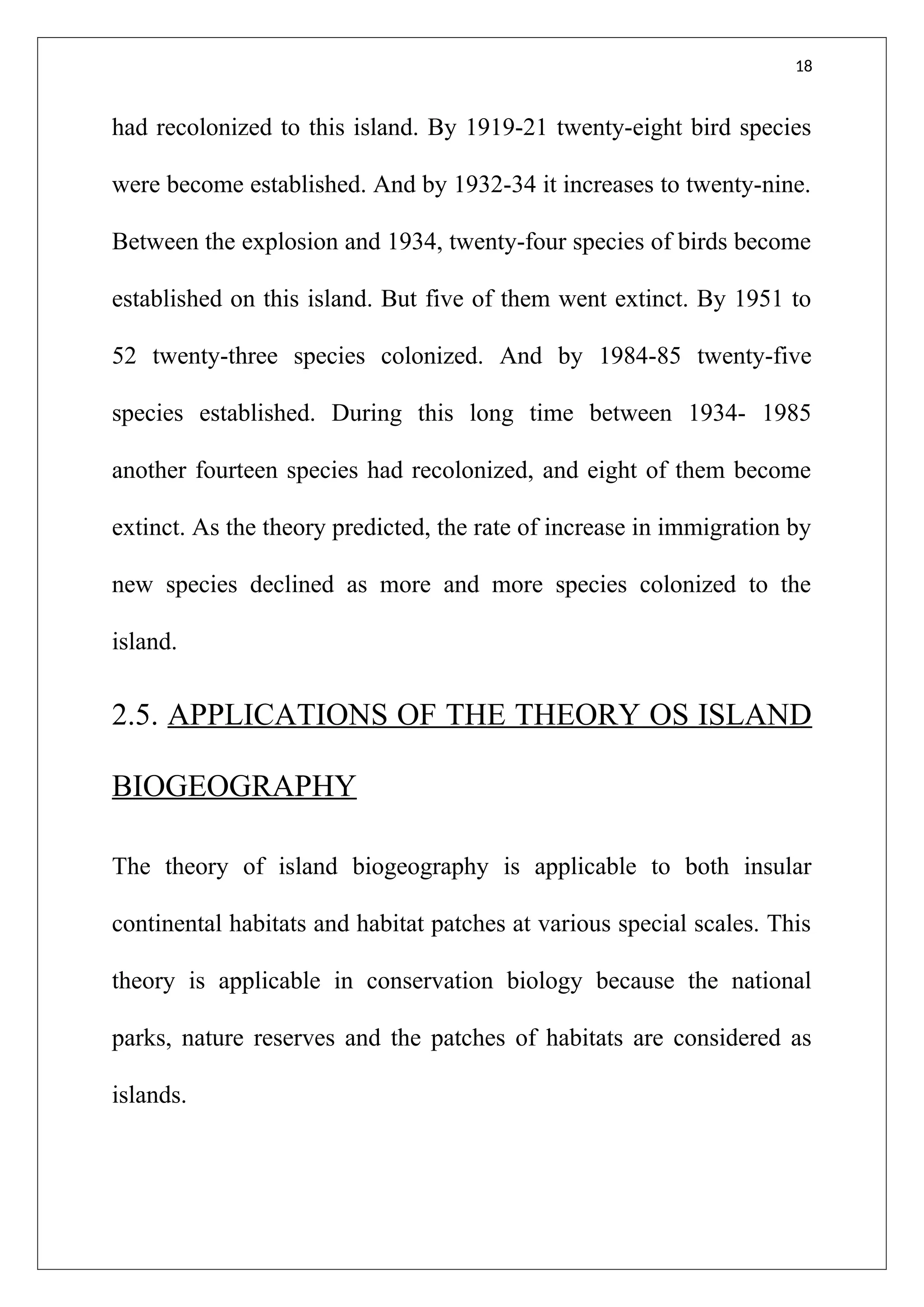
extinct. As the theory predicted, the rate of increase in immigration by
new species declined as more and more species colonized to the
island.
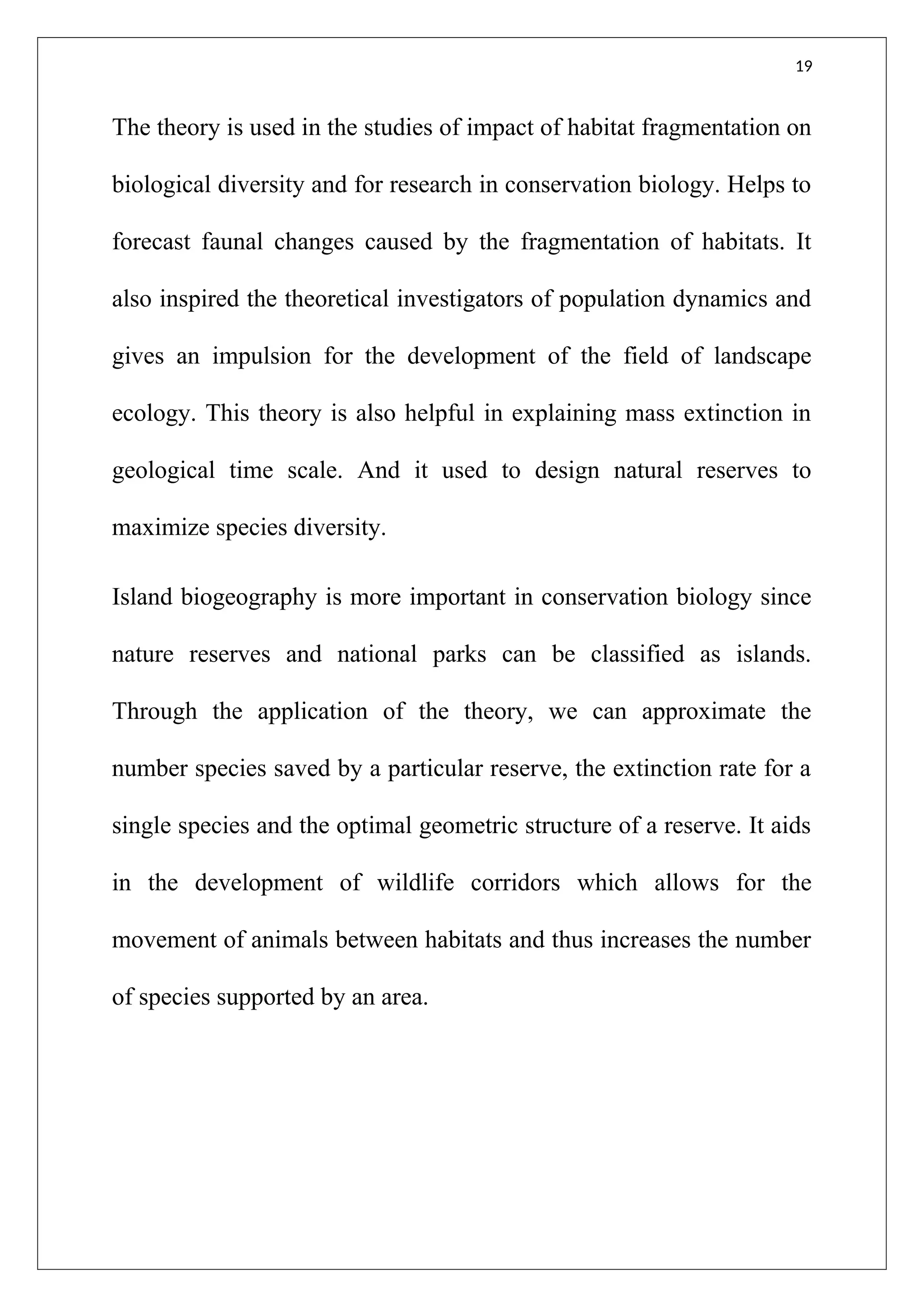
2.5. APPLICATIONS OF THE THEORY OS ISLAND
BIOGEOGRAPHY
The theory of island biogeography is applicable to both insular
continental habitats and habitat patches at various special scales. This
theory is applicable in conservation biology because the national
parks, nature reserves and the patches of habitats are considered as
islands.
19
The theory is used in the studies of impact of habitat fragmentation on
biological diversity and for research in conservation biology. Helps to
forecast faunal changes caused by the fragmentation of habitats. It
also inspired the theoretical investigators of population dynamics and
gives an impulsion for the development of the field of landscape
ecology. This theory is also helpful in explaining mass extinction in
geological time scale. And it used to design natural reserves to
maximize species diversity.
Island biogeography is more important in conservation biology since
nature reserves and national parks can be classified as islands.
Through the application of the theory, we can approximate the
number species saved by a particular reserve, the extinction rate for a
single species and the optimal geometric structure of a reserve. It aids
in the development of wildlife corridors which allows for the
movement of animals between habitats and thus increases the number
of species supported by an area.
20
CONCLUSION
The equilibrium theory of biogeography is one of the most successful
theoretical developments in the history of biogeography and
ecological science. It remains at the center of discussions about the
geographic distributions of species. Inspired by this theory many
studies are conducted.
The theory of island biogeography predicts that the number of species
on an island is related to the island area and degree of isolation of the
island. it states that smaller, more isolated islands have few species
richness. Larger, less isolated islands have a smaller number of
species richness. Immigration and extinction are two important factors
which determine the species diversity of the island. The species
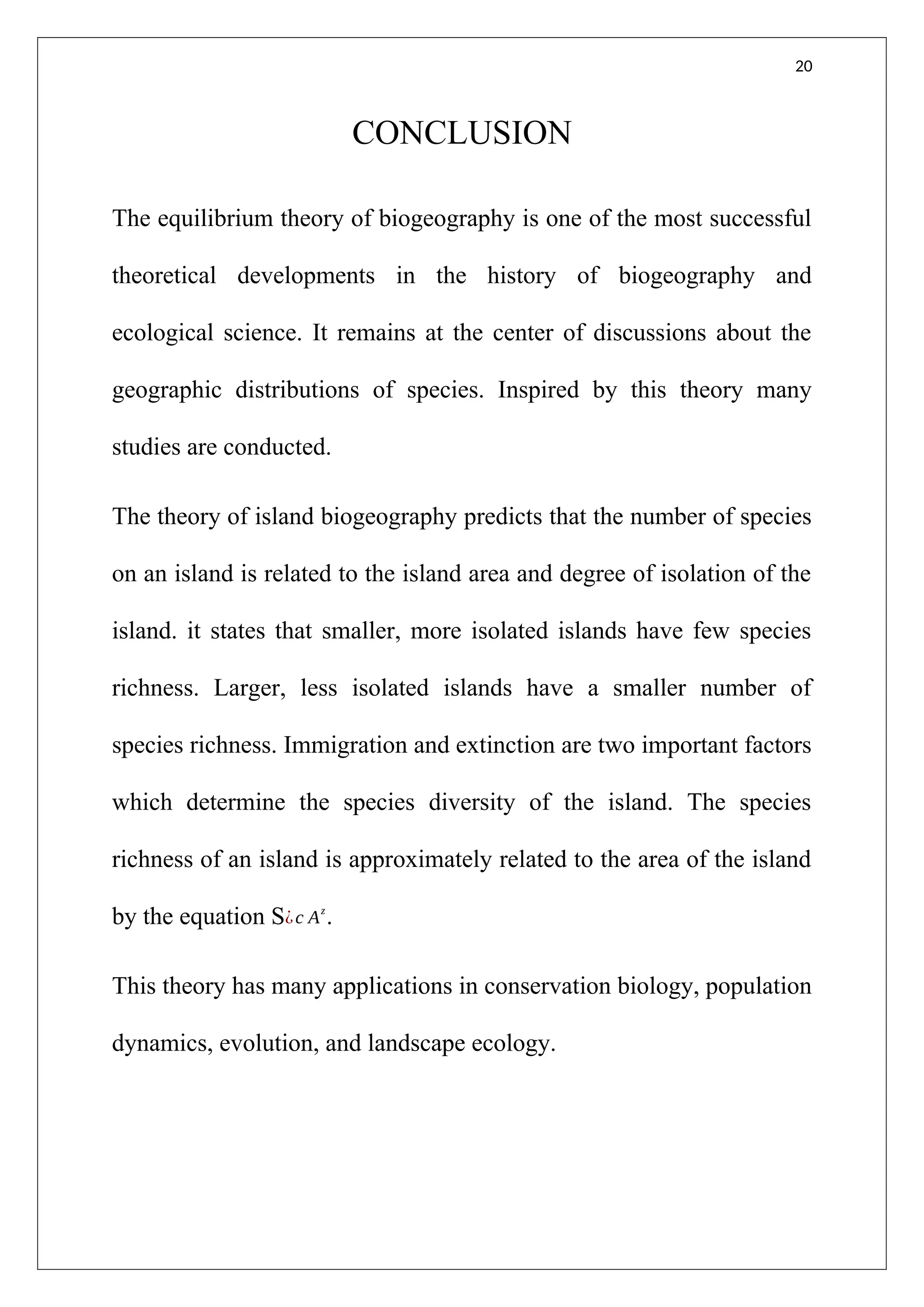
richness of an island is approximately related to the area of the island
by the equation S¿c A
z
.
This theory has many applications in conservation biology, population
dynamics, evolution, and landscape ecology.
21
REFERENCE
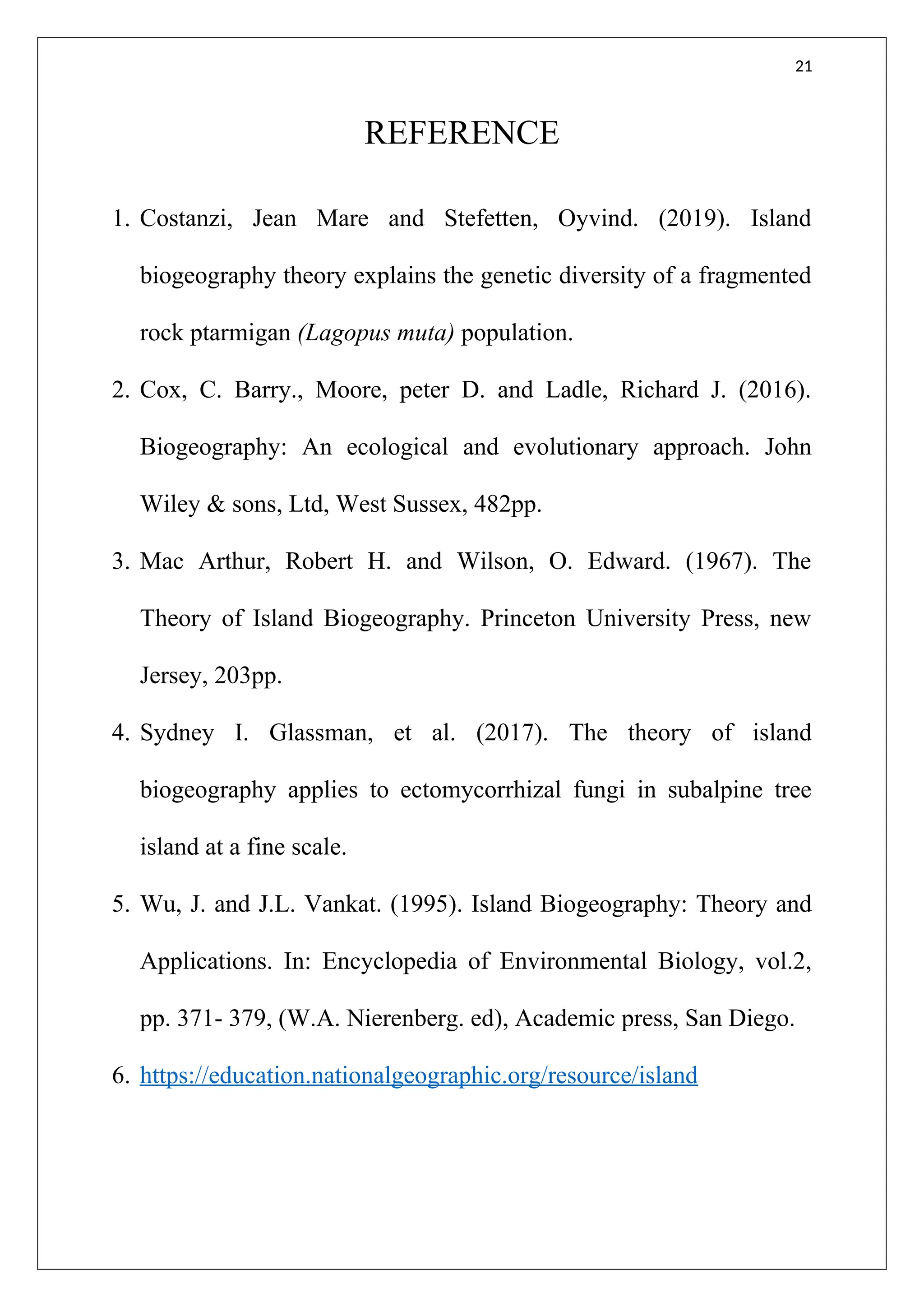
1. Costanzi, Jean Mare and Stefetten, Oyvind. (2019). Island
biogeography theory explains the genetic diversity of a fragmented
rock ptarmigan (Lagopus muta) population.
2. Cox, C. Barry., Moore, peter D. and Ladle, Richard J. (2016).
Biogeography: An ecological and evolutionary approach. John
Wiley & sons, Ltd, West Sussex, 482pp.
3. Mac Arthur, Robert H. and Wilson, O. Edward. (1967). The
Theory of Island Biogeography. Princeton University Press, new
Jersey, 203pp.
4. Sydney I. Glassman, et al. (2017). The theory of island
biogeography applies to ectomycorrhizal fungi in subalpine tree
island at a fine scale.
5. Wu, J. and J.L. Vankat. (1995). Island Biogeography: Theory and
Applications. In: Encyclopedia of Environmental Biology, vol.2,
pp. 371- 379, (W.A. Nierenberg. ed), Academic press, San Diego.
6. https://education.nationalgeographic.org/resource/island
22
7. https://www.biointeractive.org/sites/default/files/media/file/2021-
12/ExploringIBTData-Educator-act.pdf

ISLAND BIOGEOGRAPHY (Assignment).docx

  • 1.
  • 2.
    2 CONTENT Sl no: Title Page no: Introduction 3 1.0Islands 5 2.0 The theory of island biogeography 7 2.1 Species- area relationship 12 2.2 Species- isolation relationship 13 2.3 The predictions of equilibrium theory of island biogeography (ETIB): 14 2.4 Example for the theory of island biogeography 16 2.5 Applications of the theory of island biogeography 17 Conclusion 18 Reference 19
  • 3.
    3 INTRODUCTION The island isa naturally formed area of land, surrounded by water and which is above water at high tide. It includes a lake surrounded by desert, patches of woodland and mountain peaks. They are small geographic units with definite boundaries and are closed environments. Islands are used as models to demonstrate the mechanism of biogeographic phenomena. The studies on islands provided information’s about invasion, colonization patterns, dispersal mechanisms, and extinction rates. Biogeography is a branch of biology which deals with the geographic distribution of plants, animals, and other organisms. Alfred Russel Wallace is regarded as the father of biogeography due to his great contributions to the study of geographic distribution of species. Island biogeography is the study of patterns of distribution of species on islands. Which is influenced by ecological and evolutionary processes related to island characteristics such as isolation and area. The theory of island biogeography is one of the major theories in ecology. The theory was published in 1967 and was written by two
  • 4.
    4 American biologists RobertMacArthur and Edward Wilson. It is also known as MacArthur-Wilson theory. This theory is one of the most important products of island studies. Island biogeography gives the best evidence to support natural selection and the theory of evolution. This theory helps to explain the richness and uniqueness of species found in an isolated area. Georg Forster was the first biologist who mentioned some features of island biogeography. He noted that islands contain fewer species than the mainland and the number species vary according to the size and ecological diversity of the island. Another contributor Candolle suggests that age, climate, and degree of isolation would affect its diversity of organisms. Alfred Wallace was another contributor. He mentioned that the origin of the island and its distance from the mainland and from another island would affect the nature and diversity of its biota. The islands are considered as the most important natural experimental laboratories since the time of Darwin. Eugene G. Munroe was the first one who developed the concept that islands have an equilibrium species number when he was studying the species area relationships
  • 5.
    5 in this workdistribution of butterflies in the West Indies. His ideas were unrecognized by ecologists and biogeographers. Later, Frank W. Preston made a great contribution to the development of island biogeography. Robert H. MacArthur and Edward O. Wilson are the two biologists who provided a complete theory with suitable mathematical models “the theory of island biogeography”. This theory was modified and elaborated by others and many studies have been conducted inspired by it.
  • 6.
    6 1.0. ISLANDS Islands aresmall pieces of land surrounded by water and are smaller than continents. They are seen in oceans, seas, rivers, and lakes. The major difference between the island and continent is their size. Islands are isolated lands; its isolation controls the species diversity. There are six major types of islands: 1. Oceanic islands: they never had any connection with the continent. These islands are either volcanic origin or are constructed by corals. The climate, vegetation, and fauna are different from the mainland. They have spare flora and fauna. Eg : Bermuda, Galapagos islands 2. Continental islands: these islands were once part of the continent and separated by a stretch of sea either by sinking or by rise in the sea level. They situated close to their continent and are geologically resemble each other. Eg: Great Britain, Taiwan
  • 7.
    7 3. Tidal islands:the existence of these islands depends on tidal action. These islands are visible during the low tide and submerged during the high tide. Eg: Jindo and Mondo in South Korea. 4. Barrier islands: these are a constantly changing deposit of sand that forms parallel to the mainland coast due to waves and tidal action. They occur in chains and contain large number of islands. Eg: Great barrier island, New Zealand 5. Coral islands: these islands are formed from coral debris and other organic matters. Eg: Lakshadweep Island 6. Artificial island: they are islands made by people. Eg: the Dubai waterfront
  • 8.
    8 2.0. THE THEORYOF ISLAND BIOGEOGRAPHY Island biogeography is the study of pattern in distribution of species on islands as influenced by ecological and evolutionary processes related to island characteristic such as isolation and area.The theory of island biogeography predicts that the number of species on island is dependent on two factors, immigration, and extinction. Immigration: it is the movement of species from one place to another (inward migration of species). The species immigrate to new islands to meet their necessities. Immigration is also affected by the level of isolation of the island. More isolated islands are harder for species to live. Immigration is higher on nearby islands than the distant islands. Extinction: it is the dying out of a species. It occurs because of environmental and evolutionary factors. Extinction causes a reduction in the number of species and biodiversity of an island. There are two factors which affect the rate of extinction of an island: the size of the land and degree of isolation. Smaller more isolated islands have a higher rate of extinction than the larger and less isolated islands. The extinction rate increases as the individuals from different species
  • 9.
    9 compete for resources.The islands which are once part of a continent were likely to contain organisms from the mainland. But in islands which arisen independently like volcanic or coral atoll islands would only contain organisms which are able to cross the stretch of sea. When the number species on an island increase, the immigration rate decreases, and the extinction rate increases. These two factors act in balance and are influenced by another two geographic characters of the island, the area and the distance from the mainland. There is a positive relationship between species persistence and island area and between distance from the mainland and immigration rate. Based on this larger islands and islands closer to the mainland have lower extinction rate and higher immigration rate than the smaller and more distant islands. The immigration rate decreases with increase of distance between islands and its continental source. This phenomenon is known as the distance effect. The species extinction rate reduce with the increase of island area is known as area effect. When immigration and extinction rates are equal the species diversity becomes in an equilibrium. The intersection of number of species
  • 10.
    10 incoming and thenumber species leaving the island is called equilibrium. It indicates the species richness of the island. In an island the extinction of existing species and their replacement by immigration of new species results in species turnover. The rate of change in species composition is called turnover rate.
  • 11.
    11 According to theequilibrium theory of island biogeography, the number of species in an island is determined by equilibrium between species immigration and extinction. The rate of immigration of a new species to an island decreases as the number of species on the island increases. On the other hand, the species extinction rate increases as the number of species present increases. On the islands closer to the mainland there is a high immigration rate because the shorter distance makes it more likely that species will be able to migrate to that island. But in faraway islands there is low immigration rate because greater distance makes it less likely that immigrating species reach the island. Due to the low immigration rate the remote islands also have high extinction rate.
  • 12.
    12 In small islandsimmigration rate is low because of the small area. The migrating species are less likely to arrive on the island. The extinction rate is high because species that have driven off the island will be less likely to remigrate. But in large islands immigration rate is high because the greater area makes it more likely that the migrating species will arrive the island and take up residence. The extinction rate is low since the species that are driven off the island are more likely to remigrate. The large islands have higher species richness than the smaller islands.
  • 13.
    13 2.1. SPECIES-AREA RELATIONSHIP Thenumber of species increases with increase in island area. The species area curve mathematically expressed as, S=c A z or log(S)= log(C) + z [log (A)] Where, S= number of species, A= island area, c and z are positive constants.
  • 14.
    14 The relationship representedusing species-area curve. The large islands can hold a greater number of species. thus, extinction is less. Small islands have a smaller number of species and extinction rate is high due to the competition for resources. 2.2. SPECIES- ISOLATION RELATIONSHIP The far isolated islands have low immigration rate. It prevents them from attaining equilibrium. The species are more likely to go extinct due to low immigration. The populations on near islands are less
  • 15.
    15 likely to extinctdue to immigration from mainland. This phenomenon is said to be rescue effect. The species isolation relationship expressed mathematically as, Where, S= number of species, I= isolation, k1and k2 = fitted constants. 2.3. THE PREDICTIONS OF EQUILIBRIUM THEORY OF ISLAND BIOGEOGRAPHY (ETIB):
  • 16.
    16 There are severalcontroversies for the ETIB. Based on this theory there are some predictions. 1. A given island biota have an equilibrium, which is achieved when the immigration and extinction rates are equal. 2. The distance between the islands and the continental biota affects the immigration rate. And the extinction rate varies with the island area. 3. In an island the immigration rate decreases and extinction rate increases when the number of species already present increases. 4. The species richness at equilibrium decreases with island- mainland distance and it is faster on smaller islands. 5. The species richness increases with island area and this increase is more in more remote islands.
  • 17.
    17 6. The speciesturnover rate at equilibrium is greater on less distant and smaller islands. 2.4. EXAMPLE FOR THE THEORY OF ISLAND BIOGEOGRAPHY: One of the famous example for island biogeography was provided in the 1883 by the catastrophic volcanic explosion that destroyed the island of Krakatoa, which is located between the islands Sumatra and Java. The flora and fauna of this and two adjacent islands were completely wipe out. Within 25 years (1908) thirteen species of birds
  • 18.
    18 had recolonized tothis island. By 1919-21 twenty-eight bird species were become established. And by 1932-34 it increases to twenty-nine. Between the explosion and 1934, twenty-four species of birds become established on this island. But five of them went extinct. By 1951 to 52 twenty-three species colonized. And by 1984-85 twenty-five species established. During this long time between 1934- 1985 another fourteen species had recolonized, and eight of them become extinct. As the theory predicted, the rate of increase in immigration by new species declined as more and more species colonized to the island. 2.5. APPLICATIONS OF THE THEORY OS ISLAND BIOGEOGRAPHY The theory of island biogeography is applicable to both insular continental habitats and habitat patches at various special scales. This theory is applicable in conservation biology because the national parks, nature reserves and the patches of habitats are considered as islands.
  • 19.
    19 The theory isused in the studies of impact of habitat fragmentation on biological diversity and for research in conservation biology. Helps to forecast faunal changes caused by the fragmentation of habitats. It also inspired the theoretical investigators of population dynamics and gives an impulsion for the development of the field of landscape ecology. This theory is also helpful in explaining mass extinction in geological time scale. And it used to design natural reserves to maximize species diversity. Island biogeography is more important in conservation biology since nature reserves and national parks can be classified as islands. Through the application of the theory, we can approximate the number species saved by a particular reserve, the extinction rate for a single species and the optimal geometric structure of a reserve. It aids in the development of wildlife corridors which allows for the movement of animals between habitats and thus increases the number of species supported by an area.
  • 20.
    20 CONCLUSION The equilibrium theoryof biogeography is one of the most successful theoretical developments in the history of biogeography and ecological science. It remains at the center of discussions about the geographic distributions of species. Inspired by this theory many studies are conducted. The theory of island biogeography predicts that the number of species on an island is related to the island area and degree of isolation of the island. it states that smaller, more isolated islands have few species richness. Larger, less isolated islands have a smaller number of species richness. Immigration and extinction are two important factors which determine the species diversity of the island. The species richness of an island is approximately related to the area of the island by the equation S¿c A z . This theory has many applications in conservation biology, population dynamics, evolution, and landscape ecology.
  • 21.
    21 REFERENCE 1. Costanzi, JeanMare and Stefetten, Oyvind. (2019). Island biogeography theory explains the genetic diversity of a fragmented rock ptarmigan (Lagopus muta) population. 2. Cox, C. Barry., Moore, peter D. and Ladle, Richard J. (2016). Biogeography: An ecological and evolutionary approach. John Wiley & sons, Ltd, West Sussex, 482pp. 3. Mac Arthur, Robert H. and Wilson, O. Edward. (1967). The Theory of Island Biogeography. Princeton University Press, new Jersey, 203pp. 4. Sydney I. Glassman, et al. (2017). The theory of island biogeography applies to ectomycorrhizal fungi in subalpine tree island at a fine scale. 5. Wu, J. and J.L. Vankat. (1995). Island Biogeography: Theory and Applications. In: Encyclopedia of Environmental Biology, vol.2, pp. 371- 379, (W.A. Nierenberg. ed), Academic press, San Diego. 6. https://education.nationalgeographic.org/resource/island
  • 22.