ACCTG 327
Lesson 2:
The Research
Process
“Research… is essentially nothing but a state of mind – a
friendly, welcoming attitude towards change. Going out to
look for change, instead of waiting for it to come. Research
for practical men, is an effort to do things better and not to
be caught asleep at a switch. The research state of mind can
apply to anything. Personal affairs or any kind of business big
or little. It is the problem-solving mind as contrasted with
let-well-enough-alone mind; it is the composer mind, instead
of a fiddler mind; it is the “tomorrow” instead of the
yesterday mind.”
- C.F. Kettering
A Research is conducted with a purpose to :
Discover new facts about known phenomena
Find answers to problems which are only partially solved by existing methods
and information
Discover previously unrecognized substances and elements
Provide basis for decision making in business, industry, education,
government, and other undertakings
Satisfy the researcher’s curiosity
Find answers to queries by means of scientific method
A Research is conducted with a purpose to :
Acquire a deeper and better understanding about a phenomena
Verify or expand existing knowledge
Improve educational practices for raising quality of school products
Promote health and prolong life
Make work, communication, and travel faster, easier and more comfortable
and convenient.
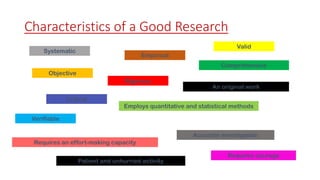
Characteristics of a Good Research
Systematic
Objective
Empirical
Comprehensive
Critical
Rigorous
Valid
Verifiable
Employs quantitative and statistical methods
An original work
Accurate investigation
Patient and unhurried activity
Requires an effort-making capacity
Requires courage
Characteristics of a Good Research
Systematic - Follows an orderly and sequential procedure that leads to the discovery of truth, solution
of a problem or is aimed to be discovered.
Objective
- All findings and conclusions are logically based on empirical data and no effort is made to
alter the result of the research.
Empirical
- Generalizations are drawn by the researcher upon hard evidence gathered from
information collected from the real life experiences and observations.
Comprehensive
- In understanding a phenomenon, the research should examine and analyze all its aspects
or angles before making a generalization or conclusion.
Critical
Characteristics of a Good Research
- Procedures employed must withstand scrutiny by others and data should be analyzed
critically to avoid error.
Rigorous
- Procedures followed in solving a problem should be relevant, appropriate, justified and
strictly observed.
Valid - Conclusions formulated are based on actual findings.
Verifiable - Other parties can check on the correctness of its results by replicating the study based on
the methods and procedures employed by the researcher.
1. Idea generation
Phases of the Research Process
2. Problem definition 3. Procedure design
4. Data collection
5. Data analysis
6. Interpretation
7. Communication
Phases of the Research Process
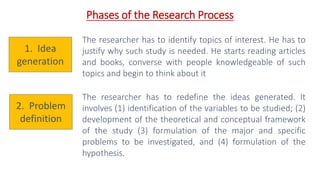
1. Idea
generation
2. Problem
definition
The researcher has to identify topics of interest. He has to
justify why such study is needed. He starts reading articles
and books, converse with people knowledgeable of such
topics and begin to think about it
The researcher has to redefine the ideas generated. It
involves (1) identification of the variables to be studied; (2)
development of the theoretical and conceptual framework
of the study (3) formulation of the major and specific
problems to be investigated, and (4) formulation of the
hypothesis.
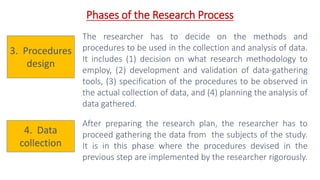
3. Procedures
design
The researcher has to decide on the methods and
procedures to be used in the collection and analysis of data.
It includes (1) decision on what research methodology to
employ, (2) development and validation of data-gathering
tools, (3) specification of the procedures to be observed in
the actual collection of data, and (4) planning the analysis of
data gathered.
Phases of the Research Process
4. Data
collection
After preparing the research plan, the researcher has to
proceed gathering the data from the subjects of the study.
It is in this phase where the procedures devised in the
previous step are implemented by the researcher rigorously.
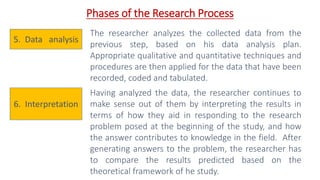
5. Data analysis
6. Interpretation
Phases of the Research Process
The researcher analyzes the collected data from the
previous step, based on his data analysis plan.
Appropriate qualitative and quantitative techniques and
procedures are then applied for the data that have been
recorded, coded and tabulated.
Having analyzed the data, the researcher continues to
make sense out of them by interpreting the results in
terms of how they aid in responding to the research
problem posed at the beginning of the study, and how
the answer contributes to knowledge in the field. After
generating answers to the problem, the researcher has
to compare the results predicted based on the
theoretical framework of he study.
7. Communication
After completing the data analysis and interpretation phases, the
researcher has to prepare a written or oral report of the study
conducted, either for publication or presentation to colleagues or
a panel of experts. This report has to include a description of all
the previous steps in the research process.
Phases of the Research Process
Classifications of Research
1. On the basis of who undertakes research – it can either be an academic research or research project
a. Academic – for the fulfillment of academic requirements
b. Research project – undertaken as part of professional work or assignment
2. On the basis of the final use or application of the research results – it can either be pure/theoretical or
applied/practical.
a. Pure/Theoretical – for the purpose of formulating a theory, principle, or law with no
intended application of results; to gain knowledge.
b. Applied/Practical – is an inquiry to test or evaluate a theory or knowledge arrived at, in
the solution of a problem for useful ends.
Classifications of Research
3. On the basis of methodology or research design
a. Descriptive – endeavors to describe systematically, factually, accurately and objectively a
situation, problem or phenomenon. It seeks to describe “what is
b. Correlational/Associational –tries to probe the significance of relationship between two or
more actors or characteristics.
c. Explanatory – seeks to clarify how and why a relationship exists between two or more
aspects of a situation or phenomenon.
d. Exploratory – undertaken when the researcher is after probing or exploring areas where life
is known about the research problem.
e. Experimental – probes into the cause of an effect by exposing one or more experimental
groups to one or more treatments or conditions.
f. Ex-post facto/Causal-Comparative – delves on analyzing the possible effect of a factor
which cannot be manipulated and controlled.
g. Historical – attempts to reconstruct the past objectively and accurately or to explain an
incident that happened in the past with the use of data from the past.
h. Ethnographic – concerned with explaining or describing a phenomenon wholistically with
the use of multiple data collection techniques.
Good practices in doing research
1. A systematic approach must be followed for accurate data. Rules and
procedures are an integral part of the process that set the objective.
3. The data or knowledge that is derived is in real time from actual observations
in natural settings
5. Research makes use of all the available data so that there is no ambiguity in
inference.
6. Accuracy is one of the most important aspects of research. The information
that is obtained should be accurate and true to its nature.
4. There is an in-depth analysis of all data collected so that there are no
anomalies associated with it.
2. Researchers need to practice ethics and a code of conduct while making
observations or drawing conclusions.

Lesson 2 Research Process.pdf

  • 1.
    ACCTG 327 Lesson 2: TheResearch Process
  • 2.
    “Research… is essentiallynothing but a state of mind – a friendly, welcoming attitude towards change. Going out to look for change, instead of waiting for it to come. Research for practical men, is an effort to do things better and not to be caught asleep at a switch. The research state of mind can apply to anything. Personal affairs or any kind of business big or little. It is the problem-solving mind as contrasted with let-well-enough-alone mind; it is the composer mind, instead of a fiddler mind; it is the “tomorrow” instead of the yesterday mind.” - C.F. Kettering
  • 3.
    A Research isconducted with a purpose to : Discover new facts about known phenomena Find answers to problems which are only partially solved by existing methods and information Discover previously unrecognized substances and elements Provide basis for decision making in business, industry, education, government, and other undertakings Satisfy the researcher’s curiosity Find answers to queries by means of scientific method
  • 4.
    A Research isconducted with a purpose to : Acquire a deeper and better understanding about a phenomena Verify or expand existing knowledge Improve educational practices for raising quality of school products Promote health and prolong life Make work, communication, and travel faster, easier and more comfortable and convenient.
  • 5.
    Characteristics of aGood Research Systematic Objective Empirical Comprehensive Critical Rigorous Valid Verifiable Employs quantitative and statistical methods An original work Accurate investigation Patient and unhurried activity Requires an effort-making capacity Requires courage
  • 6.
    Characteristics of aGood Research Systematic - Follows an orderly and sequential procedure that leads to the discovery of truth, solution of a problem or is aimed to be discovered. Objective - All findings and conclusions are logically based on empirical data and no effort is made to alter the result of the research. Empirical - Generalizations are drawn by the researcher upon hard evidence gathered from information collected from the real life experiences and observations. Comprehensive - In understanding a phenomenon, the research should examine and analyze all its aspects or angles before making a generalization or conclusion.
  • 7.
    Critical Characteristics of aGood Research - Procedures employed must withstand scrutiny by others and data should be analyzed critically to avoid error. Rigorous - Procedures followed in solving a problem should be relevant, appropriate, justified and strictly observed. Valid - Conclusions formulated are based on actual findings. Verifiable - Other parties can check on the correctness of its results by replicating the study based on the methods and procedures employed by the researcher.
  • 8.
    1. Idea generation Phasesof the Research Process 2. Problem definition 3. Procedure design 4. Data collection 5. Data analysis 6. Interpretation 7. Communication
  • 9.
    Phases of theResearch Process 1. Idea generation 2. Problem definition The researcher has to identify topics of interest. He has to justify why such study is needed. He starts reading articles and books, converse with people knowledgeable of such topics and begin to think about it The researcher has to redefine the ideas generated. It involves (1) identification of the variables to be studied; (2) development of the theoretical and conceptual framework of the study (3) formulation of the major and specific problems to be investigated, and (4) formulation of the hypothesis.
  • 10.
    3. Procedures design The researcherhas to decide on the methods and procedures to be used in the collection and analysis of data. It includes (1) decision on what research methodology to employ, (2) development and validation of data-gathering tools, (3) specification of the procedures to be observed in the actual collection of data, and (4) planning the analysis of data gathered. Phases of the Research Process 4. Data collection After preparing the research plan, the researcher has to proceed gathering the data from the subjects of the study. It is in this phase where the procedures devised in the previous step are implemented by the researcher rigorously.
  • 11.
    5. Data analysis 6.Interpretation Phases of the Research Process The researcher analyzes the collected data from the previous step, based on his data analysis plan. Appropriate qualitative and quantitative techniques and procedures are then applied for the data that have been recorded, coded and tabulated. Having analyzed the data, the researcher continues to make sense out of them by interpreting the results in terms of how they aid in responding to the research problem posed at the beginning of the study, and how the answer contributes to knowledge in the field. After generating answers to the problem, the researcher has to compare the results predicted based on the theoretical framework of he study.
  • 12.
    7. Communication After completingthe data analysis and interpretation phases, the researcher has to prepare a written or oral report of the study conducted, either for publication or presentation to colleagues or a panel of experts. This report has to include a description of all the previous steps in the research process. Phases of the Research Process
  • 13.
    Classifications of Research 1.On the basis of who undertakes research – it can either be an academic research or research project a. Academic – for the fulfillment of academic requirements b. Research project – undertaken as part of professional work or assignment 2. On the basis of the final use or application of the research results – it can either be pure/theoretical or applied/practical. a. Pure/Theoretical – for the purpose of formulating a theory, principle, or law with no intended application of results; to gain knowledge. b. Applied/Practical – is an inquiry to test or evaluate a theory or knowledge arrived at, in the solution of a problem for useful ends.
  • 14.
    Classifications of Research 3.On the basis of methodology or research design a. Descriptive – endeavors to describe systematically, factually, accurately and objectively a situation, problem or phenomenon. It seeks to describe “what is b. Correlational/Associational –tries to probe the significance of relationship between two or more actors or characteristics. c. Explanatory – seeks to clarify how and why a relationship exists between two or more aspects of a situation or phenomenon. d. Exploratory – undertaken when the researcher is after probing or exploring areas where life is known about the research problem. e. Experimental – probes into the cause of an effect by exposing one or more experimental groups to one or more treatments or conditions. f. Ex-post facto/Causal-Comparative – delves on analyzing the possible effect of a factor which cannot be manipulated and controlled. g. Historical – attempts to reconstruct the past objectively and accurately or to explain an incident that happened in the past with the use of data from the past. h. Ethnographic – concerned with explaining or describing a phenomenon wholistically with the use of multiple data collection techniques.
  • 15.
    Good practices indoing research 1. A systematic approach must be followed for accurate data. Rules and procedures are an integral part of the process that set the objective. 3. The data or knowledge that is derived is in real time from actual observations in natural settings 5. Research makes use of all the available data so that there is no ambiguity in inference. 6. Accuracy is one of the most important aspects of research. The information that is obtained should be accurate and true to its nature. 4. There is an in-depth analysis of all data collected so that there are no anomalies associated with it. 2. Researchers need to practice ethics and a code of conduct while making observations or drawing conclusions.