Designing the methodology
By Mrs . Sapana Patil
Department of
Pharmacy, SVDU
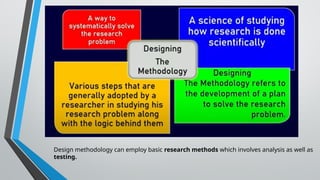
Design methodology can employ basic research methods which involves analysis as well as
testing.
• Decisions regarding what, where, when, how much, by what
means concerning an inquiry or a research study constitute a
research design.
• “A research design is the arrangement of conditions for collection
and analysis of data in a manner that aims to combine relevance to
the research purpose with economy in procedure.”
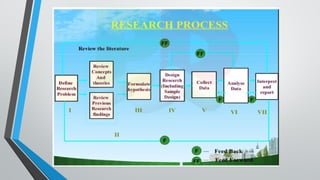
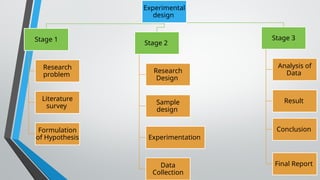
Experimental
design
Stage 1
Research
problem
Literature
survey
Formulation
of Hypothesis
Stage 2
Research
Design
Sample
design
Experimentation
Data
Collection
Stage 3
Analysis of
Data
Result
Conclusion
Final Report
1. Formulating the research problem:
• The researcher must single out the problem he wants to study, i.e., he
should decide the general area of interest or aspect of a subject matter
that he would like to inquire into.
• Initially, the problem may be stated broadly and then the uncertainties,
if any, relating to the problem be resolved.
• Then, the feasibility of a particular solution has to be considered before a
working formulation of the problem can be set up.
• Essentially two steps are involved in formulating the research problem are
• 1. Understanding the problem thoroughly, and
• 2. Rephrasing the same into meaningful terms from an analytical
point of view
2. Extensive literature survey:
• Once the problem is formulated, a brief summary of it should be
written down.
• At this point the researcher should undertake extensive literature
survey connected with the problem.
• For this purpose, the abstracting and indexing journals and
published or unpublished bibliographies are the first place to go to.
• Academic journals, conference proceedings, government
reports, books etc., must be tapped depending on the nature of the
problem.
• The earlier studies, if any, which are similar to the study in hand
should be carefully studied.
• A good library will be a great help to the researcher at this stage
3. Development of working hypotheses:
• After extensive literature survey, researcher should state in clear
terms the working hypothesis or hypotheses
• Working hypothesis is tentative assumption made to draw out and
test its logical or empirical consequences.
• As such how research hypotheses are developed is particularly
important since they provide the focal point for research
• A hypothesis is a theoretical statement in solving a logical
relationship between the variables.
• Do not be afraid if your hypothesis proves to be incorrect after the
experimentation because it is only considered as an educated guess.
• Always remember that when you formulate a hypothesis, it should be
based on the research problem being solved.
4. Preparing the research design:
• The research problem having been formulated in clear-cut terms,
the researcher will be required to prepare a research design, i.e.,
he will have to state the conceptual structure within which
research would be conducted.
• The function of research design is to provide for the collection of
relevant evidence with minimal expenditure of effort, time and
money
• Research purposes may be grouped into four categories, viz.,
• (i) Exploration
• (ii) Description
• (iii) Diagnosis
• (iv) Experimentation.
• There are several research designs, such as experimental and
non-experimental for hypothesis testing.
• Experimental designs can be either informal designs such as
 before-and-after without control,
 after-only with control, or
 before-and-after with control, or
• formal designs such as completely
randomized design,
randomized block design,
Latin square design,
simple and complex factorial designs), out of which the
researcher must select one for his project
5. Determining sample design:
• The items so selected constitute what is technically called a
sample.
• The researcher must decide the way of selecting a sample or
what is popularly known as the sample design.
• In other words, a sample design is a definite plan determined
before any data are actually collected for obtaining a sample from
a given population.
• Types of Sampling …….
• The sample design to be used must be decided by the researcher
taking into consideration the nature of the inquiry and other
related factors.
6. Collecting the data
• In dealing with any real life problem it is often found that the data
at hand are inadequate, and hence, it becomes necessary to
collect appropriate data .
• Appropriate data which differ considerably in context of money
costs, time and other resources at the disposal of the researcher.
• Primary data can be collected either through experiments or
through survey.
• If the researcher conducts an experiment, he observes some
quantitative measurements, or the data, with the help of which
he examines the truth contained in his hypothesis.
• But in the case of a survey, data can be collected by any one or more
of the following ways:
• (i) By observation:
• (ii) Through personal interview
• (iii) Through telephone interviews:
• (iv) By mailing of questionnaires:
• (v) Through schedules
• The researcher should select one of these methods of collecting the
data taking into consideration the nature of the investigation, the
objective and scope of the inquiry, financial resources, available time,
and the desired degree of accuracy .
7. Execution of the project:
• Execution of the project is a very important step in the research
process.
• If the execution of the project proceeds on correct lines, the data
to be collected will be adequate and dependable
• The researcher should see that the project is executed in a
systematic manner and on time.
• A careful watch should be kept for unanticipated factors to keep
the survey as realistic as possible.
8. Analysis of data:
• After the data have been collected, the researcher turns to the
task of analyzing them.
• The analysis of data requires a number of closely related
operations such as establishment of categories, the application
of these categories to raw data through coding, tabulation, and
then drawing statistical inferences.
• Coding operation is usually done at this stage through which the
categories of data are transformed into symbols that may be
tabulated and counted. Editing is the procedure that improves the
quality of the data for coding. With coding the stage is ready for
tabulation. Tabulation is a part of the technical procedure
wherein the classified data are put in the form of tables.
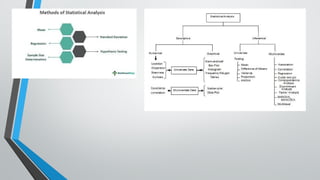
• Computers not only save time but also make it possible to study
large number of variables affecting a problem simultaneously
• Analysis work after tabulation is generally based on the
computation of various percentages, coefficients, etc., by
applying various well defined statistical formulae.
• In the process of analysis, relationships or differences supporting
or conflicting with original or new hypotheses should be subjected
to tests of significance to determine with what validity data can be
said to indicate any conclusion(s).
9. Hypothesis-testing:
• After analyzing the data as stated above, the researcher is in a
position to test the hypotheses, if any, he had formulated earlier.
• Do the facts support the hypotheses or they happen to be
contrary?
• This is the usual question that should be answered while testing
hypotheses.
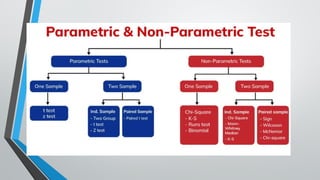
• Various tests, such as Chi square test, t-test, F-test, have been
developed by statisticians for the purpose.
10. Generalisations and interpretation
• If a hypothesis is tested and upheld several times, it may be
possible for the researcher to arrive at a generalization, i.e., to
build a theory.
• As a matter of fact, the real value of research lies in its ability to
arrive at certain generalizations.
• If the researcher had no hypothesis to start with, he might seek to
explain his findings based on some theory. It is known as
interpretation .
11. Preparation of the report or the
thesis
• Finally, the researcher has to prepare the report of what has been done by
him. Writing of report must be done with great care keeping in view the
following
• 1. The layout of the report should be as follows:
• (i) the preliminary pages
• (ii) the main text
• (iii) the end matter.
• In its preliminary pages the report should carry a title and date followed by
acknowledgements and foreword.
• Then there should be a table of contents followed by a list of tables and
list of graphs and charts, if any, given in the report.
• The main text of the report should have the following parts:
(A) An Introduction: It should contain a clear statement of the
objective of the research and an explanation of the methodology
adopted in accomplishing the research. The scope of the study along
with various limitations should as well be stated in this part.
(b) Summary of findings: After introduction there would appear a
statement of findings and recommendations in non-technical language.
If the findings are extensive, they should be summarized.
(c) Main report: The main body of the report should be presented in
logical sequence and broken down into readily identifiable sections.
(d) Conclusion: Towards the end of the main text, researcher should
again put down the results of his research clearly and precisely. In
fact, it is the final summing up
• 2. Report should be written in a concise and objective style in
simple language avoiding vague expressions such as ‘it seems,’
‘there may be’, and the like.
• 3. Charts and illustrations in the main report should be used only if
they present the information more clearly and forcibly.
• 4. Calculated ‘confidence limits’ must be mentioned and the various
constraints experienced in conducting research operations may as
well be stated.

designing the methodology .....................

  • 1.
    Designing the methodology ByMrs . Sapana Patil Department of Pharmacy, SVDU
  • 2.
    Design methodology canemploy basic research methods which involves analysis as well as testing.
  • 3.
    • Decisions regardingwhat, where, when, how much, by what means concerning an inquiry or a research study constitute a research design. • “A research design is the arrangement of conditions for collection and analysis of data in a manner that aims to combine relevance to the research purpose with economy in procedure.”
  • 5.
    Experimental design Stage 1 Research problem Literature survey Formulation of Hypothesis Stage2 Research Design Sample design Experimentation Data Collection Stage 3 Analysis of Data Result Conclusion Final Report
  • 6.
    1. Formulating theresearch problem: • The researcher must single out the problem he wants to study, i.e., he should decide the general area of interest or aspect of a subject matter that he would like to inquire into. • Initially, the problem may be stated broadly and then the uncertainties, if any, relating to the problem be resolved. • Then, the feasibility of a particular solution has to be considered before a working formulation of the problem can be set up. • Essentially two steps are involved in formulating the research problem are • 1. Understanding the problem thoroughly, and • 2. Rephrasing the same into meaningful terms from an analytical point of view
  • 7.
    2. Extensive literaturesurvey: • Once the problem is formulated, a brief summary of it should be written down. • At this point the researcher should undertake extensive literature survey connected with the problem. • For this purpose, the abstracting and indexing journals and published or unpublished bibliographies are the first place to go to. • Academic journals, conference proceedings, government reports, books etc., must be tapped depending on the nature of the problem. • The earlier studies, if any, which are similar to the study in hand should be carefully studied. • A good library will be a great help to the researcher at this stage
  • 8.
    3. Development ofworking hypotheses: • After extensive literature survey, researcher should state in clear terms the working hypothesis or hypotheses • Working hypothesis is tentative assumption made to draw out and test its logical or empirical consequences. • As such how research hypotheses are developed is particularly important since they provide the focal point for research • A hypothesis is a theoretical statement in solving a logical relationship between the variables. • Do not be afraid if your hypothesis proves to be incorrect after the experimentation because it is only considered as an educated guess. • Always remember that when you formulate a hypothesis, it should be based on the research problem being solved.
  • 9.
    4. Preparing theresearch design: • The research problem having been formulated in clear-cut terms, the researcher will be required to prepare a research design, i.e., he will have to state the conceptual structure within which research would be conducted. • The function of research design is to provide for the collection of relevant evidence with minimal expenditure of effort, time and money • Research purposes may be grouped into four categories, viz., • (i) Exploration • (ii) Description • (iii) Diagnosis • (iv) Experimentation.
  • 10.
    • There areseveral research designs, such as experimental and non-experimental for hypothesis testing. • Experimental designs can be either informal designs such as  before-and-after without control,  after-only with control, or  before-and-after with control, or • formal designs such as completely randomized design, randomized block design, Latin square design, simple and complex factorial designs), out of which the researcher must select one for his project
  • 11.
    5. Determining sampledesign: • The items so selected constitute what is technically called a sample. • The researcher must decide the way of selecting a sample or what is popularly known as the sample design. • In other words, a sample design is a definite plan determined before any data are actually collected for obtaining a sample from a given population. • Types of Sampling ……. • The sample design to be used must be decided by the researcher taking into consideration the nature of the inquiry and other related factors.
  • 12.
    6. Collecting thedata • In dealing with any real life problem it is often found that the data at hand are inadequate, and hence, it becomes necessary to collect appropriate data . • Appropriate data which differ considerably in context of money costs, time and other resources at the disposal of the researcher. • Primary data can be collected either through experiments or through survey. • If the researcher conducts an experiment, he observes some quantitative measurements, or the data, with the help of which he examines the truth contained in his hypothesis.
  • 13.
    • But inthe case of a survey, data can be collected by any one or more of the following ways: • (i) By observation: • (ii) Through personal interview • (iii) Through telephone interviews: • (iv) By mailing of questionnaires: • (v) Through schedules • The researcher should select one of these methods of collecting the data taking into consideration the nature of the investigation, the objective and scope of the inquiry, financial resources, available time, and the desired degree of accuracy .
  • 14.
    7. Execution ofthe project: • Execution of the project is a very important step in the research process. • If the execution of the project proceeds on correct lines, the data to be collected will be adequate and dependable • The researcher should see that the project is executed in a systematic manner and on time. • A careful watch should be kept for unanticipated factors to keep the survey as realistic as possible.
  • 15.
    8. Analysis ofdata: • After the data have been collected, the researcher turns to the task of analyzing them. • The analysis of data requires a number of closely related operations such as establishment of categories, the application of these categories to raw data through coding, tabulation, and then drawing statistical inferences. • Coding operation is usually done at this stage through which the categories of data are transformed into symbols that may be tabulated and counted. Editing is the procedure that improves the quality of the data for coding. With coding the stage is ready for tabulation. Tabulation is a part of the technical procedure wherein the classified data are put in the form of tables.
  • 17.
    • Computers notonly save time but also make it possible to study large number of variables affecting a problem simultaneously • Analysis work after tabulation is generally based on the computation of various percentages, coefficients, etc., by applying various well defined statistical formulae. • In the process of analysis, relationships or differences supporting or conflicting with original or new hypotheses should be subjected to tests of significance to determine with what validity data can be said to indicate any conclusion(s).
  • 18.
    9. Hypothesis-testing: • Afteranalyzing the data as stated above, the researcher is in a position to test the hypotheses, if any, he had formulated earlier. • Do the facts support the hypotheses or they happen to be contrary? • This is the usual question that should be answered while testing hypotheses. • Various tests, such as Chi square test, t-test, F-test, have been developed by statisticians for the purpose.
  • 20.
    10. Generalisations andinterpretation • If a hypothesis is tested and upheld several times, it may be possible for the researcher to arrive at a generalization, i.e., to build a theory. • As a matter of fact, the real value of research lies in its ability to arrive at certain generalizations. • If the researcher had no hypothesis to start with, he might seek to explain his findings based on some theory. It is known as interpretation .
  • 21.
    11. Preparation ofthe report or the thesis • Finally, the researcher has to prepare the report of what has been done by him. Writing of report must be done with great care keeping in view the following • 1. The layout of the report should be as follows: • (i) the preliminary pages • (ii) the main text • (iii) the end matter. • In its preliminary pages the report should carry a title and date followed by acknowledgements and foreword. • Then there should be a table of contents followed by a list of tables and list of graphs and charts, if any, given in the report.
  • 22.
    • The maintext of the report should have the following parts: (A) An Introduction: It should contain a clear statement of the objective of the research and an explanation of the methodology adopted in accomplishing the research. The scope of the study along with various limitations should as well be stated in this part. (b) Summary of findings: After introduction there would appear a statement of findings and recommendations in non-technical language. If the findings are extensive, they should be summarized. (c) Main report: The main body of the report should be presented in logical sequence and broken down into readily identifiable sections. (d) Conclusion: Towards the end of the main text, researcher should again put down the results of his research clearly and precisely. In fact, it is the final summing up
  • 23.
    • 2. Reportshould be written in a concise and objective style in simple language avoiding vague expressions such as ‘it seems,’ ‘there may be’, and the like. • 3. Charts and illustrations in the main report should be used only if they present the information more clearly and forcibly. • 4. Calculated ‘confidence limits’ must be mentioned and the various constraints experienced in conducting research operations may as well be stated.