I'm Glad To Join This Event
Topic : Data collection
Dr. R.H. Pavithra
Senior Assistant Professor
Department of Economics
Karnataka state open University
Muktha gangotri Mysore, 570006
Theme : Research Methodology
CONTENT
Research
Methodology
INTRODUCTION
Research is a highly specialised activity that is
more than just collecting information or writing
a description in a targeted fashion, which is
further analysed thoroughly to lead to answers
of research questions and evaluate results.
The collection of data is the heart of any research
design, irrespective of the field of study.
Data collection is the process of gathering the
desirable information carefully, with least possible
distortion, so that the analysis may provide answers
that are credible and stand to logic.
DATA COLLECTION
During the 19th and 20th Centuries data collection
become popular population census.
The term data refers to any kind of information
researchers obtain on the subjects, respondents
or participants of the study. In research, data are
collected and used to answer the research
questions or objectives of the study.
Collecting statistics not only on the population
but on Health, commerce, employment, law
enforcement, education and all the other
Concerns of a modern nation state.
Data Collection Definition:
Data collection is defined as the procedure of
collecting, measuring and analyzing accurate
insights for research using standard validated
techniques.
A dictionary defines data as facts or figures from
which conclusions may be drawn.
Dictionary:
Data collection means gathering information to
address those critical evaluation questions that
the author/researcher has identified earlier in
the evaluation process.
HOW IMPORTANT DATA IS?
Improve People’s Lives
Make Informed Decisions
Find Solutions To Problems
To Track Information
To Access The Resources Around Us
To Convert Data Into Information
OBJECTIVES OF DATA COLLECTION
Identify interpretations/conclusions to be made
regarding each question or issue.
To Define the study boundaries.
Optimize the design for obtaining data.
Discuss how to plan and run a successful data
collection Program.
Identify and understand the geochemical
questions or issues that are to be answered or
evaluated.
Continue...
Enable to plan and implement ideas.
Communicate in a better way the purpose of the
statistics and the benefits of taking part in the
data collection.
Provide us with a well-functioning support service
More systematically apply methods that have a
positive effect on response rates
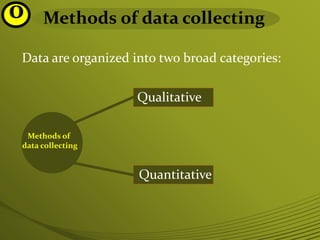
Methods of data collecting
Data are organized into two broad categories:
Methods of
data collecting
Qualitative
Quantitative
Qualitative data collection
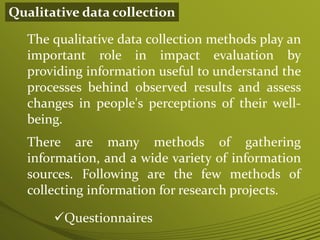
The qualitative data collection methods play an
important role in impact evaluation by
providing information useful to understand the
processes behind observed results and assess
changes in people's perceptions of their well-
being.
There are many methods of gathering
information, and a wide variety of information
sources. Following are the few methods of
collecting information for research projects.
Questionnaires
Qualitative data collection
Merits Demerits
Interviews
Direct observations
Documents and other materials
Focus group interviews
Case-study
Diaries
Critical incidents
Continue…
Quantitative Data Collection
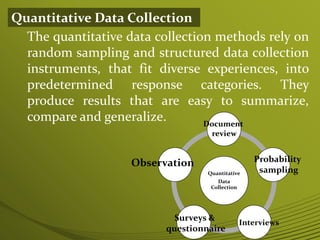
The quantitative data collection methods rely on
random sampling and structured data collection
instruments, that fit diverse experiences, into
predetermined response categories. They
produce results that are easy to summarize,
compare and generalize.
Quantitative
Data
Collection
Observation
Document
review
Probability
sampling
Interviews
Surveys &
questionnaire
Quantitative data collection
Merits Demerits
DATA PRESENTATON
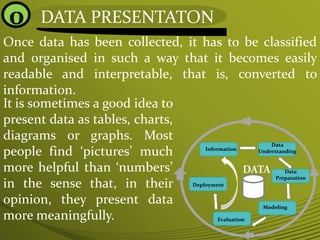
Once data has been collected, it has to be classified
and organised in such a way that it becomes easily
readable and interpretable, that is, converted to
information.
Information
Data
Understanding
Data
Preparation
Modeling
Evaluation
Deployment
DATA
It is sometimes a good idea to
present data as tables, charts,
diagrams or graphs. Most
people find ‘pictures’ much
more helpful than ‘numbers’
in the sense that, in their
opinion, they present data
more meaningfully.
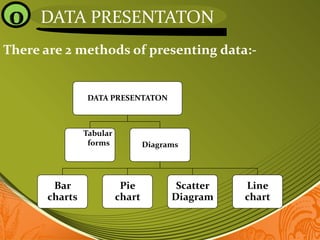
DATA PRESENTATON
DATA PRESENTATON
Diagrams
Bar
charts
Pie
chart
Scatter
Diagram
Line
chart
Tabular
forms
There are 2 methods of presenting data:-
Tabular forms (Arrays/Tabulation)
Continue…
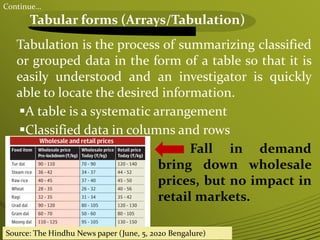
Tabulation is the process of summarizing classified
or grouped data in the form of a table so that it is
easily understood and an investigator is quickly
able to locate the desired information.
A table is a systematic arrangement
Classified data in columns and rows
Fall in demand
bring down wholesale
prices, but no impact in
retail markets.
Source: The Hindhu News paper (June, 5, 2020 Bengalure)
A statistical table makes it possible for the
investigator to present a huge mass of data in a
detailed and orderly form.
Continue…
Continue…
Diagrams And Graphs
Where as tables can be used for presenting all
the information, graphs simplify complex
information by using images and emphasizing
data patterns or trends, and are useful for
summarizing, explaining, or exploring
quantitative data.
Graphs are effective for presenting large
amounts of data,
Readers and reviewers can easily understand
the information.
Continue…
Bar charts
A bar graph is a chart that uses either horizontal
or vertical bars to show comparisons among
categories. One axis of the chart shows the
specific categories being compared, and the
other axis represents a discrete value.
Bharath is the
fastest growing
technology, hub
with 55% share
of global
sourcing5th June 2020
Pie chart
Continue…
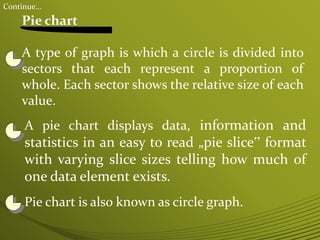
A type of graph is which a circle is divided into
sectors that each represent a proportion of
whole. Each sector shows the relative size of each
value.
A pie chart displays data, information and
statistics in an easy to read „pie slice‟ format
with varying slice sizes telling how much of
one data element exists.
Pie chart is also known as circle graph.
Continue…
The bigger the slice, the more of that particular
data was gathered. The main use of a pie chart is
to show comparisons.
China
India
USA
INdonesia
Brazil
Pakistan
Bangladesh
Nigeria
Russian Fed
Japan
India In World Population
China 19.4%
India 17.5%
USA 4.5%
Indonesia 3.4%
Brazil 2.8%
Pakistan 2.7%
Bangladesh 2.4%
Nigeria 2.4%
Russian Fed 2.0%
Japan 1.9%
Other
Countries
41.2%
Source: Census ofIndia 2011
Scatter Diagram
Continue…
While working with statistical data it is often
observed that there are connections between sets
of data.
For example the mass and height of persons are
related: the taller the person the greater his/her
mass. To find out whether or not two sets of data
are connected scatter diagrams can be used.
A scatter diagram is a tool for analyzing
relationship between two variables.
Scatter Plot—Literacy and WPR(Wisconsin
Public Radio) of Main and Marginal Workers,
2011
Source: Authors' calculation based on Census 2011.
Note: (a) Rural and urban combined; (b) male and female combined.
Line chart
Continue…
Line chart is the most basic type of chart used in
finance and it is generally created by connecting a
series of past recorded data together with a line.
It is a style of chart that is created by
connecting a series of data points together
with a line.
 Line charts are ideal for representing trends
over time.
Continue…
Climate in Chennai (Tamil Nadu), India
0
5
10
15
20
25
30
35
40
January
February
March
April
May
June
July
August
September
October
November
December
Minimum
Temperature
Maximum
Temperature
Source: Weather and climate India 2019
The months January,
February, November and
December have a nice
average temperature.
On average, the
temperatures are
always high
On average, the
warmest month is May.
On average, the coolest
month is January.
The average annual
maximum temperature
is: 33.0° Celsius
The average annual minimum
temperature is: 25.0° Celsius
Data Science: Solving Problems with Data
Data science is an emerging discipline that
draws upon knowledge in statistical
methodology and computer science to create
impactful predictions and insights for a wide
range of traditional scholarly fields.
Impact of data science on society
Saving energy
Data driven hospitals
A cleaner environment
Volunteer with a socially-oriented data science
program/organization
Contribute via competitions
Consider solutions to real-world problems that
you encounter
Be thoughtful in professional work
Continue…
Difference between social science
and science data collection.
Social Science Data Collection
Focus on data generated in social sciences
research, both quantitative and qualitative.
Notably, within the field of social sciences,
you will often work with data originating
from human participants. This can mean that
you are handling (sensitive) personal data,
which deserve special attention.
Science Data Collection
Data collection is the process of gathering and
measuring data, information or any variables
of interest in a standardized and established
manner that enables the collector to answer or
test hypothesis and evaluate outcomes of the
particular collection.
• Social Science • Science
Difference between social science
and science data collection.
Conclusion
Thank you

Research Methodology Data Collection

  • 1.
    I'm Glad ToJoin This Event
  • 2.
    Topic : Datacollection Dr. R.H. Pavithra Senior Assistant Professor Department of Economics Karnataka state open University Muktha gangotri Mysore, 570006 Theme : Research Methodology
  • 3.
  • 4.
    INTRODUCTION Research is ahighly specialised activity that is more than just collecting information or writing a description in a targeted fashion, which is further analysed thoroughly to lead to answers of research questions and evaluate results. The collection of data is the heart of any research design, irrespective of the field of study. Data collection is the process of gathering the desirable information carefully, with least possible distortion, so that the analysis may provide answers that are credible and stand to logic.
  • 5.
    DATA COLLECTION During the19th and 20th Centuries data collection become popular population census. The term data refers to any kind of information researchers obtain on the subjects, respondents or participants of the study. In research, data are collected and used to answer the research questions or objectives of the study. Collecting statistics not only on the population but on Health, commerce, employment, law enforcement, education and all the other Concerns of a modern nation state.
  • 6.
    Data Collection Definition: Datacollection is defined as the procedure of collecting, measuring and analyzing accurate insights for research using standard validated techniques. A dictionary defines data as facts or figures from which conclusions may be drawn. Dictionary: Data collection means gathering information to address those critical evaluation questions that the author/researcher has identified earlier in the evaluation process.
  • 7.
    HOW IMPORTANT DATAIS? Improve People’s Lives Make Informed Decisions Find Solutions To Problems To Track Information To Access The Resources Around Us To Convert Data Into Information
  • 8.
    OBJECTIVES OF DATACOLLECTION Identify interpretations/conclusions to be made regarding each question or issue. To Define the study boundaries. Optimize the design for obtaining data. Discuss how to plan and run a successful data collection Program. Identify and understand the geochemical questions or issues that are to be answered or evaluated.
  • 9.
    Continue... Enable to planand implement ideas. Communicate in a better way the purpose of the statistics and the benefits of taking part in the data collection. Provide us with a well-functioning support service More systematically apply methods that have a positive effect on response rates
  • 10.
    Methods of datacollecting Data are organized into two broad categories: Methods of data collecting Qualitative Quantitative
  • 11.
    Qualitative data collection Thequalitative data collection methods play an important role in impact evaluation by providing information useful to understand the processes behind observed results and assess changes in people's perceptions of their well- being. There are many methods of gathering information, and a wide variety of information sources. Following are the few methods of collecting information for research projects. Questionnaires
  • 12.
  • 13.
    Interviews Direct observations Documents andother materials Focus group interviews Case-study Diaries Critical incidents Continue…
  • 14.
    Quantitative Data Collection Thequantitative data collection methods rely on random sampling and structured data collection instruments, that fit diverse experiences, into predetermined response categories. They produce results that are easy to summarize, compare and generalize. Quantitative Data Collection Observation Document review Probability sampling Interviews Surveys & questionnaire
  • 15.
  • 16.
    DATA PRESENTATON Once datahas been collected, it has to be classified and organised in such a way that it becomes easily readable and interpretable, that is, converted to information. Information Data Understanding Data Preparation Modeling Evaluation Deployment DATA It is sometimes a good idea to present data as tables, charts, diagrams or graphs. Most people find ‘pictures’ much more helpful than ‘numbers’ in the sense that, in their opinion, they present data more meaningfully.
  • 17.
  • 18.
    Tabular forms (Arrays/Tabulation) Continue… Tabulationis the process of summarizing classified or grouped data in the form of a table so that it is easily understood and an investigator is quickly able to locate the desired information. A table is a systematic arrangement Classified data in columns and rows Fall in demand bring down wholesale prices, but no impact in retail markets. Source: The Hindhu News paper (June, 5, 2020 Bengalure)
  • 19.
    A statistical tablemakes it possible for the investigator to present a huge mass of data in a detailed and orderly form. Continue…
  • 20.
    Continue… Diagrams And Graphs Whereas tables can be used for presenting all the information, graphs simplify complex information by using images and emphasizing data patterns or trends, and are useful for summarizing, explaining, or exploring quantitative data. Graphs are effective for presenting large amounts of data, Readers and reviewers can easily understand the information.
  • 21.
    Continue… Bar charts A bargraph is a chart that uses either horizontal or vertical bars to show comparisons among categories. One axis of the chart shows the specific categories being compared, and the other axis represents a discrete value. Bharath is the fastest growing technology, hub with 55% share of global sourcing5th June 2020
  • 22.
    Pie chart Continue… A typeof graph is which a circle is divided into sectors that each represent a proportion of whole. Each sector shows the relative size of each value. A pie chart displays data, information and statistics in an easy to read „pie slice‟ format with varying slice sizes telling how much of one data element exists. Pie chart is also known as circle graph.
  • 23.
    Continue… The bigger theslice, the more of that particular data was gathered. The main use of a pie chart is to show comparisons. China India USA INdonesia Brazil Pakistan Bangladesh Nigeria Russian Fed Japan India In World Population China 19.4% India 17.5% USA 4.5% Indonesia 3.4% Brazil 2.8% Pakistan 2.7% Bangladesh 2.4% Nigeria 2.4% Russian Fed 2.0% Japan 1.9% Other Countries 41.2% Source: Census ofIndia 2011
  • 24.
    Scatter Diagram Continue… While workingwith statistical data it is often observed that there are connections between sets of data. For example the mass and height of persons are related: the taller the person the greater his/her mass. To find out whether or not two sets of data are connected scatter diagrams can be used. A scatter diagram is a tool for analyzing relationship between two variables.
  • 25.
    Scatter Plot—Literacy andWPR(Wisconsin Public Radio) of Main and Marginal Workers, 2011 Source: Authors' calculation based on Census 2011. Note: (a) Rural and urban combined; (b) male and female combined.
  • 26.
    Line chart Continue… Line chartis the most basic type of chart used in finance and it is generally created by connecting a series of past recorded data together with a line. It is a style of chart that is created by connecting a series of data points together with a line.  Line charts are ideal for representing trends over time.
  • 27.
    Continue… Climate in Chennai(Tamil Nadu), India 0 5 10 15 20 25 30 35 40 January February March April May June July August September October November December Minimum Temperature Maximum Temperature Source: Weather and climate India 2019 The months January, February, November and December have a nice average temperature. On average, the temperatures are always high On average, the warmest month is May. On average, the coolest month is January. The average annual maximum temperature is: 33.0° Celsius The average annual minimum temperature is: 25.0° Celsius
  • 28.
    Data Science: SolvingProblems with Data Data science is an emerging discipline that draws upon knowledge in statistical methodology and computer science to create impactful predictions and insights for a wide range of traditional scholarly fields.
  • 29.
    Impact of datascience on society Saving energy Data driven hospitals A cleaner environment Volunteer with a socially-oriented data science program/organization Contribute via competitions
  • 30.
    Consider solutions toreal-world problems that you encounter Be thoughtful in professional work Continue…
  • 31.
    Difference between socialscience and science data collection. Social Science Data Collection Focus on data generated in social sciences research, both quantitative and qualitative. Notably, within the field of social sciences, you will often work with data originating from human participants. This can mean that you are handling (sensitive) personal data, which deserve special attention.
  • 32.
    Science Data Collection Datacollection is the process of gathering and measuring data, information or any variables of interest in a standardized and established manner that enables the collector to answer or test hypothesis and evaluate outcomes of the particular collection.
  • 33.
    • Social Science• Science Difference between social science and science data collection.
  • 35.
  • 36.

Editor's Notes

  • #24 The population of india, at 1210.2 million, is almost equal to the combined population of U.S.A, Indonesia, Brazil, Pakistan, Bangladesh and Japan put Together. the population of these six countries totals 1214.3 million!