Presented By- Prabhat Kumar
Pradeep Yadav
Praveen Kumar
Praveen K. Srivastav

1
Content
 Introduction
 Profit sharing
 Gain sharing
 Employee stock ownership plan

 References

2
Introduction
 Organization wide incentive plans reward employees







on the basis of the success of the organization over a
specified time period.
These plans seek to promote a culture of ownership
by developing a senses of belongingness, cooperation
and teamwork among all employees.
There are three basic types of organization wide
incentive plans;
Profit sharing
Gain sharing
Employees stock ownership plans
Profit sharing:
Profit sharing is a scheme whereby employers undertake to
pay a particular potion of net profits to their employees on
compliance with certain service conditions.

The purpose:


To strengthen the loyalty of employees to the firm by
offering them an annual bonus.
 The share of profit of the worker may be given in cash or
in the form of shares in the company.
 In India, the share of the worker is governed by the
Payment of Bonus act.
Merits:
1) inspires the management and the worker to be
sincere, devoted and loyal to the firm.
2) It helps in supplementing the remuneration of
workers and enables them to lead a rich life.

3) It is likely to induce motivation in the workers and
other staff for quicker and better work.
Merits(cont….)
4) Workers do not require close supervision as they
are self-motivated to put in extra labour for the
prosperity of the firm.

5) It attracts talented people to join the ranks of a
firm with a view to share the profits.

6
Demerits
1) Workers may get nothing if the business does not
succeed.
2) Management may dress up profit figures and deprive
the workers of their legitimate share in the profits.
3) Workers tend to develop loyalty towards firms
discounting their loyalty towards trade unions, thus,
impairing the unity of trade unions.
•Gainsharing is the sharing with employees of greater-than-

expected gains in profits and/or productivity.
Gainsharing attempts to increase ―discretionary efforts‖—that

is, the difference between the maximum amount of effort a person
can exert and the minimum amount of effort necessary to keep
from being fired.
 Cost-savings gains are shared among employees and the

company.
It is better for motivation.
8
Gainsharing(cont…….)
 It is a popular family of incentive programs that include a

system to monitor the performance of the organization and
distribute rewards when goals are met, and focuses on
employee involvement in order to increase their sense of
ownership.
 The basic principle is that everyone will gain more if each
person acts in the interest of the group rather than in the
interest of the self. Thus, gainsharing rewards people for
working together.

9
When does Gainsharing work best?
 Gainsharing works best when an organization's
performance levels are easily measurable.
Measureable metrics include teamwork, output,
product quality, safety, and attendance.
 When work environment is based on openness and
trust.

 Requires management commitment, training and
frequent and ongoing communications.
10
Commonly used gainsharing plans:
 Scanlon Plan
 Rucker Plan

 ImproShare

11
Scanlon Plan
 Joseph Scanlon, 1937
 The Scanlon plan has been implemented in many
organizations, especially in smaller unionized

industrial firms.
 The basic concept underlying the Scanlon plan is that

efficiency depends on teamwork and plant wide
cooperation.
12
Scanlon Plan(cont……)
 The system is activated through departmental
employee committees that receive and review costsaving ideas submitted by employees.

 The scope of the departmental committees are passed
to the plant screening committee for review.
 Savings that result from suggestions are passed on to
all members of the organization.
13
Scanlon Plan(cont……)
 Incentive rewards are paid to employees on the basis
of improvements in pre established ratios.
 Incentive =$ Labours cost / $ total sales value
 The Scanlon plan is not a true profit-sharing plan,
because employees receive incentive compensation

for reducing labor costs, regardless of whether the
orga-nization ultimately makes a profit.
14
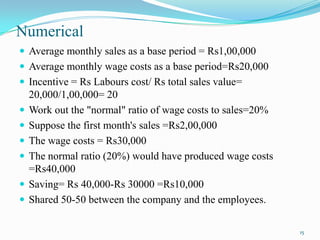
Numerical
 Average monthly sales as a base period = Rs1,00,000

 Average monthly wage costs as a base period=Rs20,000
 Incentive = Rs Labours cost/ Rs total sales value=








20,000/1,00,000= 20
Work out the "normal" ratio of wage costs to sales=20%
Suppose the first month's sales =Rs2,00,000
The wage costs = Rs30,000
The normal ratio (20%) would have produced wage costs
=Rs40,000
Saving= Rs 40,000-Rs 30000 =Rs10,000
Shared 50-50 between the company and the employees.
15
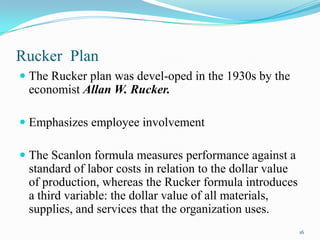
Rucker Plan
 The Rucker plan was devel-oped in the 1930s by the
economist Allan W. Rucker.
 Emphasizes employee involvement
 The Scanlon formula measures performance against a
standard of labor costs in relation to the dollar value
of production, whereas the Rucker formula introduces
a third variable: the dollar value of all materials,
supplies, and services that the organization uses.
16
Rucker Plan(cont….)
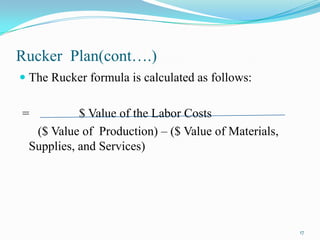
 The Rucker formula is calculated as follows:

=

$ Value of the Labor Costs
($ Value of Production) – ($ Value of Materials,
Supplies, and Services)

17
Numerical











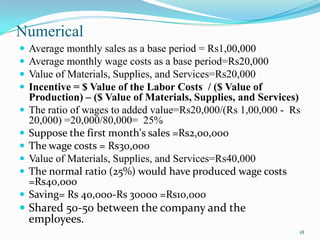
Average monthly sales as a base period = Rs1,00,000
Average monthly wage costs as a base period=Rs20,000
Value of Materials, Supplies, and Services=Rs20,000
Incentive = $ Value of the Labor Costs / ($ Value of
Production) – ($ Value of Materials, Supplies, and Services)
The ratio of wages to added value=Rs20,000/(Rs 1,00,000 - Rs
20,000) =20,000/80,000= 25%
Suppose the first month's sales =Rs2,00,000
The wage costs = Rs30,000
Value of Materials, Supplies, and Services=Rs40,000
The normal ratio (25%) would have produced wage costs
=Rs40,000
Saving= Rs 40,000-Rs 30000 =Rs10,000

 Shared 50-50 between the company and the

employees.

18
IMPROSHARE
 Improshare plans measure changes in the relationship
between outputs and the time (input) required to
produce them.
 This plan is minimally affected by changes in sales

volume, technology and capital equipment, product
mix, or price and wage increases. It's the easiest of the
gainsharing plans to understand and install.

19
 It is an industrial engineering-based gainsharing plan that

uses past production records to establish base
performance standards.
 The ImproShare plan, which was developed in 1973,
measures only labour cost and uses time standards and
past production records to set a production criterion. The
difference between current labour hours to produce a
given amount of output and past labour hours on similar
output is the basis of the bonus formula.

20
Advantages of Gainsharing
 Supports other performance improvement efforts and
helps promote positive change
 Helps companies achieve sustained improvement in

key performance measures
 Rewards only performance improvement
 Enhances employee focus and awareness
21
 Enhances the level of involvement, teamwork and
cooperation
 Aligns employees to organization goals
 Promotes morale, pride, and more positive attitudes
toward the organization

22
Disadvantages of Gainsharing
 Paid on the basis of group performance rather than individual

merit.
 Requires a participative management style.
 Requires that management openly shares information related to

performance measures.
 Increases the level of organizational stress since everyone has

more of a financial stake in the organization's success.
23
ESOP
 Employee stock ownership plan originated in the USA in

early 90’s.
 Stock option plan implies the right of an eligible
employee to purchase a certain amount of stock in future
at agreed price.
 The eligible criteria may include length of service,
contribution to the department/division where employee
works.

24
 The company may even permit employees to pay the
price of stock allotted to them in instalments or even
advance money to be recovered from their salary
every month.

 The allotted shares are generally held in trust and
transferred to the name of the employee whenever he
or she decides to exercise the option.

25
Benefits by ESOP
 Stock options are motivator.
 Employees remain loyal and committed towards
company.
 ESOP foster a long term bond between the employee
and the company.
 Reduced employee turnover
 Lesser supervision

26
Demerits of ESOP
 Only profitable companies can use the tool
 Falling share price could mean losses for employees
 Sometimes employee feel forced to join

27
Reference
 http://www.citeman.com/13906-organizationwide-incentive-plans.html#ixzz2PtpXubV0.
 Human Resource Management By V S P Rao.
 Human Resource Management By K Aswathappa.

28
THANK YOU.

29

Organisation wide incentive plans

  • 1.
    Presented By- PrabhatKumar Pradeep Yadav Praveen Kumar Praveen K. Srivastav 1
  • 2.
    Content  Introduction  Profitsharing  Gain sharing  Employee stock ownership plan  References 2
  • 3.
    Introduction  Organization wideincentive plans reward employees     on the basis of the success of the organization over a specified time period. These plans seek to promote a culture of ownership by developing a senses of belongingness, cooperation and teamwork among all employees. There are three basic types of organization wide incentive plans; Profit sharing Gain sharing Employees stock ownership plans
  • 4.
    Profit sharing: Profit sharingis a scheme whereby employers undertake to pay a particular potion of net profits to their employees on compliance with certain service conditions. The purpose:  To strengthen the loyalty of employees to the firm by offering them an annual bonus.  The share of profit of the worker may be given in cash or in the form of shares in the company.  In India, the share of the worker is governed by the Payment of Bonus act.
  • 5.
    Merits: 1) inspires themanagement and the worker to be sincere, devoted and loyal to the firm. 2) It helps in supplementing the remuneration of workers and enables them to lead a rich life. 3) It is likely to induce motivation in the workers and other staff for quicker and better work.
  • 6.
    Merits(cont….) 4) Workers donot require close supervision as they are self-motivated to put in extra labour for the prosperity of the firm. 5) It attracts talented people to join the ranks of a firm with a view to share the profits. 6
  • 7.
    Demerits 1) Workers mayget nothing if the business does not succeed. 2) Management may dress up profit figures and deprive the workers of their legitimate share in the profits. 3) Workers tend to develop loyalty towards firms discounting their loyalty towards trade unions, thus, impairing the unity of trade unions.
  • 8.
    •Gainsharing is thesharing with employees of greater-than- expected gains in profits and/or productivity. Gainsharing attempts to increase ―discretionary efforts‖—that is, the difference between the maximum amount of effort a person can exert and the minimum amount of effort necessary to keep from being fired.  Cost-savings gains are shared among employees and the company. It is better for motivation. 8
  • 9.
    Gainsharing(cont…….)  It isa popular family of incentive programs that include a system to monitor the performance of the organization and distribute rewards when goals are met, and focuses on employee involvement in order to increase their sense of ownership.  The basic principle is that everyone will gain more if each person acts in the interest of the group rather than in the interest of the self. Thus, gainsharing rewards people for working together. 9
  • 10.
    When does Gainsharingwork best?  Gainsharing works best when an organization's performance levels are easily measurable. Measureable metrics include teamwork, output, product quality, safety, and attendance.  When work environment is based on openness and trust.  Requires management commitment, training and frequent and ongoing communications. 10
  • 11.
    Commonly used gainsharingplans:  Scanlon Plan  Rucker Plan  ImproShare 11
  • 12.
    Scanlon Plan  JosephScanlon, 1937  The Scanlon plan has been implemented in many organizations, especially in smaller unionized industrial firms.  The basic concept underlying the Scanlon plan is that efficiency depends on teamwork and plant wide cooperation. 12
  • 13.
    Scanlon Plan(cont……)  Thesystem is activated through departmental employee committees that receive and review costsaving ideas submitted by employees.  The scope of the departmental committees are passed to the plant screening committee for review.  Savings that result from suggestions are passed on to all members of the organization. 13
  • 14.
    Scanlon Plan(cont……)  Incentiverewards are paid to employees on the basis of improvements in pre established ratios.  Incentive =$ Labours cost / $ total sales value  The Scanlon plan is not a true profit-sharing plan, because employees receive incentive compensation for reducing labor costs, regardless of whether the orga-nization ultimately makes a profit. 14
  • 15.
    Numerical  Average monthlysales as a base period = Rs1,00,000  Average monthly wage costs as a base period=Rs20,000  Incentive = Rs Labours cost/ Rs total sales value=       20,000/1,00,000= 20 Work out the "normal" ratio of wage costs to sales=20% Suppose the first month's sales =Rs2,00,000 The wage costs = Rs30,000 The normal ratio (20%) would have produced wage costs =Rs40,000 Saving= Rs 40,000-Rs 30000 =Rs10,000 Shared 50-50 between the company and the employees. 15
  • 16.
    Rucker Plan  TheRucker plan was devel-oped in the 1930s by the economist Allan W. Rucker.  Emphasizes employee involvement  The Scanlon formula measures performance against a standard of labor costs in relation to the dollar value of production, whereas the Rucker formula introduces a third variable: the dollar value of all materials, supplies, and services that the organization uses. 16
  • 17.
    Rucker Plan(cont….)  TheRucker formula is calculated as follows: = $ Value of the Labor Costs ($ Value of Production) – ($ Value of Materials, Supplies, and Services) 17
  • 18.
    Numerical           Average monthly salesas a base period = Rs1,00,000 Average monthly wage costs as a base period=Rs20,000 Value of Materials, Supplies, and Services=Rs20,000 Incentive = $ Value of the Labor Costs / ($ Value of Production) – ($ Value of Materials, Supplies, and Services) The ratio of wages to added value=Rs20,000/(Rs 1,00,000 - Rs 20,000) =20,000/80,000= 25% Suppose the first month's sales =Rs2,00,000 The wage costs = Rs30,000 Value of Materials, Supplies, and Services=Rs40,000 The normal ratio (25%) would have produced wage costs =Rs40,000 Saving= Rs 40,000-Rs 30000 =Rs10,000  Shared 50-50 between the company and the employees. 18
  • 19.
    IMPROSHARE  Improshare plansmeasure changes in the relationship between outputs and the time (input) required to produce them.  This plan is minimally affected by changes in sales volume, technology and capital equipment, product mix, or price and wage increases. It's the easiest of the gainsharing plans to understand and install. 19
  • 20.
     It isan industrial engineering-based gainsharing plan that uses past production records to establish base performance standards.  The ImproShare plan, which was developed in 1973, measures only labour cost and uses time standards and past production records to set a production criterion. The difference between current labour hours to produce a given amount of output and past labour hours on similar output is the basis of the bonus formula. 20
  • 21.
    Advantages of Gainsharing Supports other performance improvement efforts and helps promote positive change  Helps companies achieve sustained improvement in key performance measures  Rewards only performance improvement  Enhances employee focus and awareness 21
  • 22.
     Enhances thelevel of involvement, teamwork and cooperation  Aligns employees to organization goals  Promotes morale, pride, and more positive attitudes toward the organization 22
  • 23.
    Disadvantages of Gainsharing Paid on the basis of group performance rather than individual merit.  Requires a participative management style.  Requires that management openly shares information related to performance measures.  Increases the level of organizational stress since everyone has more of a financial stake in the organization's success. 23
  • 24.
    ESOP  Employee stockownership plan originated in the USA in early 90’s.  Stock option plan implies the right of an eligible employee to purchase a certain amount of stock in future at agreed price.  The eligible criteria may include length of service, contribution to the department/division where employee works. 24
  • 25.
     The companymay even permit employees to pay the price of stock allotted to them in instalments or even advance money to be recovered from their salary every month.  The allotted shares are generally held in trust and transferred to the name of the employee whenever he or she decides to exercise the option. 25
  • 26.
    Benefits by ESOP Stock options are motivator.  Employees remain loyal and committed towards company.  ESOP foster a long term bond between the employee and the company.  Reduced employee turnover  Lesser supervision 26
  • 27.
    Demerits of ESOP Only profitable companies can use the tool  Falling share price could mean losses for employees  Sometimes employee feel forced to join 27
  • 28.
    Reference  http://www.citeman.com/13906-organizationwide-incentive-plans.html#ixzz2PtpXubV0.  HumanResource Management By V S P Rao.  Human Resource Management By K Aswathappa. 28
  • 29.