LESSON NO. 4
RESEARCH FORMATS
ROMALYN A. RIZARDO
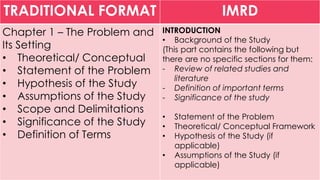
TRADITIONAL FORMAT IMRD
Chapter 1 – The Problem and
Its Setting
• Theoretical/ Conceptual
• Statement of the Problem
• Hypothesis of the Study
• Assumptions of the Study
• Scope and Delimitations
• Significance of the Study
• Definition of Terms
INTRODUCTION
• Background of the Study
(This part contains the following but
there are no specific sections for them:
- Review of related studies and
literature
- Definition of important terms
- Significance of the study
• Statement of the Problem
• Theoretical/ Conceptual Framework
• Hypothesis of the Study (if
applicable)
• Assumptions of the Study (if
applicable)
TRADITIONAL FORMAT IMRD
Note:
The IMRD does not have the
Scope and Delimitation section.
Instead, the IMRD paper identifies
the limitations of the study, which
refer to the constraints in the
conduct of the study.
Most papers discuss this in the
opening paragraph of the Results
section or the Discussion section
TRADITIONAL FORMAT IMRD
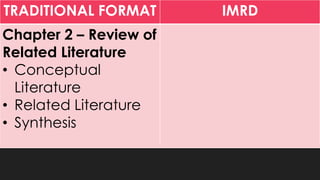
Chapter 2 – Review of
Related Literature
• Conceptual
Literature
• Related Literature
• Synthesis
TRADITIONAL FORMAT IMRD
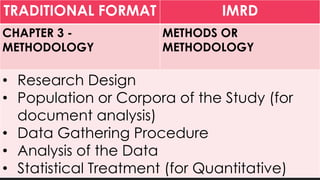
CHAPTER 3 -
METHODOLOGY
METHODS OR
METHODOLOGY
• Research Design
• Population or Corpora of the Study (for
document analysis)
• Data Gathering Procedure
• Analysis of the Data
• Statistical Treatment (for Quantitative)
TRADITIONAL FORMAT IMRD
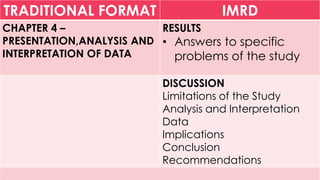
CHAPTER 4 –
PRESENTATION,ANALYSIS AND
INTERPRETATION OF DATA
RESULTS
• Answers to specific
problems of the study
DISCUSSION
Limitations of the Study
Analysis and Interpretation
Data
Implications
Conclusion
Recommendations
TRADITIONAL FORMAT IMRD
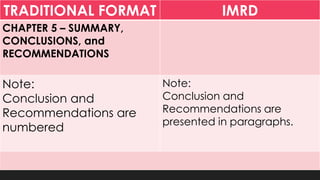
CHAPTER 5 – SUMMARY,
CONCLUSIONS, and
RECOMMENDATIONS
Note:
Conclusion and
Recommendations are
numbered
Note:
Conclusion and
Recommendations are
presented in paragraphs.

Research Formats

  • 1.
    LESSON NO. 4 RESEARCHFORMATS ROMALYN A. RIZARDO
  • 2.
    TRADITIONAL FORMAT IMRD Chapter1 – The Problem and Its Setting • Theoretical/ Conceptual • Statement of the Problem • Hypothesis of the Study • Assumptions of the Study • Scope and Delimitations • Significance of the Study • Definition of Terms INTRODUCTION • Background of the Study (This part contains the following but there are no specific sections for them: - Review of related studies and literature - Definition of important terms - Significance of the study • Statement of the Problem • Theoretical/ Conceptual Framework • Hypothesis of the Study (if applicable) • Assumptions of the Study (if applicable)
  • 3.
    TRADITIONAL FORMAT IMRD Note: TheIMRD does not have the Scope and Delimitation section. Instead, the IMRD paper identifies the limitations of the study, which refer to the constraints in the conduct of the study. Most papers discuss this in the opening paragraph of the Results section or the Discussion section
  • 4.
    TRADITIONAL FORMAT IMRD Chapter2 – Review of Related Literature • Conceptual Literature • Related Literature • Synthesis
  • 5.
    TRADITIONAL FORMAT IMRD CHAPTER3 - METHODOLOGY METHODS OR METHODOLOGY • Research Design • Population or Corpora of the Study (for document analysis) • Data Gathering Procedure • Analysis of the Data • Statistical Treatment (for Quantitative)
  • 6.
    TRADITIONAL FORMAT IMRD CHAPTER4 – PRESENTATION,ANALYSIS AND INTERPRETATION OF DATA RESULTS • Answers to specific problems of the study DISCUSSION Limitations of the Study Analysis and Interpretation Data Implications Conclusion Recommendations
  • 7.
    TRADITIONAL FORMAT IMRD CHAPTER5 – SUMMARY, CONCLUSIONS, and RECOMMENDATIONS Note: Conclusion and Recommendations are numbered Note: Conclusion and Recommendations are presented in paragraphs.