CONTEXT AND TEXT’S
MEANING
LESSON 4
MELC
Discuss how different contexts
enhance the text’s meaning and enrich
the reader’s understanding
CONTEXT is the overall set-up of a
story based on the contributing
factors like setting (time and place),
situations or events
CONTEXT is defined as the
circumstances that form the setting of
events, statements, or ideas and in
the way of which it can be fully
understood and assessed
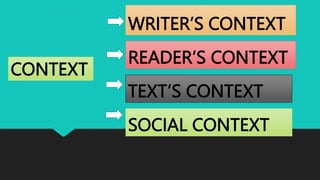
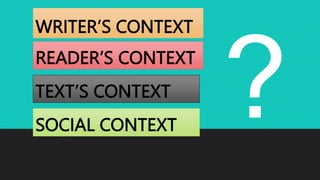
CONTEXT
WRITER’S CONTEXT
READER’S CONTEXT
TEXT’S CONTEXT
SOCIAL CONTEXT
WRITER’S CONTEXT
It is the idea of the author as he/she
writes the story based on his/her
beliefs, experiences in life, and
personal background. (writer’s world)
READER’S CONTEXT
It is the perception/ interpretation of
the reader on the story based on
his/her personal experiences and
knowledge. (reader’s world)
TEXT’S CONTEXT
It is the overall idea of the text; if it just
discusses a certain topic or it is a representation
of the author’s experiences in life. Simply put,
this is what the text is all about.
SOCIAL CONTEXT
It features the society in which the
characters live and in which the author's text
was produced. Simply put, it is the world
where the story is based.
Novel: Noli Me Tangere by Dr. Jose Rizal
Writer’s Context: The idea of the author is to expose
the situation of the Filipinos during the Spanish
colonization. His personal background and experiences
helped him to narrate the events since he used to live
during that period.
Novel: Noli Me Tangere by Dr. Jose Rizal
Reader’s Context: As I read the novel, I realized how
many symbolisms were used to hide the identity of the
actual persons pertained to in every chapter. Based on
its structure, I could say that it is a novel because it is
composed of many chapters. (I learned symbolisms
and novel in our English subject).
Novel: Noli Me Tangere by Dr. Jose Rizal
Text’s Context: It is a novel with lots of chapter
highlighting the author’s representation of
Filipino’s life during the Spanish regime.
Novel: Noli Me Tangere by Dr. Jose Rizal
Social context: The novel is a representation of the actual
society during the Spanish colonization. The characters are
types of people in our society back then. The places and
situations were also representations of what really
happened to some Filipinos that time.
The context of poems, stories, and novels are
shaped by the words used by the author.
In POETRY, there are a lot of symbolisms,
figures of speech, and imagery used to create
an aesthetic effect to the readers.
Symbolisms are words representing the actual things
we are pertaining to. They could be used in poetry and
stories
Examples:
dove= peace,
black cat= bad luck,
four-leaf clover= luck
Imagery is used to create a picture in the reader's
mind through words which appeal to the senses
Examples:
cold summer breeze= senses of touch
silhouettes during sunset= sense of sight
mouth-watery dishes= sense of taste
Types of Imagery (Menoy 2016)
Visual imagery produced by the use of words that
appeal to the sense of sight.
Auditory Imagery produced by the use of words
that appeal to the sense of hearing.
Kinesthetic imagery produced by the use of words
that appeal to the actions and movement.
Figures of speech are flowery words used to compare and
represent a person, place, thing, animal, and events
 Simile (indirect comparison) Ex.You are as beautiful as a
goddess.
 Metaphor (direct comparison) Ex. You are a snake.
(traitor)
 Personification (using action words for nonliving things)
Ex. The wind is blowing.
 Onomatopoeia (use of sounds to express
something) Ex. broom...broom…
 Apostrophe (talking to someone who cannot
respond in reality) Ex. Are you there, God?
 Oxymoron (using two contradicting words to
describe something) Ex. beautiful disaster
ACTIVITY: Give the various forms
of context of the given literary
works.
Sa Aking Mga Kababata
ni Dr. Jose P. Rizal
Sa Aking Mga Kababata
ni Dr. Jose P. Rizal
Kapagka ang baya’y sadyang umiibig
Sa langit salitang kaloob ng langit
Sanlang kalayaan nasa ring masapi
Katulad ng ibong nasa himpapawid
Pagka’t ang salita’y isang kahatulan
Sa bayan, sa nayo't mga kaharian
At ang isang tao’y katulad, kabagay
Ng alin mang likha noong kalayaan.
Ang hindi magmahal sa kanyang salita
Mahigit sa hayop at malansang isda
Kaya ang marapat pagyamanin kusa
Na tulad sa inang tunay na nagpala
Ang wikang Tagalog tulad din sa Latin,
Sa Ingles, Kastila, at salitang anghel,
Sapagkat ang Poong maalam tumingin
Ang siyang naggagawad, nagbibigay sa atin.
Ang salita nati’y tulad din sa iba
Na may alfabeto at sariling letra,
Na kaya nawala’y dinatnan ng sigwa
Ang lunday sa lawa noong dakong una.
WRITER’S CONTEXT
READER’S CONTEXT
TEXT’S CONTEXT
SOCIAL CONTEXT
Direction: The author used imagery in the poem below, such as visual,
auditory, and kinesthetic. Find those lines and write them in the diagram.
Directions: The author used imagery in the poem below, such as visual,
auditory, and kinesthetic. Find those lines and write them in the diagram.
Assignment: Give 3 examples for each
figure of speech.
-Simile
-Metaphor
-Personification
-Onomatopoeia
-Apostrophe
-Oxymoron

4.-Context-and-Texts-Meaning.pptx

  • 1.
  • 2.
    MELC Discuss how differentcontexts enhance the text’s meaning and enrich the reader’s understanding
  • 3.
    CONTEXT is theoverall set-up of a story based on the contributing factors like setting (time and place), situations or events
  • 4.
    CONTEXT is definedas the circumstances that form the setting of events, statements, or ideas and in the way of which it can be fully understood and assessed
  • 5.
  • 6.
    WRITER’S CONTEXT It isthe idea of the author as he/she writes the story based on his/her beliefs, experiences in life, and personal background. (writer’s world)
  • 7.
    READER’S CONTEXT It isthe perception/ interpretation of the reader on the story based on his/her personal experiences and knowledge. (reader’s world)
  • 8.
    TEXT’S CONTEXT It isthe overall idea of the text; if it just discusses a certain topic or it is a representation of the author’s experiences in life. Simply put, this is what the text is all about.
  • 9.
    SOCIAL CONTEXT It featuresthe society in which the characters live and in which the author's text was produced. Simply put, it is the world where the story is based.
  • 10.
    Novel: Noli MeTangere by Dr. Jose Rizal Writer’s Context: The idea of the author is to expose the situation of the Filipinos during the Spanish colonization. His personal background and experiences helped him to narrate the events since he used to live during that period.
  • 11.
    Novel: Noli MeTangere by Dr. Jose Rizal Reader’s Context: As I read the novel, I realized how many symbolisms were used to hide the identity of the actual persons pertained to in every chapter. Based on its structure, I could say that it is a novel because it is composed of many chapters. (I learned symbolisms and novel in our English subject).
  • 12.
    Novel: Noli MeTangere by Dr. Jose Rizal Text’s Context: It is a novel with lots of chapter highlighting the author’s representation of Filipino’s life during the Spanish regime.
  • 13.
    Novel: Noli MeTangere by Dr. Jose Rizal Social context: The novel is a representation of the actual society during the Spanish colonization. The characters are types of people in our society back then. The places and situations were also representations of what really happened to some Filipinos that time.
  • 14.
    The context ofpoems, stories, and novels are shaped by the words used by the author. In POETRY, there are a lot of symbolisms, figures of speech, and imagery used to create an aesthetic effect to the readers.
  • 15.
    Symbolisms are wordsrepresenting the actual things we are pertaining to. They could be used in poetry and stories Examples: dove= peace, black cat= bad luck, four-leaf clover= luck
  • 16.
    Imagery is usedto create a picture in the reader's mind through words which appeal to the senses Examples: cold summer breeze= senses of touch silhouettes during sunset= sense of sight mouth-watery dishes= sense of taste
  • 17.
    Types of Imagery(Menoy 2016) Visual imagery produced by the use of words that appeal to the sense of sight. Auditory Imagery produced by the use of words that appeal to the sense of hearing. Kinesthetic imagery produced by the use of words that appeal to the actions and movement.
  • 18.
    Figures of speechare flowery words used to compare and represent a person, place, thing, animal, and events  Simile (indirect comparison) Ex.You are as beautiful as a goddess.  Metaphor (direct comparison) Ex. You are a snake. (traitor)  Personification (using action words for nonliving things) Ex. The wind is blowing.
  • 19.
     Onomatopoeia (useof sounds to express something) Ex. broom...broom…  Apostrophe (talking to someone who cannot respond in reality) Ex. Are you there, God?  Oxymoron (using two contradicting words to describe something) Ex. beautiful disaster
  • 20.
    ACTIVITY: Give thevarious forms of context of the given literary works.
  • 21.
    Sa Aking MgaKababata ni Dr. Jose P. Rizal
  • 22.
    Sa Aking MgaKababata ni Dr. Jose P. Rizal Kapagka ang baya’y sadyang umiibig Sa langit salitang kaloob ng langit Sanlang kalayaan nasa ring masapi
  • 23.
    Katulad ng ibongnasa himpapawid Pagka’t ang salita’y isang kahatulan Sa bayan, sa nayo't mga kaharian
  • 24.
    At ang isangtao’y katulad, kabagay Ng alin mang likha noong kalayaan. Ang hindi magmahal sa kanyang salita Mahigit sa hayop at malansang isda
  • 25.
    Kaya ang marapatpagyamanin kusa Na tulad sa inang tunay na nagpala Ang wikang Tagalog tulad din sa Latin, Sa Ingles, Kastila, at salitang anghel,
  • 26.
    Sapagkat ang Poongmaalam tumingin Ang siyang naggagawad, nagbibigay sa atin. Ang salita nati’y tulad din sa iba
  • 27.
    Na may alfabetoat sariling letra, Na kaya nawala’y dinatnan ng sigwa Ang lunday sa lawa noong dakong una.
  • 28.
  • 29.
    Direction: The authorused imagery in the poem below, such as visual, auditory, and kinesthetic. Find those lines and write them in the diagram.
  • 30.
    Directions: The authorused imagery in the poem below, such as visual, auditory, and kinesthetic. Find those lines and write them in the diagram.
  • 31.
    Assignment: Give 3examples for each figure of speech. -Simile -Metaphor -Personification -Onomatopoeia -Apostrophe -Oxymoron