Background
of the Study
The background of a study is the first
section of the paper and establishes the
context underlying the research. It contains
the rationale, the key problem statement,
and a brief overview of research questions
that are addressed in the rest of the paper.
How to structure the background?
The section should be organized as:
•What is known about the broad topic?
•What are the gaps or missing links that
need to be addressed?
•What is the significance of addressing
those gaps?
•What are the rationale and hypothesis of
your study?
How to make the background engaging?
As the background includes a lot of
information, it can become a long drag,
causing the readers to lose interest. To
ensure that your background is
engaging, you should try to build a story
around the central theme of your
research.
How to avoid common
mistakes in writing the
background?
Don’t write a background that is too
long or too short.
Don’t be ambiguous.
Don’t discuss unrelated themes.
Don’t be disorganized.
How is the background different from the
literature review?
The literature review section should follow the
background section, as the second section of
your manuscript/thesis. This section basically
supports the background section by providing
evidence for the proposed hypothesis. This
section should be more comprehensive and
thoroughly describe all the studies that you
have mentioned in the background section. It
should also elaborate on all studies that form
evidence for the present study and discuss the
current trends.
A Step-by-Step on How to Do a Background Study for a
Thesis
• Conduct preliminary research in the beginning stages of
formulating a thesis, when many issues are unclear and
thoughts need to be solidified.
• Read the information and develop a research question or
thesis statement that will guide your thesis.
• Write a thesis statement or research question.
• Complete your research using your thesis statement and
research question as your guide.
•Create relevant sections as you write the
background study.
•Conclude by identifying any further study that
needs to be done in that area, or provide
possible solutions to the issue that haven't
been considered before.
•Revise and edit your background study.
FRAMEWORK OF THE STUDY
The terms ‘conceptual framework’
and ‘theoretical framework’ are
commonly used in referring to the
overall structure that shapes a
research project. However, there
are subtle differences between the
two.
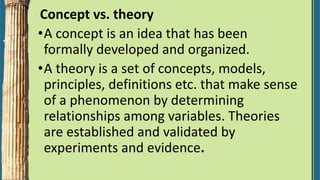
Concept vs. theory
•A concept is an idea that has been
formally developed and organized.
•A theory is a set of concepts, models,
principles, definitions etc. that make sense
of a phenomenon by determining
relationships among variables. Theories
are established and validated by
experiments and evidence.
While a theoretical framework
explores the relationship between
things in a given phenomenon in a
broad and general way, a conceptual
framework is more specific and
represents the researcher’s idea on
how the research problem will be
explored.
A conceptual framework is like a
roadmap for your study, helping you
visualize your research project and put
it into action. It defines the relevant
variables for your study and maps out
how they might relate to each other.
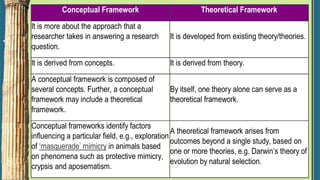
Conceptual Framework Theoretical Framework
It is more about the approach that a
researcher takes in answering a research
question.
It is developed from existing theory/theories.
It is derived from concepts. It is derived from theory.
A conceptual framework is composed of
several concepts. Further, a conceptual
framework may include a theoretical
framework.
By itself, one theory alone can serve as a
theoretical framework.
Conceptual frameworks identify factors
influencing a particular field, e.g., exploration
of ‘masquerade’ mimicry in animals based
on phenomena such as protective mimicry,
crypsis and aposematism.
A theoretical framework arises from
outcomes beyond a single study, based on
one or more theories, e.g. Darwin’s theory of
evolution by natural selection.
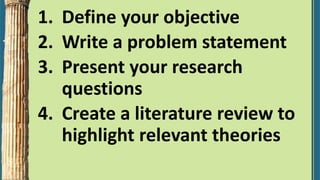
Here's how to create a theoretical
framework for your study or
research paper in four steps:
1. Define your objective
2. Write a problem statement
3. Present your research
questions
4. Create a literature review to
highlight relevant theories
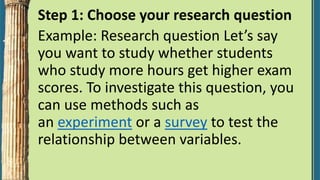
Step 1: Choose your research question
Example: Research question Let’s say
you want to study whether students
who study more hours get higher exam
scores. To investigate this question, you
can use methods such as
an experiment or a survey to test the
relationship between variables.
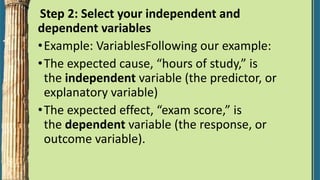
Step 2: Select your independent and
dependent variables
•Example: VariablesFollowing our example:
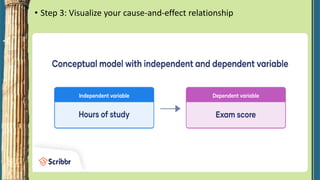
•The expected cause, “hours of study,” is
the independent variable (the predictor, or
explanatory variable)
•The expected effect, “exam score,” is
the dependent variable (the response, or
outcome variable).
• Step 3: Visualize your cause-and-effect relationship
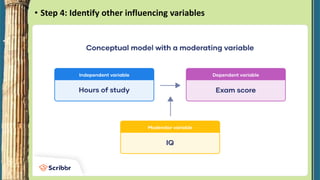
• Step 4: Identify other influencing variables
• Moderator vs. mediator
• It’s important not to confuse moderating and mediating
variables. To remember the difference, you can think of them
in relation to the independent variable:
• A moderating variable is not affected by the independent
variable, even though it affects the dependent variable. For
example, no matter how many hours you study (the
independent variable), your IQ will not get higher.
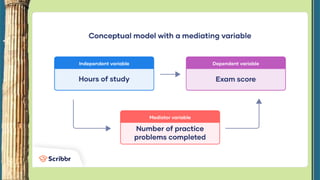
• A mediating variable is affected by the independent variable.
In turn, it also affects the dependent variable. Therefore, it
links the two variables and helps explain the relationship
between them.
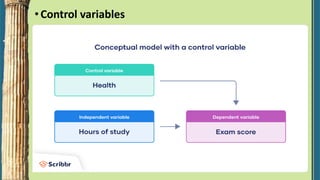
•Control variables
Thank You

Background & Framework of the Study ppt.pptx

  • 2.
  • 3.
    The background ofa study is the first section of the paper and establishes the context underlying the research. It contains the rationale, the key problem statement, and a brief overview of research questions that are addressed in the rest of the paper.
  • 4.
    How to structurethe background?
  • 5.
    The section shouldbe organized as: •What is known about the broad topic? •What are the gaps or missing links that need to be addressed? •What is the significance of addressing those gaps? •What are the rationale and hypothesis of your study?
  • 6.
    How to makethe background engaging? As the background includes a lot of information, it can become a long drag, causing the readers to lose interest. To ensure that your background is engaging, you should try to build a story around the central theme of your research.
  • 7.
    How to avoidcommon mistakes in writing the background?
  • 8.
    Don’t write abackground that is too long or too short. Don’t be ambiguous. Don’t discuss unrelated themes. Don’t be disorganized.
  • 9.
    How is thebackground different from the literature review?
  • 10.
    The literature reviewsection should follow the background section, as the second section of your manuscript/thesis. This section basically supports the background section by providing evidence for the proposed hypothesis. This section should be more comprehensive and thoroughly describe all the studies that you have mentioned in the background section. It should also elaborate on all studies that form evidence for the present study and discuss the current trends.
  • 11.
    A Step-by-Step onHow to Do a Background Study for a Thesis • Conduct preliminary research in the beginning stages of formulating a thesis, when many issues are unclear and thoughts need to be solidified. • Read the information and develop a research question or thesis statement that will guide your thesis. • Write a thesis statement or research question. • Complete your research using your thesis statement and research question as your guide.
  • 12.
    •Create relevant sectionsas you write the background study. •Conclude by identifying any further study that needs to be done in that area, or provide possible solutions to the issue that haven't been considered before. •Revise and edit your background study.
  • 13.
  • 14.
    The terms ‘conceptualframework’ and ‘theoretical framework’ are commonly used in referring to the overall structure that shapes a research project. However, there are subtle differences between the two.
  • 15.
    Concept vs. theory •Aconcept is an idea that has been formally developed and organized. •A theory is a set of concepts, models, principles, definitions etc. that make sense of a phenomenon by determining relationships among variables. Theories are established and validated by experiments and evidence.
  • 16.
    While a theoreticalframework explores the relationship between things in a given phenomenon in a broad and general way, a conceptual framework is more specific and represents the researcher’s idea on how the research problem will be explored.
  • 17.
    A conceptual frameworkis like a roadmap for your study, helping you visualize your research project and put it into action. It defines the relevant variables for your study and maps out how they might relate to each other.
  • 18.
    Conceptual Framework TheoreticalFramework It is more about the approach that a researcher takes in answering a research question. It is developed from existing theory/theories. It is derived from concepts. It is derived from theory. A conceptual framework is composed of several concepts. Further, a conceptual framework may include a theoretical framework. By itself, one theory alone can serve as a theoretical framework. Conceptual frameworks identify factors influencing a particular field, e.g., exploration of ‘masquerade’ mimicry in animals based on phenomena such as protective mimicry, crypsis and aposematism. A theoretical framework arises from outcomes beyond a single study, based on one or more theories, e.g. Darwin’s theory of evolution by natural selection.
  • 19.
    Here's how tocreate a theoretical framework for your study or research paper in four steps:
  • 20.
    1. Define yourobjective 2. Write a problem statement 3. Present your research questions 4. Create a literature review to highlight relevant theories
  • 21.
    Step 1: Chooseyour research question Example: Research question Let’s say you want to study whether students who study more hours get higher exam scores. To investigate this question, you can use methods such as an experiment or a survey to test the relationship between variables.
  • 22.
    Step 2: Selectyour independent and dependent variables •Example: VariablesFollowing our example: •The expected cause, “hours of study,” is the independent variable (the predictor, or explanatory variable) •The expected effect, “exam score,” is the dependent variable (the response, or outcome variable).
  • 23.
    • Step 3:Visualize your cause-and-effect relationship
  • 24.
    • Step 4:Identify other influencing variables
  • 26.
    • Moderator vs.mediator • It’s important not to confuse moderating and mediating variables. To remember the difference, you can think of them in relation to the independent variable: • A moderating variable is not affected by the independent variable, even though it affects the dependent variable. For example, no matter how many hours you study (the independent variable), your IQ will not get higher. • A mediating variable is affected by the independent variable. In turn, it also affects the dependent variable. Therefore, it links the two variables and helps explain the relationship between them.
  • 27.
  • 28.