Research Challenges in AI:
Tackling the Complexity of Human Intelligence and
Applications
(a very short introduction)
Matteo Palmonari
INSID&S Lab - inside.disco.unimib.it
University of Milano-Bicocca
Credits to Stafania Bandini & Federico Bianchi Write to matteo.palmonari AT unimib.it
Impact of Modern Machine Learning on
Problem Solving / Games
2
1997 deep blue beats Kasparov 2019 DeepMind’s AI beats a pro gamer on
Starcraft II (strategic game)
Cons. Humans have limited attention and
slower action/m rate
Cons. Humans learn 1000x
faster in the Frostbite game
[Tsividis et al. AAAI 2017]
Humans use background
knowledge
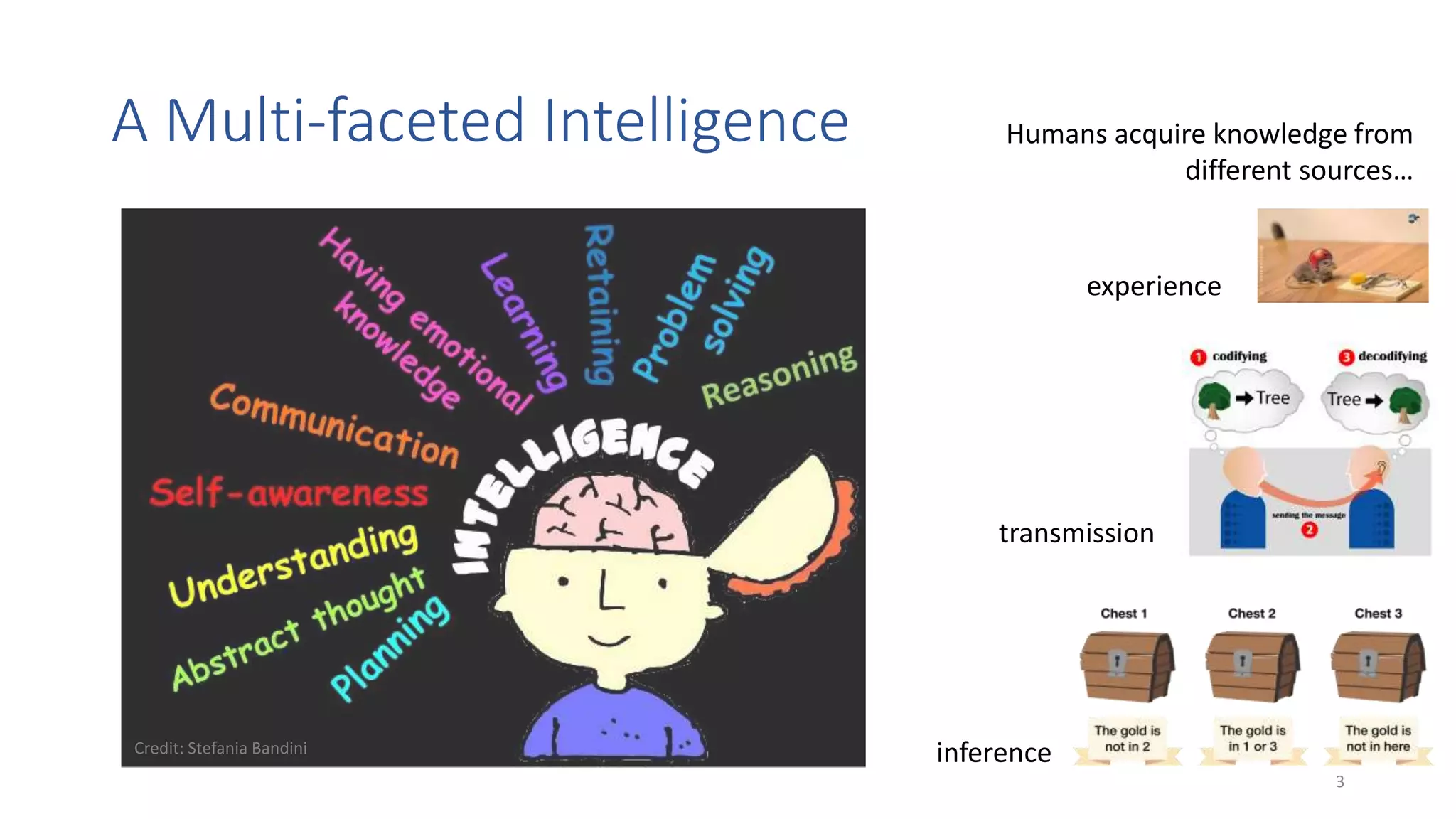
A Multi-faceted Intelligence
3
experience
transmission
inference
Humans acquire knowledge from
different sources…
Credit: Stefania Bandini
Research Trends: Towards Human-level AI
1. Humans learn faster and without limited training “data”
• Transfer learning, few-shot learning, combination of symbolic knowledge and learning
2. Different humans’ cognitive skills are highly connected and not learnt
independently
• Transfer learning, multi-modal learning (e.g., text + images, verbal + non-verbal
communication, images + emotions, …); multi-task learning (e.g., ~ one model for different
tasks); combination of analogical and logical reasoning; cognitively grounded architectures
3. Humans can imagine and reason about things and events that do not exist, and
at higher level of depth and abstraction
• Imagination machines, generative models, what-if question answering, counterfactuals
4
Impact of Modern Machine Learning on
Problem Solving / Games
5
1997 deep blue beats Kasparov 2019 DeepMind’s AI beats a pro gamer on
Starcraft II (strategic game)
Cons. Humans have limited attention and
slower action/m rate
Cons. Humans learn 1000x
faster in the Frostbite game
[Tsividis et al. AAAI 2017]
Humans use background
knowledge
Research Trends: Towards Human-level AI
1. Humans learn faster and without limited training “data”
• Transfer learning, few-shot learning, combination of symbolic knowledge and learning
2. Different humans’ cognitive skills are highly connected and not learnt
independently
• Transfer learning, multi-modal learning (e.g., text + images, verbal + non-verbal
communication, images + emotions, …); multi-task learning (e.g., ~ one model for different
tasks); combination of analogical and logical reasoning; cognitively grounded architectures
3. Humans can imagine and reason about things and events that do not exist, and
at higher level of depth and abstraction
• Imagination machines, generative models, what-if question answering, counterfactuals
6
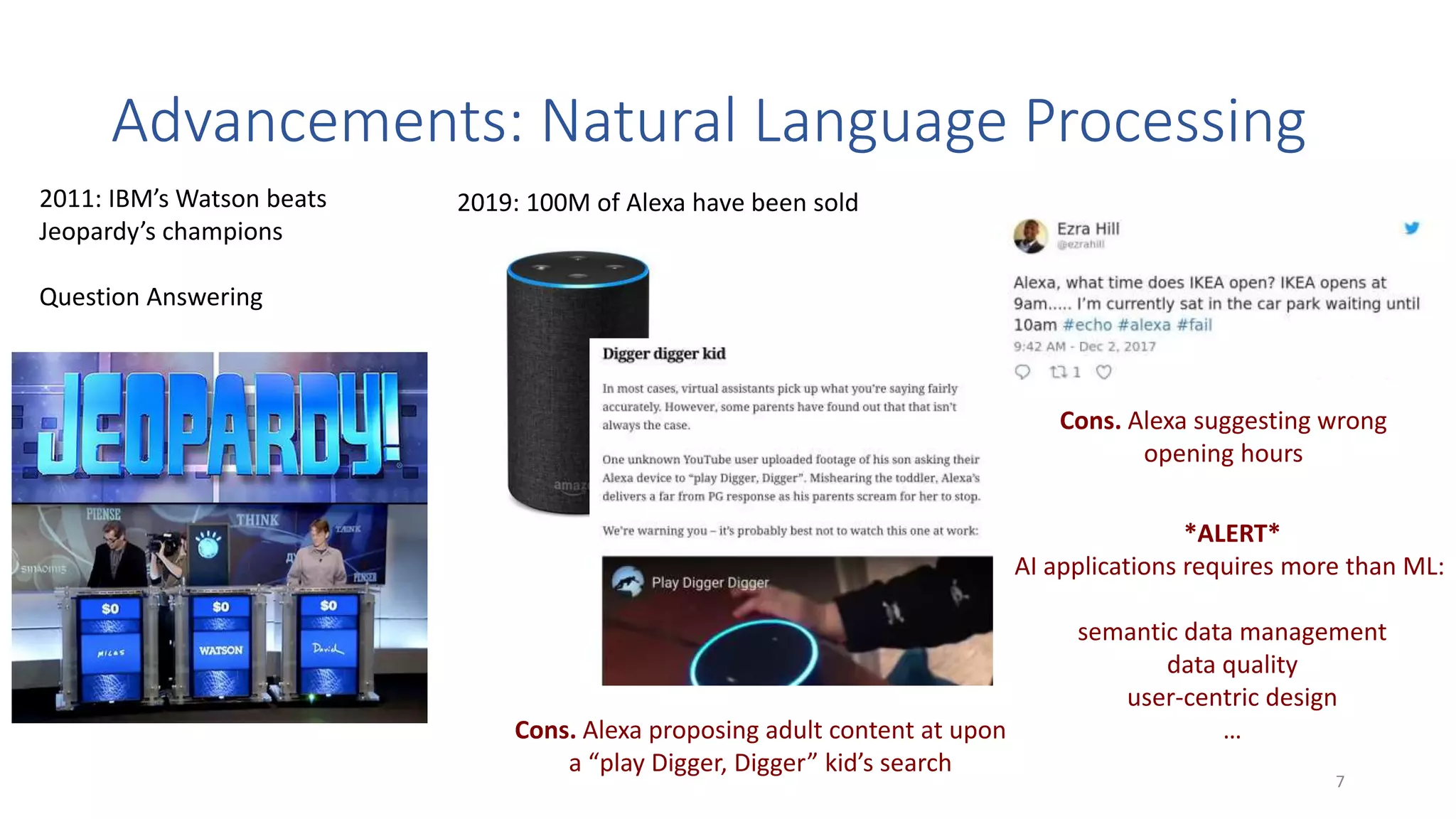
Advancements: Natural Language Processing
7
2011: IBM’s Watson beats
Jeopardy’s champions
Question Answering
2019: 100M of Alexa have been sold
Cons. Alexa proposing adult content at upon
a “play Digger, Digger” kid’s search
Cons. Alexa suggesting wrong
opening hours
*ALERT*
AI applications requires more than ML:
semantic data management
data quality
user-centric design
…
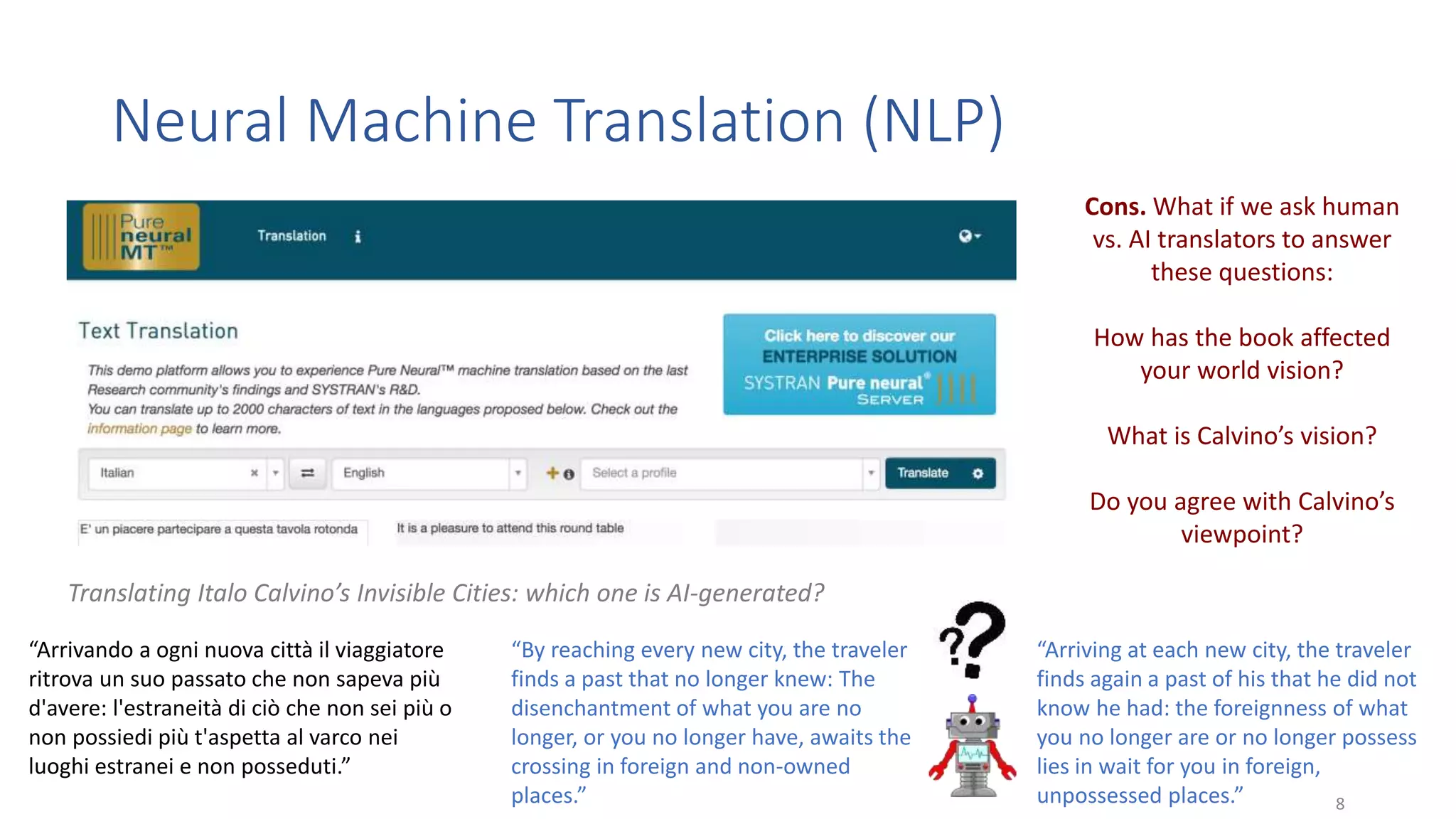
Neural Machine Translation (NLP)
8
“Arrivando a ogni nuova città il viaggiatore
ritrova un suo passato che non sapeva più
d'avere: l'estraneità di ciò che non sei più o
non possiedi più t'aspetta al varco nei
luoghi estranei e non posseduti.”
“By reaching every new city, the traveler
finds a past that no longer knew: The
disenchantment of what you are no
longer, or you no longer have, awaits the
crossing in foreign and non-owned
places.”
“Arriving at each new city, the traveler
finds again a past of his that he did not
know he had: the foreignness of what
you no longer are or no longer possess
lies in wait for you in foreign,
unpossessed places.”
Cons. What if we ask human
vs. AI translators to answer
these questions:
How has the book affected
your world vision?
What is Calvino’s vision?
Do you agree with Calvino’s
viewpoint?
Translating Italo Calvino’s Invisible Cities: which one is AI-generated?
Combining Knowledge Representation and
Learning
9
Pros. Accurate reasoning, scalability
Cons. Hand-written rules, rigid inferences
Analogical reasoning over words [Mikolov, 2013]
and entities [Bianchi & al., 2018]
Pros. Data-driven, soft inferences, latent factors
Cons. Limited precision, limited scalability
Link prediction based on latent factors
[Trouillon & al., 2017]
2016: Neural Theorem Prover [Rocktaschel & al., 2016]
Combining modern ML and reasoning (neuro-symbolic integration)
Learning Representations for Reasoning
Credit: http://ontogenesis.knowledgeblog.org/1376
Symbolic Knowledge Representation &
Reasoning
Credit:
http://pyvandenbussche.info/2017/transla
ting-embeddings-transe/
Research Trends: Towards Human-level AI
1. Humans learn faster and without limited training “data”
• Transfer learning, few-shot learning, combination of symbolic knowledge and learning
2. Different humans’ cognitive skills are highly connected and not learnt
independently
• Transfer learning, multi-modal learning (e.g., text + images, verbal + non-verbal
communication, images + emotions, …); multi-task learning (e.g., ~ one model for different
tasks); combination of analogical and logical reasoning; cognitively grounded architectures
3. Humans can imagine and reason about things and events that do not exist,
and at higher level of depth and abstraction
• Imagination machines, generative models, what-if question answering, counterfactuals
10
Imagination and AI in Creative Processes
11
2018: DJ Algoriddim - AI-powered
music selector and mixer
Cons. unfair comparison of
resources
AI: deeply listening 40M songs
Human DJ: can’t listen more
than ~7MIL songs in a lifetime
(75 years 12h/day)
2018: Face Generation with BigGAN [Brock, 2018]
Neural Music
Composition
Software by Google
Cons.
Portrait of Edmond Belamy
Sold for $432,500 at Christie’s
Painted by Obvious algorithm
after training with 15k paintings
Cons. Still errors that many humans would not make even
on “AI better than humans” image classification tasks
Research Trends: Towards Human-level AI
1. Humans learn faster and without limited training “data”
• Transfer learning, few-shot learning, combination of symbolic knowledge and learning
2. Different humans’ cognitive skills are highly connected and not learnt
independently
• Transfer learning, multi-modal learning (e.g., text + images, verbal + non-verbal
communication, images + emotions, …); multi-task learning (e.g., ~ one model for different
tasks); combination of analogical and logical reasoning; cognitively grounded architectures
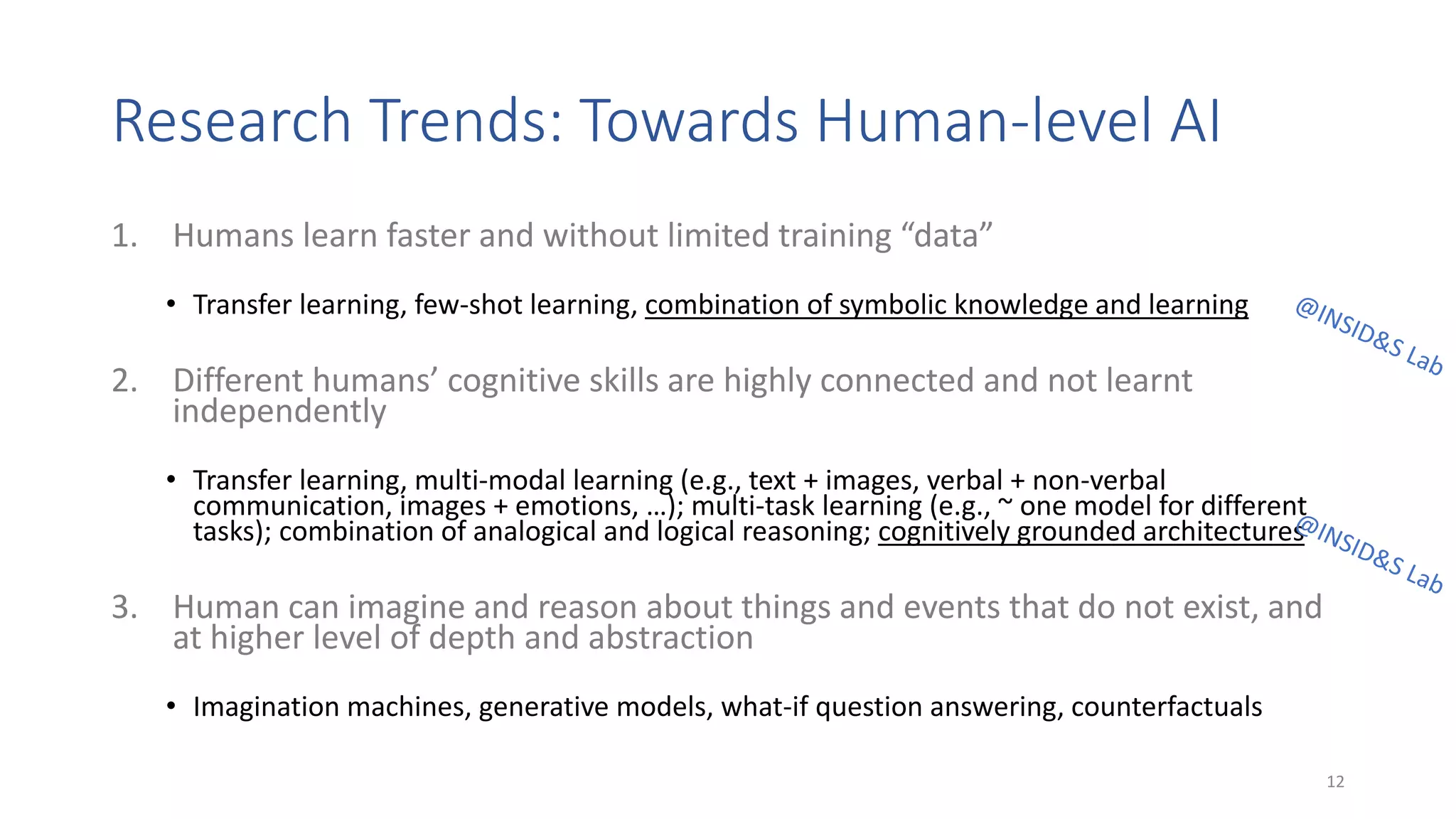
3. Human can imagine and reason about things and events that do not exist, and
at higher level of depth and abstraction
• Imagination machines, generative models, what-if question answering, counterfactuals
12
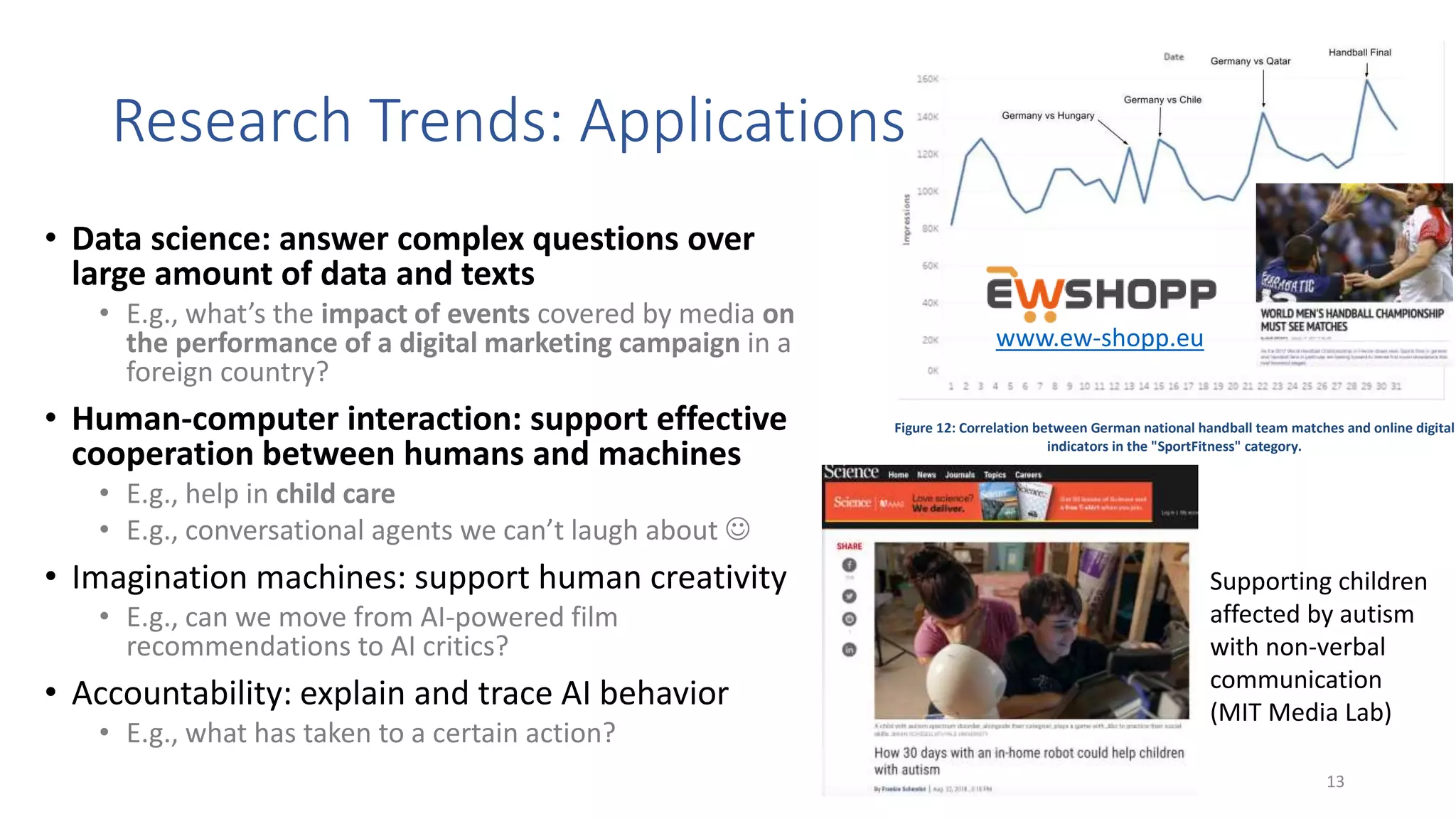
• Data science: answer complex questions over
large amount of data and texts
• E.g., what’s the impact of events covered by media on
the performance of a digital marketing campaign in a
foreign country?
• Human-computer interaction: support effective
cooperation between humans and machines
• E.g., help in child care
• E.g., conversational agents we can’t laugh about 
• Imagination machines: support human creativity
• E.g., can we move from AI-powered film
recommendations to AI critics?
• Accountability: explain and trace AI behavior
• E.g., what has taken to a certain action?
13
Supporting children
affected by autism
with non-verbal
communication
(MIT Media Lab)
EW_Shopp 2017 GA number: 732590 H2020-ICT-2016-2017/H202
campaigns indicators under the “SportFitness” category.
Figure 12: Correlation between German national handball team matches and online digital
indicators in the "SportFitness" category.
www.ew-shopp.eu
Research Trends: Applications
This work has received funding from the European Union’s Horizon 2020 research and innovation program under grant agreements n. 732003 and n. 732590
Supporting Event and Weather-
based Data Analytics and
Marketing along the Shopper
Journeywww.ew-shopp.eu
Enabling the European Business Graph for
Innovative Data Products and Services
www.eubusinessgraph.eu/
14
Credits & Links
• Much inspiration from the great tutorial on “Imagination Science: Beyond Data Science” by Sridhar
Mahadevan (University of Massachusset, Director of Data Science Lab at Adobe Research) at AAAI
2019
• https://people.cs.umass.edu/~mahadeva/AAAI_2019_Tutorial/Welcome.html
• EW-Shopp: check out the solutions, toolkit and data blog sections
• www.ew-shopp.eu
• Work on temporal representation learning @INSID&S Lab:
• Di Carlo, V., Bianchi, F. & Palmonari, M. (2019). Training Temporal Word Embeddings with a Compass. In
AAAI
• Bianchi, F., Palmonari, M., & Nozza, D. (2018, October). Towards Encoding Time in Text-Based Entity
Embeddings. In ISWC.

Research Challenges in Artificial Intelligence: Tackling the Complexity of Human Intelligence and Applications

  • 1.
    Research Challenges inAI: Tackling the Complexity of Human Intelligence and Applications (a very short introduction) Matteo Palmonari INSID&S Lab - inside.disco.unimib.it University of Milano-Bicocca Credits to Stafania Bandini & Federico Bianchi Write to matteo.palmonari AT unimib.it
  • 2.
    Impact of ModernMachine Learning on Problem Solving / Games 2 1997 deep blue beats Kasparov 2019 DeepMind’s AI beats a pro gamer on Starcraft II (strategic game) Cons. Humans have limited attention and slower action/m rate Cons. Humans learn 1000x faster in the Frostbite game [Tsividis et al. AAAI 2017] Humans use background knowledge
  • 3.
    A Multi-faceted Intelligence 3 experience transmission inference Humansacquire knowledge from different sources… Credit: Stefania Bandini
  • 4.
    Research Trends: TowardsHuman-level AI 1. Humans learn faster and without limited training “data” • Transfer learning, few-shot learning, combination of symbolic knowledge and learning 2. Different humans’ cognitive skills are highly connected and not learnt independently • Transfer learning, multi-modal learning (e.g., text + images, verbal + non-verbal communication, images + emotions, …); multi-task learning (e.g., ~ one model for different tasks); combination of analogical and logical reasoning; cognitively grounded architectures 3. Humans can imagine and reason about things and events that do not exist, and at higher level of depth and abstraction • Imagination machines, generative models, what-if question answering, counterfactuals 4
  • 5.
    Impact of ModernMachine Learning on Problem Solving / Games 5 1997 deep blue beats Kasparov 2019 DeepMind’s AI beats a pro gamer on Starcraft II (strategic game) Cons. Humans have limited attention and slower action/m rate Cons. Humans learn 1000x faster in the Frostbite game [Tsividis et al. AAAI 2017] Humans use background knowledge
  • 6.
    Research Trends: TowardsHuman-level AI 1. Humans learn faster and without limited training “data” • Transfer learning, few-shot learning, combination of symbolic knowledge and learning 2. Different humans’ cognitive skills are highly connected and not learnt independently • Transfer learning, multi-modal learning (e.g., text + images, verbal + non-verbal communication, images + emotions, …); multi-task learning (e.g., ~ one model for different tasks); combination of analogical and logical reasoning; cognitively grounded architectures 3. Humans can imagine and reason about things and events that do not exist, and at higher level of depth and abstraction • Imagination machines, generative models, what-if question answering, counterfactuals 6
  • 7.
    Advancements: Natural LanguageProcessing 7 2011: IBM’s Watson beats Jeopardy’s champions Question Answering 2019: 100M of Alexa have been sold Cons. Alexa proposing adult content at upon a “play Digger, Digger” kid’s search Cons. Alexa suggesting wrong opening hours *ALERT* AI applications requires more than ML: semantic data management data quality user-centric design …
  • 8.
    Neural Machine Translation(NLP) 8 “Arrivando a ogni nuova città il viaggiatore ritrova un suo passato che non sapeva più d'avere: l'estraneità di ciò che non sei più o non possiedi più t'aspetta al varco nei luoghi estranei e non posseduti.” “By reaching every new city, the traveler finds a past that no longer knew: The disenchantment of what you are no longer, or you no longer have, awaits the crossing in foreign and non-owned places.” “Arriving at each new city, the traveler finds again a past of his that he did not know he had: the foreignness of what you no longer are or no longer possess lies in wait for you in foreign, unpossessed places.” Cons. What if we ask human vs. AI translators to answer these questions: How has the book affected your world vision? What is Calvino’s vision? Do you agree with Calvino’s viewpoint? Translating Italo Calvino’s Invisible Cities: which one is AI-generated?
  • 9.
    Combining Knowledge Representationand Learning 9 Pros. Accurate reasoning, scalability Cons. Hand-written rules, rigid inferences Analogical reasoning over words [Mikolov, 2013] and entities [Bianchi & al., 2018] Pros. Data-driven, soft inferences, latent factors Cons. Limited precision, limited scalability Link prediction based on latent factors [Trouillon & al., 2017] 2016: Neural Theorem Prover [Rocktaschel & al., 2016] Combining modern ML and reasoning (neuro-symbolic integration) Learning Representations for Reasoning Credit: http://ontogenesis.knowledgeblog.org/1376 Symbolic Knowledge Representation & Reasoning Credit: http://pyvandenbussche.info/2017/transla ting-embeddings-transe/
  • 10.
    Research Trends: TowardsHuman-level AI 1. Humans learn faster and without limited training “data” • Transfer learning, few-shot learning, combination of symbolic knowledge and learning 2. Different humans’ cognitive skills are highly connected and not learnt independently • Transfer learning, multi-modal learning (e.g., text + images, verbal + non-verbal communication, images + emotions, …); multi-task learning (e.g., ~ one model for different tasks); combination of analogical and logical reasoning; cognitively grounded architectures 3. Humans can imagine and reason about things and events that do not exist, and at higher level of depth and abstraction • Imagination machines, generative models, what-if question answering, counterfactuals 10
  • 11.
    Imagination and AIin Creative Processes 11 2018: DJ Algoriddim - AI-powered music selector and mixer Cons. unfair comparison of resources AI: deeply listening 40M songs Human DJ: can’t listen more than ~7MIL songs in a lifetime (75 years 12h/day) 2018: Face Generation with BigGAN [Brock, 2018] Neural Music Composition Software by Google Cons. Portrait of Edmond Belamy Sold for $432,500 at Christie’s Painted by Obvious algorithm after training with 15k paintings Cons. Still errors that many humans would not make even on “AI better than humans” image classification tasks
  • 12.
    Research Trends: TowardsHuman-level AI 1. Humans learn faster and without limited training “data” • Transfer learning, few-shot learning, combination of symbolic knowledge and learning 2. Different humans’ cognitive skills are highly connected and not learnt independently • Transfer learning, multi-modal learning (e.g., text + images, verbal + non-verbal communication, images + emotions, …); multi-task learning (e.g., ~ one model for different tasks); combination of analogical and logical reasoning; cognitively grounded architectures 3. Human can imagine and reason about things and events that do not exist, and at higher level of depth and abstraction • Imagination machines, generative models, what-if question answering, counterfactuals 12
  • 13.
    • Data science:answer complex questions over large amount of data and texts • E.g., what’s the impact of events covered by media on the performance of a digital marketing campaign in a foreign country? • Human-computer interaction: support effective cooperation between humans and machines • E.g., help in child care • E.g., conversational agents we can’t laugh about  • Imagination machines: support human creativity • E.g., can we move from AI-powered film recommendations to AI critics? • Accountability: explain and trace AI behavior • E.g., what has taken to a certain action? 13 Supporting children affected by autism with non-verbal communication (MIT Media Lab) EW_Shopp 2017 GA number: 732590 H2020-ICT-2016-2017/H202 campaigns indicators under the “SportFitness” category. Figure 12: Correlation between German national handball team matches and online digital indicators in the "SportFitness" category. www.ew-shopp.eu Research Trends: Applications
  • 14.
    This work hasreceived funding from the European Union’s Horizon 2020 research and innovation program under grant agreements n. 732003 and n. 732590 Supporting Event and Weather- based Data Analytics and Marketing along the Shopper Journeywww.ew-shopp.eu Enabling the European Business Graph for Innovative Data Products and Services www.eubusinessgraph.eu/ 14 Credits & Links • Much inspiration from the great tutorial on “Imagination Science: Beyond Data Science” by Sridhar Mahadevan (University of Massachusset, Director of Data Science Lab at Adobe Research) at AAAI 2019 • https://people.cs.umass.edu/~mahadeva/AAAI_2019_Tutorial/Welcome.html • EW-Shopp: check out the solutions, toolkit and data blog sections • www.ew-shopp.eu • Work on temporal representation learning @INSID&S Lab: • Di Carlo, V., Bianchi, F. & Palmonari, M. (2019). Training Temporal Word Embeddings with a Compass. In AAAI • Bianchi, F., Palmonari, M., & Nozza, D. (2018, October). Towards Encoding Time in Text-Based Entity Embeddings. In ISWC.