Artificial
Intelligence
Introduction
AIMA Chapter
1
This work is licensed under a Creative
Commons Attribution-ShareAlike 4.0
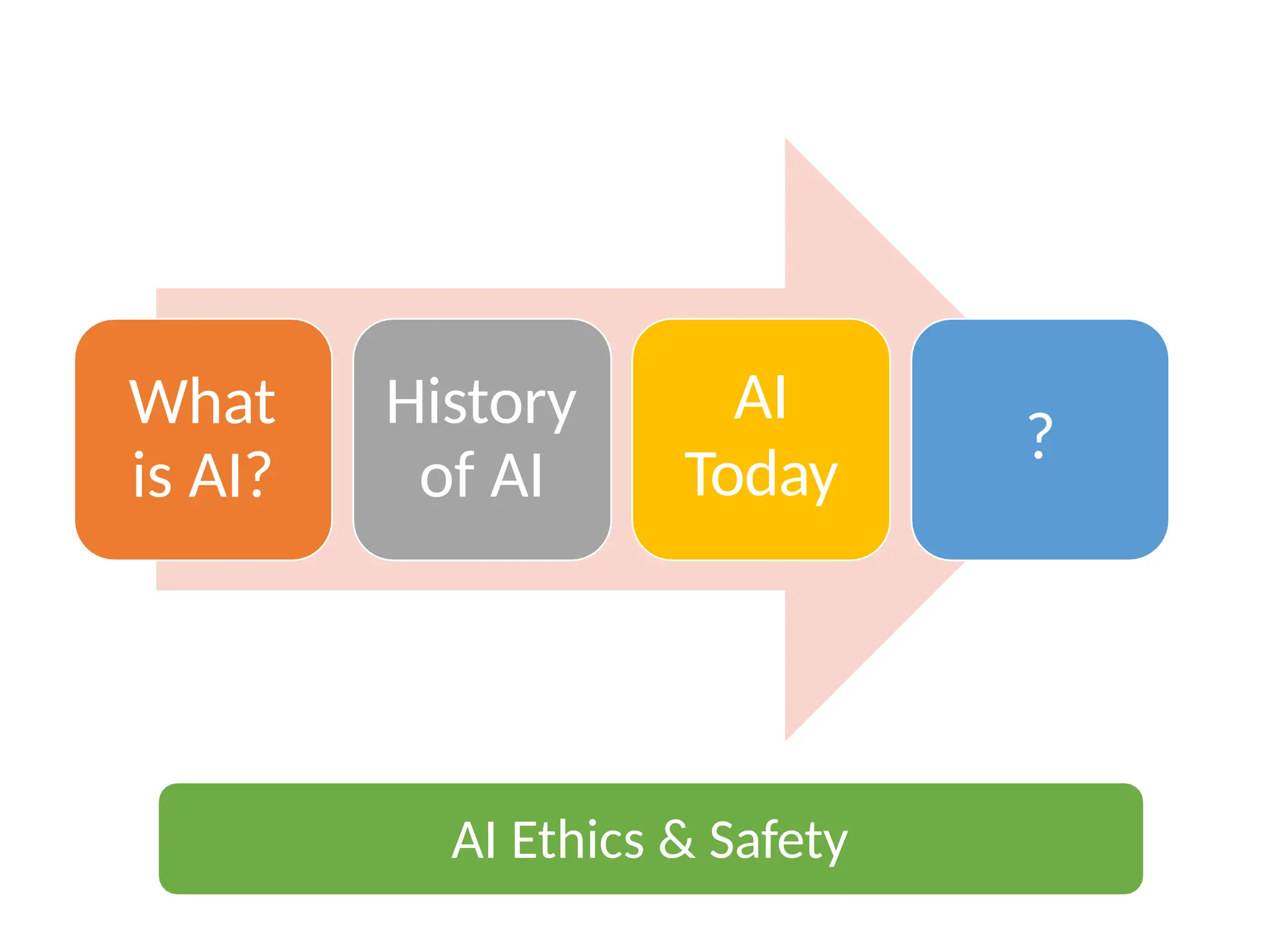
What
is AI?
History
of AI
AI
Today
?
AI Ethics & Safety
What is AI?
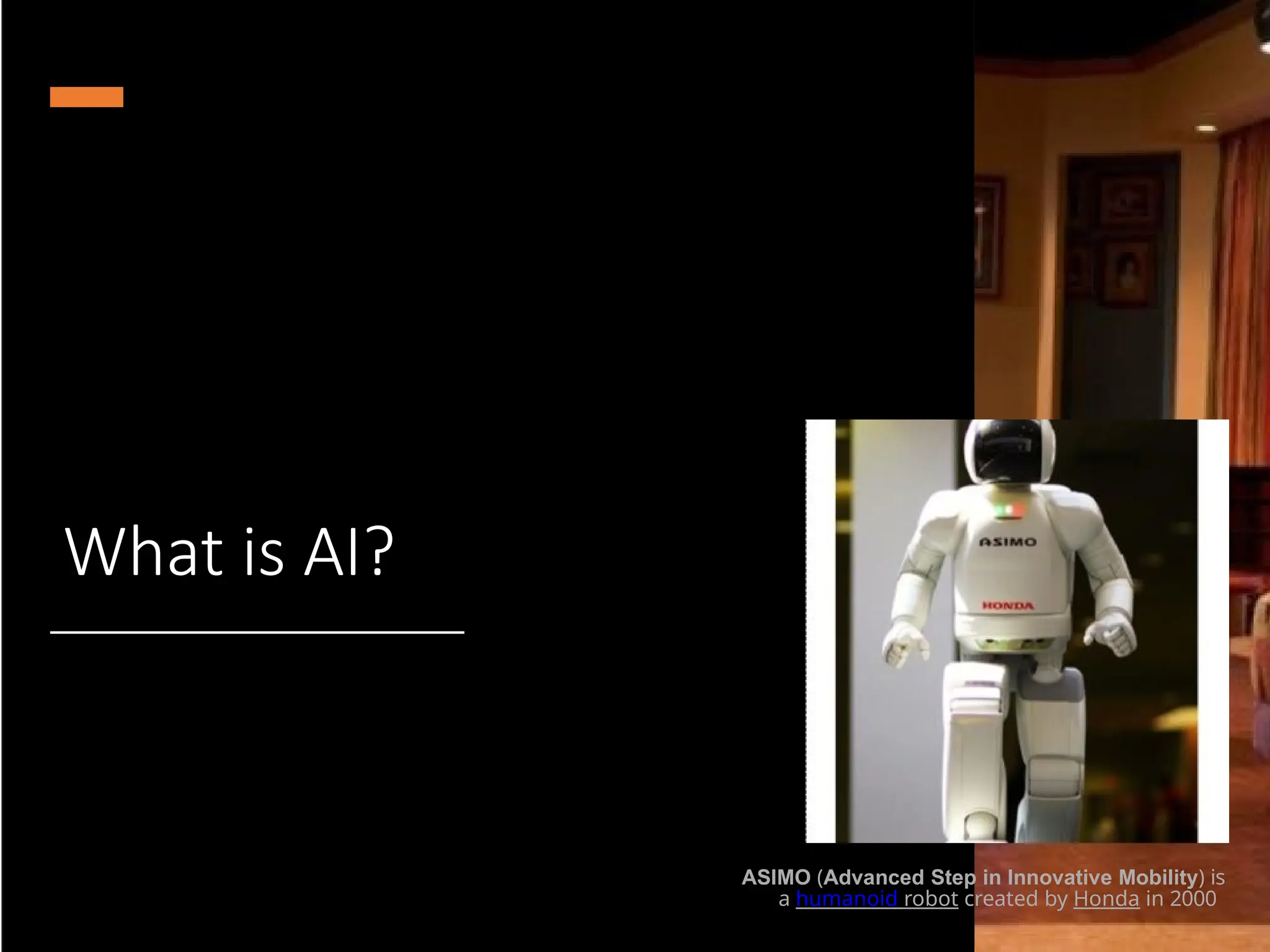
ASIMO (Advanced Step in Innovative Mobility) is
a humanoid robot created by Honda in 2000
What is it the Goal of AI?
thinks like
a human?
acts like a
human?
thinks
rationally?
acts
rationally?
“Have machines solve problems that a challenging for humans.”
• Narrow AI focuses on intelligent agents to solve a specific subproblem.
• An artificial general intelligence (AGI) is a hypothetical intelligent agent
which can understand or learn any intellectual task that human beings
or other animals can. [Wikipedia entry on
AGI]
How do we achieve this?
Create an agent that
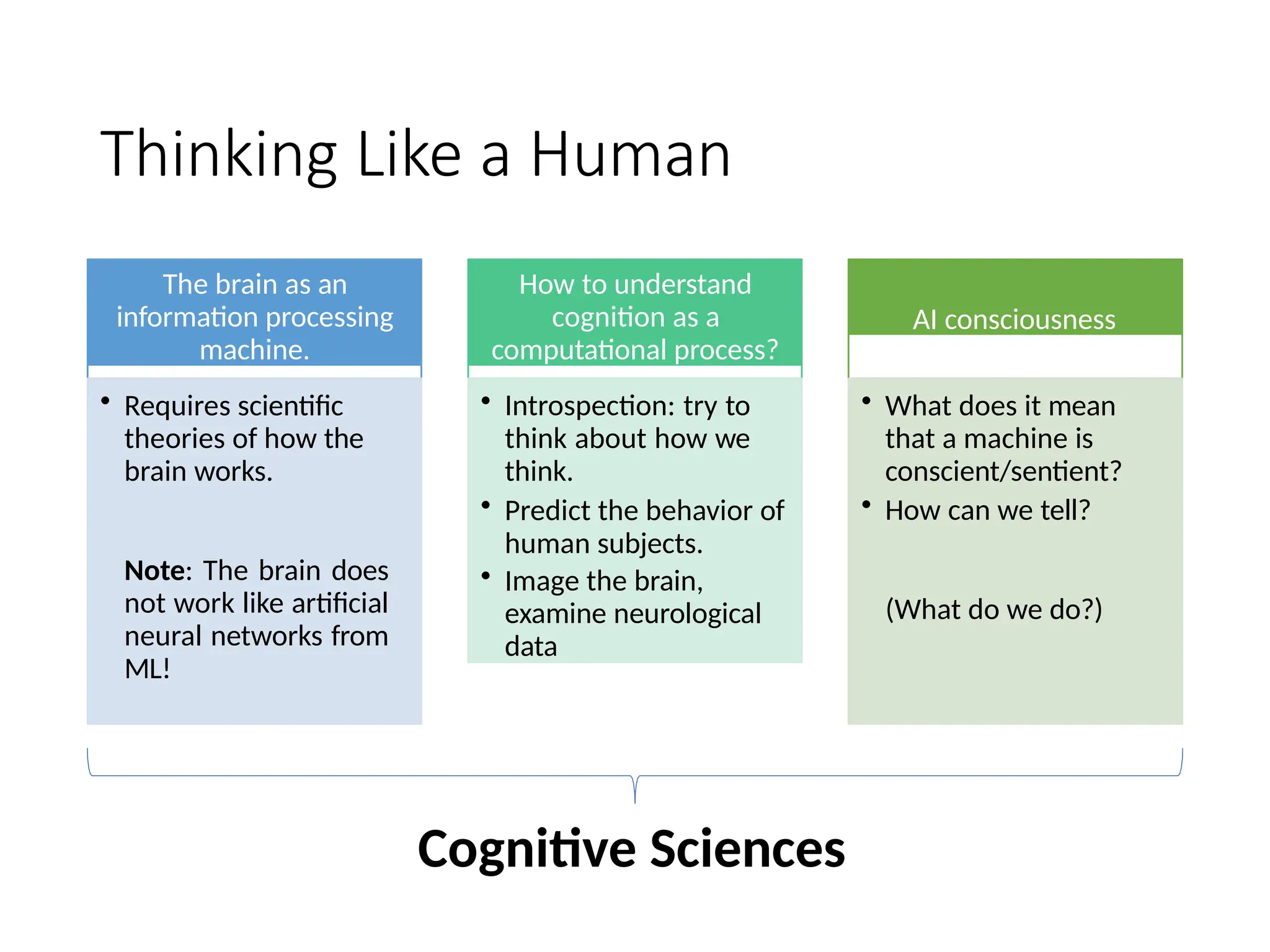
Thinking Like a Human
The brain as an
information processing
machine.
• Requires scientific
theories of how the
brain works.
Note: The brain does
not work like artificial
neural networks from
ML!
How to understand
cognition as a
computational process?
• Introspection: try to
think about how we
think.
• Predict the behavior of
human subjects.
• Image the brain,
examine neurological
data
AI consciousness
• What does it mean
that a machine is
conscient/sentient?
• How can we tell?
(What do we do?)
Cognitive Sciences
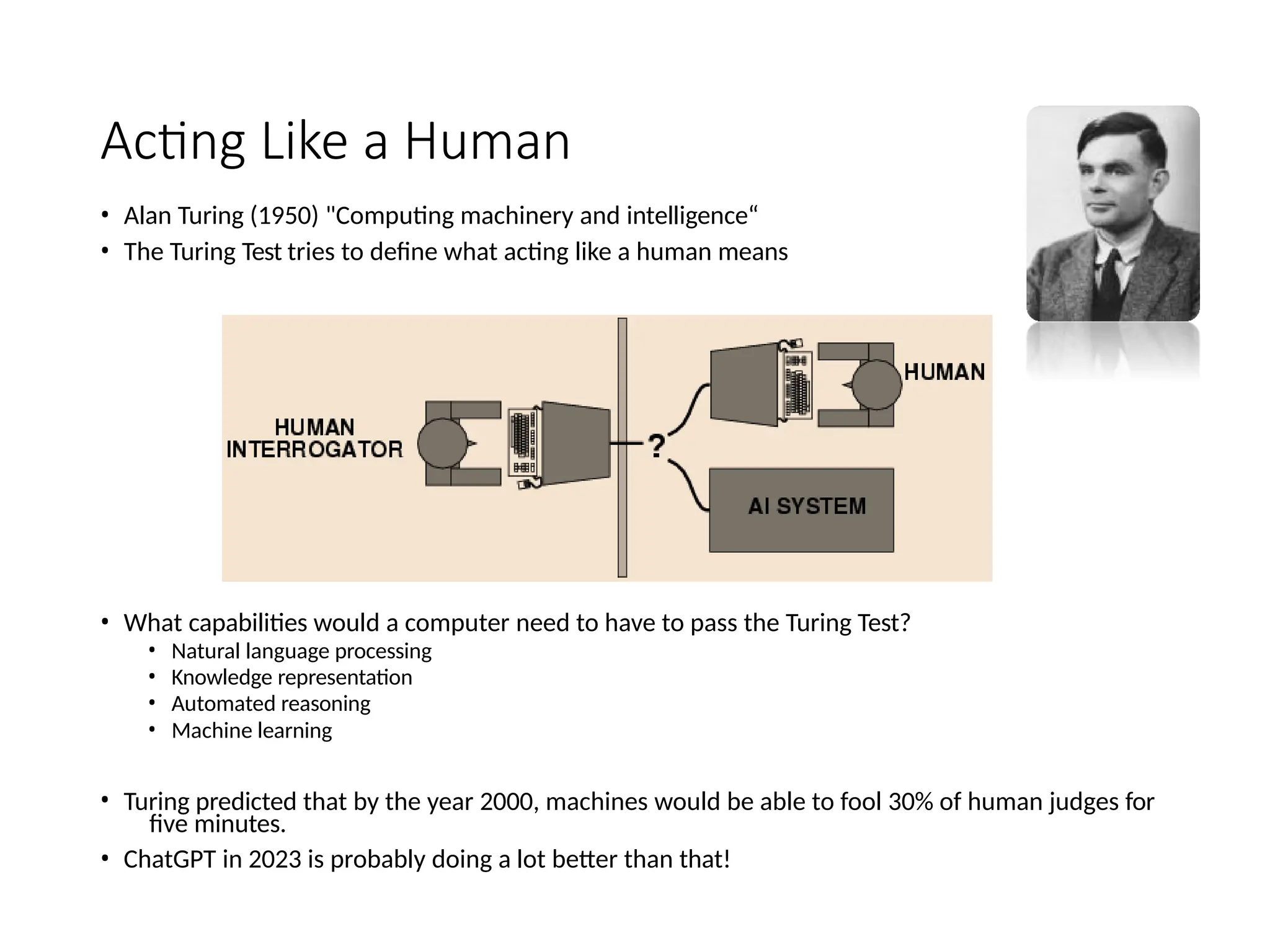
Acting Like a Human
• Alan Turing (1950) "Computing machinery and intelligence“
• The Turing Test tries to define what acting like a human means
• What capabilities would a computer need to have to pass the Turing Test?
• Natural language processing
• Knowledge representation
• Automated reasoning
• Machine learning
• Turing predicted that by the year 2000, machines would be able to fool 30% of human judges for
five minutes.
• ChatGPT in 2023 is probably doing a lot better than that!
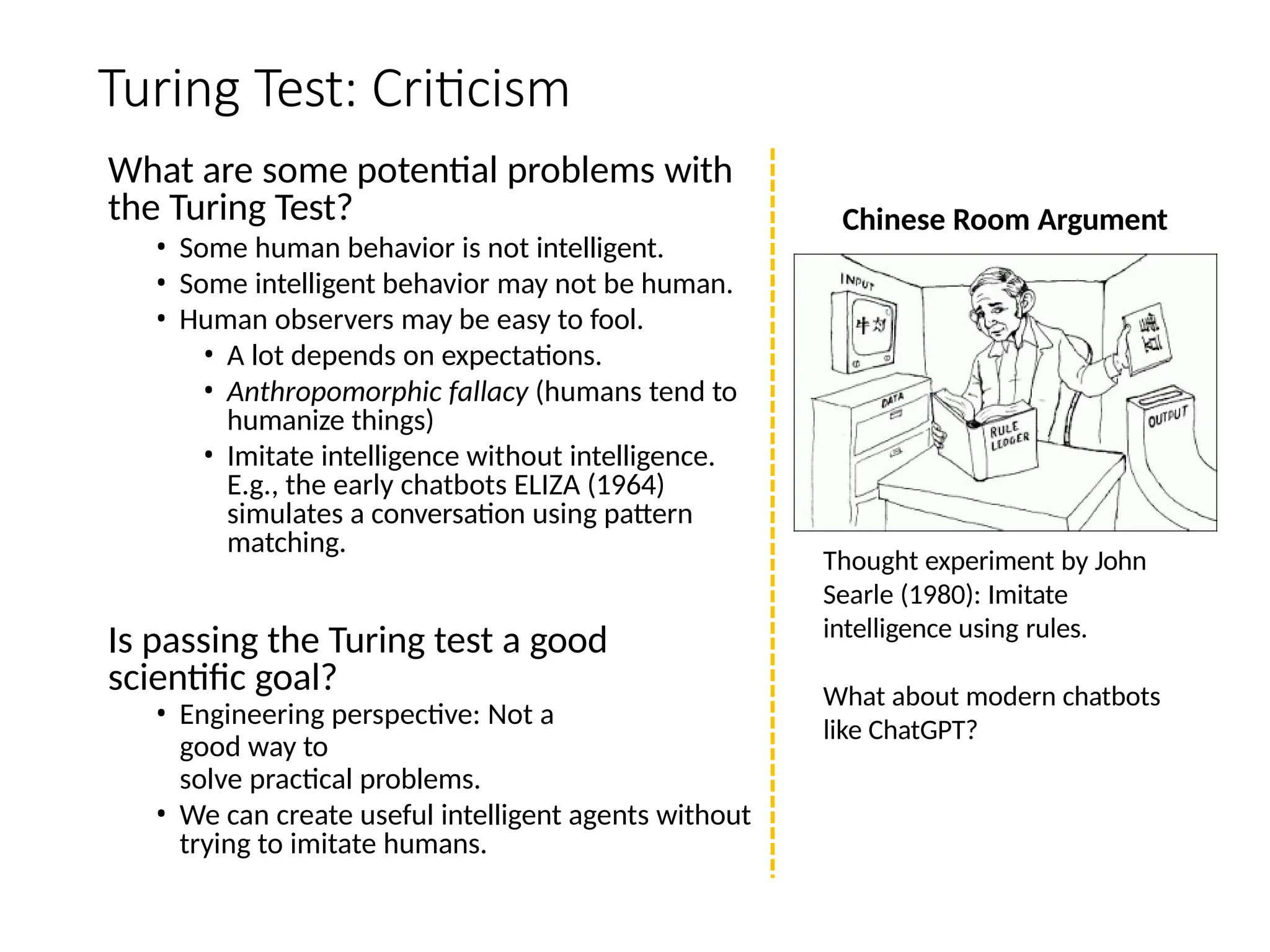
Turing Test: Criticism
What are some potential problems with
the Turing Test?
• Some human behavior is not intelligent.
• Some intelligent behavior may not be human.
• Human observers may be easy to fool.
• A lot depends on expectations.
• Anthropomorphic fallacy (humans tend to
humanize things)
• Imitate intelligence without intelligence.
E.g., the early chatbots ELIZA (1964)
simulates a conversation using pattern
matching.
Is passing the Turing test a good
scientific goal?
• Engineering perspective: Not a
good way to
solve practical problems.
• We can create useful intelligent agents without
trying to imitate humans.
Chinese Room Argument
Thought experiment by John
Searle (1980): Imitate
intelligence using rules.
What about modern chatbots
like ChatGPT?
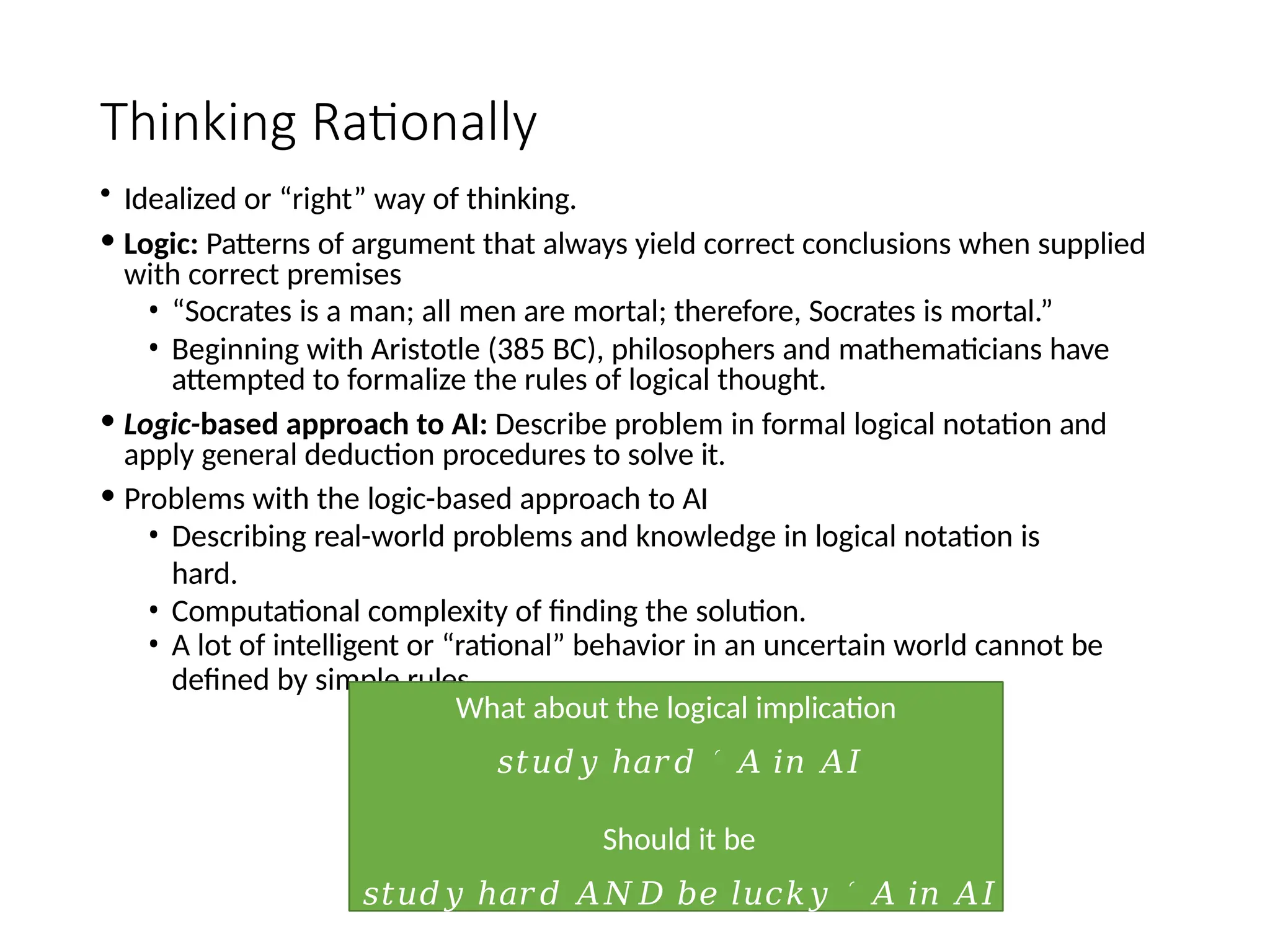
Thinking Rationally
• Idealized or “right” way of thinking.
• Logic: Patterns of argument that always yield correct conclusions when supplied
with correct premises
• “Socrates is a man; all men are mortal; therefore, Socrates is mortal.”
• Beginning with Aristotle (385 BC), philosophers and mathematicians have
attempted to formalize the rules of logical thought.
• Logic-based approach to AI: Describe problem in formal logical notation and
apply general deduction procedures to solve it.
• Problems with the logic-based approach to AI
• Describing real-world problems and knowledge in logical notation is
hard.
• Computational complexity of finding the solution.
• A lot of intelligent or “rational” behavior in an uncertain world cannot be
defined by simple rules.
What about the logical implication
𝑠𝑡𝑢𝑑𝑦 ℎ𝑎𝑟𝑑 ֜ 𝐴 𝑖𝑛 𝐴𝐼
Should it be
𝑠𝑡𝑢𝑑𝑦 ℎ𝑎𝑟𝑑 𝐴𝑁𝐷 𝑏𝑒 𝑙𝑢𝑐𝑘𝑦 ֜ 𝐴 𝑖𝑛 𝐴𝐼
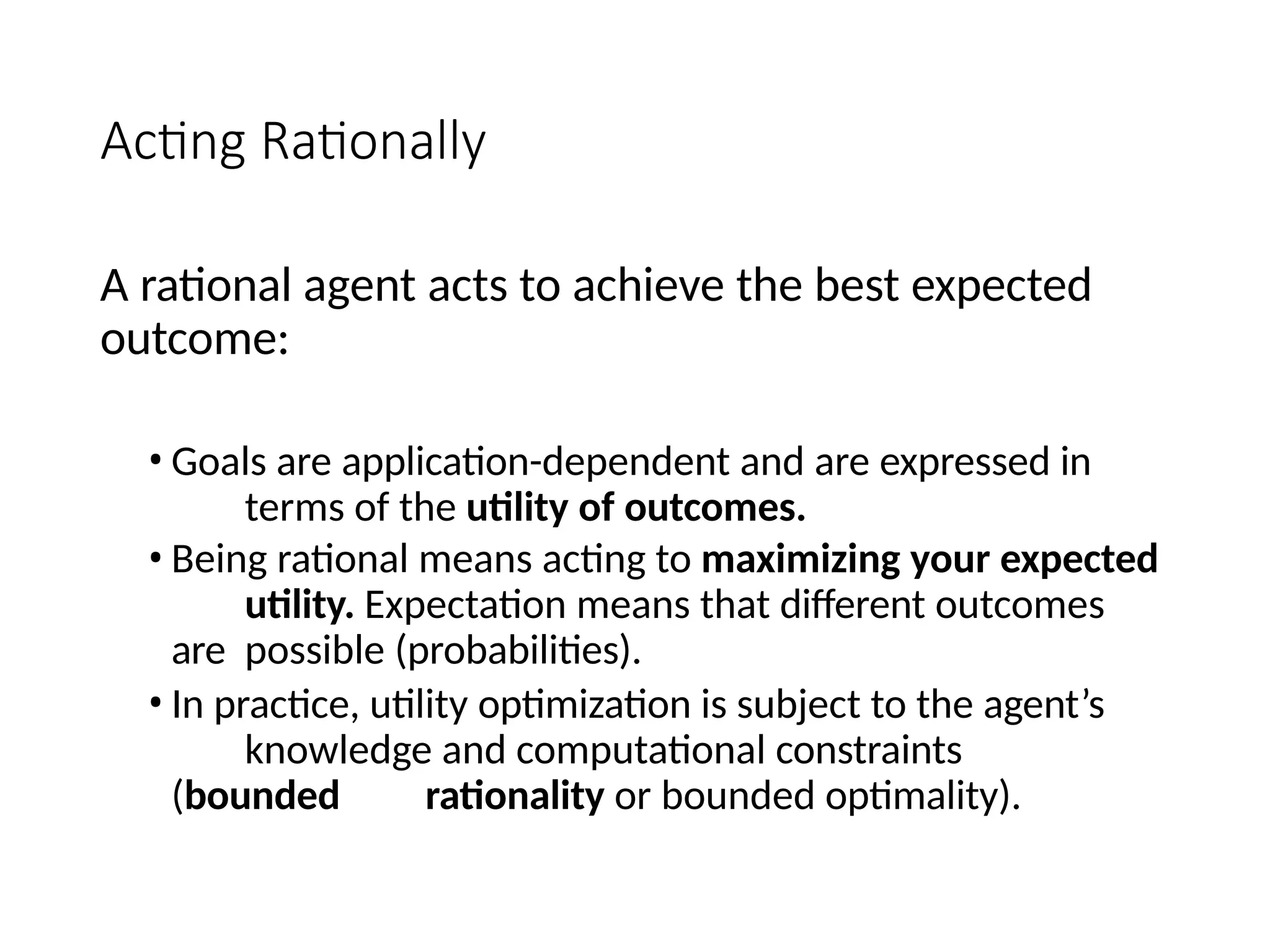
Acting Rationally
A rational agent acts to achieve the best expected
outcome:
• Goals are application-dependent and are expressed in
terms of the utility of outcomes.
• Being rational means acting to maximizing your expected
utility. Expectation means that different outcomes
are possible (probabilities).
• In practice, utility optimization is subject to the agent’s
knowledge and computational constraints
(bounded rationality or bounded optimality).
Acting Rationally
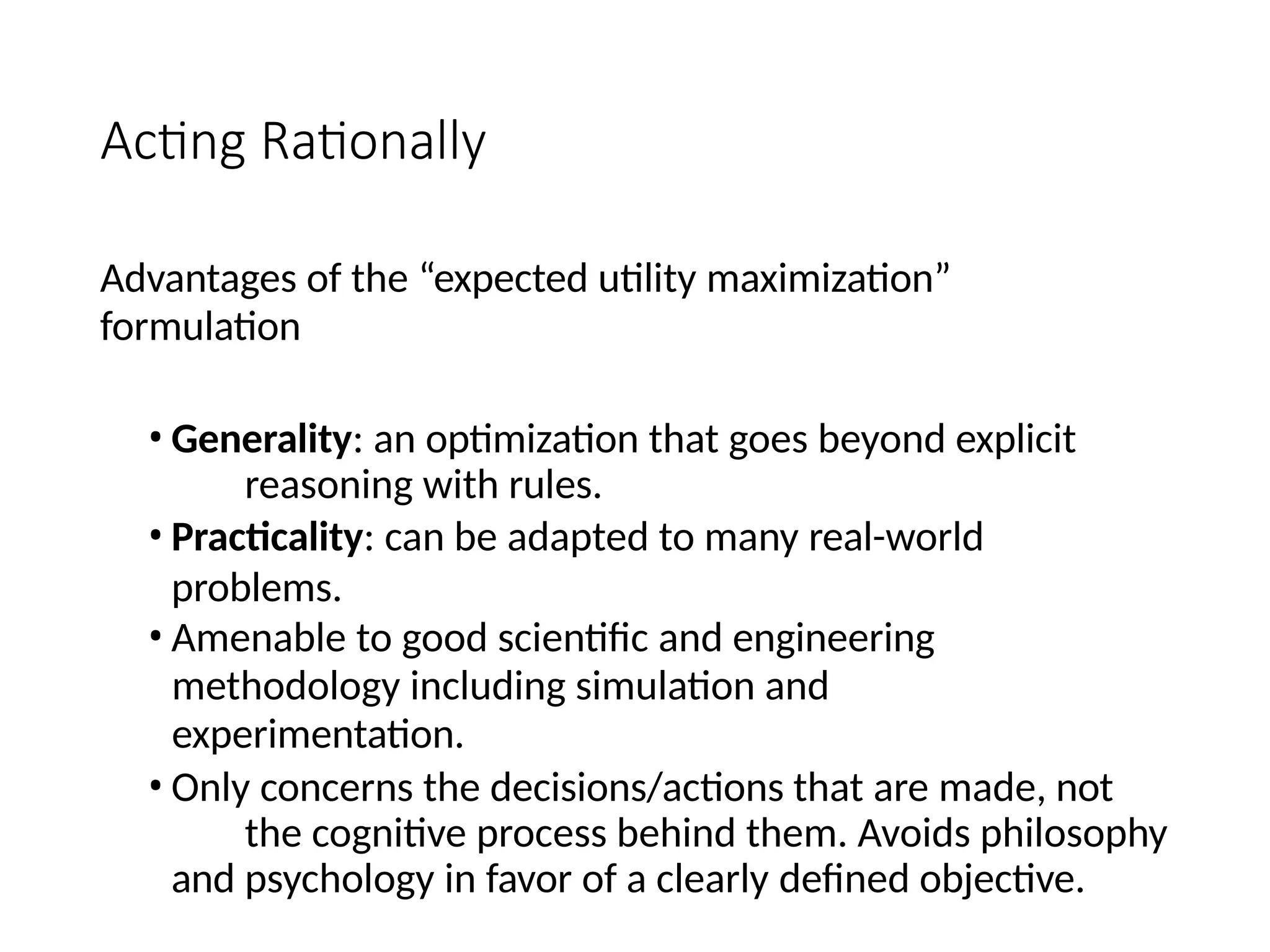
Advantages of the “expected utility maximization”
formulation
• Generality: an optimization that goes beyond explicit
reasoning with rules.
• Practicality: can be adapted to many real-world
problems.
• Amenable to good scientific and engineering
methodology including simulation and
experimentation.
• Only concerns the decisions/actions that are made, not
the cognitive process behind them. Avoids philosophy
and psychology in favor of a clearly defined objective.
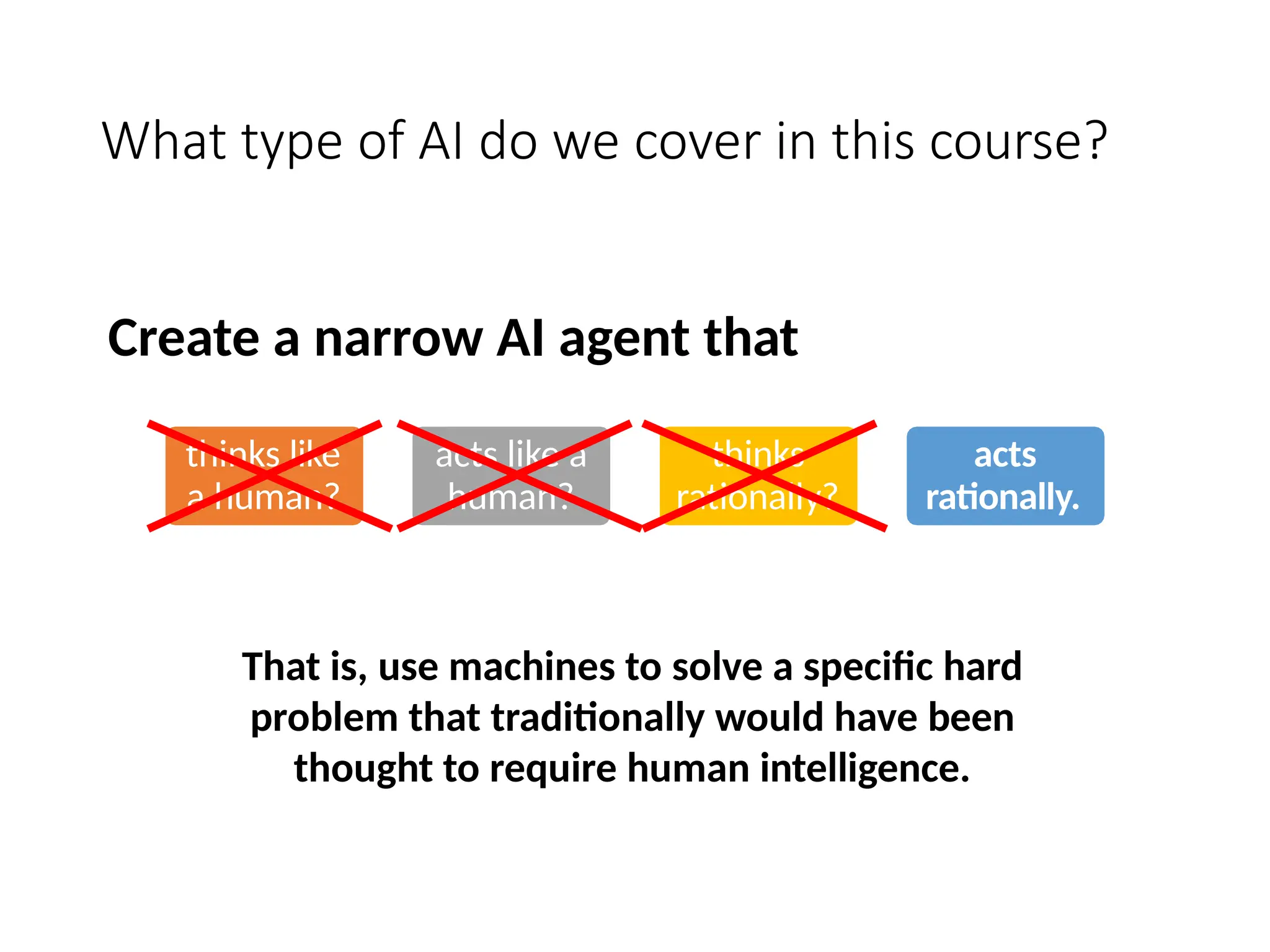
What type of AI do we cover in this course?
thinks like
a human?
acts like a
human?
thinks
rationally?
acts
rationally.
Create a narrow AI agent that
That is, use machines to solve a specific hard
problem that traditionally would have been
thought to require human intelligence.
What are the Components of an
Intelligent Agent?
Agent interacting with the environment
[Artificial Intelligence: A Modern Approach, Editions 1-3]
Intelligent agents need to
• Communicate with the
environment
• Represent knowledge,
reason and plan to
achieve a desired
outcome
Optional
• Learn
Developer
Machine Learning vs. Artificial Intelligence
ML
Learning from examples
instead of being programmed
• Supervised learning
• Unsupervised learning
• RL
Deep
Learning
• Vision
• Sensors
• Motion
• NLP
• Knowledge
representation
• Planning
• Goals
AI
Designing an intelligent
agent
ML
ML
ML
Agent interacting with the environment
[Artificial Intelligence: A Modern Approach, Editions 1-3]
The History
of AI
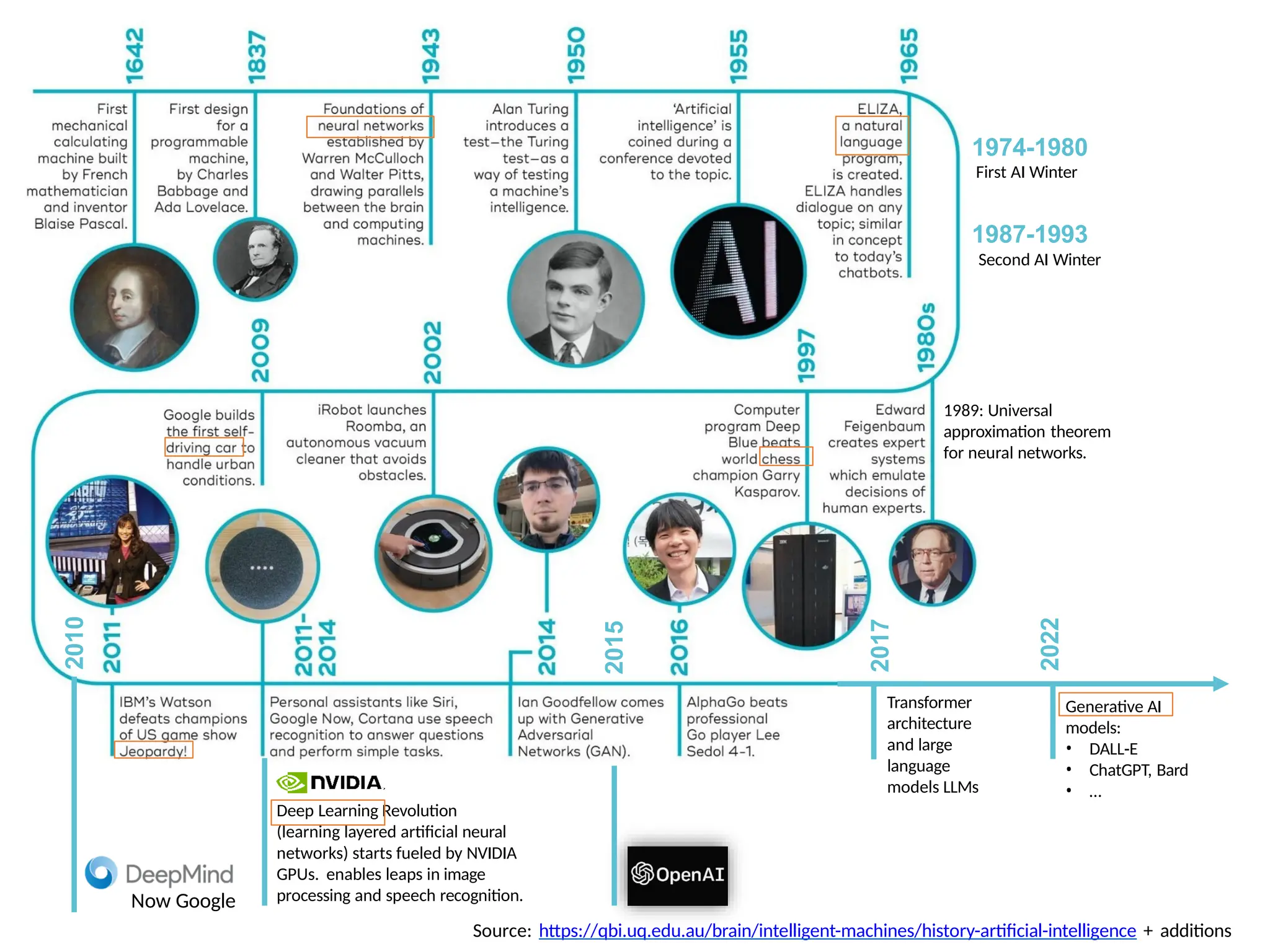
Source: https://qbi.uq.edu.au/brain/intelligent-machines/history-artificial-intelligence + additions
Deep Learning Revolution
(learning layered artificial neural
networks) starts fueled by NVIDIA
GPUs. enables leaps in image
processing and speech recognition.
2022
Generative AI
models:
• DALL-E
• ChatGPT, Bard
• …
Transformer
architecture
and large
language
models LLMs
2017
2015
1974-1980
First AI Winter
1987-1993
Second AI Winter
2010
Now Google
1989: Universal
approximation theorem
for neural networks.
What accounts for
recent successes in
AI?
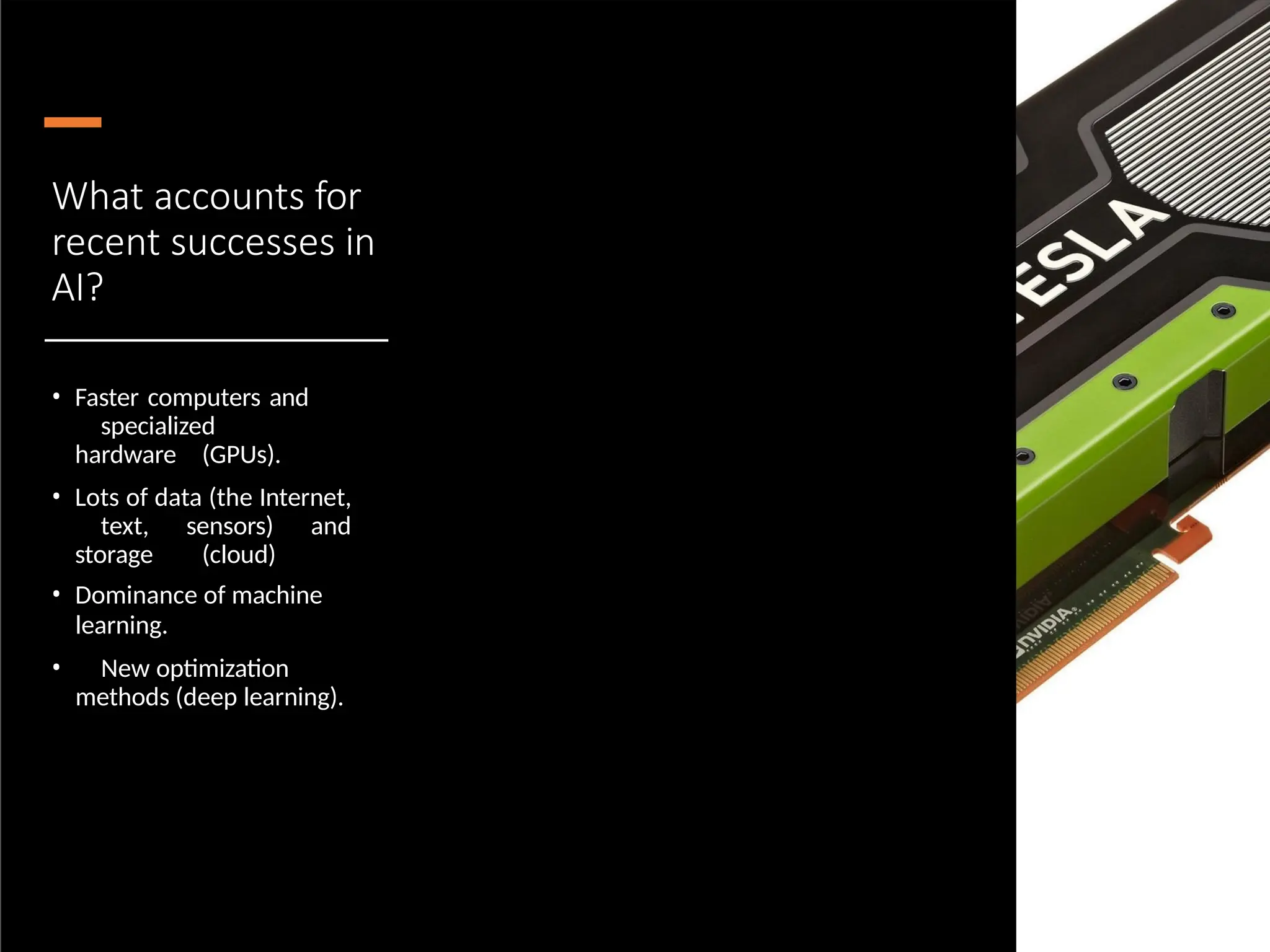
• Faster computers and
specialized
hardware (GPUs).
• Lots of data (the Internet,
text, sensors) and
storage (cloud)
• Dominance of machine
learning.
• New optimization
methods (deep learning).
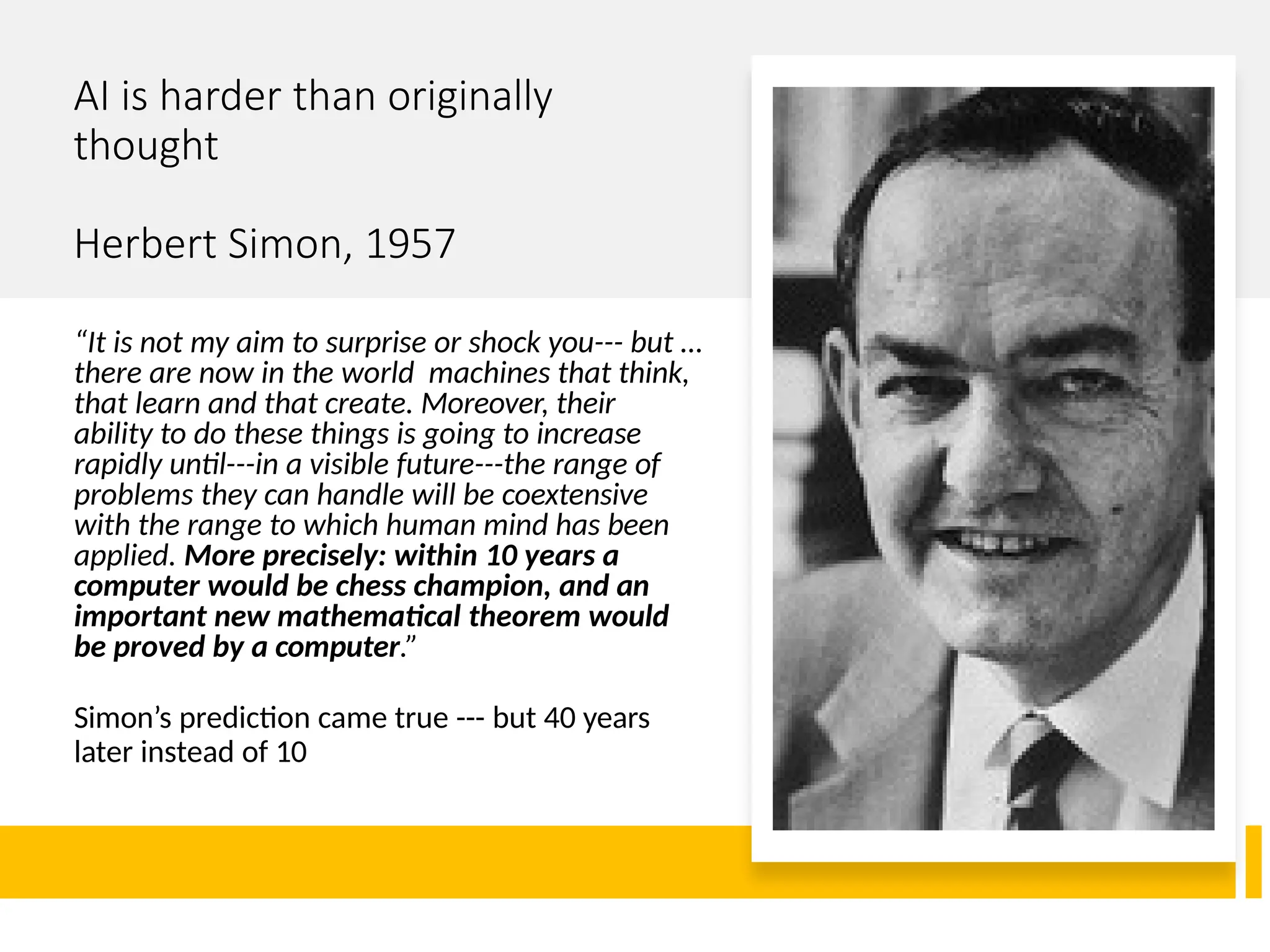
AI is harder than originally
thought
Herbert Simon, 1957
“It is not my aim to surprise or shock you--- but …
there are now in the world machines that think,
that learn and that create. Moreover, their
ability to do these things is going to increase
rapidly until---in a visible future---the range of
problems they can handle will be coextensive
with the range to which human mind has been
applied. More precisely: within 10 years a
computer would be chess champion, and an
important new mathematical theorem would
be proved by a computer.”
Simon’s prediction came true --- but 40 years
later instead of 10
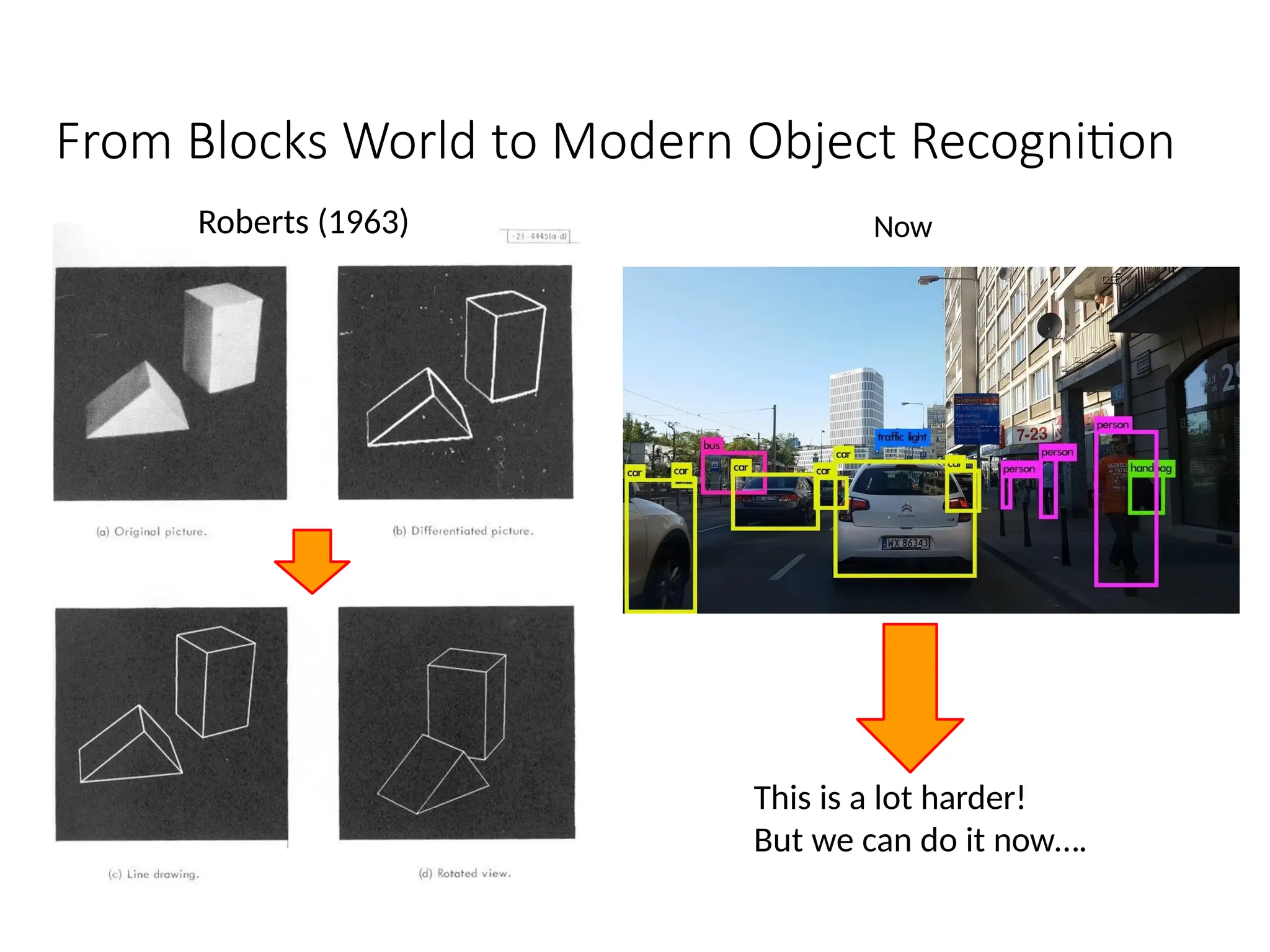
From Blocks World to Modern Object Recognition
Roberts (1963)
This is a lot harder!
But we can do it now….
Now
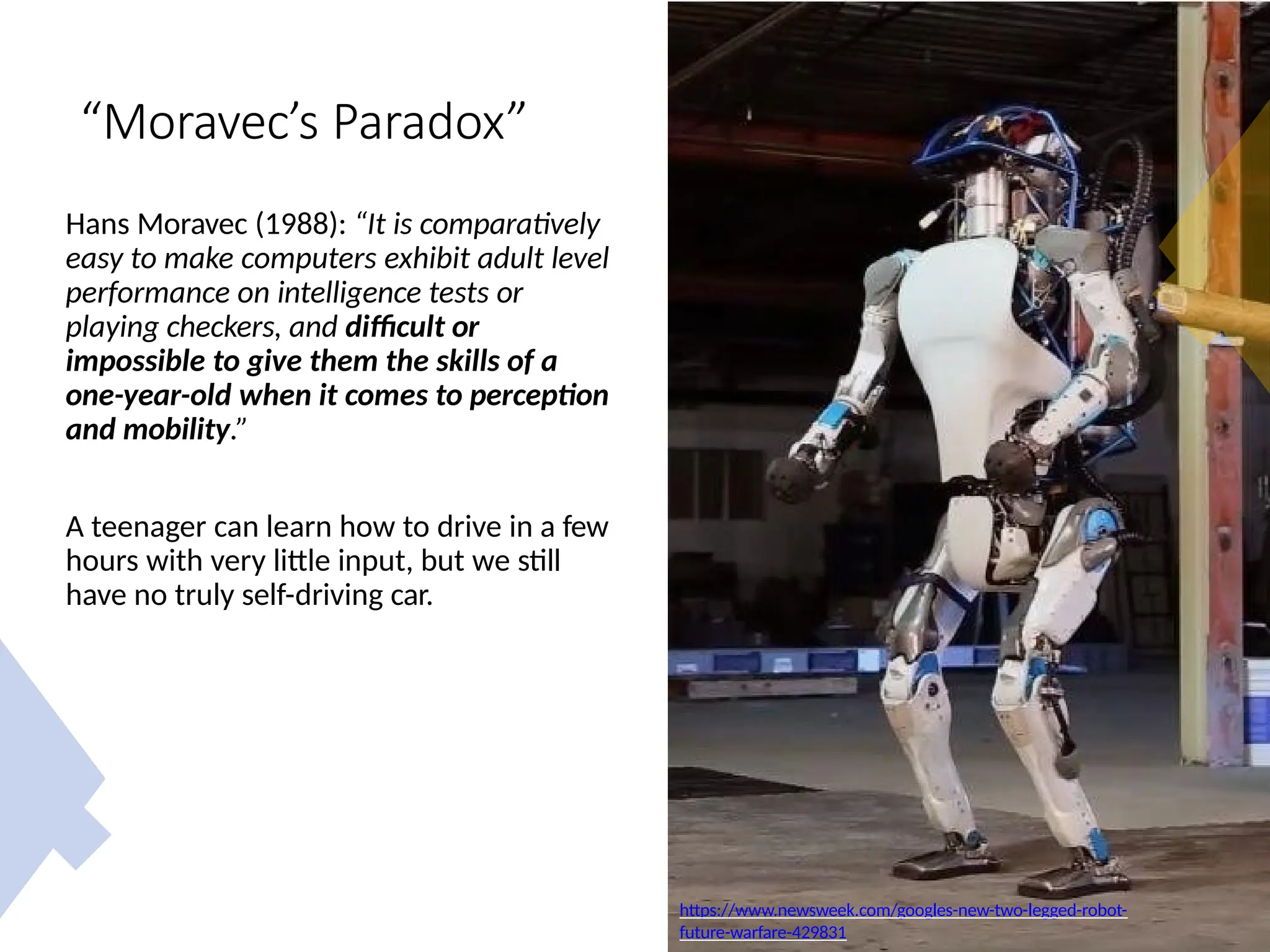
“Moravec’s Paradox”
Hans Moravec (1988): “It is comparatively
easy to make computers exhibit adult level
performance on intelligence tests or
playing checkers, and difficult or
impossible to give them the skills of a
one-year-old when it comes to perception
and mobility.”
A teenager can learn how to drive in a few
hours with very little input, but we still
have no truly self-driving car.
https://www.newsweek.com/googles-new-two-legged-robot-
future-warfare-429831
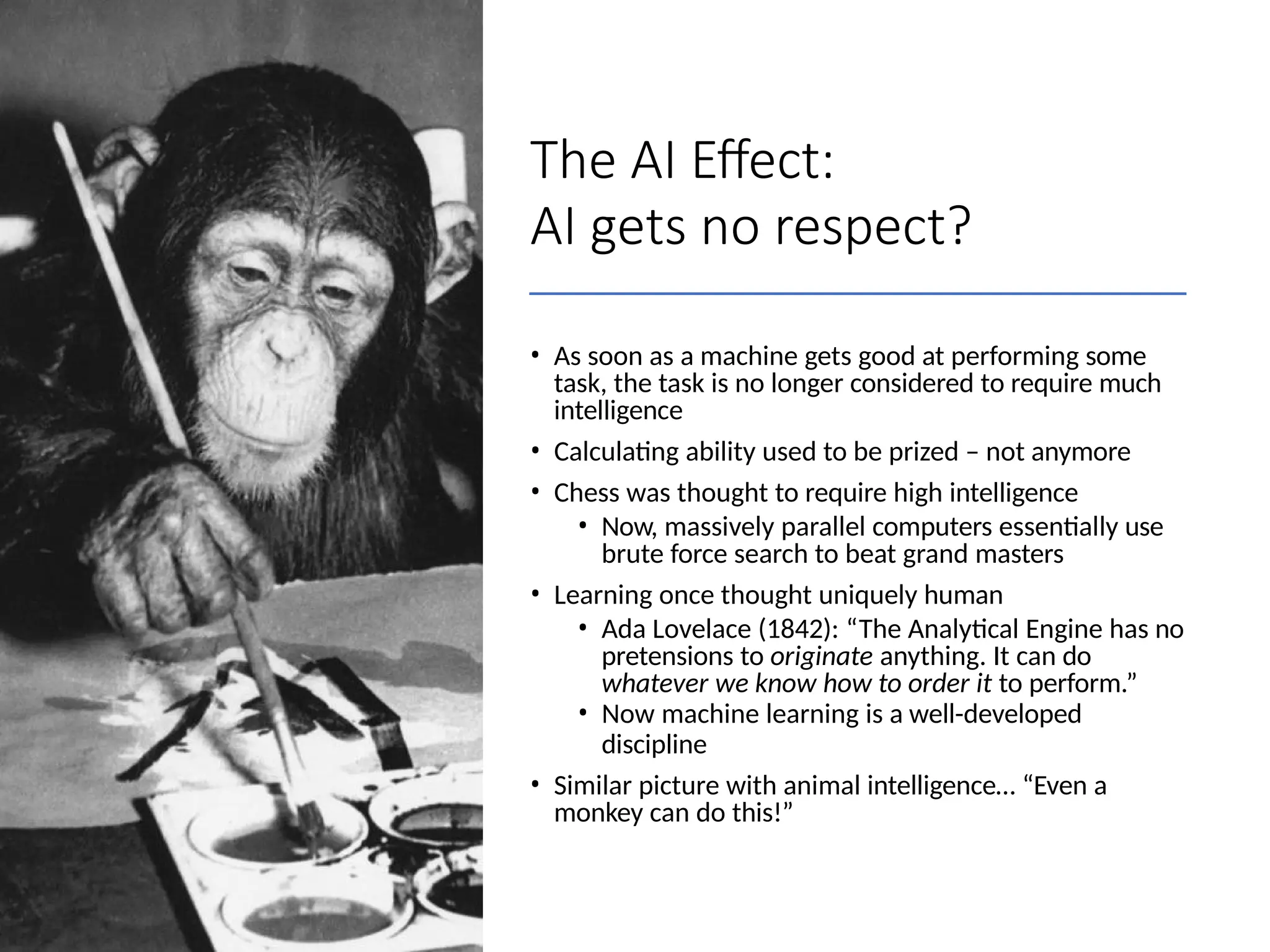
The AI Effect:
AI gets no respect?
• As soon as a machine gets good at performing some
task, the task is no longer considered to require much
intelligence
• Calculating ability used to be prized – not anymore
• Chess was thought to require high intelligence
• Now, massively parallel computers essentially use
brute force search to beat grand masters
• Learning once thought uniquely human
• Ada Lovelace (1842): “The Analytical Engine has no
pretensions to originate anything. It can do
whatever we know how to order it to perform.”
• Now machine learning is a well-developed
discipline
• Similar picture with animal intelligence… “Even a
monkey can do this!”
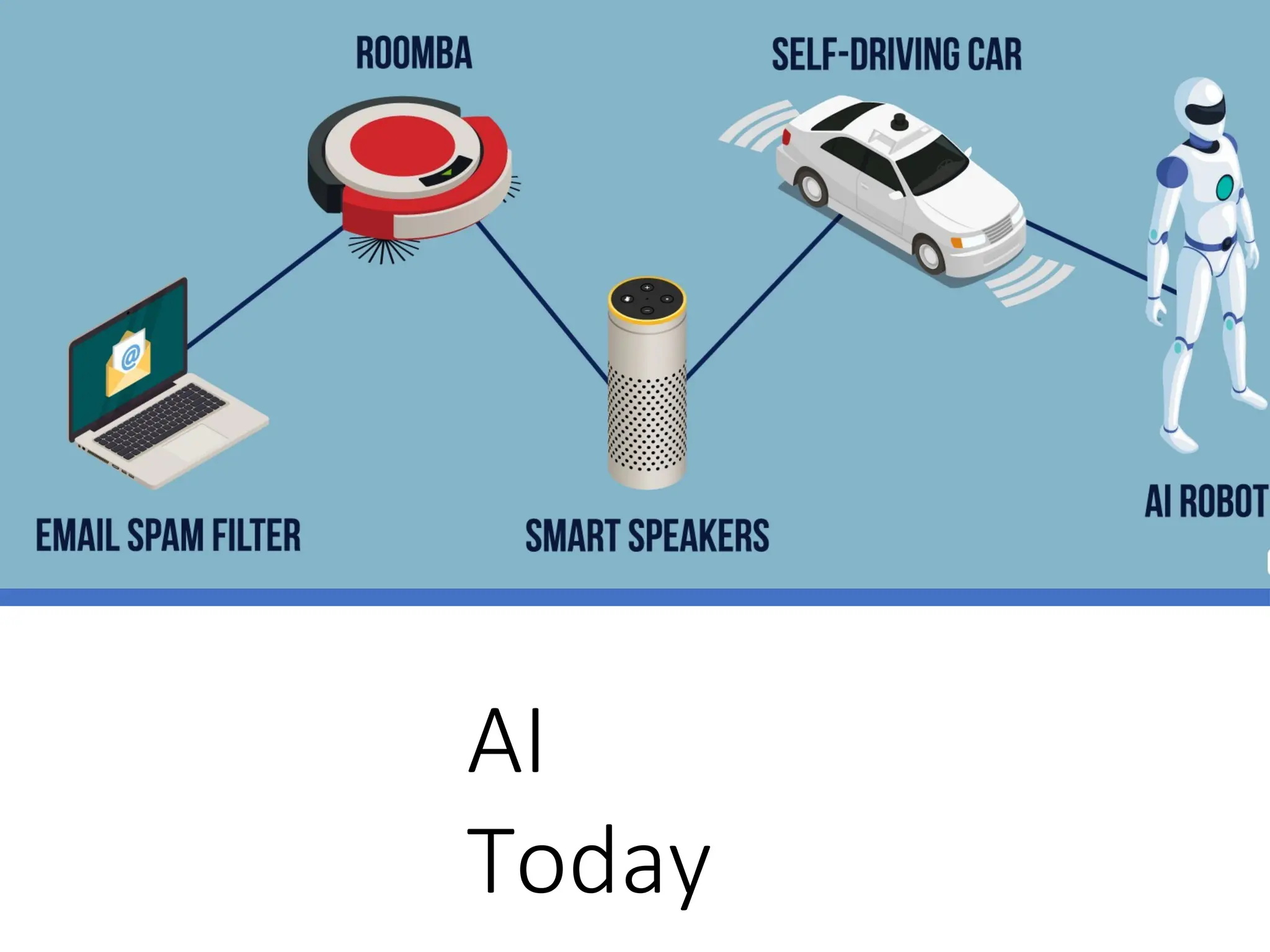
AI
Today
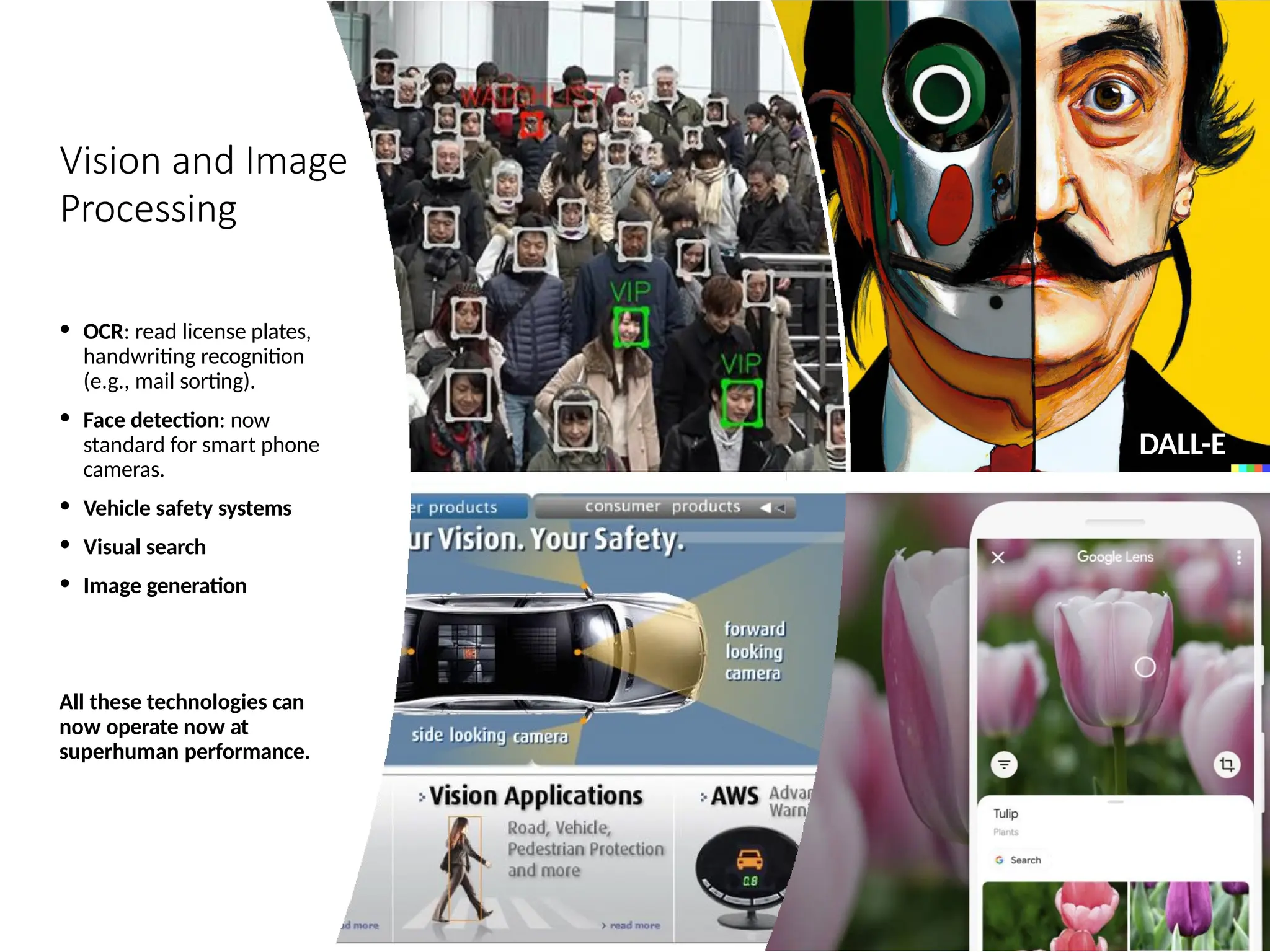
Vision and Image
Processing
• OCR: read license plates,
handwriting recognition
(e.g., mail sorting).
• Face detection: now
standard for smart phone
cameras.
• Vehicle safety systems
• Visual search
• Image generation
All these technologies can
now operate now at
superhuman performance.
DALL-E
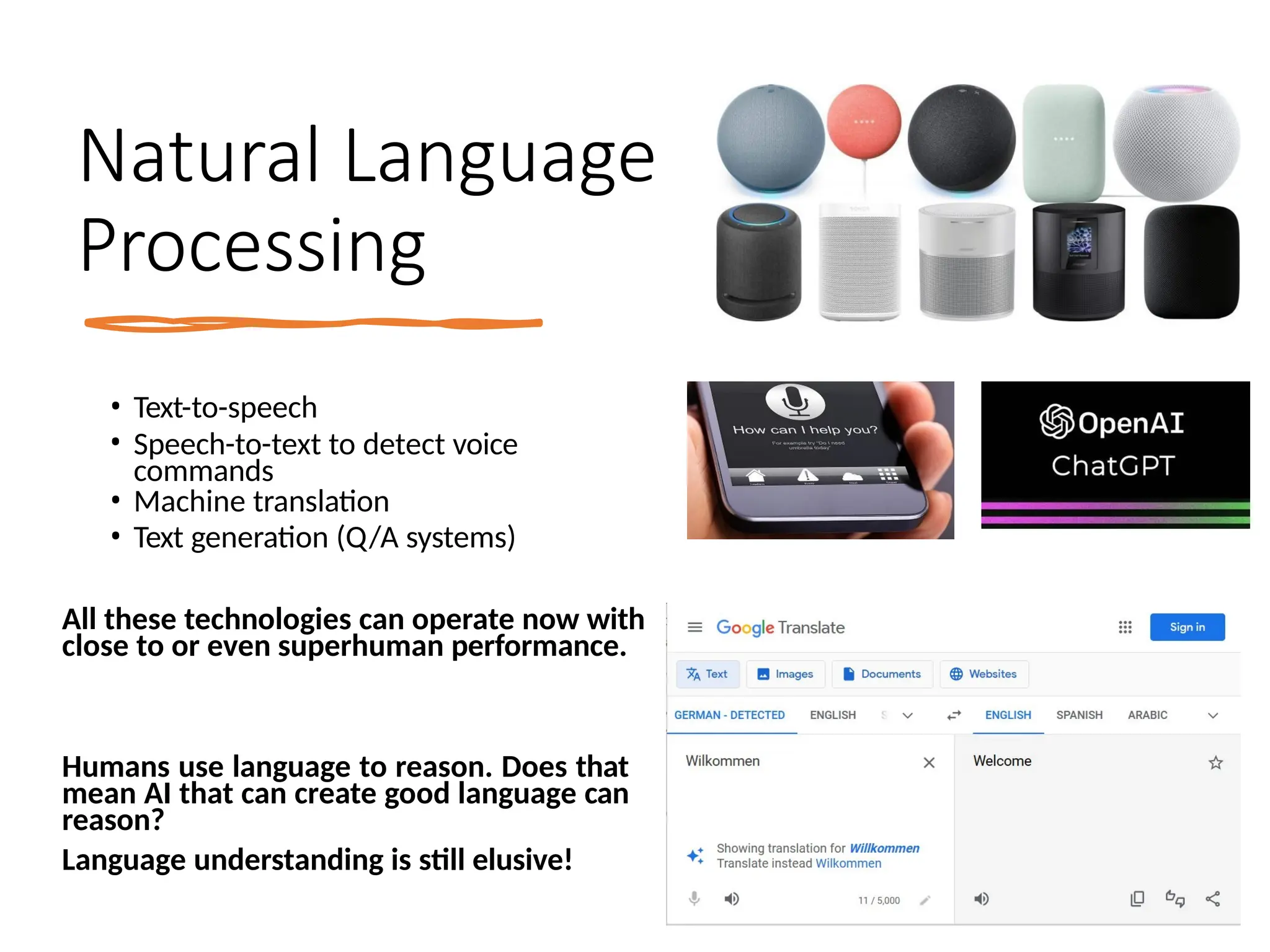
Natural Language
Processing
• Text-to-speech
• Speech-to-text to detect voice
commands
• Machine translation
• Text generation (Q/A systems)
All these technologies can operate now with
close to or even superhuman performance.
Humans use language to reason. Does that
mean AI that can create good language can
reason?
Language understanding is still elusive!
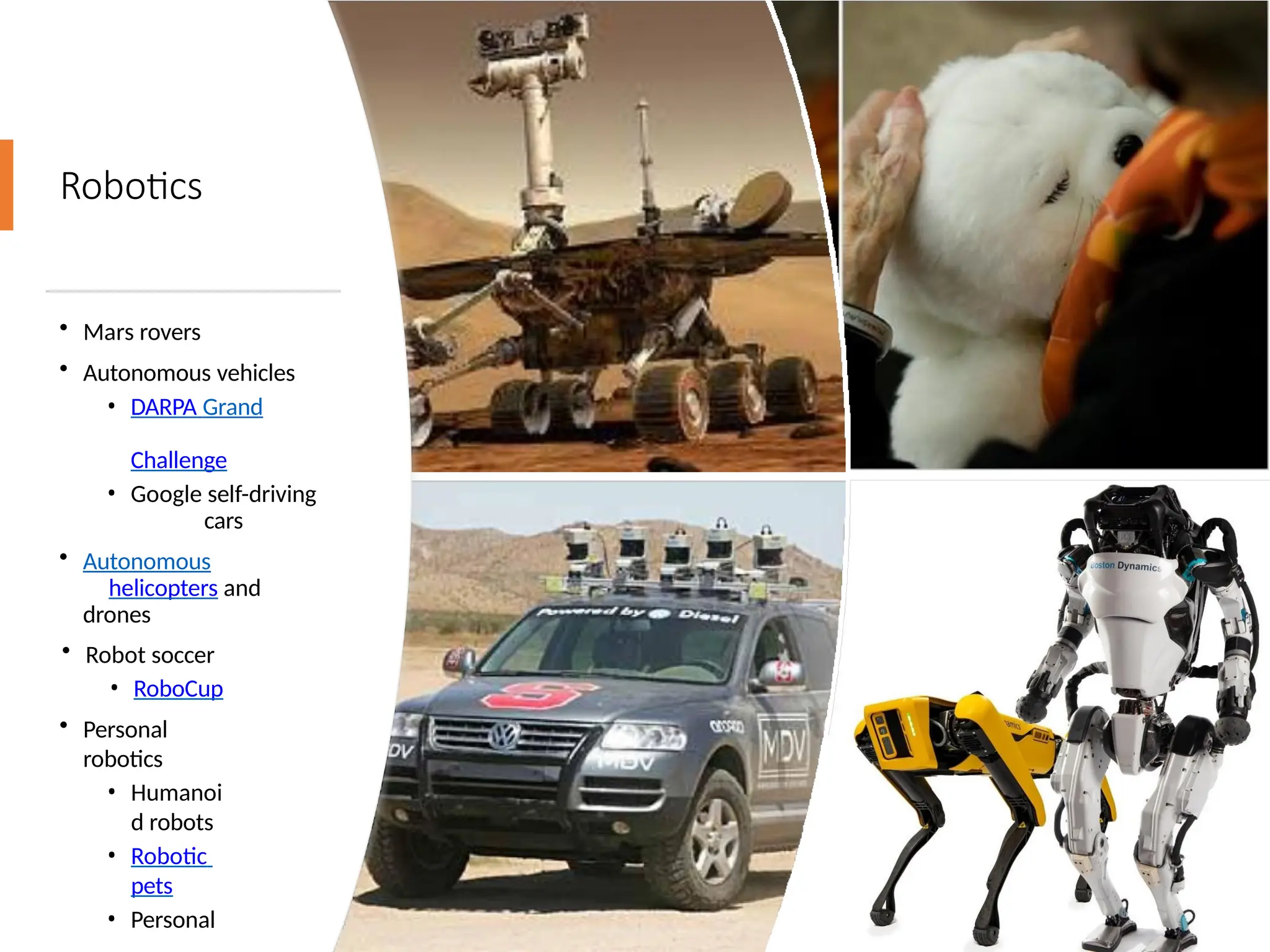
Robotics
• Mars rovers
• Autonomous vehicles
• DARPA Grand
Challenge
• Google self-driving
cars
• Autonomous
helicopters and
drones
• Robot soccer
• RoboCup
• Personal
robotics
• Humanoi
d robots
• Robotic
pets
• Personal
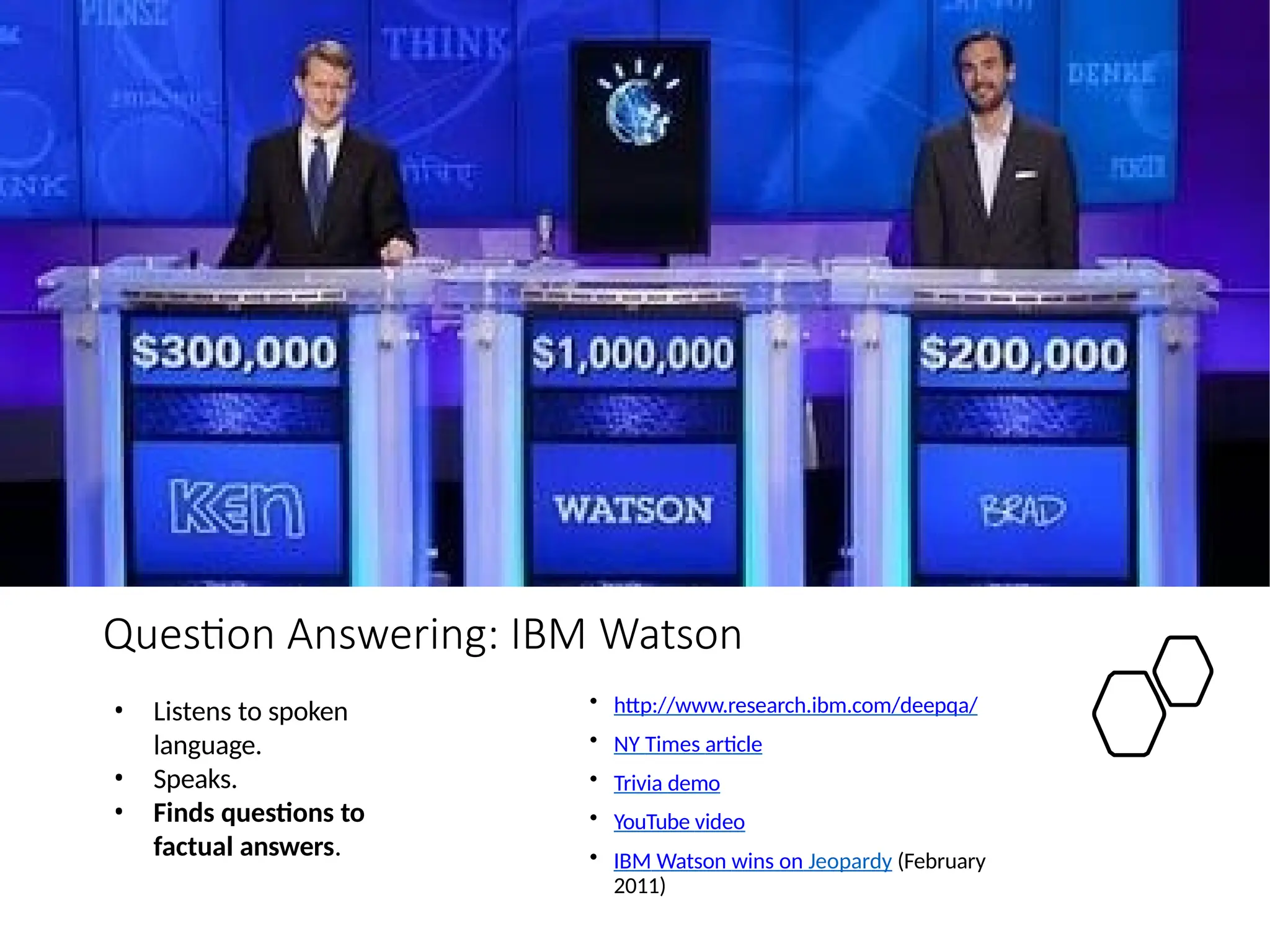
Question Answering: IBM Watson
• http://www.research.ibm.com/deepqa/
• NY Times article
• Trivia demo
• YouTube video
• IBM Watson wins on Jeopardy (February
2011)
• Listens to spoken
language.
• Speaks.
• Finds questions to
factual answers.
Math, Games and Puzzles
• 1996: A computer program written by researchers at Argonne
National Laboratory proved a mathematical conjecture
(Robbins conjecture) unsolved for decades
• NY Times story: “[The proof] would have been called
creative if
a human had thought of it”
• 1996/97: IBM’s Deep Blue defeated the reigning world chess
champion Garry Kasparov in 1997
• 1996: Kasparov Beats Deep Blue
“I could feel --- I could smell --- a new kind
of intelligence across the table.”
• 1997: Deep Blue Beats Kasparov
“Deep Blue hasn't proven anything.”
• 2007: Checkers was “solved” --- a computer system that never loses
was developed. Science article
• 2017+: AlphaZero learns chess, shogi and go by playing itself. Science
article
• 2019: MuZero learns to play Atari computer games.
AI exhibits superhuman performance on almost all games.
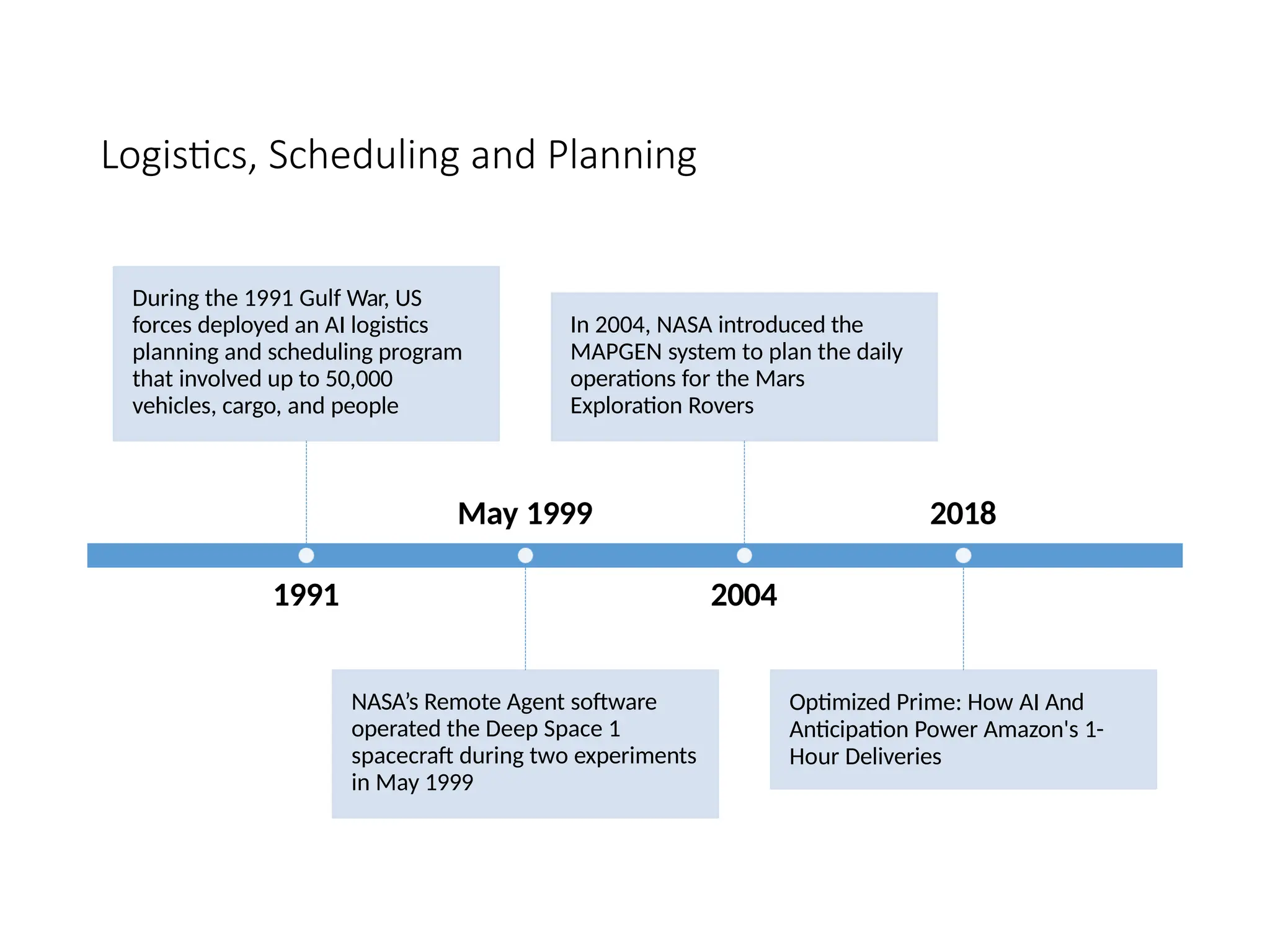
Logistics, Scheduling and Planning
1991
During the 1991 Gulf War, US
forces deployed an AI logistics
planning and scheduling program
that involved up to 50,000
vehicles, cargo, and people
May 1999
NASA’s Remote Agent software
operated the Deep Space 1
spacecraft during two experiments
in May 1999
2004
In 2004, NASA introduced the
MAPGEN system to plan the daily
operations for the Mars
Exploration Rovers
2018
Optimized Prime: How AI And
Anticipation Power Amazon's 1-
Hour Deliveries
Information
agents
• Search engines
• Chat Agents / Automated helpdesks
• Recommendation systems
• Spam filtering
• Medical diagnosis systems
• Fraud detection
• Automated stock trading
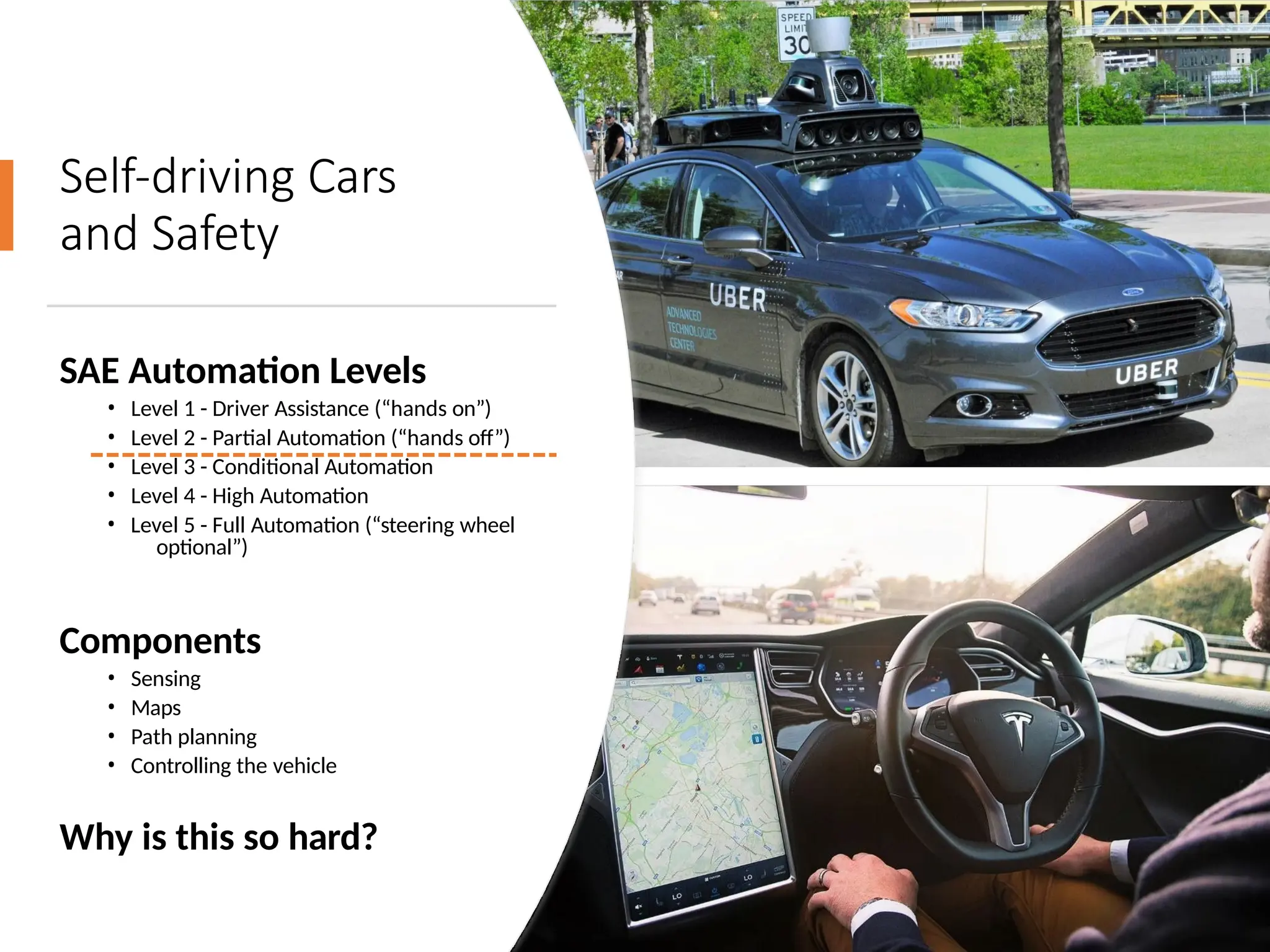
Self-driving Cars
and Safety
SAE Automation Levels
• Level 1 - Driver Assistance (“hands on”)
• Level 2 - Partial Automation (“hands off”)
• Level 3 - Conditional Automation
• Level 4 - High Automation
• Level 5 - Full Automation (“steering wheel
optional”)
Components
• Sensing
• Maps
• Path planning
• Controlling the vehicle
Why is this so hard?
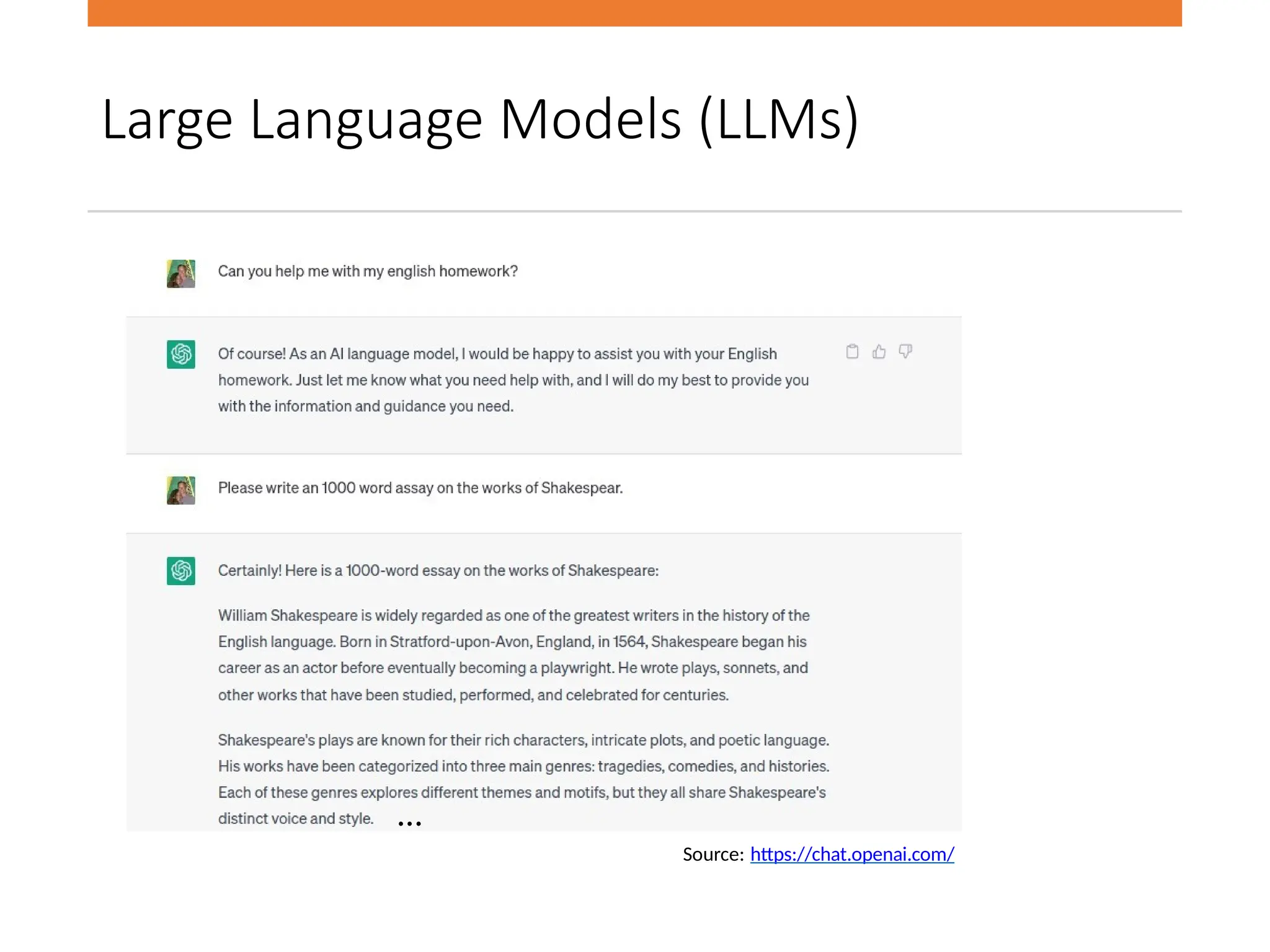
Large Language Models (LLMs)
…
Source: https://chat.openai.com/
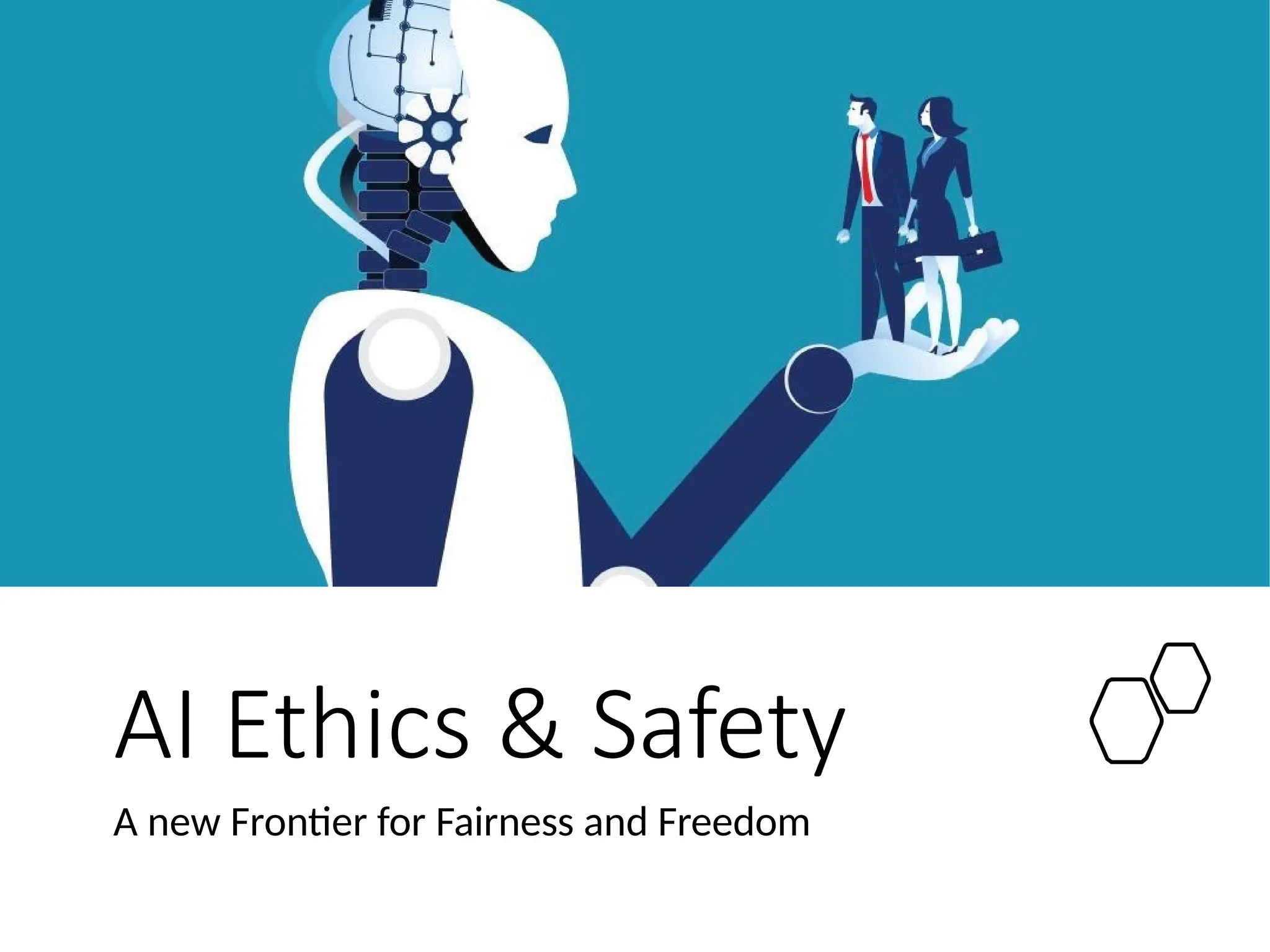
AI Ethics & Safety
A new Frontier for Fairness and Freedom
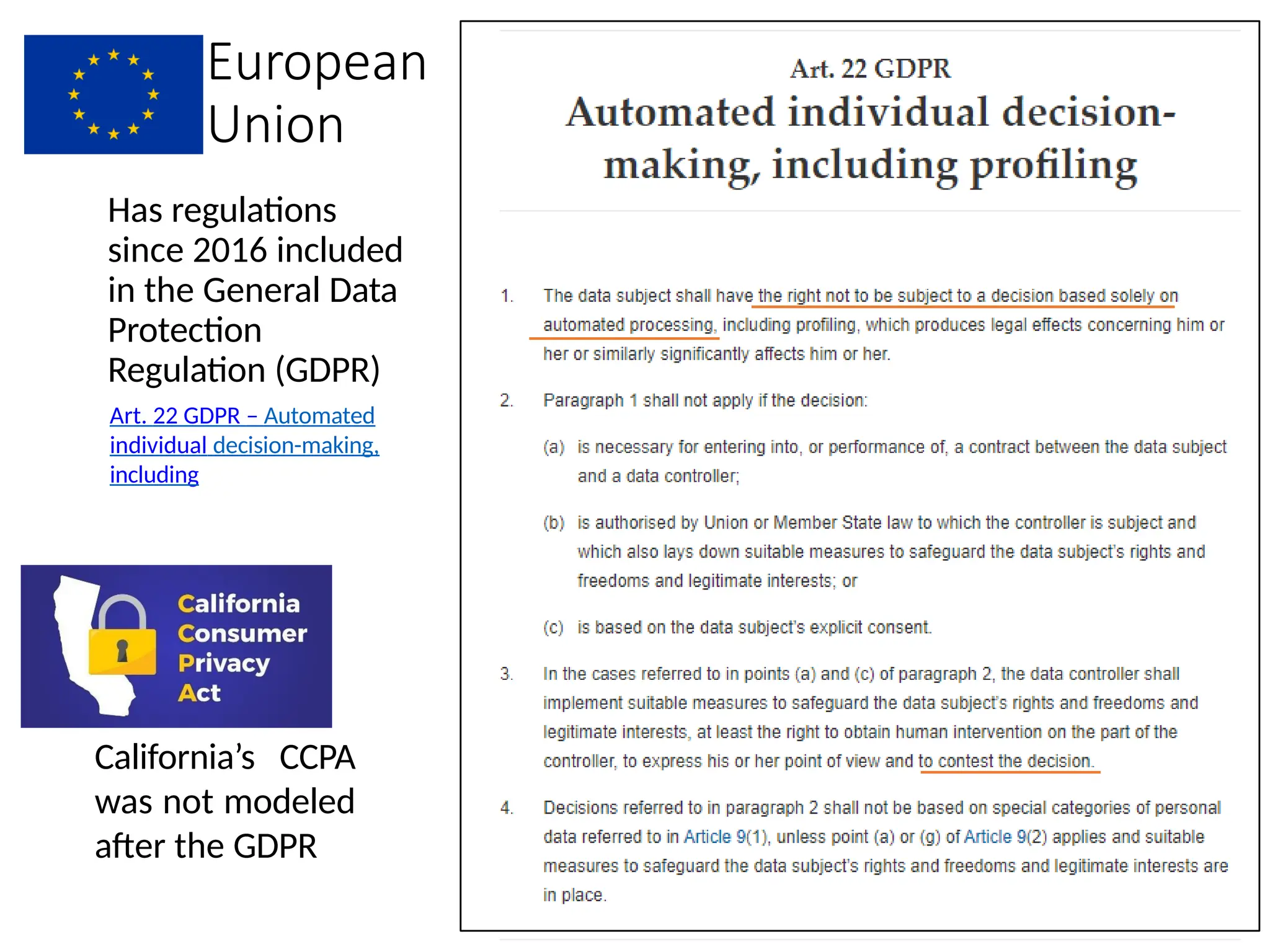
European
Union
Has regulations
since 2016 included
in the General Data
Protection
Regulation (GDPR)
Art. 22 GDPR – Automated
individual decision-making,
including
California’s CCPA
was not modeled
after the GDPR
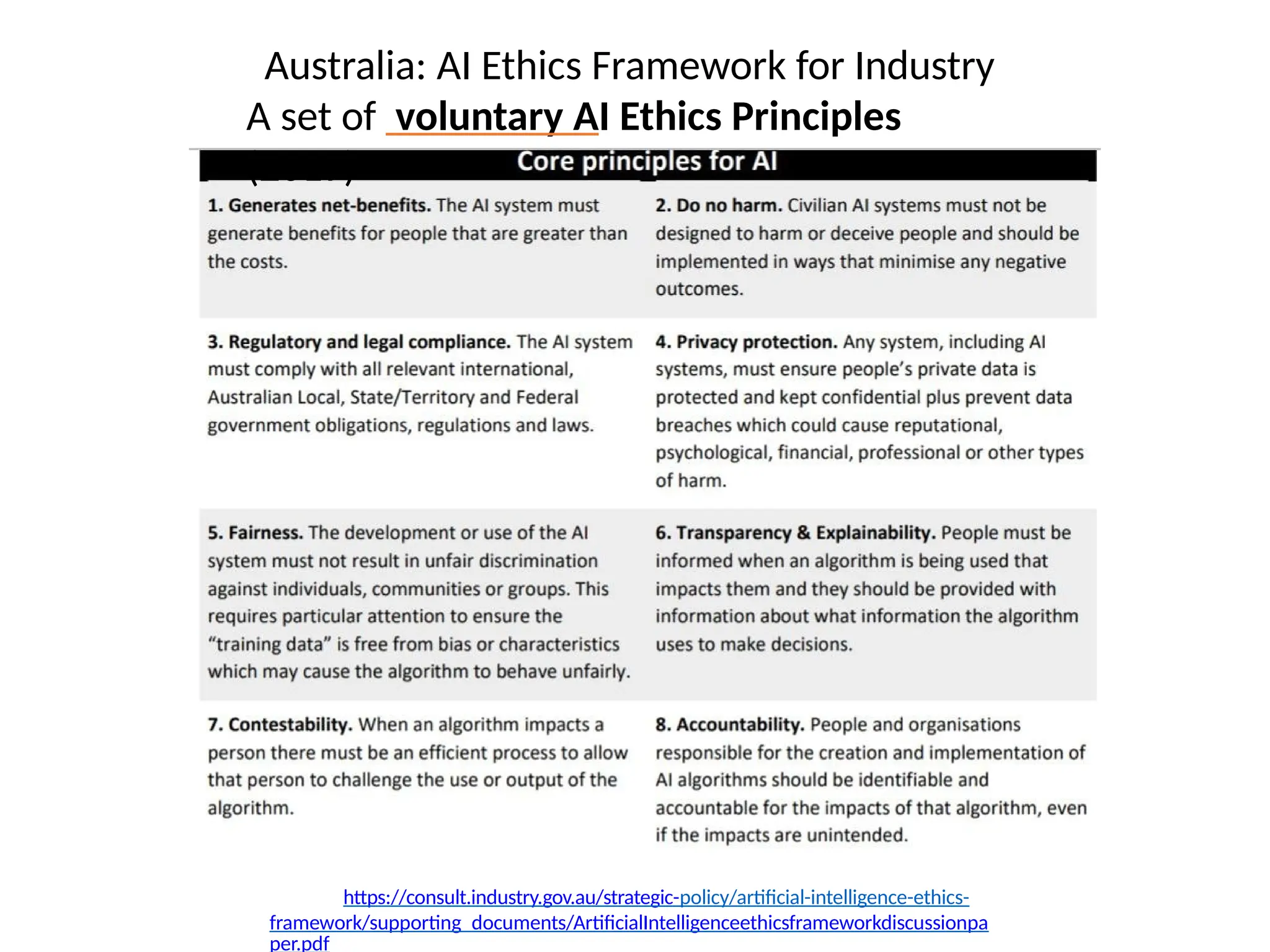
https://consult.industry.gov.au/strategic-policy/artificial-intelligence-ethics-
framework/supporting_documents/ArtificialIntelligenceethicsframeworkdiscussionpa
per.pdf
Australia: AI Ethics Framework for Industry
A set of voluntary AI Ethics Principles
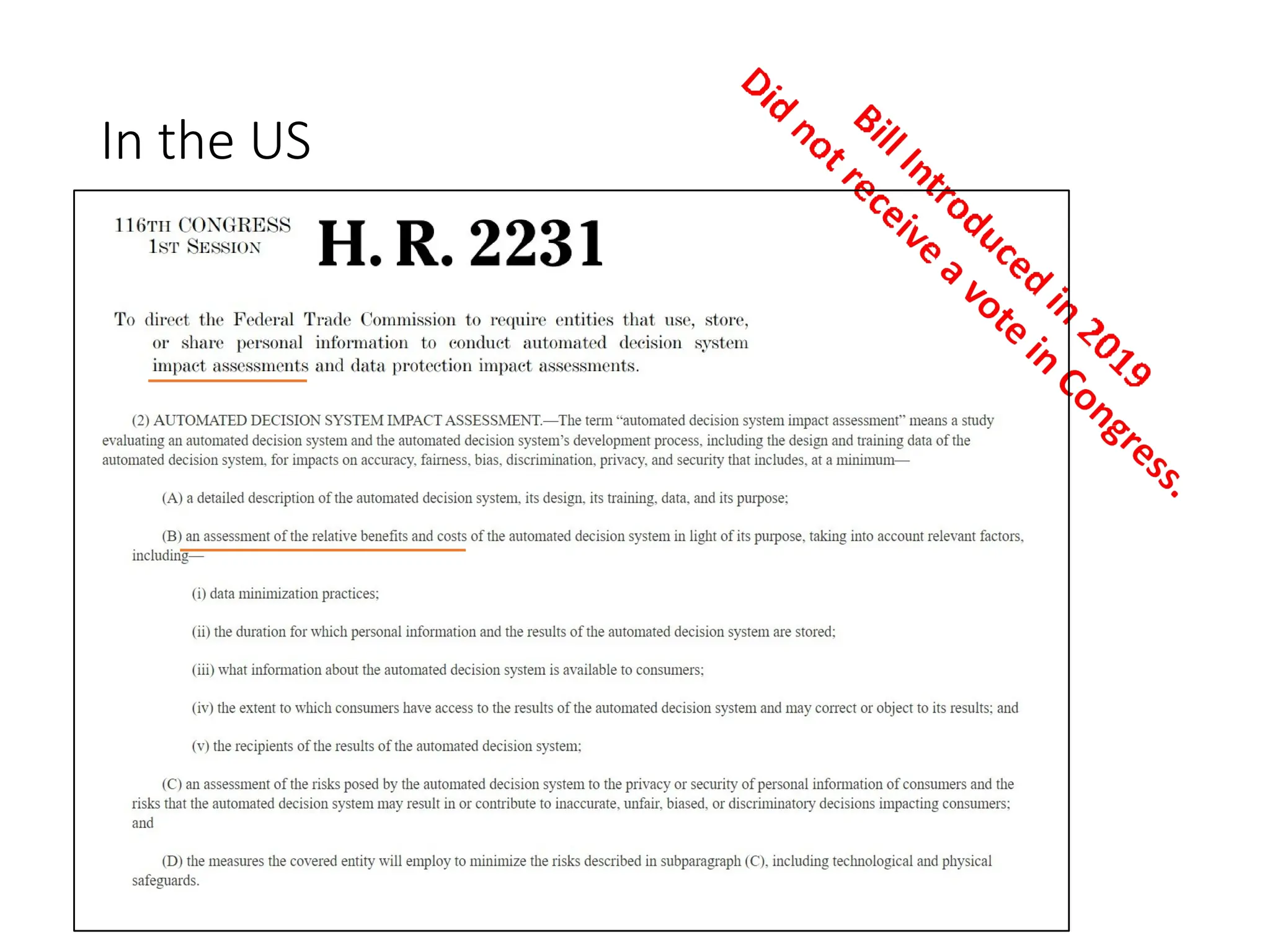
(2019)
In the US
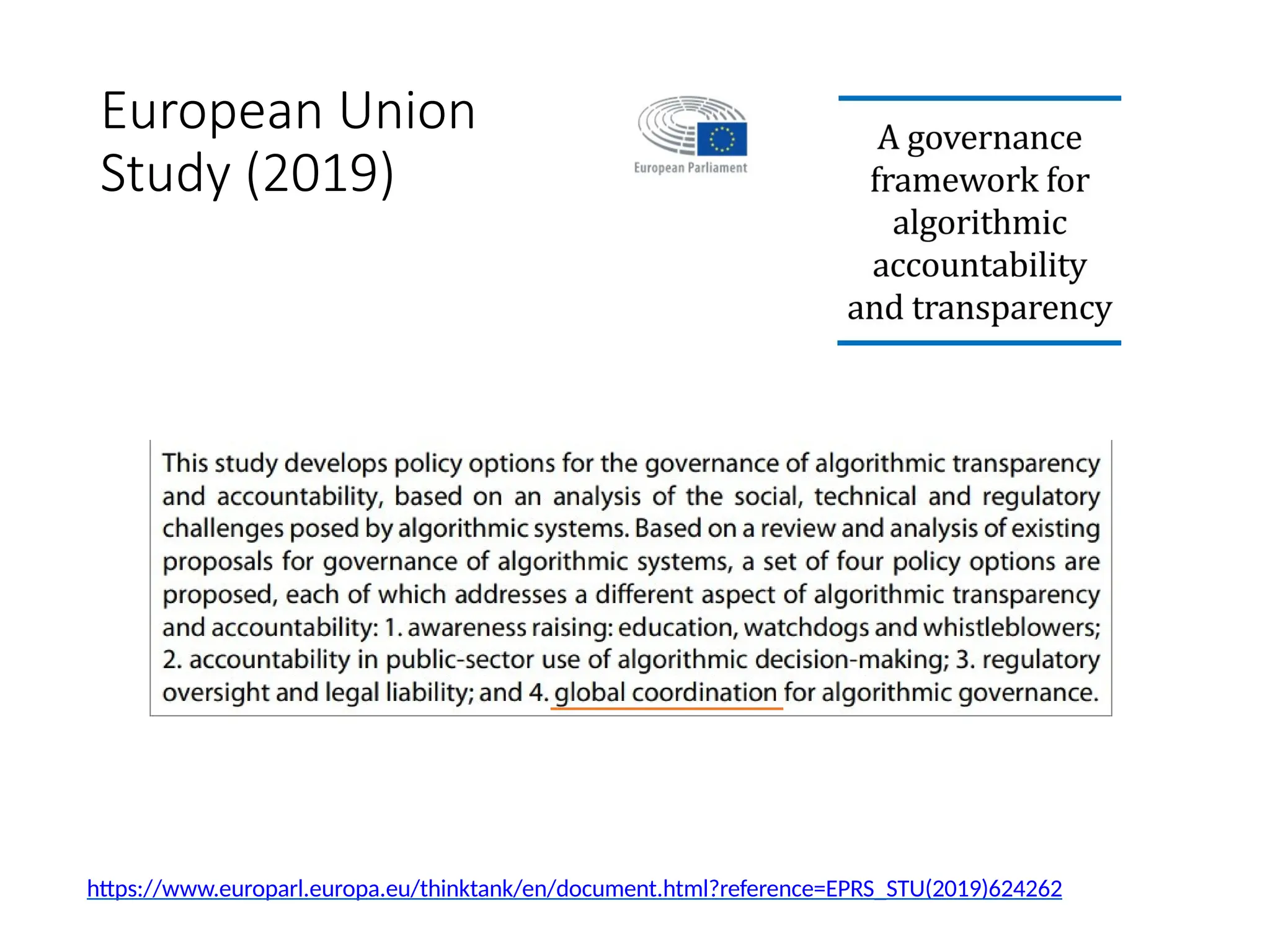
European Union
Study (2019)
https://www.europarl.europa.eu/thinktank/en/document.html?reference=EPRS_STU(2019)624262
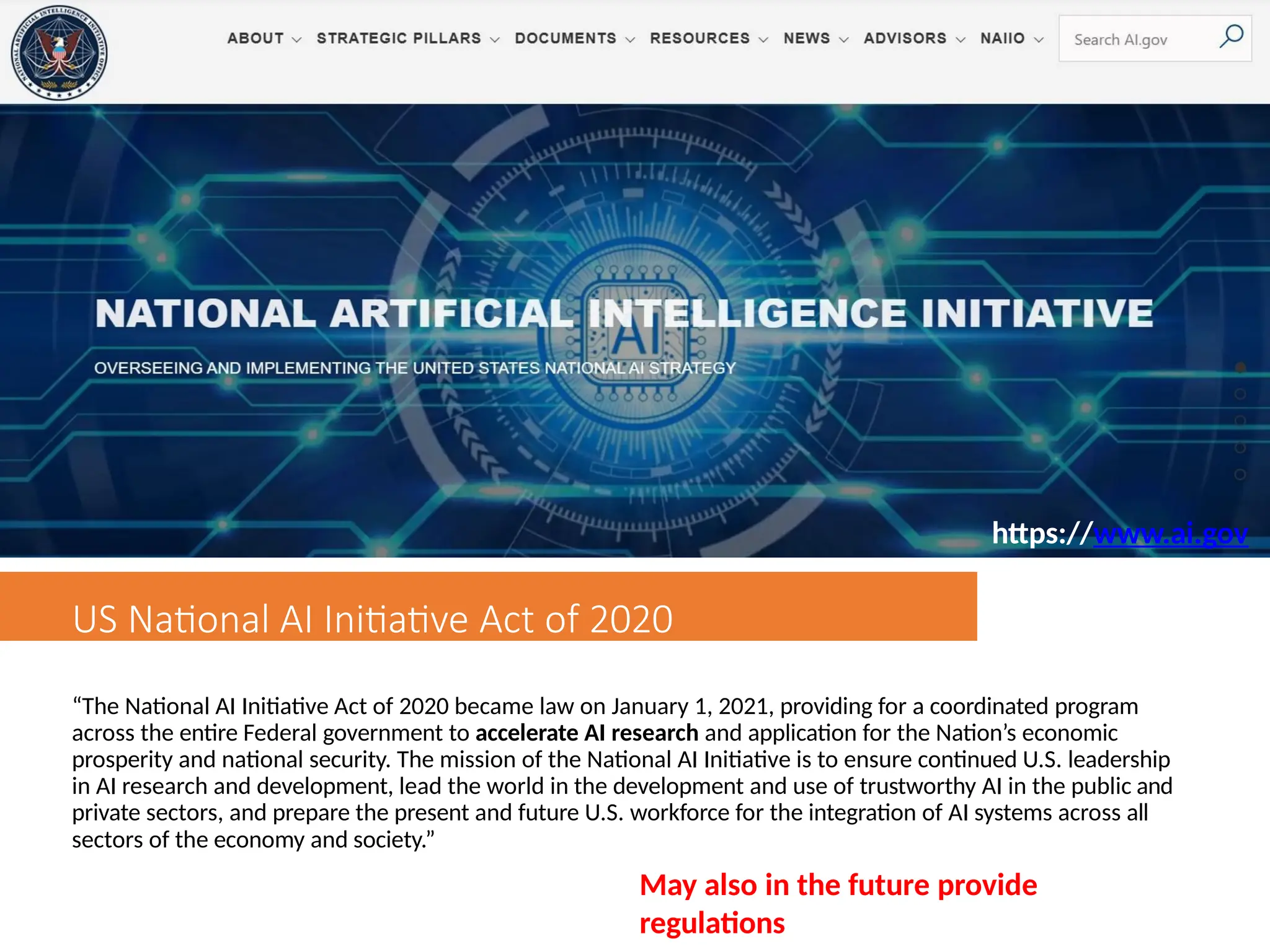
US National AI Initiative Act of 2020
“The National AI Initiative Act of 2020 became law on January 1, 2021, providing for a coordinated program
across the entire Federal government to accelerate AI research and application for the Nation’s economic
prosperity and national security. The mission of the National AI Initiative is to ensure continued U.S. leadership
in AI research and development, lead the world in the development and use of trustworthy AI in the public and
private sectors, and prepare the present and future U.S. workforce for the integration of AI systems across all
sectors of the economy and society.”
May also in the future provide
regulations
https://www.ai.gov
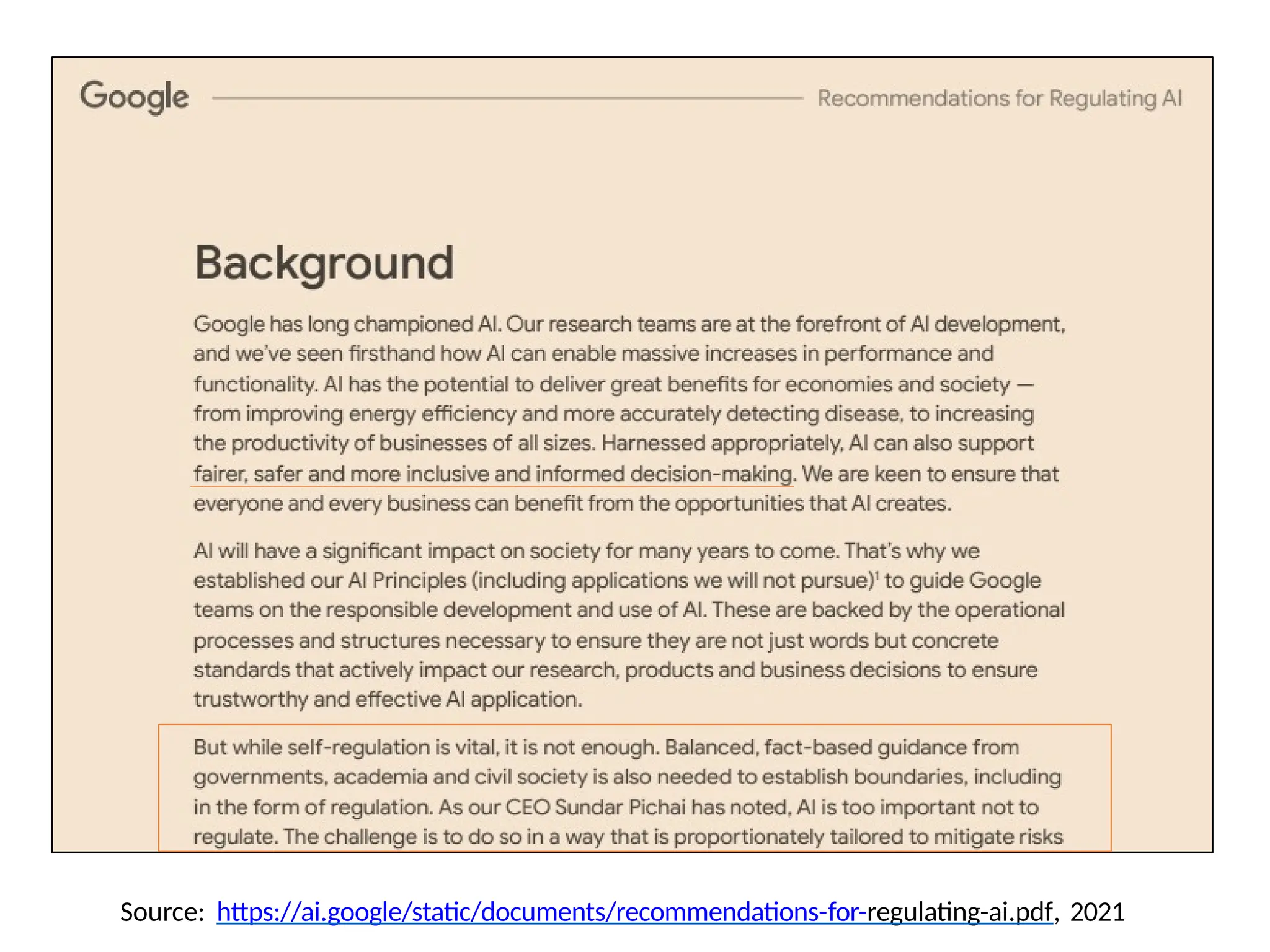
Source: https://ai.google/static/documents/recommendations-for-regulating-ai.pdf, 2021
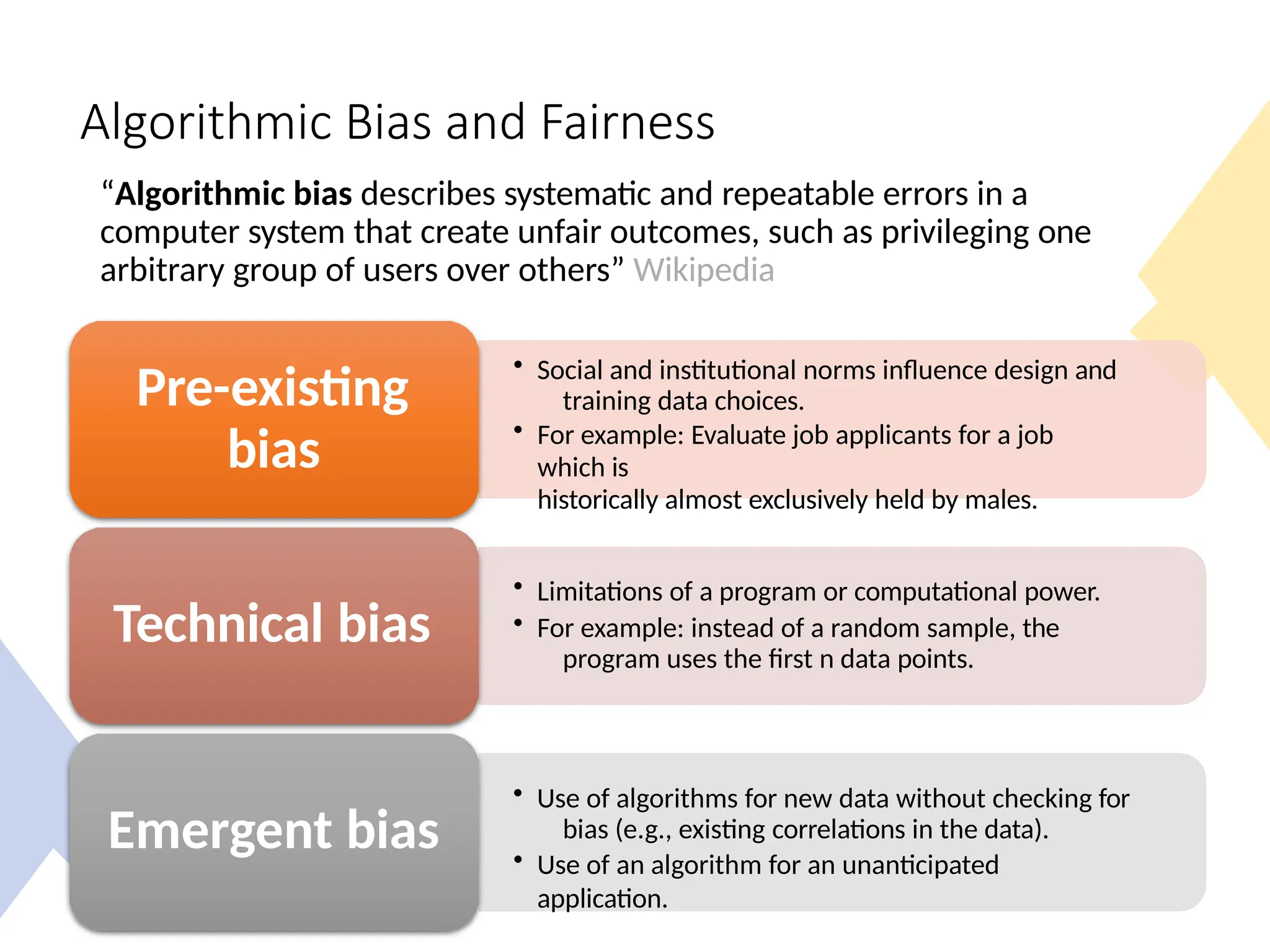
Algorithmic Bias and Fairness
“Algorithmic bias describes systematic and repeatable errors in a
computer system that create unfair outcomes, such as privileging one
arbitrary group of users over others” Wikipedia
• Social and institutional norms influence design and
training data choices.
• For example: Evaluate job applicants for a job
which is
historically almost exclusively held by males.
Pre-existing
bias
• Limitations of a program or computational power.
• For example: instead of a random sample, the
program uses the first n data points.
Technical bias
• Use of algorithms for new data without checking for
bias (e.g., existing correlations in the data).
• Use of an algorithm for an unanticipated
application.
Emergent bias
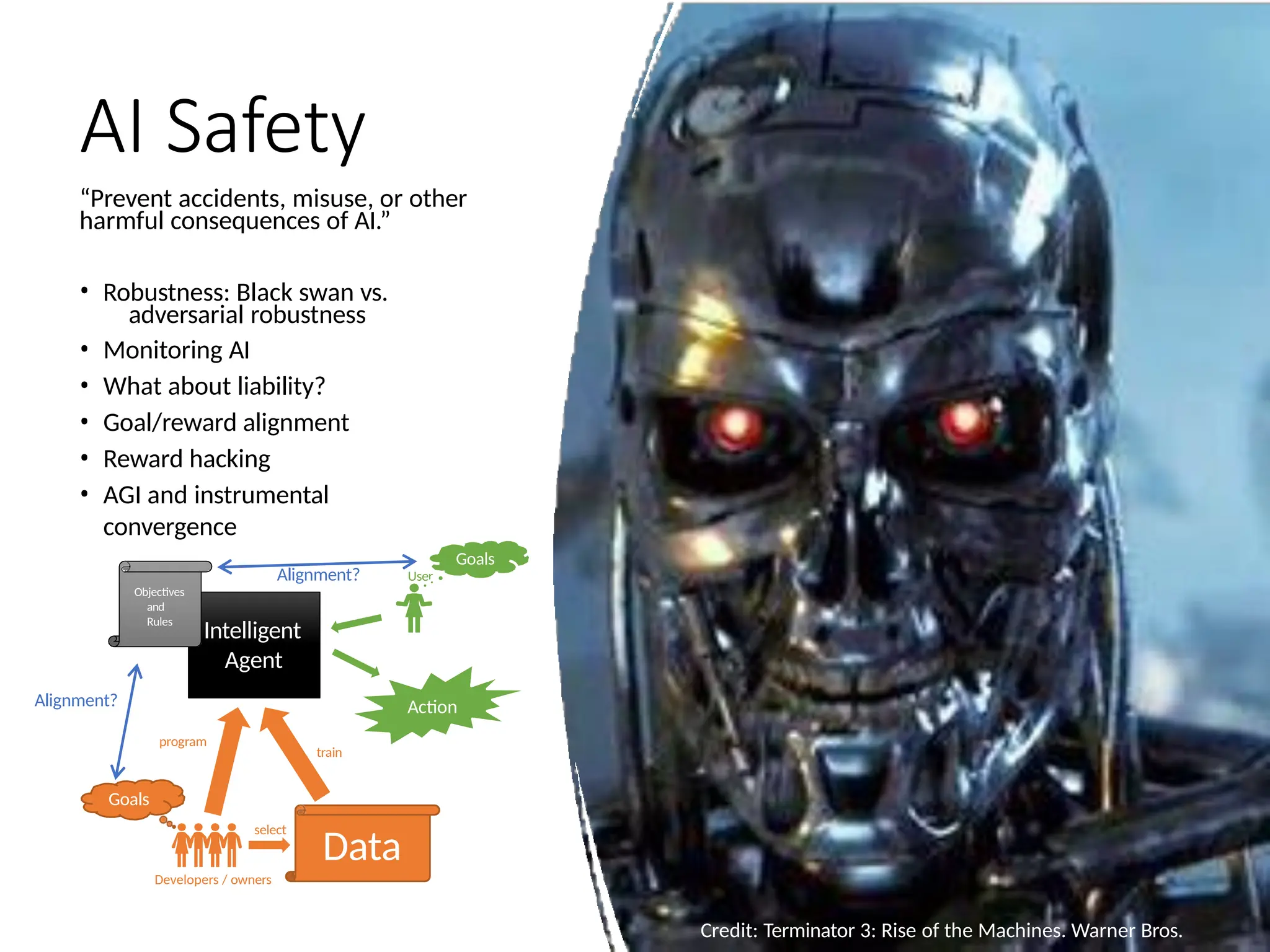
AI Safety
Credit: Terminator 3: Rise of the Machines. Warner Bros.
Intelligent
Agent
User
Goals
Data
select
train
Objectives
and
Rules
Developers / owners
Goals
Action
Alignment?
“Prevent accidents, misuse, or other
harmful consequences of AI.”
• Robustness: Black swan vs.
adversarial robustness
• Monitoring AI
• What about liability?
• Goal/reward alignment
• Reward hacking
• AGI and instrumental
convergence
Alignment?
program
Outlook
AI is a technology that is on
the verge of significant
leaps…
• New technologies always
had a profound
impacted on the way
we live and
work (e.g., electricity,
the internet,
mobile
communication).
• We can expect
unprecedented gains
in productivity from
better narrow AI.
• This course will
introduce simple
techniques to
create
intelligent agents.

Introduction to Artificial Intelligence 01_intro.pptx

  • 1.
    Artificial Intelligence Introduction AIMA Chapter 1 This workis licensed under a Creative Commons Attribution-ShareAlike 4.0
  • 2.
  • 3.
    What is AI? ASIMO(Advanced Step in Innovative Mobility) is a humanoid robot created by Honda in 2000
  • 4.
    What is itthe Goal of AI? thinks like a human? acts like a human? thinks rationally? acts rationally? “Have machines solve problems that a challenging for humans.” • Narrow AI focuses on intelligent agents to solve a specific subproblem. • An artificial general intelligence (AGI) is a hypothetical intelligent agent which can understand or learn any intellectual task that human beings or other animals can. [Wikipedia entry on AGI] How do we achieve this? Create an agent that
  • 5.
    Thinking Like aHuman The brain as an information processing machine. • Requires scientific theories of how the brain works. Note: The brain does not work like artificial neural networks from ML! How to understand cognition as a computational process? • Introspection: try to think about how we think. • Predict the behavior of human subjects. • Image the brain, examine neurological data AI consciousness • What does it mean that a machine is conscient/sentient? • How can we tell? (What do we do?) Cognitive Sciences
  • 6.
    Acting Like aHuman • Alan Turing (1950) "Computing machinery and intelligence“ • The Turing Test tries to define what acting like a human means • What capabilities would a computer need to have to pass the Turing Test? • Natural language processing • Knowledge representation • Automated reasoning • Machine learning • Turing predicted that by the year 2000, machines would be able to fool 30% of human judges for five minutes. • ChatGPT in 2023 is probably doing a lot better than that!
  • 7.
    Turing Test: Criticism Whatare some potential problems with the Turing Test? • Some human behavior is not intelligent. • Some intelligent behavior may not be human. • Human observers may be easy to fool. • A lot depends on expectations. • Anthropomorphic fallacy (humans tend to humanize things) • Imitate intelligence without intelligence. E.g., the early chatbots ELIZA (1964) simulates a conversation using pattern matching. Is passing the Turing test a good scientific goal? • Engineering perspective: Not a good way to solve practical problems. • We can create useful intelligent agents without trying to imitate humans. Chinese Room Argument Thought experiment by John Searle (1980): Imitate intelligence using rules. What about modern chatbots like ChatGPT?
  • 8.
    Thinking Rationally • Idealizedor “right” way of thinking. • Logic: Patterns of argument that always yield correct conclusions when supplied with correct premises • “Socrates is a man; all men are mortal; therefore, Socrates is mortal.” • Beginning with Aristotle (385 BC), philosophers and mathematicians have attempted to formalize the rules of logical thought. • Logic-based approach to AI: Describe problem in formal logical notation and apply general deduction procedures to solve it. • Problems with the logic-based approach to AI • Describing real-world problems and knowledge in logical notation is hard. • Computational complexity of finding the solution. • A lot of intelligent or “rational” behavior in an uncertain world cannot be defined by simple rules. What about the logical implication 𝑠𝑡𝑢𝑑𝑦 ℎ𝑎𝑟𝑑 ֜ 𝐴 𝑖𝑛 𝐴𝐼 Should it be 𝑠𝑡𝑢𝑑𝑦 ℎ𝑎𝑟𝑑 𝐴𝑁𝐷 𝑏𝑒 𝑙𝑢𝑐𝑘𝑦 ֜ 𝐴 𝑖𝑛 𝐴𝐼
  • 9.
    Acting Rationally A rationalagent acts to achieve the best expected outcome: • Goals are application-dependent and are expressed in terms of the utility of outcomes. • Being rational means acting to maximizing your expected utility. Expectation means that different outcomes are possible (probabilities). • In practice, utility optimization is subject to the agent’s knowledge and computational constraints (bounded rationality or bounded optimality).
  • 10.
    Acting Rationally Advantages ofthe “expected utility maximization” formulation • Generality: an optimization that goes beyond explicit reasoning with rules. • Practicality: can be adapted to many real-world problems. • Amenable to good scientific and engineering methodology including simulation and experimentation. • Only concerns the decisions/actions that are made, not the cognitive process behind them. Avoids philosophy and psychology in favor of a clearly defined objective.
  • 11.
    What type ofAI do we cover in this course? thinks like a human? acts like a human? thinks rationally? acts rationally. Create a narrow AI agent that That is, use machines to solve a specific hard problem that traditionally would have been thought to require human intelligence.
  • 12.
    What are theComponents of an Intelligent Agent? Agent interacting with the environment [Artificial Intelligence: A Modern Approach, Editions 1-3] Intelligent agents need to • Communicate with the environment • Represent knowledge, reason and plan to achieve a desired outcome Optional • Learn Developer
  • 13.
    Machine Learning vs.Artificial Intelligence ML Learning from examples instead of being programmed • Supervised learning • Unsupervised learning • RL Deep Learning • Vision • Sensors • Motion • NLP • Knowledge representation • Planning • Goals AI Designing an intelligent agent ML ML ML Agent interacting with the environment [Artificial Intelligence: A Modern Approach, Editions 1-3]
  • 14.
  • 15.
    Source: https://qbi.uq.edu.au/brain/intelligent-machines/history-artificial-intelligence +additions Deep Learning Revolution (learning layered artificial neural networks) starts fueled by NVIDIA GPUs. enables leaps in image processing and speech recognition. 2022 Generative AI models: • DALL-E • ChatGPT, Bard • … Transformer architecture and large language models LLMs 2017 2015 1974-1980 First AI Winter 1987-1993 Second AI Winter 2010 Now Google 1989: Universal approximation theorem for neural networks.
  • 16.
    What accounts for recentsuccesses in AI? • Faster computers and specialized hardware (GPUs). • Lots of data (the Internet, text, sensors) and storage (cloud) • Dominance of machine learning. • New optimization methods (deep learning).
  • 17.
    AI is harderthan originally thought Herbert Simon, 1957 “It is not my aim to surprise or shock you--- but … there are now in the world machines that think, that learn and that create. Moreover, their ability to do these things is going to increase rapidly until---in a visible future---the range of problems they can handle will be coextensive with the range to which human mind has been applied. More precisely: within 10 years a computer would be chess champion, and an important new mathematical theorem would be proved by a computer.” Simon’s prediction came true --- but 40 years later instead of 10
  • 18.
    From Blocks Worldto Modern Object Recognition Roberts (1963) This is a lot harder! But we can do it now…. Now
  • 19.
    “Moravec’s Paradox” Hans Moravec(1988): “It is comparatively easy to make computers exhibit adult level performance on intelligence tests or playing checkers, and difficult or impossible to give them the skills of a one-year-old when it comes to perception and mobility.” A teenager can learn how to drive in a few hours with very little input, but we still have no truly self-driving car. https://www.newsweek.com/googles-new-two-legged-robot- future-warfare-429831
  • 20.
    The AI Effect: AIgets no respect? • As soon as a machine gets good at performing some task, the task is no longer considered to require much intelligence • Calculating ability used to be prized – not anymore • Chess was thought to require high intelligence • Now, massively parallel computers essentially use brute force search to beat grand masters • Learning once thought uniquely human • Ada Lovelace (1842): “The Analytical Engine has no pretensions to originate anything. It can do whatever we know how to order it to perform.” • Now machine learning is a well-developed discipline • Similar picture with animal intelligence… “Even a monkey can do this!”
  • 21.
  • 22.
    Vision and Image Processing •OCR: read license plates, handwriting recognition (e.g., mail sorting). • Face detection: now standard for smart phone cameras. • Vehicle safety systems • Visual search • Image generation All these technologies can now operate now at superhuman performance. DALL-E
  • 23.
    Natural Language Processing • Text-to-speech •Speech-to-text to detect voice commands • Machine translation • Text generation (Q/A systems) All these technologies can operate now with close to or even superhuman performance. Humans use language to reason. Does that mean AI that can create good language can reason? Language understanding is still elusive!
  • 24.
    Robotics • Mars rovers •Autonomous vehicles • DARPA Grand Challenge • Google self-driving cars • Autonomous helicopters and drones • Robot soccer • RoboCup • Personal robotics • Humanoi d robots • Robotic pets • Personal
  • 25.
    Question Answering: IBMWatson • http://www.research.ibm.com/deepqa/ • NY Times article • Trivia demo • YouTube video • IBM Watson wins on Jeopardy (February 2011) • Listens to spoken language. • Speaks. • Finds questions to factual answers.
  • 26.
    Math, Games andPuzzles • 1996: A computer program written by researchers at Argonne National Laboratory proved a mathematical conjecture (Robbins conjecture) unsolved for decades • NY Times story: “[The proof] would have been called creative if a human had thought of it” • 1996/97: IBM’s Deep Blue defeated the reigning world chess champion Garry Kasparov in 1997 • 1996: Kasparov Beats Deep Blue “I could feel --- I could smell --- a new kind of intelligence across the table.” • 1997: Deep Blue Beats Kasparov “Deep Blue hasn't proven anything.” • 2007: Checkers was “solved” --- a computer system that never loses was developed. Science article • 2017+: AlphaZero learns chess, shogi and go by playing itself. Science article • 2019: MuZero learns to play Atari computer games. AI exhibits superhuman performance on almost all games.
  • 27.
    Logistics, Scheduling andPlanning 1991 During the 1991 Gulf War, US forces deployed an AI logistics planning and scheduling program that involved up to 50,000 vehicles, cargo, and people May 1999 NASA’s Remote Agent software operated the Deep Space 1 spacecraft during two experiments in May 1999 2004 In 2004, NASA introduced the MAPGEN system to plan the daily operations for the Mars Exploration Rovers 2018 Optimized Prime: How AI And Anticipation Power Amazon's 1- Hour Deliveries
  • 28.
    Information agents • Search engines •Chat Agents / Automated helpdesks • Recommendation systems • Spam filtering • Medical diagnosis systems • Fraud detection • Automated stock trading
  • 29.
    Self-driving Cars and Safety SAEAutomation Levels • Level 1 - Driver Assistance (“hands on”) • Level 2 - Partial Automation (“hands off”) • Level 3 - Conditional Automation • Level 4 - High Automation • Level 5 - Full Automation (“steering wheel optional”) Components • Sensing • Maps • Path planning • Controlling the vehicle Why is this so hard?
  • 30.
    Large Language Models(LLMs) … Source: https://chat.openai.com/
  • 31.
    AI Ethics &Safety A new Frontier for Fairness and Freedom
  • 32.
    European Union Has regulations since 2016included in the General Data Protection Regulation (GDPR) Art. 22 GDPR – Automated individual decision-making, including California’s CCPA was not modeled after the GDPR
  • 33.
  • 34.
  • 35.
  • 36.
    US National AIInitiative Act of 2020 “The National AI Initiative Act of 2020 became law on January 1, 2021, providing for a coordinated program across the entire Federal government to accelerate AI research and application for the Nation’s economic prosperity and national security. The mission of the National AI Initiative is to ensure continued U.S. leadership in AI research and development, lead the world in the development and use of trustworthy AI in the public and private sectors, and prepare the present and future U.S. workforce for the integration of AI systems across all sectors of the economy and society.” May also in the future provide regulations https://www.ai.gov
  • 37.
  • 38.
    Algorithmic Bias andFairness “Algorithmic bias describes systematic and repeatable errors in a computer system that create unfair outcomes, such as privileging one arbitrary group of users over others” Wikipedia • Social and institutional norms influence design and training data choices. • For example: Evaluate job applicants for a job which is historically almost exclusively held by males. Pre-existing bias • Limitations of a program or computational power. • For example: instead of a random sample, the program uses the first n data points. Technical bias • Use of algorithms for new data without checking for bias (e.g., existing correlations in the data). • Use of an algorithm for an unanticipated application. Emergent bias
  • 39.
    AI Safety Credit: Terminator3: Rise of the Machines. Warner Bros. Intelligent Agent User Goals Data select train Objectives and Rules Developers / owners Goals Action Alignment? “Prevent accidents, misuse, or other harmful consequences of AI.” • Robustness: Black swan vs. adversarial robustness • Monitoring AI • What about liability? • Goal/reward alignment • Reward hacking • AGI and instrumental convergence Alignment? program
  • 40.
    Outlook AI is atechnology that is on the verge of significant leaps… • New technologies always had a profound impacted on the way we live and work (e.g., electricity, the internet, mobile communication). • We can expect unprecedented gains in productivity from better narrow AI. • This course will introduce simple techniques to create intelligent agents.