20AD401 - ARTIFICIAL INTELLIGENCE
By
Dr.M.SENTHILKUMAR,
Prof/AD, KNCET
AI Introduction
 One of the booming technologies of computer science is
Artificial Intelligence which is ready to create a new
revolution in the world by making intelligent machines
 It is currently working with a variety of subfields, ranging
from general to specific, such as self-driving cars, playing
chess, proving theorems, playing music, Painting, etc.
 AI holds a tendency to cause a machine to work as a
human.
 Artificial Intelligence is composed of two words Artificial
and Intelligence, where Artificial defines "man-made," and
intelligence defines "thinking power", hence AI means "a
man-made thinking power."
Define AI
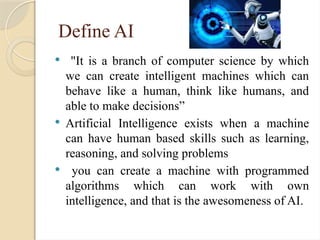
 "It is a branch of computer science by which
we can create intelligent machines which can
behave like a human, think like humans, and
able to make decisions”
 Artificial Intelligence exists when a machine
can have human based skills such as learning,
reasoning, and solving problems
 you can create a machine with programmed
algorithms which can work with own
intelligence, and that is the awesomeness of AI.
Why Artificial Intelligence?
 you can create such software or devices which can
solve real-world problems very easily and with
accuracy such as health issues, marketing, traffic
issues, etc.
 you can create your personal virtual Assistant,
such as Cortana, Google Assistant, Siri, etc.
 you can build such Robots which can work in an
environment where survival of humans can be at
risk
 AI opens a path for other new technologies, new
devices, and new Opportunities
Goals of Artificial Intelligence
 1. Replicate human intelligence
 2. Solve Knowledge-intensive tasks
 3. An intelligent connection of perception and action
 4. Building a machine which can perform tasks that
requires human intelligence such as:
◦ Proving a theorem
◦ Playing chess
◦ Plan some surgical operation
◦ Driving a car in traffic
 5. Creating some system which can exhibit intelligent
behavior, learn new things by itself, demonstrate,
explain, and can advise to its user.
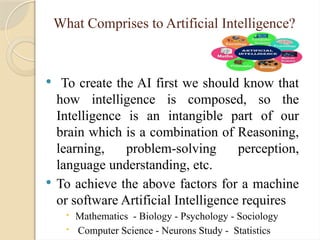
What Comprises to Artificial Intelligence?
 To create the AI first we should know that
how intelligence is composed, so the
Intelligence is an intangible part of our
brain which is a combination of Reasoning,
learning, problem-solving perception,
language understanding, etc.
 To achieve the above factors for a machine
or software Artificial Intelligence requires
 Mathematics - Biology - Psychology - Sociology
 Computer Science - Neurons Study - Statistics
Advantages of Artificial Intelligence
 High Accuracy with less errors
◦ takes decisions as per pre-experience or information
 High-Speed
◦ fast-decision making -chess champion in the Chess game.
 High reliability
◦ can perform the same action multiple times with high accuracy
 Useful for risky areas
◦ defusing a bomb, exploring the ocean floor, where to employ a human can
be risky.
 Digital Assistant
◦ various Ecommerce websites
 Useful as a public utility
◦ self-driving car which can make our journey safer and hassle-free, facial
recognition for security purpose, Natural language processing to
communicate with the human in human-language, etc
Disadvantages of Artificial Intelligence
 High Cost
◦ The hardware and software requirement of AI is very costly
 Can't think out of the box
◦ the robot will only do that work for which they are trained,
or programmed
 No feelings and emotions
◦ AI machines can be an outstanding performer
 Increase dependency on machines
◦ they are losing their mental capabilities.
 No Original Creativity
◦ As humans are so creative and can imagine some new ideas
but still AI machines cannot beat
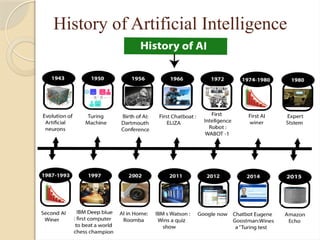
History of Artificial Intelligence
Intelligent system
 Intelligent systems can also include sophisticated AI-based software
systems, such as chatbots, expert systems and other types of
software
 Intelligent systems exist all around us in point-of-sale (POS)
terminals, digital televisions, traffic lights, smart meters,
automobiles, digital signage and airplane controls, among a great
number of other possibilities
 Built-in intelligence is an integral component of the developing
internet of things (IoT), in which almost everything imaginable can
be provided with unique identifiers and the ability to automatically
transfer data over a network without requiring human-to-human or
human-to-computer interaction.
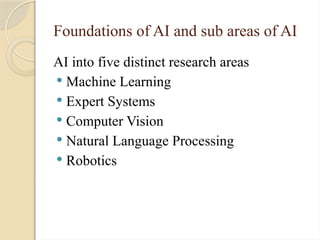
Foundations of AI and sub areas of AI
AI into five distinct research areas
 Machine Learning
 Expert Systems
 Computer Vision
 Natural Language Processing
 Robotics
Machine Learning
 Machine learning (ML) is the science of
empowering machines to make decisions without
human intervention
 This sub-discipline forms the backbone of AI,
enabling computers to learn and interpret patterns
in images, sounds, and structured data using
multidimensional arrays
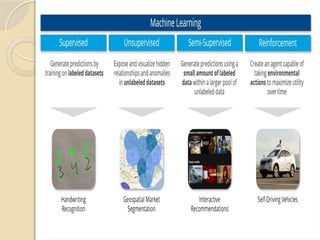
 ML is further subdivided into four types of
learning
◦ Supervised learning, Unsupervised learning, Semi-
supervised, Reinforcement learning
Expert Systems
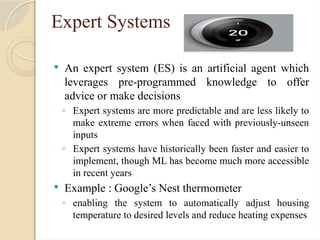
 An expert system (ES) is an artificial agent which
leverages pre-programmed knowledge to offer
advice or make decisions
◦ Expert systems are more predictable and are less likely to
make extreme errors when faced with previously-unseen
inputs
◦ Expert systems have historically been faster and easier to
implement, though ML has become much more accessible
in recent years
 Example : Google’s Nest thermometer
◦ enabling the system to automatically adjust housing
temperature to desired levels and reduce heating expenses
Computer Vision
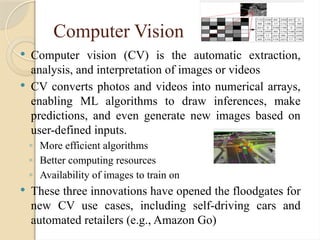
 Computer vision (CV) is the automatic extraction,
analysis, and interpretation of images or videos
 CV converts photos and videos into numerical arrays,
enabling ML algorithms to draw inferences, make
predictions, and even generate new images based on
user-defined inputs.
◦ More efficient algorithms
◦ Better computing resources
◦ Availability of images to train on
 These three innovations have opened the floodgates for
new CV use cases, including self-driving cars and
automated retailers (e.g., Amazon Go)
Natural Language Processing
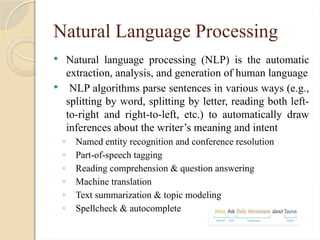
 Natural language processing (NLP) is the automatic
extraction, analysis, and generation of human language
 NLP algorithms parse sentences in various ways (e.g.,
splitting by word, splitting by letter, reading both left-
to-right and right-to-left, etc.) to automatically draw
inferences about the writer’s meaning and intent
◦ Named entity recognition and conference resolution
◦ Part-of-speech tagging
◦ Reading comprehension & question answering
◦ Machine translation
◦ Text summarization & topic modeling
◦ Spellcheck & autocomplete
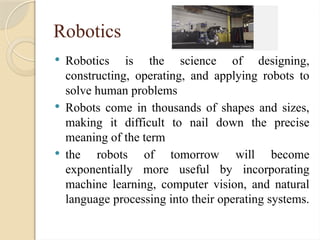
Robotics
 Robotics is the science of designing,
constructing, operating, and applying robots to
solve human problems
 Robots come in thousands of shapes and sizes,
making it difficult to nail down the precise
meaning of the term
 the robots of tomorrow will become
exponentially more useful by incorporating
machine learning, computer vision, and natural
language processing into their operating systems.
AI Applications
 AI in E-Commerce
◦ Personalized Shopping
◦ AI-powered Assistants
◦ Fraud Prevention
 AI in Navigation
◦ GPS technology can provide users with accurate, timely, and
detailed information to improve safety
 The technology uses a combination of Convolutional Neural Network
and Graph Neural Network
 AI in Robotics
◦ Carrying goods in hospitals, factories, and warehouses
◦ Cleaning offices and large equipment
◦ Inventory management
 AI in Human Resource
◦ AI drive systems can scan job candidates' profiles, and resumes
to provide recruiters an understanding of the talent pool they
must choose from
 AI in Healthcare
◦ AI uses the combination of historical data and medical
intelligence for the discovery of new drugs
 AI in Agriculture
◦ AI bots can help to harvest crops at a higher volume and faster
pace than human laborers
 AI in Gaming
◦ AI can be used to create smart, human-like NPCs to interact with
the players
◦ Alien Isolation games released in 2014 uses AI
 ‘Director AI’ that frequently knows your location and the ‘Alien AI,’
driven by sensors and behaviors that continuously hunt the player
 AI in Automobiles
◦ AI can be used along with the vehicle’s camera, radar, cloud
services, GPS, and control signals to operate the vehicle.
 AI in Social Media
◦ Instagram, Facebook, Twitter
 AI in Marketing
◦ marketers can deliver highly targeted and personalized ads
with the help of behavioral analysis, pattern recognition, etc
◦ AI can help with content marketing in a way that matches
the brand's style and voice
◦ Chatbots powered by AI
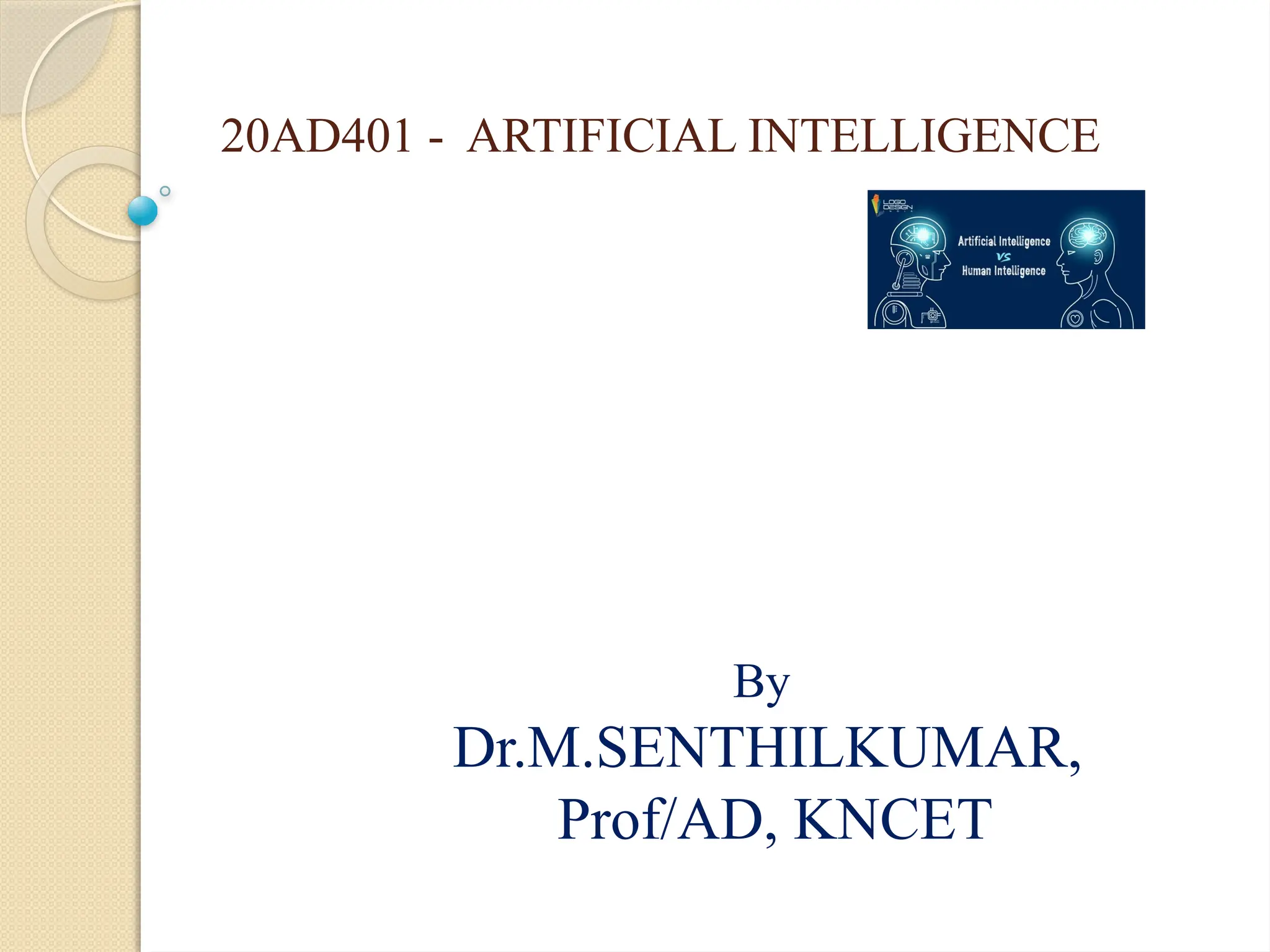
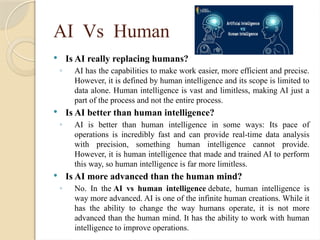
AI Vs Human
 Is AI really replacing humans?
◦ AI has the capabilities to make work easier, more efficient and precise.
However, it is defined by human intelligence and its scope is limited to
data alone. Human intelligence is vast and limitless, making AI just a
part of the process and not the entire process.
 Is AI better than human intelligence?
◦ AI is better than human intelligence in some ways: Its pace of
operations is incredibly fast and can provide real-time data analysis
with precision, something human intelligence cannot provide.
However, it is human intelligence that made and trained AI to perform
this way, so human intelligence is far more limitless.
 Is AI more advanced than the human mind?
◦ No. In the AI vs human intelligence debate, human intelligence is
way more advanced. AI is one of the infinite human creations. While it
has the ability to change the way humans operate, it is not more
advanced than the human mind. It has the ability to work with human
intelligence to improve operations.

AI Introduction-History-Foundation-Applications

  • 1.
    20AD401 - ARTIFICIALINTELLIGENCE By Dr.M.SENTHILKUMAR, Prof/AD, KNCET
  • 2.
    AI Introduction  Oneof the booming technologies of computer science is Artificial Intelligence which is ready to create a new revolution in the world by making intelligent machines  It is currently working with a variety of subfields, ranging from general to specific, such as self-driving cars, playing chess, proving theorems, playing music, Painting, etc.  AI holds a tendency to cause a machine to work as a human.  Artificial Intelligence is composed of two words Artificial and Intelligence, where Artificial defines "man-made," and intelligence defines "thinking power", hence AI means "a man-made thinking power."
  • 3.
    Define AI  "Itis a branch of computer science by which we can create intelligent machines which can behave like a human, think like humans, and able to make decisions”  Artificial Intelligence exists when a machine can have human based skills such as learning, reasoning, and solving problems  you can create a machine with programmed algorithms which can work with own intelligence, and that is the awesomeness of AI.
  • 4.
    Why Artificial Intelligence? you can create such software or devices which can solve real-world problems very easily and with accuracy such as health issues, marketing, traffic issues, etc.  you can create your personal virtual Assistant, such as Cortana, Google Assistant, Siri, etc.  you can build such Robots which can work in an environment where survival of humans can be at risk  AI opens a path for other new technologies, new devices, and new Opportunities
  • 5.
    Goals of ArtificialIntelligence  1. Replicate human intelligence  2. Solve Knowledge-intensive tasks  3. An intelligent connection of perception and action  4. Building a machine which can perform tasks that requires human intelligence such as: ◦ Proving a theorem ◦ Playing chess ◦ Plan some surgical operation ◦ Driving a car in traffic  5. Creating some system which can exhibit intelligent behavior, learn new things by itself, demonstrate, explain, and can advise to its user.
  • 6.
    What Comprises toArtificial Intelligence?  To create the AI first we should know that how intelligence is composed, so the Intelligence is an intangible part of our brain which is a combination of Reasoning, learning, problem-solving perception, language understanding, etc.  To achieve the above factors for a machine or software Artificial Intelligence requires  Mathematics - Biology - Psychology - Sociology  Computer Science - Neurons Study - Statistics
  • 7.
    Advantages of ArtificialIntelligence  High Accuracy with less errors ◦ takes decisions as per pre-experience or information  High-Speed ◦ fast-decision making -chess champion in the Chess game.  High reliability ◦ can perform the same action multiple times with high accuracy  Useful for risky areas ◦ defusing a bomb, exploring the ocean floor, where to employ a human can be risky.  Digital Assistant ◦ various Ecommerce websites  Useful as a public utility ◦ self-driving car which can make our journey safer and hassle-free, facial recognition for security purpose, Natural language processing to communicate with the human in human-language, etc
  • 8.
    Disadvantages of ArtificialIntelligence  High Cost ◦ The hardware and software requirement of AI is very costly  Can't think out of the box ◦ the robot will only do that work for which they are trained, or programmed  No feelings and emotions ◦ AI machines can be an outstanding performer  Increase dependency on machines ◦ they are losing their mental capabilities.  No Original Creativity ◦ As humans are so creative and can imagine some new ideas but still AI machines cannot beat
  • 9.
  • 10.
    Intelligent system  Intelligentsystems can also include sophisticated AI-based software systems, such as chatbots, expert systems and other types of software  Intelligent systems exist all around us in point-of-sale (POS) terminals, digital televisions, traffic lights, smart meters, automobiles, digital signage and airplane controls, among a great number of other possibilities  Built-in intelligence is an integral component of the developing internet of things (IoT), in which almost everything imaginable can be provided with unique identifiers and the ability to automatically transfer data over a network without requiring human-to-human or human-to-computer interaction.
  • 11.
    Foundations of AIand sub areas of AI AI into five distinct research areas  Machine Learning  Expert Systems  Computer Vision  Natural Language Processing  Robotics
  • 12.
    Machine Learning  Machinelearning (ML) is the science of empowering machines to make decisions without human intervention  This sub-discipline forms the backbone of AI, enabling computers to learn and interpret patterns in images, sounds, and structured data using multidimensional arrays  ML is further subdivided into four types of learning ◦ Supervised learning, Unsupervised learning, Semi- supervised, Reinforcement learning
  • 14.
    Expert Systems  Anexpert system (ES) is an artificial agent which leverages pre-programmed knowledge to offer advice or make decisions ◦ Expert systems are more predictable and are less likely to make extreme errors when faced with previously-unseen inputs ◦ Expert systems have historically been faster and easier to implement, though ML has become much more accessible in recent years  Example : Google’s Nest thermometer ◦ enabling the system to automatically adjust housing temperature to desired levels and reduce heating expenses
  • 15.
    Computer Vision  Computervision (CV) is the automatic extraction, analysis, and interpretation of images or videos  CV converts photos and videos into numerical arrays, enabling ML algorithms to draw inferences, make predictions, and even generate new images based on user-defined inputs. ◦ More efficient algorithms ◦ Better computing resources ◦ Availability of images to train on  These three innovations have opened the floodgates for new CV use cases, including self-driving cars and automated retailers (e.g., Amazon Go)
  • 16.
    Natural Language Processing Natural language processing (NLP) is the automatic extraction, analysis, and generation of human language  NLP algorithms parse sentences in various ways (e.g., splitting by word, splitting by letter, reading both left- to-right and right-to-left, etc.) to automatically draw inferences about the writer’s meaning and intent ◦ Named entity recognition and conference resolution ◦ Part-of-speech tagging ◦ Reading comprehension & question answering ◦ Machine translation ◦ Text summarization & topic modeling ◦ Spellcheck & autocomplete
  • 17.
    Robotics  Robotics isthe science of designing, constructing, operating, and applying robots to solve human problems  Robots come in thousands of shapes and sizes, making it difficult to nail down the precise meaning of the term  the robots of tomorrow will become exponentially more useful by incorporating machine learning, computer vision, and natural language processing into their operating systems.
  • 18.
    AI Applications  AIin E-Commerce ◦ Personalized Shopping ◦ AI-powered Assistants ◦ Fraud Prevention  AI in Navigation ◦ GPS technology can provide users with accurate, timely, and detailed information to improve safety  The technology uses a combination of Convolutional Neural Network and Graph Neural Network  AI in Robotics ◦ Carrying goods in hospitals, factories, and warehouses ◦ Cleaning offices and large equipment ◦ Inventory management
  • 19.
     AI inHuman Resource ◦ AI drive systems can scan job candidates' profiles, and resumes to provide recruiters an understanding of the talent pool they must choose from  AI in Healthcare ◦ AI uses the combination of historical data and medical intelligence for the discovery of new drugs  AI in Agriculture ◦ AI bots can help to harvest crops at a higher volume and faster pace than human laborers  AI in Gaming ◦ AI can be used to create smart, human-like NPCs to interact with the players ◦ Alien Isolation games released in 2014 uses AI  ‘Director AI’ that frequently knows your location and the ‘Alien AI,’ driven by sensors and behaviors that continuously hunt the player
  • 20.
     AI inAutomobiles ◦ AI can be used along with the vehicle’s camera, radar, cloud services, GPS, and control signals to operate the vehicle.  AI in Social Media ◦ Instagram, Facebook, Twitter  AI in Marketing ◦ marketers can deliver highly targeted and personalized ads with the help of behavioral analysis, pattern recognition, etc ◦ AI can help with content marketing in a way that matches the brand's style and voice ◦ Chatbots powered by AI
  • 21.
    AI Vs Human Is AI really replacing humans? ◦ AI has the capabilities to make work easier, more efficient and precise. However, it is defined by human intelligence and its scope is limited to data alone. Human intelligence is vast and limitless, making AI just a part of the process and not the entire process.  Is AI better than human intelligence? ◦ AI is better than human intelligence in some ways: Its pace of operations is incredibly fast and can provide real-time data analysis with precision, something human intelligence cannot provide. However, it is human intelligence that made and trained AI to perform this way, so human intelligence is far more limitless.  Is AI more advanced than the human mind? ◦ No. In the AI vs human intelligence debate, human intelligence is way more advanced. AI is one of the infinite human creations. While it has the ability to change the way humans operate, it is not more advanced than the human mind. It has the ability to work with human intelligence to improve operations.