What	is	Coding	in	University	in	Practice?
Assistant	Professor,	Winnie	Soon	|	Aarhus	University
The	Purpose	of	the	Future	University	Conference,	7-Nov-2017
http://www.siusoon.net
https://www.hackerearth.com/challenges/
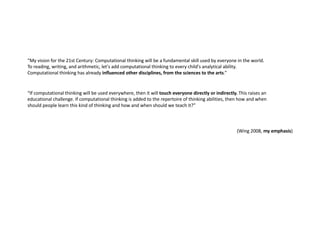
“My	vision	for	the	21st	Century:	Computational	thinking	will	be	a	fundamental	skill	used	by	everyone	in	the	world.
To	reading,	writing,	and	arithmetic,	let's	add	computational	thinking	to	every	child's	analytical	ability.
Computational	thinking	has	already	influenced	other	disciplines,	from	the	sciences	to	the	arts.”
“If	computational	thinking	will	be	used	everywhere,	then	it	will	touch	everyone	directly	or	indirectly. This	raises	an	
educational	challenge.	If	computational	thinking	is	added	to	the	repertoire	of	thinking	abilities,	then	how	and	when	
should	people	learn	this	kind	of	thinking	and	how	and	when	should	we	teach	it?”
(Wing	2008,	my	emphasis)
Coding	in	university	in	practice:
A	critical	attention	to	the	culture of	computation	and	technology,	including	logics,	
software,	platforms	and	data	processing,	via	experimental	coding	practice.
Experimental	systems	must	be	sufficiently	open	to	allow	[not	yet	crystallized	status	of	the	
knowledge	object]	to	come	into	view;	enough	space	must	be	present	to	produce	what	we	
do	not	yet	know.	
(Borgdorff 2011:190)
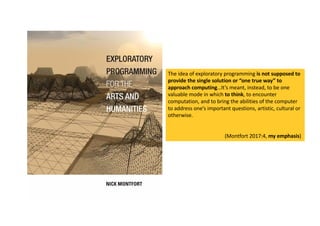
The	idea	of	exploratory	programming	is	not	supposed	to	
provide	the	single	solution	or	“one	true	way”	to	
approach	computing…It’s	meant,	instead,	to	be	one	
valuable	mode	in	which	to	think,	to	encounter	
computation,	and	to	bring	the	abilities	of	the	computer	
to	address	one’s	important	questions,	artistic,	cultural	or	
otherwise.
(Montfort	2017:4,	my	emphasis)
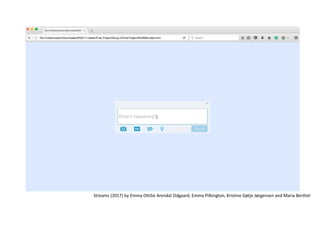
Streams	(2017)	by	Emma	Ottilie Arendal Odgaard,	Emma	Pilkington,	Kristine	Gøtje Jørgensen and	Maria	Berthel
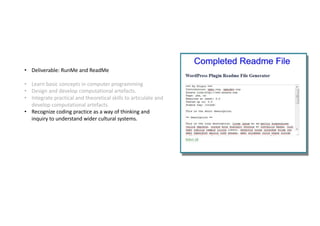
• Deliverable:	RunMe and	ReadMe
• Learn	basic	concepts	in	computer	programming
• Design	and	develop	computational	artefacts.
• Integrate	practical	and	theoretical	skills	to	articulate	and	
develop	computational	artefacts.
• Recognize	coding	practice	as	a	way	of	thinking	and	
inquiry	to	understand	wider	cultural	systems.
Challenges:	
• Undo	the	concept	of	having	‘model	answers’	
• Create	an	open	environment	with	certain	constraints/parameters
• Not	only	focus	on	the	final	‘product’	but	the	experimental	and	
creative	processes	that	emerge	and	inform	the	understanding	of	
things	(digital	culture)
Thank	You
Winnie	Soon	|	Aarhus	University
http://www.siusoon.net

What is Coding in University in Practice?