



ADVANCED JAVA
REQUEST DISPATCHER INTERFACE
Prepared by:
Taha Malampattiwala – 140050107052
Introduction to Request Dispatcher
 RequestDispatcher is an interface, implementation of which defines an object which can dispatch request to
any resources(such as HTML, Image, JSP, Servlet) on the server.
 Methods of RequestDispatcher
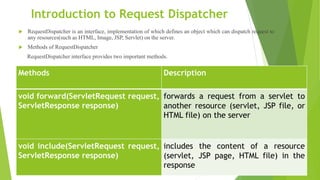
RequestDispatcher interface provides two important methods.
Methods Description
void forward(ServletRequest request,
ServletResponse response)
forwards a request from a servlet to
another resource (servlet, JSP file, or
HTML file) on the server
void include(ServletRequest request,
ServletResponse response)
includes the content of a resource
(servlet, JSP page, HTML file) in the
response
 How to get an Object of RequestDispatcher
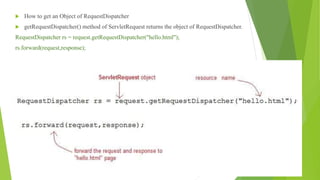
 getRequestDispatcher() method of ServletRequest returns the object of RequestDispatcher.
RequestDispatcher rs = request.getRequestDispatcher("hello.html");
rs.forward(request,response);
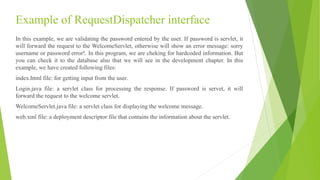
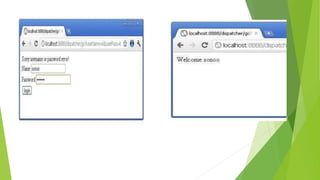
Example of RequestDispatcher interface
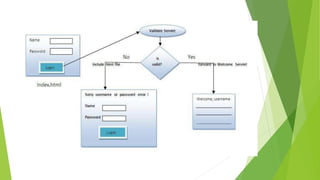
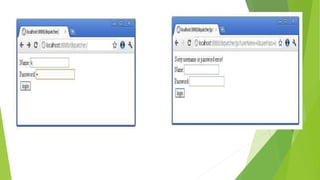
In this example, we are validating the password entered by the user. If password is servlet, it
will forward the request to the WelcomeServlet, otherwise will show an error message: sorry
username or password error!. In this program, we are cheking for hardcoded information. But
you can check it to the database also that we will see in the development chapter. In this
example, we have created following files:
index.html file: for getting input from the user.
Login.java file: a servlet class for processing the response. If password is servet, it will
forward the request to the welcome servlet.
WelcomeServlet.java file: a servlet class for displaying the welcome message.
web.xml file: a deployment descriptor file that contains the information about the servlet.
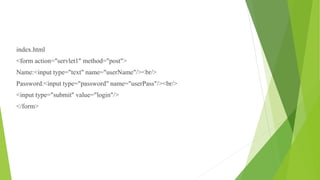
index.html
<form action="servlet1" method="post">
Name:<input type="text" name="userName"/><br/>
Password:<input type="password" name="userPass"/><br/>
<input type="submit" value="login"/>
</form>
WelcomeServlet.java
import java.io.*;
import javax.servlet.*;
import javax.servlet.http.*;
public class WelcomeServlet extends HttpServlet {
public void doPost(HttpServletRequest request, HttpServletResponse response)
throws ServletException, IOException {
response.setContentType("text/html");
PrintWriter out = response.getWriter();
String n=request.getParameter("userName");
out.print("Welcome "+n);
}
}
Login.java
import java.io.*;
import javax.servlet.*;
import javax.servlet.http.*;
public class Login extends HttpServlet {
public void doPost(HttpServletRequest request, HttpServletResponse response)
throws ServletException, IOException {
response.setContentType("text/html");
PrintWriter out = response.getWriter();
String n=request.getParameter("userName");
String p=request.getParameter("userPass");
if(p.equals("servlet"){
RequestDispatcher rd=request.getRequestDispatcher("servlet2");
rd.forward(request, response);
}
else{
out.print("Sorry UserName or Password Error!");
RequestDispatcher rd=request.getRequestDispatcher("/index.html");
rd.include(request, response);
} } }
web.xml
<web-app>
<servlet>
<servlet-name>Login</servlet-name>
<servlet-class>Login</servlet-class>
</servlet>
<servlet>
<servlet-name>WelcomeServlet</servlet-name>
<servlet-class>WelcomeServlet</servlet-class>
</servlet>
<servlet-mapping>
<servlet-name>Login</servlet-name>
<url-pattern>/servlet1</url-pattern>
</servlet-mapping>
<servlet-mapping>
<servlet-name>WelcomeServlet</servlet-name>
<url-pattern>/servlet2</url-pattern>
</servlet-mapping>
<welcome-file-list>
<welcome-file>index.html</welcome-file>
</welcome-file-list> </web-app>
THANK YOU

Request dispacther interface ppt