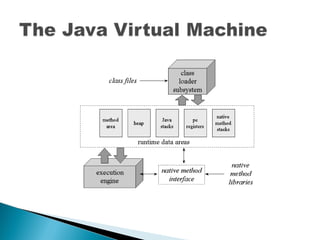
The Java Virtual Machine
 Taha Malampatti - 140050107052By:-
 A software emulation of a hypothetical computing
machine that runs Java bytecodes.
(Java compiler output)
 ISV’s can license the JVM from Sun Microsystems
 To have a JVM licensed Sun must approve the
implementation
 Rigid test procedure with published suite of test code.
 Core classes must not be modified
◦ this was the root of the Sun/Microsoft Lawsuit
 Separate versions for command line and browser
environments
 Many restrictions on browser version to ensure the
Java security model and robustness of the JVM.
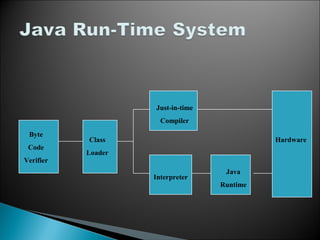
Byte
Code
Verifier
Class
Loader
Interpreter
Just-in-time
Compiler
Java
Runtime
Hardware
 Target Hardware - all CISC and RISC
 Machine type - stack (similar to Forth VM)
 A number of companies have promised a Java chip but
haven’t delivered…yet
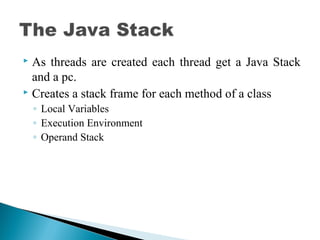
 As threads are created each thread get a Java Stack
and a pc.
 Creates a stack frame for each method of a class
◦ Local Variables
◦ Execution Environment
◦ Operand Stack
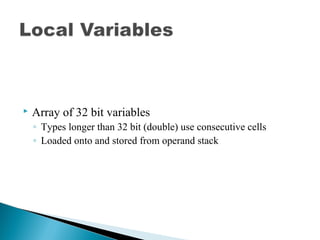
 Array of 32 bit variables
◦ Types longer than 32 bit (double) use consecutive cells
◦ Loaded onto and stored from operand stack
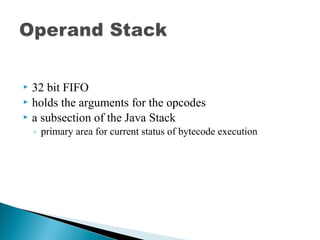
 32 bit FIFO
 holds the arguments for the opcodes
 a subsection of the Java Stack
◦ primary area for current status of bytecode execution
 Memory from which class instances are allocated
 Interpreter monitors memory usage and reclaims
memory when no longer in use.
 Garbage collection is automatic (unlike C/C++).
System.gc()
 Method Area - bytecodes for all Java Methods
 Constant Pool - class names, method and field names,
string constants
 4 Gb internal addressing due to 32 bit wide stack
implementation
 Methods are limited to 32 Kb due to 16 bit offset
addressing used for branching
 256 local variables /stack (8 bit field)
 32k constant pool entries per method
 Unix (many)
 Windows/NT/95/95/2000/XP
 OS/2
 Linux
 VM/CMS (1Q98)
 MVS / S390 (1Q98)

Java Virtual Machine

  • 1.
  • 2.
     Taha Malampatti- 140050107052By:-
  • 3.
     A softwareemulation of a hypothetical computing machine that runs Java bytecodes. (Java compiler output)  ISV’s can license the JVM from Sun Microsystems
  • 4.
     To havea JVM licensed Sun must approve the implementation  Rigid test procedure with published suite of test code.  Core classes must not be modified ◦ this was the root of the Sun/Microsoft Lawsuit
  • 5.
     Separate versionsfor command line and browser environments  Many restrictions on browser version to ensure the Java security model and robustness of the JVM.
  • 6.
  • 7.
     Target Hardware- all CISC and RISC  Machine type - stack (similar to Forth VM)  A number of companies have promised a Java chip but haven’t delivered…yet
  • 9.
     As threadsare created each thread get a Java Stack and a pc.  Creates a stack frame for each method of a class ◦ Local Variables ◦ Execution Environment ◦ Operand Stack
  • 10.
     Array of32 bit variables ◦ Types longer than 32 bit (double) use consecutive cells ◦ Loaded onto and stored from operand stack
  • 11.
     32 bitFIFO  holds the arguments for the opcodes  a subsection of the Java Stack ◦ primary area for current status of bytecode execution
  • 12.
     Memory fromwhich class instances are allocated  Interpreter monitors memory usage and reclaims memory when no longer in use.  Garbage collection is automatic (unlike C/C++). System.gc()
  • 13.
     Method Area- bytecodes for all Java Methods  Constant Pool - class names, method and field names, string constants
  • 14.
     4 Gbinternal addressing due to 32 bit wide stack implementation  Methods are limited to 32 Kb due to 16 bit offset addressing used for branching  256 local variables /stack (8 bit field)  32k constant pool entries per method
  • 15.
     Unix (many) Windows/NT/95/95/2000/XP  OS/2  Linux  VM/CMS (1Q98)  MVS / S390 (1Q98)