Vectors
Vectors
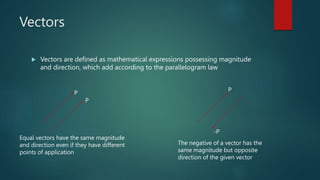
 Vectors are defined as mathematical expressions possessing magnitude
and direction, which add according to the parallelogram law
P
P
Equal vectors have the same magnitude
and direction even if they have different
points of application
The negative of a vector has the
same magnitude but opposite
direction of the given vector
P
-P
Addition of Vectors
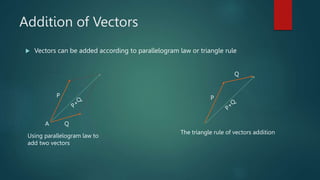
 Vectors can be added according to parallelogram law or triangle rule
A Q
P P
Q
Using parallelogram law to
add two vectors
The triangle rule of vectors addition
Addition of Vectors 3 or more
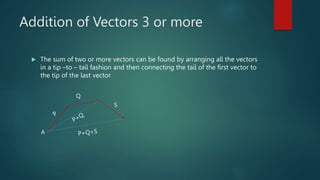
 The sum of two or more vectors can be found by arranging all the vectors
in a tip –to – tail fashion and then connecting the tail of the first vector to
the tip of the last vector
A
Q
S
PRODUCT OF SCALAR AND VECTOR
 Multiplying a vector by a scalar changes the vector’s magnitude but not its
direction.
P
1.5P
-2P
Resultant of Several Concurrent Forces
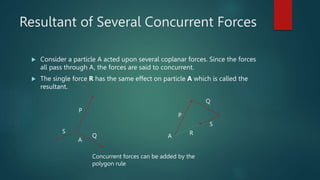
 Consider a particle A acted upon several coplanar forces. Since the forces
all pass through A, the forces are said to concurrent.
 The single force R has the same effect on particle A which is called the
resultant.
Q
P
A
S
A
Q
Q
P
S
R
Concurrent forces can be added by the
polygon rule
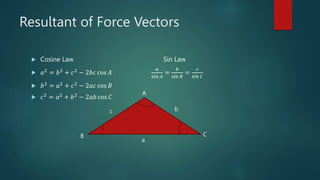
Resultant of Force Vectors
 Cosine Law Sin Law
 𝑎2 = 𝑏2 + 𝑐2 − 2𝑏𝑐 cos 𝐴
𝑎
sin 𝐴
=
𝑏
sin 𝐵
=
𝑐
sin 𝐶
 𝑏2 = 𝑎2 + 𝑐2 − 2𝑎𝑐 cos 𝐵
 𝑐2 = 𝑎2 + 𝑏2 − 2𝑎𝑏 cos 𝐶
B
A
C
a
c b
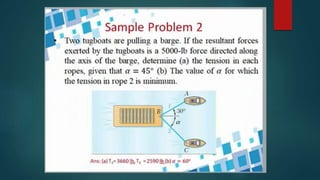
Sample Problem
 Two forces P and Q act on a bolt A. Determine the resultant
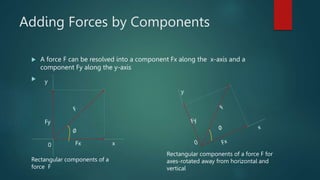
Adding Forces by Components
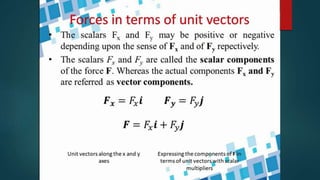
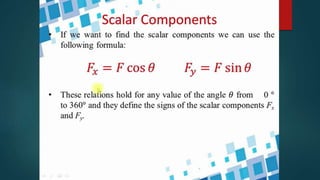
 A force F can be resolved into a component Fx along the x-axis and a
component Fy along the y-axis

Fx
Fy
x
y
0
∅
y
Rectangular components of a
force F
Rectangular components of a force F for
axes-rotated away from horizontal and
vertical
Vectors.pptx
Vectors.pptx
Vectors.pptx
Vectors.pptx
Vectors.pptx
Vectors.pptx
Vectors.pptx

Vectors.pptx

  • 1.
  • 2.
    Vectors  Vectors aredefined as mathematical expressions possessing magnitude and direction, which add according to the parallelogram law P P Equal vectors have the same magnitude and direction even if they have different points of application The negative of a vector has the same magnitude but opposite direction of the given vector P -P
  • 3.
    Addition of Vectors Vectors can be added according to parallelogram law or triangle rule A Q P P Q Using parallelogram law to add two vectors The triangle rule of vectors addition
  • 4.
    Addition of Vectors3 or more  The sum of two or more vectors can be found by arranging all the vectors in a tip –to – tail fashion and then connecting the tail of the first vector to the tip of the last vector A Q S
  • 5.
    PRODUCT OF SCALARAND VECTOR  Multiplying a vector by a scalar changes the vector’s magnitude but not its direction. P 1.5P -2P
  • 6.
    Resultant of SeveralConcurrent Forces  Consider a particle A acted upon several coplanar forces. Since the forces all pass through A, the forces are said to concurrent.  The single force R has the same effect on particle A which is called the resultant. Q P A S A Q Q P S R Concurrent forces can be added by the polygon rule
  • 7.
    Resultant of ForceVectors  Cosine Law Sin Law  𝑎2 = 𝑏2 + 𝑐2 − 2𝑏𝑐 cos 𝐴 𝑎 sin 𝐴 = 𝑏 sin 𝐵 = 𝑐 sin 𝐶  𝑏2 = 𝑎2 + 𝑐2 − 2𝑎𝑐 cos 𝐵  𝑐2 = 𝑎2 + 𝑏2 − 2𝑎𝑏 cos 𝐶 B A C a c b
  • 8.
    Sample Problem  Twoforces P and Q act on a bolt A. Determine the resultant
  • 10.
    Adding Forces byComponents  A force F can be resolved into a component Fx along the x-axis and a component Fy along the y-axis  Fx Fy x y 0 ∅ y Rectangular components of a force F Rectangular components of a force F for axes-rotated away from horizontal and vertical