UNIT VIII.
Prepared by: Carlo P. Cortez
This unit presents how media influences the economic, political, cultural, and social
aspects of people's lives and how globalization affects economic growth.
• MEDIA DEFINED- According to Lule (2014), the word media are tools used to store
and deliver information or data. The term is often used synonymously with mass
media, but it can also refer to a single medium used to communicate any data for any
purpose.
ROLE OF MEDIA
• Economic, political, cultural, and social changes and needs have contributed to the
development of various forms of media technology. It influenced and shaped
human life through generations.
• The mass media are today seen as playing a key role in enhancing globalization,
and facilitating cultural exchange and multiple flows of information and images
between countries through international news broadcasts, television programming,
new technologies, film, and music.
Evolution of Media and Globalization
• In the study of globalization, there are five time periods that usefully
capture the study of globalization and media such as oral, script, print,
electronic, and digital.
1. Oral Communication
• Speech is often the most overlooked medium in the history of
globalization. Yet the oral medium - human speech - is the oldest and
most enduring of all media. Despite numerous changes in hundreds of
years, the first and very last humans will share at least one thing - the
ability to speak.
• In our primitive lives, language and communication is a very important
tool in enriching knowledge, experiences, and skills in surviving
everyday life.
Evolution of Media and Globalization
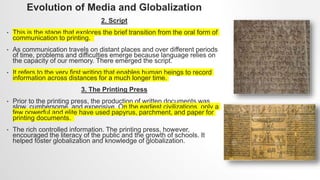
2. Script
• This is the stage that explores the brief transition from the oral form of
communication to printing.
• As communication travels on distant places and over different periods
of time, problems and difficulties emerge because language relies on
the capacity of our memory. There emerged the script.
• It refers to the very first writing that enables human beings to record
information across distances for a much longer time.
3. The Printing Press
• Prior to the printing press, the production of written documents was
slow, cumbersome, and expensive. On the earliest civilizations, only a
few powerful and elite have used papyrus, parchment, and paper for
printing documents.
• The rich controlled information. The printing press, however,
encouraged the literacy of the public and the growth of schools. It
helped foster globalization and knowledge of globalization.
4. Electronic Media
• Electronic media is an efficient way to communicate with
one another, either by the use of media devices or social
media sources such as radio, television, telephone, and
etc. Scholars have come to call these "electronic media"
because they require electromagnetic energy - electricity
- to use.
• Radio was developed alongside the telegraph and
telephone in the late 1890s. It was first conceived as a
"wireless telegraph". By the 1920s, broadcast stations
were "on the air" transmitting music and news.
• Television is the electronic delivery of moving images
and sound from a source to a receiver. By extending the
senses of vision and hearing beyond the limits of
physical distance, television has had a considerable
influence on society. (britannica.com) With Cable TV.
Television became an even more powerful medium
catering to a wide range of global interests such as arts,
adventure, entertainment, education, food, history,
nature, politics, travel, and many more.
• Digital Media
• Digital Media are most often electronic media that rely
on digital codes - the long arcane combinations of Os
and 1s that represent information. Ex. The digital code
for “A” is “01000001.” Every letter of the alphabet has
its own digital code. The code for “C” is “01000011.”
And the code for “T” is “01010100.”.
• Digital media is commonly used software, websites,
and social media but the computer, cellular phone,
and the internet are the usual representations of it. It
is currently the most significant media of influence to
globalization. It provides more interactive
communication, unlike print and TV which only
provides one-way communication.
• MEDIA AND GLOBALIZATION
1. Economy
• E-commerce is becoming a major form of business. Amazon, Lazada, and Zalora
are some examples of start-up companies that have grown into successful global e-
commerce platforms. Micro-Entrepreneurs like farmers, fishermen, and start-ups
are now able to access micro-financing using mobile phones or computers.
• The media have been essential to the growth of economic globalization in the world.
Indeed, the media have made it possible by creating the conditions for global
capitalism and by promoting the conceptual foundation of the world's market
economy.
2. Politics
• Globalization has transformed world politics in profound ways. Media is able to
spark collective public opinion and action towards politics. Even during election
campaigns, various forms of media have used by candidates to appeal for public
votes and by people to assert their support to candidates.
3. Education
• The internet is helping democratize access to affordable
learning as open universities, online courses, and webinars
are just one click away through phones and computers.
Media has made it easy to search for information on the
internet.
4. Culture
• Media is the primary carrier of culture. There is now a wealth
of exchange and fusion of culture including fashion, arts, and
music through the use of newspapers, magazines, movies,
advertisements, television, radio, the Internet, and other
forms of media.
• LOCAL AND GLOBAL CULTURAL PRODUCTION
• We use, adopt, and create a culture in different ways in our everyday
living, though we may not be conscious of it.
• Examples:
• • The way we dress
• • The way we communicate
• • The way we interact with others
• Though, media is a great help to the exchange and fusion of culture
around the world. There are also conflicting views on the impact of
globalization on cultural production.
• Negative Effect - it is a threat to the local economy and it has
disadvantages for poor countries and small businesses. It can also
destroy traditional culture, beliefs, and value systems and may result in
a loss of cultural identity.
• Positive Effect - it expands global market opportunities and it drives
economic growth in the poor parts of the world. Local culture enriches
when exposed to other cultures. It increases the knowledge and
understanding of people around the world.
• Globalization has grown due to the advancement of media and
technology. With the increased global interaction comes the growth of
international trade, ideas, and culture. There are positive and negative
points of view and these are not opposites but inherently
interdependent.

report-no.-5.pptx

  • 1.
    UNIT VIII. Prepared by:Carlo P. Cortez This unit presents how media influences the economic, political, cultural, and social aspects of people's lives and how globalization affects economic growth.
  • 2.
    • MEDIA DEFINED-According to Lule (2014), the word media are tools used to store and deliver information or data. The term is often used synonymously with mass media, but it can also refer to a single medium used to communicate any data for any purpose. ROLE OF MEDIA • Economic, political, cultural, and social changes and needs have contributed to the development of various forms of media technology. It influenced and shaped human life through generations. • The mass media are today seen as playing a key role in enhancing globalization, and facilitating cultural exchange and multiple flows of information and images between countries through international news broadcasts, television programming, new technologies, film, and music.
  • 3.
    Evolution of Mediaand Globalization • In the study of globalization, there are five time periods that usefully capture the study of globalization and media such as oral, script, print, electronic, and digital. 1. Oral Communication • Speech is often the most overlooked medium in the history of globalization. Yet the oral medium - human speech - is the oldest and most enduring of all media. Despite numerous changes in hundreds of years, the first and very last humans will share at least one thing - the ability to speak. • In our primitive lives, language and communication is a very important tool in enriching knowledge, experiences, and skills in surviving everyday life.
  • 4.
    Evolution of Mediaand Globalization 2. Script • This is the stage that explores the brief transition from the oral form of communication to printing. • As communication travels on distant places and over different periods of time, problems and difficulties emerge because language relies on the capacity of our memory. There emerged the script. • It refers to the very first writing that enables human beings to record information across distances for a much longer time. 3. The Printing Press • Prior to the printing press, the production of written documents was slow, cumbersome, and expensive. On the earliest civilizations, only a few powerful and elite have used papyrus, parchment, and paper for printing documents. • The rich controlled information. The printing press, however, encouraged the literacy of the public and the growth of schools. It helped foster globalization and knowledge of globalization.
  • 5.
    4. Electronic Media •Electronic media is an efficient way to communicate with one another, either by the use of media devices or social media sources such as radio, television, telephone, and etc. Scholars have come to call these "electronic media" because they require electromagnetic energy - electricity - to use. • Radio was developed alongside the telegraph and telephone in the late 1890s. It was first conceived as a "wireless telegraph". By the 1920s, broadcast stations were "on the air" transmitting music and news. • Television is the electronic delivery of moving images and sound from a source to a receiver. By extending the senses of vision and hearing beyond the limits of physical distance, television has had a considerable influence on society. (britannica.com) With Cable TV. Television became an even more powerful medium catering to a wide range of global interests such as arts, adventure, entertainment, education, food, history, nature, politics, travel, and many more.
  • 6.
    • Digital Media •Digital Media are most often electronic media that rely on digital codes - the long arcane combinations of Os and 1s that represent information. Ex. The digital code for “A” is “01000001.” Every letter of the alphabet has its own digital code. The code for “C” is “01000011.” And the code for “T” is “01010100.”. • Digital media is commonly used software, websites, and social media but the computer, cellular phone, and the internet are the usual representations of it. It is currently the most significant media of influence to globalization. It provides more interactive communication, unlike print and TV which only provides one-way communication.
  • 7.
    • MEDIA ANDGLOBALIZATION 1. Economy • E-commerce is becoming a major form of business. Amazon, Lazada, and Zalora are some examples of start-up companies that have grown into successful global e- commerce platforms. Micro-Entrepreneurs like farmers, fishermen, and start-ups are now able to access micro-financing using mobile phones or computers. • The media have been essential to the growth of economic globalization in the world. Indeed, the media have made it possible by creating the conditions for global capitalism and by promoting the conceptual foundation of the world's market economy. 2. Politics • Globalization has transformed world politics in profound ways. Media is able to spark collective public opinion and action towards politics. Even during election campaigns, various forms of media have used by candidates to appeal for public votes and by people to assert their support to candidates.
  • 8.
    3. Education • Theinternet is helping democratize access to affordable learning as open universities, online courses, and webinars are just one click away through phones and computers. Media has made it easy to search for information on the internet. 4. Culture • Media is the primary carrier of culture. There is now a wealth of exchange and fusion of culture including fashion, arts, and music through the use of newspapers, magazines, movies, advertisements, television, radio, the Internet, and other forms of media.
  • 9.
    • LOCAL ANDGLOBAL CULTURAL PRODUCTION • We use, adopt, and create a culture in different ways in our everyday living, though we may not be conscious of it. • Examples: • • The way we dress • • The way we communicate • • The way we interact with others • Though, media is a great help to the exchange and fusion of culture around the world. There are also conflicting views on the impact of globalization on cultural production.
  • 10.
    • Negative Effect- it is a threat to the local economy and it has disadvantages for poor countries and small businesses. It can also destroy traditional culture, beliefs, and value systems and may result in a loss of cultural identity. • Positive Effect - it expands global market opportunities and it drives economic growth in the poor parts of the world. Local culture enriches when exposed to other cultures. It increases the knowledge and understanding of people around the world. • Globalization has grown due to the advancement of media and technology. With the increased global interaction comes the growth of international trade, ideas, and culture. There are positive and negative points of view and these are not opposites but inherently interdependent.