GLOBAL MEDIA
CULTURES
P R E S E N T E D BY :
G R O U P 5
GLOBALIZATION
AND MEDIA
CULTURAL IMPERIALISM AND THE
GLOBAL MEDIA DEBATE
Cultural Imperialism – the idea that one culture can either influence or dominate
another.
 Theory that the audiences across the globe are heavily affected by the media
messages emanating from the Western industrialized countries.
 Media Imperialism only have minor differences to cultural imperialism
 Cultural Imperialism is firmly rooted in a political-economy perspective on
international communication
Early Stage of Cultural Imperialism
- Researchers focused their effort on mostly nation-states as primary actors in
international relations.
- The flow of news and entertainment was biased in favor of industrialized countries
- Developing nations received scant and prejudicial coverage in Western Media.
- The rise of New World Information Order (NWIO) debate, later known as New
World Information and Communication Order
- Debate among media representations in 1970s among developing countries in
UNESCO
- The debate was first focused on the news flows between north and south, it soon
evolve to include all international media flows.
Global Media Debate launched in 1973 during the General Conference of UNESCO in
Nairobi, Kenya
- Strong differences arose between Western industrialized nations and developing
countries
- Free flow of information vs. Concern of imbalance in international media flow
 The first group, which is led by the United States, insisted on “free flow of
information “ with a doctrine of advocating “free trade” in information and media
programs without restrictions.
 The second group, concerned on the lack of balance in international media flow,
accused the Western countries invoking the free flow of information ideology
Second Stage of Research in Cultural Imperialism
- Call to revive the New World Information and Communication Order debate
- Emphasis on commercialization of sphere of culture
- focused on transnational corporations as the primary actors on international
relations ; and on transnational capital flows
• Transnational corporation (TNC) - any enterprise that undertakes foreign direct
investment, owns or controls income-gathering assets in more than one
country, produces goods or services outside its country of origin, or engages in
international production. Variously termed multinational corporations (MNCs)
and multinational enterprises (MNEs), transnational corporations are formal
business organizations that have spatially dispersed operations in at least two
countries.
• "Culture is not a zero-sum game, so the greater reach of one culture does not
necessarily mean diminished stature for others. In the broad sweep of history,
many different traditions have grown together and flourished. American popular
culture will continue to make money, but the 21st century will bring a broad
melange of influences, with no clear world cultural leader." - Tyler cowen
• Capital flows refer to the movement of money for the purpose of investment, trade
or business production, including the flow of capital within corporations in the
form of investment capital, capital spending on operations and research and
development (R&D). On a larger scale, a government directs capital flows from tax
receipts into programs and operations and through trade with other nations and
currencies. Individual investors direct savings and investment capital into securities,
such as stocks, bonds, and mutual funds.
• Media flows is very much a one-way flow, since only about 2% of US TV
programmes are foreign imports (compared to about a third in most countries).
Such flows are often more regionalized, based on shared language and cultural
affinity. Governments often seek to control media flows as a way of protecting
national culture but online media have undermined this cultural gatekeeper role.
MEDIA, GLOBALIZATION, AND
HYBRIDIZATION
 The end of cold war as a global framework for ideological, Geopolitical, and
Economic competition calls for a rethinking of the analytical categories and
paradigms of thought.
 The nation state is no longer the sale or dominant player since transnational
transactions occur on sub national, national, and supranational levels.
 According to John Tomlinson (1991) Globalization replaced cultural imperialism
because it conveys a process with less coherence and direction, which will weaken
the cultural unity of all nation -states ,Not only those in the developing world.
 Globalization has emerged as a key perspective across the humanities and social
sciences, a current undoubtedly affecting the discipline of communication.
 Globalization of culture has become a conceptual magnet attracting research and
theorizing efforts from a variety of disciplines and interdisciplinary formations such
as anthropology, comparative literature, cultural studies, communication and
media studies, geography, and sociology.
Perspectives in Globalization of Culture
 somewhat reminiscent of cultural imperialism in terms of the nature of the effect
of media in culture, but somewhat different in conceptualization of the issue is the
view that the media contribute to the homogenization of cultural differences
across the planet
One of the Proponent:
Benjamin R. Barber (August 2, 1939 – April 24,
2017) --- American political theorist and author,
- Known for his book, Jihad vs. McWorld,(1995)
and for 2013's If Mayors Ruled the World as well
as the classic of democratic theory, 1984's
Strong Democracy (revised in 2004).
- He became a top-level international consultant
on participatory democracy as well as an adviser
to Bill Clinton, Howard Dean, and Muammar
Gaddafi.
 Another perspective on the globalization is cultural hybridity or hybridization. This
view privileges an understanding of the interface of globalization and localization
as a dynamic process and hybrid product of mixed traditions and cultural forms.
 Hybridization means blending of elements from different cultures.
 It advocates the emphasis on the processes of mediations that it views as central
to cultural globalization
Proponents of Hybridization :
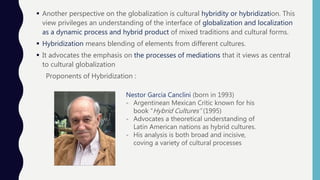
Nestor Garcia Canclini (born in 1993)
- Argentinean Mexican Critic known for his
book “Hybrid Cultures” (1995)
- Advocates a theoretical understanding of
Latin American nations as hybrid cultures.
- His analysis is both broad and incisive,
coving a variety of cultural processes
 Three Main Features of Cultural Hybridity, according to Garcia Canclini:
• Mixing of previously separate cultural systems
• Deterritorialization of cultural process from their physical environment to new
foreign context
• Entails impure cultural genres are formed out of the mixture of several cultural
domains
 In media and communication research, it is reasonable to assume that
transnational mass media intensify the hybridity that is already in existence in
cultures across the globe. Consequently, the globalization of culture through the
media is not a process of complete homogenization but rather one where
cohesion and fragmentation coexist.

Global Media cultures

  • 1.
    GLOBAL MEDIA CULTURES P RE S E N T E D BY : G R O U P 5
  • 2.
  • 3.
    CULTURAL IMPERIALISM ANDTHE GLOBAL MEDIA DEBATE Cultural Imperialism – the idea that one culture can either influence or dominate another.  Theory that the audiences across the globe are heavily affected by the media messages emanating from the Western industrialized countries.  Media Imperialism only have minor differences to cultural imperialism  Cultural Imperialism is firmly rooted in a political-economy perspective on international communication Early Stage of Cultural Imperialism - Researchers focused their effort on mostly nation-states as primary actors in international relations. - The flow of news and entertainment was biased in favor of industrialized countries - Developing nations received scant and prejudicial coverage in Western Media.
  • 4.
    - The riseof New World Information Order (NWIO) debate, later known as New World Information and Communication Order - Debate among media representations in 1970s among developing countries in UNESCO - The debate was first focused on the news flows between north and south, it soon evolve to include all international media flows. Global Media Debate launched in 1973 during the General Conference of UNESCO in Nairobi, Kenya - Strong differences arose between Western industrialized nations and developing countries - Free flow of information vs. Concern of imbalance in international media flow  The first group, which is led by the United States, insisted on “free flow of information “ with a doctrine of advocating “free trade” in information and media programs without restrictions.  The second group, concerned on the lack of balance in international media flow, accused the Western countries invoking the free flow of information ideology
  • 5.
    Second Stage ofResearch in Cultural Imperialism - Call to revive the New World Information and Communication Order debate - Emphasis on commercialization of sphere of culture - focused on transnational corporations as the primary actors on international relations ; and on transnational capital flows • Transnational corporation (TNC) - any enterprise that undertakes foreign direct investment, owns or controls income-gathering assets in more than one country, produces goods or services outside its country of origin, or engages in international production. Variously termed multinational corporations (MNCs) and multinational enterprises (MNEs), transnational corporations are formal business organizations that have spatially dispersed operations in at least two countries.
  • 6.
    • "Culture isnot a zero-sum game, so the greater reach of one culture does not necessarily mean diminished stature for others. In the broad sweep of history, many different traditions have grown together and flourished. American popular culture will continue to make money, but the 21st century will bring a broad melange of influences, with no clear world cultural leader." - Tyler cowen • Capital flows refer to the movement of money for the purpose of investment, trade or business production, including the flow of capital within corporations in the form of investment capital, capital spending on operations and research and development (R&D). On a larger scale, a government directs capital flows from tax receipts into programs and operations and through trade with other nations and currencies. Individual investors direct savings and investment capital into securities, such as stocks, bonds, and mutual funds. • Media flows is very much a one-way flow, since only about 2% of US TV programmes are foreign imports (compared to about a third in most countries). Such flows are often more regionalized, based on shared language and cultural affinity. Governments often seek to control media flows as a way of protecting national culture but online media have undermined this cultural gatekeeper role.
  • 7.
    MEDIA, GLOBALIZATION, AND HYBRIDIZATION The end of cold war as a global framework for ideological, Geopolitical, and Economic competition calls for a rethinking of the analytical categories and paradigms of thought.  The nation state is no longer the sale or dominant player since transnational transactions occur on sub national, national, and supranational levels.  According to John Tomlinson (1991) Globalization replaced cultural imperialism because it conveys a process with less coherence and direction, which will weaken the cultural unity of all nation -states ,Not only those in the developing world.  Globalization has emerged as a key perspective across the humanities and social sciences, a current undoubtedly affecting the discipline of communication.  Globalization of culture has become a conceptual magnet attracting research and theorizing efforts from a variety of disciplines and interdisciplinary formations such as anthropology, comparative literature, cultural studies, communication and media studies, geography, and sociology.
  • 8.
    Perspectives in Globalizationof Culture  somewhat reminiscent of cultural imperialism in terms of the nature of the effect of media in culture, but somewhat different in conceptualization of the issue is the view that the media contribute to the homogenization of cultural differences across the planet One of the Proponent: Benjamin R. Barber (August 2, 1939 – April 24, 2017) --- American political theorist and author, - Known for his book, Jihad vs. McWorld,(1995) and for 2013's If Mayors Ruled the World as well as the classic of democratic theory, 1984's Strong Democracy (revised in 2004). - He became a top-level international consultant on participatory democracy as well as an adviser to Bill Clinton, Howard Dean, and Muammar Gaddafi.
  • 9.
     Another perspectiveon the globalization is cultural hybridity or hybridization. This view privileges an understanding of the interface of globalization and localization as a dynamic process and hybrid product of mixed traditions and cultural forms.  Hybridization means blending of elements from different cultures.  It advocates the emphasis on the processes of mediations that it views as central to cultural globalization Proponents of Hybridization : Nestor Garcia Canclini (born in 1993) - Argentinean Mexican Critic known for his book “Hybrid Cultures” (1995) - Advocates a theoretical understanding of Latin American nations as hybrid cultures. - His analysis is both broad and incisive, coving a variety of cultural processes
  • 10.
     Three MainFeatures of Cultural Hybridity, according to Garcia Canclini: • Mixing of previously separate cultural systems • Deterritorialization of cultural process from their physical environment to new foreign context • Entails impure cultural genres are formed out of the mixture of several cultural domains  In media and communication research, it is reasonable to assume that transnational mass media intensify the hybridity that is already in existence in cultures across the globe. Consequently, the globalization of culture through the media is not a process of complete homogenization but rather one where cohesion and fragmentation coexist.