MEDIA AND
GLOBALIZATION
G R O U P N O . 1
MEDIA
GLOBALIZATION
MEDIA
GLOBALIZATION It is the interconnectedness of people and
business across the world that eventually lead to global,
cultural, political and economic integration.
-
It is the ability to move and communicate easily with others all
over the world in order to conduct business internationally.
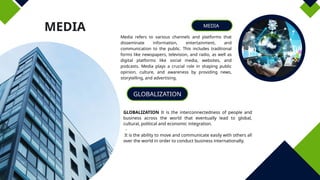
Media refers to various channels and platforms that
disseminate information, entertainment, and
communication to the public. This includes traditional
forms like newspapers, television, and radio, as well as
digital platforms like social media, websites, and
podcasts. Media plays a crucial role in shaping public
opinion, culture, and awareness by providing news,
storytelling, and advertising.
The role of media in humanization through globalization involves the media's
capacity to connect people across the world, promote shared values, foster
understanding, and build empathy across different cultures. It helps people from
diverse backgrounds see each other as part of a shared global community, which
leads to greater humanization by reducing prejudices and stereotypes
1. Promoting Cultural Awareness and Exchange
The media plays a key role in promoting cultural exchange by showcasing diverse
cultures, traditions, and lifestyles, helping individuals appreciate and understand
different ways of life.
2. Advocating Human Rights and Social Justice
Media brings attention to human rights issues around the world, pushing for
global action. It amplifies the voices of marginalized communities, showcasing
their struggles and aspirations to a global audience.
3. Bridging Communication Gaps
Media breaks down language and geographical barriers by providing translation
tools and multi-lingual content, making it easier for people to communicate and
share ideas globally.
4. Providing a Platform for Global Discourse
Media outlets create platforms where global issues can be discussed, debated,
and resolved, allowing for diverse perspectives and collective problem-solving on
matters like climate change, pandemics, or international conflicts.
5. Fostering Global Solidarity during Crises
In times of global crises, media serves as a critical tool in mobilizing support and
showing collective resilience.
Media and Globalization
1. All media messages are constructed.
2. Media messages are constructed using a creative
language with its own rules.
3. Different people experience the same media
message differently.
4. Media have embedded values and points of view.
5. Most media messages are organized to gain
profit and/or power.
CONCEPTS OF MEDIA
Traditional Media
Print Media: Newspapers, magazines, books, brochures, flyers, etc.
Broadcast Media: Television, radio
Digital Media
Internet Media: Websites, blogs, social media platforms, email, etc.
Mobile Media: Smartphones, tablets, other mobile devices
Outdoor Media
Billboards, posters, signs, etc.
FORMS OF MEDIA
CLASSIFICATIONS OF MEDIA CHANNELS
1.PRINT MEDIA
2.BROADCAST MEDIA
3.DIGITAL MEDIA
4.MOBILE / INTERNET MEDIA
5.OUTDOOR MEDIA
PRINT
MEDIA
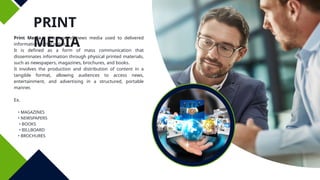
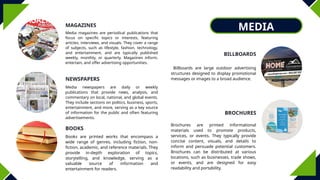
Print Media - this type of news media used to delivered
information to the public.
It is defined as a form of mass communication that
disseminates information through physical printed materials,
such as newspapers, magazines, brochures, and books.
It involves the production and distribution of content in a
tangible format, allowing audiences to access news,
entertainment, and advertising in a structured, portable
manner.
Ex.
• MAGAZINES
• NEWSPAPERS
• BOOKS
• BILLBOARD
• BROCHURES
MEDIA
MAGAZINES
BOOKS
BILLBOARDS
BROCHURES
NEWSPAPERS
Media magazines are periodical publications that
focus on specific topics or interests, featuring
articles, interviews, and visuals. They cover a range
of subjects, such as lifestyle, fashion, technology,
and entertainment, and are typically published
weekly, monthly, or quarterly. Magazines inform,
entertain, and offer advertising opportunities.
Media newspapers are daily or weekly
publications that provide news, analysis, and
commentary on local, national, and global events.
They include sections on politics, business, sports,
entertainment, and more, serving as a key source
of information for the public and often featuring
advertisements.
Books are printed works that encompass a
wide range of genres, including fiction, non-
fiction, academic, and reference materials. They
provide in-depth exploration of topics,
storytelling, and knowledge, serving as a
valuable source of information and
entertainment for readers.
Billboards are large outdoor advertising
structures designed to display promotional
messages or images to a broad audience.
Brochures are printed informational
materials used to promote products,
services, or events. They typically provide
concise content, visuals, and details to
inform and persuade potential customers.
Brochures can be distributed at various
locations, such as businesses, trade shows,
or events, and are designed for easy
readability and portability.
Broadcast Media
Broadcast Media - It is the most expedient means to
transmit information immediately to the widest possible
audience.
It includes videos, audios, or written content that provides i
mportant or entertaining information shared by different
methods.
Ex.
• Television
• Radio
• Movies
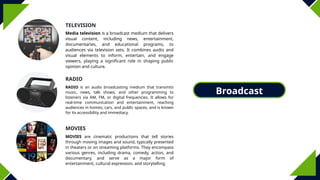
Broadcast
Media
TELEVISION
MOVIES
RADIO
Media television is a broadcast medium that delivers
visual content, including news, entertainment,
documentaries, and educational programs, to
audiences via television sets. It combines audio and
visual elements to inform, entertain, and engage
viewers, playing a significant role in shaping public
opinion and culture.
RADIO is an audio broadcasting medium that transmits
music, news, talk shows, and other programming to
listeners via AM, FM, or digital frequencies. It allows for
real-time communication and entertainment, reaching
audiences in homes, cars, and public spaces, and is known
for its accessibility and immediacy.
MOVIES are cinematic productions that tell stories
through moving images and sound, typically presented
in theaters or on streaming platforms. They encompass
various genres, including drama, comedy, action, and
documentary, and serve as a major form of
entertainment, cultural expression, and storytelling.
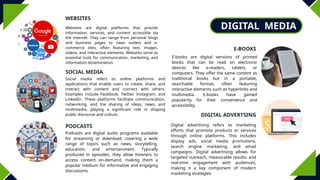
Digital Media
Digital Media - It is digitized content that cant be
transmitted over the internet or computer networks.
It refers to content that is created, stored, and
distributed in digital formats, accessible through
electronic devices.
Ex.
Websites:
Social Media:
Podcasts:
E-books:
Digital Advertising:
DIGITAL MEDIA
WEBSITES
PODCASTS
E-BOOKS
DIGITAL ADVERTSING
SOCIAL MEDIA
Websites are digital platforms that provide
information, services, and content accessible via
the internet. They can range from personal blogs
and business pages to news outlets and e-
commerce sites, often featuring text, images,
videos, and interactive elements. Websites serve as
essential tools for communication, marketing, and
information dissemination.
Social media refers to online platforms and
applications that enable users to create, share, and
interact with content and connect with others.
Examples include Facebook, Twitter, Instagram, and
LinkedIn. These platforms facilitate communication,
networking, and the sharing of ideas, news, and
multimedia, playing a significant role in shaping
public discourse and culture.
Podcasts are digital audio programs available
for streaming or download, covering a wide
range of topics such as news, storytelling,
education, and entertainment. Typically
produced in episodes, they allow listeners to
access content on-demand, making them a
popular medium for informative and engaging
discussions.
E-books are digital versions of printed
books that can be read on electronic
devices like e-readers, tablets, or
computers. They offer the same content as
traditional books but in a portable,
searchable format, often featuring
interactive elements such as hyperlinks and
multimedia. E-books have gained
popularity for their convenience and
accessibility.
Digital advertising refers to marketing
efforts that promote products or services
through online platforms. This includes
display ads, social media promotions,
search engine marketing, and email
campaigns. Digital advertising allows for
targeted outreach, measurable results, and
real-time engagement with audiences,
making it a key component of modern
marketing strategies.
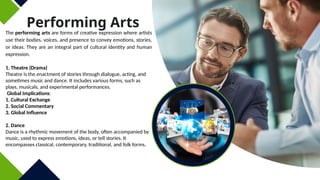
Performing Arts
The performing arts are forms of creative expression where artists
use their bodies, voices, and presence to convey emotions, stories,
or ideas. They are an integral part of cultural identity and human
expression.
1. Theatre (Drama)
Theatre is the enactment of stories through dialogue, acting, and
sometimes music and dance. It includes various forms, such as
plays, musicals, and experimental performances.
Global Implications:
1. Cultural Exchange
2. Social Commentary
3. Global Influence
2. Dance
Dance is a rhythmic movement of the body, often accompanied by
music, used to express emotions, ideas, or tell stories. It
encompasses classical, contemporary, traditional, and folk forms.
• Global Implications:
– Cultural Identity
– Cross-cultural Influence
– Diplomacy and Collaboration
• 3. Music
Music, one of the most universal forms of performing arts, uses sound organized in time to convey emotion and
meaning. It encompasses genres like classical, folk, jazz, rock, and pop, among many others.
• Global Implications:
1. Cultural Fusion
2. Social Movements
3. Economic Impact
4. Opera
• Opera combines singing, acting, orchestral music, and often dance, to tell a dramatic story. It originated in
Italy but has since evolved and spread globally.
• Global Implications:
• Cultural Preservation
• Global Adaptation
• Cultural Diplomacy
5. Circus Arts
• Circus arts combine acrobatics, clowning, juggling, and other forms of physical performance, often performed
in arenas or tents. It’s an ancient art form with roots in various cultures.
• Global Implications:
• Global Appeal
• Cultural Hybridity
• Social Outreach
• 6. Puppetry
• Puppetry involves the manipulation of puppets to tell stories, using various
techniques such as marionettes, hand puppets, or shadow puppets. It has roots in
ancient civilizations like Egypt, Greece, and China.
• Global Implications:
– Cultural Transmission
– Cross-cultural Dialogue
– Educational and Therapeutic Use
• 7. Performance Art
• Performance art is a highly experimental form of performing art that combines
visual arts, theater, music, and other media in live, often non-traditional venues. It
focuses more on the concept and the process than the final product.
• Global Implications:
1. Political and Social Commentary
2. Cultural Experimentation
3. Digital Integration
• 8. Mime
• Mime is a form of silent performance where actors express emotions and actions
through body movements, facial expressions, and gestures without speaking.
• Global Implications:
• Universal Language
• Cultural Evolution
• Cultural Adaptations
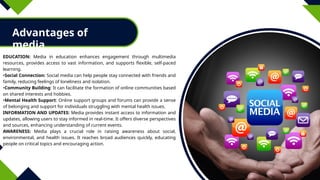
Advantages of
media
EDUCATION: Media in education enhances engagement through multimedia
resources, provides access to vast information, and supports flexible, self-paced
learning.
•Social Connection: Social media can help people stay connected with friends and
family, reducing feelings of loneliness and isolation.
•Community Building: It can facilitate the formation of online communities based
on shared interests and hobbies.
•Mental Health Support: Online support groups and forums can provide a sense
of belonging and support for individuals struggling with mental health issues.
INFORMATION AND UPDATES: Media provides instant access to information and
updates, allowing users to stay informed in real-time. It offers diverse perspectives
and sources, enhancing understanding of current events.
AWARENESS: Media plays a crucial role in raising awareness about social,
environmental, and health issues. It reaches broad audiences quickly, educating
people on critical topics and encouraging action.
Disadvantages of
media
HACKING: Hacking media poses significant risks, including data breaches that
compromise personal information and privacy. It can lead to misinformation,
damaging reputations and eroding trust in credible sources.
•Sleep Disruption: The blue light emitted by screens can interfere with sleep
patterns, leading to sleep deprivation and its associated mental health issues.
•Cyberbullying: Cyberbullying and online harassment can have severe
emotional and psychological consequences.
ADDICTION: Media addiction can lead to negative effects on mental health,
including anxiety and depression, as excessive consumption may disrupt real-
life interactions. It can reduce productivity, impair focus, and lead to unhealthy
lifestyle choices, such as sedentary behavior.
•Anxiety and Depression: Social media can contribute to anxiety and
depression by amplifying negative thoughts and feelings
HEALTH ISSUE: Media can contribute to health issues by promoting unrealistic
body images and lifestyle standards, leading to body dissatisfaction and eating
disorders. Excessive screen time is linked to physical problems, such as eye
strain and poor posture, as well as mental health concerns like anxiety and
depression, particularly among youth.
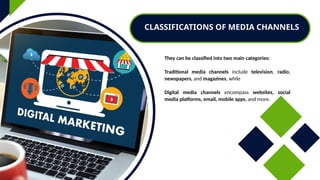
They can be classified into two main categories:
Traditional media channels include television, radio,
newspapers, and magazines, while
Digital media channels encompass websites, social
media platforms, email, mobile apps, and more.
CLASSIFICATIONS OF MEDIA CHANNELS
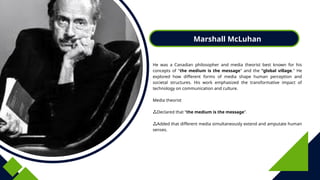
Marshall McLuhan
He was a Canadian philosopher and media theorist best known for his
concepts of "the medium is the message" and the "global village." He
explored how different forms of media shape human perception and
societal structures. His work emphasized the transformative impact of
technology on communication and culture.
Media theorist
Declared that “the medium is the message”.
Added that different media simultaneously extend and amputate human
senses.
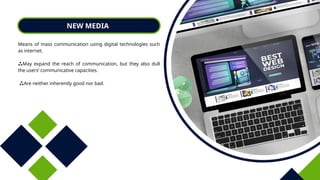
NEW MEDIA
Means of mass communication using digital technologies such
as internet.
May expand the reach of communication, but they also dull
the users’ communicative capacities.
Are neither inherently good nor bad.
How can media affect
Globalization?
• Information Dissemination: It enables rapid sharing
of news and information across borders, fostering a
global awareness of events and issues.
• Cultural Exchange: Media promotes the exchange of
cultural products, such as films, music, and art,
facilitating cross-cultural interactions and influences.
• Economic Integration: Advertising and marketing
through media can create global brands, linking
economies and markets.
• Social Connectivity: Social media platforms connect
individuals worldwide, allowing for collaboration,
activism, and the formation of global communities.
• Language and Education: Access to educational
content and resources in multiple languages helps
bridge knowledge gaps and promote understanding.
Jacqueline Thompson
Meet Our Group Member’s
Jhela Mae Ramos Abegail T.
Elhig
Aizyl Mae Arnaiz Ma. Lenie Bayles Kenneth Seloterio
Avegail Pardillo
•QUIZ
1. It is a digital audio programs available for streaming or download,
covering a wide range of topics such as news, storytelling, education, and
entertainment.
2. He was a Canadian philosopher and media theorist best known for his
concepts of "the medium is the message" and the "global village.“
3. It is digitized content that cant be transmitted over the internet or
computer networks.
4. It is defined as a form of mass communication that disseminates
information through physical printed materials, such as newspapers,
magazines, brochures, and books.
5. He describes media as “ a mean of conveying something, such as channel
of communication’.
6-9 Give the four types of media.
10. Give me atleast one function of media.
THANK YOU
E V E R Y O N E !
M A B U H A Y ! !

SUPER FINAL TOPIC-3.-MEDIA-AND-GLOBALIZATION.pptx

  • 1.
  • 2.
    MEDIA GLOBALIZATION MEDIA GLOBALIZATION It isthe interconnectedness of people and business across the world that eventually lead to global, cultural, political and economic integration. - It is the ability to move and communicate easily with others all over the world in order to conduct business internationally. Media refers to various channels and platforms that disseminate information, entertainment, and communication to the public. This includes traditional forms like newspapers, television, and radio, as well as digital platforms like social media, websites, and podcasts. Media plays a crucial role in shaping public opinion, culture, and awareness by providing news, storytelling, and advertising.
  • 3.
    The role ofmedia in humanization through globalization involves the media's capacity to connect people across the world, promote shared values, foster understanding, and build empathy across different cultures. It helps people from diverse backgrounds see each other as part of a shared global community, which leads to greater humanization by reducing prejudices and stereotypes 1. Promoting Cultural Awareness and Exchange The media plays a key role in promoting cultural exchange by showcasing diverse cultures, traditions, and lifestyles, helping individuals appreciate and understand different ways of life. 2. Advocating Human Rights and Social Justice Media brings attention to human rights issues around the world, pushing for global action. It amplifies the voices of marginalized communities, showcasing their struggles and aspirations to a global audience. 3. Bridging Communication Gaps Media breaks down language and geographical barriers by providing translation tools and multi-lingual content, making it easier for people to communicate and share ideas globally. 4. Providing a Platform for Global Discourse Media outlets create platforms where global issues can be discussed, debated, and resolved, allowing for diverse perspectives and collective problem-solving on matters like climate change, pandemics, or international conflicts. 5. Fostering Global Solidarity during Crises In times of global crises, media serves as a critical tool in mobilizing support and showing collective resilience. Media and Globalization
  • 4.
    1. All mediamessages are constructed. 2. Media messages are constructed using a creative language with its own rules. 3. Different people experience the same media message differently. 4. Media have embedded values and points of view. 5. Most media messages are organized to gain profit and/or power. CONCEPTS OF MEDIA
  • 5.
    Traditional Media Print Media:Newspapers, magazines, books, brochures, flyers, etc. Broadcast Media: Television, radio Digital Media Internet Media: Websites, blogs, social media platforms, email, etc. Mobile Media: Smartphones, tablets, other mobile devices Outdoor Media Billboards, posters, signs, etc. FORMS OF MEDIA CLASSIFICATIONS OF MEDIA CHANNELS 1.PRINT MEDIA 2.BROADCAST MEDIA 3.DIGITAL MEDIA 4.MOBILE / INTERNET MEDIA 5.OUTDOOR MEDIA
  • 6.
    PRINT MEDIA Print Media -this type of news media used to delivered information to the public. It is defined as a form of mass communication that disseminates information through physical printed materials, such as newspapers, magazines, brochures, and books. It involves the production and distribution of content in a tangible format, allowing audiences to access news, entertainment, and advertising in a structured, portable manner. Ex. • MAGAZINES • NEWSPAPERS • BOOKS • BILLBOARD • BROCHURES
  • 7.
    MEDIA MAGAZINES BOOKS BILLBOARDS BROCHURES NEWSPAPERS Media magazines areperiodical publications that focus on specific topics or interests, featuring articles, interviews, and visuals. They cover a range of subjects, such as lifestyle, fashion, technology, and entertainment, and are typically published weekly, monthly, or quarterly. Magazines inform, entertain, and offer advertising opportunities. Media newspapers are daily or weekly publications that provide news, analysis, and commentary on local, national, and global events. They include sections on politics, business, sports, entertainment, and more, serving as a key source of information for the public and often featuring advertisements. Books are printed works that encompass a wide range of genres, including fiction, non- fiction, academic, and reference materials. They provide in-depth exploration of topics, storytelling, and knowledge, serving as a valuable source of information and entertainment for readers. Billboards are large outdoor advertising structures designed to display promotional messages or images to a broad audience. Brochures are printed informational materials used to promote products, services, or events. They typically provide concise content, visuals, and details to inform and persuade potential customers. Brochures can be distributed at various locations, such as businesses, trade shows, or events, and are designed for easy readability and portability.
  • 8.
    Broadcast Media Broadcast Media- It is the most expedient means to transmit information immediately to the widest possible audience. It includes videos, audios, or written content that provides i mportant or entertaining information shared by different methods. Ex. • Television • Radio • Movies
  • 9.
    Broadcast Media TELEVISION MOVIES RADIO Media television isa broadcast medium that delivers visual content, including news, entertainment, documentaries, and educational programs, to audiences via television sets. It combines audio and visual elements to inform, entertain, and engage viewers, playing a significant role in shaping public opinion and culture. RADIO is an audio broadcasting medium that transmits music, news, talk shows, and other programming to listeners via AM, FM, or digital frequencies. It allows for real-time communication and entertainment, reaching audiences in homes, cars, and public spaces, and is known for its accessibility and immediacy. MOVIES are cinematic productions that tell stories through moving images and sound, typically presented in theaters or on streaming platforms. They encompass various genres, including drama, comedy, action, and documentary, and serve as a major form of entertainment, cultural expression, and storytelling.
  • 10.
    Digital Media Digital Media- It is digitized content that cant be transmitted over the internet or computer networks. It refers to content that is created, stored, and distributed in digital formats, accessible through electronic devices. Ex. Websites: Social Media: Podcasts: E-books: Digital Advertising:
  • 11.
    DIGITAL MEDIA WEBSITES PODCASTS E-BOOKS DIGITAL ADVERTSING SOCIALMEDIA Websites are digital platforms that provide information, services, and content accessible via the internet. They can range from personal blogs and business pages to news outlets and e- commerce sites, often featuring text, images, videos, and interactive elements. Websites serve as essential tools for communication, marketing, and information dissemination. Social media refers to online platforms and applications that enable users to create, share, and interact with content and connect with others. Examples include Facebook, Twitter, Instagram, and LinkedIn. These platforms facilitate communication, networking, and the sharing of ideas, news, and multimedia, playing a significant role in shaping public discourse and culture. Podcasts are digital audio programs available for streaming or download, covering a wide range of topics such as news, storytelling, education, and entertainment. Typically produced in episodes, they allow listeners to access content on-demand, making them a popular medium for informative and engaging discussions. E-books are digital versions of printed books that can be read on electronic devices like e-readers, tablets, or computers. They offer the same content as traditional books but in a portable, searchable format, often featuring interactive elements such as hyperlinks and multimedia. E-books have gained popularity for their convenience and accessibility. Digital advertising refers to marketing efforts that promote products or services through online platforms. This includes display ads, social media promotions, search engine marketing, and email campaigns. Digital advertising allows for targeted outreach, measurable results, and real-time engagement with audiences, making it a key component of modern marketing strategies.
  • 12.
    Performing Arts The performingarts are forms of creative expression where artists use their bodies, voices, and presence to convey emotions, stories, or ideas. They are an integral part of cultural identity and human expression. 1. Theatre (Drama) Theatre is the enactment of stories through dialogue, acting, and sometimes music and dance. It includes various forms, such as plays, musicals, and experimental performances. Global Implications: 1. Cultural Exchange 2. Social Commentary 3. Global Influence 2. Dance Dance is a rhythmic movement of the body, often accompanied by music, used to express emotions, ideas, or tell stories. It encompasses classical, contemporary, traditional, and folk forms.
  • 13.
    • Global Implications: –Cultural Identity – Cross-cultural Influence – Diplomacy and Collaboration • 3. Music Music, one of the most universal forms of performing arts, uses sound organized in time to convey emotion and meaning. It encompasses genres like classical, folk, jazz, rock, and pop, among many others. • Global Implications: 1. Cultural Fusion 2. Social Movements 3. Economic Impact 4. Opera • Opera combines singing, acting, orchestral music, and often dance, to tell a dramatic story. It originated in Italy but has since evolved and spread globally. • Global Implications: • Cultural Preservation • Global Adaptation • Cultural Diplomacy 5. Circus Arts • Circus arts combine acrobatics, clowning, juggling, and other forms of physical performance, often performed in arenas or tents. It’s an ancient art form with roots in various cultures. • Global Implications: • Global Appeal • Cultural Hybridity • Social Outreach • 6. Puppetry • Puppetry involves the manipulation of puppets to tell stories, using various techniques such as marionettes, hand puppets, or shadow puppets. It has roots in ancient civilizations like Egypt, Greece, and China. • Global Implications: – Cultural Transmission – Cross-cultural Dialogue – Educational and Therapeutic Use • 7. Performance Art • Performance art is a highly experimental form of performing art that combines visual arts, theater, music, and other media in live, often non-traditional venues. It focuses more on the concept and the process than the final product. • Global Implications: 1. Political and Social Commentary 2. Cultural Experimentation 3. Digital Integration • 8. Mime • Mime is a form of silent performance where actors express emotions and actions through body movements, facial expressions, and gestures without speaking. • Global Implications: • Universal Language • Cultural Evolution • Cultural Adaptations
  • 14.
    Advantages of media EDUCATION: Mediain education enhances engagement through multimedia resources, provides access to vast information, and supports flexible, self-paced learning. •Social Connection: Social media can help people stay connected with friends and family, reducing feelings of loneliness and isolation. •Community Building: It can facilitate the formation of online communities based on shared interests and hobbies. •Mental Health Support: Online support groups and forums can provide a sense of belonging and support for individuals struggling with mental health issues. INFORMATION AND UPDATES: Media provides instant access to information and updates, allowing users to stay informed in real-time. It offers diverse perspectives and sources, enhancing understanding of current events. AWARENESS: Media plays a crucial role in raising awareness about social, environmental, and health issues. It reaches broad audiences quickly, educating people on critical topics and encouraging action.
  • 15.
    Disadvantages of media HACKING: Hackingmedia poses significant risks, including data breaches that compromise personal information and privacy. It can lead to misinformation, damaging reputations and eroding trust in credible sources. •Sleep Disruption: The blue light emitted by screens can interfere with sleep patterns, leading to sleep deprivation and its associated mental health issues. •Cyberbullying: Cyberbullying and online harassment can have severe emotional and psychological consequences. ADDICTION: Media addiction can lead to negative effects on mental health, including anxiety and depression, as excessive consumption may disrupt real- life interactions. It can reduce productivity, impair focus, and lead to unhealthy lifestyle choices, such as sedentary behavior. •Anxiety and Depression: Social media can contribute to anxiety and depression by amplifying negative thoughts and feelings HEALTH ISSUE: Media can contribute to health issues by promoting unrealistic body images and lifestyle standards, leading to body dissatisfaction and eating disorders. Excessive screen time is linked to physical problems, such as eye strain and poor posture, as well as mental health concerns like anxiety and depression, particularly among youth.
  • 16.
    They can beclassified into two main categories: Traditional media channels include television, radio, newspapers, and magazines, while Digital media channels encompass websites, social media platforms, email, mobile apps, and more. CLASSIFICATIONS OF MEDIA CHANNELS
  • 17.
    Marshall McLuhan He wasa Canadian philosopher and media theorist best known for his concepts of "the medium is the message" and the "global village." He explored how different forms of media shape human perception and societal structures. His work emphasized the transformative impact of technology on communication and culture. Media theorist Declared that “the medium is the message”. Added that different media simultaneously extend and amputate human senses.
  • 18.
    NEW MEDIA Means ofmass communication using digital technologies such as internet. May expand the reach of communication, but they also dull the users’ communicative capacities. Are neither inherently good nor bad.
  • 19.
    How can mediaaffect Globalization? • Information Dissemination: It enables rapid sharing of news and information across borders, fostering a global awareness of events and issues. • Cultural Exchange: Media promotes the exchange of cultural products, such as films, music, and art, facilitating cross-cultural interactions and influences. • Economic Integration: Advertising and marketing through media can create global brands, linking economies and markets. • Social Connectivity: Social media platforms connect individuals worldwide, allowing for collaboration, activism, and the formation of global communities. • Language and Education: Access to educational content and resources in multiple languages helps bridge knowledge gaps and promote understanding.
  • 20.
    Jacqueline Thompson Meet OurGroup Member’s Jhela Mae Ramos Abegail T. Elhig Aizyl Mae Arnaiz Ma. Lenie Bayles Kenneth Seloterio Avegail Pardillo
  • 21.
    •QUIZ 1. It isa digital audio programs available for streaming or download, covering a wide range of topics such as news, storytelling, education, and entertainment. 2. He was a Canadian philosopher and media theorist best known for his concepts of "the medium is the message" and the "global village.“ 3. It is digitized content that cant be transmitted over the internet or computer networks. 4. It is defined as a form of mass communication that disseminates information through physical printed materials, such as newspapers, magazines, brochures, and books. 5. He describes media as “ a mean of conveying something, such as channel of communication’. 6-9 Give the four types of media. 10. Give me atleast one function of media.
  • 22.
    THANK YOU E VE R Y O N E ! M A B U H A Y ! !