1
‫االسم‬
:
-
‫حمزة‬ ‫مرزة‬ ‫حاتم‬ ‫عدي‬
A :‫الشعبة‬
:‫المرحلة‬
-
‫الثالثة‬
EMAIL :-O.Hatam1703@coeng.uobaghdad.edu.iq
2
OBJECTIVES…………………………………………………………………………………(1)
INTRODUCTION ………………………………………………………………………….(2)
DAMPERS…………………………………………………………………………………….(3)
APPLICATION……………………………………………………………………………….(4)
CEILING TYPE………………………………………………………………………………(4.1)
TUNED MASS DAMPER……………………………………………………………….(4.2)
VARIABLE SPEED MACHINES……………………………………………………….(4.3)
ANALYSIS…………………………………………………………………………………….(5)
DISCUSSION…………………………………………………………………………………(6)
REFERENCES………………………………………………………………………………..(7)
CONTENT
3
1. Objectives
• Use vibration nomographs and vibration criteria to determine the leve
vibration to be controlled or reduced.
• Apply one- and two-plane balancing techniques for eliminating vibration
(unbalance).
• Control the vibration caused by the unbalance in rotating shafts.
• Reduce the unbalance in reciprocating engines.
• Design vibration and shock isolations for systems with fixed base as well
as vibrating base.
• Design active vibration-control systems.
• Design undamped and damped vibration absorbers
There are numerous sources of vibration in an industrial environment:
impact processes such as pile driving and blasting; rotating or reciprocating
machinery such as engines, compressors, and motors; transportation
vehicles such as trucks, trains, and aircraft; and the flow of fluids. The
presence of vibration often leads to excessive wear of bearings,
formation of cracks, loosening of fasteners, structural and mechanical
failures, frequent and costly maintenance of machines, electronic
malfunctions through fracture of solder joints, and abrasion of insulation
around electric conductors causing shorts. The occupational
1.OBJECTIVES
2. Introduction
4
exposure of humans to vibration leads to pain, discomfort, and reduced
efficiency. Vibration can sometimes be eliminated on the basis of
theoretical analysis. However, the manufacturing costs involved in
eliminating the vibration may be too high; a designer must compromise
between an acceptable amount of vibration and a reasonable
manufacturing cost. In some cases the excitation or shaking force is
inherent in the machine. As seen earlier, even a relatively small excitation
force can cause an undesirably large response near resonance, especially
in lightly damped systems. In these cases, the magnitude of the
response can be significantly reduced by the use of isolators and auxiliary
mass absorbers
Material used in vibration dampers:
Metal, polymers, cement and their composites. Metal and polymer are dominant due
to their viscoelasticity. Damping enhancement mainly involves micro-structural
design for metals, interface design for polymers and admixture use for cement.
Metals:
• SMA’s
• Ferromagnetic alloys provide damping through magneto-mechanical
mechanism i.e. movement of magnetic domain in boundaries during vibration.
• Other alloys provide damping through micro-structural design. It is used due
to their low cost.
Polymers:
Due to their viscoelastic behavior, polymers (particularly thermoplastics) can
provide damping ability. Polymer used for damping rubber, polytetrafluoroethylene
(PTFE), polyurethane, polypropylene, polyvinylchloride, polyimide or other
polymer network. In general, elastomer and other amorphous thermoplastics with a
glass transition temperature below room temperature are attractive for damping.
Polymer blends and interpenetrating networks are also attractive, due to the interface
between the components in the blend or network providing a mechanism for
3. Dampers
5
damping. In relation to fibrous structural composites, viscoelastic polymeric
interlayer's between the laminae of continuous fibers are often used for damping.
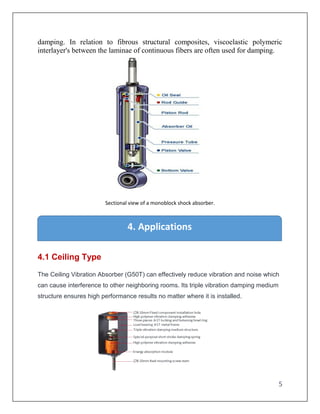
Sectional view of a monoblock shock absorber.
4.1 Ceiling Type
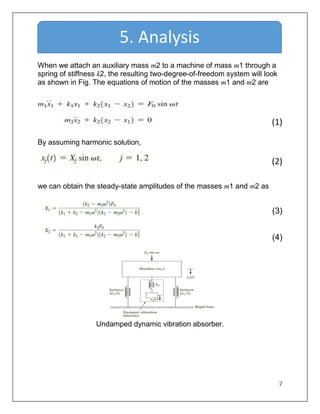
The Ceiling Vibration Absorber (G50T) can effectively reduce vibration and noise which
can cause interference to other neighboring rooms. Its triple vibration damping medium
structure ensures high performance results no matter where it is installed.
4. Applications
6
4.2 Tuned mass damper
A tuned mass damper (TMD), also known as a harmonic absorber or seismic damper, is
a device mounted in structures to reduce the amplitude of mechanical vibrations. Their
application can prevent discomfort, damage, or outright structural failure. They are
frequently used in power transmission, automobiles, and buildings.
4.3 Variable Speed Machines
With the wide use of variable frequency drives in the pump industry and increasing unit
size, it is becoming more diffi cult to design mechanical systems free from natural
frequencies within operating speed range. If such an occurrence is allowed in the fi eld,
a resulting resonance condition threatens to signifi cantly impact performance and
longevity of the equipment. Traditional treatment methods that involve structural modifi
cations are often time consuming and expensive.
7
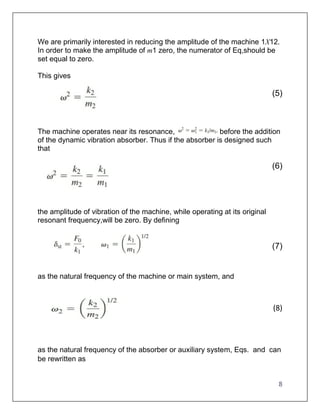
When we attach an auxiliary mass m2 to a machine of mass m1 through a
spring of stiffness k2, the resulting two-degree-of-freedom system will look
as shown in Fig. The equations of motion of the masses m1 and m2 are
(1)
By assuming harmonic solution,
(2)
we can obtain the steady-state amplitudes of the masses m1 and m2 as
(3)
(4)
Undamped dynamic vibration absorber.
5. Analysis
8
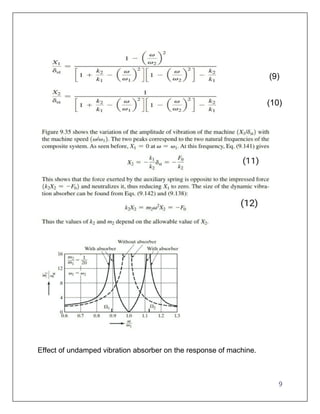
We are primarily interested in reducing the amplitude of the machine 1X12.
In order to make the amplitude of m1 zero, the numerator of Eq,should be
set equal to zero.
This gives
(5)
The machine operates near its resonance, before the addition
of the dynamic vibration absorber. Thus if the absorber is designed such
that
(6)
the amplitude of vibration of the machine, while operating at its original
resonant frequency,will be zero. By defining
(7)
as the natural frequency of the machine or main system, and
(8)
as the natural frequency of the absorber or auxiliary system, Eqs. and can
be rewritten as
9
(9)
(10)
Effect of undamped vibration absorber on the response of machine.
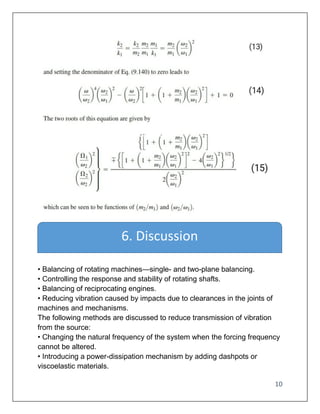
10
• Balancing of rotating machines—single- and two-plane balancing.
• Controlling the response and stability of rotating shafts.
• Balancing of reciprocating engines.
• Reducing vibration caused by impacts due to clearances in the joints of
machines and mechanisms.
The following methods are discussed to reduce transmission of vibration
from the source:
• Changing the natural frequency of the system when the forcing frequency
cannot be altered.
• Introducing a power-dissipation mechanism by adding dashpots or
viscoelastic materials.
6. Discussion
11
• Designing an isolator which changes the stiffness/damping of the system.
• Using an active control technique.
• Designing a vibration absorber by adding an auxiliary mass to absorb the
vibration energy of the original mass.
1. Mechanical Vibrations Sixth Edition in sl Units SINGIRESU S.RAO
2. Engineering Vibrations Fourth Edition DANIEL J. INMAN
3. Mechanical Vibration Fourth Edition ANALYSIS,
UNCERTAINTTIES,AND CONTROL
7.References

report Vibration absorber

  • 1.
    1 ‫االسم‬ : - ‫حمزة‬ ‫مرزة‬ ‫حاتم‬‫عدي‬ A :‫الشعبة‬ :‫المرحلة‬ - ‫الثالثة‬ EMAIL :-O.Hatam1703@coeng.uobaghdad.edu.iq
  • 2.
    2 OBJECTIVES…………………………………………………………………………………(1) INTRODUCTION ………………………………………………………………………….(2) DAMPERS…………………………………………………………………………………….(3) APPLICATION……………………………………………………………………………….(4) CEILING TYPE………………………………………………………………………………(4.1) TUNEDMASS DAMPER……………………………………………………………….(4.2) VARIABLE SPEED MACHINES……………………………………………………….(4.3) ANALYSIS…………………………………………………………………………………….(5) DISCUSSION…………………………………………………………………………………(6) REFERENCES………………………………………………………………………………..(7) CONTENT
  • 3.
    3 1. Objectives • Usevibration nomographs and vibration criteria to determine the leve vibration to be controlled or reduced. • Apply one- and two-plane balancing techniques for eliminating vibration (unbalance). • Control the vibration caused by the unbalance in rotating shafts. • Reduce the unbalance in reciprocating engines. • Design vibration and shock isolations for systems with fixed base as well as vibrating base. • Design active vibration-control systems. • Design undamped and damped vibration absorbers There are numerous sources of vibration in an industrial environment: impact processes such as pile driving and blasting; rotating or reciprocating machinery such as engines, compressors, and motors; transportation vehicles such as trucks, trains, and aircraft; and the flow of fluids. The presence of vibration often leads to excessive wear of bearings, formation of cracks, loosening of fasteners, structural and mechanical failures, frequent and costly maintenance of machines, electronic malfunctions through fracture of solder joints, and abrasion of insulation around electric conductors causing shorts. The occupational 1.OBJECTIVES 2. Introduction
  • 4.
    4 exposure of humansto vibration leads to pain, discomfort, and reduced efficiency. Vibration can sometimes be eliminated on the basis of theoretical analysis. However, the manufacturing costs involved in eliminating the vibration may be too high; a designer must compromise between an acceptable amount of vibration and a reasonable manufacturing cost. In some cases the excitation or shaking force is inherent in the machine. As seen earlier, even a relatively small excitation force can cause an undesirably large response near resonance, especially in lightly damped systems. In these cases, the magnitude of the response can be significantly reduced by the use of isolators and auxiliary mass absorbers Material used in vibration dampers: Metal, polymers, cement and their composites. Metal and polymer are dominant due to their viscoelasticity. Damping enhancement mainly involves micro-structural design for metals, interface design for polymers and admixture use for cement. Metals: • SMA’s • Ferromagnetic alloys provide damping through magneto-mechanical mechanism i.e. movement of magnetic domain in boundaries during vibration. • Other alloys provide damping through micro-structural design. It is used due to their low cost. Polymers: Due to their viscoelastic behavior, polymers (particularly thermoplastics) can provide damping ability. Polymer used for damping rubber, polytetrafluoroethylene (PTFE), polyurethane, polypropylene, polyvinylchloride, polyimide or other polymer network. In general, elastomer and other amorphous thermoplastics with a glass transition temperature below room temperature are attractive for damping. Polymer blends and interpenetrating networks are also attractive, due to the interface between the components in the blend or network providing a mechanism for 3. Dampers
  • 5.
    5 damping. In relationto fibrous structural composites, viscoelastic polymeric interlayer's between the laminae of continuous fibers are often used for damping. Sectional view of a monoblock shock absorber. 4.1 Ceiling Type The Ceiling Vibration Absorber (G50T) can effectively reduce vibration and noise which can cause interference to other neighboring rooms. Its triple vibration damping medium structure ensures high performance results no matter where it is installed. 4. Applications
  • 6.
    6 4.2 Tuned massdamper A tuned mass damper (TMD), also known as a harmonic absorber or seismic damper, is a device mounted in structures to reduce the amplitude of mechanical vibrations. Their application can prevent discomfort, damage, or outright structural failure. They are frequently used in power transmission, automobiles, and buildings. 4.3 Variable Speed Machines With the wide use of variable frequency drives in the pump industry and increasing unit size, it is becoming more diffi cult to design mechanical systems free from natural frequencies within operating speed range. If such an occurrence is allowed in the fi eld, a resulting resonance condition threatens to signifi cantly impact performance and longevity of the equipment. Traditional treatment methods that involve structural modifi cations are often time consuming and expensive.
  • 7.
    7 When we attachan auxiliary mass m2 to a machine of mass m1 through a spring of stiffness k2, the resulting two-degree-of-freedom system will look as shown in Fig. The equations of motion of the masses m1 and m2 are (1) By assuming harmonic solution, (2) we can obtain the steady-state amplitudes of the masses m1 and m2 as (3) (4) Undamped dynamic vibration absorber. 5. Analysis
  • 8.
    8 We are primarilyinterested in reducing the amplitude of the machine 1X12. In order to make the amplitude of m1 zero, the numerator of Eq,should be set equal to zero. This gives (5) The machine operates near its resonance, before the addition of the dynamic vibration absorber. Thus if the absorber is designed such that (6) the amplitude of vibration of the machine, while operating at its original resonant frequency,will be zero. By defining (7) as the natural frequency of the machine or main system, and (8) as the natural frequency of the absorber or auxiliary system, Eqs. and can be rewritten as
  • 9.
    9 (9) (10) Effect of undampedvibration absorber on the response of machine.
  • 10.
    10 • Balancing ofrotating machines—single- and two-plane balancing. • Controlling the response and stability of rotating shafts. • Balancing of reciprocating engines. • Reducing vibration caused by impacts due to clearances in the joints of machines and mechanisms. The following methods are discussed to reduce transmission of vibration from the source: • Changing the natural frequency of the system when the forcing frequency cannot be altered. • Introducing a power-dissipation mechanism by adding dashpots or viscoelastic materials. 6. Discussion
  • 11.
    11 • Designing anisolator which changes the stiffness/damping of the system. • Using an active control technique. • Designing a vibration absorber by adding an auxiliary mass to absorb the vibration energy of the original mass. 1. Mechanical Vibrations Sixth Edition in sl Units SINGIRESU S.RAO 2. Engineering Vibrations Fourth Edition DANIEL J. INMAN 3. Mechanical Vibration Fourth Edition ANALYSIS, UNCERTAINTTIES,AND CONTROL 7.References