ROSTOW’S MODEL OF DEVELOPMENT
W.W. Rostow was an American
economist who proposed five (5)
stages of economic growth.
History of The Rostow Model
One of the first models to account
for economic growth, and probably
still the simplest was put forward
by W.W.Rostow in 1960. He
suggested that all the countries in
his study had the potential to break
the cycle of poverty and develop
through five linear stages.
The Stages of Economic Development
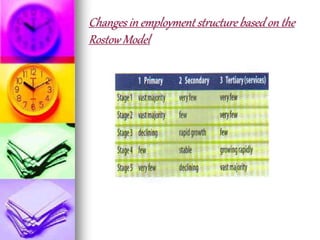
This is a linear theory of development.
Economies can be divided into primary
secondary and tertiary sectors. The
history of developed countries suggests a
common pattern of structural change:
Changes in employment structure based on the
Rostow Model
What was the model ?
Every society had to pass through
these five stages, if they were in
transition to modernity or
development.
What is development?
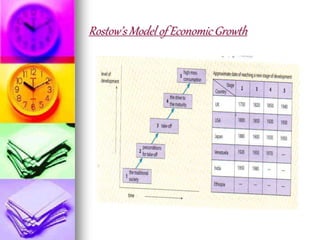
Rostow’s Model of Economic Growth
STAGE 1
Traditional Society
The economy is dominated by
subsistence activity.
Output is consumed by producers
rather than traded.
Any kind of trading is done by
bartering.
Agriculture is the most important
industry thus making production
labour intensive.
Stage 1 Traditional Society subsistence
economic activity i.e. output is consumed by
producers rather than traded, but is consumed
by those who produce it; trade by barter where
goods are exchanged they are 'swapped';
Agriculture is the most important industry and
production is labour intensive, using only
limited quantities of capital.
STAGE 2
Pre-conditions of modernization
 Industrialization would have just began.
 An emergence of transport and
infrastructure to support trade.
 Savings and investment grew
This resulted in entrepreneurs emerging
and external trading.
Stage 2 Transitional Stage
(the preconditions for takeoff)
Surpluses for trading emerge
supported by an emerging
transport and infrastructure.
Savings and investment grow.
Entrepreneurs emerge.
STAGE 3
 Take Off Stage
Industrialization increased.
Workers switched from the agricultural
sector to the manufacturing sector.
Economic Transitions
Evolution of new political and social
institutions to support industrialization.
Generates increasing incomes and
therefore able to sustain more
investment.
Stage 3 Take Off Industrialization
increases, with workers switching
form the land to manufacturing.
Growth is concentrated in a few
regions of the country and in one or
two industries. New political and
social institutions are evolve to
support industrialization.
STAGE 4
Drive to Maturity
 The economy begins to diversify
into new areas.
 Technological innovation
a diverse range of investment
opportunities.
The economy begins to produce a wider range
of goods and services.
Less reliance on imports.
Stage 4 Drive to Maturity : Growth is now
diverse supported by technological innovation.
This diversity leads to greatly reduced rates of
poverty and rising standards of livivng, as the
society no longer needs to sacrifice its comfort
in order to strengthen certain sectors.
STAGE 5
 High Mass Consumption
Economy is geared towards mass
consumption.
The service sector becomes
increasingly dominant.
Stage 5 High Mass Consumption
The age of high refers tothe period
of contemporary comfort afforded
many western nations, wherein
consumers concentrate on durable
goods, and hardly remember the
subsistence concerns of previous
stages mass consumption
Failures of the Rostow Model
Rostow's model is limited. The
determinants of a country's stage of
economic development are usually seen
in broader terms i.e. dependent on:
The quality and quantity of resources, a
country's technologies, a countries
institutional structures e.g. law of
contract.
 Rostow's model explains the
development experience of Western
countries, well. However, Rostow
does not explain the experience of
countries with different cultures and
traditions e.g. Sub Sahara countries
which have experienced little
economic development.
 The Rostow model assumes incorrectly that all
countries start off at the same level.
 It predicts to short a timescale between the
beginning of growth and the time when a
country becomes self-sustaining. It over
emphasizes the effect of the learning curve i.e.
the time taken for a country to develop
diminishes as countries learn from others that
are developed.
 Its generalized nature makes it
somewhat limited.
 It does not set down the
detailed nature of the pre-
conditions for growth.
 In reality policy makers are
unable to clearly identify
stages as they merge together
Strengths of the Model
According to a report on Human
Development :-
 Our economic self-interest calls for rapid
development of the rest of the world: our
export markets will thereby grow and
there will no longer be the lure of low
wages to our jobs.
 A richer world is likely to be a more
peaceful world.
 Savings and capital formation
(accumulation) are central to the process
of growth hence development.
The key to development is to mobilize
savings to generate the investment to set
in motion self generating economic
growth.
Development can stall at stage
3 for lack of savings – 15-20%
of GDP required. If the
domestic Savings rate is 5%,
then international aid/loan must
total 10-15% in order to plug
the ‘savings gap’. Resultant
investment means a move to
stage 4 Drive to Maturity and
self-generating economic

Rostow’s model of_development_2

  • 1.
    ROSTOW’S MODEL OFDEVELOPMENT W.W. Rostow was an American economist who proposed five (5) stages of economic growth.
  • 2.
    History of TheRostow Model One of the first models to account for economic growth, and probably still the simplest was put forward by W.W.Rostow in 1960. He suggested that all the countries in his study had the potential to break the cycle of poverty and develop through five linear stages.
  • 3.
    The Stages ofEconomic Development This is a linear theory of development. Economies can be divided into primary secondary and tertiary sectors. The history of developed countries suggests a common pattern of structural change:
  • 4.
    Changes in employmentstructure based on the Rostow Model
  • 5.
    What was themodel ? Every society had to pass through these five stages, if they were in transition to modernity or development. What is development?
  • 6.
    Rostow’s Model ofEconomic Growth
  • 7.
    STAGE 1 Traditional Society Theeconomy is dominated by subsistence activity. Output is consumed by producers rather than traded. Any kind of trading is done by bartering. Agriculture is the most important industry thus making production labour intensive.
  • 8.
    Stage 1 TraditionalSociety subsistence economic activity i.e. output is consumed by producers rather than traded, but is consumed by those who produce it; trade by barter where goods are exchanged they are 'swapped'; Agriculture is the most important industry and production is labour intensive, using only limited quantities of capital.
  • 9.
    STAGE 2 Pre-conditions ofmodernization  Industrialization would have just began.  An emergence of transport and infrastructure to support trade.  Savings and investment grew This resulted in entrepreneurs emerging and external trading.
  • 10.
    Stage 2 TransitionalStage (the preconditions for takeoff) Surpluses for trading emerge supported by an emerging transport and infrastructure. Savings and investment grow. Entrepreneurs emerge.
  • 11.
    STAGE 3  TakeOff Stage Industrialization increased. Workers switched from the agricultural sector to the manufacturing sector. Economic Transitions Evolution of new political and social institutions to support industrialization. Generates increasing incomes and therefore able to sustain more investment.
  • 12.
    Stage 3 TakeOff Industrialization increases, with workers switching form the land to manufacturing. Growth is concentrated in a few regions of the country and in one or two industries. New political and social institutions are evolve to support industrialization.
  • 13.
    STAGE 4 Drive toMaturity  The economy begins to diversify into new areas.  Technological innovation a diverse range of investment opportunities.
  • 14.
    The economy beginsto produce a wider range of goods and services. Less reliance on imports. Stage 4 Drive to Maturity : Growth is now diverse supported by technological innovation. This diversity leads to greatly reduced rates of poverty and rising standards of livivng, as the society no longer needs to sacrifice its comfort in order to strengthen certain sectors.
  • 15.
    STAGE 5  HighMass Consumption Economy is geared towards mass consumption. The service sector becomes increasingly dominant.
  • 16.
    Stage 5 HighMass Consumption The age of high refers tothe period of contemporary comfort afforded many western nations, wherein consumers concentrate on durable goods, and hardly remember the subsistence concerns of previous stages mass consumption
  • 17.
    Failures of theRostow Model Rostow's model is limited. The determinants of a country's stage of economic development are usually seen in broader terms i.e. dependent on: The quality and quantity of resources, a country's technologies, a countries institutional structures e.g. law of contract.
  • 18.
     Rostow's modelexplains the development experience of Western countries, well. However, Rostow does not explain the experience of countries with different cultures and traditions e.g. Sub Sahara countries which have experienced little economic development.
  • 19.
     The Rostowmodel assumes incorrectly that all countries start off at the same level.  It predicts to short a timescale between the beginning of growth and the time when a country becomes self-sustaining. It over emphasizes the effect of the learning curve i.e. the time taken for a country to develop diminishes as countries learn from others that are developed.
  • 20.
     Its generalizednature makes it somewhat limited.  It does not set down the detailed nature of the pre- conditions for growth.  In reality policy makers are unable to clearly identify stages as they merge together
  • 21.
    Strengths of theModel According to a report on Human Development :-  Our economic self-interest calls for rapid development of the rest of the world: our export markets will thereby grow and there will no longer be the lure of low wages to our jobs.  A richer world is likely to be a more peaceful world.
  • 22.
     Savings andcapital formation (accumulation) are central to the process of growth hence development. The key to development is to mobilize savings to generate the investment to set in motion self generating economic growth.
  • 23.
    Development can stallat stage 3 for lack of savings – 15-20% of GDP required. If the domestic Savings rate is 5%, then international aid/loan must total 10-15% in order to plug the ‘savings gap’. Resultant investment means a move to stage 4 Drive to Maturity and self-generating economic