FOREIGN AID
Presented By:
Stephanie A. Follante-Palconit
Discussion Outline
• Definition of Foreign Aid
• Types and Purpose of Foreign Aid
• Advantages and Disadvantages
• History of Foreign Aid
Definition of Foreign Aid
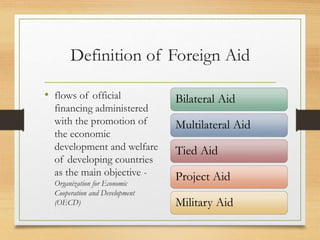
• flows of official
financing administered
with the promotion of
the economic
development and welfare
of developing countries
as the main objective -
Organization for Economic
Cooperation and Development
(OECD)
Bilateral Aid
Multilateral Aid
Tied Aid
Project Aid
Military Aid
Definition of Foreign Aid
• The voluntary transfer of resources from one
country to another – Prateek Agrawal
• It can be in the form of loan or a grant
• Maybe either in a soft or hard loan
• Hard, if repayment requires foreign currency
• Soft, if repayment requires home currency
Purpose of Foreign Aid
• The voluntary transfer of resources from one
country to another – Prateek Agrawal
• It can be in the form of loan or a grant
• Maybe either in a soft or hard loan
• Hard, if repayment requires foreign currency
• Soft, if repayment requires home currency
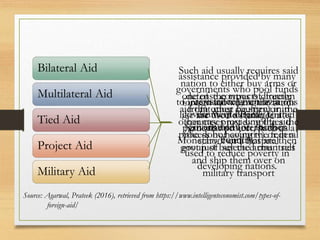
Bilateral Aid
Multilateral Aid
Tied Aid
Project Aid
Military Aid
assistance given by a
government directly to the
government of another
country
assistance provided by many
governments who pool funds
to international organizations
like the World Bank, United
Nations and International
Monetary Fund that are then
used to reduce poverty in
developing nations.
one of the types of foreign
aid that must be spent in the
country providing the aid
(the donor country) or in a
group of selected countries
foreign aid where the funds
are used to finance a
particular project, such as a
school or a hospital
Such aid usually requires said
nation to either buy arms or
defense contracts directly
from other country or in
other cases just simplifies the
process by having the federal
govt just buy the arms itself
and ship them over on
military transport
Source: Agarwal, Prateek (2016), retrieved from https://www.intelligenteconomist.com/types-of-
foreign-aid/
Colonialism
1944-46
Post-war
Development
1949
Modernization
and
Industrialization
1950s-1960s
Decolonization
1970s A more
human
approach
1980s The Lost
Decade of
Development
2000
Millennium
Development
Goals
2005 The Paris
Declaration
 Britain and other imperial powers exported
capital and manufactured goods to
colonized countries in return for substantial
imports of raw materials.
 Aid money from the colonizers to their
colonial governments, usually in the form of
loans, was never enough for genuine
economic development, instead it usually
benefitted urban elites and colonial business
interests
 The United Nations was established along with
international financial institutions (IFIs):
International Bank for Reconstruction and
Development (IBRD or World Bank) & the
International Monetary Fund (IMF).
 Aid was viewed as a way of supporting
‘developing’ country economies to
industrialise, attracting large scale investments
of capital and technical expertise that would
lead to western style industrial development.
 Development aid focused on the dominant
economic and political theories of the time.
 Industrialization proved largely disastrous
for communities and environments
mandated for development largely due to
the power imbalance between the IFI’s and
recipient countries in Africa, Asia and the
Pacific.
 Notions of the ‘developed’ and
‘developing world’ emerge out of
decolonization and the lack of
industrialization in many newly
formed independent states.
 Development focused more on social
considerations such as health (life expectancy,
infant mortality rates and disease), education,
income distribution, and gender equality, rather
than simply macroeconomic growth.
 Recession in the industrialized world and debt
crisis in developing countries ensues. The
structural adjustment policies of the World Bank
and regional development banks force major
economic reforms through privatization and
deregulation in the developing world.
 Partly as a response to the failure
of explicitly growth-focused aid
in alleviating poverty,
governments come together to
form an international action plan
to increase the amount of aid and
to target poverty reduction in
eight areas.
 91 countries make a joint agreement on aid
effectiveness. The Declaration sidelines growth as the
foundation of aid effectiveness, instead focusing the
principles of recipient ownership, alignment,
harmonization, managing for results, and mutual
accountability.
Advantages Disadvantages
does not promote
faster growth
focused on the growth
of modern sector
Increase in inflation
Interference of donor
country
Basic human decency
Improve the
country’s international
image
Build positive working
relationships with
other governments
Promote the
conditions for peace
and stability
Source: Agarwal, Prateek (2016), retrieved from https://www.intelligenteconomist.com/types-of-
foreign-aid/

Foreign aid

  • 1.
  • 2.
    Discussion Outline • Definitionof Foreign Aid • Types and Purpose of Foreign Aid • Advantages and Disadvantages • History of Foreign Aid
  • 3.
    Definition of ForeignAid • flows of official financing administered with the promotion of the economic development and welfare of developing countries as the main objective - Organization for Economic Cooperation and Development (OECD) Bilateral Aid Multilateral Aid Tied Aid Project Aid Military Aid
  • 4.
    Definition of ForeignAid • The voluntary transfer of resources from one country to another – Prateek Agrawal • It can be in the form of loan or a grant • Maybe either in a soft or hard loan • Hard, if repayment requires foreign currency • Soft, if repayment requires home currency
  • 5.
    Purpose of ForeignAid • The voluntary transfer of resources from one country to another – Prateek Agrawal • It can be in the form of loan or a grant • Maybe either in a soft or hard loan • Hard, if repayment requires foreign currency • Soft, if repayment requires home currency
  • 6.
    Bilateral Aid Multilateral Aid TiedAid Project Aid Military Aid assistance given by a government directly to the government of another country assistance provided by many governments who pool funds to international organizations like the World Bank, United Nations and International Monetary Fund that are then used to reduce poverty in developing nations. one of the types of foreign aid that must be spent in the country providing the aid (the donor country) or in a group of selected countries foreign aid where the funds are used to finance a particular project, such as a school or a hospital Such aid usually requires said nation to either buy arms or defense contracts directly from other country or in other cases just simplifies the process by having the federal govt just buy the arms itself and ship them over on military transport Source: Agarwal, Prateek (2016), retrieved from https://www.intelligenteconomist.com/types-of- foreign-aid/
  • 7.
    Colonialism 1944-46 Post-war Development 1949 Modernization and Industrialization 1950s-1960s Decolonization 1970s A more human approach 1980sThe Lost Decade of Development 2000 Millennium Development Goals 2005 The Paris Declaration  Britain and other imperial powers exported capital and manufactured goods to colonized countries in return for substantial imports of raw materials.  Aid money from the colonizers to their colonial governments, usually in the form of loans, was never enough for genuine economic development, instead it usually benefitted urban elites and colonial business interests  The United Nations was established along with international financial institutions (IFIs): International Bank for Reconstruction and Development (IBRD or World Bank) & the International Monetary Fund (IMF).  Aid was viewed as a way of supporting ‘developing’ country economies to industrialise, attracting large scale investments of capital and technical expertise that would lead to western style industrial development.  Development aid focused on the dominant economic and political theories of the time.  Industrialization proved largely disastrous for communities and environments mandated for development largely due to the power imbalance between the IFI’s and recipient countries in Africa, Asia and the Pacific.  Notions of the ‘developed’ and ‘developing world’ emerge out of decolonization and the lack of industrialization in many newly formed independent states.  Development focused more on social considerations such as health (life expectancy, infant mortality rates and disease), education, income distribution, and gender equality, rather than simply macroeconomic growth.  Recession in the industrialized world and debt crisis in developing countries ensues. The structural adjustment policies of the World Bank and regional development banks force major economic reforms through privatization and deregulation in the developing world.  Partly as a response to the failure of explicitly growth-focused aid in alleviating poverty, governments come together to form an international action plan to increase the amount of aid and to target poverty reduction in eight areas.  91 countries make a joint agreement on aid effectiveness. The Declaration sidelines growth as the foundation of aid effectiveness, instead focusing the principles of recipient ownership, alignment, harmonization, managing for results, and mutual accountability.
  • 8.
    Advantages Disadvantages does notpromote faster growth focused on the growth of modern sector Increase in inflation Interference of donor country Basic human decency Improve the country’s international image Build positive working relationships with other governments Promote the conditions for peace and stability Source: Agarwal, Prateek (2016), retrieved from https://www.intelligenteconomist.com/types-of- foreign-aid/

Editor's Notes

  • #7 Bilateral Aid – These are to assist in long-term projects to promote democracy, economic growth, stability and development Tied Aid – a developed country will provide bilateral loan/grant to a developing country, but mandate that the money be spent on goods or services produced in the selected country