Unbalanced Growth Theory by
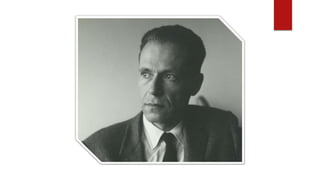
Albert O. Hirschman
PRESENTATION BY VEDANSH BAGHEL
INTODUCTION
 Unbalanced Growth Theory,
pioneered by the eminent economist
Albert O. Hirschman, is a concept
that has had a profound impact on
our understanding of economic
development.
 In this presentation, we will explore
the key ideas behind this theory and
how it has influenced economic
thought.
Albert O.
Hirschman
 Albert O. Hirschman (1915-2012) was
a distinguished economist and social
scientist known for his
groundbreaking work in the field of
development economics.
 Hirschman's career spanned several
decades and encompassed various
areas of economics and social
science. His contributions to the field
are still widely studied and respected
today.
Historical Context
 Unbalanced Growth Theory emerged
during a time of significant global
change.
 It was a response to the development
challenges faced by many countries
in the post-World War II era.
 Factors such as decolonization, the
Cold War, and the need for economic
reconstruction influenced
Hirschman's thinking.
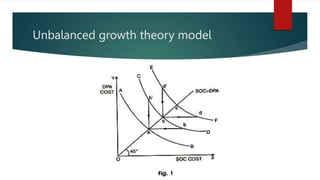
Unbalanced growth theory model
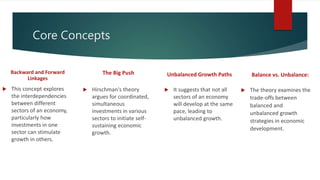
Core Concepts
Backward and Forward
Linkages
 This concept explores
the interdependencies
between different
sectors of an economy,
particularly how
investments in one
sector can stimulate
growth in others.
The Big Push
 Hirschman's theory
argues for coordinated,
simultaneous
investments in various
sectors to initiate self-
sustaining economic
growth.
Unbalanced Growth Paths
 It suggests that not all
sectors of an economy
will develop at the same
pace, leading to
unbalanced growth.
Balance vs. Unbalance:
 The theory examines the
trade-offs between
balanced and
unbalanced growth
strategies in economic
development.
Backward and
Forward
Linkages
 Backward and forward linkages are essential components of
Unbalanced Growth Theory.
 Backward Linkages refer to the connections between an
industry and its suppliers or the industries that provide
inputs. For instance, if you invest in agriculture, it can
stimulate growth in the fertilizer and machinery industries.
 Forward Linkages refer to the connections between an
industry and its customers or the industries that use its
products. For example, investment in a steel industry can
have forward linkages to construction and manufacturing
sectors.
 These linkages highlight the importance of intersectoral
dependencies in economic development.
The Big Push
 The "Big Push" concept is central to
Unbalanced Growth Theory.
 It proposes that for economic
development to take off, a
synchronized effort involving large
investments in multiple sectors is
necessary.
 This simultaneous push creates a
synergy that can kickstart self-
sustaining growth, similar to a
domino effect.
Unbalanced
Growth Paths
 Unbalanced Growth Theory
recognizes that different sectors may
develop at different rates.
 Some sectors may require more
substantial initial investments, while
others may follow suit later.
 This dynamic approach to growth
paths acknowledges the complexity
of economic development.
Balance vs.
Unbalance
 Balanced Growth: A strategy where
investments are spread evenly across
all sectors to achieve uniform
development.
 Unbalanced Growth: A strategy that
targets specific sectors or regions
with high-potential to spur overall
economic growth, even if it leads to
disparities in development.
Applications
 Unbalanced Growth Theory has found real-world applications in
numerous countries and regions. Some notable examples include:
 South Korea's heavy investments in its steel and automotive
industries.
 China's focus on export-oriented growth in certain coastal regions.
 The development of Silicon Valley in the United States as a hub for
technology innovation.
Conclusion
 In essence, Unbalanced Growth Theory, by Albert O. Hirschman, challenges
the notion of uniform development.
 It underscores the importance of sectoral interdependencies and tailored
growth strategies.
 This theory remains a thought-provoking perspective in economic
development, advocating adaptability and recognizing that growth isn't
always balanced but can be productive nonetheless.
THANK YOU

Unbalanced Growth Theory.pptx

  • 1.
    Unbalanced Growth Theoryby Albert O. Hirschman PRESENTATION BY VEDANSH BAGHEL
  • 2.
    INTODUCTION  Unbalanced GrowthTheory, pioneered by the eminent economist Albert O. Hirschman, is a concept that has had a profound impact on our understanding of economic development.  In this presentation, we will explore the key ideas behind this theory and how it has influenced economic thought.
  • 4.
    Albert O. Hirschman  AlbertO. Hirschman (1915-2012) was a distinguished economist and social scientist known for his groundbreaking work in the field of development economics.  Hirschman's career spanned several decades and encompassed various areas of economics and social science. His contributions to the field are still widely studied and respected today.
  • 5.
    Historical Context  UnbalancedGrowth Theory emerged during a time of significant global change.  It was a response to the development challenges faced by many countries in the post-World War II era.  Factors such as decolonization, the Cold War, and the need for economic reconstruction influenced Hirschman's thinking.
  • 6.
  • 7.
    Core Concepts Backward andForward Linkages  This concept explores the interdependencies between different sectors of an economy, particularly how investments in one sector can stimulate growth in others. The Big Push  Hirschman's theory argues for coordinated, simultaneous investments in various sectors to initiate self- sustaining economic growth. Unbalanced Growth Paths  It suggests that not all sectors of an economy will develop at the same pace, leading to unbalanced growth. Balance vs. Unbalance:  The theory examines the trade-offs between balanced and unbalanced growth strategies in economic development.
  • 8.
    Backward and Forward Linkages  Backwardand forward linkages are essential components of Unbalanced Growth Theory.  Backward Linkages refer to the connections between an industry and its suppliers or the industries that provide inputs. For instance, if you invest in agriculture, it can stimulate growth in the fertilizer and machinery industries.  Forward Linkages refer to the connections between an industry and its customers or the industries that use its products. For example, investment in a steel industry can have forward linkages to construction and manufacturing sectors.  These linkages highlight the importance of intersectoral dependencies in economic development.
  • 9.
    The Big Push The "Big Push" concept is central to Unbalanced Growth Theory.  It proposes that for economic development to take off, a synchronized effort involving large investments in multiple sectors is necessary.  This simultaneous push creates a synergy that can kickstart self- sustaining growth, similar to a domino effect.
  • 10.
    Unbalanced Growth Paths  UnbalancedGrowth Theory recognizes that different sectors may develop at different rates.  Some sectors may require more substantial initial investments, while others may follow suit later.  This dynamic approach to growth paths acknowledges the complexity of economic development.
  • 11.
    Balance vs. Unbalance  BalancedGrowth: A strategy where investments are spread evenly across all sectors to achieve uniform development.  Unbalanced Growth: A strategy that targets specific sectors or regions with high-potential to spur overall economic growth, even if it leads to disparities in development.
  • 12.
    Applications  Unbalanced GrowthTheory has found real-world applications in numerous countries and regions. Some notable examples include:  South Korea's heavy investments in its steel and automotive industries.  China's focus on export-oriented growth in certain coastal regions.  The development of Silicon Valley in the United States as a hub for technology innovation.
  • 13.
    Conclusion  In essence,Unbalanced Growth Theory, by Albert O. Hirschman, challenges the notion of uniform development.  It underscores the importance of sectoral interdependencies and tailored growth strategies.  This theory remains a thought-provoking perspective in economic development, advocating adaptability and recognizing that growth isn't always balanced but can be productive nonetheless.
  • 14.