

Kristian Peralta | Macki Cosgayon
Thea Obamos | Gigi Alba
Functions of Human Resource Management
1. Job Organization and Acquisition
2. Human Resource Retention
3. Development of Human Resources
4. Separation
Objectives
By the end of this session, participants should
be able to:
 Define training, learn its goals and
objectives, and explain its significance to the
organization
 Identify and explain the 4-stage Training
Cycle
Objectives
 Give examples of training strategies that
organizations use for human resource
development
 Define career planning, learn its goals and
objectives, and explain its significance to the
organization
 Enumerate the 4 steps in the career planning
process and explain the strategies used
Objectives
 Define employee engagement and explain its
significance to human resource development
 Give examples on how to generate
employee engagement in the organization
Training
Training & Development Definition
Training – an organization’s planned effort to
facilitate employees’ learning of job-related
competencies
Development – formal education, job
experiences, relationships, and assessments of
personality and abilities that help employees
prepare for the future.
Objective of Training
To help the organization achieve its mission and
goals by improving individual and, ultimately,
organizational performance
Significance of Training
 Maintains qualified products and/or services
 Achieves high service standards
 Provides information for new comers
 Refreshes memory of old employees
 Achieves learning about new things;
technology, products/service delivery
Significance of Training
 Reduces mistakes – minimizing costs
 Opportunity for staff to give
feedback/suggest improvements
 Improves communication & relationships –
better teamwork
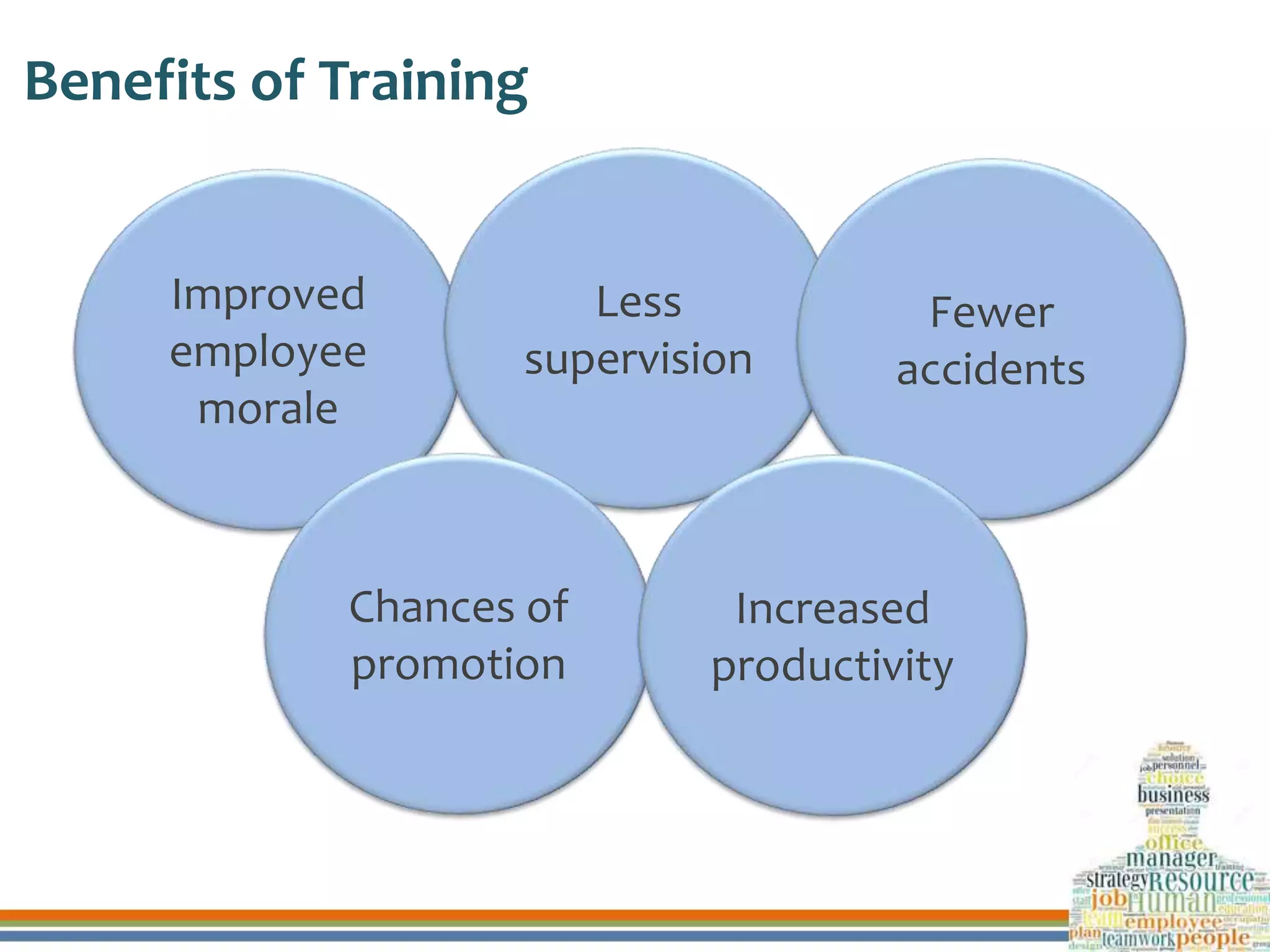
Benefits of Training
Improved
employee
morale
Less
supervision
Fewer
accidents
Chances of
promotion
Increased
productivity
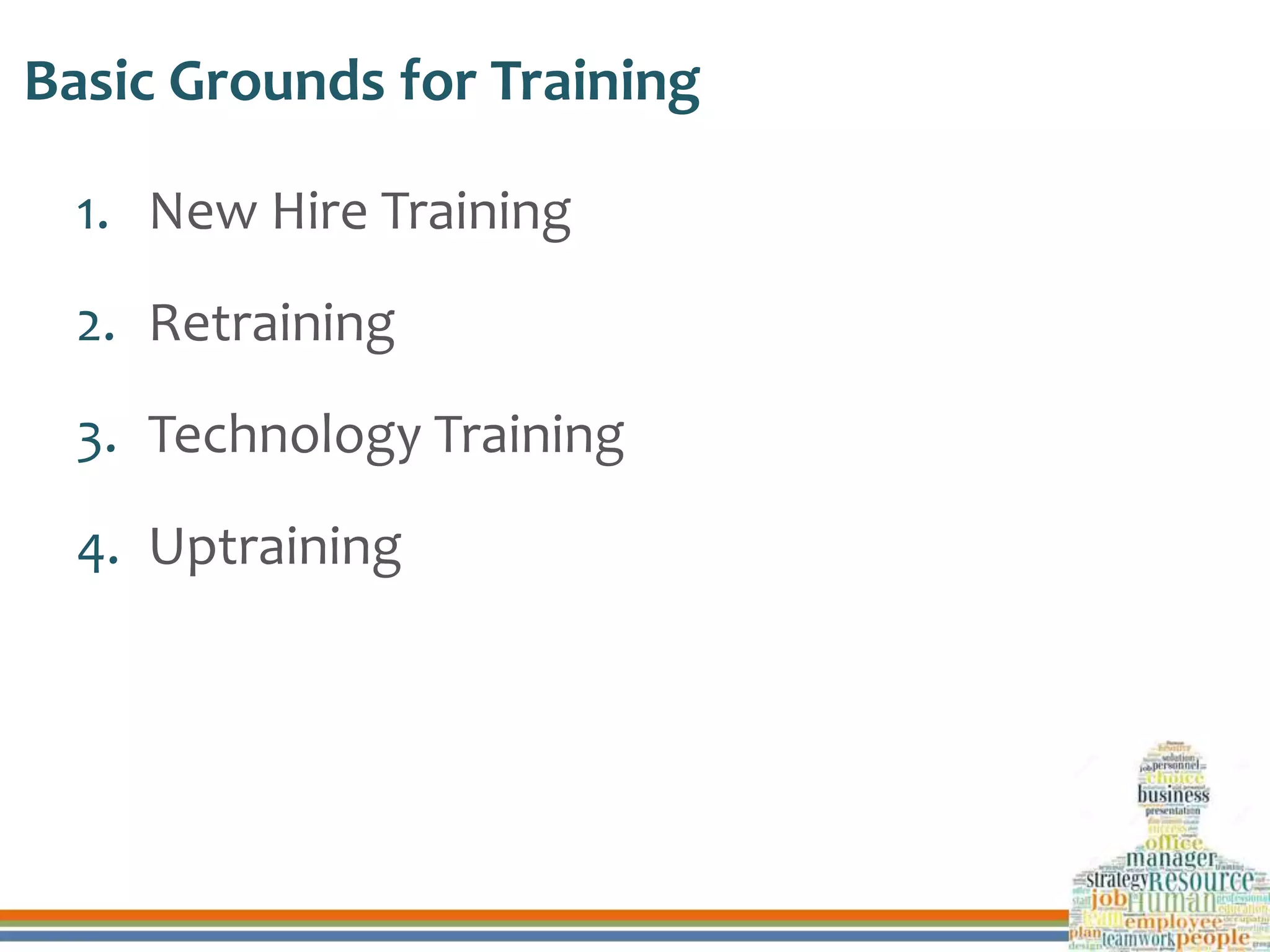
Basic Grounds for Training
1. New Hire Training
2. Retraining
3. Technology Training
4. Uptraining
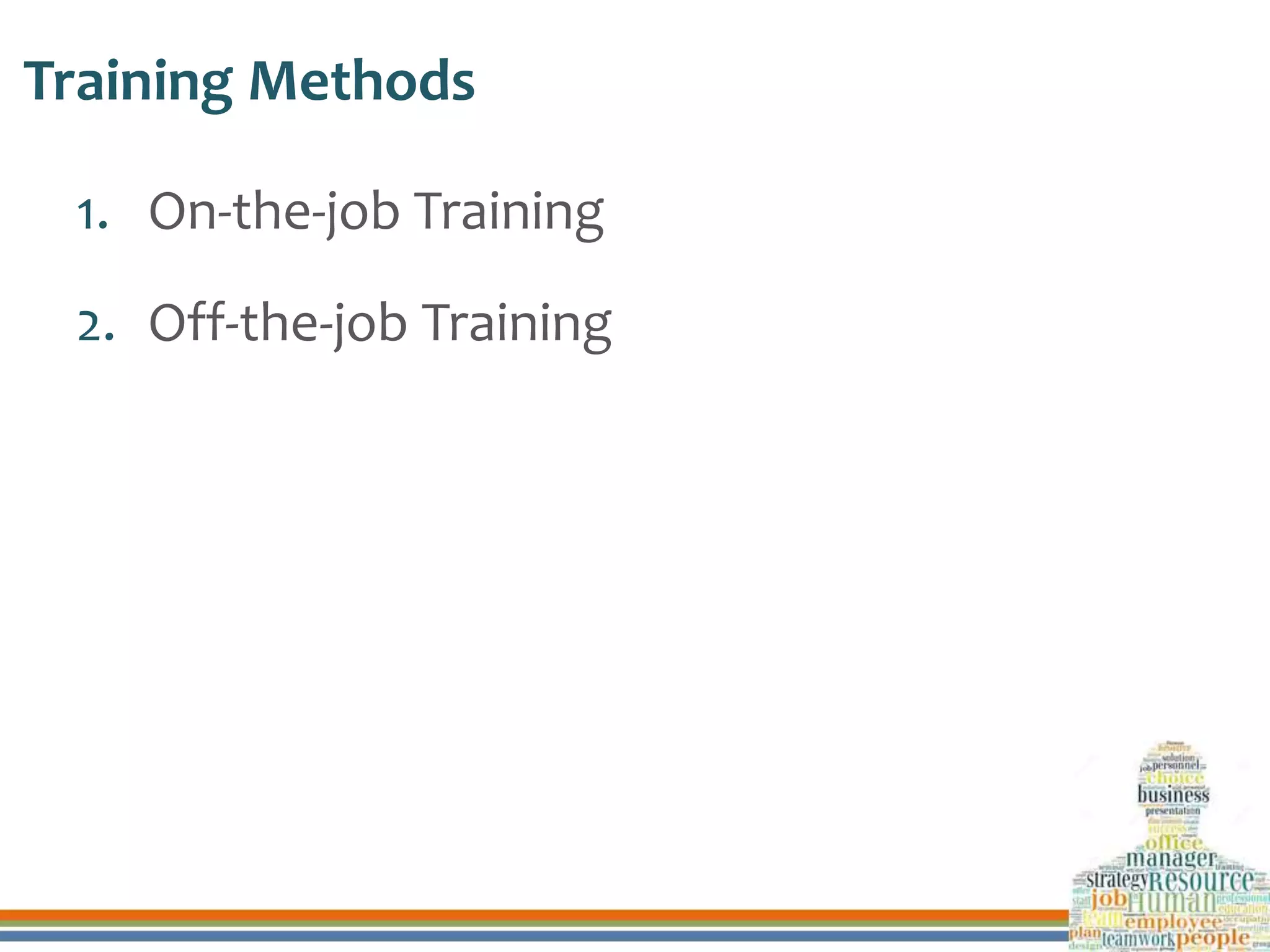
Training Methods
1. On-the-job Training
2. Off-the-job Training
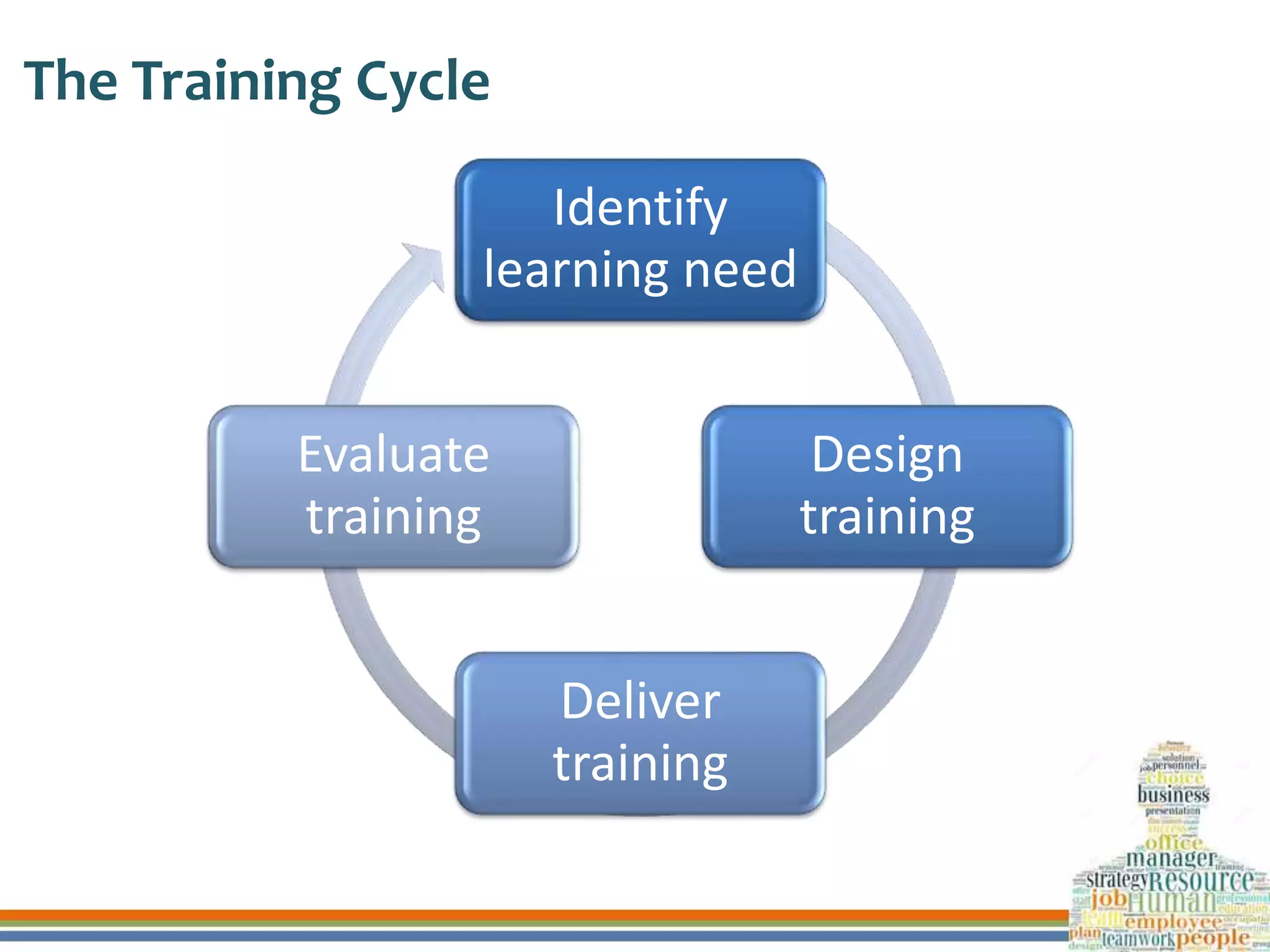
The Training Cycle
Identify
learning need
Design
training
Deliver
training
Evaluate
training
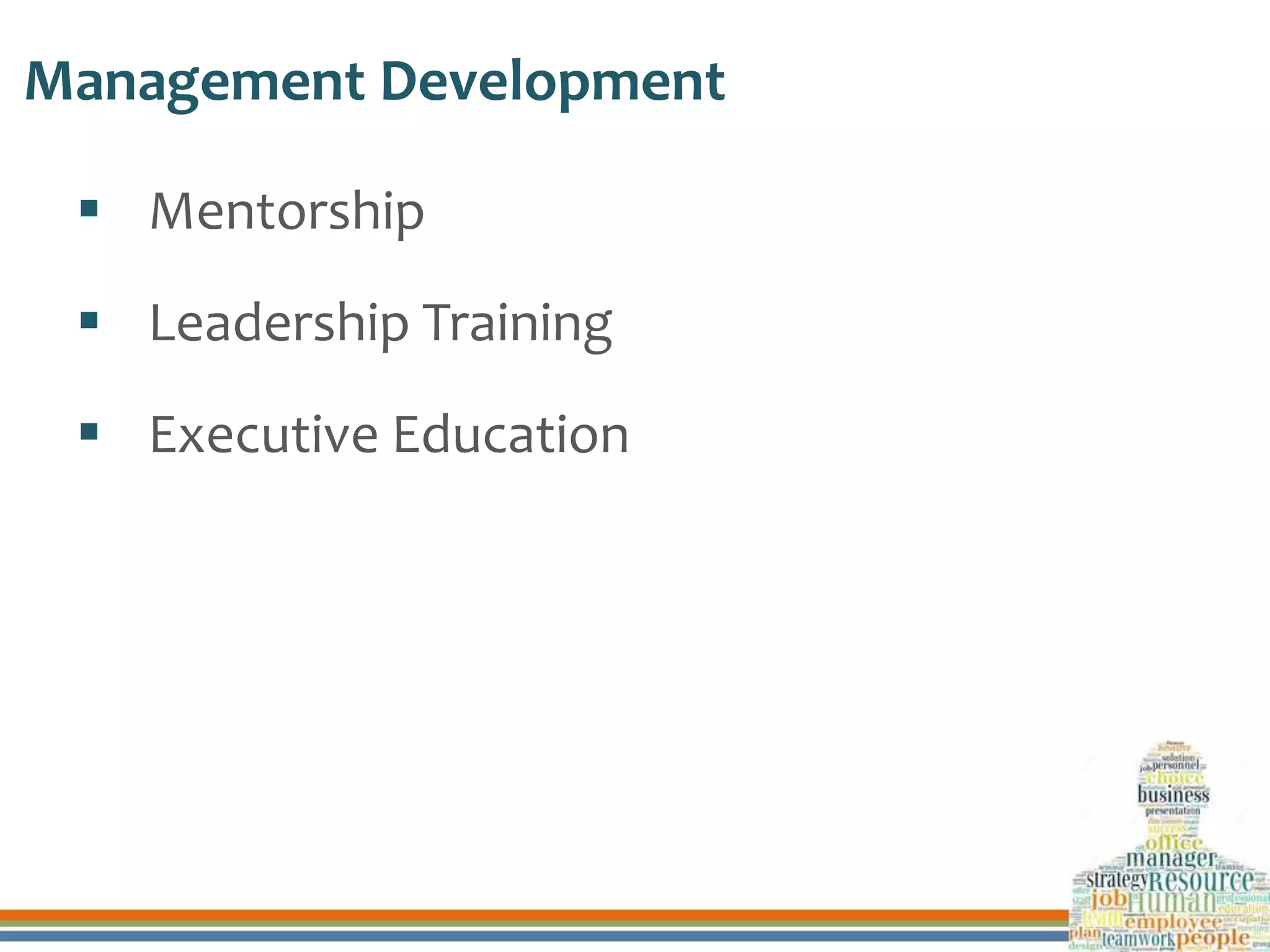
Management Development
 Mentorship
 Leadership Training
 Executive Education
Career Planning
Career Planning
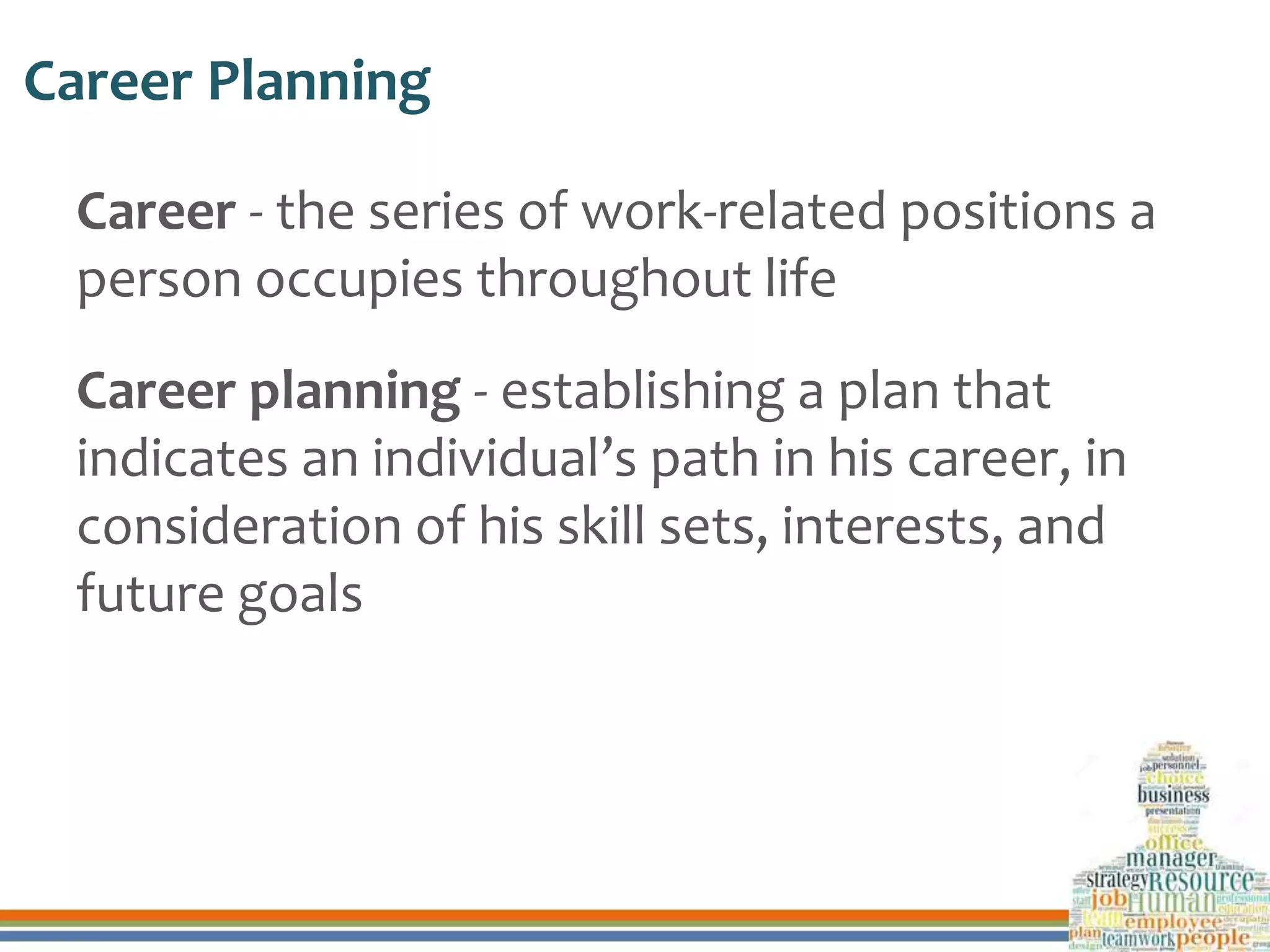
Career - the series of work-related positions a
person occupies throughout life
Career planning - establishing a plan that
indicates an individual’s path in his career, in
consideration of his skill sets, interests, and
future goals
Significance of Career Planning
 Goal-driven productivity
 Personal and organizational growth
 Succession planning
 Position alignment with skills and interests
 Financial advantages of in-house experts
Objective of Career Planning
Develop employee career plans that take into
account their skills, interests, expertise, and
preferences, matching them with specific steps
and actions for development and growth, in
alignment with a company’s organizational
goals
Career Planning
 Organization-centered career planning
 Individual-centered career planning
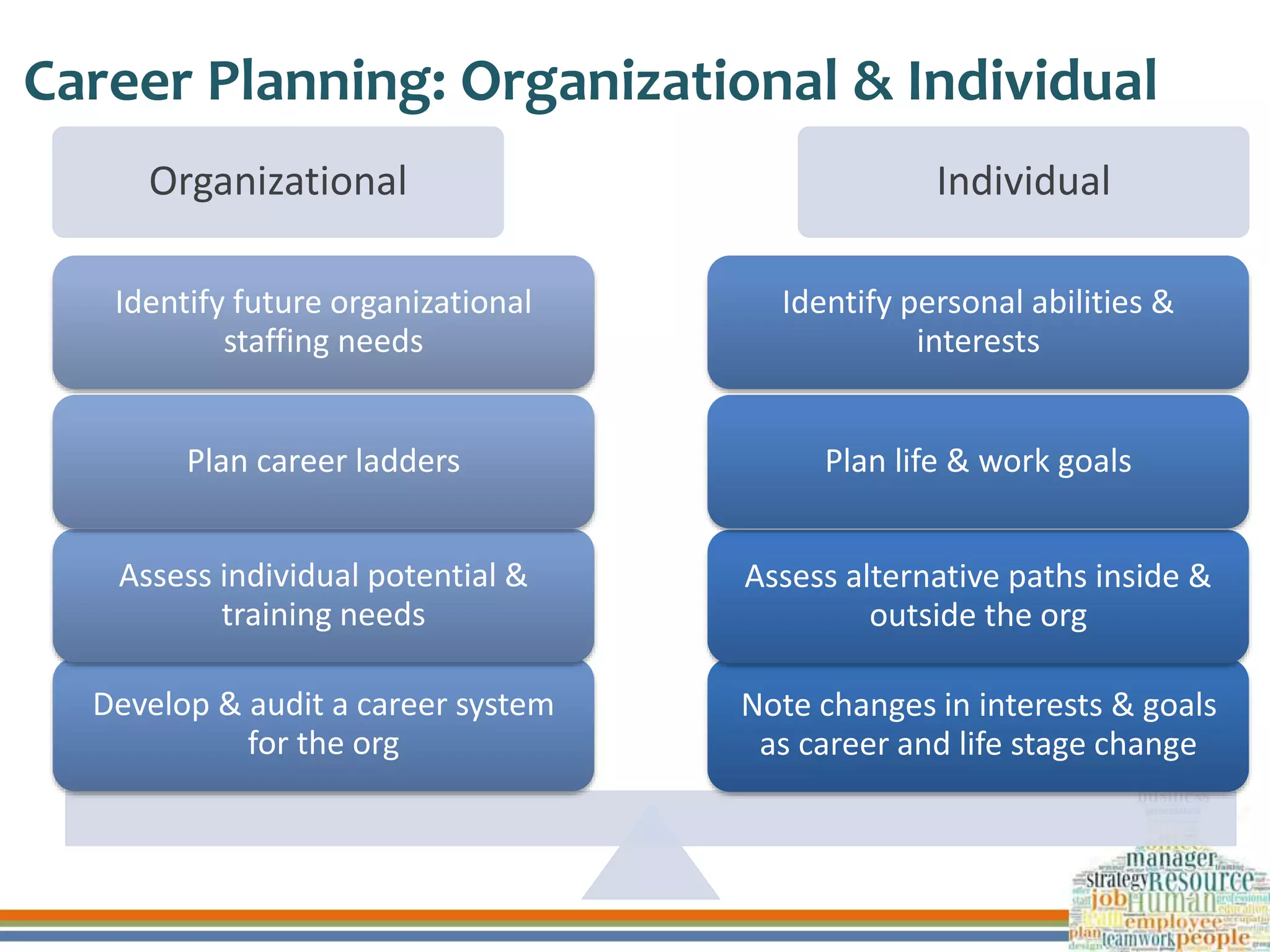
Career Planning: Organizational & Individual
Organizational Individual
Note changes in interests & goals
as career and life stage change
Assess alternative paths inside &
outside the org
Plan life & work goals
Identify personal abilities &
interests
Develop & audit a career system
for the org
Assess individual potential &
training needs
Plan career ladders
Identify future organizational
staffing needs
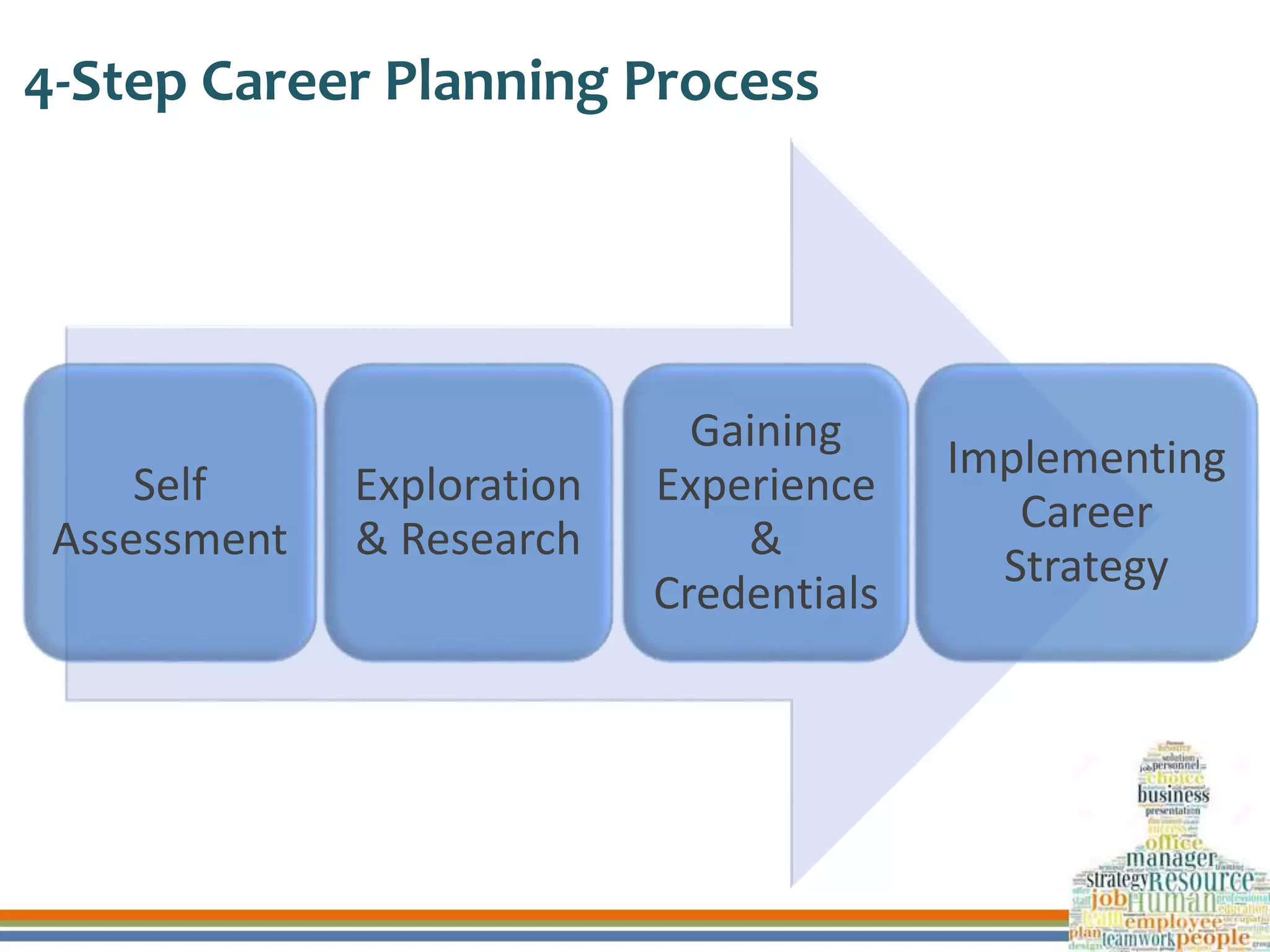
4-Step Career Planning Process
Self
Assessment
Exploration
& Research
Gaining
Experience
&
Credentials
Implementing
Career
Strategy
Strategies in Career Planning
 Aptitude and personality testing
 Income graphing
 Job rotations
 Internal hiring
 Lateral and vertical transfers
 Work-life balance
Employee Engagement
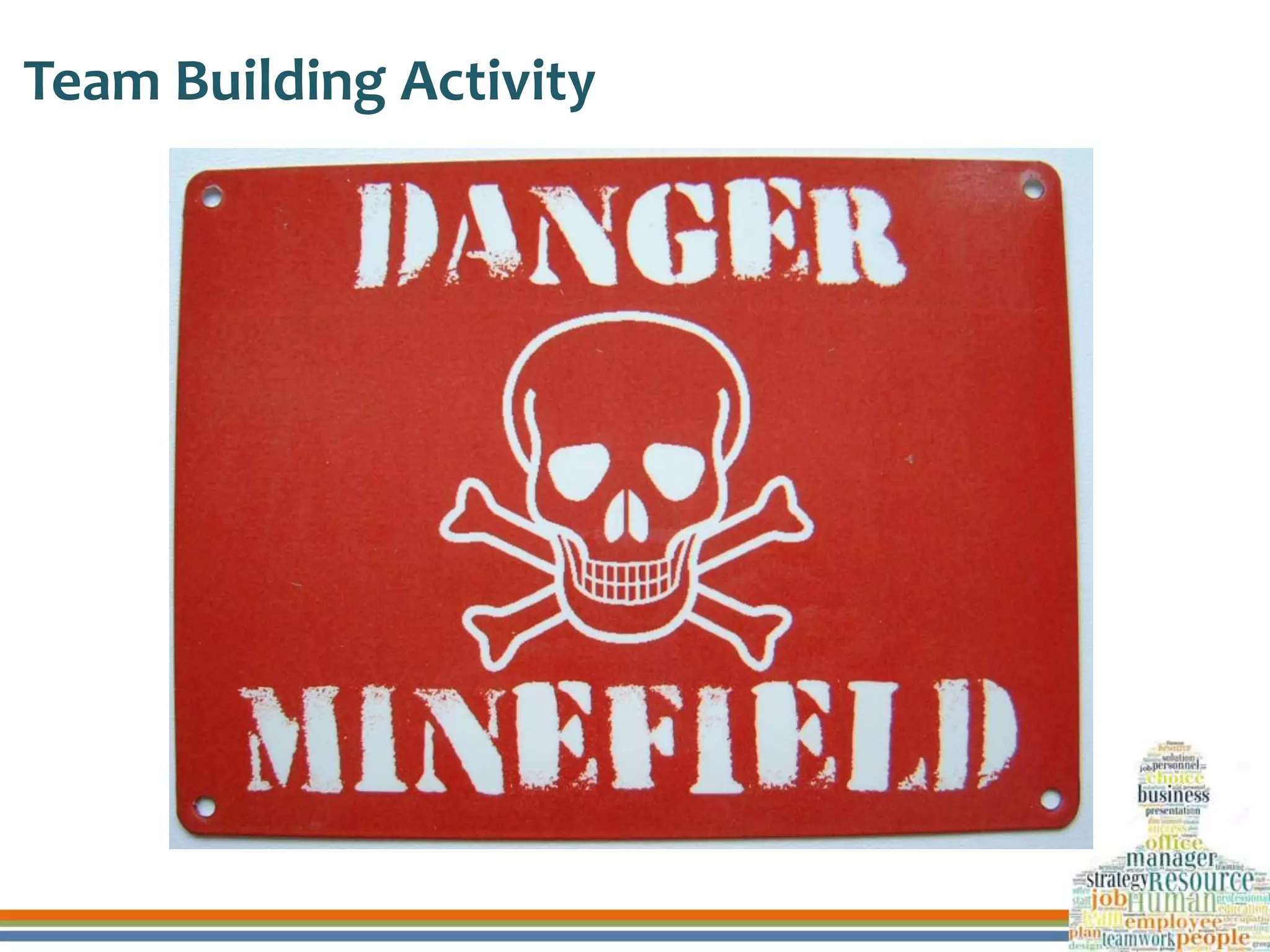
Team Building Activity
Campbell’s Soup CEO Doug Conant
“To win in the marketplace you must first win in
the workplace.”
Definition
Employee engagement - the emotional
commitment the employee has to the
organization and its goals
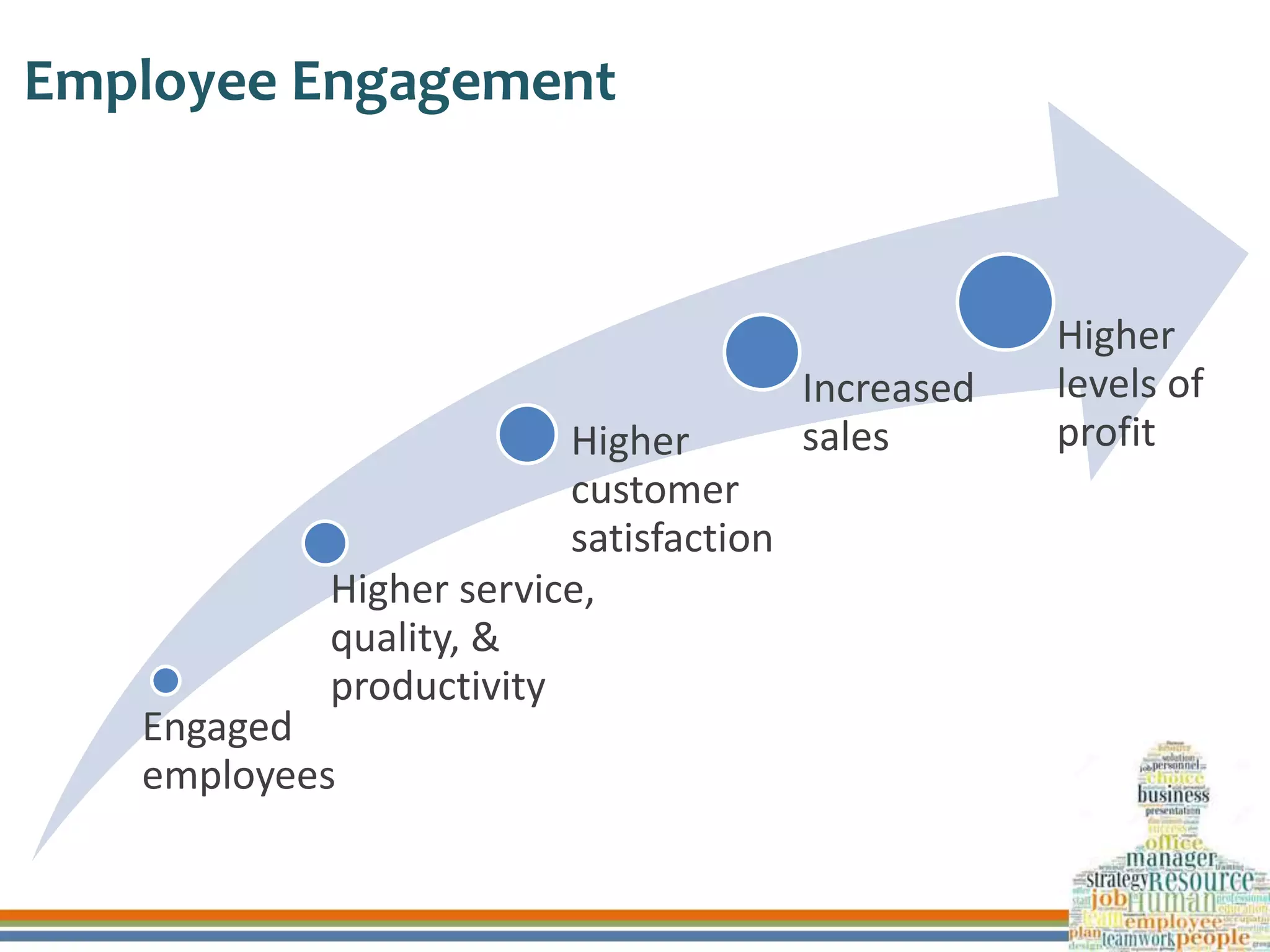
Employee Engagement
Engaged
employees
Higher service,
quality, &
productivity
Higher
customer
satisfaction
Increased
sales
Higher
levels of
profit
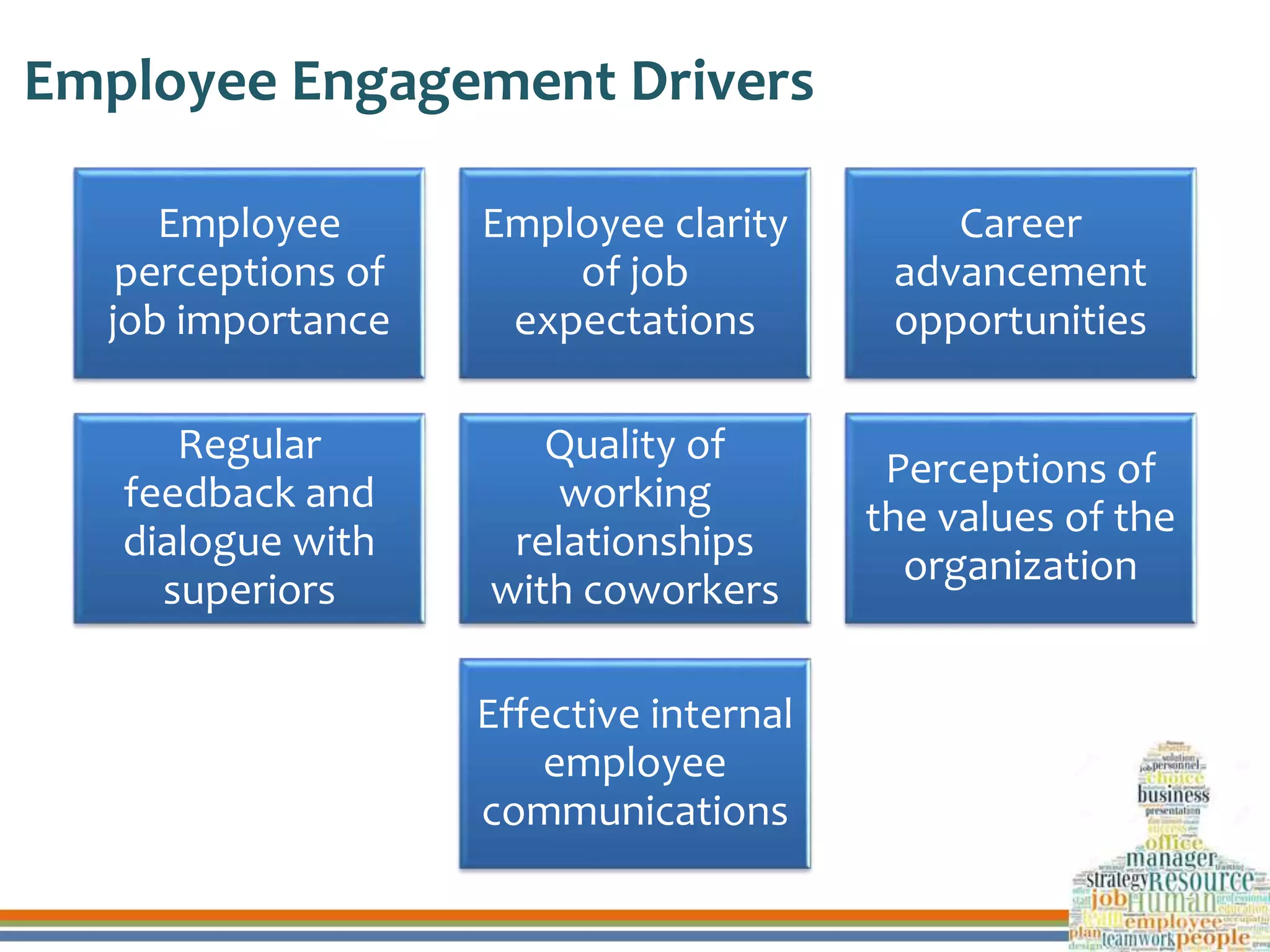
Employee Engagement Drivers
Employee
perceptions of
job importance
Employee clarity
of job
expectations
Career
advancement
opportunities
Regular
feedback and
dialogue with
superiors
Quality of
working
relationships
with coworkers
Perceptions of
the values of the
organization
Effective internal
employee
communications
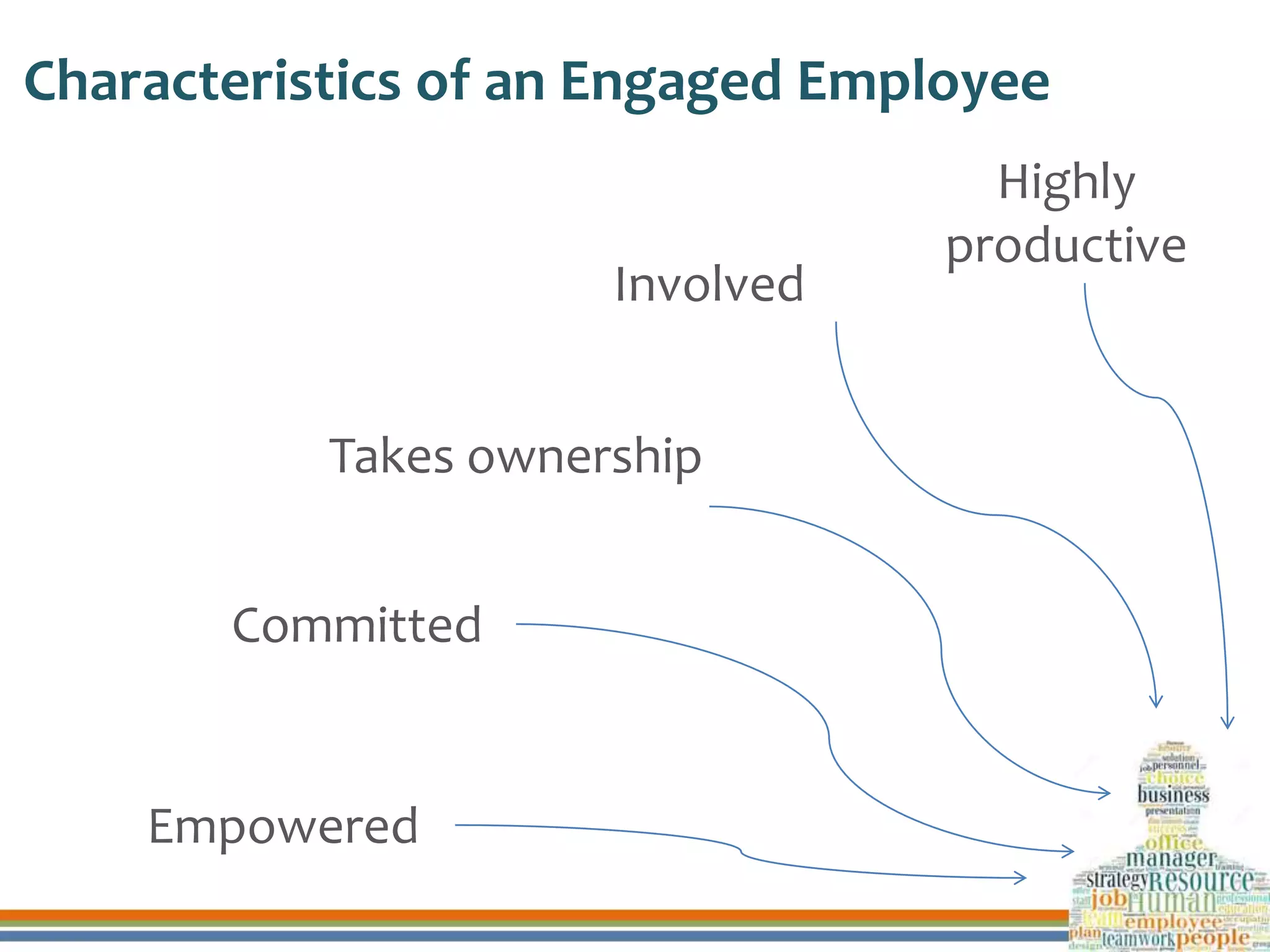
Characteristics of an Engaged Employee
Highly
productive
Involved
Takes ownership
Committed
Empowered
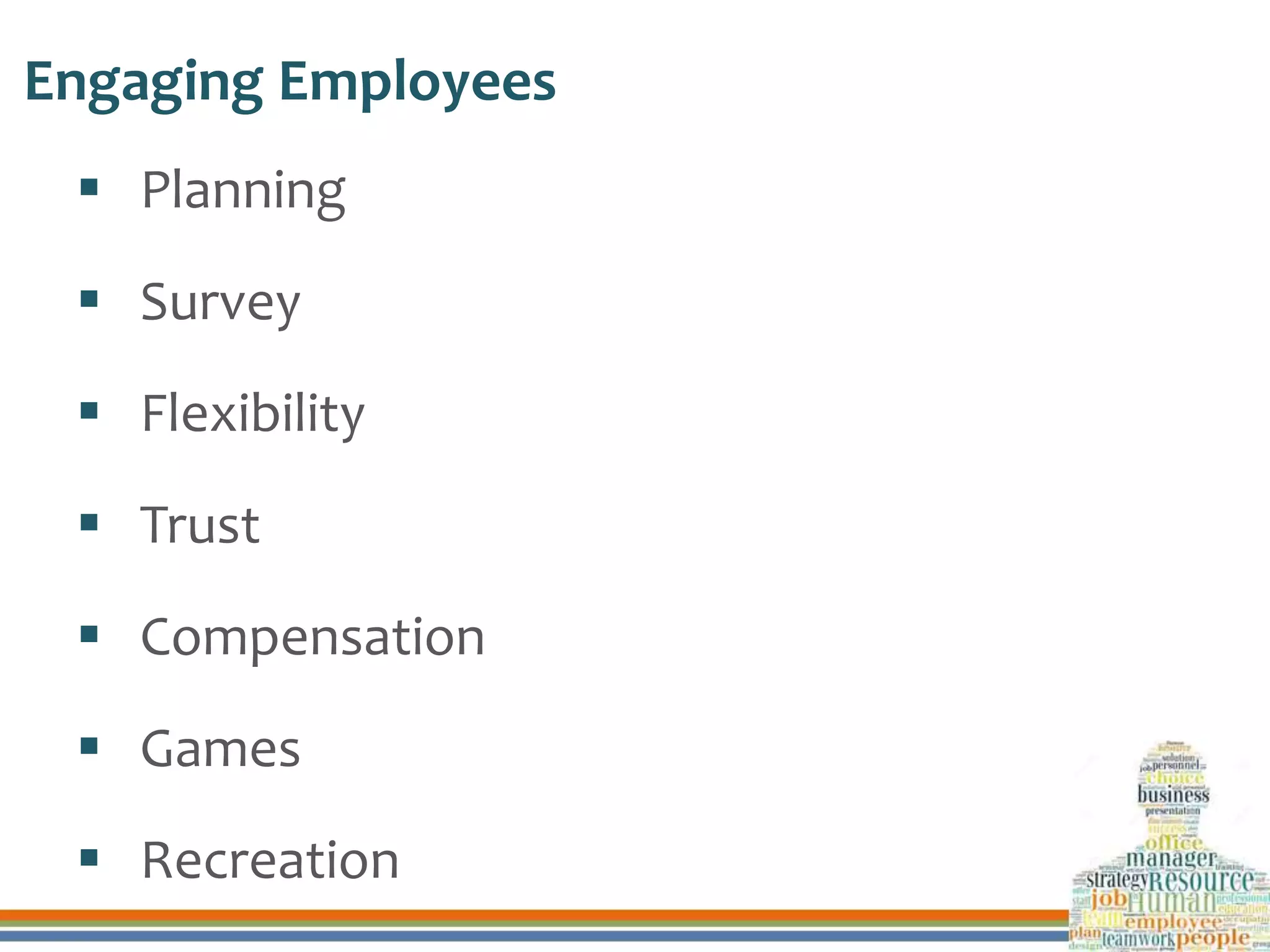
Engaging Employees
 Planning
 Survey
 Flexibility
 Trust
 Compensation
 Games
 Recreation
How 3 Organizations Ensure
Human Resource Development through
Training, Career Planning, and Employee
Engagement
 Directly hires employees except utility staff
 Conducts employee orientation after
contract signing
 New hire classroom/exposure training for 7
days, 1 month buddy system (shadowing)
 Contractual employees for 5 months,
performance evaluation for regularization
before 6th month
 Bi-annual performance appraisals
 Medical, dental, and cooperative benefits
upon regularization
 Basic salary with incentives and bonuses
 Training for newly-rolled out polices and
processes, constant training for customer
care
 Training for leadership, communication,
decision-making, team building
 Lateral and vertical job movements
 Loyalty awards with rewards for year
5/10/15/20…
 Directly hires employees except utility staff
 Conducts employee orientation after
contract signing
 New hire classroom training for at least 3
weeks (depending on client requirements),
at least 2 weeks of nesting
 6-month probationary period, quarterly
performance appraisals with yearly
performance-based salary increase
 Lifestyle benefits: Teletech passport
(discount card), game rooms, concerts,
award nights, family day, summer outing,
team building activities, etc.
 Internal lateral and vertical job movements
with opportunities for interim positions,
leadership and management trainings
 Basic salary, allowances, and performance-
based incentives, commissions, bonuses,
Teletech Dollars and Teletech Store
 Employee referral programs
 Teletech University
 Technology based systems for
transparency: Intranet system, Kronos for
schedule and pay monitoring, Sick Hotline
for calling in sick, IT portal for technology-
related issues, etc.
 Partnership with Cornell University for
online courses
 1-month new hire training and orientation
at Training Center, branch immersion
 1-2 days for existing employee seminars
(branch, region, hub)
 Technical training (branch, region, hub)
 1-month training for Customer Service
Representative (CSR) to New Accounts
Clerk (NAC)
 2-week training for CSR to Loans
 1-week training for lateral operations
transfers
 1-month New Systems Training (Training
Center), 1-week immersion, 1-month
rotation among departments and/or
branches
 4-month training for Branch Operations
Officers at the Training Center
 6-month Managerial Training at the Training
Center
 Think Big Program - little ideas that can
create a huge impact by economies of scale
 Other Orientations and Seminars
 Quarterly bonuses, performance-based
salary increase, bonuses for year 5/10/15,
bonus for passing board or bar exams
 Medical, dental, and optical benefits
 Outings, anniversary and holiday parties
Sir Ken Robinson
“You cannot predict the outcome of human
development. All you can do is - like a farmer -
create the conditions under which it will begin
to flourish.”
References
 Anthony W.P., Kacmar, K.M., Perrewé, P.L. (2002) Human resource management: a strategic
approach, 4th ed. Fort Worth : Harcourt College Publishers.HF5549 .A866 2002
 Crim, Dan and Gerard H. Seijts (2006). "What Engages Employees the Most or, The Ten C’s of
Employee Engagement". Ivey Business Journal. Retrieved 2013-01-24.
 Employee Commitment Remains Unchanged..... Watson Wyatt Worldwide. 2002. Retrieved
2006-11-07.
 Engage Employees and Boost Performance. Hay Group. 2002. Archived from the original on
2006-11-23. Retrieved 2006-11-09
 Fresno State University Website
(http://www.fresnostate.edu/studentaffairs/careers/alumni/planning/)
 Goldstein, I. L., Ford J.K. (2002) Training in organizations: needs assessment, development,
and evaluation, 4th ed. Belmont, CA . HF5549.5.T7 G543 2002
 Greer, C.R. (1995) Strategy and human resources – a general managerial perspective,
Prentice Hall.
 Hamilton, Chris Top Ten Ideas for Employee Engagement
http://smallbusiness.chron.com/top-ten-ideas-employee-engagement-31543.html
 Hulme, Virginia A. (March 2006). "What Distinguishes the Best from the Rest". China
Business Review.
 Kruse, Kevin Forbes Website http://www.forbes.com/sites/kevinkruse/2012/06/22/employee-
engagement-what-and-why/
 Mathis, R. Human Resource Management 13th Edition
References
 MSG Experts (2013). Management Study Guide. Retrieved January 26, 2015, from Employee
Training: http://www.managementstudyguide.com/employee-training.htm
 Noe, R. A. (2008). Employee Training & Development, 4th ed., New York: McGraw-Hill Irwin.
 Riley, Michael, (1996) Human resource management in the hospitality and tourism industry,
2nd ed. Oxford ; Boston : Butterworth-Heinemann. TX911.3.P4 R55 1996
 Ryan, Richard M. and Edward L. Deci (January 2000). "Self-Determination Theory and
Facilitation of Intrinsic Motivation, Social Development, and Well-Being". American
Psychologist Association 55: 68–78. doi:10.1037/0003-066x.55.1.68. Archived from the original
on 2006-12-12. Retrieved 2006-11-06.
 State Government of Victoria Website (http://careers.vic.gov.au/exploration/a-fair-workplace)
 United State General Accounting Office. (2004). Human Capital: A Guide for Assessing Strategic
Training and Development Efforts in the Federal Government. GAO-04-546G.

Report development of human resources hrm report grp4 personal

  • 1.
    Kristian Peralta |Macki Cosgayon Thea Obamos | Gigi Alba
  • 2.
    Functions of HumanResource Management 1. Job Organization and Acquisition 2. Human Resource Retention 3. Development of Human Resources 4. Separation
  • 3.
    Objectives By the endof this session, participants should be able to:  Define training, learn its goals and objectives, and explain its significance to the organization  Identify and explain the 4-stage Training Cycle
  • 4.
    Objectives  Give examplesof training strategies that organizations use for human resource development  Define career planning, learn its goals and objectives, and explain its significance to the organization  Enumerate the 4 steps in the career planning process and explain the strategies used
  • 5.
    Objectives  Define employeeengagement and explain its significance to human resource development  Give examples on how to generate employee engagement in the organization
  • 6.
  • 7.
    Training & DevelopmentDefinition Training – an organization’s planned effort to facilitate employees’ learning of job-related competencies Development – formal education, job experiences, relationships, and assessments of personality and abilities that help employees prepare for the future.
  • 8.
    Objective of Training Tohelp the organization achieve its mission and goals by improving individual and, ultimately, organizational performance
  • 9.
    Significance of Training Maintains qualified products and/or services  Achieves high service standards  Provides information for new comers  Refreshes memory of old employees  Achieves learning about new things; technology, products/service delivery
  • 10.
    Significance of Training Reduces mistakes – minimizing costs  Opportunity for staff to give feedback/suggest improvements  Improves communication & relationships – better teamwork
  • 11.
  • 12.
    Basic Grounds forTraining 1. New Hire Training 2. Retraining 3. Technology Training 4. Uptraining
  • 13.
    Training Methods 1. On-the-jobTraining 2. Off-the-job Training
  • 14.
    The Training Cycle Identify learningneed Design training Deliver training Evaluate training
  • 15.
    Management Development  Mentorship Leadership Training  Executive Education
  • 16.
  • 17.
    Career Planning Career -the series of work-related positions a person occupies throughout life Career planning - establishing a plan that indicates an individual’s path in his career, in consideration of his skill sets, interests, and future goals
  • 18.
    Significance of CareerPlanning  Goal-driven productivity  Personal and organizational growth  Succession planning  Position alignment with skills and interests  Financial advantages of in-house experts
  • 19.
    Objective of CareerPlanning Develop employee career plans that take into account their skills, interests, expertise, and preferences, matching them with specific steps and actions for development and growth, in alignment with a company’s organizational goals
  • 20.
    Career Planning  Organization-centeredcareer planning  Individual-centered career planning
  • 21.
    Career Planning: Organizational& Individual Organizational Individual Note changes in interests & goals as career and life stage change Assess alternative paths inside & outside the org Plan life & work goals Identify personal abilities & interests Develop & audit a career system for the org Assess individual potential & training needs Plan career ladders Identify future organizational staffing needs
  • 22.
    4-Step Career PlanningProcess Self Assessment Exploration & Research Gaining Experience & Credentials Implementing Career Strategy
  • 23.
    Strategies in CareerPlanning  Aptitude and personality testing  Income graphing  Job rotations  Internal hiring  Lateral and vertical transfers  Work-life balance
  • 24.
  • 25.
  • 26.
    Campbell’s Soup CEODoug Conant “To win in the marketplace you must first win in the workplace.”
  • 27.
    Definition Employee engagement -the emotional commitment the employee has to the organization and its goals
  • 28.
    Employee Engagement Engaged employees Higher service, quality,& productivity Higher customer satisfaction Increased sales Higher levels of profit
  • 29.
    Employee Engagement Drivers Employee perceptionsof job importance Employee clarity of job expectations Career advancement opportunities Regular feedback and dialogue with superiors Quality of working relationships with coworkers Perceptions of the values of the organization Effective internal employee communications
  • 30.
    Characteristics of anEngaged Employee Highly productive Involved Takes ownership Committed Empowered
  • 31.
    Engaging Employees  Planning Survey  Flexibility  Trust  Compensation  Games  Recreation
  • 32.
    How 3 OrganizationsEnsure Human Resource Development through Training, Career Planning, and Employee Engagement
  • 33.
     Directly hiresemployees except utility staff  Conducts employee orientation after contract signing  New hire classroom/exposure training for 7 days, 1 month buddy system (shadowing)  Contractual employees for 5 months, performance evaluation for regularization before 6th month
  • 34.
     Bi-annual performanceappraisals  Medical, dental, and cooperative benefits upon regularization  Basic salary with incentives and bonuses  Training for newly-rolled out polices and processes, constant training for customer care  Training for leadership, communication, decision-making, team building
  • 35.
     Lateral andvertical job movements  Loyalty awards with rewards for year 5/10/15/20…
  • 36.
     Directly hiresemployees except utility staff  Conducts employee orientation after contract signing  New hire classroom training for at least 3 weeks (depending on client requirements), at least 2 weeks of nesting  6-month probationary period, quarterly performance appraisals with yearly performance-based salary increase
  • 37.
     Lifestyle benefits:Teletech passport (discount card), game rooms, concerts, award nights, family day, summer outing, team building activities, etc.  Internal lateral and vertical job movements with opportunities for interim positions, leadership and management trainings  Basic salary, allowances, and performance- based incentives, commissions, bonuses, Teletech Dollars and Teletech Store
  • 38.
     Employee referralprograms  Teletech University  Technology based systems for transparency: Intranet system, Kronos for schedule and pay monitoring, Sick Hotline for calling in sick, IT portal for technology- related issues, etc.  Partnership with Cornell University for online courses
  • 39.
     1-month newhire training and orientation at Training Center, branch immersion  1-2 days for existing employee seminars (branch, region, hub)  Technical training (branch, region, hub)  1-month training for Customer Service Representative (CSR) to New Accounts Clerk (NAC)  2-week training for CSR to Loans
  • 40.
     1-week trainingfor lateral operations transfers  1-month New Systems Training (Training Center), 1-week immersion, 1-month rotation among departments and/or branches  4-month training for Branch Operations Officers at the Training Center
  • 41.
     6-month ManagerialTraining at the Training Center  Think Big Program - little ideas that can create a huge impact by economies of scale  Other Orientations and Seminars  Quarterly bonuses, performance-based salary increase, bonuses for year 5/10/15, bonus for passing board or bar exams
  • 42.
     Medical, dental,and optical benefits  Outings, anniversary and holiday parties
  • 43.
    Sir Ken Robinson “Youcannot predict the outcome of human development. All you can do is - like a farmer - create the conditions under which it will begin to flourish.”
  • 44.
    References  Anthony W.P.,Kacmar, K.M., Perrewé, P.L. (2002) Human resource management: a strategic approach, 4th ed. Fort Worth : Harcourt College Publishers.HF5549 .A866 2002  Crim, Dan and Gerard H. Seijts (2006). "What Engages Employees the Most or, The Ten C’s of Employee Engagement". Ivey Business Journal. Retrieved 2013-01-24.  Employee Commitment Remains Unchanged..... Watson Wyatt Worldwide. 2002. Retrieved 2006-11-07.  Engage Employees and Boost Performance. Hay Group. 2002. Archived from the original on 2006-11-23. Retrieved 2006-11-09  Fresno State University Website (http://www.fresnostate.edu/studentaffairs/careers/alumni/planning/)  Goldstein, I. L., Ford J.K. (2002) Training in organizations: needs assessment, development, and evaluation, 4th ed. Belmont, CA . HF5549.5.T7 G543 2002  Greer, C.R. (1995) Strategy and human resources – a general managerial perspective, Prentice Hall.  Hamilton, Chris Top Ten Ideas for Employee Engagement http://smallbusiness.chron.com/top-ten-ideas-employee-engagement-31543.html  Hulme, Virginia A. (March 2006). "What Distinguishes the Best from the Rest". China Business Review.  Kruse, Kevin Forbes Website http://www.forbes.com/sites/kevinkruse/2012/06/22/employee- engagement-what-and-why/  Mathis, R. Human Resource Management 13th Edition
  • 45.
    References  MSG Experts(2013). Management Study Guide. Retrieved January 26, 2015, from Employee Training: http://www.managementstudyguide.com/employee-training.htm  Noe, R. A. (2008). Employee Training & Development, 4th ed., New York: McGraw-Hill Irwin.  Riley, Michael, (1996) Human resource management in the hospitality and tourism industry, 2nd ed. Oxford ; Boston : Butterworth-Heinemann. TX911.3.P4 R55 1996  Ryan, Richard M. and Edward L. Deci (January 2000). "Self-Determination Theory and Facilitation of Intrinsic Motivation, Social Development, and Well-Being". American Psychologist Association 55: 68–78. doi:10.1037/0003-066x.55.1.68. Archived from the original on 2006-12-12. Retrieved 2006-11-06.  State Government of Victoria Website (http://careers.vic.gov.au/exploration/a-fair-workplace)  United State General Accounting Office. (2004). Human Capital: A Guide for Assessing Strategic Training and Development Efforts in the Federal Government. GAO-04-546G.

Editor's Notes

  • #3 A review on the Functions of Human Resource Management
  • #8 It is important to note that training focuses on improving an employee’s skill level as related to his/her current job; while development has a more long-term focus intended to help an employee prepare for future jobs.
  • #12 Training is crucial for organizational development and success. It is fruitful to both employers and employees of an organization. An employee will become more efficient and productive if he is trained well. 1. Improved employee morale – Training helps the employee to get job security and job satisfaction. The more satisfied the employee is and the greater is his morale, the more he will contribute to organizational success and the lesser will be employee absenteeism and turnover. 2. Less supervision – A well trained employee will be well acquainted with the job and will need less supervision. 3. Fewer accidents – Errors are likely to occur if the employees lack knowledge and skills required for doing a particular job. The more trained an employee is, the less chances of committing accidents and the more proficient the employee becomes. 4. Chances of promotion – Employees acquire skills and efficiency during training. They become more eligible for promotion. They become an asset for the organization. 5. Increased productivity – Training improves efficiency and productivity of employees. Well trained employees show both quantity and quality performance. There is less wastage of time, money, and resources if employees are properly trained.
  • #13 New Hire Training - New candidates who join an organization are given training. This training familiarizes them with the organizational mission, vision, rules and regulations, and the working conditions. Retraining - The existing employees are trained to refresh and enhance their knowledge. Technology Training - If any updates and amendments take place in technology, training is given to cope up with those changes. For instance, purchasing new equipment, changes in technique of production, computerization, among others. The employees are trained about use of new equipment and work methods. Uptraining - When promotion and career growth becomes important, training is given so that employees are prepared to share the responsibilities of the higher level job.
  • #14 1. On the job training – this training method takes place in a normal working situation. It is a simple and cost-effective training method. The employees are trained in actual working scenario. The motto of such training is “learning by doing”. 2. Off the job training – this training method is provided away from the actual working conditions. It is generally used in case of new employees. Such method is costly and is only effective if a large number of employees have to be trained within a short time period.
  • #15 In order for the training to be effective, employers and trainers must follow the established training cycle. Training Designs are never generic. The processes vary depending on the needs of a particular company and the type of employees to be trained.
  • #16 Mentorship is a personal developmental relationship in which a more experienced or more knowledgeable person helps to guide a less experienced or less knowledgeable person Leadership Training is aimed at developing leadership abilities and attitudes of individuals Executive Education refers to academic programs at graduate-level business schools worldwide for executives, business leaders and functional managers
  • #19 Goal-driven productivity – employees are more driven to perform Personal and organizational growth – there is growth both in the individual employees and the organization as a whole as employees become more driven to succeed and move up the ladder Succession planning – responsibilities and accountabilities can be more clearly defined along with the roles the hierarchy Position alignment with skills and interests – each person is matched with a position that matches his skill and interest Financial advantages of an in-house experts – it is usually cheaper to promote within the organization that hiring externally
  • #21 Organization-centered career planning - focuses on identifying career paths that provide for the logical progression of people between jobs in an organization   Individual-centered career planning - focuses on an individual’s responsibility for a career rather than on organizational needs
  • #22 Effective career planning considers both organization-centered and individual-centered perspectives.
  • #23 4 Steps in the Career Planning Process Self-Assessment Personal Assessment (Skills, Values, Interests, Needs, Aptitudes & Personality) Self-Care: Consider the work-life balance that you need Geography Finances Exploration and Research Occupational Research Informational Interviews with people in your field of interest Educational Research – What sort of training or credentials would you need? Industry Research Professional & Trade Associations in the field Gaining Experience & Credentials Short-Term Training Education (Classroom and e-Learning) Internships Volunteer Work Interim or Temporary Employment Job Shadowing Implementing Career Strategy Updating CV Job Application Salary Negotiation
  • #26 Divide class into 2 groups Each group should select 2 “soldiers” The 2 soldiers need to cross the minefield blindfolded, while the rest of the group will be the navigators, guiding them through it Each group will be timed on how quickly they can get their 2 soldiers safely out of the minefield The group with the shortest time record wins
  • #28 Employee Engagement is a workplace approach designed to ensure that employees are committed to their organization’s goals and values, motivated to contribute to organizational success, and are able at the same time to enhance their own sense of well-being. Engagement boils down to an employee’s passion and commitment to the organisation and their job (investment) and the drive to deliver the organisation’s objectives, (motivation) going the extra mile to do so.  Engagement is not transactional - it’s about emotion, behaviors and relationships; there’s a connect between the employee and the organisation. Engaged employees have pride in their job and the organisation and are more likely to recommend the organisation, its products, and services to others. 
  • #29 Studies conducted by Gallup and Aon Hewitt over the past several years have shown a conclusive correlation between an employee's engagement in a company and increased and higher quality productivity. When an employee feels invested in a company, he is driven to go above and beyond the minimum required of him. Engaged employees are more inclined to stay with the company and work at making it better rather than leaving it for better opportunities elsewhere.  Engaged workers have bought into what the organization is about and are trying to make a difference. This is why they're usually the most productive workers. Gallup researchers studied the differences in performance between engaged and actively disengaged work units and found that those scoring in the top half on employee engagement nearly doubled their odds of success compared with those in the bottom half. Those at the 99th percentile had four times the success rate of those at the first percentile.  The same studies have shown that the level of engagement in employees leads to higher earnings per share brought about by higher customer satisfaction ratings and increased revenues. 
  • #30 Employee engagement is enabled by four (4) factors, specifically: Strong Leadership - a visible and empowering leader who can provide a a clear vision about the company, what it stands for, where it comes from, and the direction it is headed. Charismatic Managers - managers who can focus their people and give them direction in attaining the goals of company.  Employee Voice -giving employees a say in how the company is run is key to employee engagement. It reinforces the view that their opinion counts and their participation appreciated. Integrity - the values of the company, what it stands for, must be reflected in its day to day operations. There can be no gap between what it says and what it does. Employee engagement is driven by  Employee perceptions of job importance - the employee needs to feel that what he does matters to the company, a vital cog in the great machine. Surveys have shown that this had the greatest impact on loyalty and customer service than all other employee factors combined.  Employee clarity of job expectations - the employee must know what is expected of him and must be given the tools he needs to do his job. This prevents confusion and frustration, which will eventually lead to employee disengagement. Career advancement / improvement opportunities - the employee must be able to better himself. A dead end job does not motivate an employee to do better because he has nowhere else to go. Regular feedback and dialogue with superiors - Feedback is the key to giving employees a sense of where they’re going and if they are on the right track. A simple pat on the back is sometimes enough. Quality of working relationships with peers, superiors, and subordinates - employee engagement is a direct reflection of how employees feel about their relationship with the boss. If the employee's relationship with his managers is fractured, no amount of perks will persuade the employees to perform at top levels.  Perceptions of the ethos and values of the organization - the employee needs to feel that the company is doing the right thing, not just doing business at the expense of others. He must feel pride in the company, otherwise he can never be engaged in it.  Effective internal employee communications - there must be channels for internal communication across the organization. This will allow employees to feel that they are part of the organization.
  • #31 Highly productive Involved in the welfare of the company Takes ownership and pride in the company Committed to his job and does things above and beyond what is required Empowered and feels a part of the company
  • #32 Planning It is important that from the very start, the right man is chosen for the job. An employee who can not do the job well will feel inadequate and his job satisfaction will be lowered, thus decreasing his engagement in the company. Orientation after hiring to let the employee know what is required of him and training to prepare him for the job.  Survey Recent studies suggest that the traditional annual review of employee engagement is no longer enough in a volatile business environment. Companies must redefine engagement into a continuous and holistic part of its business strategy instead of a mere tool.  http://www.forbes.com/sites/joshbersin/2014/04/10/its-time-to-rethink-the-employee-engagement-issue/  Flexibility A company must be flexible enough to adapt to the changing needs of its environment. This includes changing internal policies and procedures to better engage its employees and maintain its edge, keeping the organization a well oiled machine. Trust Companies have to be open and transparent when dealing with employees. Rules must be clearly stated and enforcement equal among all.  There is an old truism “ people leave managers, not organizations.” Research suggests this is no longer true. When people leave it is usually a combination of the organization and all its elements that cause turnover. A bad manager can force someone to leave, but usually there are many other factors that create low performance or a departure. Compensation A fair wage for a fair day's labor. Employees expect to be compensated fairly for their work. Compensation packages which include stock options and profit are often better at making employees more engaged in the company because then they feel that they have a stake in it. Games All work and no play makes for a burnt out and ineffective employee. A bit of healthy competition could break the monotony of work and increase productivity. Recreation Company get togethers and meet and greet events boost for employee morale and make them feel that it is more than just impersonal bricks and mortar and that there are flesh and blood people at the helm.
  • #33 It is important to note that training focuses on improving an employee’s skill level as related to his/her current job; while development has a more long-term focus intended to help an employee prepare for future jobs.
  • #42 Think Big Program: (e.g. reuse paper, paperclips, rubber bands, integration of forms to eliminate rubber stamps, Metrobank Online)
  • #44 Sir Kenneth Robinson (born 4 March 1950) is an English author, speaker and international advisor on education in the arts to government, non-profits, education and arts bodies.