

Getting to Yes:
Engaging Candidates Throughout
    the Recruitment Process

   Geoff Ramey & Debra Watkinson

             October 2012
Introduction / Agenda
• The evolution of the candidate experience
• Creating exceptional candidate and employee interactions
• Assessing and understanding hot buttons
• Creating and selling a compelling employer value proposition
• The role of the recruiter: not just getting to “yes”
• The power of Choice Architecture and how it relates to
  getting a “yes”
• The fine art of building trust and relationship-based
  interviewing
• Ensuring offer acceptance, a great First Day and engagement
  beyond the Honeymoon
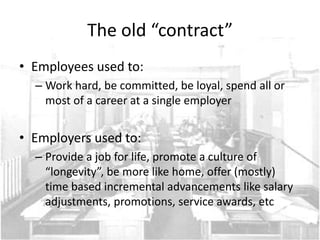
The old “contract”
• Employees used to:
  – Work hard, be committed, be loyal, spend all or
    most of a career at a single employer


• Employers used to:
  – Provide a job for life, promote a culture of
    “longevity”, be more like home, offer (mostly)
    time based incremental advancements like salary
    adjustments, promotions, service awards, etc
The new workplace
• Workplaces now tend to:
   – Be fast paced and aggressive, focus on competitive
     advantage, push for market dominance, emphasize
     employee performance and discretional effort, be more
     reliant on worker knowledge, tolerate fewer mistakes


• All of these factors often require other sacrifices

• If we are creating workplaces with short term
  competitive thinking, why would we expect long
  term commitments from employees?
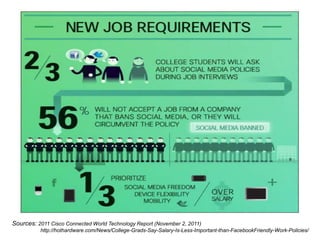
Regardless of your brand,
not every top candidate is
kept awake at night with
hopes of working for you!
Sources: 2011 Cisco Connected World Technology Report (November 2, 2011)
          http://hothardware.com/News/College-Grads-Say-Salary-Is-Less-Important-than-FacebookFriendly-Work-Policies/
The New Recruitment Landscape
• Macro challenges
   –   Demographic trends will continue to cause under-supply of knowledge workers
   –   Job liquidity on the rise
   –   Increasing employee expectations
   –   Proven role of the Internet – easier to move between jobs
   –   New and changing roles as technology advances—candidate experience, education
       and/or skill sets can’t meet new demands

• Micro challenges
   – Companies have shrinking qualified candidate pools to select from
   – Companies are increasingly cost conscious as budgets across functions remain tight
     and market pressures push asking salaries up
   – Companies must leverage technology to source and recruit candidates through
     new and unique channels aka fish where the fish are


            Top talent will always be in demand
Recruitment Objectives
Success in the global-connected economy depends on
  the ability to attract, evaluate, hire, integrate and
  retain the critical talent necessary to execute your
                    business strategy.
• You must:
   – Develop a compelling Employer Value Proposition
   – Effectively partner with all stakeholders in the
     recruitment process…including the candidate!
   – Develop a consistent process to identify, assess and
     engage top talent
   – Hire with your head, not your heart
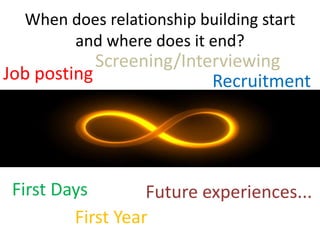
When does relationship building start
       and where does it end?
            Screening/Interviewing
Job posting               Recruitment


 First Days        Future experiences...
         First Year
Candidate Experience
To talk acceptance only is to talk within limited
 confines.


Think...


  Getting to Yes!
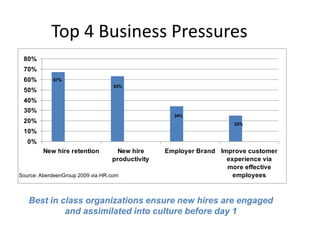
Top 4 Business Pressures
 80%                                                      Source: AberdeenGroup 2009

 70%
 60%        67%
                                   63%
 50%
 40%
 30%
                                                   34%
 20%                                                                  25%
 10%
   0%
         New hire retention         New hire     Employer Brand Improve customer
                                  productivity                    experience via
                                                                  more effective
Source: AberdeenGroup 2009 via HR.com                               employees


   Best in class organizations ensure new hires are engaged
            and assimilated into culture before day 1
Engagement & Retention Facts
Many Managers and Organizations:
• typically think about engaging and retaining employees
  only when an employee gives notice
• do not actively tie engagement or retention strategies to
  critical organizational activities (ie. Recruiting,
  onboarding, performance management, project
  assignments, job assignments)
• do not embrace a career planning approach and if they
  do, it consists of infrequent informal conversations that
  are not documented or followed up on
• believe succession planning equals retention/engagement
  strategy
• are not proactive about retention and engagement
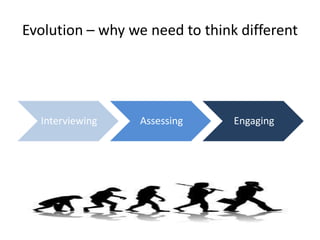
Evolution – why we need to think different


  Interviewing   Assessing      Engaging
The EVP
Employer Value Proposition:
• Reflects & represents the culture; the people
  and our values
• Is emotional
• Is meaningful to candidates, not just the
  organization
• Is human, organic, not staged or idealistic
• Makes a promise for the future (Vision)
Key Benefits Of An
        Employer Value Proposition
 Provides employees with
  personalized experiences
 Improves loyalty
 Builds employer brand
 Builds market brand
 Creates shared expectations
 Promotes understanding of company processes
 Creates an emotional attachment to the business
 Improves acceptance and retention
The magic bullet (sort of)...

To retain an employee, think
 like the employee and build
     your recruitment and
 engagement programs from
     the perspective of the
           employee.
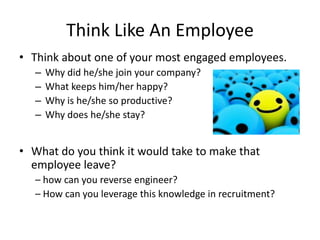
Think Like An Employee
• Think about one of your most engaged employees.
   –   Why did he/she join your company?
   –   What keeps him/her happy?
   –   Why is he/she so productive?
   –   Why does he/she stay?


• What do you think it would take to make that
  employee leave?
   – how can you reverse engineer?
   – How can you leverage this knowledge in recruitment?
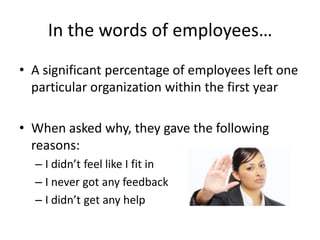
In the words of employees…
• A significant percentage of employees left one
  particular organization within the first year

• When asked why, they gave the following
  reasons:
  – I didn’t feel like I fit in
  – I never got any feedback
  – I didn’t get any help
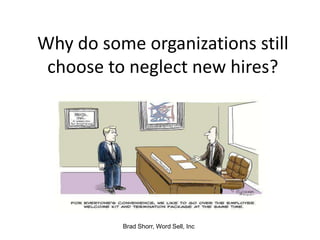
Why do some organizations still
 choose to neglect new hires?


          Brad Shorr, Word Sell, Inc
Walk a day
• Would you tolerate your recruitment process?

  – Timelines
  – Job portals & ATS’s
  – Number of interviews
  – Depth of feedback
  – Personal interaction
  – Quality and type of people involved
  – Listening to needs and wants
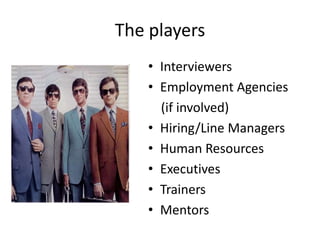
The players
    • Interviewers
    • Employment Agencies
      (if involved)
    • Hiring/Line Managers
    • Human Resources
    • Executives
    • Trainers
    • Mentors
Building Trust
Make candidates like you (your company) better by:

• Building a relationship with them
• Treating them as client, not a candidate
• Respecting their time and investment in the
  process
• Keeping connected
• Providing feedback
Coaching Up
• Polish off those hiring managers in the rough:
  Engage hiring managers as partners in
   the process

  Have them articulate the EVP to you in
   their words (this is what they are
   sharing with the candidates)

  Guide them toward successful
   practices-don’t focus on process

  Help them see from the candidate
   perspective
Choice Architecture
     Many employers are inclined to believe
      overselling EVPs and its aspects and/or
   inundating candidates with information gets
                    them to Yes.
But remember:


“A wealth of information creates a poverty
         of attention.” (Herbert Simon)
Levels of Investment

• What degree of investment are you making in
  your candidates pre-hire and post-hire?

• Should you consider moving some of the
  activities forward into the pre-hire process?
Choice Architecture:
           Level 1 – The Basics
•   Need to know information
•   Satisfies HR / Legal Needs
•   Benefits packages
•   Overview of the organization
•   Mission, Vision, Values
•   Overview of the company/products
•   Computer policies
•   Safety/security procedures
•   Compensation, bonus, vacation
Choice Architecture
        Level 2 - The Affirmation
•   Providing a fun interactive experience
•   Meeting with or introduction to executives
•   Tour of office or facilities
•   Introduction to others / team snapshot
•   Discussion about culture / environment
•   Company “schwag”
Choice Architecture
                   Level 3 - The Fit
• Mission/vision/values overview – Detailed discussion
  with hiring manager of expectations and how
  employee would contribute?
• Org Charts – understanding role / responsibility
    –   At the individual level
    –   At the team level
    –   At the departmental level
    –   At the organizational level
•   Discussion on overt and covert culture
•   Clarify work conditions / expectations
•   Job specific information
•   Career and development discussion
Choice Architecture
 Level 4 - The Job
 • Detailed job and responsibility
   discussions between employees and
   managers
 • Goal & strategy alignment
 • Objective setting
 • Provide mentoring and build the
   foundation for essential relationships
 • Understand employee strengths or
   weaknesses (knowledge & skills) and
   seek ways to shorten the learning curve
Keeping candidates passionate and
        connected to the process
• Communicate with candidates
• Anticipate candidate expectations
• Communicate with candidates
• Solicit the needs/wants of candidates directly
  from them, have open conversations
• Meet candidate needs and exceed their
  expectations
• Communicate with candidates
Extending the Honeymoon
• My candidate said yes, now what?

  “Because you have developed a relationship
   with your new hire, you’ve got to continue to
     do to keep ‘em what you did to get ‘em.”
Getting Full Disclosure

             • No surprises
             • Ask early, ask often
             • Process Transparency
             • Come to me
             • Communicate
Final strategies and thoughts
•   Start with a documented plan
•   Think like a new hire
•   Listen for overt cues
•   Listen for subtle cues
•   Communicate regularly
•   Ensure all players know their part
•   Be realistic about your expectations
•   Never take for granted that top talent will always
    have a CHOICE to select you or another employer
Thank You
Debra Watkinson
Director, People Development & Engagement                  Geoff Ramey
Maple Leafs Sports + Entertainment Ltd.            VP, Human Resources
                                                St Andrew Goldfields Ltd.
dwatkinson(at)mapleleafsports.com
                                            gramey(at)sasgoldmines.com

Getting to “Yes” and Beyond: Engaging Candidates Before- and After- The Point of First Contact by Debra Watkinson, Maple Leaf Sports Entertainment Geoff Ramey, CHRP, SHRP Vice President, Human Resources, St Andrew Goldfields Ltd.

  • 1.
    Getting to Yes: EngagingCandidates Throughout the Recruitment Process Geoff Ramey & Debra Watkinson October 2012
  • 2.
    Introduction / Agenda •The evolution of the candidate experience • Creating exceptional candidate and employee interactions • Assessing and understanding hot buttons • Creating and selling a compelling employer value proposition • The role of the recruiter: not just getting to “yes” • The power of Choice Architecture and how it relates to getting a “yes” • The fine art of building trust and relationship-based interviewing • Ensuring offer acceptance, a great First Day and engagement beyond the Honeymoon
  • 3.
    The old “contract” •Employees used to: – Work hard, be committed, be loyal, spend all or most of a career at a single employer • Employers used to: – Provide a job for life, promote a culture of “longevity”, be more like home, offer (mostly) time based incremental advancements like salary adjustments, promotions, service awards, etc
  • 4.
    The new workplace •Workplaces now tend to: – Be fast paced and aggressive, focus on competitive advantage, push for market dominance, emphasize employee performance and discretional effort, be more reliant on worker knowledge, tolerate fewer mistakes • All of these factors often require other sacrifices • If we are creating workplaces with short term competitive thinking, why would we expect long term commitments from employees?
  • 5.
    Regardless of yourbrand, not every top candidate is kept awake at night with hopes of working for you!
  • 6.
    Sources: 2011 CiscoConnected World Technology Report (November 2, 2011) http://hothardware.com/News/College-Grads-Say-Salary-Is-Less-Important-than-FacebookFriendly-Work-Policies/
  • 7.
    The New RecruitmentLandscape • Macro challenges – Demographic trends will continue to cause under-supply of knowledge workers – Job liquidity on the rise – Increasing employee expectations – Proven role of the Internet – easier to move between jobs – New and changing roles as technology advances—candidate experience, education and/or skill sets can’t meet new demands • Micro challenges – Companies have shrinking qualified candidate pools to select from – Companies are increasingly cost conscious as budgets across functions remain tight and market pressures push asking salaries up – Companies must leverage technology to source and recruit candidates through new and unique channels aka fish where the fish are Top talent will always be in demand
  • 8.
    Recruitment Objectives Success inthe global-connected economy depends on the ability to attract, evaluate, hire, integrate and retain the critical talent necessary to execute your business strategy. • You must: – Develop a compelling Employer Value Proposition – Effectively partner with all stakeholders in the recruitment process…including the candidate! – Develop a consistent process to identify, assess and engage top talent – Hire with your head, not your heart
  • 9.
    When does relationshipbuilding start and where does it end? Screening/Interviewing Job posting Recruitment First Days Future experiences... First Year
  • 10.
    Candidate Experience To talkacceptance only is to talk within limited confines. Think... Getting to Yes!
  • 11.
    Top 4 BusinessPressures 80% Source: AberdeenGroup 2009 70% 60% 67% 63% 50% 40% 30% 34% 20% 25% 10% 0% New hire retention New hire Employer Brand Improve customer productivity experience via more effective Source: AberdeenGroup 2009 via HR.com employees Best in class organizations ensure new hires are engaged and assimilated into culture before day 1
  • 12.
    Engagement & RetentionFacts Many Managers and Organizations: • typically think about engaging and retaining employees only when an employee gives notice • do not actively tie engagement or retention strategies to critical organizational activities (ie. Recruiting, onboarding, performance management, project assignments, job assignments) • do not embrace a career planning approach and if they do, it consists of infrequent informal conversations that are not documented or followed up on • believe succession planning equals retention/engagement strategy • are not proactive about retention and engagement
  • 13.
    Evolution – whywe need to think different Interviewing Assessing Engaging
  • 14.
    The EVP Employer ValueProposition: • Reflects & represents the culture; the people and our values • Is emotional • Is meaningful to candidates, not just the organization • Is human, organic, not staged or idealistic • Makes a promise for the future (Vision)
  • 15.
    Key Benefits OfAn Employer Value Proposition  Provides employees with personalized experiences  Improves loyalty  Builds employer brand  Builds market brand  Creates shared expectations  Promotes understanding of company processes  Creates an emotional attachment to the business  Improves acceptance and retention
  • 16.
    The magic bullet(sort of)... To retain an employee, think like the employee and build your recruitment and engagement programs from the perspective of the employee.
  • 17.
    Think Like AnEmployee • Think about one of your most engaged employees. – Why did he/she join your company? – What keeps him/her happy? – Why is he/she so productive? – Why does he/she stay? • What do you think it would take to make that employee leave? – how can you reverse engineer? – How can you leverage this knowledge in recruitment?
  • 18.
    In the wordsof employees… • A significant percentage of employees left one particular organization within the first year • When asked why, they gave the following reasons: – I didn’t feel like I fit in – I never got any feedback – I didn’t get any help
  • 19.
    Why do someorganizations still choose to neglect new hires? Brad Shorr, Word Sell, Inc
  • 20.
    Walk a day •Would you tolerate your recruitment process? – Timelines – Job portals & ATS’s – Number of interviews – Depth of feedback – Personal interaction – Quality and type of people involved – Listening to needs and wants
  • 21.
    The players • Interviewers • Employment Agencies (if involved) • Hiring/Line Managers • Human Resources • Executives • Trainers • Mentors
  • 22.
    Building Trust Make candidateslike you (your company) better by: • Building a relationship with them • Treating them as client, not a candidate • Respecting their time and investment in the process • Keeping connected • Providing feedback
  • 23.
    Coaching Up • Polishoff those hiring managers in the rough: Engage hiring managers as partners in the process Have them articulate the EVP to you in their words (this is what they are sharing with the candidates) Guide them toward successful practices-don’t focus on process Help them see from the candidate perspective
  • 24.
    Choice Architecture Many employers are inclined to believe overselling EVPs and its aspects and/or inundating candidates with information gets them to Yes. But remember: “A wealth of information creates a poverty of attention.” (Herbert Simon)
  • 25.
    Levels of Investment •What degree of investment are you making in your candidates pre-hire and post-hire? • Should you consider moving some of the activities forward into the pre-hire process?
  • 26.
    Choice Architecture: Level 1 – The Basics • Need to know information • Satisfies HR / Legal Needs • Benefits packages • Overview of the organization • Mission, Vision, Values • Overview of the company/products • Computer policies • Safety/security procedures • Compensation, bonus, vacation
  • 27.
    Choice Architecture Level 2 - The Affirmation • Providing a fun interactive experience • Meeting with or introduction to executives • Tour of office or facilities • Introduction to others / team snapshot • Discussion about culture / environment • Company “schwag”
  • 28.
    Choice Architecture Level 3 - The Fit • Mission/vision/values overview – Detailed discussion with hiring manager of expectations and how employee would contribute? • Org Charts – understanding role / responsibility – At the individual level – At the team level – At the departmental level – At the organizational level • Discussion on overt and covert culture • Clarify work conditions / expectations • Job specific information • Career and development discussion
  • 29.
    Choice Architecture Level4 - The Job • Detailed job and responsibility discussions between employees and managers • Goal & strategy alignment • Objective setting • Provide mentoring and build the foundation for essential relationships • Understand employee strengths or weaknesses (knowledge & skills) and seek ways to shorten the learning curve
  • 30.
    Keeping candidates passionateand connected to the process • Communicate with candidates • Anticipate candidate expectations • Communicate with candidates • Solicit the needs/wants of candidates directly from them, have open conversations • Meet candidate needs and exceed their expectations • Communicate with candidates
  • 31.
    Extending the Honeymoon •My candidate said yes, now what? “Because you have developed a relationship with your new hire, you’ve got to continue to do to keep ‘em what you did to get ‘em.”
  • 32.
    Getting Full Disclosure • No surprises • Ask early, ask often • Process Transparency • Come to me • Communicate
  • 33.
    Final strategies andthoughts • Start with a documented plan • Think like a new hire • Listen for overt cues • Listen for subtle cues • Communicate regularly • Ensure all players know their part • Be realistic about your expectations • Never take for granted that top talent will always have a CHOICE to select you or another employer
  • 34.
    Thank You Debra Watkinson Director,People Development & Engagement Geoff Ramey Maple Leafs Sports + Entertainment Ltd. VP, Human Resources St Andrew Goldfields Ltd. dwatkinson(at)mapleleafsports.com gramey(at)sasgoldmines.com