




Attracting, Engaging and
    Retaining Top Talent

           Winning the Battle


            Presented By:
            Terri Joosten
   Benefits of Small Business
   Obstacles to Small Business
   Importance of Talent Management
   How To Make Changes
   Building a Brand Internal and External
   Recruiting
   Performance
   Learning/Development
   Succession Planning
   Analytics
   Industry Facts
   Conclusions
   Technology Decisions
   Solution Review
   Companies with employee base of under 500
   In some cases with less than 1000 if HR is
    really being under utilized or if large amounts
    of part-time or season help.
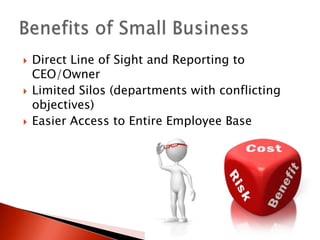
   Direct Line of Sight and Reporting to
    CEO/Owner
   Limited Silos (departments with conflicting
    objectives)
   Easier Access to Entire Employee Base
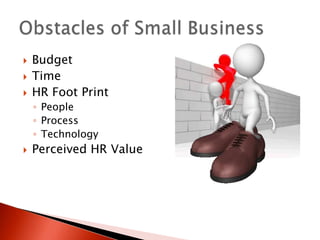
   Budget
   Time
   HR Foot Print
    ◦ People
    ◦ Process
    ◦ Technology
   Perceived HR Value
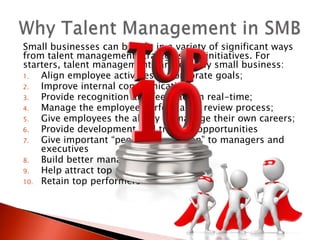
Small businesses can benefit in a variety of significant ways
from talent management strategies and initiatives. For
starters, talent management can help any small business:
1.  Align employee activities to corporate goals;
2.  Improve internal communication;
3.  Provide recognition and feedback in real-time;
4.  Manage the employee performance review process;
5.  Give employees the ability to manage their own careers;
6.  Provide development and training opportunities
7.  Give important “people information” to managers and
    executives
8.  Build better managers
9.  Help attract top performers
10. Retain top performers
   What Employees are looking for in an
    employer
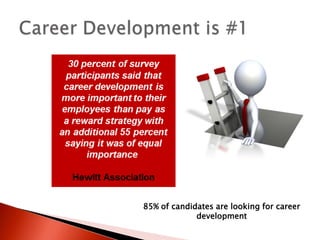
85% of candidates are looking for career
             development
   Organizations in are attempting to brand
    their organizations as an “employer of choice”
    in order to attract and retain top talent
   Our People are our Biggest Asset!
   Saying you’re great is not good enough you
    need to walk the talk
People, People, People………
   Most small companies don’t have a brand


   Brain Storm Session
    ◦ Department Heads
    ◦ What makes your company competitive in market
    ◦ What differentiates your company from competitors
   Competencies
    ◦ Core (Strengths) – Customer Service, Quality
    ◦ Unique – Google/Creativity
   Once you have the competencies you need to
    communicate
    ◦ Mission Statement
    ◦ Tag Line – on web site (including careers), on letter head, add to
      logo, in sales presentations, etc.
    ◦ Monthly employee newsletter focus on attainments that map to
      corporate competency achievements from company, department
      and individual level
    ◦ Performance – Rate your staff on how they are doing against your
      company competencies
    ◦ Develop – provide opportunities for your employees to improve in
      these areas
    ◦ Suggestions – allow employees opportunities to help improve on
      these competencies (Suggestion Box, Reward program for
      savings, etc.)
    ◦ Walk the talk! Make sure your company is focused on these
      competencies

                   “If you build it they will come”
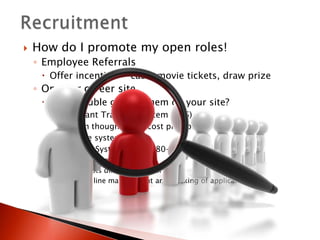
   How do I promote my open roles!
    ◦ Employee Referrals
      Offer incentive - cash, movie tickets, draw prize
    ◦ On your career site
      Have trouble getting them on your site?
        Applicant Tracking System (ATS)
          Often thought to be cost prohibitive
            Free systems
            Saas Systems from $80-$150/mth
              Re-usable database
              Posts directly to career site
              Online management and tracking of applicants
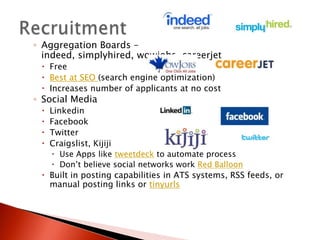
◦ Aggregation Boards –
  indeed, simplyhired, wowjobs, careerjet
  Free
  Best at SEO (search engine optimization)
  Increases number of applicants at no cost
◦ Social Media
    Linkedin
    Facebook
    Twitter
    Craigslist, Kijiji
      Use Apps like tweetdeck to automate process
      Don’t believe social networks work Red Balloon
  Built in posting capabilities in ATS systems, RSS feeds, or
   manual posting links or tinyurls
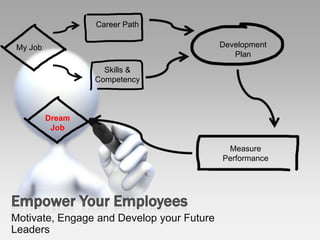
Career Path

My Job                                     Development
                                              Plan
                   Skills &
                 Competency


         Dream
          Job

                                            Measure
                                           Performance


Motivate, Engage and Develop your Future
Leaders
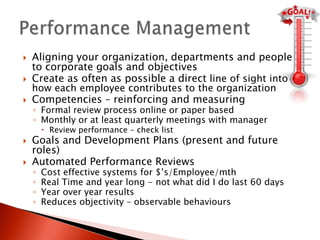
   Aligning your organization, departments and people
    to corporate goals and objectives
   Create as often as possible a direct line of sight into
    how each employee contributes to the organization
   Competencies – reinforcing and measuring
    ◦ Formal review process online or paper based
    ◦ Monthly or at least quarterly meetings with manager
         Review performance – check list
   Goals and Development Plans (present and future
    roles)
   Automated Performance Reviews
    ◦   Cost effective systems for $’s/Employee/mth
    ◦   Real Time and year long - not what did I do last 60 days
    ◦   Year over year results
    ◦   Reduces objectivity – observable behaviours
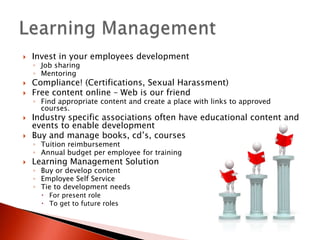
   Invest in your employees development
    ◦ Job sharing
    ◦ Mentoring
   Compliance! (Certifications, Sexual Harassment)
   Free content online – Web is our friend
    ◦ Find appropriate content and create a place with links to approved
      courses.
   Industry specific associations often have educational content and
    events to enable development
   Buy and manage books, cd’s, courses
    ◦ Tuition reimbursement
    ◦ Annual budget per employee for training
   Learning Management Solution
    ◦ Buy or develop content
    ◦ Employee Self Service
    ◦ Tie to development needs
       For present role
       To get to future roles
Definition
Succession Planning is the process of getting
the right people, at the right cost, at the right
time again and again, by planning for changes in the workforce.

   Identify Key Roles
    ◦ Not just C-Level
         Any role that is difficult to fill (labor shortage) or when empty costs the organization not
          just in production but in soft costs relationships, time to gain knowledge lost
   Identify key skills and competencies required for key roles
   Take internal look for possible replacements
    ◦ Understand investment needed to get them ready for key roles
             Too often this is never followed up on once key successor is determined be diligent on
              continued development
    ◦ If no internal resources identify external resources and track them (linkedin,
      facebook) know where they are and what they are doing.
   Schedule meetings to check your plan, ask department heads who do
    you have available should employee ABC leave? Things change and if
    your don’t review your plan it will no longer be a plan!
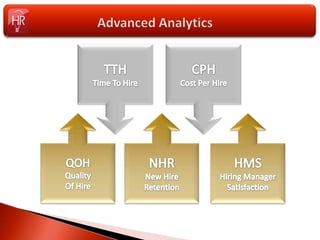
   Measure! Measure! Measure!
   Accountability
   Return on Investment (ROI)
   Improvements – Time, Money, Employee
    Satisfaction!
   Technology makes reporting easier as built in
    analytics to track performance improvements
   Turn over, time to hire, employee
    satisfaction, company
    performance, individual performance
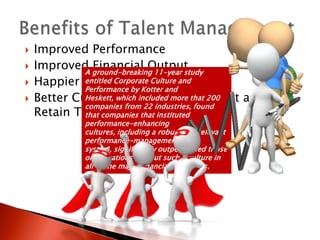
   Improved Performance
   Improved ground-breaking 11-year study
             A
               Financial Output
   Happier People/Retention
             entitled Corporate Culture and
             Performance by Kotter and
   Better Culture which included more that 200
             Heskett, and Ability to Attract and
             companies from 22 industries, found
    Retain Top Talent that instituted
             that companies
             performance-enhancing
             cultures, including a robust and relevant
             performance-management
             system, significantly outperformed those
             organizations without such a culture in
             all of the major financial categories.
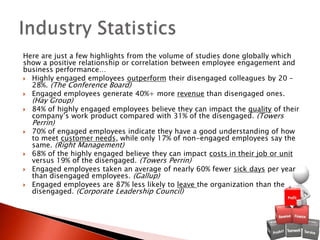
Here are just a few highlights from the volume of studies done globally which
show a positive relationship or correlation between employee engagement and
business performance…
 Highly engaged employees outperform their disengaged colleagues by 20 –
  28%. (The Conference Board)
 Engaged employees generate 40%+ more revenue than disengaged ones.
    (Hay Group)
   84% of highly engaged employees believe they can impact the quality of their
    company’s work product compared with 31% of the disengaged. (Towers
    Perrin)
   70% of engaged employees indicate they have a good understanding of how
    to meet customer needs, while only 17% of non-engaged employees say the
    same. (Right Management)
   68% of the highly engaged believe they can impact costs in their job or unit
    versus 19% of the disengaged. (Towers Perrin)
   Engaged employees taken an average of nearly 60% fewer sick days per year
    than disengaged employees. (Gallup)
   Engaged employees are 87% less likely to leave the organization than the
    disengaged. (Corporate Leadership Council)
   Talent Management is equally important in SMB
    as in Large organizations
   Communication is still a key to success
    ◦ Do it well and do it often!
   There are ways to manage your people cost
    effectively
    ◦ Free
    ◦ SaaS solutions priced for your market
   You have to be the advocate and cheer leader but
    you need C-Level buy in
   Align your companies mission with their people
    so it becomes part of your culture
   Monthly check lists for HR and Managers
Point Solution = Partial Intelligence
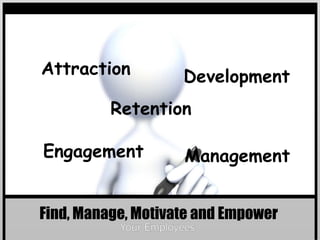
Attraction          Development
          Retention

Engagement          Management


Find, Manage, Motivate and Empower
Terri Joosten
   Director of Sales
tjoosten@hrsmart.com
905-754-0200 ext 230
Talent management for SMB

Talent management for SMB

  • 1.
    Attracting, Engaging and Retaining Top Talent Winning the Battle Presented By: Terri Joosten
  • 2.
    Benefits of Small Business  Obstacles to Small Business  Importance of Talent Management  How To Make Changes  Building a Brand Internal and External  Recruiting  Performance  Learning/Development  Succession Planning  Analytics  Industry Facts  Conclusions  Technology Decisions  Solution Review
  • 3.
    Companies with employee base of under 500  In some cases with less than 1000 if HR is really being under utilized or if large amounts of part-time or season help.
  • 4.
    Direct Line of Sight and Reporting to CEO/Owner  Limited Silos (departments with conflicting objectives)  Easier Access to Entire Employee Base
  • 5.
    Budget  Time  HR Foot Print ◦ People ◦ Process ◦ Technology  Perceived HR Value
  • 8.
    Small businesses canbenefit in a variety of significant ways from talent management strategies and initiatives. For starters, talent management can help any small business: 1. Align employee activities to corporate goals; 2. Improve internal communication; 3. Provide recognition and feedback in real-time; 4. Manage the employee performance review process; 5. Give employees the ability to manage their own careers; 6. Provide development and training opportunities 7. Give important “people information” to managers and executives 8. Build better managers 9. Help attract top performers 10. Retain top performers
  • 9.
    What Employees are looking for in an employer
  • 11.
    85% of candidatesare looking for career development
  • 12.
    Organizations in are attempting to brand their organizations as an “employer of choice” in order to attract and retain top talent
  • 13.
    Our People are our Biggest Asset!  Saying you’re great is not good enough you need to walk the talk
  • 15.
  • 16.
    Most small companies don’t have a brand  Brain Storm Session ◦ Department Heads ◦ What makes your company competitive in market ◦ What differentiates your company from competitors  Competencies ◦ Core (Strengths) – Customer Service, Quality ◦ Unique – Google/Creativity
  • 17.
    Once you have the competencies you need to communicate ◦ Mission Statement ◦ Tag Line – on web site (including careers), on letter head, add to logo, in sales presentations, etc. ◦ Monthly employee newsletter focus on attainments that map to corporate competency achievements from company, department and individual level ◦ Performance – Rate your staff on how they are doing against your company competencies ◦ Develop – provide opportunities for your employees to improve in these areas ◦ Suggestions – allow employees opportunities to help improve on these competencies (Suggestion Box, Reward program for savings, etc.) ◦ Walk the talk! Make sure your company is focused on these competencies “If you build it they will come”
  • 18.
    How do I promote my open roles! ◦ Employee Referrals  Offer incentive - cash, movie tickets, draw prize ◦ On your career site  Have trouble getting them on your site?  Applicant Tracking System (ATS)  Often thought to be cost prohibitive  Free systems  Saas Systems from $80-$150/mth  Re-usable database  Posts directly to career site  Online management and tracking of applicants
  • 19.
    ◦ Aggregation Boards– indeed, simplyhired, wowjobs, careerjet  Free  Best at SEO (search engine optimization)  Increases number of applicants at no cost ◦ Social Media  Linkedin  Facebook  Twitter  Craigslist, Kijiji  Use Apps like tweetdeck to automate process  Don’t believe social networks work Red Balloon  Built in posting capabilities in ATS systems, RSS feeds, or manual posting links or tinyurls
  • 22.
    Career Path My Job Development Plan Skills & Competency Dream Job Measure Performance Motivate, Engage and Develop your Future Leaders
  • 23.
    Aligning your organization, departments and people to corporate goals and objectives  Create as often as possible a direct line of sight into how each employee contributes to the organization  Competencies – reinforcing and measuring ◦ Formal review process online or paper based ◦ Monthly or at least quarterly meetings with manager  Review performance – check list  Goals and Development Plans (present and future roles)  Automated Performance Reviews ◦ Cost effective systems for $’s/Employee/mth ◦ Real Time and year long - not what did I do last 60 days ◦ Year over year results ◦ Reduces objectivity – observable behaviours
  • 24.
    Invest in your employees development ◦ Job sharing ◦ Mentoring  Compliance! (Certifications, Sexual Harassment)  Free content online – Web is our friend ◦ Find appropriate content and create a place with links to approved courses.  Industry specific associations often have educational content and events to enable development  Buy and manage books, cd’s, courses ◦ Tuition reimbursement ◦ Annual budget per employee for training  Learning Management Solution ◦ Buy or develop content ◦ Employee Self Service ◦ Tie to development needs  For present role  To get to future roles
  • 25.
    Definition Succession Planning isthe process of getting the right people, at the right cost, at the right time again and again, by planning for changes in the workforce.  Identify Key Roles ◦ Not just C-Level  Any role that is difficult to fill (labor shortage) or when empty costs the organization not just in production but in soft costs relationships, time to gain knowledge lost  Identify key skills and competencies required for key roles  Take internal look for possible replacements ◦ Understand investment needed to get them ready for key roles  Too often this is never followed up on once key successor is determined be diligent on continued development ◦ If no internal resources identify external resources and track them (linkedin, facebook) know where they are and what they are doing.  Schedule meetings to check your plan, ask department heads who do you have available should employee ABC leave? Things change and if your don’t review your plan it will no longer be a plan!
  • 26.
    Measure! Measure! Measure!  Accountability  Return on Investment (ROI)  Improvements – Time, Money, Employee Satisfaction!  Technology makes reporting easier as built in analytics to track performance improvements  Turn over, time to hire, employee satisfaction, company performance, individual performance
  • 27.
    Improved Performance  Improved ground-breaking 11-year study A Financial Output  Happier People/Retention entitled Corporate Culture and Performance by Kotter and  Better Culture which included more that 200 Heskett, and Ability to Attract and companies from 22 industries, found Retain Top Talent that instituted that companies performance-enhancing cultures, including a robust and relevant performance-management system, significantly outperformed those organizations without such a culture in all of the major financial categories.
  • 28.
    Here are justa few highlights from the volume of studies done globally which show a positive relationship or correlation between employee engagement and business performance…  Highly engaged employees outperform their disengaged colleagues by 20 – 28%. (The Conference Board)  Engaged employees generate 40%+ more revenue than disengaged ones. (Hay Group)  84% of highly engaged employees believe they can impact the quality of their company’s work product compared with 31% of the disengaged. (Towers Perrin)  70% of engaged employees indicate they have a good understanding of how to meet customer needs, while only 17% of non-engaged employees say the same. (Right Management)  68% of the highly engaged believe they can impact costs in their job or unit versus 19% of the disengaged. (Towers Perrin)  Engaged employees taken an average of nearly 60% fewer sick days per year than disengaged employees. (Gallup)  Engaged employees are 87% less likely to leave the organization than the disengaged. (Corporate Leadership Council)
  • 29.
    Talent Management is equally important in SMB as in Large organizations  Communication is still a key to success ◦ Do it well and do it often!  There are ways to manage your people cost effectively ◦ Free ◦ SaaS solutions priced for your market  You have to be the advocate and cheer leader but you need C-Level buy in  Align your companies mission with their people so it becomes part of your culture  Monthly check lists for HR and Managers
  • 30.
    Point Solution =Partial Intelligence
  • 33.
    Attraction Development Retention Engagement Management Find, Manage, Motivate and Empower
  • 34.
    Terri Joosten Director of Sales tjoosten@hrsmart.com 905-754-0200 ext 230

Editor's Notes

  • #5 Everyone knows almost everyone, you know all managers, you can go to Owners/CEO’s Office.
  • #6 No formal budgetYou are only one in HR or limited resources most companies are 1 HR to 80-100 employees.No formal process or strategy for anything around human resources functionsNo technology or little – payroll maybe automated, nothing else.Little buy in to the value of or emphasis on people or all talk to action
  • #7 How many of your organizations define talent management in one of these ways:
  • #23 Imagine – your employee and/or manager being able to plot out their or their employees development plan and be able to automate and track it!
  • #25 Reminder that development is equally important as salary!
  • #33 Presently you have some staffing metrics that are certainly helpful, but imagine how much more knowledge you would gain buy having the following metrics! We all know it is about quality not quantity of candidates the same goes for hires.