

Welcome
 Report Cards 101
             Brandi Clark
       February 23, 2012
         District Wide PD
Agenda
 FRONTLOADING: Key Learner Outcomes
  and a Brief Look at Assessment
 Guidelines for Writing Report Card
  Comments
 Collaborative Time
What is the definition?

Report cards are:

(on the 11x17
paper write down
as many words or
phrases that come
to mind)


Brainstorm
1. Join with 2 or 3 other participants.

2. Working with the words you have
collectively created. Circle the words to
form groups or categories.

3. Label these groups.

         Be prepared to share 


      List – Group - Label
Report cards are EMOTIONAL!
Report Cards are formal.
Report cards are time consuming!
Report cards are a celebration of
growth.
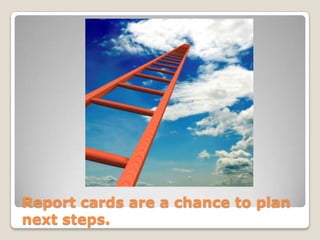
Report cards are a chance to plan
next steps.
Report cards are a way to give
feedback.
Report Cards…
report on Assessment
Teachers can collect anecdotal
 information on student’s right from
 the beginning of term. Some ways are
 to …

 create rubrics of targeted learning skills
 use a rubric on effort levels as a student
 self-assessment piece as well
 keep descriptive language accessible to
 apply it more easily
 use student self-assessment on specific
 assignments (keep a manageable portfolio)


Collecting Anecdotal Info…
 organize grade books by strand in
 order to more easily identify areas of
 need – a grade book with only quiz,
 assignment, paragraph, book report, test,
 a performance based assessment does
 not clearly reveal content nor targeted
 outcome.


Collecting Anecdotal Info…
Outcome-based - Formative
Outcome-based - summative
   A. Selecting Key Learner Outcomes
    Key Learner Outcomes for Elementary
    Language Arts encompass more than
    one specific learner outcome (SLO)
    from the Program of Studies. This
    allows teachers to provide a

   summative assessment of the wide
    range of concepts and skills included in
    the Alberta ELA Program.


Key Learner Outcomes
Grade 1 Key Learner Outcome:

 Readsand Comprehends at
 Grade Level
 The key learner outcome above
 represents the following
 specific learner outcomes
 from the ELA Program of
 Studies.

Using KLOs and SLOs
Effective language arts programs
 employ appropriate evaluation and
 reporting processes.
 Effective evaluation should:
 reflect the learning objectives
 focus on what students have learned and
 can do
 be congruent with instruction and be
 based on meaningful tasks
 be based on appropriate criteria that
 students know and understand

Collecting Evidence of Learning
 reflect a range of tools and methods
 of assessment and evaluation
 provide multiple opportunities and
 ways for students to demonstrate their
 learning
 be ongoing and continuous
 inform practice and instructional
 decisions
 inform others (e.g., students and
 parents) in a clear, accurate, and
 practical way.


Collecting Evidence of Learning
Evidence of Student Learning Used to Assess Reading
  Strategies:
 Running Records (analysis of miscues tells about
  use of visual, sentence structure and meaning cues in
  the text)
 Retellings (shows how many inferences,
  elaborations or how much on-the-page information the
  student uses to recall a text)
 Comprehension Conversations (shows whether or
  not the student is capable of using on-the-page and off-
  the-page information)
 Written Responses (shows whether or not a student
  can recall, choose and interpret information read)
 Book Club Discussions (anecdotal notes show
  whether or not the student can talk about a text by
  referring to on and off the page information in the text)

Sources of Evidence….
How do you
                         set up
                          your
                      assessment
                       notebook?


Take turns sharing with a partner.

     TURN AND TALK
Writing Comments…


       The Bee’s Knees
Caution should be used to ensure that:

a) The report card targets significant
 English Language Arts.
b) The knowledge and skills described in
 the key learner outcomes clearly lend
 themselves to distinct levels of
 achievement.
c) All key learner outcomes are clearly tied
 to the Program of Studies.


Important points to ponder
Statements which do not meet these
 criteria should not appear on the report
 card. The following examples are

 not   appropriate to use as key
 learner outcomes on the report card.

   Completes entries in reading log
   Contributes to class discussions
   Maintains and organized writing folder
   Works cooperatively in groups

Caution….
Report card comments should …
 be phrased in positive language
 be professional in tone but not use
 educational jargon
 have an “affective” reference to the
 student so as to refrain from being too
 clinical (in other words, use the student’s
 name)
 be consistent in the audience throughout
 the report card (i.e., “Kyle performs work
 that…”, not “Kyle, you…”)

Comment tips…from Elem doc.
 refer to student’s work samples or to the
 evidence of learning that supports the
 summative assessment, focusing on
 student strengths and weaknesses and
 identifying the next steps

 be a reasonable length (2 – 3 sentences)

 be developed from anecdotal notes
 throughout the term


Comment tips from Elem doc.
Take out your
                    samples. Circle
                      anything you
                      think “needs
                       some love”.
                    Underline some
                      phrases you
                     really like…the
                        “keepers”.

Take turns sharing with a partner.

      TURN AND TALK
Literacy Fiascos to Avoid
1. Do not repeat the
 descriptor in the comments.
Outcome:
Reads and comprehends at grade level.   Proficient


Comment: Jory reads and comprehends at
 grade level.
Instead…further clarify the comment by
 offering a goal/next step.

Outcome:
Reads and comprehends at grade level. Proficient


 Comment: Jory is gaining confidence in
 solving unknown words. He still needs
 strengthening in his reading fluency. Jory
 would benefit from reading stories out loud
 on a daily basis.
2. Fountas and Pinnell levels
 should not be reported on
 the report card.
Descriptor:
Reads and comprehends at grade level.

Comment:
Evan is reading at Level M.
3. There should not be inflexible
 high – medium- low comments.
Outcome:

Reads and comprehends at grade level. ???????

  Comment: Jory is gaining confidence in
  solving unknown words. He still needs
  strengthening in his reading fluency. Jory
  would benefit from reading stories out
  loud on a daily basis.


Grade Two…What is the level of achievement?
Comment Autopsy
Bob
Reporting as Easy as 1-2-3
Focus on Student Learning

 This term, ____ has been working on …
 ____ should be commended for …
 ____ has strengthened his/her skills in …
 ____ is strong in …
 ____ continues to show growth in …
 ____ is gaining more self-confidence in …
 ____ is making steady progress
 academically in …
 There has been a noticeable improvement in
 _____’s …
Areas for growth
 As we have discussed, ____ could work
 on …
 ____ would benefit from …
 To ensure ____’s continued success next
 term, …
 It may be helpful for ____ to practice …
 ____ still needs strengthening in …
Suggestions for next steps…

 ____ would benefit by focusing on …
 ____ could improve writing skills by …
 ____ could improve reading skills by …
 ____ and I have set clear goals for this
 next term to improve …
What
        do you
        notice?


Betty
Collaborative
            Time….
.

TALK and SHARE and WRITE

Report cards 101 Presentation

  • 1.
    Welcome Report Cards101 Brandi Clark February 23, 2012 District Wide PD
  • 2.
    Agenda  FRONTLOADING: KeyLearner Outcomes and a Brief Look at Assessment  Guidelines for Writing Report Card Comments  Collaborative Time
  • 3.
    What is thedefinition? Report cards are: (on the 11x17 paper write down as many words or phrases that come to mind) Brainstorm
  • 4.
    1. Join with2 or 3 other participants. 2. Working with the words you have collectively created. Circle the words to form groups or categories. 3. Label these groups. Be prepared to share  List – Group - Label
  • 5.
    Report cards areEMOTIONAL!
  • 6.
  • 7.
    Report cards aretime consuming!
  • 8.
    Report cards area celebration of growth.
  • 9.
    Report cards area chance to plan next steps.
  • 10.
    Report cards area way to give feedback.
  • 11.
  • 12.
    Teachers can collectanecdotal information on student’s right from the beginning of term. Some ways are to …  create rubrics of targeted learning skills  use a rubric on effort levels as a student self-assessment piece as well  keep descriptive language accessible to apply it more easily  use student self-assessment on specific assignments (keep a manageable portfolio) Collecting Anecdotal Info…
  • 13.
     organize gradebooks by strand in order to more easily identify areas of need – a grade book with only quiz, assignment, paragraph, book report, test, a performance based assessment does not clearly reveal content nor targeted outcome. Collecting Anecdotal Info…
  • 14.
  • 15.
  • 16.
    A. Selecting Key Learner Outcomes Key Learner Outcomes for Elementary Language Arts encompass more than one specific learner outcome (SLO) from the Program of Studies. This allows teachers to provide a  summative assessment of the wide range of concepts and skills included in the Alberta ELA Program. Key Learner Outcomes
  • 17.
    Grade 1 KeyLearner Outcome:  Readsand Comprehends at Grade Level The key learner outcome above represents the following specific learner outcomes from the ELA Program of Studies. Using KLOs and SLOs
  • 19.
    Effective language artsprograms employ appropriate evaluation and reporting processes. Effective evaluation should:  reflect the learning objectives  focus on what students have learned and can do  be congruent with instruction and be based on meaningful tasks  be based on appropriate criteria that students know and understand Collecting Evidence of Learning
  • 20.
     reflect arange of tools and methods of assessment and evaluation  provide multiple opportunities and ways for students to demonstrate their learning  be ongoing and continuous  inform practice and instructional decisions  inform others (e.g., students and parents) in a clear, accurate, and practical way. Collecting Evidence of Learning
  • 21.
    Evidence of StudentLearning Used to Assess Reading Strategies:  Running Records (analysis of miscues tells about use of visual, sentence structure and meaning cues in the text)  Retellings (shows how many inferences, elaborations or how much on-the-page information the student uses to recall a text)  Comprehension Conversations (shows whether or not the student is capable of using on-the-page and off- the-page information)  Written Responses (shows whether or not a student can recall, choose and interpret information read)  Book Club Discussions (anecdotal notes show whether or not the student can talk about a text by referring to on and off the page information in the text) Sources of Evidence….
  • 22.
    How do you set up your assessment notebook? Take turns sharing with a partner. TURN AND TALK
  • 23.
    Writing Comments… The Bee’s Knees
  • 24.
    Caution should beused to ensure that: a) The report card targets significant English Language Arts. b) The knowledge and skills described in the key learner outcomes clearly lend themselves to distinct levels of achievement. c) All key learner outcomes are clearly tied to the Program of Studies. Important points to ponder
  • 25.
    Statements which donot meet these criteria should not appear on the report card. The following examples are not appropriate to use as key learner outcomes on the report card.  Completes entries in reading log  Contributes to class discussions  Maintains and organized writing folder  Works cooperatively in groups Caution….
  • 26.
    Report card commentsshould …  be phrased in positive language  be professional in tone but not use educational jargon  have an “affective” reference to the student so as to refrain from being too clinical (in other words, use the student’s name)  be consistent in the audience throughout the report card (i.e., “Kyle performs work that…”, not “Kyle, you…”) Comment tips…from Elem doc.
  • 27.
     refer tostudent’s work samples or to the evidence of learning that supports the summative assessment, focusing on student strengths and weaknesses and identifying the next steps  be a reasonable length (2 – 3 sentences)  be developed from anecdotal notes throughout the term Comment tips from Elem doc.
  • 28.
    Take out your samples. Circle anything you think “needs some love”. Underline some phrases you really like…the “keepers”. Take turns sharing with a partner. TURN AND TALK
  • 29.
  • 30.
    1. Do notrepeat the descriptor in the comments. Outcome: Reads and comprehends at grade level. Proficient Comment: Jory reads and comprehends at grade level.
  • 31.
    Instead…further clarify thecomment by offering a goal/next step. Outcome: Reads and comprehends at grade level. Proficient Comment: Jory is gaining confidence in solving unknown words. He still needs strengthening in his reading fluency. Jory would benefit from reading stories out loud on a daily basis.
  • 32.
    2. Fountas andPinnell levels should not be reported on the report card. Descriptor: Reads and comprehends at grade level. Comment: Evan is reading at Level M.
  • 33.
    3. There shouldnot be inflexible high – medium- low comments. Outcome: Reads and comprehends at grade level. ??????? Comment: Jory is gaining confidence in solving unknown words. He still needs strengthening in his reading fluency. Jory would benefit from reading stories out loud on a daily basis. Grade Two…What is the level of achievement?
  • 34.
  • 35.
  • 36.
  • 37.
    Focus on StudentLearning  This term, ____ has been working on …  ____ should be commended for …  ____ has strengthened his/her skills in …  ____ is strong in …  ____ continues to show growth in …  ____ is gaining more self-confidence in …  ____ is making steady progress academically in …  There has been a noticeable improvement in _____’s …
  • 38.
    Areas for growth As we have discussed, ____ could work on …  ____ would benefit from …  To ensure ____’s continued success next term, …  It may be helpful for ____ to practice …  ____ still needs strengthening in …
  • 39.
    Suggestions for nextsteps…  ____ would benefit by focusing on …  ____ could improve writing skills by …  ____ could improve reading skills by …  ____ and I have set clear goals for this next term to improve …
  • 40.
    What do you notice? Betty
  • 41.
    Collaborative Time…. . TALK and SHARE and WRITE

Editor's Notes

  • #6 There is no denying that report cards are a “powder keg” of emotion. Ther