THE PRINCIPAL as SCHOOL
MANAGER
BY: SADIA SHAHZAD
Content
The Principal and Relationships
The Personnel Role of Principal
School Law for Principal
The Principal and Relationships
A PRINCIPAL:
 Any person who has the legal capacity (meaning that they are not insane,
or in certain circumstances a minor) to perform an act may be a principal
and empower an agent to carry out that act. Persons, corporations,
partnerships, not-for-profit organizations, and government agencies may
all be principals and appoint agents.
 A principal is someone who is the leader of an entire community within a
school. He or she is responsible for managing the major administrative
tasks and supervising all students and teachers. They are also known as
head masters in some countries, as well as a few select schools in the
United States.
What does a Principal do?
There are many duties of a school principal. Some of these duties include,
but are not limited to the following:
 The hiring of staff members
 Communicating with parents and faculty when necessary
 Creating policies (such as dress code)
 Planning academic calendars for the school
 Handling of student recruitment and admissions into the school
 Disciplining students when needed
 Supervising students, staff and other faculty members
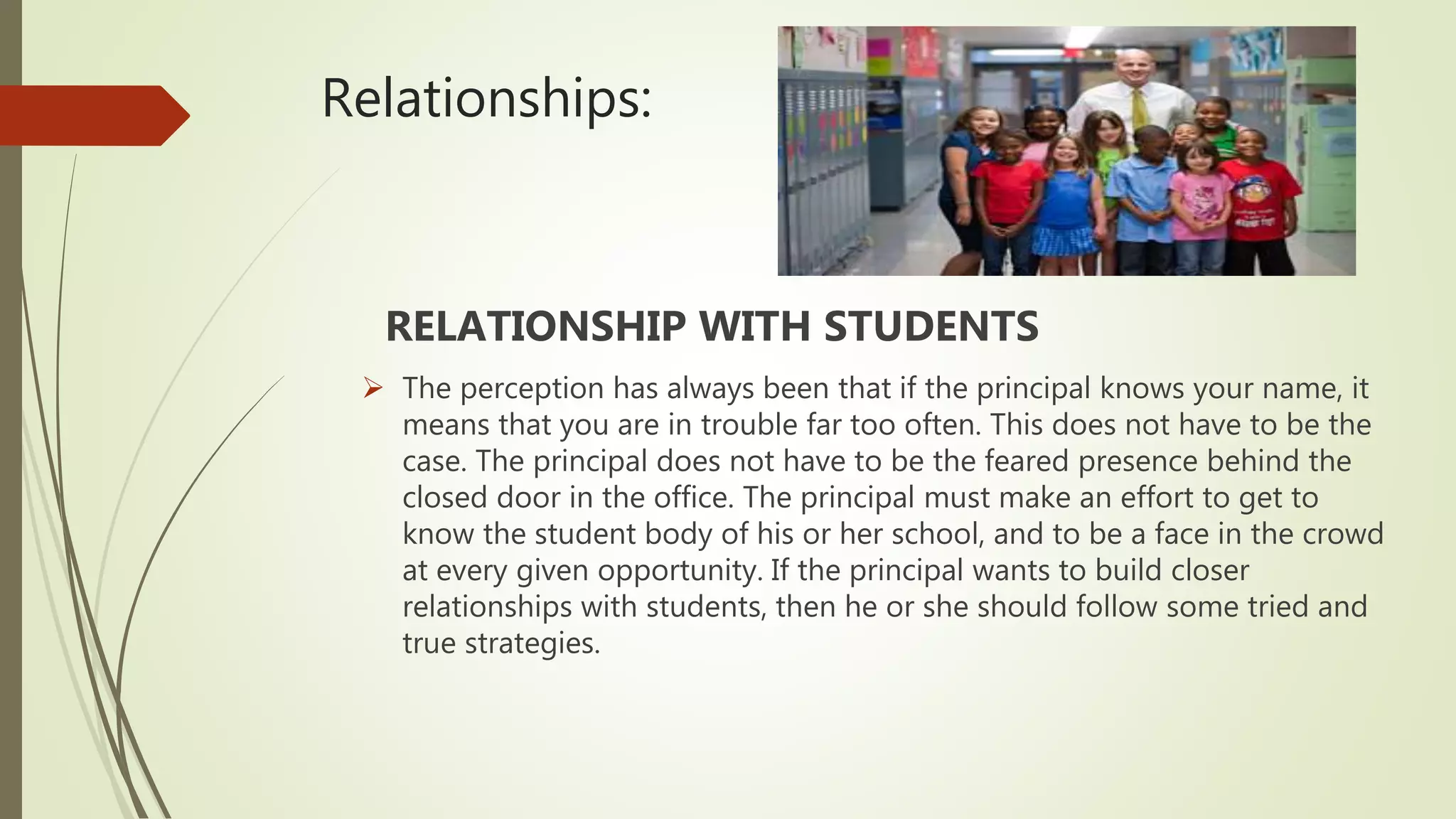
Relationships:
RELATIONSHIP WITH STUDENTS
 The perception has always been that if the principal knows your name, it
means that you are in trouble far too often. This does not have to be the
case. The principal does not have to be the feared presence behind the
closed door in the office. The principal must make an effort to get to
know the student body of his or her school, and to be a face in the crowd
at every given opportunity. If the principal wants to build closer
relationships with students, then he or she should follow some tried and
true strategies.
 The principal can also spend some time before and after school greeting
students as they enter the school or get off of the buses.
 The principal can take this opportunity to be seen as more friendly, since
there is no need for discipline at this juncture.
 The principal can say hello to a small group by name, and perhaps ask the
one or two students they do not know for their names. This will give the
principal some street credit in terms of being a nice person.
 The principal should come across as the stern disciplinarian, but they
should also strive to be seen as a friend or confidant.
 The principal can try and attend all sporting events, musical concerts,
drama presentations, and any other extra-curricular activities that they can
fit in to their lives.
 The principal should have an open door policy, and should encourage all
students to come and visit, either just to introduce themselves and say hi,
or to come in and air their grievances.
 Leadership dictates the feeling in and around the school, and the principal
has some form of control over this. Another way that the principal can
build closer relationships with students is to be a model of consistency. In
terms of disciplinary action, the principal should treat every student in
exactly the same manner. When it seems, whether or not perceived or
reality, that another student caught a more lenient punishment for the
same offence, then it becomes a matter of negativity in which the students
are under the impression that there are different rules for different
students.
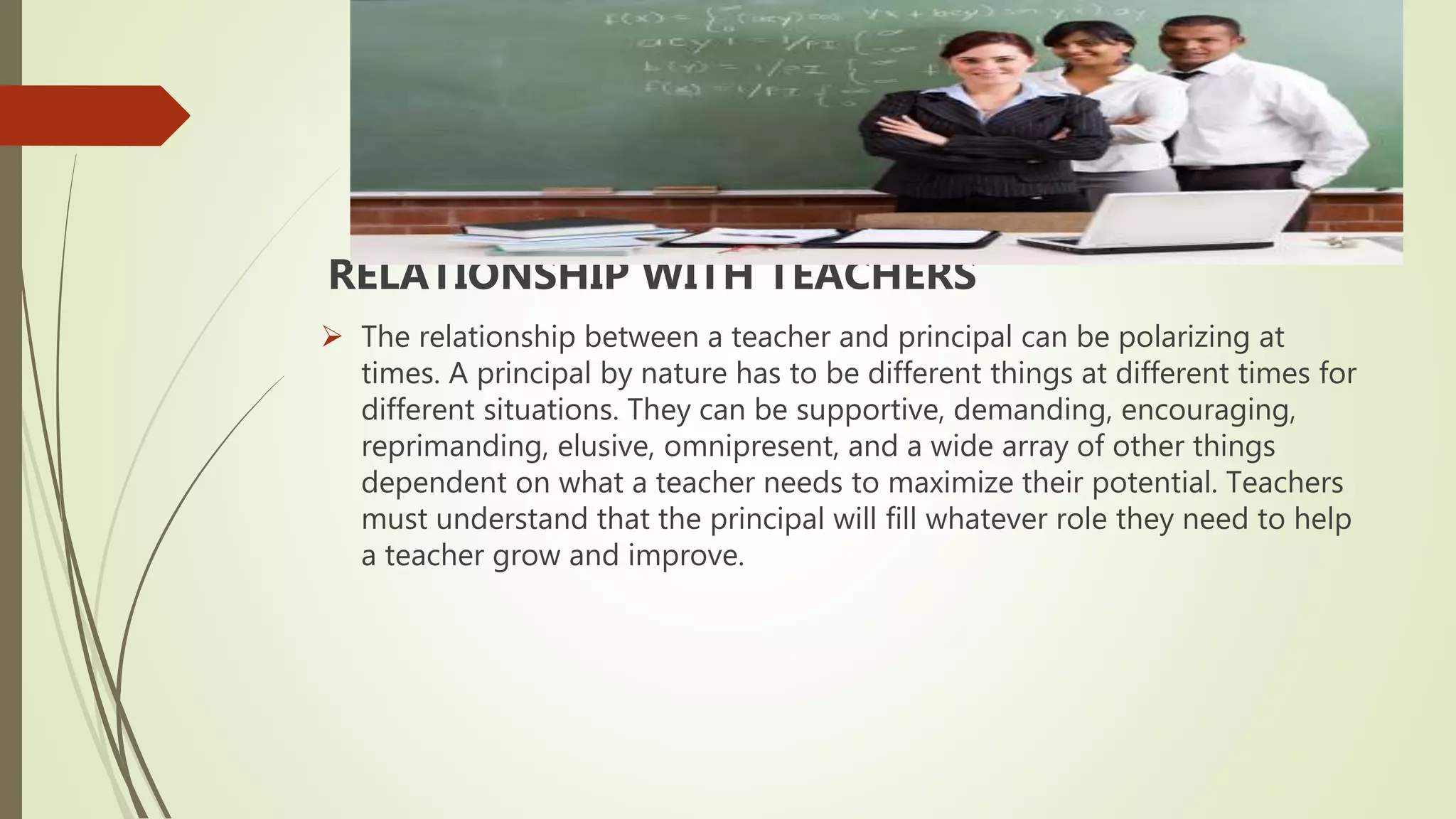
RELATIONSHIP WITH TEACHERS
 The relationship between a teacher and principal can be polarizing at
times. A principal by nature has to be different things at different times for
different situations. They can be supportive, demanding, encouraging,
reprimanding, elusive, omnipresent, and a wide array of other things
dependent on what a teacher needs to maximize their potential. Teachers
must understand that the principal will fill whatever role they need to help
a teacher grow and improve.
A teacher must also recognize the value in building a trusting relationship
with their principal. Trust is a two-way street that is earned over time through
merit and based on actions. The following are suggestion that teachers can
utilize to build a trusting relationship with their principal.
 One key priority for the principal is establishing a sense of confidence in
the school staff.
 The principal must have the same heart for the children as the teachers. A
principal who teaches a class during the year has a better awareness of the
students needs.
 Each principal serves as a role model for teachers who aspire to become
principals. Good relationships are established when there is ongoing
concern for the resources that will help teachers to be successful.
 The principal should find ways to interact with teachers throughout a
week. It may be convenient to work until the next meeting but addressing
issues as they arise will make staff meetings less cumbersome.
 The principal can collaborate with teachers who are providing similar
interactions . For example, a principal who is teaching one of the sections
of Algebra I can get ideas from other teachers. This will foster a greater
sense of collaboration.
 Finally, it is important to expect the best for your school. When the
principals and teachers are working together and they have high
expectations for the student great things can be accomplished.
 It’s important to have goals and objectives for the entire school. The
principal and teachers should come together to create goals and share
ideas.
 The principal and teacher relationship is a key element of each school’s
success.
The Personnel Role of Principal
 The role of the principal covers many different areas including leadership,
teacher evaluation, student discipline, and many others. Being an effective
principal is hard work and is also time-consuming.
 A good principal is balanced within all their roles and works hard to ensure
that that they are doing what they feel is best for all constituents involved.
Time is a major limiting factor for every principal.
 A principal must become efficient at practices such as prioritizing,
scheduling, and organization.
 A school principal is the primary leader in a school building.
A good leader always leads by example.
 A principal should be positive, enthusiastic, have their hand
in the day to day activities of the school, and listen to what
their constituents are saying. An effective leader is available
to teachers, staff members, parents, students, and
community members.
 A good principal will listen to all sides of an issue without
jumping to conclusions collecting as much evidence as
student can.
 An individual school’s governing document is their student handbook. A
principal should have their stamp on the handbook. A principal should
review, remove, rewrite, or write policies and procedures every year as
needed. Having an effective student handbook can improve the quality of
education your students receive. It can also make a principal’s job a little
easier.
 The principal’s role is to make sure students, teachers, and parents know
what these policies and procedures are and to hold each individual
accountable for following them.
 A vital part of any school administrator’s job is to hire teachers and staff
that are going to do their job correctly. Hiring the wrong person can cause
you huge headaches down the line while hiring the right person makes
your job easier.
 Many leaders by nature have a hard time putting things in others hands
without their direct stamp on it. However, there is so much that has to be
done, that it is vital that a school principal delegates some duties as
necessary. Having people around you that you trust implicitly will make
this easier.
 An effective school principal simply does not have enough time to do
everything that needs done by themselves. They must rely on other people
to assist them with getting things done and trust that they are going to do
the job well.
School Law for Principal
 Being an active principal as well as teaching school law to over 100
aspiring principals in the last few years has given me a broad perspective
on which education laws are stressed, overlooked, or unclear to different
school districts. Throughout course discussions, students in the program
share their experiences with the topic, which range from student discipline
and special education (which are the most litigated areas of school law), to
religion in school, student and educator privacy issues, and more.
 Whether decisions are made quickly or with time to process,
understanding how school law should guide your decision making will
protect you and your campus from any legal issues.
 Principals work in all Western Australian schools, including public,
catholic and independent schools. They usually work regular teaching
hours, but are expected to work additional hours to attend staff meetings
and undertake administrative tasks and, in some cases, prepare for
classes. They may also be required to work additional hours to take
students on excursions or camps, or to attend assemblies, graduations or
other school functions. They frequently have a high level of contact with
the public, often acting as the school's representative in the community
and sometimes meeting with prospective students and their parents.
 They work long hours, often working into the evening. Principals work
closely with vice-principals, teachers and other faculty with the common
goal of providing a rich and safe learning environment for the students.
 School principals are required to hold a bachelor's degree and a master's
degree in educational leadership or administration, as well as having
teaching experience, certifications, and licenses.
 Degree Level :Bachelor's degree and master's degree
 Degree Field: Educational leadership or educational administration
 Licensure and/or Certification: State-specific teacher certification and
principal certification required, some states require school administrator
certification
 Experience: Student teaching internship required; employers may prefer
teacher experience
 Key Skills: Decision-making, critical thinking, communication, leadership,
basic computer skills, and an understanding of school fire and alarm
systems and 2-way radios
The principal-and-relationships

The principal-and-relationships

  • 1.
    THE PRINCIPAL asSCHOOL MANAGER BY: SADIA SHAHZAD
  • 2.
    Content The Principal andRelationships The Personnel Role of Principal School Law for Principal
  • 3.
    The Principal andRelationships A PRINCIPAL:  Any person who has the legal capacity (meaning that they are not insane, or in certain circumstances a minor) to perform an act may be a principal and empower an agent to carry out that act. Persons, corporations, partnerships, not-for-profit organizations, and government agencies may all be principals and appoint agents.  A principal is someone who is the leader of an entire community within a school. He or she is responsible for managing the major administrative tasks and supervising all students and teachers. They are also known as head masters in some countries, as well as a few select schools in the United States.
  • 4.
    What does aPrincipal do? There are many duties of a school principal. Some of these duties include, but are not limited to the following:  The hiring of staff members  Communicating with parents and faculty when necessary  Creating policies (such as dress code)  Planning academic calendars for the school  Handling of student recruitment and admissions into the school  Disciplining students when needed  Supervising students, staff and other faculty members
  • 5.
    Relationships: RELATIONSHIP WITH STUDENTS The perception has always been that if the principal knows your name, it means that you are in trouble far too often. This does not have to be the case. The principal does not have to be the feared presence behind the closed door in the office. The principal must make an effort to get to know the student body of his or her school, and to be a face in the crowd at every given opportunity. If the principal wants to build closer relationships with students, then he or she should follow some tried and true strategies.
  • 6.
     The principalcan also spend some time before and after school greeting students as they enter the school or get off of the buses.  The principal can take this opportunity to be seen as more friendly, since there is no need for discipline at this juncture.  The principal can say hello to a small group by name, and perhaps ask the one or two students they do not know for their names. This will give the principal some street credit in terms of being a nice person.
  • 7.
     The principalshould come across as the stern disciplinarian, but they should also strive to be seen as a friend or confidant.  The principal can try and attend all sporting events, musical concerts, drama presentations, and any other extra-curricular activities that they can fit in to their lives.  The principal should have an open door policy, and should encourage all students to come and visit, either just to introduce themselves and say hi, or to come in and air their grievances.
  • 8.
     Leadership dictatesthe feeling in and around the school, and the principal has some form of control over this. Another way that the principal can build closer relationships with students is to be a model of consistency. In terms of disciplinary action, the principal should treat every student in exactly the same manner. When it seems, whether or not perceived or reality, that another student caught a more lenient punishment for the same offence, then it becomes a matter of negativity in which the students are under the impression that there are different rules for different students.
  • 9.
    RELATIONSHIP WITH TEACHERS The relationship between a teacher and principal can be polarizing at times. A principal by nature has to be different things at different times for different situations. They can be supportive, demanding, encouraging, reprimanding, elusive, omnipresent, and a wide array of other things dependent on what a teacher needs to maximize their potential. Teachers must understand that the principal will fill whatever role they need to help a teacher grow and improve.
  • 10.
    A teacher mustalso recognize the value in building a trusting relationship with their principal. Trust is a two-way street that is earned over time through merit and based on actions. The following are suggestion that teachers can utilize to build a trusting relationship with their principal.  One key priority for the principal is establishing a sense of confidence in the school staff.  The principal must have the same heart for the children as the teachers. A principal who teaches a class during the year has a better awareness of the students needs.
  • 11.
     Each principalserves as a role model for teachers who aspire to become principals. Good relationships are established when there is ongoing concern for the resources that will help teachers to be successful.  The principal should find ways to interact with teachers throughout a week. It may be convenient to work until the next meeting but addressing issues as they arise will make staff meetings less cumbersome.  The principal can collaborate with teachers who are providing similar interactions . For example, a principal who is teaching one of the sections of Algebra I can get ideas from other teachers. This will foster a greater sense of collaboration.
  • 12.
     Finally, itis important to expect the best for your school. When the principals and teachers are working together and they have high expectations for the student great things can be accomplished.  It’s important to have goals and objectives for the entire school. The principal and teachers should come together to create goals and share ideas.  The principal and teacher relationship is a key element of each school’s success.
  • 13.
    The Personnel Roleof Principal  The role of the principal covers many different areas including leadership, teacher evaluation, student discipline, and many others. Being an effective principal is hard work and is also time-consuming.  A good principal is balanced within all their roles and works hard to ensure that that they are doing what they feel is best for all constituents involved. Time is a major limiting factor for every principal.  A principal must become efficient at practices such as prioritizing, scheduling, and organization.
  • 14.
     A schoolprincipal is the primary leader in a school building. A good leader always leads by example.  A principal should be positive, enthusiastic, have their hand in the day to day activities of the school, and listen to what their constituents are saying. An effective leader is available to teachers, staff members, parents, students, and community members.  A good principal will listen to all sides of an issue without jumping to conclusions collecting as much evidence as student can.
  • 15.
     An individualschool’s governing document is their student handbook. A principal should have their stamp on the handbook. A principal should review, remove, rewrite, or write policies and procedures every year as needed. Having an effective student handbook can improve the quality of education your students receive. It can also make a principal’s job a little easier.  The principal’s role is to make sure students, teachers, and parents know what these policies and procedures are and to hold each individual accountable for following them.  A vital part of any school administrator’s job is to hire teachers and staff that are going to do their job correctly. Hiring the wrong person can cause you huge headaches down the line while hiring the right person makes your job easier.
  • 16.
     Many leadersby nature have a hard time putting things in others hands without their direct stamp on it. However, there is so much that has to be done, that it is vital that a school principal delegates some duties as necessary. Having people around you that you trust implicitly will make this easier.  An effective school principal simply does not have enough time to do everything that needs done by themselves. They must rely on other people to assist them with getting things done and trust that they are going to do the job well.
  • 17.
    School Law forPrincipal  Being an active principal as well as teaching school law to over 100 aspiring principals in the last few years has given me a broad perspective on which education laws are stressed, overlooked, or unclear to different school districts. Throughout course discussions, students in the program share their experiences with the topic, which range from student discipline and special education (which are the most litigated areas of school law), to religion in school, student and educator privacy issues, and more.  Whether decisions are made quickly or with time to process, understanding how school law should guide your decision making will protect you and your campus from any legal issues.
  • 18.
     Principals workin all Western Australian schools, including public, catholic and independent schools. They usually work regular teaching hours, but are expected to work additional hours to attend staff meetings and undertake administrative tasks and, in some cases, prepare for classes. They may also be required to work additional hours to take students on excursions or camps, or to attend assemblies, graduations or other school functions. They frequently have a high level of contact with the public, often acting as the school's representative in the community and sometimes meeting with prospective students and their parents.  They work long hours, often working into the evening. Principals work closely with vice-principals, teachers and other faculty with the common goal of providing a rich and safe learning environment for the students.
  • 19.
     School principalsare required to hold a bachelor's degree and a master's degree in educational leadership or administration, as well as having teaching experience, certifications, and licenses.  Degree Level :Bachelor's degree and master's degree  Degree Field: Educational leadership or educational administration  Licensure and/or Certification: State-specific teacher certification and principal certification required, some states require school administrator certification  Experience: Student teaching internship required; employers may prefer teacher experience  Key Skills: Decision-making, critical thinking, communication, leadership, basic computer skills, and an understanding of school fire and alarm systems and 2-way radios