Manuscript
Submission Checklist:
Everything you need to consider before journal submission
2
WHAT ARE THE TOP
REASONS FOR
JOURNAL REJECTION?
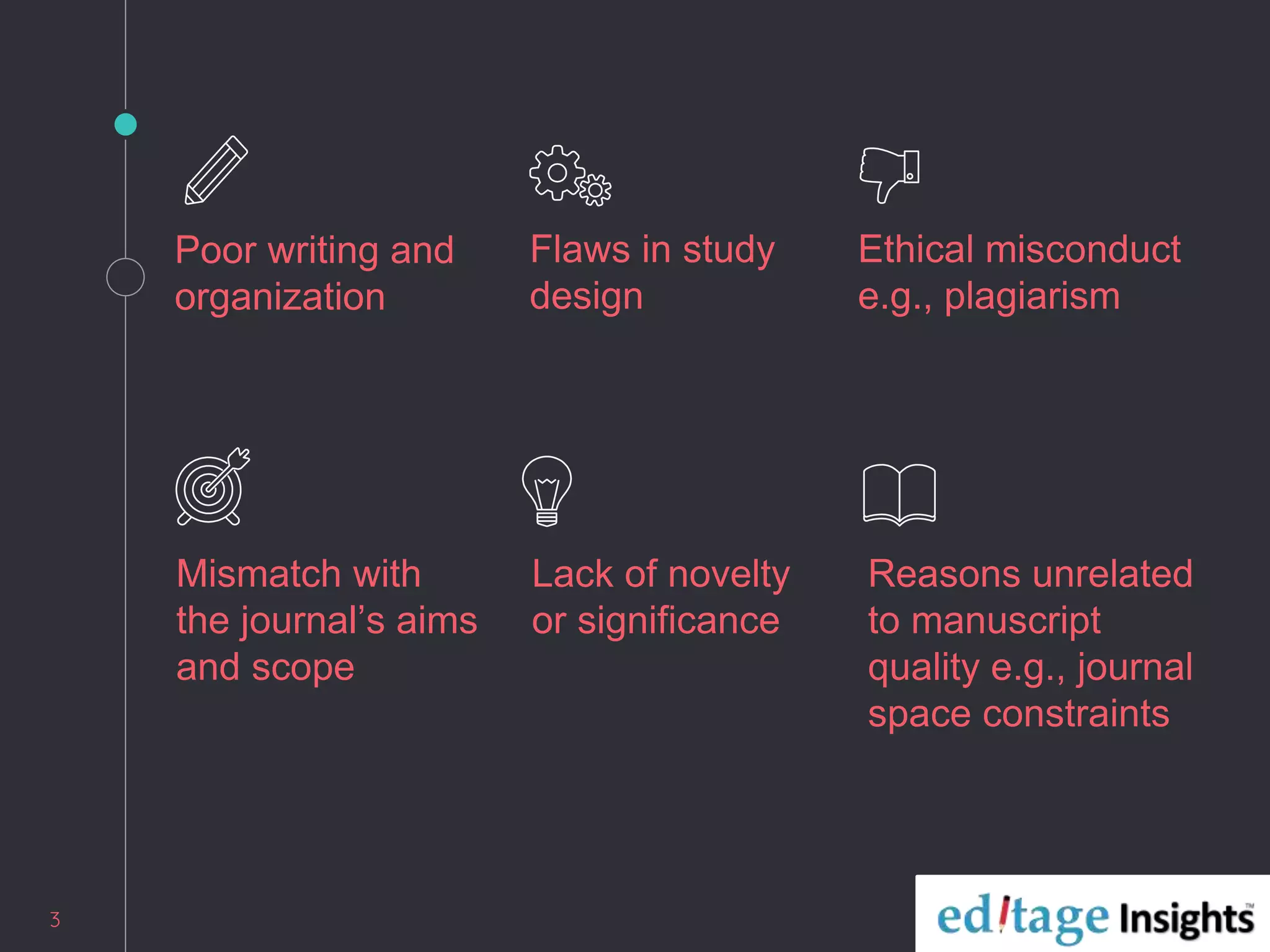
Poor writing and
organization
Flaws in study
design
Ethical misconduct
e.g., plagiarism
Mismatch with
the journal’s aims
and scope
3
Lack of novelty
or significance
Reasons unrelated
to manuscript
quality e.g., journal
space constraints
You can prepare a great submission package!
WHAT CAN YOU DO TO AVOID THESE MISTAKES?
4
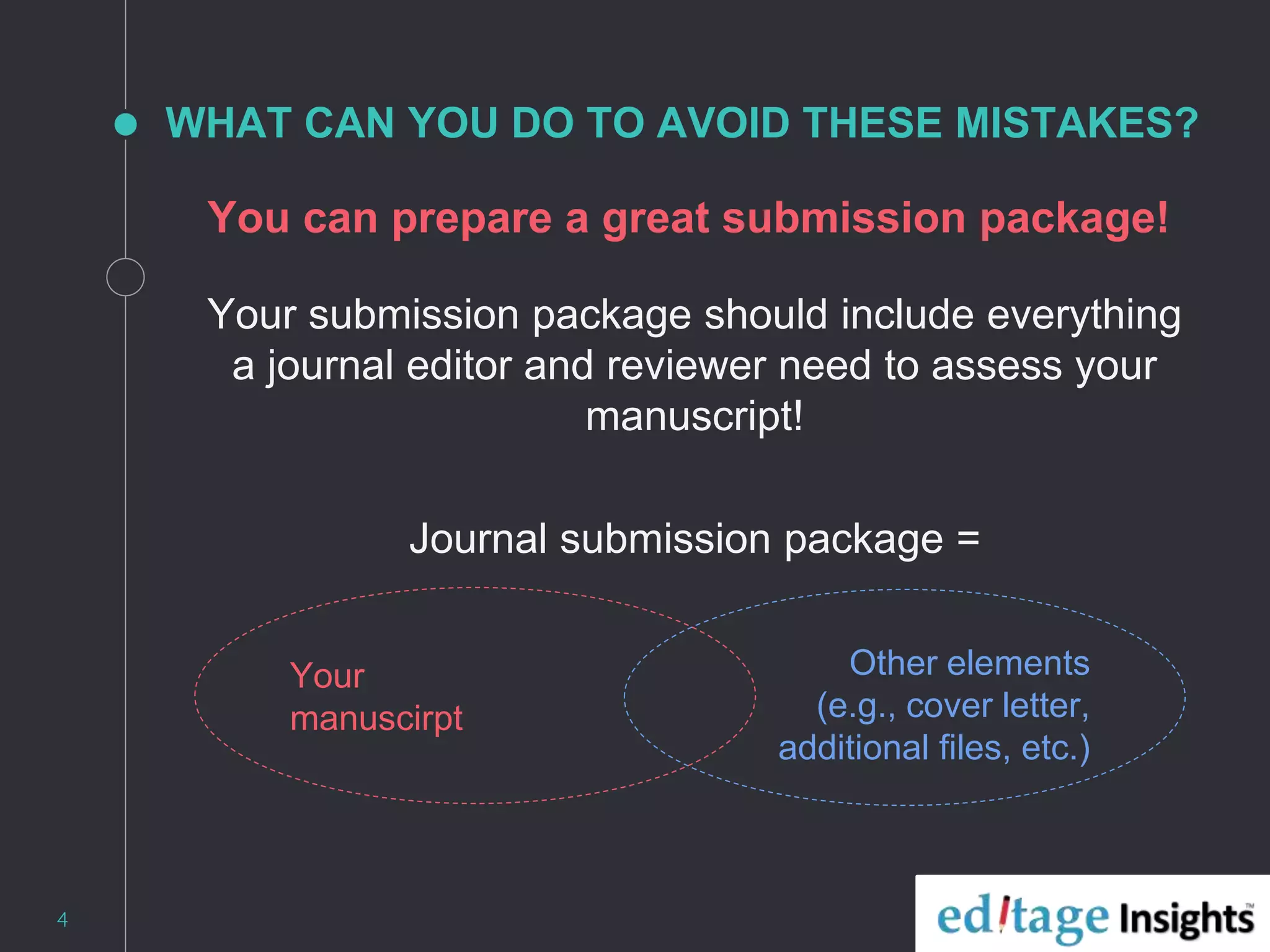
Your submission package should include everything
a journal editor and reviewer need to assess your
manuscript!
Journal submission package =
Your
manuscirpt
Other elements
(e.g., cover letter,
additional files, etc.)
5
Here’s a detailed list of everything to need to
consider before journal submission.
This checklist will help you avoid the common reasons for
journal rejection
◦ Manuscript formatting
◦ Manuscript structure
◦ Language and flow
◦ Tables, figures, graphs
◦ Facts and details
◦ Author information
◦ Attribution and acknowledgement
◦ Cover letter
◦ Conflict of interest
◦ Compliance
MANUSCRIPT FORMATTING1
6
A well-formatted manuscript follows all journal instructions.
Get these things right:
File type (Word/LaTeX/PDF), font type or size, layout, spacing,
page margins, numbering, heading style, etc.
Have you adhered to the stipulated word count?
Check the journal’s recommendations for specific sections such as
the Title and Abstract
Are you references in order?
Make sure that:
• All the in-text citations are included in the reference list
• Your reference list has been formatted as per the journal’s style
• In-text citations and references are complete and consistently
styled
7
8
2 MANUSCRIPT STRUCTURE
You need to pay attention to each section of your paper!
9
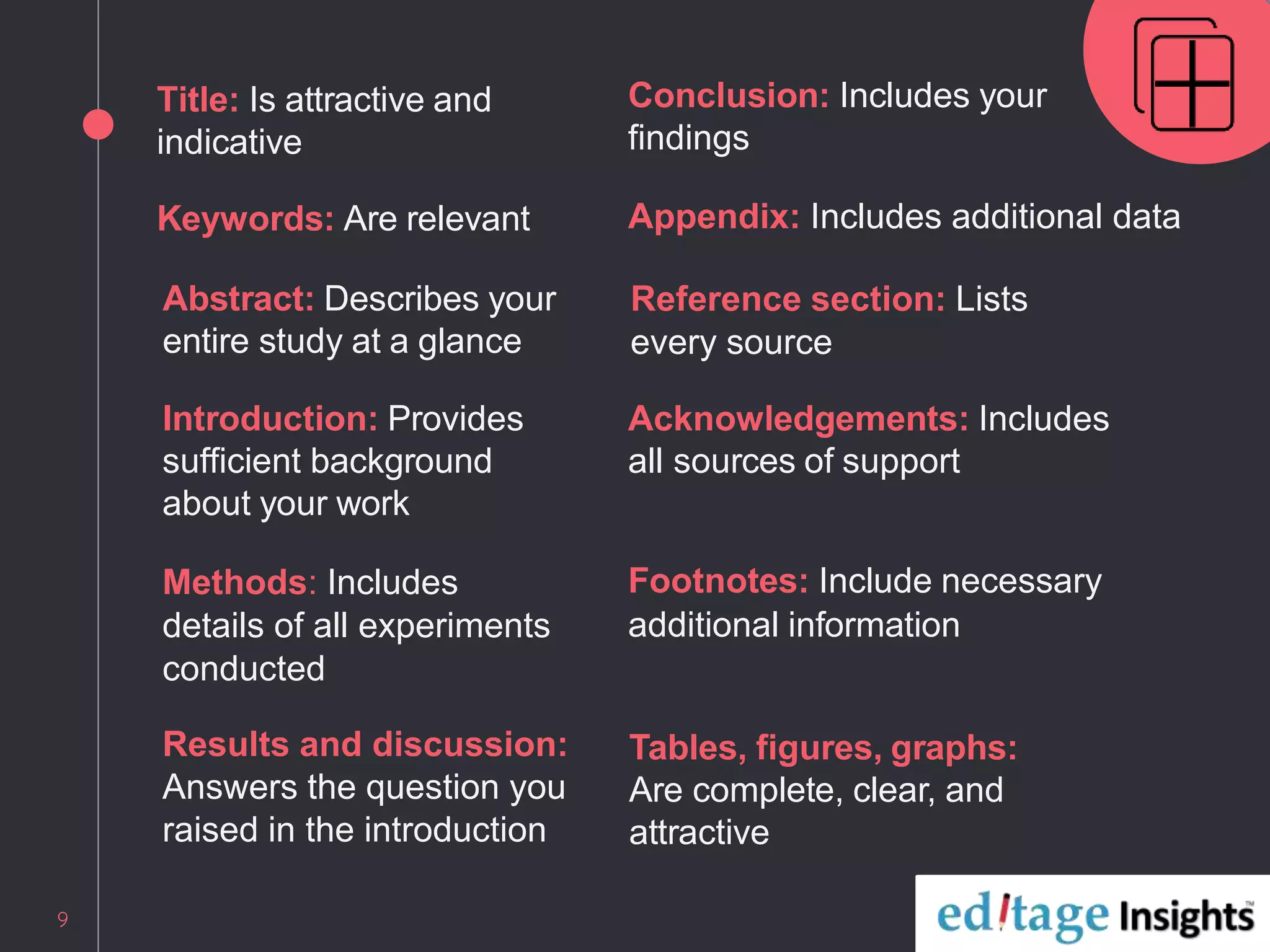
Title: Is attractive and
indicative
Keywords: Are relevant
Abstract: Describes your
entire study at a glance
Introduction: Provides
sufficient background
about your work
Methods: Includes
details of all experiments
conducted
Results and discussion:
Answers the question you
raised in the introduction
Conclusion: Includes your
findings
Reference section: Lists
every source
Acknowledgements: Includes
all sources of support
Footnotes: Include necessary
additional information
Tables, figures, graphs:
Are complete, clear, and
attractive
Appendix: Includes additional data
10
3 LANGUAGE AND FLOW
A well-written manuscript has greater chances of acceptance.
11
Pay attention to:
◦ Sentence structure: Avoid long, complicated
sentences; keep it simple
◦ Logic and comprehension: Your sentences
should be understandable
◦ Flow: Your ideas should flow smoothly
◦ Word choice: Use correct terminology, avoid
excessive jargon and grandiose language
◦ Grammar: Make sure there are no grammatical
mistakes
Here are some additional tips:
12
Run a spelling and grammar check
Request a friend/colleague to review your paper
Approach an editing service for help with polishing
your manuscript
TABLES, FIGURES, GRAPHS
13
4
Tables and figures will be among the first few sections
checked by the journal editor and reviewers. Get them right!
Double check these details:
◦ Ensure that tables and figures do not repeat the
information in the text.
◦ Tables should not be too long. Include additional
information in the Appendix.
◦ Are the figures/images clear and readable?
◦ Check table titles, figure and graph legends, and
image captions.
◦ Is the file size too small?
◦ Are they in the correct format (file type) as
requested by the journal?
14
15
5 FACTS AND DETAILS
Check ALL details, even the smaller ones.
Ensure that there are no errors regarding:
◦ Data accuracy
◦ Symbols
◦ Units of measurement
◦ Calculations and equations
◦ Numerical consistency between text and tables
◦ Correspondence between in-text citations and your
reference list
Tip: If you have a lot of data, consider using tools to help
store or share it
16
17
6 AUTHOR INFORMATION
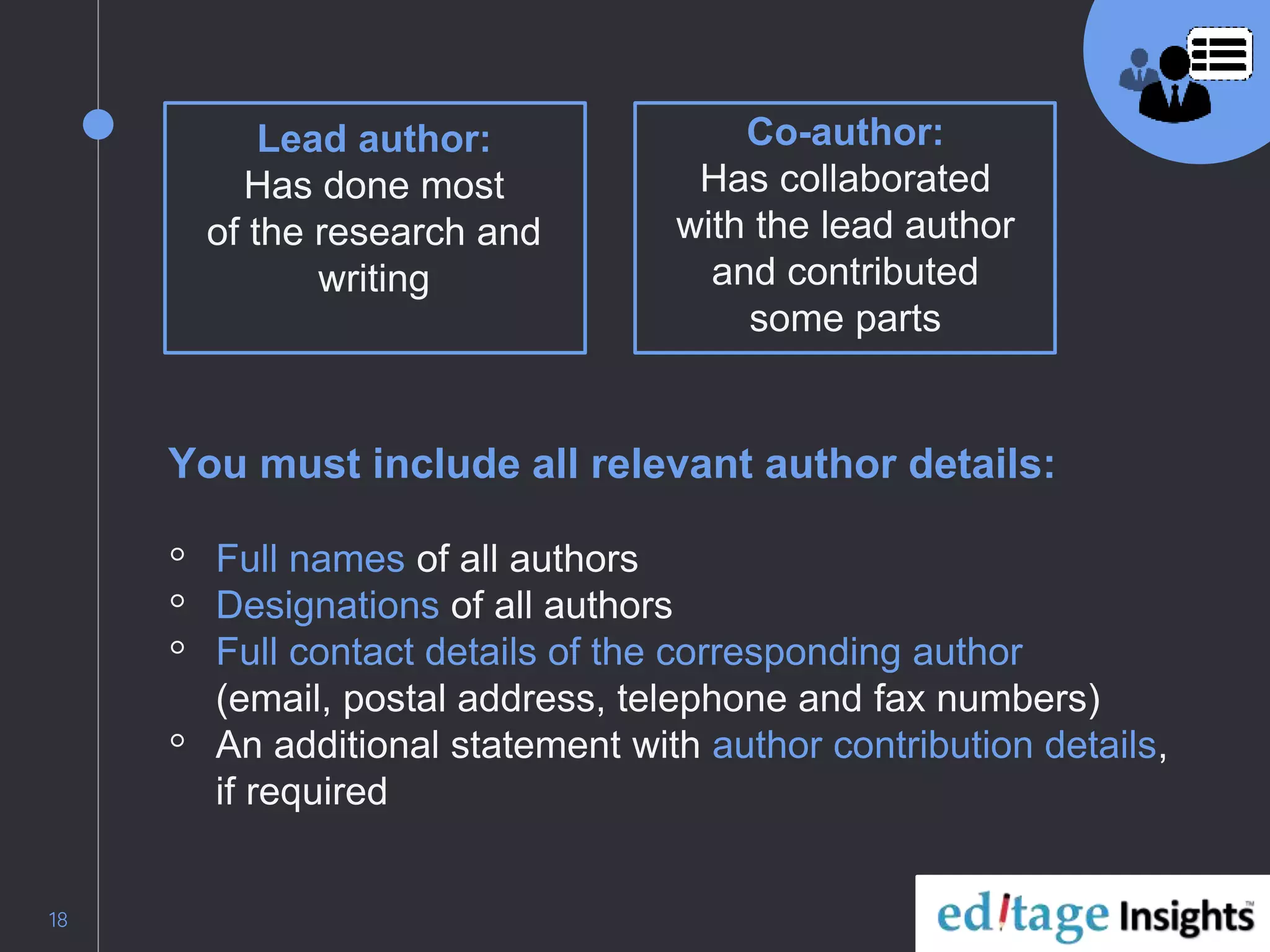
Understand the differences between lead author and co-author
Co-author:
Has collaborated
with the lead author
and contributed
some parts
18
Lead author:
Has done most
of the research and
writing
You must include all relevant author details:
◦ Full names of all authors
◦ Designations of all authors
◦ Full contact details of the corresponding author
(email, postal address, telephone and fax numbers)
◦ An additional statement with author contribution details,
if required
19
7 ATTRIBUTION AND ACKNOWLEDGEMENT
Failure to acknowledge relevant sources of information and
show proof of consent may be viewed as an ethical violation
Acknowledge all help received and each
source of information used
◦ Use quotation marks for material copied or reproduced
as is
◦ Get written permission for reproducing graphics or
copyrighted material and submit it along with your
manuscript
◦ Acknowledge all sources of support
◦ Submit any forms of informed consent from
patients/subjects, if applicable
20
21
8 COVER LETTER
Your cover letter should be complete and make a strong pitch
Your cover letter should include all these details:
◦ Full details of all authors
◦ A brief explanation of your manuscript’s relevance and impact
◦ Disclosure of whether you have published the study previously
elsewhere or if it is in consideration by another journal
◦ Details of any supplementary material you may be submitting
◦ Disclosure of any commercial or financial relationship that may
be viewed as a conflict of interest
◦ If needed, a brief statement explaining why the journal should
publish your study
22
23
CONFLICT OF INTEREST
Include a statement disclosing any potential conflict of interest
9
24
Make sure that:
◦ All financial support you have received has been
acknowledged
◦ Your cover letter includes any commercial/financial
relationship that may be viewed as a conflict of interest
◦ You have not signed any document that will bias the
results of your research in any way
◦ You have referred to the journal’s submission
guidelines for specific forms or followed ICMJE
guidelines
25
COMPLIANCE
Make sure your study complies with relevant ethical guidelines
10
Make sure that you:
◦ Follow all relevant patient and animal care
guidelines, clinical trial registration guidelines,
environmental protection guidelines, etc.
◦ Get an approval from your institutional review board
Tip: Ensure that your journal submission package
includes details of your compliance with relevant
protocols.
26
27
Once you have everything ready,
you’re good to go!
Good luck
with your submission!
www.editage.com/insights
Connect with us
For more useful resources and tips on publication, visit:
@EditageInsights

Manuscript Submission Checklist: Everything you need to consider before submission

  • 1.
    Manuscript Submission Checklist: Everything youneed to consider before journal submission
  • 2.
    2 WHAT ARE THETOP REASONS FOR JOURNAL REJECTION?
  • 3.
    Poor writing and organization Flawsin study design Ethical misconduct e.g., plagiarism Mismatch with the journal’s aims and scope 3 Lack of novelty or significance Reasons unrelated to manuscript quality e.g., journal space constraints
  • 4.
    You can preparea great submission package! WHAT CAN YOU DO TO AVOID THESE MISTAKES? 4 Your submission package should include everything a journal editor and reviewer need to assess your manuscript! Journal submission package = Your manuscirpt Other elements (e.g., cover letter, additional files, etc.)
  • 5.
    5 Here’s a detailedlist of everything to need to consider before journal submission. This checklist will help you avoid the common reasons for journal rejection ◦ Manuscript formatting ◦ Manuscript structure ◦ Language and flow ◦ Tables, figures, graphs ◦ Facts and details ◦ Author information ◦ Attribution and acknowledgement ◦ Cover letter ◦ Conflict of interest ◦ Compliance
  • 6.
    MANUSCRIPT FORMATTING1 6 A well-formattedmanuscript follows all journal instructions.
  • 7.
    Get these thingsright: File type (Word/LaTeX/PDF), font type or size, layout, spacing, page margins, numbering, heading style, etc. Have you adhered to the stipulated word count? Check the journal’s recommendations for specific sections such as the Title and Abstract Are you references in order? Make sure that: • All the in-text citations are included in the reference list • Your reference list has been formatted as per the journal’s style • In-text citations and references are complete and consistently styled 7
  • 8.
    8 2 MANUSCRIPT STRUCTURE Youneed to pay attention to each section of your paper!
  • 9.
    9 Title: Is attractiveand indicative Keywords: Are relevant Abstract: Describes your entire study at a glance Introduction: Provides sufficient background about your work Methods: Includes details of all experiments conducted Results and discussion: Answers the question you raised in the introduction Conclusion: Includes your findings Reference section: Lists every source Acknowledgements: Includes all sources of support Footnotes: Include necessary additional information Tables, figures, graphs: Are complete, clear, and attractive Appendix: Includes additional data
  • 10.
    10 3 LANGUAGE ANDFLOW A well-written manuscript has greater chances of acceptance.
  • 11.
    11 Pay attention to: ◦Sentence structure: Avoid long, complicated sentences; keep it simple ◦ Logic and comprehension: Your sentences should be understandable ◦ Flow: Your ideas should flow smoothly ◦ Word choice: Use correct terminology, avoid excessive jargon and grandiose language ◦ Grammar: Make sure there are no grammatical mistakes
  • 12.
    Here are someadditional tips: 12 Run a spelling and grammar check Request a friend/colleague to review your paper Approach an editing service for help with polishing your manuscript
  • 13.
    TABLES, FIGURES, GRAPHS 13 4 Tablesand figures will be among the first few sections checked by the journal editor and reviewers. Get them right!
  • 14.
    Double check thesedetails: ◦ Ensure that tables and figures do not repeat the information in the text. ◦ Tables should not be too long. Include additional information in the Appendix. ◦ Are the figures/images clear and readable? ◦ Check table titles, figure and graph legends, and image captions. ◦ Is the file size too small? ◦ Are they in the correct format (file type) as requested by the journal? 14
  • 15.
    15 5 FACTS ANDDETAILS Check ALL details, even the smaller ones.
  • 16.
    Ensure that thereare no errors regarding: ◦ Data accuracy ◦ Symbols ◦ Units of measurement ◦ Calculations and equations ◦ Numerical consistency between text and tables ◦ Correspondence between in-text citations and your reference list Tip: If you have a lot of data, consider using tools to help store or share it 16
  • 17.
    17 6 AUTHOR INFORMATION Understandthe differences between lead author and co-author
  • 18.
    Co-author: Has collaborated with thelead author and contributed some parts 18 Lead author: Has done most of the research and writing You must include all relevant author details: ◦ Full names of all authors ◦ Designations of all authors ◦ Full contact details of the corresponding author (email, postal address, telephone and fax numbers) ◦ An additional statement with author contribution details, if required
  • 19.
    19 7 ATTRIBUTION ANDACKNOWLEDGEMENT Failure to acknowledge relevant sources of information and show proof of consent may be viewed as an ethical violation
  • 20.
    Acknowledge all helpreceived and each source of information used ◦ Use quotation marks for material copied or reproduced as is ◦ Get written permission for reproducing graphics or copyrighted material and submit it along with your manuscript ◦ Acknowledge all sources of support ◦ Submit any forms of informed consent from patients/subjects, if applicable 20
  • 21.
    21 8 COVER LETTER Yourcover letter should be complete and make a strong pitch
  • 22.
    Your cover lettershould include all these details: ◦ Full details of all authors ◦ A brief explanation of your manuscript’s relevance and impact ◦ Disclosure of whether you have published the study previously elsewhere or if it is in consideration by another journal ◦ Details of any supplementary material you may be submitting ◦ Disclosure of any commercial or financial relationship that may be viewed as a conflict of interest ◦ If needed, a brief statement explaining why the journal should publish your study 22
  • 23.
    23 CONFLICT OF INTEREST Includea statement disclosing any potential conflict of interest 9
  • 24.
    24 Make sure that: ◦All financial support you have received has been acknowledged ◦ Your cover letter includes any commercial/financial relationship that may be viewed as a conflict of interest ◦ You have not signed any document that will bias the results of your research in any way ◦ You have referred to the journal’s submission guidelines for specific forms or followed ICMJE guidelines
  • 25.
    25 COMPLIANCE Make sure yourstudy complies with relevant ethical guidelines 10
  • 26.
    Make sure thatyou: ◦ Follow all relevant patient and animal care guidelines, clinical trial registration guidelines, environmental protection guidelines, etc. ◦ Get an approval from your institutional review board Tip: Ensure that your journal submission package includes details of your compliance with relevant protocols. 26
  • 27.
    27 Once you haveeverything ready, you’re good to go! Good luck with your submission!
  • 28.
    www.editage.com/insights Connect with us Formore useful resources and tips on publication, visit: @EditageInsights