Alex.Holcombe@sydney.edu.au
School of Psychology
@ceptional
Fixing Science:
The Replicability Crisis
http://www.slideshare.net/holcombea/
1Wednesday, 1 May 13
In the course of describing the scientific method, a popular second-
grade textbook instructs students that "Experiments should be done
more than once". But in the professional scientific literature, the
proportion of published studies that report replications are very small.
While individual research articles typically report statistics designed to
insure that the false-positive rate is below a nominal value (e.g, .05),
common forms of bias in scientific practice can inflate the false-
positive rate to much higher levels. For this and other reasons, the
second-graders are right: without replications, it is difficult to know
whether to believe individual results.
Science now has the means to solve the problem, by taking
advantage of new technology (the "Internet"). We are in a new era of
cheap, open access, unlimited publishing. Nevertheless, academia
continues to actively suppress replication studies. As this gradually
changes, we will see not only a continued increase in the demand for
statisticians, but also the emergence of a new class of data re-
analysts. From my perspective as a psychological scientist, I will
describe new initiatives that are coaxing replication studies, and raw
data, out of the closet and onto the internet.
Abstract
2Wednesday, 1 May 13
The Replicability Crisis
Rule among early-stage venture
capital firms that “at least 50% of
published studies, even those in top-
tier academic journals, can't be
repeated with the same conclusions
by an industrial lab” - Prinz,
Schlange, & Asadullah. Nature Rev.
Drug Discov. 10, 712 (2011)
Bayer HealthCare :only about 25% of published
preclinical studies could be validated to the point
at which projects could continue
Amgen Fifty-three papers were deemed ‘landmark’
studies (see ‘Reproducibility of research
findings’)... scientific findings were confirmed in
only 6 (11%) cases
3Wednesday, 1 May 13
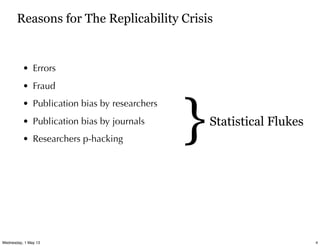
Reasons for The Replicability Crisis
• Errors
• Fraud
• Publication bias by researchers
• Publication bias by journals
• Researchers p-hacking
Statistical Flukes
}
4Wednesday, 1 May 13
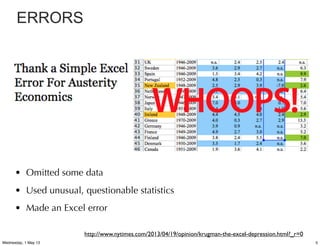
http://www.nytimes.com/2013/04/19/opinion/krugman-the-excel-depression.html?_r=0
• Omitted some data
• Used unusual, questionable statistics
• Made an Excel error
ERRORS
5Wednesday, 1 May 13
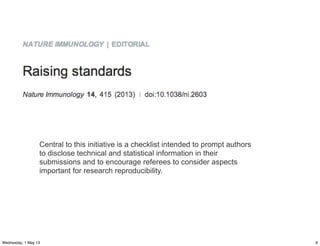
Central to this initiative is a checklist intended to prompt authors
to disclose technical and statistical information in their
submissions and to encourage referees to consider aspects
important for research reproducibility.
6Wednesday, 1 May 13
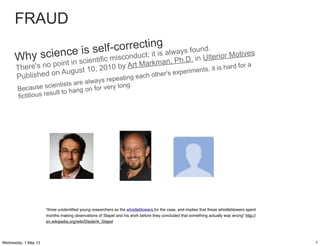
Why science is self-correcting
There's no point in scientific misconduct; it is always found.
Published on August 10, 2010 by Art Markman, Ph.D. in Ulterior Motives
Because scientists are always repeating each other's experiments, it is hard for a
fictitious result to hang on for very long.
“three unidentified young researchers as the whistleblowers for the case, and implies that these whistleblowers spent
months making observations of Stapel and his work before they concluded that something actually was wrong” http://
en.wikipedia.org/wiki/Diederik_Stapel
FRAUD
7Wednesday, 1 May 13
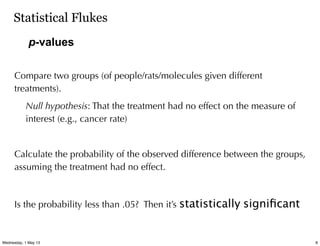
p-values
Compare two groups (of people/rats/molecules given different
treatments).
Null hypothesis: That the treatment had no effect on the measure of
interest (e.g., cancer rate)
Calculate the probability of the observed difference between the groups,
assuming the treatment had no effect.
Is the probability less than .05? Then it’s statistically significant
Statistical Flukes
8Wednesday, 1 May 13
Publication Bias
bias introduced into the scientific literature by selective publication
— chiefly by a tendency to publish positive results but not to
publish negative or nonconfirmatory results.
9Wednesday, 1 May 13
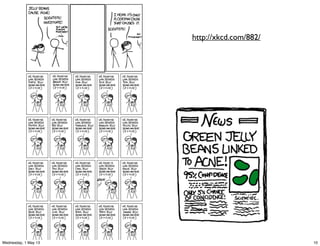
http://xkcd.com/882/
10Wednesday, 1 May 13
Publication bias
• By journals
• “Unfortunately, despite the tens of thousands of
available journals, places to send negative results
are exceedingly scarce.”
• even for those that do, uphill battle
to get accepted
• By researchers
• No glory (promotions, grants, prizes) for a
negative result
http://expertedge.journalexperts.com/
2013/04/26/negative-results-the-dark-
matter-of-research/
11Wednesday, 1 May 13
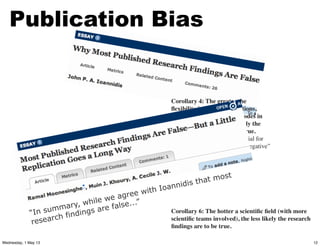
Corollary 4: The greater the
flexibility in designs, definitions,
outcomes, and analytical modes in
a scientific field, the less likely the
research findings are to be true.
Flexibility increases the potential for
transforming what would be “negative”
results into “positive” results.
Corollary 6: The hotter a scientific field (with more
scientific teams involved), the less likely the research
findings are to be true.
Publication Bias
“In summary, while we agree with Ioannidis that most
research findings are false...”
12Wednesday, 1 May 13
Reasons for the Replicability Crisis
• Errors
• Fraud
• Publication bias by researchers
• Publication bias by journals
• Researchers p-hacking
Statistical Flukes
}
Partial solution: Conduct and publish replication studies
13Wednesday, 1 May 13
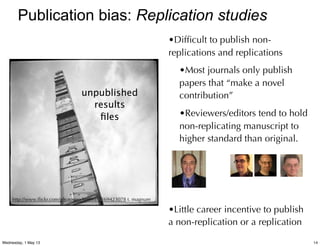
Publication bias: Replication studies
•Difficult to publish non-
replications and replications
•Most journals only publish
papers that “make a novel
contribution”
•Reviewers/editors tend to hold
non-replicating manuscript to
higher standard than original.
•Bem
•Little career incentive to publish
a non-replication or a replication
http://www.flickr.com/photos/nickperez/2569423078 t. magnum
unpublished
results
files
14Wednesday, 1 May 13
“Which of the following do you consider to be scientific fraud?
1) A scientist collects 100 observations in an experiment and
discards the 80 that run counter to his desired outcome
2) A scientist runs ten experiments then selectively writes up the
two that produced statistically significant effects
3) A journal reviews ten papers on the same topic and selectively
publishes the two that reported statistically significant effects”
Dr. Chris Chambers
http://www.scilogs.com/sifting_the_evidence/tackling-the-f-word/
What’s fraud and what’s publication bias?
15Wednesday, 1 May 13
Reasons for the Replicability Crisis
• Errors
• Fraud
• Publication bias by researchers
• Publication bias by journals
• Researchers p-hacking
Statistical Flukes
}
Partial solution: Conduct and publish replication studies
16Wednesday, 1 May 13
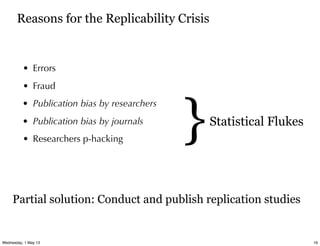
Barriers to publishing replications and failed-
replications
• No glory in publishing a replication
• Few journals publish replications
• usually uphill battle even with
those that do
• The wrath of the original researcher
17Wednesday, 1 May 13
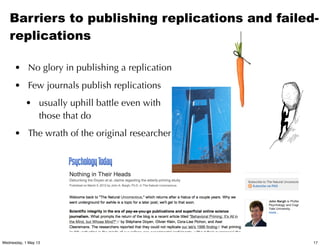
18Wednesday, 1 May 13
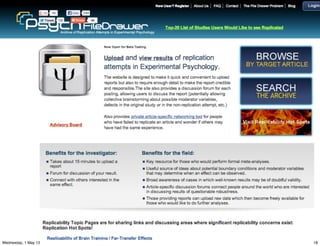
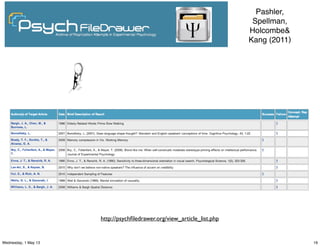
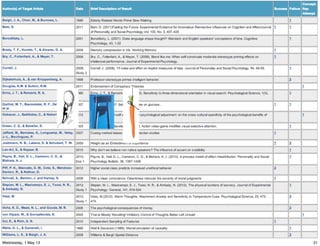
http://psychfiledrawer.org/view_article_list.php
Pashler,
Spellman,
Holcombe&
Kang (2011)
19Wednesday, 1 May 13
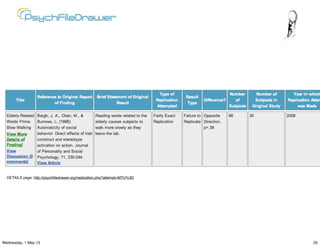
DETAILS page: http://psychfiledrawer.org/replication.php?attempt=MTU%3D
20Wednesday, 1 May 13
P
Sp
Ho
Kan
21Wednesday, 1 May 13
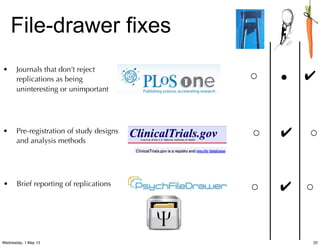
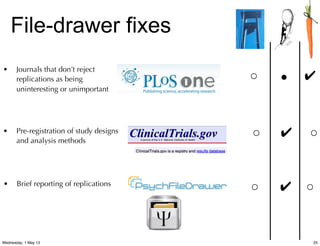
File-drawer fixes
• Journals that don’t reject
replications as being
uninteresting or unimportant
• Pre-registration of study designs
and analysis methods
• Brief reporting of replications
✔•◦
✔
◦ ◦
◦◦
✔
22Wednesday, 1 May 13
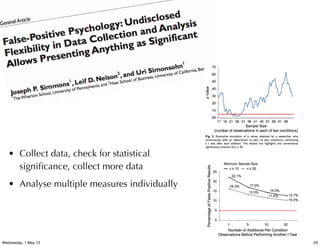
• Collect data, check for statistical
significance, collect more data
• Analyse multiple measures individually
23Wednesday, 1 May 13
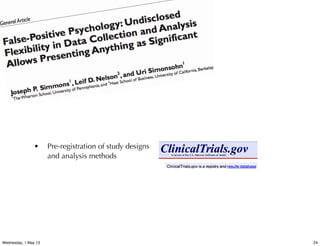
• Pre-registration of study designs
and analysis methods
24Wednesday, 1 May 13
File-drawer fixes
• Journals that don’t reject
replications as being
uninteresting or unimportant
• Pre-registration of study designs
and analysis methods
• Brief reporting of replications
✔•◦
✔
◦ ◦
◦◦
✔
25Wednesday, 1 May 13
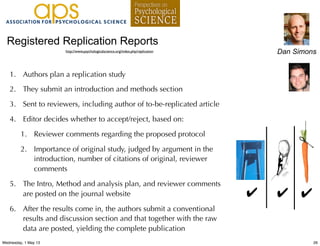
Registered Replication Reports
1. Authors plan a replication study
2. They submit an introduction and methods section
3. Sent to reviewers, including author of to-be-replicated article
4. Editor decides whether to accept/reject, based on:
1. Reviewer comments regarding the proposed protocol
2. Importance of original study, judged by argument in the
introduction, number of citations of original, reviewer
comments
5. The Intro, Method and analysis plan, and reviewer comments
are posted on the journal website
6. After the results come in, the authors submit a conventional
results and discussion section and that together with the raw
data are posted, yielding the complete publication
✔
Dan Simons
✔✔
http://www.psychologicalscience.org/index.php/replication
26Wednesday, 1 May 13
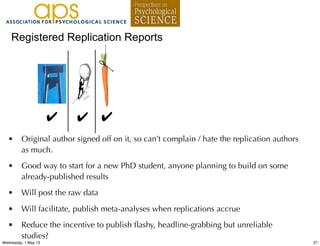
• Original author signed off on it, so can’t complain / hate the replication authors
as much.
• Good way to start for a new PhD student, anyone planning to build on some
already-published results
• Will post the raw data
• Will facilitate, publish meta-analyses when replications accrue
• Reduce the incentive to publish flashy, headline-grabbing but unreliable
studies?
✔✔✔
Registered Replication Reports
27Wednesday, 1 May 13
Reasons for the Replicability Crisis
• Errors
• Fraud
• Publication bias by researchers
• Publication bias by journals
• Researchers p-hacking
Statistical Flukes
}
Partial solution: Conduct and publish replication studies
28Wednesday, 1 May 13
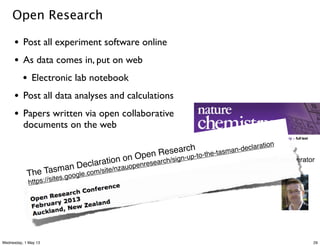
Open Research
• Post all experiment software online
• As data comes in, put on web
• Electronic lab notebook
• Post all data analyses and calculations
• Papers written via open collaborative
documents on the web
The Tasman Declaration on Open Research
https://sites.google.com/site/nzauopenresearch/sign-up-to-the-tasman-declaration
29Wednesday, 1 May 13
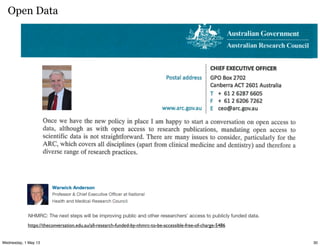
Open Data
NHMRC: The next steps will be improving public and other researchers’ access to publicly funded data.
https://theconversation.edu.au/all-research-funded-by-nhmrc-to-be-accessible-free-of-charge-5486
30Wednesday, 1 May 13
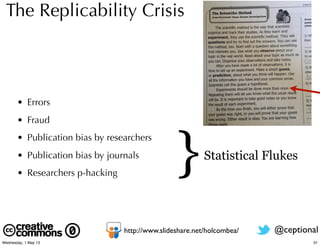
• Errors
• Fraud
• Publication bias by researchers
• Publication bias by journals
• Researchers p-hacking
Statistical Flukes
}
@ceptionalhttp://www.slideshare.net/holcombea/
The Replicability Crisis
31Wednesday, 1 May 13

Fixing Science: The Replicability Crisis

  • 1.
    Alex.Holcombe@sydney.edu.au School of Psychology @ceptional FixingScience: The Replicability Crisis http://www.slideshare.net/holcombea/ 1Wednesday, 1 May 13
  • 2.
    In the courseof describing the scientific method, a popular second- grade textbook instructs students that "Experiments should be done more than once". But in the professional scientific literature, the proportion of published studies that report replications are very small. While individual research articles typically report statistics designed to insure that the false-positive rate is below a nominal value (e.g, .05), common forms of bias in scientific practice can inflate the false- positive rate to much higher levels. For this and other reasons, the second-graders are right: without replications, it is difficult to know whether to believe individual results. Science now has the means to solve the problem, by taking advantage of new technology (the "Internet"). We are in a new era of cheap, open access, unlimited publishing. Nevertheless, academia continues to actively suppress replication studies. As this gradually changes, we will see not only a continued increase in the demand for statisticians, but also the emergence of a new class of data re- analysts. From my perspective as a psychological scientist, I will describe new initiatives that are coaxing replication studies, and raw data, out of the closet and onto the internet. Abstract 2Wednesday, 1 May 13
  • 3.
    The Replicability Crisis Ruleamong early-stage venture capital firms that “at least 50% of published studies, even those in top- tier academic journals, can't be repeated with the same conclusions by an industrial lab” - Prinz, Schlange, & Asadullah. Nature Rev. Drug Discov. 10, 712 (2011) Bayer HealthCare :only about 25% of published preclinical studies could be validated to the point at which projects could continue Amgen Fifty-three papers were deemed ‘landmark’ studies (see ‘Reproducibility of research findings’)... scientific findings were confirmed in only 6 (11%) cases 3Wednesday, 1 May 13
  • 4.
    Reasons for TheReplicability Crisis • Errors • Fraud • Publication bias by researchers • Publication bias by journals • Researchers p-hacking Statistical Flukes } 4Wednesday, 1 May 13
  • 5.
    http://www.nytimes.com/2013/04/19/opinion/krugman-the-excel-depression.html?_r=0 • Omitted somedata • Used unusual, questionable statistics • Made an Excel error ERRORS 5Wednesday, 1 May 13
  • 6.
    Central to thisinitiative is a checklist intended to prompt authors to disclose technical and statistical information in their submissions and to encourage referees to consider aspects important for research reproducibility. 6Wednesday, 1 May 13
  • 7.
    Why science isself-correcting There's no point in scientific misconduct; it is always found. Published on August 10, 2010 by Art Markman, Ph.D. in Ulterior Motives Because scientists are always repeating each other's experiments, it is hard for a fictitious result to hang on for very long. “three unidentified young researchers as the whistleblowers for the case, and implies that these whistleblowers spent months making observations of Stapel and his work before they concluded that something actually was wrong” http:// en.wikipedia.org/wiki/Diederik_Stapel FRAUD 7Wednesday, 1 May 13
  • 8.
    p-values Compare two groups(of people/rats/molecules given different treatments). Null hypothesis: That the treatment had no effect on the measure of interest (e.g., cancer rate) Calculate the probability of the observed difference between the groups, assuming the treatment had no effect. Is the probability less than .05? Then it’s statistically significant Statistical Flukes 8Wednesday, 1 May 13
  • 9.
    Publication Bias bias introducedinto the scientific literature by selective publication — chiefly by a tendency to publish positive results but not to publish negative or nonconfirmatory results. 9Wednesday, 1 May 13
  • 10.
  • 11.
    Publication bias • Byjournals • “Unfortunately, despite the tens of thousands of available journals, places to send negative results are exceedingly scarce.” • even for those that do, uphill battle to get accepted • By researchers • No glory (promotions, grants, prizes) for a negative result http://expertedge.journalexperts.com/ 2013/04/26/negative-results-the-dark- matter-of-research/ 11Wednesday, 1 May 13
  • 12.
    Corollary 4: Thegreater the flexibility in designs, definitions, outcomes, and analytical modes in a scientific field, the less likely the research findings are to be true. Flexibility increases the potential for transforming what would be “negative” results into “positive” results. Corollary 6: The hotter a scientific field (with more scientific teams involved), the less likely the research findings are to be true. Publication Bias “In summary, while we agree with Ioannidis that most research findings are false...” 12Wednesday, 1 May 13
  • 13.
    Reasons for theReplicability Crisis • Errors • Fraud • Publication bias by researchers • Publication bias by journals • Researchers p-hacking Statistical Flukes } Partial solution: Conduct and publish replication studies 13Wednesday, 1 May 13
  • 14.
    Publication bias: Replicationstudies •Difficult to publish non- replications and replications •Most journals only publish papers that “make a novel contribution” •Reviewers/editors tend to hold non-replicating manuscript to higher standard than original. •Bem •Little career incentive to publish a non-replication or a replication http://www.flickr.com/photos/nickperez/2569423078 t. magnum unpublished results files 14Wednesday, 1 May 13
  • 15.
    “Which of thefollowing do you consider to be scientific fraud? 1) A scientist collects 100 observations in an experiment and discards the 80 that run counter to his desired outcome 2) A scientist runs ten experiments then selectively writes up the two that produced statistically significant effects 3) A journal reviews ten papers on the same topic and selectively publishes the two that reported statistically significant effects” Dr. Chris Chambers http://www.scilogs.com/sifting_the_evidence/tackling-the-f-word/ What’s fraud and what’s publication bias? 15Wednesday, 1 May 13
  • 16.
    Reasons for theReplicability Crisis • Errors • Fraud • Publication bias by researchers • Publication bias by journals • Researchers p-hacking Statistical Flukes } Partial solution: Conduct and publish replication studies 16Wednesday, 1 May 13
  • 17.
    Barriers to publishingreplications and failed- replications • No glory in publishing a replication • Few journals publish replications • usually uphill battle even with those that do • The wrath of the original researcher 17Wednesday, 1 May 13
  • 18.
  • 19.
  • 20.
  • 21.
  • 22.
    File-drawer fixes • Journalsthat don’t reject replications as being uninteresting or unimportant • Pre-registration of study designs and analysis methods • Brief reporting of replications ✔•◦ ✔ ◦ ◦ ◦◦ ✔ 22Wednesday, 1 May 13
  • 23.
    • Collect data,check for statistical significance, collect more data • Analyse multiple measures individually 23Wednesday, 1 May 13
  • 24.
    • Pre-registration ofstudy designs and analysis methods 24Wednesday, 1 May 13
  • 25.
    File-drawer fixes • Journalsthat don’t reject replications as being uninteresting or unimportant • Pre-registration of study designs and analysis methods • Brief reporting of replications ✔•◦ ✔ ◦ ◦ ◦◦ ✔ 25Wednesday, 1 May 13
  • 26.
    Registered Replication Reports 1.Authors plan a replication study 2. They submit an introduction and methods section 3. Sent to reviewers, including author of to-be-replicated article 4. Editor decides whether to accept/reject, based on: 1. Reviewer comments regarding the proposed protocol 2. Importance of original study, judged by argument in the introduction, number of citations of original, reviewer comments 5. The Intro, Method and analysis plan, and reviewer comments are posted on the journal website 6. After the results come in, the authors submit a conventional results and discussion section and that together with the raw data are posted, yielding the complete publication ✔ Dan Simons ✔✔ http://www.psychologicalscience.org/index.php/replication 26Wednesday, 1 May 13
  • 27.
    • Original authorsigned off on it, so can’t complain / hate the replication authors as much. • Good way to start for a new PhD student, anyone planning to build on some already-published results • Will post the raw data • Will facilitate, publish meta-analyses when replications accrue • Reduce the incentive to publish flashy, headline-grabbing but unreliable studies? ✔✔✔ Registered Replication Reports 27Wednesday, 1 May 13
  • 28.
    Reasons for theReplicability Crisis • Errors • Fraud • Publication bias by researchers • Publication bias by journals • Researchers p-hacking Statistical Flukes } Partial solution: Conduct and publish replication studies 28Wednesday, 1 May 13
  • 29.
    Open Research • Postall experiment software online • As data comes in, put on web • Electronic lab notebook • Post all data analyses and calculations • Papers written via open collaborative documents on the web The Tasman Declaration on Open Research https://sites.google.com/site/nzauopenresearch/sign-up-to-the-tasman-declaration 29Wednesday, 1 May 13
  • 30.
    Open Data NHMRC: Thenext steps will be improving public and other researchers’ access to publicly funded data. https://theconversation.edu.au/all-research-funded-by-nhmrc-to-be-accessible-free-of-charge-5486 30Wednesday, 1 May 13
  • 31.
    • Errors • Fraud •Publication bias by researchers • Publication bias by journals • Researchers p-hacking Statistical Flukes } @ceptionalhttp://www.slideshare.net/holcombea/ The Replicability Crisis 31Wednesday, 1 May 13