 Definitions
 History
 Indications
 Contraindications
 Advantages
 Disadvantages
 Classification
 Selection of attachments
 Intra-coronal attachments
 Extra-coronal attachments
 Stud attachments
 Bar attachments
 Magnetic attachments
 Auxiliary attachments
 Referances
3/21/2023 2
 Attachment:
 a mechanical device for the fixation, retention, and stabilization of a prosthesis
 a retainer consisting of a metal receptacle and a closely fitting part; the former (matrix
component) is usually contained within the normal or expanded contours of the crown of
the abutment tooth and the latter (patrix component), is attached to a pontic or the denture
framework.
 Semiprecision attachment: a laboratory fabricated rigid metallic patrix of a fixed or
removable partial denture that fits into a matrix in a cast restoration, allowing some
movement between the com- ponents; attachments with plastic components are often called
semiprecision attachments even if prefabricated
 Precision attachment: a retainer consisting of a metal receptacle (matrix) and a closely
fitting part (patrix); the matrix is usually contained within the normal or expanded contours of
the crown on the abutment tooth/dental implant and the patrix is attached to a pontic or a
removable partial denture;
GPT - 9
 Internal attachment,
 parallel attachment,
 frictional attachment,
 key and key way attachment,
 slotted attachment.
3/21/2023 4
1. Winder – ‘Winder’s design’: screw joint
retention
2. Parr (1886) – Extracoronal socket
attachment
3. Stair – Telescopic abutment restoration
4. Hermes E S (1906) – T shaped precision
attachment
5. Ash (1912) – Split bar attachment system
6. H shaped Chayes attachment (1912)
3/21/2023 5
 Esthetics zone.
 Redistribution of forces required.
 Minimize trauma to soft tissue.
 Control of loading and rotational forces.
 Nonparallel abutments present.
 Segmenting of the long span bridges.
 Future salvages efforts.
 Improved retention.
 Movable joints in fixed movable bridge work.
 As stress breaker in free end saddles and bridges.
 Intracoronal attachments as effective direct retainers
for removable partial dentures.
 As a connector for sectional dentures.
 Sections of a fixed prosthesis may be connected with
intracoronal attachments.
 To lock a connector joining saddles in the opposite
side of the arch.
 As contingency devices for the extension or
conversion of existing dentures.
 Where fixed dentures are contraindicated due to
periodontal condition.
 To retain hybrid dentures.
Becerra G, Macentee M. A classification of precision attachments. J Prosthet Dent
 Poor periodontal support
 Poor oral hygiene habits
 High caries index
 Inadequate space to employ attachment
 Compromised endodontics and restorative status
Becerra G, Macentee M. A classification of precision attachments. J Prosthet Dent
 Improved esthetics and elevated psychological acceptance of the prosthesis
 better retention and stability, less liable to fracture than clasp, less bulk, and
reduced incidence of secondary caries.
 Lateral forces in the abutment during the insertion and removal are eliminated,
and more axial force during functions is achieved.
 Improved cross arch load transfer/force transmission and prosthesis stabilization
 incorporates broken stress philosophy that limits the potentially damaging forces
(stress transfer) imparted to the abutment
 provide better vertical support and better stimulation to the underlying tissue
through intermittent vertical massage.
Patel H, Patel K, Thummer S, Patel RK. Use of precision attachment and cast partial denture for long-span
partially edentulous mouth-A case report. Int J Appl Dent Sci 2014;1:22-5.
 Complexity of design, complex principles, and procedures for fabrication and
clinical treatment.
 Expensive increased overall cost of the treatment.
 Requires high technical expertise for successful fabrication experience and
knowledge on the part of dentist and laboratory technician are essential.
 Increased demand on oral hygiene performance.
 The tooth may have to be extensively prepared to provide required space to
accommodate intra-coronal attachment.
 The attachment is subjected to wear as a result of friction between metal parts; as
wear occurs, male portion fits more loosely, thus permitting excessive movement
leading injury to abutment teeth.
Patel H, Patel K, Thummer S, Patel RK. Use of precision attachment and cast partial denture for long-span
par- tially edentulous mouth-A case report. Int J Appl Dent Sci 2014;1:22-5.
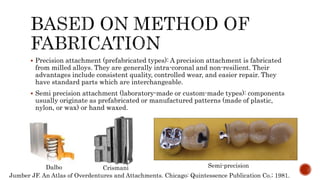
 Precision attachment (prefabricated types): A precision attachment is fabricated
from milled alloys. They are generally intra-coronal and non-resilient. Their
advantages include consistent quality, controlled wear, and easier repair. They
have standard parts which are interchangeable.
 Semi precision attachment (laboratory-made or custom-made types): components
usually originate as prefabricated or manufactured patterns (made of plastic,
nylon, or wax) or hand waxed.
Jumber JF. An Atlas of Overdentures and Attachments. Chicago: Quintessence Publication Co.; 1981.
Crismani
Dalbo Semi-precision
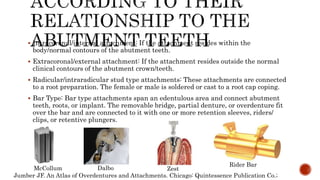
 Intracoronal/internal attachment: If the attachment resides within the
body/normal contours of the abutment teeth.
 Extracoronal/external attachment: If the attachment resides outside the normal
clinical contours of the abutment crown/teeth.
 Radicular/intraradicular stud type attachments: These attachments are connected
to a root preparation. The female or male is soldered or cast to a root cap coping.
 Bar Type: Bar type attachments span an edentulous area and connect abutment
teeth, roots, or implant. The removable bridge, partial denture, or overdenture fit
over the bar and are connected to it with one or more retention sleeves, riders/
clips, or retentive plungers.
Jumber JF. An Atlas of Overdentures and Attachments. Chicago: Quintessence Publication Co.;
McCollum Zest
Dalbo
Rider Bar
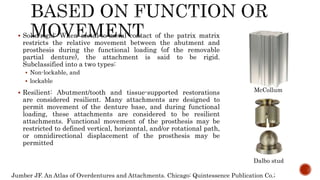
 Solid/rigid: When metal-to-metal contact of the patrix matrix
restricts the relative movement between the abutment and
prosthesis during the functional loading (of the removable
partial denture), the attachment is said to be rigid.
Subclassified into a two types:
 Non-lockable, and
 lockable
 Resilient: Abutment/tooth and tissue-supported restorations
are considered resilient. Many attachments are designed to
permit movement of the denture base, and during functional
loading, these attachments are considered to be resilient
attachments. Functional movement of the prosthesis may be
restricted to defined vertical, horizontal, and/or rotational path,
or omnidirectional displacement of the prosthesis may be
permitted
Jumber JF. An Atlas of Overdentures and Attachments. Chicago: Quintessence Publication Co.;
McCollum
Dalbo stud
 Frictional: Frictional retention is resistance to the relative motion of two or more
surfaces in intimate contact with each other.
 Mechanical: Mechanical retention is resistance to the relative motion of two or more
surfaces due to a physical undercut.
 Frictional and Mechanical: Frictional and mechanical retention combines both
features of frictional and mechanical retention.
 Magnetic: Magnetic retention is the resistance to movement caused by a magnetic
body that attracts certain materials by virtue of a surrounding field of force produced
by the motion of its atomic electrons and the alignment of its atoms. Magnets do not
provide lateral stability and are contraindicated for flat ridges. It is used in limited
applications, heat curing will weaken magnets, and they are liable to corrode.
 Suction types: Suction is a force created by a vacuum that causes a solid object to
adhere to a surface. An example would be a well-fitting denture.
Jumber JF. An Atlas of Overdentures and Attachments. Chicago: Quintessence Publication Co.; 1981.
Key and keyway.
Ball and socket.
Bar and clip or bar and
sleeve.
Telescope.
Hinge.
Push button.
Latch.
Screw units.
Interlock.
Jumber JF. An Atlas of Overdentures and Attachments. Chicago: Quintessence Publication Co.;
 Attachments used for Removable dentures
 Attachments used for Fixed partial dentures
 Attachments used for Implant supported overdentures
3/21/2023 16
Merrill C, Mensor JR. Classification and selection of attachments. J Prosthet Dent 1973;29:494-7.
 Based on Location: Intra-coronal attachments, extra-coronal attachments, and
radicular/intra-radicular stud type attachments, bar type.
 Based on function: It is important to differentiate between a solid and
resilient-type restoration.
 Based on modes of Retention: They are frictional, mechanical, frictional and
mechanical, magnetic and suction types.
 Space: The space available vertically, buccolingually, and mesiodistally plays a key
role in attachment selection.
 Cost: Cost is directly related to the type and material of attachment selected.
 intracoronal or extracoronal attachment?
 resilient or a non-resilient type?
 The third consideration is that the largest attachment can be used within the
given space should be chosen to gain maximum stability, retention, and strength
for the prosthesis.
 size and shape of the abutment teeth.
 Intracoronal attachment requires more teeth preparation and tooth reduction.
 Insufficient space  the abutment retainer will be over contoured on the proximal
surface resulting in restoration that can create periodontal problems.
 Adequate space  intracoronal attachment is preferred as they direct the forces
along the long axis of abutment teeth.
 Although extracoronal attachments are employed in areas of inadequate space,
they can create areas which may be difficult to clean leading to mainte- nance
problems. The lever arm associated with extra- coronal attachment may not direct
all force along the long axis of teeth.
 Major differences of philosophy regarding the use of resilient or non-resilient
attachment system occur when dealing with distal extension edentulous situation.
Theoretically, resilient attachment allows the func- tional forces to be directed to
the tissues and alveolar ridge, and the non-resilient attachment primarily directs
the vertical functional forces to the abutment teeth. Realistically, there is some
sharing of function at loads in both systems.
 Vertical displaceability of natural tooth ≠ soft tissue covering edentulous ridge.
 Thus forces applied to RPD are transferred to the abutments.
 Thus rigid connectors are damaging to the abutments.
 Stress directors are essential to protect them.
 Stress directors are adjusted to control the permitted vertical travel.
3/21/2023 22
Stewart’s Clinical Removable Partial Prosthodontics; Ed. 4
Advantage:
 Minimal direct retential allowing the denture bases to operate
more independently.
 Minimize tipping forces to the abutment teeth, thereby limiting
bone resorption.
Disadvantages:
 Fragile
 Costly
 Require constant maintenance
 Often difficult or impossible to repair.
3/21/2023 23
Stewart’s Clinical Removable Partial Prosthodontics; Ed. 4
 Many attachments allow certain degree of movement
between the components.
 They are often known as ‘Stress-breakers’.
 Mensor called this term as misleading and called them
as ‘stress distributor’ or ‘stress directors’.
3/21/2023 24
 Rationale: Movement should be restricted only to movable tissues
 Disadvantages:
 More complex, increased wear and breakage
 Increased bone resorption and trauma
 Fatigue of spring like device
3/21/2023 25
 Developed a color-coded millimeter gauge to define the vertical clearance available
in the edentulous region of occluded casts for attachment selection.
 The gauge is made up of plastic and measures 75 mm in length.
 It is graduated from 3 to 8 mm in 1 mm increments with a corresponding color.
 Red → 3–4 mm.
 Yellow → 5–6 mm.
 Black → 7–8 mm.
 consists of five 8
1
2
by 11 inch color-coded selector cards and a
quick-reference overlay.
 It is a compendium of the attachments and connecting units
available throughout the world, and it contains 30 points of
information for each of more than 105 different attachment
systems.
 This is a total of over 3,000 points of information.
 Each of the five cards is numbered to correspond with the five
attachment classification groups presented in the Table.
Merrill C, Mensor JR. Classification and selection of attachments. J Prosthet Dent 1973;29:494-7.
 forces should be widely distributed to all available tissues.
 The denture base of tooth/tissue-supported removable partial dentures should be
extended to cover the entire residual ridge within the limitation of functional
muscle movements.
 The teeth and denture-supporting area should both be used to provide support,
bracing, retention, direct-indirect retention, and stability.
 It is important that the removable partial denture framework can be properly
related to the teeth and the denture base to the framework.
 Prieskel Group I: Frictional
 With adjustment potential
 Without adjustment potential
 Preiskel Group II: Mechanical
Precision attachments in Dentistry by Harold W. Preiskel
Passive
attachment
Active
attachment
Locked precision
attachment
Precision attachments in Dentistry by Harold W. Preiskel
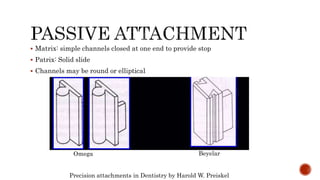
 Matrix: simple channels closed at one end to provide stop
 Patrix: Solid slide
 Channels may be round or elliptical
Omega Beyelar
Precision attachments in Dentistry by Harold W. Preiskel
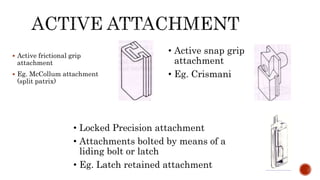
 Active frictional grip
attachment
 Eg. McCollum attachment
(split patrix)
• Active snap grip
attachment
• Eg. Crismani
• Locked Precision attachment
• Attachments bolted by means of a
liding bolt or latch
• Eg. Latch retained attachment
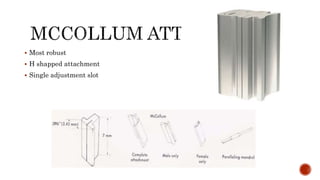
 Most robust
 H shapped attachment
 Single adjustment slot
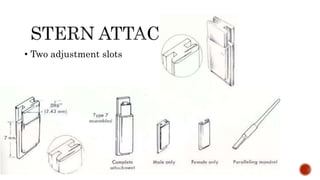
• Two adjustment slots
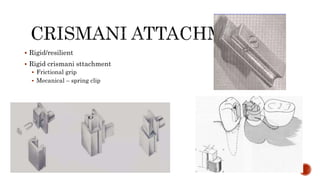
 Rigid/resilient
 Rigid crismani sttachment
 Frictional grip
 Mecanical – spring clip
Standard
(conventional H
shaped)
Lock split
(wide
reinforcing
plate)
Latch
retained
Male – skirt (unique feature)
 Dovetail shaped
 Spring loaded plunger
 Roach attachment (Ball and tube attachment)
 Oldest attachment
 Patrix – round ball
 Matrix - tube
Patrix – round
Matrix – tube
 Two retention pins
 Disadvantage: increased length
 Smaller version
 Two types of pins (friction and mechanical retention)
 Dalbo attachment
 Allows rotational and vertical movement
 Excellent resistance to both distal and lateral
displacing forces.
 Developed by Kurl Cluytens (1951)
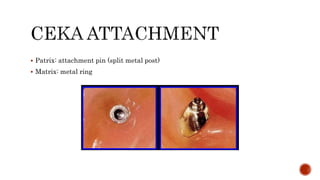
Matrix  metal ring retainer
Patrix  Attachment pin (split
metal post)
Reduces frictional wear during insertion and removal
 Patrix – post with the groove or undercut
 Matrix – O ring synthetic polymer gasket + encapsulator
 O-ring may be made up of:
 Silicone
 Nitrile
 Fluorocarbon
 Ethylene propylene
Its is the simplest of all attachments. It
consists of two parts:
 The stud (male component): usually attached to
a metal coping cemented over prepared
abutment.
 Housing (female component) embedded in the
fitting surface of the overdenture.
Precision attachments in Dentistry by Harold W. Preiskel
 Male element projects from the root surface
 The stud is attached to the metal coping cemented over the prepared abutment, while
the housing is embedded in the fitting surface of the denture.
Gerber Ceka Rothermann
Precision attachments in Dentistry by Harold W. Preiskel
The stud is attached to the
fitting surface of the denture
and the housing is incorporated
in the abutment.
Zest Anchor
Advantage Disadvantage
Overcomes any space
problem
Leverage to the
abutment tooth is
reduced
Attachment procedure is
simple
Due to flexibility of
nylon, parallelism of the
abutment teeth are no
necessary.
Susceptible to caries, as
there is no coping
Nylon stud may bend,
causing difficulty of
seating the denture.
This may reqire frequent
revisits for correction.
Eating food without the
overdenture may cause
food lodgment in the
female part.
Precision attachments in Dentistry by Harold W. Preiskel
 Attachments should be aligned to each other
 Should be in line with the path of insertion of the denture
 Up to 10° divergence can be tolerated
 Contra indicated in significantly divergent roots or implants
 One stud on either side of the arch is sufficient. Simple copings may be placed on
the other roots.
 Studs on adjacent roots are not advised due to difficulty in maintaining hygiene.
 Increasing the number of studs do not always increase retention, it may
contribute to improved stability but will definitely weaken the denture base.
Precision attachments in Dentistry by Harold W. Preiskel
Rigid unit
Ball and socket unit
(allows vertical and
rotational movement)
 Button shaped attachment
 Patrix – eccentric cylinder with undercut or groove
 Matrix – clip or clasp arm
 Advantage – occupies less space and easy to use
Rigid units
Resilient unit
 Intra-radicular
 Patrix: polyethylene – nylon stud
 Matrix: intra-radicular funnel shaped
tube
 Largest of the studs
 Resilient – spring controlled vertical unit
 Patrix – threaded post
 Matrix – retention spring and ring
 Disadvantages:
 Complex attachment system
 Requires more space
 Permits little rotation
 Patrix: attachment pin (split metal post)
 Matrix: metal ring
 Patrix – threaded post/screw
 Matrix – recessed collar, cap nut/lock nut
 Indication: divergent roots
 It consists of a bar contoured to connect abutment teeth together, run parallel and
overlie residual ridge.
 They are soldered to the copings and can be made of metal or plastic.
Purpose of using bar attachments:
 Splinting of abutment teeth
 Retention and support to prosthetic appliance
 Spreads loading
Precision attachments in Dentistry by Harold W. Preiskel
 Rigidly splint the teeth
 Provides good retention, stability and support
 Provides cross-arch stabilization
 Positioned close to the alveolar bone and thus exhibits less leverage
Precision attachments in Dentistry by Harold W. Preiskel
 They increase torque.
 Plaque control is difficult
 Relining them is complicated.
 Higher bulk of the bur and related attachments
 Vertical and buccolingual space requirements limits their applications.
 They demand greater oral hygiene maintenance from the patient.
Precision attachments in Dentistry by Harold W. Preiskel
 They are rigid and there is no
movement between bar and sleeve.
 They transmit occlusal stresses
directly to the abutments.
 Thus they are tooth borne.
Precision attachments in Dentistry by Harold W. Preiskel
 They are resilient in nature.
 Allow some rotational movement
between bar and sleeve.
 Utilize support both from residual ridge
and abutment.
 Thus both tooth and tissue borne.
Precision attachments in Dentistry by Harold W. Preiskel
 Haden bar
 Dolber bar
 Baker clip
 Ackerman clip and CM clip
 King connector
Precision attachments in Dentistry by Harold W. Preiskel
 Egg shaped in cross-section
 Open sided sleeve
 Two sizes:
 3.5mm x 1.6mm
 3.0mm x 2.2mm
 Spacerallows some degree of
vertical and rotationalmovement
Advantages:
 Excellent retention, stability and support
 Cross arch stabilization
Disadvantages:
 Increased bulk
 Plaque accumulation
 Soldering necessary
 Wearing
 Helmut Hader in 1960
 Available as prefabricated plastic pattern
 Resin/plastic sleeve with no spacer
More support and retention
Reduced movement/resiliency
Soldering not required
 Circular cross section and can be bent in all planes
 Made of precious or semi-precious alloy
 Retention tags in the long axis of the bar
 Sleeves
 Disadvantage: occupies more buccolingual
space
 Detachable keeper element
 Generally made of stainless steel and is
fixed to abutment teeth by cementing or
screwing.
 Denture retention element
 Has paired, cylindrical SmCo magnets
axially magnetized and arranged with their
opposite poles adjacent.
Precision attachments in Dentistry by Harold W. Preiskel
Advantages:
Smaller size and strong attractive force
Constant retention
Easy to incorporate in prosthesis
Automatic seating
Very useful for disabled or senile patients
Less lateral force to abutment teeth
3/21/2023 71
Disadvantages:
Loss of retention due to corrosion and heat instability
Requires encapsulation within inert alloys
Impossible to repair
High cost
Less longevity
Sliding movements on their keepers
3/21/2023 72
 Screw and tube attachments
 Key and key-way attachments
 Pressomatic attachments
 Bar connectors
 Attachments for sectional dentures
3/21/2023 73
 Two-part dentures
 One part – chrome cobalt base
 Second part – removable acrylic flange
with teeth
 Advantage: superior esthetics with
improved retention
3/21/2023 74
3/21/2023
75
 Stewart’s Clinical Removable Partial Prosthodontics; Ed. 4
 Precision attachments in Dentistry by Harold W. Preiskel
 Becerra G, Macentee M. A classification of precision attachments. J Prosthet Dent
 Patel H, Patel K, Thummer S, Patel RK. Use of precision attachment and cast partial
denture for long-span partially edentulous mouth-A case report. Int J Appl Dent Sci
2014;1:22-5.
 Jumber JF. An Atlas of Overdentures and Attachments. Chicago: Quintessence
Publication Co.; 1981.
 Merrill C, Mensor JR. Classification and selection of attachments. J Prosthet Dent
1973;29:494-7
3/21/2023 76

Precision attachment.pptx

  • 2.
     Definitions  History Indications  Contraindications  Advantages  Disadvantages  Classification  Selection of attachments  Intra-coronal attachments  Extra-coronal attachments  Stud attachments  Bar attachments  Magnetic attachments  Auxiliary attachments  Referances 3/21/2023 2
  • 3.
     Attachment:  amechanical device for the fixation, retention, and stabilization of a prosthesis  a retainer consisting of a metal receptacle and a closely fitting part; the former (matrix component) is usually contained within the normal or expanded contours of the crown of the abutment tooth and the latter (patrix component), is attached to a pontic or the denture framework.  Semiprecision attachment: a laboratory fabricated rigid metallic patrix of a fixed or removable partial denture that fits into a matrix in a cast restoration, allowing some movement between the com- ponents; attachments with plastic components are often called semiprecision attachments even if prefabricated  Precision attachment: a retainer consisting of a metal receptacle (matrix) and a closely fitting part (patrix); the matrix is usually contained within the normal or expanded contours of the crown on the abutment tooth/dental implant and the patrix is attached to a pontic or a removable partial denture; GPT - 9
  • 4.
     Internal attachment, parallel attachment,  frictional attachment,  key and key way attachment,  slotted attachment. 3/21/2023 4
  • 5.
    1. Winder –‘Winder’s design’: screw joint retention 2. Parr (1886) – Extracoronal socket attachment 3. Stair – Telescopic abutment restoration 4. Hermes E S (1906) – T shaped precision attachment 5. Ash (1912) – Split bar attachment system 6. H shaped Chayes attachment (1912) 3/21/2023 5
  • 6.
     Esthetics zone. Redistribution of forces required.  Minimize trauma to soft tissue.  Control of loading and rotational forces.  Nonparallel abutments present.  Segmenting of the long span bridges.  Future salvages efforts.  Improved retention.  Movable joints in fixed movable bridge work.  As stress breaker in free end saddles and bridges.  Intracoronal attachments as effective direct retainers for removable partial dentures.  As a connector for sectional dentures.  Sections of a fixed prosthesis may be connected with intracoronal attachments.  To lock a connector joining saddles in the opposite side of the arch.  As contingency devices for the extension or conversion of existing dentures.  Where fixed dentures are contraindicated due to periodontal condition.  To retain hybrid dentures. Becerra G, Macentee M. A classification of precision attachments. J Prosthet Dent
  • 7.
     Poor periodontalsupport  Poor oral hygiene habits  High caries index  Inadequate space to employ attachment  Compromised endodontics and restorative status Becerra G, Macentee M. A classification of precision attachments. J Prosthet Dent
  • 8.
     Improved estheticsand elevated psychological acceptance of the prosthesis  better retention and stability, less liable to fracture than clasp, less bulk, and reduced incidence of secondary caries.  Lateral forces in the abutment during the insertion and removal are eliminated, and more axial force during functions is achieved.  Improved cross arch load transfer/force transmission and prosthesis stabilization  incorporates broken stress philosophy that limits the potentially damaging forces (stress transfer) imparted to the abutment  provide better vertical support and better stimulation to the underlying tissue through intermittent vertical massage. Patel H, Patel K, Thummer S, Patel RK. Use of precision attachment and cast partial denture for long-span partially edentulous mouth-A case report. Int J Appl Dent Sci 2014;1:22-5.
  • 9.
     Complexity ofdesign, complex principles, and procedures for fabrication and clinical treatment.  Expensive increased overall cost of the treatment.  Requires high technical expertise for successful fabrication experience and knowledge on the part of dentist and laboratory technician are essential.  Increased demand on oral hygiene performance.  The tooth may have to be extensively prepared to provide required space to accommodate intra-coronal attachment.  The attachment is subjected to wear as a result of friction between metal parts; as wear occurs, male portion fits more loosely, thus permitting excessive movement leading injury to abutment teeth. Patel H, Patel K, Thummer S, Patel RK. Use of precision attachment and cast partial denture for long-span par- tially edentulous mouth-A case report. Int J Appl Dent Sci 2014;1:22-5.
  • 11.
     Precision attachment(prefabricated types): A precision attachment is fabricated from milled alloys. They are generally intra-coronal and non-resilient. Their advantages include consistent quality, controlled wear, and easier repair. They have standard parts which are interchangeable.  Semi precision attachment (laboratory-made or custom-made types): components usually originate as prefabricated or manufactured patterns (made of plastic, nylon, or wax) or hand waxed. Jumber JF. An Atlas of Overdentures and Attachments. Chicago: Quintessence Publication Co.; 1981. Crismani Dalbo Semi-precision
  • 12.
     Intracoronal/internal attachment:If the attachment resides within the body/normal contours of the abutment teeth.  Extracoronal/external attachment: If the attachment resides outside the normal clinical contours of the abutment crown/teeth.  Radicular/intraradicular stud type attachments: These attachments are connected to a root preparation. The female or male is soldered or cast to a root cap coping.  Bar Type: Bar type attachments span an edentulous area and connect abutment teeth, roots, or implant. The removable bridge, partial denture, or overdenture fit over the bar and are connected to it with one or more retention sleeves, riders/ clips, or retentive plungers. Jumber JF. An Atlas of Overdentures and Attachments. Chicago: Quintessence Publication Co.; McCollum Zest Dalbo Rider Bar
  • 13.
     Solid/rigid: Whenmetal-to-metal contact of the patrix matrix restricts the relative movement between the abutment and prosthesis during the functional loading (of the removable partial denture), the attachment is said to be rigid. Subclassified into a two types:  Non-lockable, and  lockable  Resilient: Abutment/tooth and tissue-supported restorations are considered resilient. Many attachments are designed to permit movement of the denture base, and during functional loading, these attachments are considered to be resilient attachments. Functional movement of the prosthesis may be restricted to defined vertical, horizontal, and/or rotational path, or omnidirectional displacement of the prosthesis may be permitted Jumber JF. An Atlas of Overdentures and Attachments. Chicago: Quintessence Publication Co.; McCollum Dalbo stud
  • 14.
     Frictional: Frictionalretention is resistance to the relative motion of two or more surfaces in intimate contact with each other.  Mechanical: Mechanical retention is resistance to the relative motion of two or more surfaces due to a physical undercut.  Frictional and Mechanical: Frictional and mechanical retention combines both features of frictional and mechanical retention.  Magnetic: Magnetic retention is the resistance to movement caused by a magnetic body that attracts certain materials by virtue of a surrounding field of force produced by the motion of its atomic electrons and the alignment of its atoms. Magnets do not provide lateral stability and are contraindicated for flat ridges. It is used in limited applications, heat curing will weaken magnets, and they are liable to corrode.  Suction types: Suction is a force created by a vacuum that causes a solid object to adhere to a surface. An example would be a well-fitting denture. Jumber JF. An Atlas of Overdentures and Attachments. Chicago: Quintessence Publication Co.; 1981.
  • 15.
    Key and keyway. Balland socket. Bar and clip or bar and sleeve. Telescope. Hinge. Push button. Latch. Screw units. Interlock. Jumber JF. An Atlas of Overdentures and Attachments. Chicago: Quintessence Publication Co.;
  • 16.
     Attachments usedfor Removable dentures  Attachments used for Fixed partial dentures  Attachments used for Implant supported overdentures 3/21/2023 16
  • 17.
    Merrill C, MensorJR. Classification and selection of attachments. J Prosthet Dent 1973;29:494-7.
  • 18.
     Based onLocation: Intra-coronal attachments, extra-coronal attachments, and radicular/intra-radicular stud type attachments, bar type.  Based on function: It is important to differentiate between a solid and resilient-type restoration.  Based on modes of Retention: They are frictional, mechanical, frictional and mechanical, magnetic and suction types.  Space: The space available vertically, buccolingually, and mesiodistally plays a key role in attachment selection.  Cost: Cost is directly related to the type and material of attachment selected.
  • 19.
     intracoronal orextracoronal attachment?  resilient or a non-resilient type?  The third consideration is that the largest attachment can be used within the given space should be chosen to gain maximum stability, retention, and strength for the prosthesis.
  • 20.
     size andshape of the abutment teeth.  Intracoronal attachment requires more teeth preparation and tooth reduction.  Insufficient space  the abutment retainer will be over contoured on the proximal surface resulting in restoration that can create periodontal problems.  Adequate space  intracoronal attachment is preferred as they direct the forces along the long axis of abutment teeth.  Although extracoronal attachments are employed in areas of inadequate space, they can create areas which may be difficult to clean leading to mainte- nance problems. The lever arm associated with extra- coronal attachment may not direct all force along the long axis of teeth.
  • 21.
     Major differencesof philosophy regarding the use of resilient or non-resilient attachment system occur when dealing with distal extension edentulous situation. Theoretically, resilient attachment allows the func- tional forces to be directed to the tissues and alveolar ridge, and the non-resilient attachment primarily directs the vertical functional forces to the abutment teeth. Realistically, there is some sharing of function at loads in both systems.
  • 22.
     Vertical displaceabilityof natural tooth ≠ soft tissue covering edentulous ridge.  Thus forces applied to RPD are transferred to the abutments.  Thus rigid connectors are damaging to the abutments.  Stress directors are essential to protect them.  Stress directors are adjusted to control the permitted vertical travel. 3/21/2023 22 Stewart’s Clinical Removable Partial Prosthodontics; Ed. 4
  • 23.
    Advantage:  Minimal directretential allowing the denture bases to operate more independently.  Minimize tipping forces to the abutment teeth, thereby limiting bone resorption. Disadvantages:  Fragile  Costly  Require constant maintenance  Often difficult or impossible to repair. 3/21/2023 23 Stewart’s Clinical Removable Partial Prosthodontics; Ed. 4
  • 24.
     Many attachmentsallow certain degree of movement between the components.  They are often known as ‘Stress-breakers’.  Mensor called this term as misleading and called them as ‘stress distributor’ or ‘stress directors’. 3/21/2023 24
  • 25.
     Rationale: Movementshould be restricted only to movable tissues  Disadvantages:  More complex, increased wear and breakage  Increased bone resorption and trauma  Fatigue of spring like device 3/21/2023 25
  • 26.
     Developed acolor-coded millimeter gauge to define the vertical clearance available in the edentulous region of occluded casts for attachment selection.  The gauge is made up of plastic and measures 75 mm in length.  It is graduated from 3 to 8 mm in 1 mm increments with a corresponding color.  Red → 3–4 mm.  Yellow → 5–6 mm.  Black → 7–8 mm.
  • 27.
     consists offive 8 1 2 by 11 inch color-coded selector cards and a quick-reference overlay.  It is a compendium of the attachments and connecting units available throughout the world, and it contains 30 points of information for each of more than 105 different attachment systems.  This is a total of over 3,000 points of information.  Each of the five cards is numbered to correspond with the five attachment classification groups presented in the Table. Merrill C, Mensor JR. Classification and selection of attachments. J Prosthet Dent 1973;29:494-7.
  • 28.
     forces shouldbe widely distributed to all available tissues.  The denture base of tooth/tissue-supported removable partial dentures should be extended to cover the entire residual ridge within the limitation of functional muscle movements.  The teeth and denture-supporting area should both be used to provide support, bracing, retention, direct-indirect retention, and stability.  It is important that the removable partial denture framework can be properly related to the teeth and the denture base to the framework.
  • 30.
     Prieskel GroupI: Frictional  With adjustment potential  Without adjustment potential  Preiskel Group II: Mechanical Precision attachments in Dentistry by Harold W. Preiskel
  • 31.
  • 32.
     Matrix: simplechannels closed at one end to provide stop  Patrix: Solid slide  Channels may be round or elliptical Omega Beyelar Precision attachments in Dentistry by Harold W. Preiskel
  • 33.
     Active frictionalgrip attachment  Eg. McCollum attachment (split patrix) • Active snap grip attachment • Eg. Crismani • Locked Precision attachment • Attachments bolted by means of a liding bolt or latch • Eg. Latch retained attachment
  • 34.
     Most robust H shapped attachment  Single adjustment slot
  • 35.
  • 36.
     Rigid/resilient  Rigidcrismani sttachment  Frictional grip  Mecanical – spring clip
  • 37.
  • 38.
    Male – skirt(unique feature)
  • 39.
     Dovetail shaped Spring loaded plunger
  • 41.
     Roach attachment(Ball and tube attachment)  Oldest attachment  Patrix – round ball  Matrix - tube
  • 42.
  • 43.
     Two retentionpins  Disadvantage: increased length
  • 44.
     Smaller version Two types of pins (friction and mechanical retention)
  • 45.
  • 46.
     Allows rotationaland vertical movement  Excellent resistance to both distal and lateral displacing forces.
  • 47.
     Developed byKurl Cluytens (1951) Matrix  metal ring retainer Patrix  Attachment pin (split metal post) Reduces frictional wear during insertion and removal
  • 48.
     Patrix –post with the groove or undercut  Matrix – O ring synthetic polymer gasket + encapsulator  O-ring may be made up of:  Silicone  Nitrile  Fluorocarbon  Ethylene propylene
  • 49.
    Its is thesimplest of all attachments. It consists of two parts:  The stud (male component): usually attached to a metal coping cemented over prepared abutment.  Housing (female component) embedded in the fitting surface of the overdenture. Precision attachments in Dentistry by Harold W. Preiskel
  • 50.
     Male elementprojects from the root surface  The stud is attached to the metal coping cemented over the prepared abutment, while the housing is embedded in the fitting surface of the denture. Gerber Ceka Rothermann Precision attachments in Dentistry by Harold W. Preiskel
  • 51.
    The stud isattached to the fitting surface of the denture and the housing is incorporated in the abutment. Zest Anchor Advantage Disadvantage Overcomes any space problem Leverage to the abutment tooth is reduced Attachment procedure is simple Due to flexibility of nylon, parallelism of the abutment teeth are no necessary. Susceptible to caries, as there is no coping Nylon stud may bend, causing difficulty of seating the denture. This may reqire frequent revisits for correction. Eating food without the overdenture may cause food lodgment in the female part. Precision attachments in Dentistry by Harold W. Preiskel
  • 52.
     Attachments shouldbe aligned to each other  Should be in line with the path of insertion of the denture  Up to 10° divergence can be tolerated  Contra indicated in significantly divergent roots or implants  One stud on either side of the arch is sufficient. Simple copings may be placed on the other roots.  Studs on adjacent roots are not advised due to difficulty in maintaining hygiene.  Increasing the number of studs do not always increase retention, it may contribute to improved stability but will definitely weaken the denture base. Precision attachments in Dentistry by Harold W. Preiskel
  • 53.
    Rigid unit Ball andsocket unit (allows vertical and rotational movement)
  • 54.
     Button shapedattachment  Patrix – eccentric cylinder with undercut or groove  Matrix – clip or clasp arm  Advantage – occupies less space and easy to use Rigid units Resilient unit
  • 55.
     Intra-radicular  Patrix:polyethylene – nylon stud  Matrix: intra-radicular funnel shaped tube
  • 56.
     Largest ofthe studs  Resilient – spring controlled vertical unit  Patrix – threaded post  Matrix – retention spring and ring  Disadvantages:  Complex attachment system  Requires more space  Permits little rotation
  • 57.
     Patrix: attachmentpin (split metal post)  Matrix: metal ring
  • 58.
     Patrix –threaded post/screw  Matrix – recessed collar, cap nut/lock nut  Indication: divergent roots
  • 59.
     It consistsof a bar contoured to connect abutment teeth together, run parallel and overlie residual ridge.  They are soldered to the copings and can be made of metal or plastic. Purpose of using bar attachments:  Splinting of abutment teeth  Retention and support to prosthetic appliance  Spreads loading Precision attachments in Dentistry by Harold W. Preiskel
  • 60.
     Rigidly splintthe teeth  Provides good retention, stability and support  Provides cross-arch stabilization  Positioned close to the alveolar bone and thus exhibits less leverage Precision attachments in Dentistry by Harold W. Preiskel
  • 61.
     They increasetorque.  Plaque control is difficult  Relining them is complicated.  Higher bulk of the bur and related attachments  Vertical and buccolingual space requirements limits their applications.  They demand greater oral hygiene maintenance from the patient. Precision attachments in Dentistry by Harold W. Preiskel
  • 62.
     They arerigid and there is no movement between bar and sleeve.  They transmit occlusal stresses directly to the abutments.  Thus they are tooth borne. Precision attachments in Dentistry by Harold W. Preiskel
  • 63.
     They areresilient in nature.  Allow some rotational movement between bar and sleeve.  Utilize support both from residual ridge and abutment.  Thus both tooth and tissue borne. Precision attachments in Dentistry by Harold W. Preiskel
  • 64.
     Haden bar Dolber bar  Baker clip  Ackerman clip and CM clip  King connector Precision attachments in Dentistry by Harold W. Preiskel
  • 65.
     Egg shapedin cross-section  Open sided sleeve  Two sizes:  3.5mm x 1.6mm  3.0mm x 2.2mm  Spacerallows some degree of vertical and rotationalmovement
  • 66.
    Advantages:  Excellent retention,stability and support  Cross arch stabilization Disadvantages:  Increased bulk  Plaque accumulation  Soldering necessary  Wearing
  • 67.
     Helmut Haderin 1960  Available as prefabricated plastic pattern  Resin/plastic sleeve with no spacer More support and retention Reduced movement/resiliency Soldering not required
  • 68.
     Circular crosssection and can be bent in all planes
  • 69.
     Made ofprecious or semi-precious alloy  Retention tags in the long axis of the bar  Sleeves  Disadvantage: occupies more buccolingual space
  • 70.
     Detachable keeperelement  Generally made of stainless steel and is fixed to abutment teeth by cementing or screwing.  Denture retention element  Has paired, cylindrical SmCo magnets axially magnetized and arranged with their opposite poles adjacent. Precision attachments in Dentistry by Harold W. Preiskel
  • 71.
    Advantages: Smaller size andstrong attractive force Constant retention Easy to incorporate in prosthesis Automatic seating Very useful for disabled or senile patients Less lateral force to abutment teeth 3/21/2023 71
  • 72.
    Disadvantages: Loss of retentiondue to corrosion and heat instability Requires encapsulation within inert alloys Impossible to repair High cost Less longevity Sliding movements on their keepers 3/21/2023 72
  • 73.
     Screw andtube attachments  Key and key-way attachments  Pressomatic attachments  Bar connectors  Attachments for sectional dentures 3/21/2023 73
  • 74.
     Two-part dentures One part – chrome cobalt base  Second part – removable acrylic flange with teeth  Advantage: superior esthetics with improved retention 3/21/2023 74
  • 75.
  • 76.
     Stewart’s ClinicalRemovable Partial Prosthodontics; Ed. 4  Precision attachments in Dentistry by Harold W. Preiskel  Becerra G, Macentee M. A classification of precision attachments. J Prosthet Dent  Patel H, Patel K, Thummer S, Patel RK. Use of precision attachment and cast partial denture for long-span partially edentulous mouth-A case report. Int J Appl Dent Sci 2014;1:22-5.  Jumber JF. An Atlas of Overdentures and Attachments. Chicago: Quintessence Publication Co.; 1981.  Merrill C, Mensor JR. Classification and selection of attachments. J Prosthet Dent 1973;29:494-7 3/21/2023 76