Renewables 2017
London – 04 October 2017
©	IEA	2017
Context
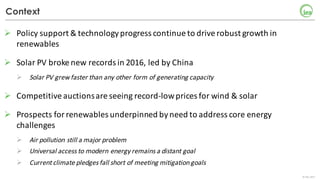
Ø Policy	support	&	technology	progress	continue	to	drive	robust	growth	in	
renewables
Ø Solar	PV	broke	new	records	in	2016,	led	by	China
Ø Solar	PV	grew	faster	than	any	other	form	of	generating	capacity	
Ø Competitive	auctions	are	seeing	record-low	prices	for	wind	&	solar
Ø Prospects	for	renewables	underpinned	by	need	to	address	core	energy	
challenges	
Ø Air	pollution	still	a	major	problem
Ø Universal	access	to	modern	energy	remains	a	distant	goal
Ø Current	climate	pledges	fall	short	of	meeting	mitigation	goals
©	IEA	2017
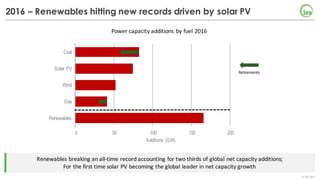
2016 – Renewables hitting new records driven by solar PV
Renewables	breaking	an	all-time	record	accounting	for	two	thirds	of	global	net	capacity	additions;	
For	the	first	time	solar	PV	becoming	the	global	leader	in	net	capacity	growth
Power	capacity	additions	by	fuel	2016
0 50 100 150 200
Renewables
Gas
Wind
Solar PV
Coal
Additions (GW)
Retirements
©	IEA	2017
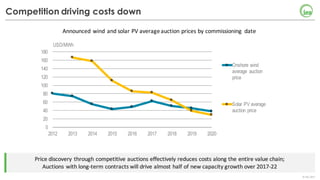
Price	discovery	through	competitive	auctions	effectively	reduces	costs	along	the	entire	value	chain;
Auctions	with	long-term	contracts	will	drive	almost	half	of	new	capacity	growth	over	2017-22
Announced	wind	and	solar	PV	average	auction	prices	by	commissioning	 date
Competition driving costs down
0
20
40
60
80
100
120
140
160
180
2012 2013 2014 2015 2016 2017 2018 2019 2020
USD/MWh
Onshore wind
average auction
price
Solar PV average
auction price
©	IEA	2017
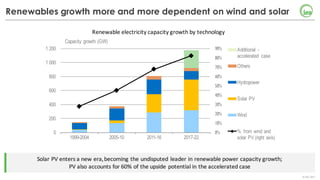
Renewables growth more and more dependent on wind and solar
Solar	PV	enters	a	new	era,	becoming	the	undisputed	leader	in	renewable	power	capacity	growth;
PV	also	accounts	for	60%	of	the	upside	potential	in	the	accelerated	case
Renewable	electricity	capacity	growth	by	technology
0%
10%
20%
30%
40%
50%
60%
70%
80%
90%
0
200
400
600
800
1 000
1 200
1999-2004 2005-10 2011-16 2017-22
Capacity growth (GW)
Additional -
accelerated case
Others
Hydropower
Solar PV
Wind
% from wind and
solar PV (right axis)
©	IEA	2017
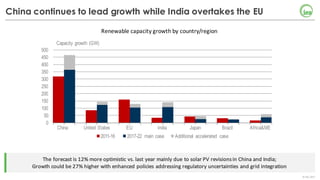
China continues to lead growth while India overtakes the EU
The	forecast	is	12%	more	optimistic	vs.	last	year	mainly	due	to	solar	PV	revisions	in	China	and	India;	
Growth	could	be	27%	higher	with	enhanced	policies	addressing	regulatory	uncertainties	and	grid	integration
Renewable	capacity	growth	by	country/region
0
50
100
150
200
250
300
350
400
450
500
China United States EU India Japan Brazil Africa&ME
Capacity growth (GW)
2011-16 2017-22 main case Additional accelerated case
©	IEA	2017
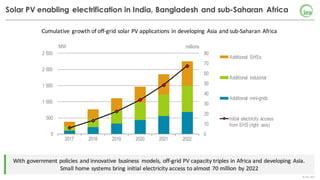
Solar PV enabling electrification in India, Bangladesh and sub-Saharan Africa
With	government	policies	and	innovative	business	 models,	off-grid	PV	capacity	triples	in	Africa	and	developing	Asia.	
Small	home	systems	bring	initial	electricity	access	to	almost	70	million	by	2022
Cumulative	growth	of	off-grid	solar	PV	applications	in	developing	Asia	and	sub-Saharan	Africa
0
10
20
30
40
50
60
70
80
0
500
1 000
1 500
2 000
2 500
2017 2018 2019 2020 2021 2022
millionsMW
Additional SHSs
Additional industrial
Additional mini-grids
Initial electricity access
from SHS (right axis)
©	IEA	2017
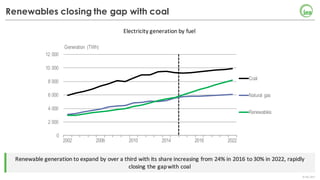
Renewables closing the gap with coal
Renewable	generation	to	expand	by	over	a	third	with	its	share	increasing	from	24%	in	2016	to	30%	in	2022,	rapidly	
closing	the	gap	with	coal
Electricity	generation	by	fuel
0
2 000
4 000
6 000
8 000
10 000
12 000
2002 2006 2010 2014 2018 2022
Generation (TWh)
Coal
Natural gas
Renewables
©	IEA	2017
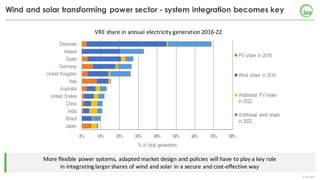
Wind and solar transforming power sector - system integration becomes key
More	flexible	power	systems,	adapted	market	design	and	policies	will	have	to	play	a	key	role	
in	integrating	larger	shares	of	wind	and	solar	in	a	secure	and	cost-effective	way
VRE	share	in	annual	electricity	generation	2016-22
0% 10% 20% 30% 40% 50% 60% 70% 80%
Japan
Brazil
India
China
United States
Australia
Italy
United Kingdom
Germany
Spain
Ireland
Denmark
% of total generation
PV share in 2016
Wind share in 2016
Additional PV share
in 2022
Additional wind share
in 2022
©	IEA	2017
Surging EVs to complement biofuels in renewable transport
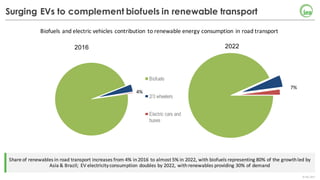
Share	of	renewables	in	road	transport	increases	from	4%	in	2016	to	almost	5%	in	2022,	with	biofuels	representing	80%	of	the	growth	led	by	
Asia	&	Brazil;		EV	electricity	consumption	doubles	by	2022,	with	renewables	providing	30%	of	demand
Biofuels
2/3 wheelers
Electric cars and
buses
2016 2022
4%
7%
Biofuels	and	electric	vehicles	contribution	to	renewable	energy	consumption	in	road	transport
©	IEA	2017
Progress in renewable heat depends on strong policies
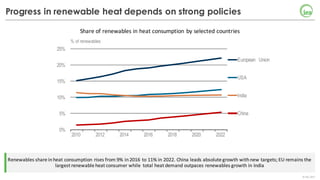
Renewables	share	in	heat	consumption	rises	from	9%	in	2016	to	11%	in	2022.	China	leads	absolute	growth	with	new	targets;	EU	remains	the	
largest	renewable	heat	consumer	while		total	heat	demand	outpaces	renewables	growth	in	India
Share	of	renewables	in	heat	consumption	by	selected	countries
0%
5%
10%
15%
20%
25%
2010 2012 2014 2016 2018 2020 2022
% of renewables
European Union
USA
India
China
©	IEA	2017
Concluding remarks
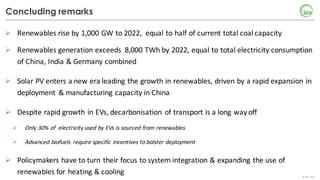
Ø Renewables	rise	by	1,000	GW	to	2022,		equal	to	half	of	current	total	coal	capacity
Ø Renewables	generation	exceeds		8,000	TWh by	2022,	equal	to	total	electricity	consumption	
of	China,	India	&	Germany	combined	
Ø Solar	PV	enters	a	new	era	leading	the	growth	in	renewables,	driven	by	a	rapid	expansion	in	
deployment	 &	manufacturing	capacity	in	China	
Ø Despite	rapid	growth	in	EVs,	decarbonisation	 of	transport	is	a	long	way	off	
Ø Only	30%	of		electricity	used	by	EVs	is	sourced	from	renewables	
Ø Advanced	biofuels	 require	specific	incentives	to	bolster	deployment	
Ø Policymakers	have	to	turn	their	focus	to	system	integration	&	expanding	the	use	of	
renewables	for	heating	&	cooling

Renewables 2017

  • 1.
  • 2.
    © IEA 2017 Context Ø Policy support & technology progress continue to drive robust growth in renewables Ø Solar PV broke new records in 2016, led by China ØSolar PV grew faster than any other form of generating capacity Ø Competitive auctions are seeing record-low prices for wind & solar Ø Prospects for renewables underpinned by need to address core energy challenges Ø Air pollution still a major problem Ø Universal access to modern energy remains a distant goal Ø Current climate pledges fall short of meeting mitigation goals
  • 3.
    © IEA 2017 2016 – Renewableshitting new records driven by solar PV Renewables breaking an all-time record accounting for two thirds of global net capacity additions; For the first time solar PV becoming the global leader in net capacity growth Power capacity additions by fuel 2016 0 50 100 150 200 Renewables Gas Wind Solar PV Coal Additions (GW) Retirements
  • 4.
  • 5.
    © IEA 2017 Renewables growth moreand more dependent on wind and solar Solar PV enters a new era, becoming the undisputed leader in renewable power capacity growth; PV also accounts for 60% of the upside potential in the accelerated case Renewable electricity capacity growth by technology 0% 10% 20% 30% 40% 50% 60% 70% 80% 90% 0 200 400 600 800 1 000 1 200 1999-2004 2005-10 2011-16 2017-22 Capacity growth (GW) Additional - accelerated case Others Hydropower Solar PV Wind % from wind and solar PV (right axis)
  • 6.
    © IEA 2017 China continues tolead growth while India overtakes the EU The forecast is 12% more optimistic vs. last year mainly due to solar PV revisions in China and India; Growth could be 27% higher with enhanced policies addressing regulatory uncertainties and grid integration Renewable capacity growth by country/region 0 50 100 150 200 250 300 350 400 450 500 China United States EU India Japan Brazil Africa&ME Capacity growth (GW) 2011-16 2017-22 main case Additional accelerated case
  • 7.
    © IEA 2017 Solar PV enablingelectrification in India, Bangladesh and sub-Saharan Africa With government policies and innovative business models, off-grid PV capacity triples in Africa and developing Asia. Small home systems bring initial electricity access to almost 70 million by 2022 Cumulative growth of off-grid solar PV applications in developing Asia and sub-Saharan Africa 0 10 20 30 40 50 60 70 80 0 500 1 000 1 500 2 000 2 500 2017 2018 2019 2020 2021 2022 millionsMW Additional SHSs Additional industrial Additional mini-grids Initial electricity access from SHS (right axis)
  • 8.
    © IEA 2017 Renewables closing thegap with coal Renewable generation to expand by over a third with its share increasing from 24% in 2016 to 30% in 2022, rapidly closing the gap with coal Electricity generation by fuel 0 2 000 4 000 6 000 8 000 10 000 12 000 2002 2006 2010 2014 2018 2022 Generation (TWh) Coal Natural gas Renewables
  • 9.
    © IEA 2017 Wind and solartransforming power sector - system integration becomes key More flexible power systems, adapted market design and policies will have to play a key role in integrating larger shares of wind and solar in a secure and cost-effective way VRE share in annual electricity generation 2016-22 0% 10% 20% 30% 40% 50% 60% 70% 80% Japan Brazil India China United States Australia Italy United Kingdom Germany Spain Ireland Denmark % of total generation PV share in 2016 Wind share in 2016 Additional PV share in 2022 Additional wind share in 2022
  • 10.
    © IEA 2017 Surging EVs tocomplement biofuels in renewable transport Share of renewables in road transport increases from 4% in 2016 to almost 5% in 2022, with biofuels representing 80% of the growth led by Asia & Brazil; EV electricity consumption doubles by 2022, with renewables providing 30% of demand Biofuels 2/3 wheelers Electric cars and buses 2016 2022 4% 7% Biofuels and electric vehicles contribution to renewable energy consumption in road transport
  • 11.
    © IEA 2017 Progress in renewableheat depends on strong policies Renewables share in heat consumption rises from 9% in 2016 to 11% in 2022. China leads absolute growth with new targets; EU remains the largest renewable heat consumer while total heat demand outpaces renewables growth in India Share of renewables in heat consumption by selected countries 0% 5% 10% 15% 20% 25% 2010 2012 2014 2016 2018 2020 2022 % of renewables European Union USA India China
  • 12.
    © IEA 2017 Concluding remarks Ø Renewables rise by 1,000 GW to 2022, equal to half of current total coal capacity ØRenewables generation exceeds 8,000 TWh by 2022, equal to total electricity consumption of China, India & Germany combined Ø Solar PV enters a new era leading the growth in renewables, driven by a rapid expansion in deployment & manufacturing capacity in China Ø Despite rapid growth in EVs, decarbonisation of transport is a long way off Ø Only 30% of electricity used by EVs is sourced from renewables Ø Advanced biofuels require specific incentives to bolster deployment Ø Policymakers have to turn their focus to system integration & expanding the use of renewables for heating & cooling