© OECD/IEA 2017
China Energy Outlook 2017
18 December 2017
© OECD/IEA 2017
Context
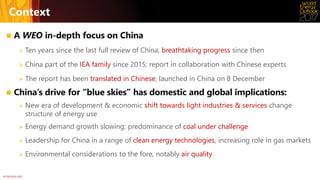
 A WEO in-depth focus on China
 Ten years since the last full review of China, breathtaking progress since then
 China part of the IEA family since 2015; report in collaboration with Chinese experts
 The report has been translated in Chinese; launched in China on 8 December
 China’s drive for “blue skies” has domestic and global implications:
 New era of development & economic shift towards light industries & services change
structure of energy use
 Energy demand growth slowing; predominance of coal under challenge
 Leadership for China in a range of clean energy technologies, increasing role in gas markets
 Environmental considerations to the fore, notably air quality
© OECD/IEA 2017
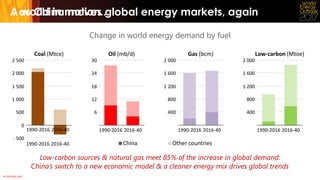
.. as China moves global energy markets, again
Change in world energy demand by fuel
Low-carbon sources & natural gas meet 85% of the increase in global demand:
Coal (Mtce)
0
500
1 000
1 500
2 000
2 500
- 500
1990-2016 2016-40
Oil (mb/d)
6
12
18
24
30
1990-2016 2016-40
Gas (bcm)
400
800
1 200
1 600
2 000
1990-2016 2016-40
Low-carbon (Mtoe)
400
800
1 200
1 600
2 000
1990-2016 2016-401990-2016 2016-40
A world in motion..
China’s switch to a new economic model & a cleaner energy mix drives global trends
Other countriesChina
© OECD/IEA 2017
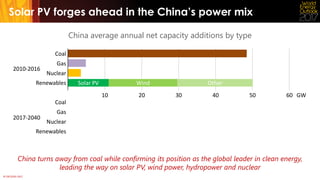
Solar PV forges ahead in the China’s power mix
China average annual net capacity additions by type
China turns away from coal while confirming its position as the global leader in clean energy,
leading the way on solar PV, wind power, hydropower and nuclear
Renewables
Nuclear
Gas
Coal
Renewables
Nuclear
Gas
Coal
10 20 30 40 50 60 GW
2010-2016
2017-2040
Solar PV Wind
Solar PV Wind Other
Other
10 20 30 40 50 60 GW
© OECD/IEA 2017
The future is electrifying
Electricity generation by selected region
India adds the equivalent of today’s European Union to its electricity generation by 2040,
Middle East
2 000 4 000 6 000 8 000 10 000
Africa
Southeast Asia
European Union
India
United States
China
TWh
2016 Growth to 2040
Sources of global
electricity demand growth
Industrial
motors
Cooling
Large
appliances
Connected
& small
appliances
Electric vehicles
Other
while China adds the equivalent of today’s United States
© OECD/IEA 2017
300
600
900
1 200
1 500
Industry
Mtoe
Transport Buildings
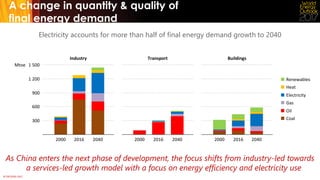
A change in quantity & quality of
final energy demand
Electricity accounts for more than half of final energy demand growth to 2040
As China enters the next phase of development, the focus shifts from industry-led towards
a services-led growth model with a focus on energy efficiency and electricity use
Renewables
Heat
Electricity
Gas
Oil
Coal
2000 2016 20402000 2016 20402000 2016 2040
© OECD/IEA 2017
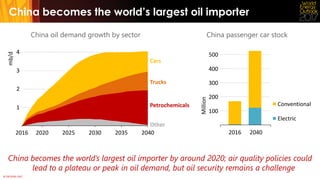
China becomes the world’s largest oil importer
China oil demand growth by sector
China becomes the world’s largest oil importer by around 2020; air quality policies could
lead to a plateau or peak in oil demand, but oil security remains a challenge
China passenger car stock
Electric
Conventional
1
2
3
4
mb/d
Cars
Trucks
Petrochemicals
Other
300
400
500
100
200
Million
2016 20402020 2025 2030 2035 20402016
© OECD/IEA 2017
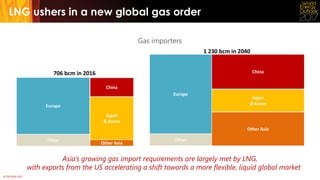
706 bcm in 2016
Global gas trade
Asia’s growing gas import requirements are largely met by LNG,
with exports from the US accelerating a shift towards a more flexible, liquid global market
LNG ushers in a new global gas order
Gas exportersGas importers
39% shipped by LNG
1 230 bcm in 2040
59% shipped by LNG
Australia
Russia
& Caspian
Middle
East
Other
Africa
US &
Canada
Australia
Russia
& Caspian
Middle
East Other
AfricaUS
& Canada
Other Other
Other Asia
China
Japan
& Korea
Japan
& Korea
China
Other Asia
Europe
Europe
© OECD/IEA 2017
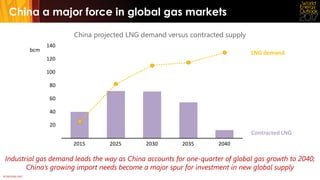
China a major force in global gas markets
China projected LNG demand versus contracted supply
Industrial gas demand leads the way as China accounts for one-quarter of global gas growth to 2040;
China’s growing import needs become a major spur for investment in new global supply
20
40
60
80
100
120
140
2015 2025 2030 2035 2040
Contracted LNG
LNG demandbcm
© OECD/IEA 2017
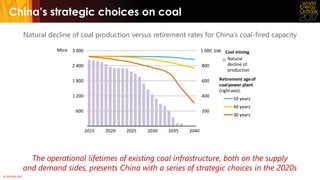
China’s strategic choices on coal
Natural decline of coal production versus retirement rates for China’s coal-fired capacity
The operational lifetimes of existing coal infrastructure, both on the supply
and demand sides, presents China with a series of strategic choices in the 2020s
200
400
600
800
1 000
600
1 200
1 800
2 400
3 000
2015 2020 2025 2030 2035 2040
50 years
40 years
30 years
Retirement ageof
coalpower plant
(rightaxis):
Natural
decline of
production
Coal mining:Mtce GW
© OECD/IEA 2017
10% 20% 30% 40% 50%
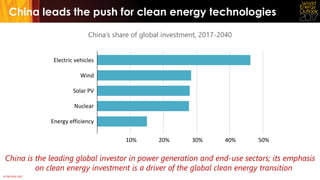
China leads the push for clean energy technologies
China’s share of global investment, 2017-2040
China is the leading global investor in power generation and end-use sectors; its emphasis
on clean energy investment is a driver of the global clean energy transition
Electric vehicles
Energy efficiency
Wind
Solar PV
Nuclear
© OECD/IEA 2017
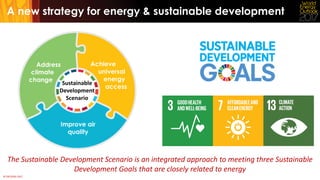
The Sustainable Development Scenario is an integrated approach to meeting three Sustainable
Development Goals that are closely related to energy
A new strategy for energy & sustainable development
Sustainable
Development
Scenario
© OECD/IEA 2017
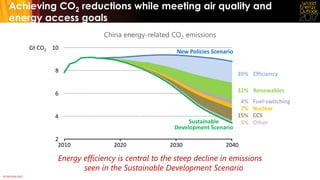
Achieving CO2 reductions while meeting air quality and
energy access goals
China energy-related CO2 emissions
2
4
6
8
10
2010 2020 2030 2040
Gt CO2
Efficiency39%
Renewables31%
Fuel-switching4%
Nuclear7%
CCS15%
Other5%
New Policies Scenario
Sustainable
Development Scenario
Energy efficiency is central to the steep decline in emissions
seen in the Sustainable Development Scenario
© OECD/IEA 2017
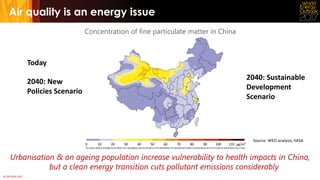
Air quality is an energy issue
Concentration of fine particulate matter in China
Urbanisation & an ageing population increase vulnerability to health impacts in China,
but a clean energy transition cuts pollutant emissions considerably
Today
2040: New
Policies Scenario
2040: Sustainable
Development
Scenario
Source: WEO analysis, IIASA
© OECD/IEA 2017
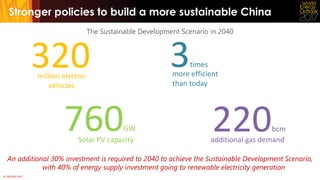
Stronger policies to build a more sustainable China
220bcm
additional gas demand
3times
more efficient
than today
760GW
Solar PV capacity
320million electric
vehicles
An additional 30% investment is required to 2040 to achieve the Sustainable Development Scenario,
with 40% of energy supply investment going to renewable electricity generation
The Sustainable Development Scenario in 2040
© OECD/IEA 2017
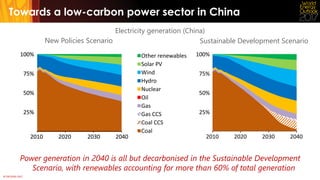
Electricity generation (China)
Towards a low-carbon power sector in China
New Policies Scenario
Power generation in 2040 is all but decarbonised in the Sustainable Development
Scenario, with renewables accounting for more than 60% of total generation
Sustainable Development Scenario
25%
50%
75%
2010 2020 2030 2040
100%
Coal
Coal CCS
Gas CCS
Gas
Oil
Nuclear
Hydro
Wind
Solar PV
Other renewables
25%
50%
75%
100%
2010 2020 2030 2040
25%
50%
75%
100%
2010 2020 2030 2040
© OECD/IEA 2017
Conclusions
 Structural shifts in the economy and the clean energy transition change quantity &
quality of energy demand growth; China moves global energy markets – once again
 China is set first to become the world‘s largest oil importer, and then the largest oil
consumer; future oil security hinges on supply- and demand-side policies
 Natural gas helps to replace coal in the energy mix and soon makes China the world’s
largest gas importer, with strong implications for global LNG markets
 China remains the world’s largest investor in clean energy; its success in delivering on a
clean energy transition is critical for its own as well as global environmental goals
 As China joined the IEA family in 2015 and partnership grows, the WEO-2017 China
Outlook sheds light on China’s energy challenges & opportunities in a global context
© OECD/IEA 2017
iea.org/weo
© OECD/IEA 2017
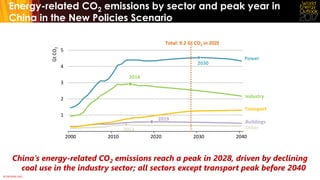
Energy-related CO2 emissions by sector and peak year in
China in the New Policies Scenario
2013
2014
2019
2030
1
2
3
4
5
2000 2010 2020 2030 2040
GtCO2
Industry
Transport
Buildings
Other
Power
Total: 9.2 Gt CO2 in 2028
China’s energy-related CO2 emissions reach a peak in 2028, driven by declining
coal use in the industry sector; all sectors except transport peak before 2040
© OECD/IEA 2017
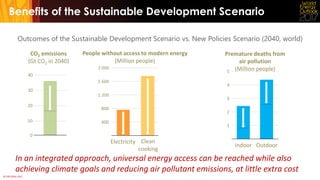
Outcomes of the Sustainable Development Scenario vs. New Policies Scenario (2040, world)
Electricity Clean
cooking
800
1 200
1 600
2 000
People without access to modern energy
(Million people)
400
Benefits of the Sustainable Development Scenario
20
30
40
CO2 emissions
(Gt CO2 in 2040)
10
1
2
3
4
5
Premature deaths from
air pollution
(Million people)
Indoor Outdoor
0
In an integrated approach, universal energy access can be reached while also
achieving climate goals and reducing air pollutant emissions, at little extra cost
© OECD/IEA 2017
200
400
600
800
200
400
600
800
200
400
600
800
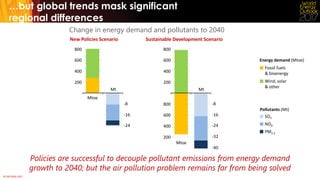
…but global trends mask significant
regional differences
Policies are successful to decouple pollutant emissions from energy demand
growth to 2040; but the air pollution problem remains far from being solved
Change in energy demand and pollutants to 2040
Mtoe
Mt
Mtoe
Sustainable Development ScenarioNew Policies Scenario
-24
-16
-8
Fossil fuels
& bioenergy
Wind, solar
& other
Energy demand (Mtoe)
SO2
NOX
Pollutants (Mt)
PM2.5
-40
-32
-24
-16
-8
Mt

China Energy Outlook 2017

  • 1.
    © OECD/IEA 2017 ChinaEnergy Outlook 2017 18 December 2017
  • 2.
    © OECD/IEA 2017 Context A WEO in-depth focus on China  Ten years since the last full review of China, breathtaking progress since then  China part of the IEA family since 2015; report in collaboration with Chinese experts  The report has been translated in Chinese; launched in China on 8 December  China’s drive for “blue skies” has domestic and global implications:  New era of development & economic shift towards light industries & services change structure of energy use  Energy demand growth slowing; predominance of coal under challenge  Leadership for China in a range of clean energy technologies, increasing role in gas markets  Environmental considerations to the fore, notably air quality
  • 3.
    © OECD/IEA 2017 ..as China moves global energy markets, again Change in world energy demand by fuel Low-carbon sources & natural gas meet 85% of the increase in global demand: Coal (Mtce) 0 500 1 000 1 500 2 000 2 500 - 500 1990-2016 2016-40 Oil (mb/d) 6 12 18 24 30 1990-2016 2016-40 Gas (bcm) 400 800 1 200 1 600 2 000 1990-2016 2016-40 Low-carbon (Mtoe) 400 800 1 200 1 600 2 000 1990-2016 2016-401990-2016 2016-40 A world in motion.. China’s switch to a new economic model & a cleaner energy mix drives global trends Other countriesChina
  • 4.
    © OECD/IEA 2017 SolarPV forges ahead in the China’s power mix China average annual net capacity additions by type China turns away from coal while confirming its position as the global leader in clean energy, leading the way on solar PV, wind power, hydropower and nuclear Renewables Nuclear Gas Coal Renewables Nuclear Gas Coal 10 20 30 40 50 60 GW 2010-2016 2017-2040 Solar PV Wind Solar PV Wind Other Other 10 20 30 40 50 60 GW
  • 5.
    © OECD/IEA 2017 Thefuture is electrifying Electricity generation by selected region India adds the equivalent of today’s European Union to its electricity generation by 2040, Middle East 2 000 4 000 6 000 8 000 10 000 Africa Southeast Asia European Union India United States China TWh 2016 Growth to 2040 Sources of global electricity demand growth Industrial motors Cooling Large appliances Connected & small appliances Electric vehicles Other while China adds the equivalent of today’s United States
  • 6.
    © OECD/IEA 2017 300 600 900 1200 1 500 Industry Mtoe Transport Buildings A change in quantity & quality of final energy demand Electricity accounts for more than half of final energy demand growth to 2040 As China enters the next phase of development, the focus shifts from industry-led towards a services-led growth model with a focus on energy efficiency and electricity use Renewables Heat Electricity Gas Oil Coal 2000 2016 20402000 2016 20402000 2016 2040
  • 7.
    © OECD/IEA 2017 Chinabecomes the world’s largest oil importer China oil demand growth by sector China becomes the world’s largest oil importer by around 2020; air quality policies could lead to a plateau or peak in oil demand, but oil security remains a challenge China passenger car stock Electric Conventional 1 2 3 4 mb/d Cars Trucks Petrochemicals Other 300 400 500 100 200 Million 2016 20402020 2025 2030 2035 20402016
  • 8.
    © OECD/IEA 2017 706bcm in 2016 Global gas trade Asia’s growing gas import requirements are largely met by LNG, with exports from the US accelerating a shift towards a more flexible, liquid global market LNG ushers in a new global gas order Gas exportersGas importers 39% shipped by LNG 1 230 bcm in 2040 59% shipped by LNG Australia Russia & Caspian Middle East Other Africa US & Canada Australia Russia & Caspian Middle East Other AfricaUS & Canada Other Other Other Asia China Japan & Korea Japan & Korea China Other Asia Europe Europe
  • 9.
    © OECD/IEA 2017 Chinaa major force in global gas markets China projected LNG demand versus contracted supply Industrial gas demand leads the way as China accounts for one-quarter of global gas growth to 2040; China’s growing import needs become a major spur for investment in new global supply 20 40 60 80 100 120 140 2015 2025 2030 2035 2040 Contracted LNG LNG demandbcm
  • 10.
    © OECD/IEA 2017 China’sstrategic choices on coal Natural decline of coal production versus retirement rates for China’s coal-fired capacity The operational lifetimes of existing coal infrastructure, both on the supply and demand sides, presents China with a series of strategic choices in the 2020s 200 400 600 800 1 000 600 1 200 1 800 2 400 3 000 2015 2020 2025 2030 2035 2040 50 years 40 years 30 years Retirement ageof coalpower plant (rightaxis): Natural decline of production Coal mining:Mtce GW
  • 11.
    © OECD/IEA 2017 10%20% 30% 40% 50% China leads the push for clean energy technologies China’s share of global investment, 2017-2040 China is the leading global investor in power generation and end-use sectors; its emphasis on clean energy investment is a driver of the global clean energy transition Electric vehicles Energy efficiency Wind Solar PV Nuclear
  • 12.
    © OECD/IEA 2017 TheSustainable Development Scenario is an integrated approach to meeting three Sustainable Development Goals that are closely related to energy A new strategy for energy & sustainable development Sustainable Development Scenario
  • 13.
    © OECD/IEA 2017 AchievingCO2 reductions while meeting air quality and energy access goals China energy-related CO2 emissions 2 4 6 8 10 2010 2020 2030 2040 Gt CO2 Efficiency39% Renewables31% Fuel-switching4% Nuclear7% CCS15% Other5% New Policies Scenario Sustainable Development Scenario Energy efficiency is central to the steep decline in emissions seen in the Sustainable Development Scenario
  • 14.
    © OECD/IEA 2017 Airquality is an energy issue Concentration of fine particulate matter in China Urbanisation & an ageing population increase vulnerability to health impacts in China, but a clean energy transition cuts pollutant emissions considerably Today 2040: New Policies Scenario 2040: Sustainable Development Scenario Source: WEO analysis, IIASA
  • 15.
    © OECD/IEA 2017 Strongerpolicies to build a more sustainable China 220bcm additional gas demand 3times more efficient than today 760GW Solar PV capacity 320million electric vehicles An additional 30% investment is required to 2040 to achieve the Sustainable Development Scenario, with 40% of energy supply investment going to renewable electricity generation The Sustainable Development Scenario in 2040
  • 16.
    © OECD/IEA 2017 Electricitygeneration (China) Towards a low-carbon power sector in China New Policies Scenario Power generation in 2040 is all but decarbonised in the Sustainable Development Scenario, with renewables accounting for more than 60% of total generation Sustainable Development Scenario 25% 50% 75% 2010 2020 2030 2040 100% Coal Coal CCS Gas CCS Gas Oil Nuclear Hydro Wind Solar PV Other renewables 25% 50% 75% 100% 2010 2020 2030 2040 25% 50% 75% 100% 2010 2020 2030 2040
  • 17.
    © OECD/IEA 2017 Conclusions Structural shifts in the economy and the clean energy transition change quantity & quality of energy demand growth; China moves global energy markets – once again  China is set first to become the world‘s largest oil importer, and then the largest oil consumer; future oil security hinges on supply- and demand-side policies  Natural gas helps to replace coal in the energy mix and soon makes China the world’s largest gas importer, with strong implications for global LNG markets  China remains the world’s largest investor in clean energy; its success in delivering on a clean energy transition is critical for its own as well as global environmental goals  As China joined the IEA family in 2015 and partnership grows, the WEO-2017 China Outlook sheds light on China’s energy challenges & opportunities in a global context
  • 18.
  • 19.
    © OECD/IEA 2017 Energy-relatedCO2 emissions by sector and peak year in China in the New Policies Scenario 2013 2014 2019 2030 1 2 3 4 5 2000 2010 2020 2030 2040 GtCO2 Industry Transport Buildings Other Power Total: 9.2 Gt CO2 in 2028 China’s energy-related CO2 emissions reach a peak in 2028, driven by declining coal use in the industry sector; all sectors except transport peak before 2040
  • 20.
    © OECD/IEA 2017 Outcomesof the Sustainable Development Scenario vs. New Policies Scenario (2040, world) Electricity Clean cooking 800 1 200 1 600 2 000 People without access to modern energy (Million people) 400 Benefits of the Sustainable Development Scenario 20 30 40 CO2 emissions (Gt CO2 in 2040) 10 1 2 3 4 5 Premature deaths from air pollution (Million people) Indoor Outdoor 0 In an integrated approach, universal energy access can be reached while also achieving climate goals and reducing air pollutant emissions, at little extra cost
  • 21.
    © OECD/IEA 2017 200 400 600 800 200 400 600 800 200 400 600 800 …butglobal trends mask significant regional differences Policies are successful to decouple pollutant emissions from energy demand growth to 2040; but the air pollution problem remains far from being solved Change in energy demand and pollutants to 2040 Mtoe Mt Mtoe Sustainable Development ScenarioNew Policies Scenario -24 -16 -8 Fossil fuels & bioenergy Wind, solar & other Energy demand (Mtoe) SO2 NOX Pollutants (Mt) PM2.5 -40 -32 -24 -16 -8 Mt