© OECD/IEA 2018
LNG: driving global gas growth &
improving flexibility
Dr. Fatih Birol
LNG Producer-Consumer Conference – Nagoya – 22 October 2018
IEA
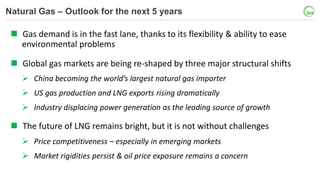
Natural Gas – Outlook for the next 5 years
 Gas demand is in the fast lane, thanks to its flexibility & ability to ease
environmental problems
 Global gas markets are being re-shaped by three major structural shifts
 China becoming the world’s largest natural gas importer
 US gas production and LNG exports rising dramatically
 Industry displacing power generation as the leading source of growth
 The future of LNG remains bright, but it is not without challenges
 Price competitiveness – especially in emerging markets
 Market rigidities persist & oil price exposure remains a concern
© OECD/IEA 2018
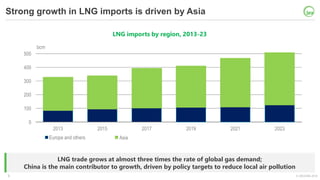
Strong growth in LNG imports is driven by Asia
LNG trade grows at almost three times the rate of global gas demand;
China is the main contributor to growth, driven by policy targets to reduce local air pollution
LNG imports by region, 2013-23
3
0
100
200
300
400
500
2013 2015 2017 2019 2021 2023
bcm
Europe and others Japan Korea Other Asia ChinaAsia
© OECD/IEA 2018
0
100
200
300
400
500
Other Qatar
Australia USA
Qatar, Australia and the United States reshape global LNG markets
LNG trade passes 500 bcm by 2023, growing by a third in five years
Qatar, Australia and the US will supply 60% of the world’s LNG by 2023
bcm
4
This map is without prejudice to the status of or sovereignty over any territory, to the delimitation of international frontiers and boundaries, and to the name of any territory, city or area.
Single player
Long-term
contracts
& spot
2011
2017
2023
Hub-indexed
Destination
flexibleSingle player
Long-term
contracts
& spot Multiple
players
Long-term
contracts
© OECD/IEA 2018
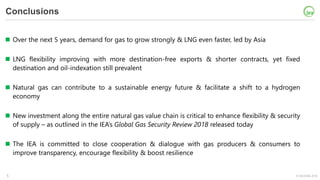
Conclusions
 Over the next 5 years, demand for gas to grow strongly & LNG even faster, led by Asia
 LNG flexibility improving with more destination-free exports & shorter contracts, yet fixed
destination and oil-indexation still prevalent
 Natural gas can contribute to a sustainable energy future & facilitate a shift to a hydrogen
economy
 New investment along the entire natural gas value chain is critical to enhance flexibility & security
of supply – as outlined in the IEA’s Global Gas Security Review 2018 released today
 The IEA is committed to close cooperation & dialogue with gas producers & consumers to
improve transparency, encourage flexibility & boost resilience
5
© OECD/IEA 2018
www.iea.org
IEA

LNG: Driving global gas growth & improving flexibility

  • 1.
    © OECD/IEA 2018 LNG:driving global gas growth & improving flexibility Dr. Fatih Birol LNG Producer-Consumer Conference – Nagoya – 22 October 2018 IEA
  • 2.
    Natural Gas –Outlook for the next 5 years  Gas demand is in the fast lane, thanks to its flexibility & ability to ease environmental problems  Global gas markets are being re-shaped by three major structural shifts  China becoming the world’s largest natural gas importer  US gas production and LNG exports rising dramatically  Industry displacing power generation as the leading source of growth  The future of LNG remains bright, but it is not without challenges  Price competitiveness – especially in emerging markets  Market rigidities persist & oil price exposure remains a concern
  • 3.
    © OECD/IEA 2018 Stronggrowth in LNG imports is driven by Asia LNG trade grows at almost three times the rate of global gas demand; China is the main contributor to growth, driven by policy targets to reduce local air pollution LNG imports by region, 2013-23 3 0 100 200 300 400 500 2013 2015 2017 2019 2021 2023 bcm Europe and others Japan Korea Other Asia ChinaAsia
  • 4.
    © OECD/IEA 2018 0 100 200 300 400 500 OtherQatar Australia USA Qatar, Australia and the United States reshape global LNG markets LNG trade passes 500 bcm by 2023, growing by a third in five years Qatar, Australia and the US will supply 60% of the world’s LNG by 2023 bcm 4 This map is without prejudice to the status of or sovereignty over any territory, to the delimitation of international frontiers and boundaries, and to the name of any territory, city or area. Single player Long-term contracts & spot 2011 2017 2023 Hub-indexed Destination flexibleSingle player Long-term contracts & spot Multiple players Long-term contracts
  • 5.
    © OECD/IEA 2018 Conclusions Over the next 5 years, demand for gas to grow strongly & LNG even faster, led by Asia  LNG flexibility improving with more destination-free exports & shorter contracts, yet fixed destination and oil-indexation still prevalent  Natural gas can contribute to a sustainable energy future & facilitate a shift to a hydrogen economy  New investment along the entire natural gas value chain is critical to enhance flexibility & security of supply – as outlined in the IEA’s Global Gas Security Review 2018 released today  The IEA is committed to close cooperation & dialogue with gas producers & consumers to improve transparency, encourage flexibility & boost resilience 5
  • 6.

Editor's Notes