

© OECD/IEA 2017
Outlook for fossil fuels
Webinar
Tim Gould
Tae-Yoon Kim
Christophe McGlade
Johannes Trüby
© OECD/IEA 2017
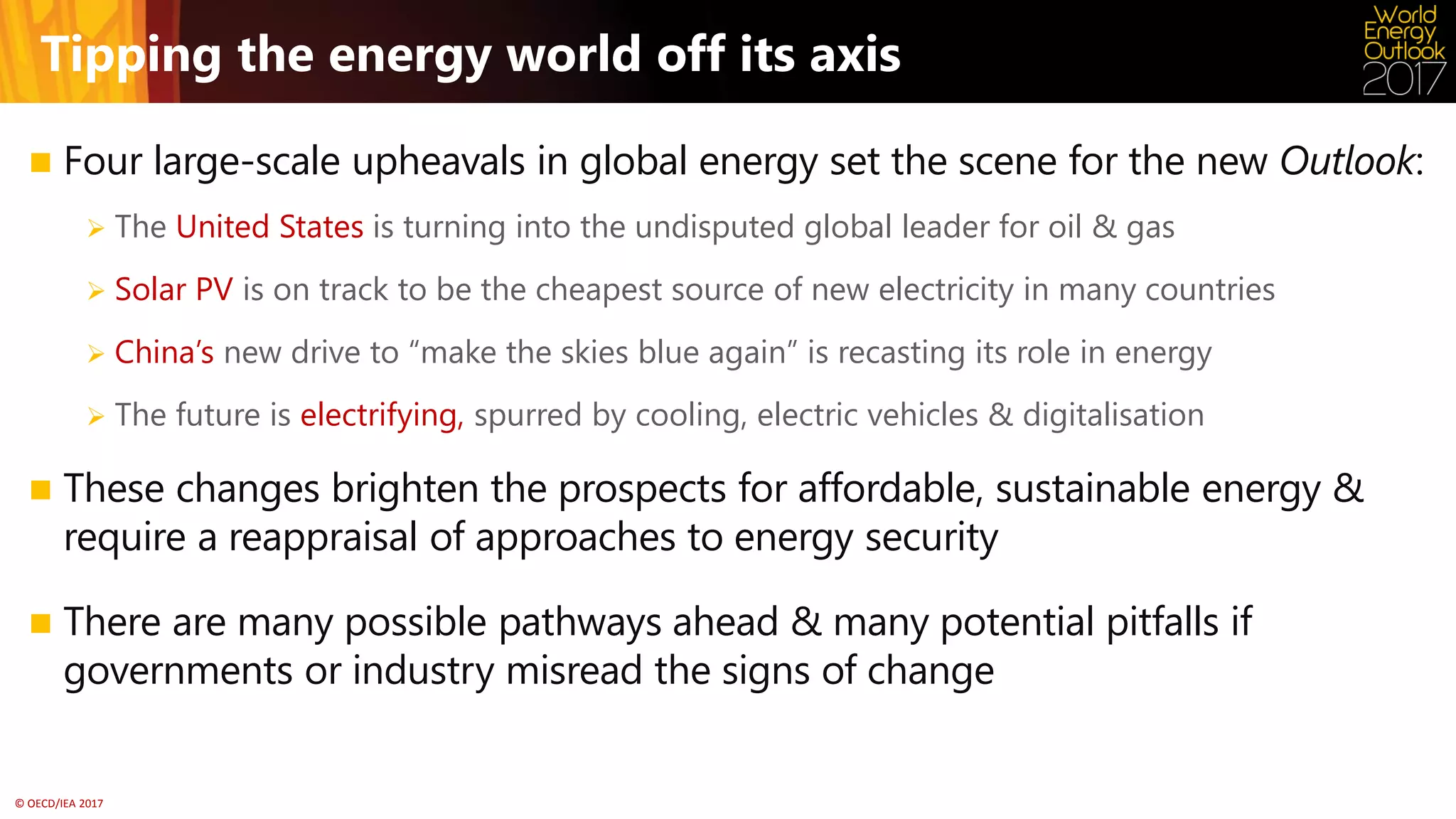
Tipping the energy world off its axis
 Four large-scale upheavals in global energy set the scene for the new Outlook:
 The United States is turning into the undisputed global leader for oil & gas
 Solar PV is on track to be the cheapest source of new electricity in many countries
 China’s new drive to “make the skies blue again” is recasting its role in energy
 The future is electrifying, spurred by cooling, electric vehicles & digitalisation
 These changes brighten the prospects for affordable, sustainable energy &
require a reappraisal of approaches to energy security
 There are many possible pathways ahead & many potential pitfalls if
governments or industry misread the signs of change
© OECD/IEA 2017
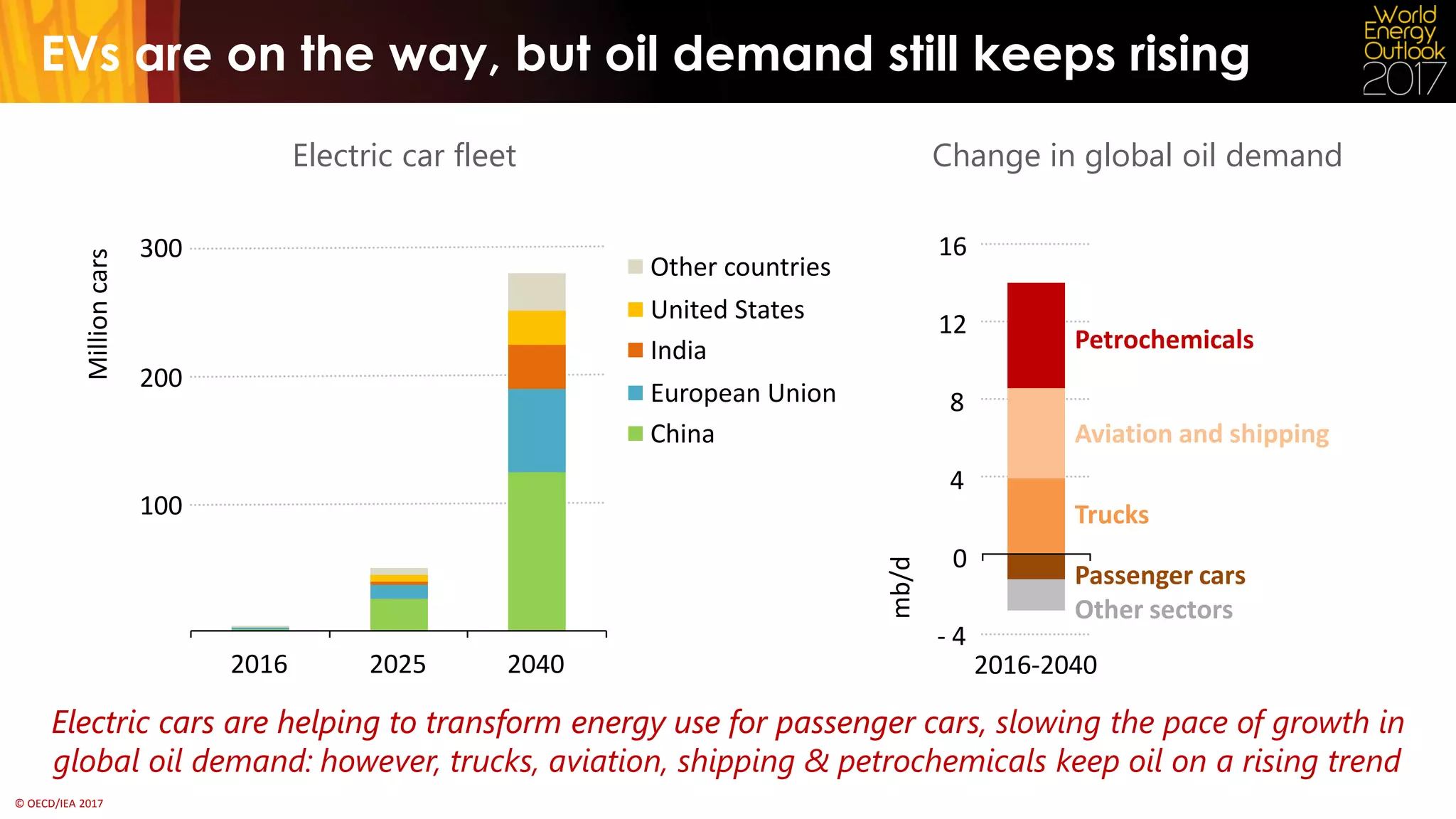
Electric cars are helping to transform energy use for passenger cars, slowing the pace of growth in
global oil demand: however, trucks, aviation, shipping & petrochemicals keep oil on a rising trend
Electric cars are helping to transform energy use for passenger cars, slowing the pace of growth in
global oil demand: however, trucks, aviation, shipping & petrochemicals keep oil on a rising trendhowever, trucks, aviation, shipping & petrochemicals keep oil on a rising trend
EVs are on the way, but oil demand still keeps rising
Electric car fleet
100
200
300
2016 2025 2040
Millioncars
Other countries
United States
India
European Union
China
Passenger cars
Other sectors
Change in global oil demand
4
8
12
16
Petrochemicals
Aviation and shipping
Trucks
mb/d
- 4
2016-2040
0
© OECD/IEA 2017
25
30
35
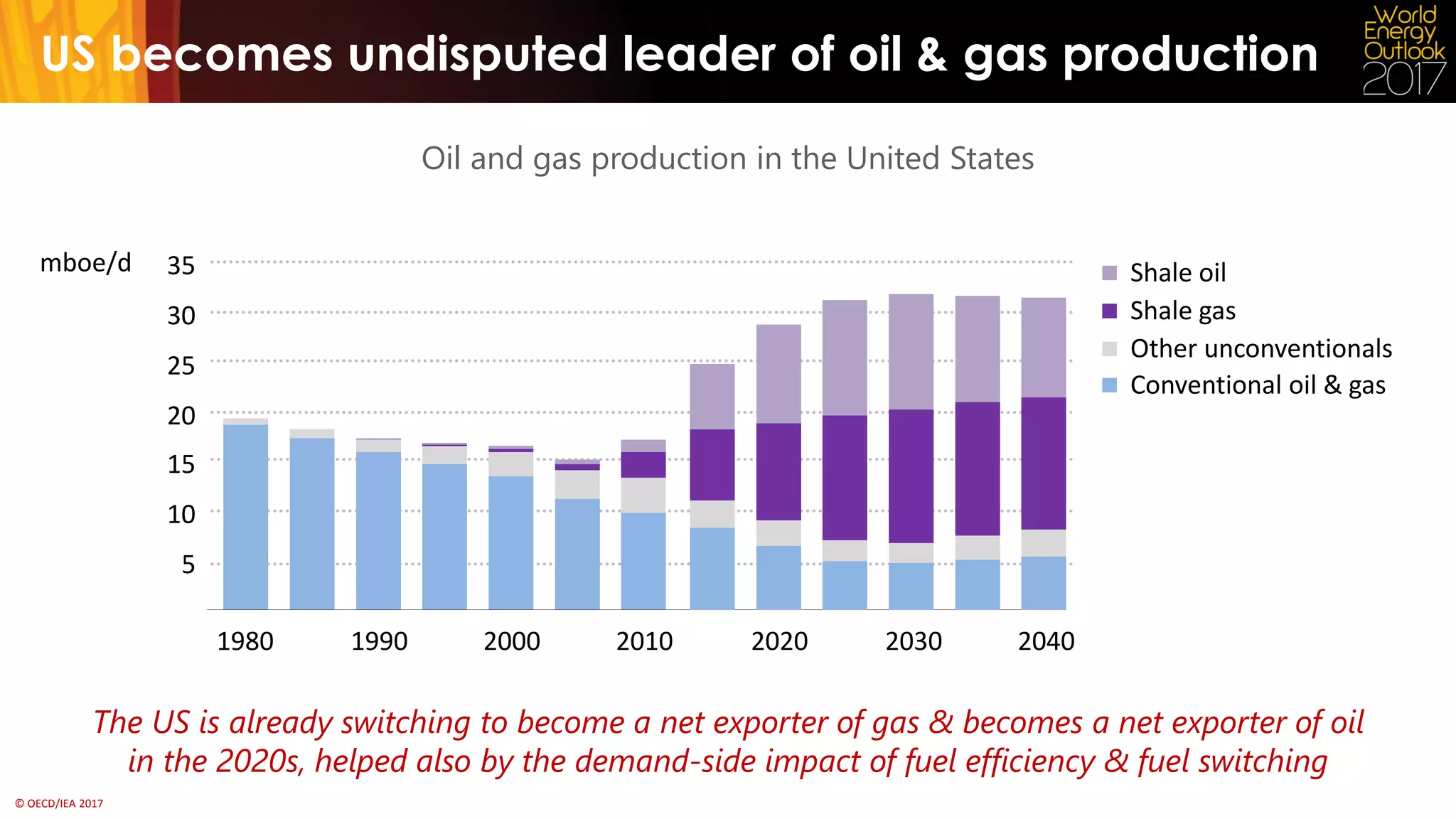
US becomes undisputed leader of oil & gas production
Oil and gas production in the United States
The US is already switching to become a net exporter of gas & becomes a net exporter of oil
in the 2020s, helped also by the demand-side impact of fuel efficiency & fuel switching
5
10
15
20
1980 1990 2000 2010 2020 2030 2040
mboe/d Shale oil
Shale gas
Other unconventionals
Conventional oil & gas
© OECD/IEA 2017
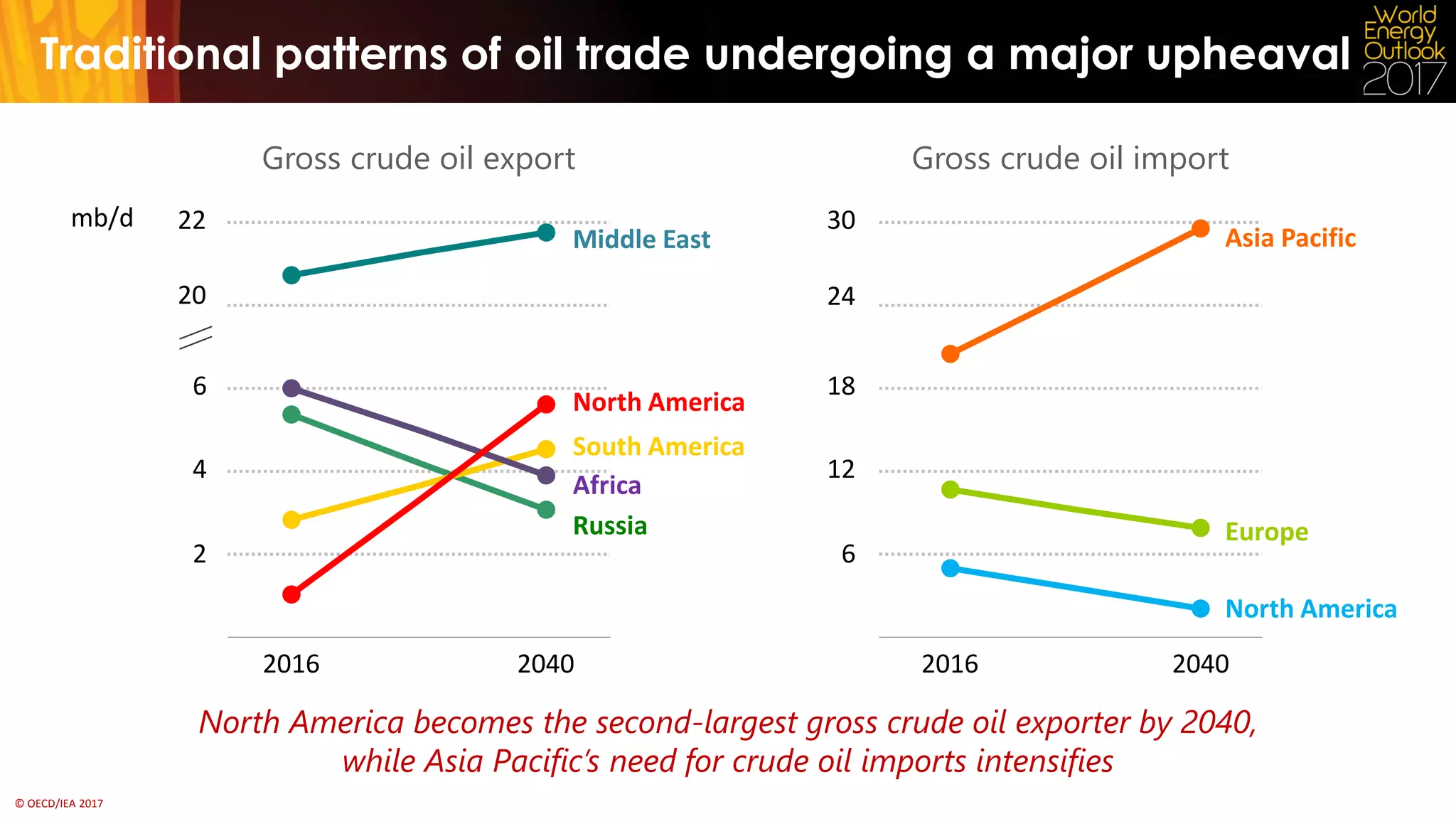
Traditional patterns of oil trade undergoing a major upheaval
Gross crude oil export
North America becomes the second-largest gross crude oil exporter by 2040,
while Asia Pacific’s need for crude oil imports intensifies
mb/d
2
4
6
2016 2040
Middle East
North America
South America
Africa
Russia
20
22
Gross crude oil import
6
12
18
24
30
2016 2040
Asia Pacific
Europe
North America
© OECD/IEA 2017
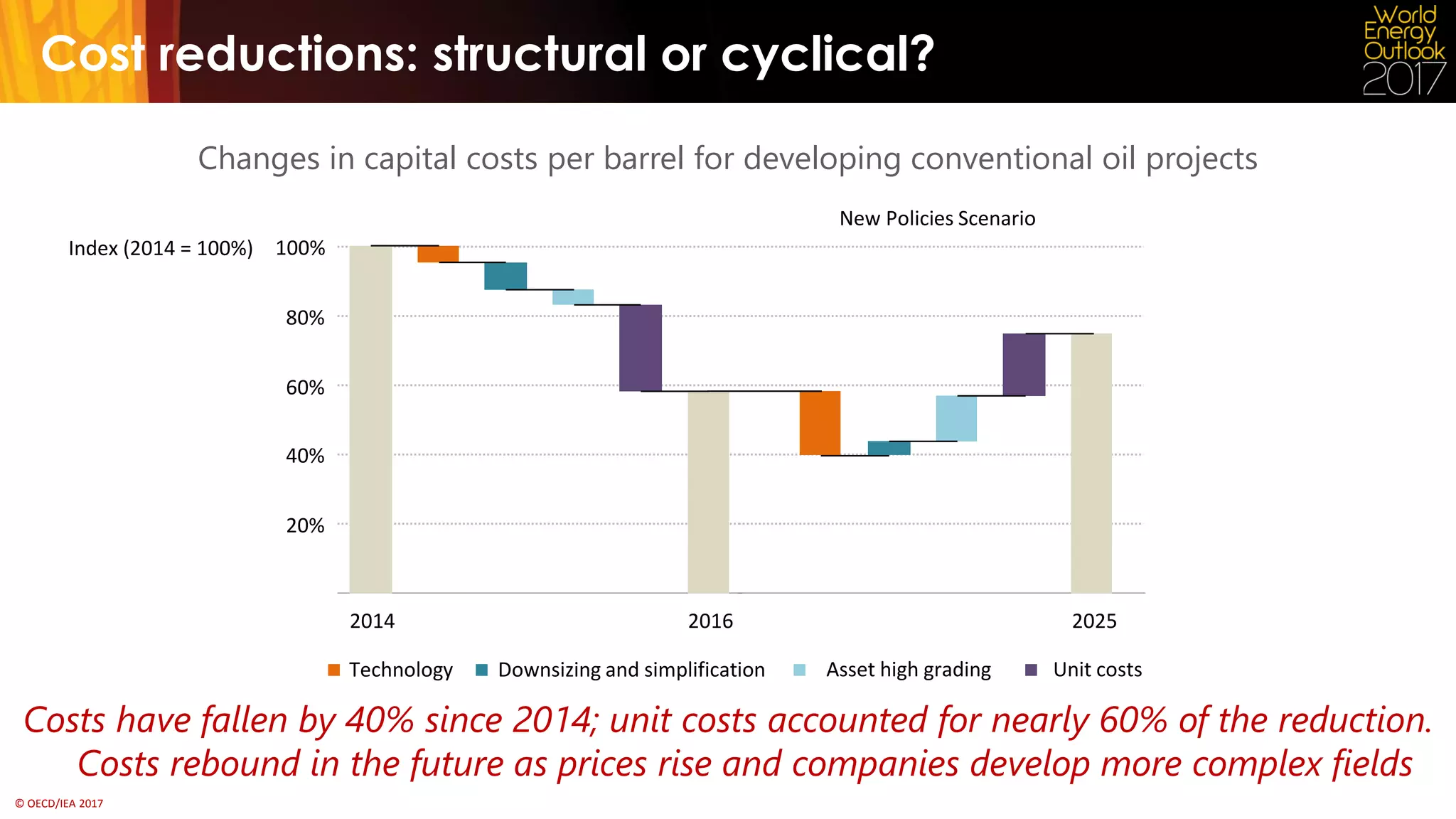
Cost reductions: structural or cyclical?
Changes in capital costs per barrel for developing conventional oil projects
Costs have fallen by 40% since 2014; unit costs accounted for nearly 60% of the reduction.
Costs rebound in the future as prices rise and companies develop more complex fields
20%
40%
60%
80%
100%
2014 2016
Index (2014 = 100%)
2025
Technology Downsizing and simplification Asset high grading Unit costs
New Policies Scenario
© OECD/IEA 2017
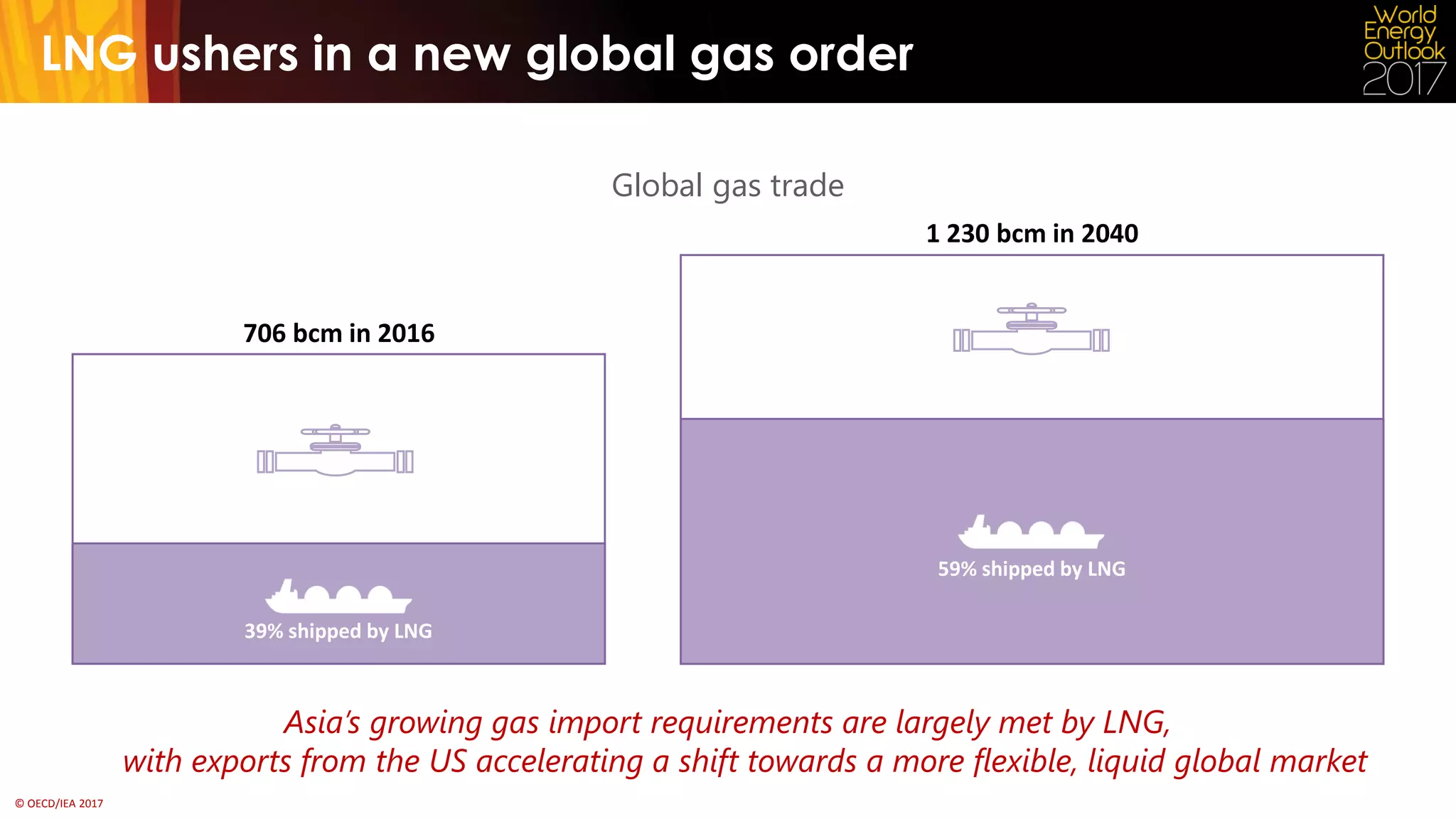
706 bcm in 2016
Global gas trade
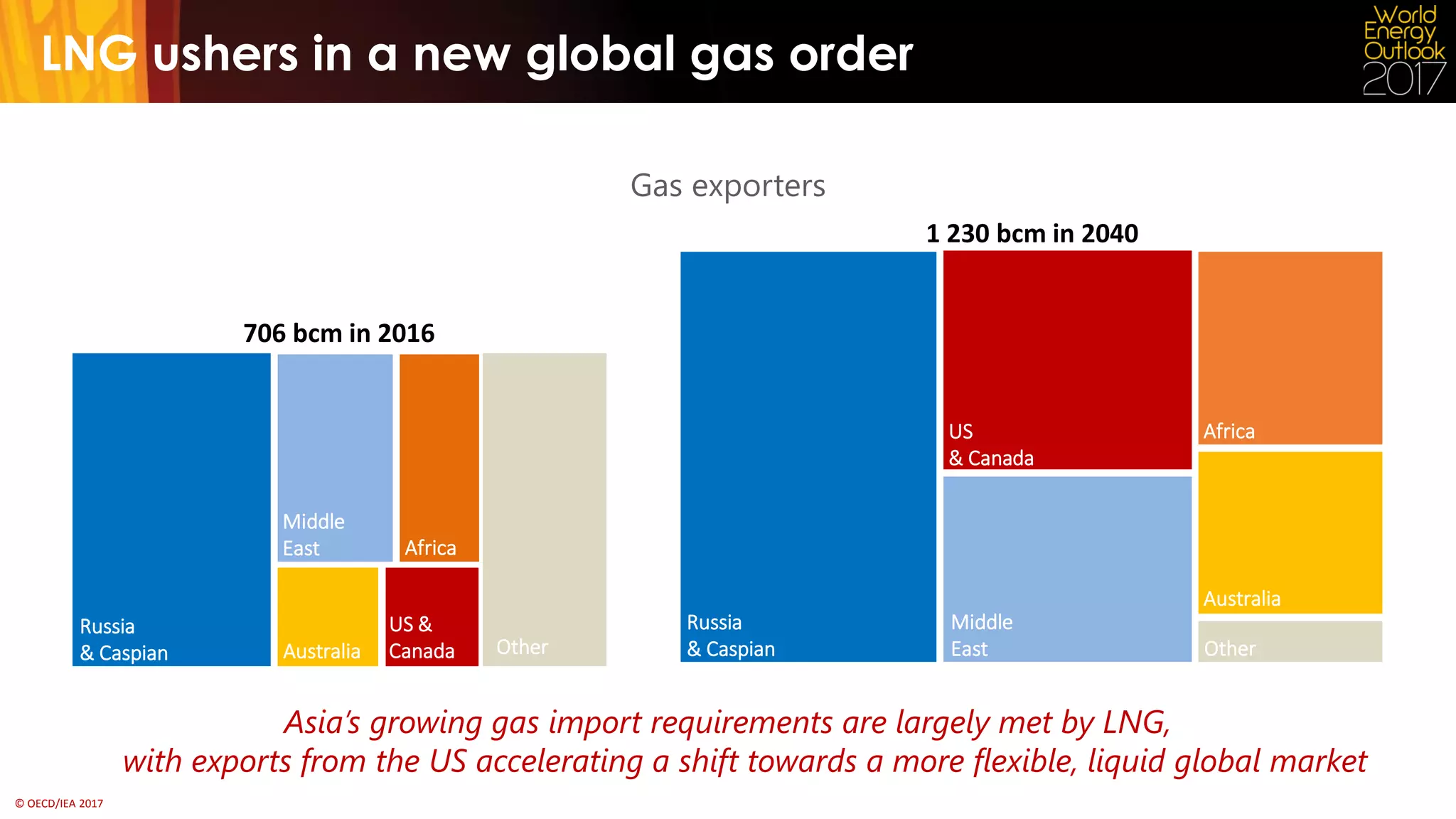
Asia’s growing gas import requirements are largely met by LNG,
with exports from the US accelerating a shift towards a more flexible, liquid global market
LNG ushers in a new global gas order
39% shipped by LNG
1 230 bcm in 2040
59% shipped by LNG
© OECD/IEA 2017
706 bcm in 2016
Global gas trade
Asia’s growing gas import requirements are largely met by LNG,
with exports from the US accelerating a shift towards a more flexible, liquid global market
LNG ushers in a new global gas order
Gas exporters
39% shipped by LNG
1 230 bcm in 2040
59% shipped by LNG
Australia
Russia
& Caspian
Middle
East
Other
Africa
US &
Canada
Australia
Russia
& Caspian
Middle
East Other
AfricaUS
& Canada
© OECD/IEA 2017
706 bcm in 2016
Global gas trade
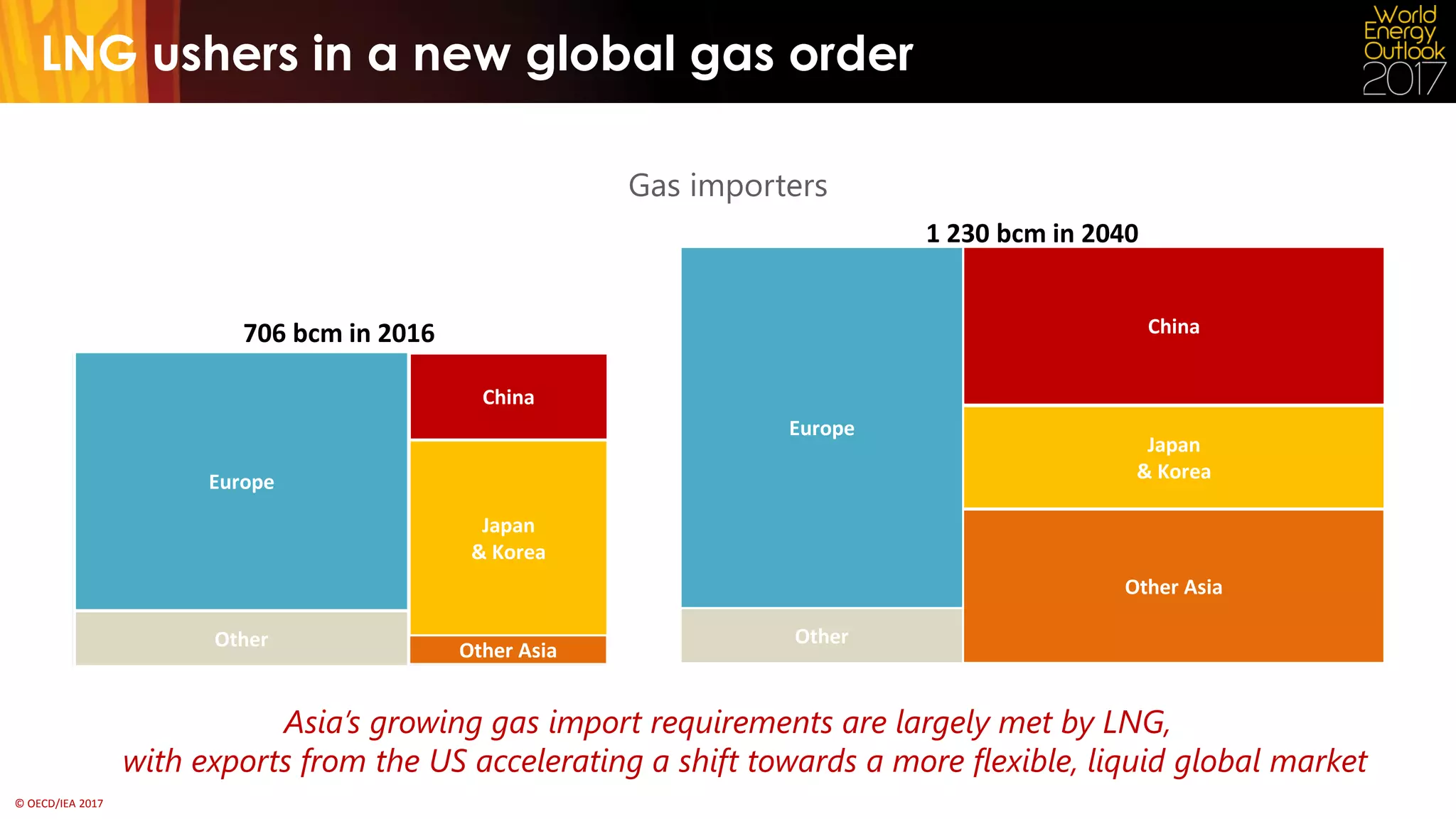
Asia’s growing gas import requirements are largely met by LNG,
with exports from the US accelerating a shift towards a more flexible, liquid global market
LNG ushers in a new global gas order
Gas exportersGas importers
39% shipped by LNG
1 230 bcm in 2040
59% shipped by LNG
Australia
Russia
& Caspian
Middle
East
Other
Africa
US &
Canada
Australia
Russia
& Caspian
Middle
East Other
AfricaUS
& Canada
Asia
37%
Europe
52%
Other
Asia
60%
Europe
35%
Other
Other Asia
China
Japan
& Korea
Japan
& Korea
China
Other Asia
Europe
Europe
© OECD/IEA 2017
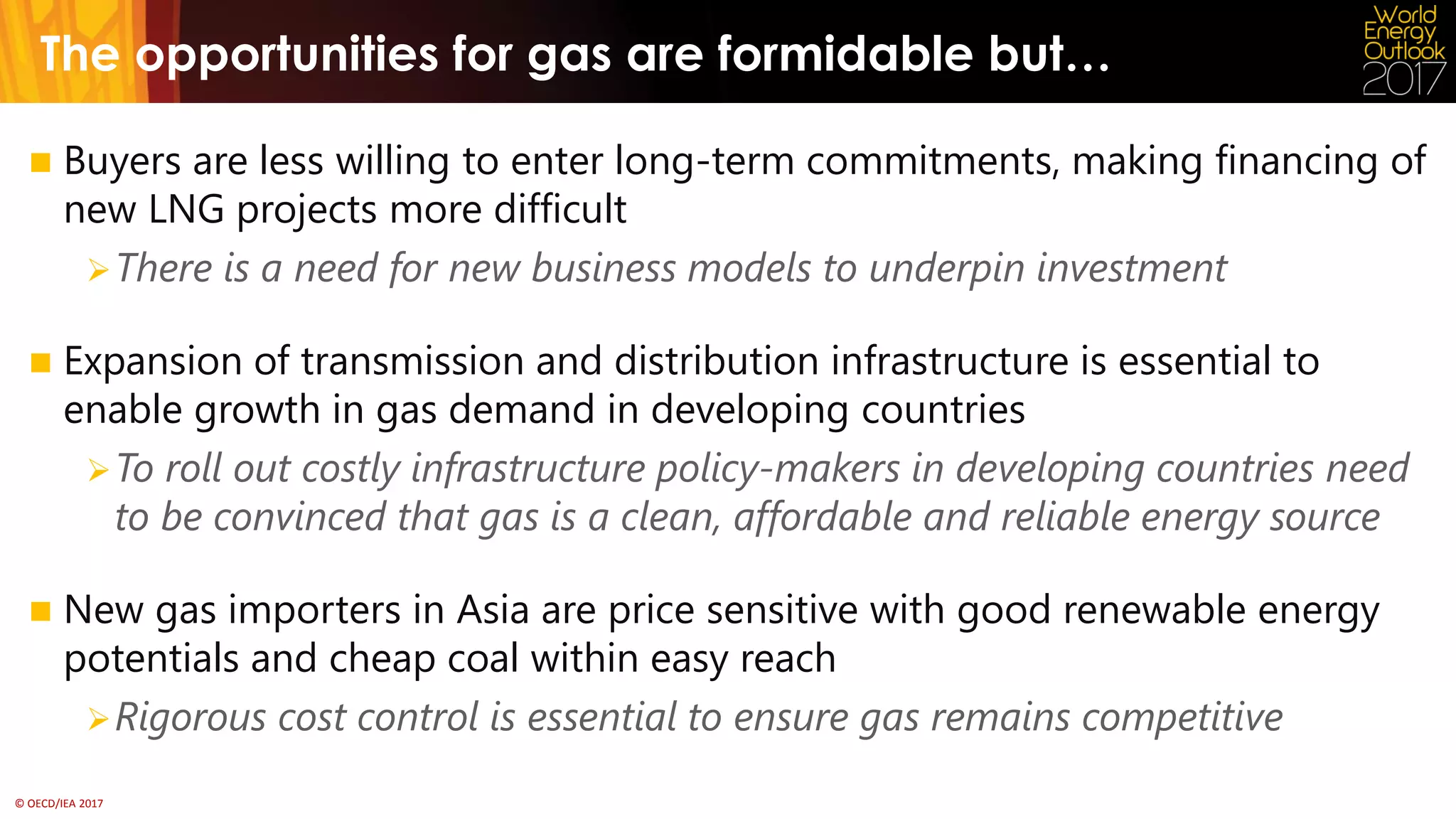
The opportunities for gas are formidable but…
 Buyers are less willing to enter long-term commitments, making financing of
new LNG projects more difficult
There is a need for new business models to underpin investment
 Expansion of transmission and distribution infrastructure is essential to
enable growth in gas demand in developing countries
To roll out costly infrastructure policy-makers in developing countries need
to be convinced that gas is a clean, affordable and reliable energy source
 New gas importers in Asia are price sensitive with good renewable energy
potentials and cheap coal within easy reach
Rigorous cost control is essential to ensure gas remains competitive
© OECD/IEA 2017
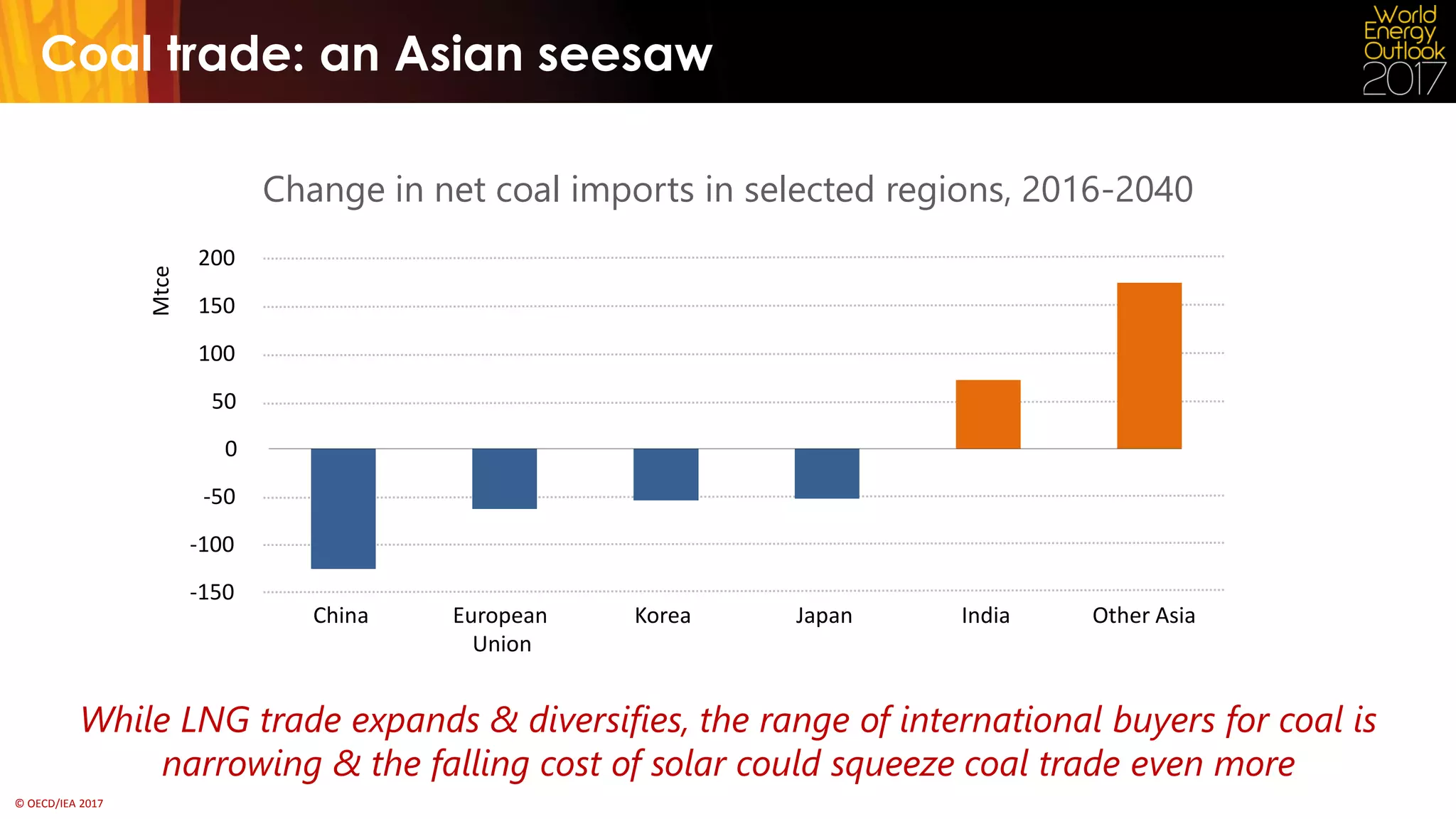
Coal trade: an Asian seesaw
Change in net coal imports in selected regions, 2016-2040
While LNG trade expands & diversifies, the range of international buyers for coal is
narrowing & the falling cost of solar could squeeze coal trade even more
-150
-100
-50
0
50
100
150
200
China European
Union
Korea Japan India Other Asia
Mtce
© OECD/IEA 2017
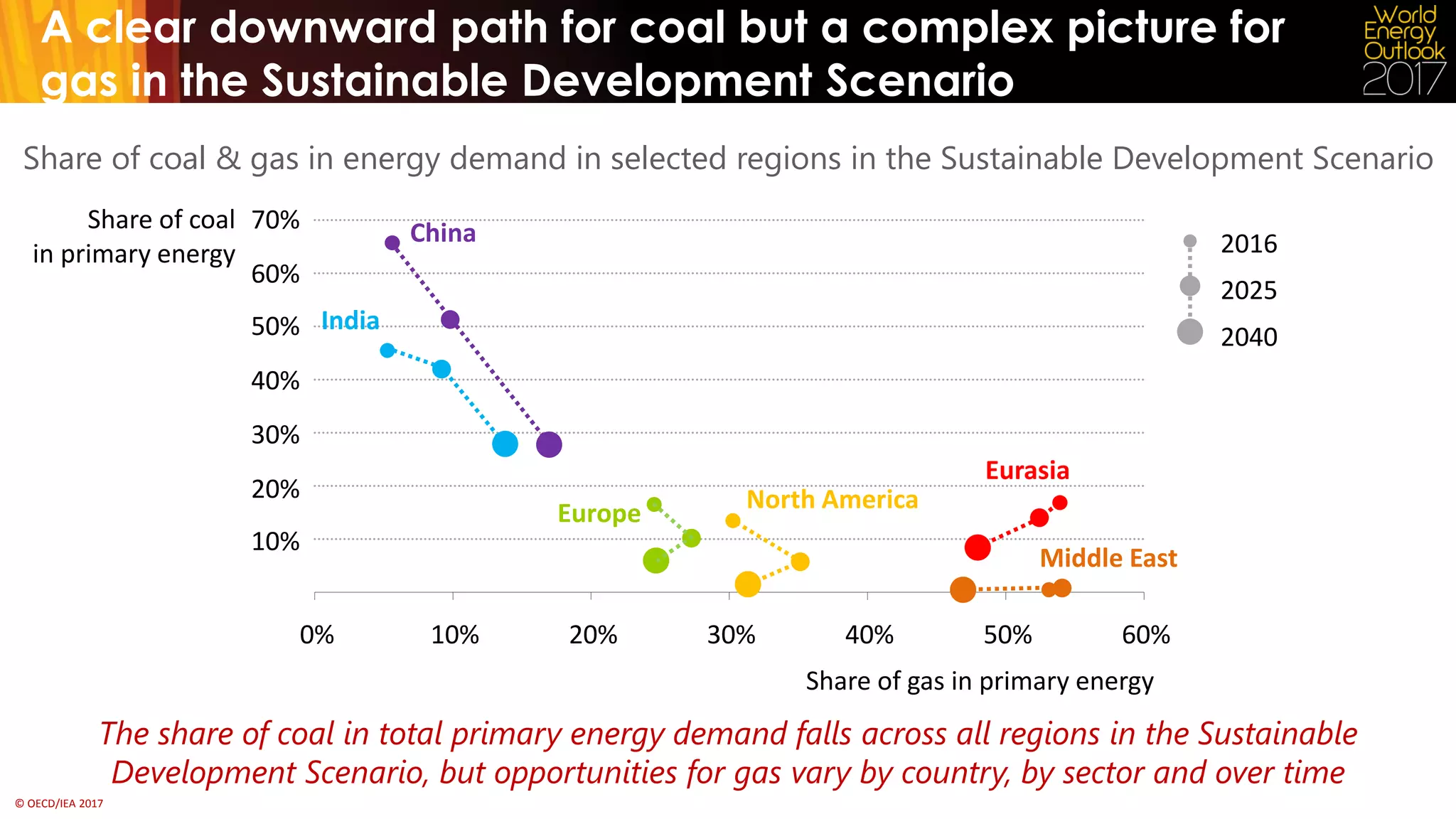
A clear downward path for coal but a complex picture for
gas in the Sustainable Development Scenario
Share of coal & gas in energy demand in selected regions in the Sustainable Development Scenario
The share of coal in total primary energy demand falls across all regions in the Sustainable
Development Scenario, but opportunities for gas vary by country, by sector and over time
10%
20%
30%
40%
50%
60%
70%
0% 10% 20% 30% 40% 50% 60%
Share of gas in primary energy
Share of coal
in primary energy
India
Europe North America
Eurasia
Middle East
China 2016
2025
2040
© OECD/IEA 2017
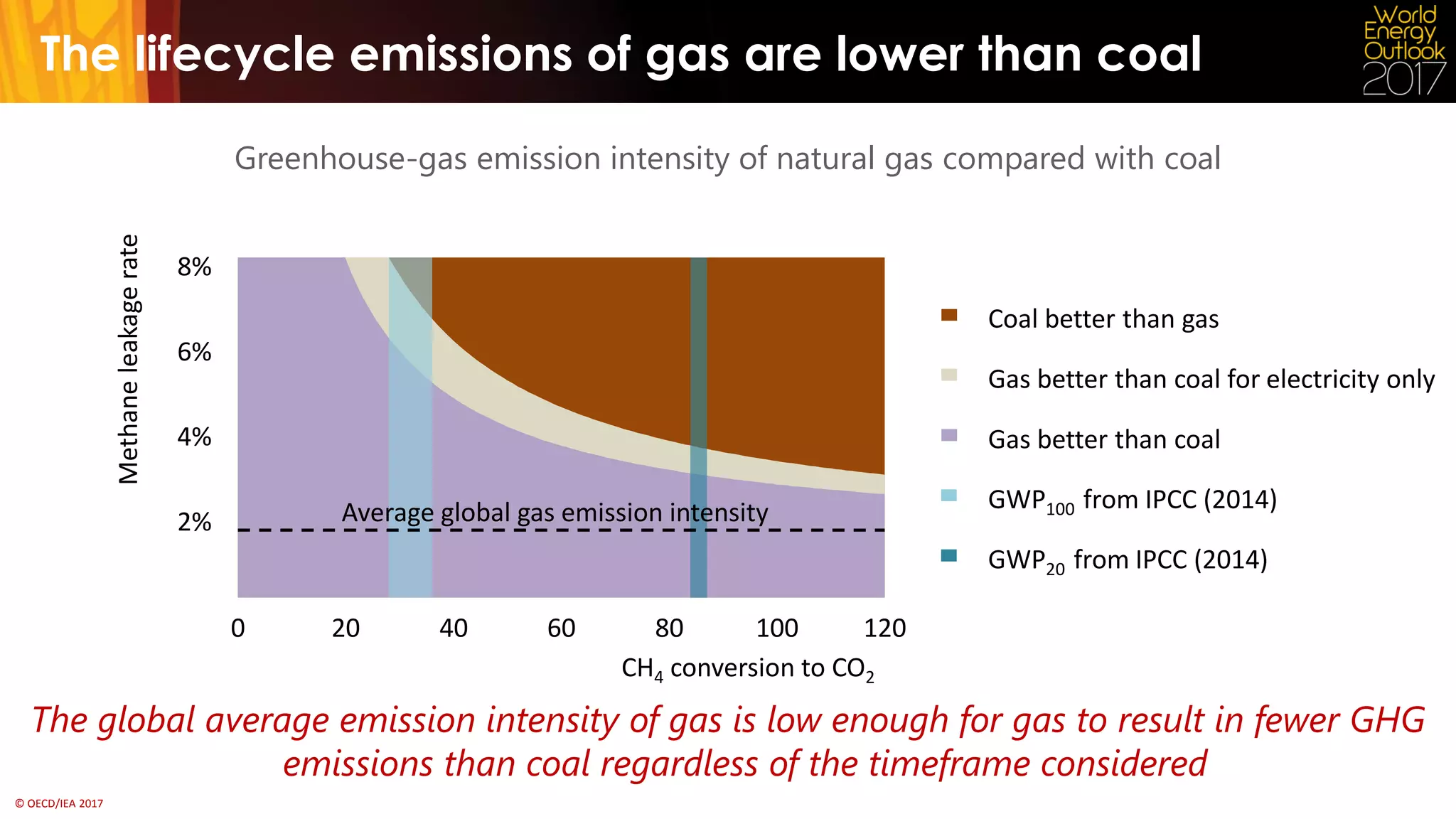
The lifecycle emissions of gas are lower than coal
Greenhouse-gas emission intensity of natural gas compared with coal
The global average emission intensity of gas is low enough for gas to result in fewer GHG
emissions than coal regardless of the timeframe considered
2%
4%
6%
8%
0 20 40 60 80 100 120
CH4 conversion to CO2
Coal better than gas
Gas better than coal for electricity only
Gas better than coal
GWP100 from IPCC (2014)
GWP20 from IPCC (2014)
Methaneleakagerate
Average global gas emission intensity
© OECD/IEA 2017
iea.org/weo

Webinar: Outlook for Fossil Fuels

  • 1.
    © OECD/IEA 2017 Outlookfor fossil fuels Webinar Tim Gould Tae-Yoon Kim Christophe McGlade Johannes Trüby
  • 2.
    © OECD/IEA 2017 Tippingthe energy world off its axis  Four large-scale upheavals in global energy set the scene for the new Outlook:  The United States is turning into the undisputed global leader for oil & gas  Solar PV is on track to be the cheapest source of new electricity in many countries  China’s new drive to “make the skies blue again” is recasting its role in energy  The future is electrifying, spurred by cooling, electric vehicles & digitalisation  These changes brighten the prospects for affordable, sustainable energy & require a reappraisal of approaches to energy security  There are many possible pathways ahead & many potential pitfalls if governments or industry misread the signs of change
  • 3.
    © OECD/IEA 2017 Electriccars are helping to transform energy use for passenger cars, slowing the pace of growth in global oil demand: however, trucks, aviation, shipping & petrochemicals keep oil on a rising trend Electric cars are helping to transform energy use for passenger cars, slowing the pace of growth in global oil demand: however, trucks, aviation, shipping & petrochemicals keep oil on a rising trendhowever, trucks, aviation, shipping & petrochemicals keep oil on a rising trend EVs are on the way, but oil demand still keeps rising Electric car fleet 100 200 300 2016 2025 2040 Millioncars Other countries United States India European Union China Passenger cars Other sectors Change in global oil demand 4 8 12 16 Petrochemicals Aviation and shipping Trucks mb/d - 4 2016-2040 0
  • 4.
    © OECD/IEA 2017 25 30 35 USbecomes undisputed leader of oil & gas production Oil and gas production in the United States The US is already switching to become a net exporter of gas & becomes a net exporter of oil in the 2020s, helped also by the demand-side impact of fuel efficiency & fuel switching 5 10 15 20 1980 1990 2000 2010 2020 2030 2040 mboe/d Shale oil Shale gas Other unconventionals Conventional oil & gas
  • 5.
    © OECD/IEA 2017 Traditionalpatterns of oil trade undergoing a major upheaval Gross crude oil export North America becomes the second-largest gross crude oil exporter by 2040, while Asia Pacific’s need for crude oil imports intensifies mb/d 2 4 6 2016 2040 Middle East North America South America Africa Russia 20 22 Gross crude oil import 6 12 18 24 30 2016 2040 Asia Pacific Europe North America
  • 6.
    © OECD/IEA 2017 Costreductions: structural or cyclical? Changes in capital costs per barrel for developing conventional oil projects Costs have fallen by 40% since 2014; unit costs accounted for nearly 60% of the reduction. Costs rebound in the future as prices rise and companies develop more complex fields 20% 40% 60% 80% 100% 2014 2016 Index (2014 = 100%) 2025 Technology Downsizing and simplification Asset high grading Unit costs New Policies Scenario
  • 7.
    © OECD/IEA 2017 706bcm in 2016 Global gas trade Asia’s growing gas import requirements are largely met by LNG, with exports from the US accelerating a shift towards a more flexible, liquid global market LNG ushers in a new global gas order 39% shipped by LNG 1 230 bcm in 2040 59% shipped by LNG
  • 8.
    © OECD/IEA 2017 706bcm in 2016 Global gas trade Asia’s growing gas import requirements are largely met by LNG, with exports from the US accelerating a shift towards a more flexible, liquid global market LNG ushers in a new global gas order Gas exporters 39% shipped by LNG 1 230 bcm in 2040 59% shipped by LNG Australia Russia & Caspian Middle East Other Africa US & Canada Australia Russia & Caspian Middle East Other AfricaUS & Canada
  • 9.
    © OECD/IEA 2017 706bcm in 2016 Global gas trade Asia’s growing gas import requirements are largely met by LNG, with exports from the US accelerating a shift towards a more flexible, liquid global market LNG ushers in a new global gas order Gas exportersGas importers 39% shipped by LNG 1 230 bcm in 2040 59% shipped by LNG Australia Russia & Caspian Middle East Other Africa US & Canada Australia Russia & Caspian Middle East Other AfricaUS & Canada Asia 37% Europe 52% Other Asia 60% Europe 35% Other Other Asia China Japan & Korea Japan & Korea China Other Asia Europe Europe
  • 10.
    © OECD/IEA 2017 Theopportunities for gas are formidable but…  Buyers are less willing to enter long-term commitments, making financing of new LNG projects more difficult There is a need for new business models to underpin investment  Expansion of transmission and distribution infrastructure is essential to enable growth in gas demand in developing countries To roll out costly infrastructure policy-makers in developing countries need to be convinced that gas is a clean, affordable and reliable energy source  New gas importers in Asia are price sensitive with good renewable energy potentials and cheap coal within easy reach Rigorous cost control is essential to ensure gas remains competitive
  • 11.
    © OECD/IEA 2017 Coaltrade: an Asian seesaw Change in net coal imports in selected regions, 2016-2040 While LNG trade expands & diversifies, the range of international buyers for coal is narrowing & the falling cost of solar could squeeze coal trade even more -150 -100 -50 0 50 100 150 200 China European Union Korea Japan India Other Asia Mtce
  • 12.
    © OECD/IEA 2017 Aclear downward path for coal but a complex picture for gas in the Sustainable Development Scenario Share of coal & gas in energy demand in selected regions in the Sustainable Development Scenario The share of coal in total primary energy demand falls across all regions in the Sustainable Development Scenario, but opportunities for gas vary by country, by sector and over time 10% 20% 30% 40% 50% 60% 70% 0% 10% 20% 30% 40% 50% 60% Share of gas in primary energy Share of coal in primary energy India Europe North America Eurasia Middle East China 2016 2025 2040
  • 13.
    © OECD/IEA 2017 Thelifecycle emissions of gas are lower than coal Greenhouse-gas emission intensity of natural gas compared with coal The global average emission intensity of gas is low enough for gas to result in fewer GHG emissions than coal regardless of the timeframe considered 2% 4% 6% 8% 0 20 40 60 80 100 120 CH4 conversion to CO2 Coal better than gas Gas better than coal for electricity only Gas better than coal GWP100 from IPCC (2014) GWP20 from IPCC (2014) Methaneleakagerate Average global gas emission intensity
  • 14.