DONE BY ANWAR
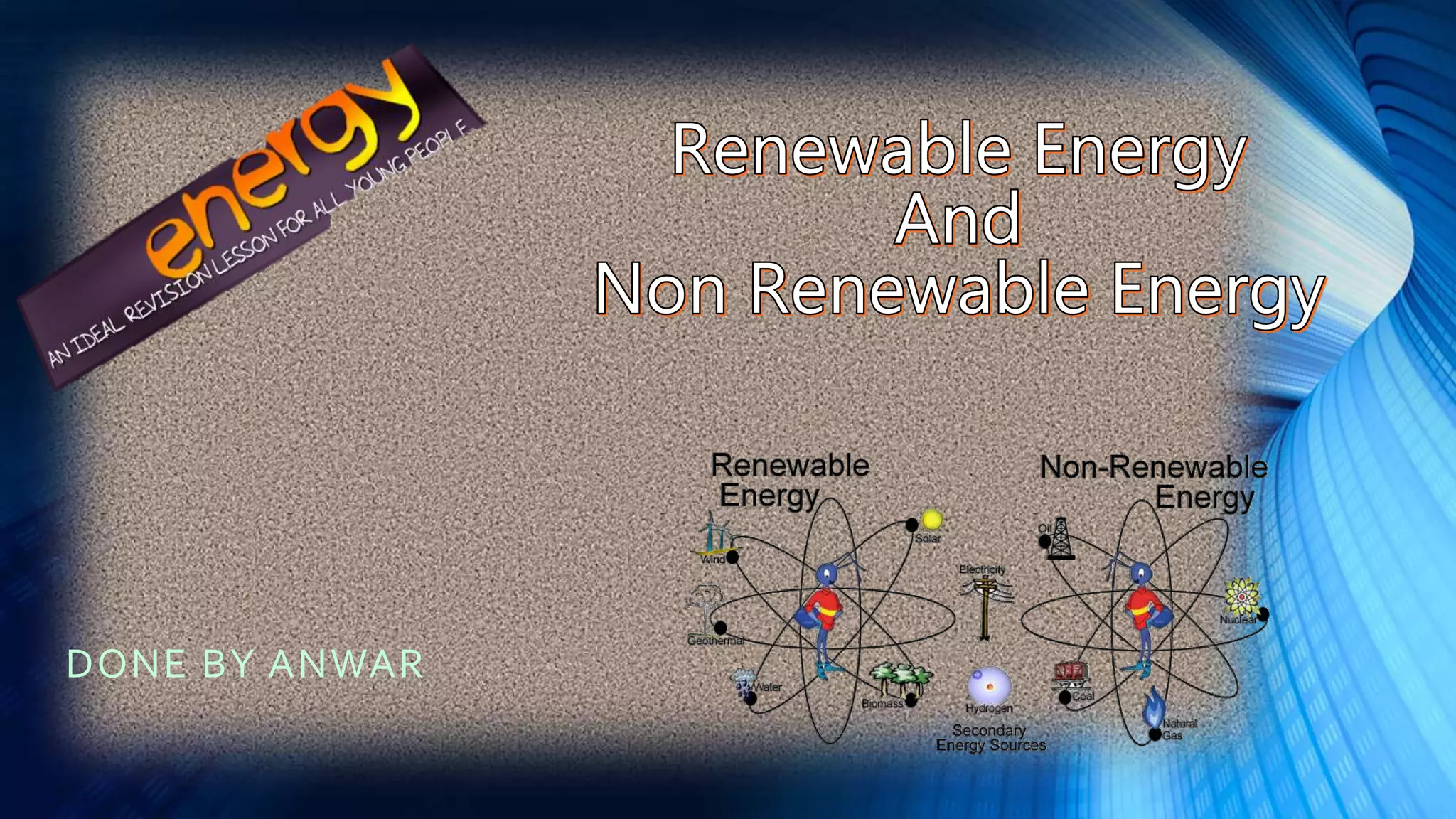
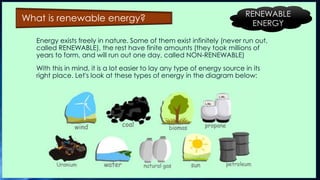
Energy exists freely in nature. Some of them exist infinitely (never run out,
called RENEWABLE), the rest have finite amounts (they took millions of
years to form, and will run out one day, called NON-RENEWABLE)
With this in mind, it is a lot easier to lay any type of energy source in its
right place. Let's look at these types of energy in the diagram below:
What is renewable energy? RENEWABLE
ENERGY
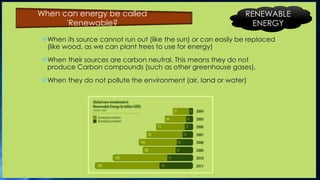
When its source cannot run out (like the sun) or can easily be replaced
(like wood, as we can plant trees to use for energy)
When their sources are carbon neutral. This means they do not
produce Carbon compounds (such as other greenhouse gases).
When they do not pollute the environment (air, land or water)
When can energy be called
'Renewable?
RENEWABLE
ENERGY
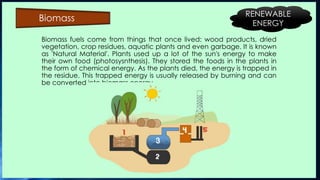
Biomass fuels come from things that once lived: wood products, dried
vegetation, crop residues, aquatic plants and even garbage. It is known
as 'Natural Material'. Plants used up a lot of the sun's energy to make
their own food (photosysnthesis). They stored the foods in the plants in
the form of chemical energy. As the plants died, the energy is trapped in
the residue. This trapped energy is usually released by burning and can
be converted into biomass energy.
Biomass RENEWABLE
ENERGY
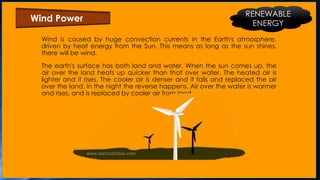
Wind is caused by huge convection currents in the Earth's atmosphere,
driven by heat energy from the Sun. This means as long as the sun shines,
there will be wind.
The earth's surface has both land and water. When the sun comes up, the
air over the land heats up quicker than that over water. The heated air is
lighter and it rises. The cooler air is denser and it falls and replaced the air
over the land. In the night the reverse happens. Air over the water is warmer
and rises, and is replaced by cooler air from land.
Wind Power
RENEWABLE
ENERGY
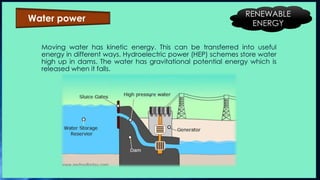
Moving water has kinetic energy. This can be transferred into useful
energy in different ways. Hydroelectric power (HEP) schemes store water
high up in dams. The water has gravitational potential energy which is
released when it falls.
Water power
RENEWABLE
ENERGY
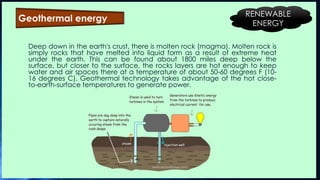
Deep down in the earth's crust, there is molten rock (magma). Molten rock is
simply rocks that have melted into liquid form as a result of extreme heat
under the earth. This can be found about 1800 miles deep below the
surface, but closer to the surface, the rocks layers are hot enough to keep
water and air spaces there at a temperature of about 50-60 degrees F (10-
16 degrees C). Geothermal technology takes advantage of the hot close-
to-earth-surface temperatures to generate power.
Geothermal energy
RENEWABLE
ENERGY
Deep down in the earth's crust, there is molten rock (magma). Molten rock is
simply rocks that have melted into liquid form as a result of extreme heat
under the earth. This can be found about 1800 miles deep below the
surface, but closer to the surface, the rocks layers are hot enough to keep
water and air spaces there at a temperature of about 50-60 degrees F (10-
16 degrees C). Geothermal technology takes advantage of the hot close-
to-earth-surface temperatures to generate power.
Solar power
RENEWABLE
ENERGY
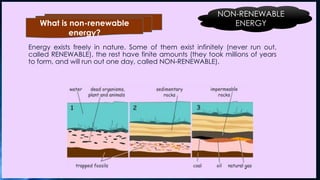
Energy exists freely in nature. Some of them exist infinitely (never run out,
called RENEWABLE), the rest have finite amounts (they took millions of years
to form, and will run out one day, called NON-RENEWABLE).
What is non-renewable
energy?
NON-RENEWABLE
ENERGY
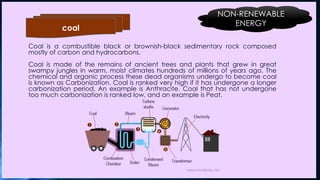
Coal is a combustible black or brownish-black sedimentary rock composed
mostly of carbon and hydrocarbons.
Coal is made of the remains of ancient trees and plants that grew in great
swampy jungles in warm, moist climates hundreds of millions of years ago. The
chemical and organic process these dead organisms undergo to become coal
is known as Carbonization. Coal is ranked very high if it has undergone a longer
carbonization period. An example is Anthracite. Coal that has not undergone
too much carbonization is ranked low, and an example is Peat.
coal
NON-RENEWABLE
ENERGY
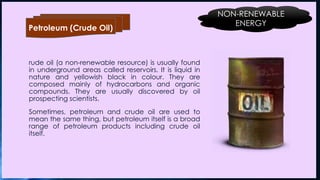
rude oil (a non-renewable resource) is usually found
in underground areas called reservoirs. It is liquid in
nature and yellowish black in colour. They are
composed mainly of hydrocarbons and organic
compounds. They are usually discovered by oil
prospecting scientists.
Sometimes, petroleum and crude oil are used to
mean the same thing, but petroleum itself is a broad
range of petroleum products including crude oil
itself.
Petroleum (Crude Oil)
NON-RENEWABLE
ENERGY
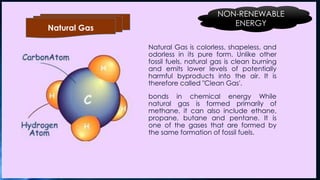
Natural Gas is colorless, shapeless, and
odorless in its pure form. Unlike other
fossil fuels, natural gas is clean burning
and emits lower levels of potentially
harmful byproducts into the air. It is
therefore called "Clean Gas'.
bonds in chemical energy While
natural gas is formed primarily of
methane, it can also include ethane,
propane, butane and pentane. It is
one of the gases that are formed by
the same formation of fossil fuels.
Natural Gas
NON-RENEWABLE
ENERGY
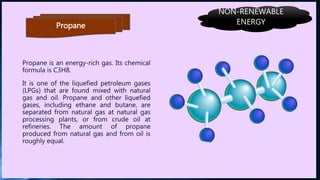
Propane
Propane is an energy-rich gas. Its chemical
formula is C3H8.
It is one of the liquefied petroleum gases
(LPGs) that are found mixed with natural
gas and oil. Propane and other liquefied
gases, including ethane and butane, are
separated from natural gas at natural gas
processing plants, or from crude oil at
refineries. The amount of propane
produced from natural gas and from oil is
roughly equal.
NON-RENEWABLE
ENERGY
Uranium (Nuclear Energy)
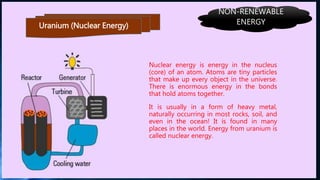
Nuclear energy is energy in the nucleus
(core) of an atom. Atoms are tiny particles
that make up every object in the universe.
There is enormous energy in the bonds
that hold atoms together.
It is usually in a form of heavy metal,
naturally occurring in most rocks, soil, and
even in the ocean! It is found in many
places in the world. Energy from uranium is
called nuclear energy.
NON-RENEWABLE
ENERGY

Renewable energy

  • 1.
  • 2.
    Energy exists freelyin nature. Some of them exist infinitely (never run out, called RENEWABLE), the rest have finite amounts (they took millions of years to form, and will run out one day, called NON-RENEWABLE) With this in mind, it is a lot easier to lay any type of energy source in its right place. Let's look at these types of energy in the diagram below: What is renewable energy? RENEWABLE ENERGY
  • 3.
    When its sourcecannot run out (like the sun) or can easily be replaced (like wood, as we can plant trees to use for energy) When their sources are carbon neutral. This means they do not produce Carbon compounds (such as other greenhouse gases). When they do not pollute the environment (air, land or water) When can energy be called 'Renewable? RENEWABLE ENERGY
  • 4.
    Biomass fuels comefrom things that once lived: wood products, dried vegetation, crop residues, aquatic plants and even garbage. It is known as 'Natural Material'. Plants used up a lot of the sun's energy to make their own food (photosysnthesis). They stored the foods in the plants in the form of chemical energy. As the plants died, the energy is trapped in the residue. This trapped energy is usually released by burning and can be converted into biomass energy. Biomass RENEWABLE ENERGY
  • 5.
    Wind is causedby huge convection currents in the Earth's atmosphere, driven by heat energy from the Sun. This means as long as the sun shines, there will be wind. The earth's surface has both land and water. When the sun comes up, the air over the land heats up quicker than that over water. The heated air is lighter and it rises. The cooler air is denser and it falls and replaced the air over the land. In the night the reverse happens. Air over the water is warmer and rises, and is replaced by cooler air from land. Wind Power RENEWABLE ENERGY
  • 6.
    Moving water haskinetic energy. This can be transferred into useful energy in different ways. Hydroelectric power (HEP) schemes store water high up in dams. The water has gravitational potential energy which is released when it falls. Water power RENEWABLE ENERGY
  • 7.
    Deep down inthe earth's crust, there is molten rock (magma). Molten rock is simply rocks that have melted into liquid form as a result of extreme heat under the earth. This can be found about 1800 miles deep below the surface, but closer to the surface, the rocks layers are hot enough to keep water and air spaces there at a temperature of about 50-60 degrees F (10- 16 degrees C). Geothermal technology takes advantage of the hot close- to-earth-surface temperatures to generate power. Geothermal energy RENEWABLE ENERGY
  • 8.
    Deep down inthe earth's crust, there is molten rock (magma). Molten rock is simply rocks that have melted into liquid form as a result of extreme heat under the earth. This can be found about 1800 miles deep below the surface, but closer to the surface, the rocks layers are hot enough to keep water and air spaces there at a temperature of about 50-60 degrees F (10- 16 degrees C). Geothermal technology takes advantage of the hot close- to-earth-surface temperatures to generate power. Solar power RENEWABLE ENERGY
  • 9.
    Energy exists freelyin nature. Some of them exist infinitely (never run out, called RENEWABLE), the rest have finite amounts (they took millions of years to form, and will run out one day, called NON-RENEWABLE). What is non-renewable energy? NON-RENEWABLE ENERGY
  • 10.
    Coal is acombustible black or brownish-black sedimentary rock composed mostly of carbon and hydrocarbons. Coal is made of the remains of ancient trees and plants that grew in great swampy jungles in warm, moist climates hundreds of millions of years ago. The chemical and organic process these dead organisms undergo to become coal is known as Carbonization. Coal is ranked very high if it has undergone a longer carbonization period. An example is Anthracite. Coal that has not undergone too much carbonization is ranked low, and an example is Peat. coal NON-RENEWABLE ENERGY
  • 11.
    rude oil (anon-renewable resource) is usually found in underground areas called reservoirs. It is liquid in nature and yellowish black in colour. They are composed mainly of hydrocarbons and organic compounds. They are usually discovered by oil prospecting scientists. Sometimes, petroleum and crude oil are used to mean the same thing, but petroleum itself is a broad range of petroleum products including crude oil itself. Petroleum (Crude Oil) NON-RENEWABLE ENERGY
  • 12.
    Natural Gas iscolorless, shapeless, and odorless in its pure form. Unlike other fossil fuels, natural gas is clean burning and emits lower levels of potentially harmful byproducts into the air. It is therefore called "Clean Gas'. bonds in chemical energy While natural gas is formed primarily of methane, it can also include ethane, propane, butane and pentane. It is one of the gases that are formed by the same formation of fossil fuels. Natural Gas NON-RENEWABLE ENERGY
  • 13.
    Propane Propane is anenergy-rich gas. Its chemical formula is C3H8. It is one of the liquefied petroleum gases (LPGs) that are found mixed with natural gas and oil. Propane and other liquefied gases, including ethane and butane, are separated from natural gas at natural gas processing plants, or from crude oil at refineries. The amount of propane produced from natural gas and from oil is roughly equal. NON-RENEWABLE ENERGY
  • 14.
    Uranium (Nuclear Energy) Nuclearenergy is energy in the nucleus (core) of an atom. Atoms are tiny particles that make up every object in the universe. There is enormous energy in the bonds that hold atoms together. It is usually in a form of heavy metal, naturally occurring in most rocks, soil, and even in the ocean! It is found in many places in the world. Energy from uranium is called nuclear energy. NON-RENEWABLE ENERGY