Renewable Energy
By: Kaleila Simon, Lucas Marsh, Jerrad Nelson,
Anders Pace, Brandon Brogan, Morgan Sim,
Evan Norman, and Mattie Stanford
What is renewable energy?
• Renewable energy is energy which comes from
natural resources such as sunlight, wind, rain,
tides, waves and geothermal heat, which are
renewable (naturally replenished).
• According to our book, only 7% of energy
consumption that is used in the U.S. is renewable
energy
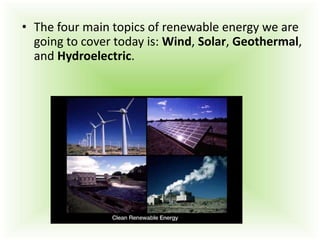
• The four main topics of renewable energy we are
going to cover today is: Wind, Solar, Geothermal,
and Hydroelectric.
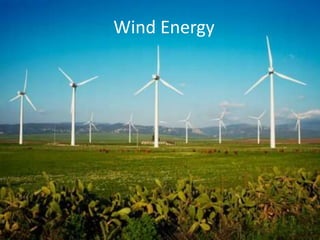
Wind Energy
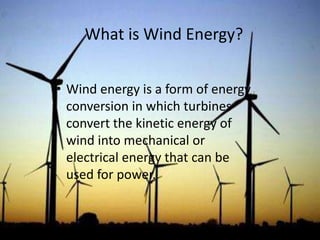
What is Wind Energy?
• Wind energy is a form of energy
conversion in which turbines
convert the kinetic energy of
wind into mechanical or
electrical energy that can be
used for power.
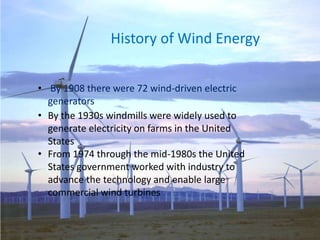
History of Wind Energy
• By 1908 there were 72 wind-driven electric
generators
• By the 1930s windmills were widely used to
generate electricity on farms in the United
States
• From 1974 through the mid-1980s the United
States government worked with industry to
advance the technology and enable large
commercial wind turbines
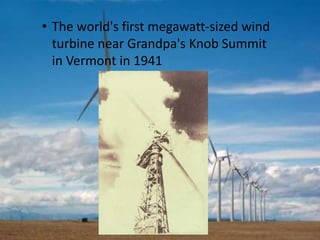
• The world's first megawatt-sized wind
turbine near Grandpa's Knob Summit
in Vermont in 1941
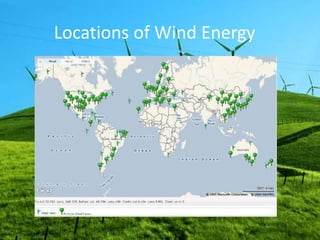
Locations of Wind Energy
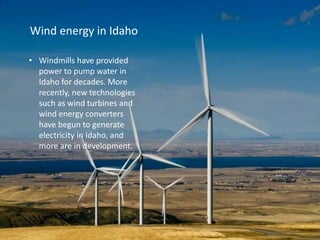
Wind energy in Idaho
• Windmills have provided
power to pump water in
Idaho for decades. More
recently, new technologies
such as wind turbines and
wind energy converters
have begun to generate
electricity in Idaho, and
more are in development.
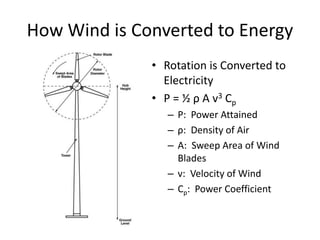
How Wind is Converted to Energy
• Rotation is Converted to
Electricity
• P = ½ ρ A v3 Cp
– P: Power Attained
– ρ: Density of Air
– A: Sweep Area of Wind
Blades
– v: Velocity of Wind
– Cp: Power Coefficient
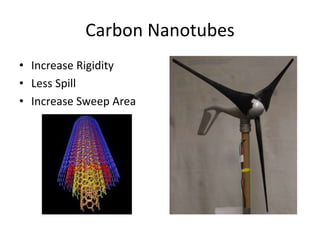
Carbon Nanotubes
• Increase Rigidity
• Less Spill
• Increase Sweep Area
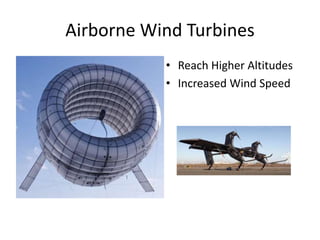
Airborne Wind Turbines
• Reach Higher Altitudes
• Increased Wind Speed
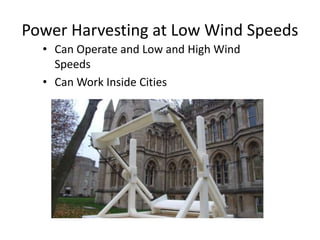
Power Harvesting at Low Wind Speeds
• Can Operate and Low and High Wind
Speeds
• Can Work Inside Cities
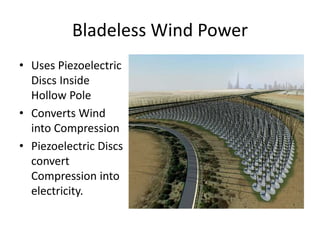
Bladeless Wind Power
• Uses Piezoelectric
Discs Inside
Hollow Pole
• Converts Wind
into Compression
• Piezoelectric Discs
convert
Compression into
electricity.
Solar Energy
Local/Commercial Examples, Cost
Efficiency, Conclusion
How Efficient is Solar Energy?
• Efficiency depends on location, general
climate, and geography
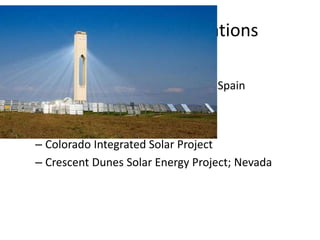
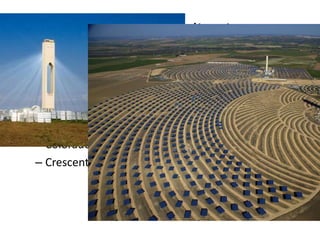
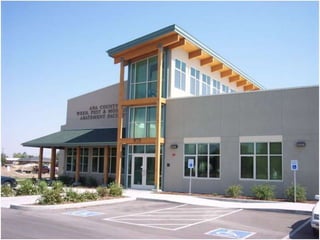
Commercial Applications
• Global
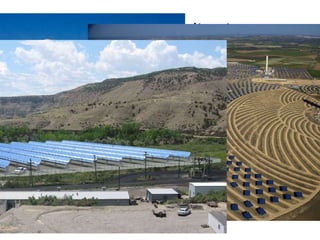
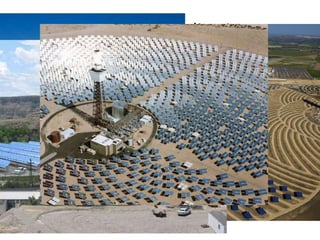
– Planta Solar 10 (PS10); Andalucia, Spain
• Local
– Colorado Integrated Solar Project (“Cameo”)
– Crescent Dunes Solar Energy Project; Nevada
Commercial Applications
• Global
– Planta Solar 10 (PS10); Andalucia, Spain
• Local
– Colorado Integrated Solar Project
– Crescent Dunes Solar Energy Project; Nevada
Commercial Applications
• Global
– Planta Solar 10 (PS10); Andalucia, Spain
• Local
– Colorado Integrated Solar Project
– Crescent Dunes Solar Energy Project; Nevada
Commercial Applications
• Global
– Planta Solar 10 (PS10); Andalucia, Spain
• Local
– Colorado Integrated Solar Project
– Crescent Dunes Solar Energy Project; Nevada
Commercial Applications
• Global
– Planta Solar 10 (PS10); Andalucia, Spain
• Local
– Colorado Integrated Solar Project
– Crescent Dunes Solar Energy Project; Nevada
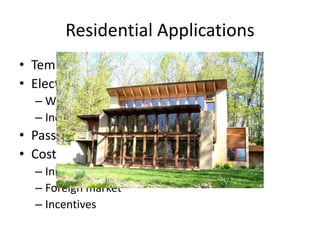
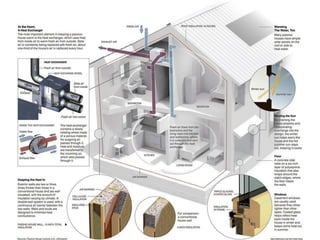
Residential Applications
• Temperature exchange
• Electricity
– Solar water heating
– Incentives
• Passive construction
• Cost
Residential Applications
• Temperature exchange
• Electricity
– Water heating
– Incentives
• Passive construction
• Cost
– Initially high
– Foreign market
– Incentives
Residential Applications
• Temperature exchange
• Electricity
– Water heating
– Incentives
• Passive construction
• Cost
– Initially high
– Foreign market
– Incentives
Residential Applications
• Temperature exchange
• Electricity
– Water heating
– Incentives
• Passive construction
• Cost
– Initially high
– Foreign market
– Incentives
Bottom Line…
• Efficiency
• Commercial Use
• Residential Use
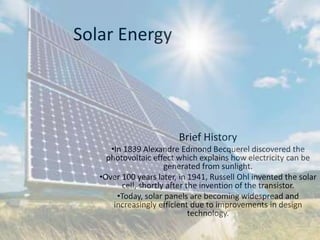
Solar Energy
Brief History
•In 1839 Alexandre Edmond Becquerel discovered the
photovoltaic effect which explains how electricity can be
generated from sunlight.
•Over 100 years later, in 1941, Russell Ohl invented the solar
cell, shortly after the invention of the transistor.
•Today, solar panels are becoming widespread and
increasingly efficient due to improvements in design
technology.
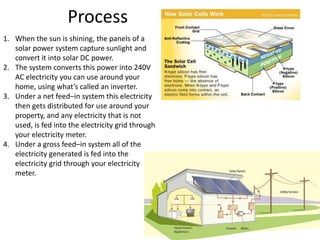
Process
1. When the sun is shining, the panels of a
solar power system capture sunlight and
convert it into solar DC power.
2. The system converts this power into 240V
AC electricity you can use around your
home, using what’s called an inverter.
3. Under a net feed–in system this electricity
then gets distributed for use around your
property, and any electricity that is not
used, is fed into the electricity grid through
your electricity meter.
4. Under a gross feed–in system all of the
electricity generated is fed into the
electricity grid through your electricity
meter.
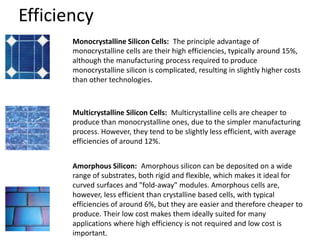
Efficiency
Monocrystalline Silicon Cells: The principle advantage of
monocrystalline cells are their high efficiencies, typically around 15%,
although the manufacturing process required to produce
monocrystalline silicon is complicated, resulting in slightly higher costs
than other technologies.
Multicrystalline Silicon Cells: Multicrystalline cells are cheaper to
produce than monocrystalline ones, due to the simpler manufacturing
process. However, they tend to be slightly less efficient, with average
efficiencies of around 12%.
Amorphous Silicon: Amorphous silicon can be deposited on a wide
range of substrates, both rigid and flexible, which makes it ideal for
curved surfaces and "fold-away" modules. Amorphous cells are,
however, less efficient than crystalline based cells, with typical
efficiencies of around 6%, but they are easier and therefore cheaper to
produce. Their low cost makes them ideally suited for many
applications where high efficiency is not required and low cost is
important.
==Geothermal energy is any energy harvested from the natural heat retained by the Earth’s
crust..
--Earth’s surface maintains temperatures of 50-60 degrees F as shallow as 10 feet
down.
--Geothermal energy is available 24/7
--90% and up energy availability from plants (very efficient)
--Produces much less waste than conventional power sources(Coal, natural gas,
nuclear)
--geothermal wastes in the form of CO2 and wastewater.
--CO2 emissions 1/6 that of clean natural gas
--Wastewater can be treated at any municipal water treatment facility or can be
re-injected into geothermal reservoir
--Small scale systems can be installed almost anywhere
--Industrial scale power plants can be placed anywhere with tectonic or hot
spring water activity, although future technology will expand this resource
tremendously.
--A typical plant today would produce power at about $0.05 per kWh
-- The U.S produces approximately 2700 MW of electricity via geothermal plants
per year, roughly equal to burning 60 million barrels of oil.
--Small but growing for of power in America and the world.
--EGS is very expensive to establish (high introductory costs)
Direct-Use and Heat
Pump Utilization
Direct Uses of geothermal energy
--hot springs
--geothermal wells
-electricity saving uses
for hot water
*greenhouses
*heating fish farms
*hot water for
buildings
Heat Pumps
--large or small scale use
--series of pipes run liquids or
gasses underground to disperse
heat or collect it.
--no visual impact
--large initial cost (20-30k on a
residential level) but saves enough
energy to compensate in 8-12 years.
 Direct Dry Steam, Flash/Double Flash Cycle, and Binary Cycle Power Plants
--Direct Dry Steam plants use super-heated liquids that decompress into steam that is
funneled directly to a turbine. Since this steam drives the turbine no fuels are burned,
transported, or stored.
--Flash/Double Flash plants pump super heated liquids into a low pressure tank causing
them to instantly vaporize. This gas is then pushed through a turbine. For double flash
processes the liquid can be vaporized in two consecutive tanks(to make sure all liquid is
flashed)
Binary Cycle plants create energy by extracting more common, moderate temperature
water and cycling it through a heat exchanger. Also running through this heat exchanger is a
second liquid, or binary liquid which boils at a very low temperature. This binary liquid is
vaporized and pushed through the turbine. There are no emissions from this process because
all liquids are contained in a closed loop.
--EGS– Future projects and research are geared towards using already existent fissures and
man made wells. Many of these are deep enough to touch superheated rocks below. By
injecting water into these fissures, letting the naturally hot rocks boil the water, and capturing
the steam in a turbine system, energy is created. This can be done almost anywhere but is still
extremely expensive based on current tech.
Geothermal Energy
Geothermal Energy
Pros:
• Almost entirely emission free
• Zero Carbon
• No fuel required (no mining or
transportation needed)
• Not subject to the same fluctuations
as solar or wind.
• Smallest land footprint of any major
power source
• Virtually limitless supply
• Simple and Reliable
• Plants have the opportunity to be
underground.
• Some level of geothermal energy is
available in most places
• New technologies are working on
utilizing cooler temperatures
• Massive potential
Cons:
• Prime sights are very location
specific and are often far from
big population centers
• Losses due to the long distance
transmission of electricity
• High construction cost
• Large amounts of water
required
• Sulfur dioxide and silica
emissions.
• Drilling into heated rock is
difficult and causes surface
instability
• Generally, at least boiling water
required (100˚C or 212˚F)
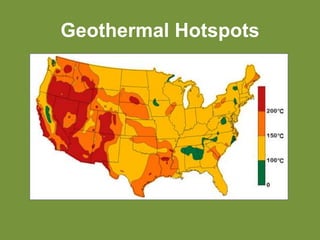
Geothermal Hotspots
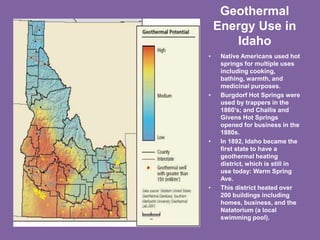
Geothermal
Energy Use in
Idaho
• Native Americans used hot
springs for multiple uses
including cooking,
bathing, warmth, and
medicinal purposes.
• Burgdorf Hot Springs were
used by trappers in the
1860’s; and Challis and
Givens Hot Springs
opened for business in the
1880s.
• In 1892, Idaho became the
first state to have a
geothermal heating
district, which is still in
use today: Warm Spring
Ave.
• This district heated over
200 buildings including
homes, business, and the
Natatorium (a local
swimming pool).
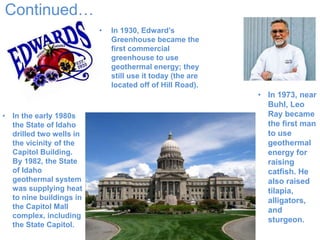
Continued…
• In 1930, Edward’s
Greenhouse became the
first commercial
greenhouse to use
geothermal energy; they
still use it today (the are
located off of Hill Road).
• In 1973, near
Buhl, Leo
Ray became
the first man
to use
geothermal
energy for
raising
catfish. He
also raised
tilapia,
alligators,
and
sturgeon.
• In the early 1980s
the State of Idaho
drilled two wells in
the vicinity of the
Capitol Building.
By 1982, the State
of Idaho
geothermal system
was supplying heat
to nine buildings in
the Capitol Mall
complex, including
the State Capitol.
Geothermal Energy Use in Boise
• During the United Nations Climate Change
Conference in 2009, Boise was voted one of the
top ten geothermal cities in the world along with
Reno, Nevada, Copenhagen, Denmark, Perth,
Australia, and Madrid, Spain.
– Three reasons got them onto this list: Boise has the
largest direct use of geothermal energy, we give back
100% of the water back to the aquifer, and because our
major buildings downtown already use geothermal
energy including the capitol and its mall, the Federal
Courthouse, City Hall, Boise High School, Ada County
Courthouse and the Boise Centre.
• Boise currently has four geothermal districts,
there are only seventeen in the whole country.
Boise State University’s Geothermal Project
• In August of 2011, BSU began their geothermal project.
• The heated water needed to be transferred across the
Boise River.
• The project is converting many buildings over to
geothermal heating: the Morrison Center, Multipurpose
Classroom Building, Interactive Learning Center,
Administration Building, Student Union Building, the
Mathematics and Geosciences Building, the
Environmental Research Building, and the Micron
Business and Economics building.
• When completed, it is estimated that approximately
625,000 square feet of building space will be heated
using geothermal energy.
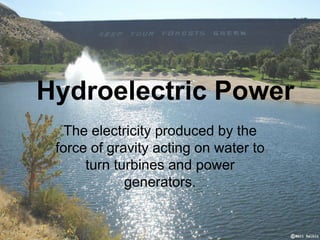
Hydroelectric Power
The electricity produced by the
force of gravity acting on water to
turn turbines and power
generators.
Processes
• The transformation of water’s kinetic
energy to mechanical energy then after
passing through a turbine to electrical
energy.
Types of Hydroelectric Plants
• High Head- Used to store water at an
increased elevation. Able to be controlled for
electricity demand.
• Low Head- Less efficient due to shorter
vertical drop of water.
• Pumped storage- Transfer of water from
one reservoir to another at a higher elevation.
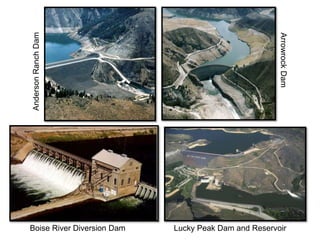
Local Examples
• Boise River Diversion Dam-1909
Provided 1,500 kw of electricity for construction of Arrowrock
Dam upstream.
Now provides surplus power when needed
• Arrowrock Dam-1915
Portland cement and sand, new concrete in 1935.
Designed to store water to push Idaho’s agriculture standing in
America
• Anderson Ranch Dam-1950
Highest embankment dam in the world when completed.
Generators updated in 1986 from 27,000 kw to 40,000 kw
production.
• Lucky Peak Dam-1955
Originally single outlet with potential for hydropower, 1986-
installed second outlet and went online with powerhouse in 1988.
Primary purpose- flood control, Secondary purpose- irrigation
Boise River Diversion Dam Lucky Peak Dam and Reservoir
ArrowrockDam
AndersonRanchDam
New Technological Processes
Harvesting energy from ocean waves, tides, and river currents
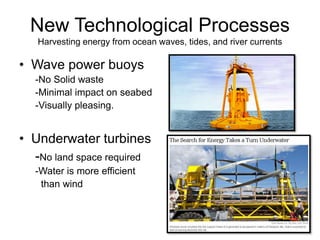
• Wave power buoys
-No Solid waste
-Minimal impact on seabed
-Visually pleasing.
• Underwater turbines
-No land space required
-Water is more efficient
than wind
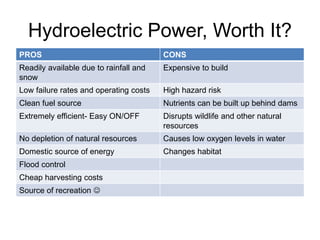
Hydroelectric Power, Worth It?
PROS CONS
Readily available due to rainfall and
snow
Expensive to build
Low failure rates and operating costs High hazard risk
Clean fuel source Nutrients can be built up behind dams
Extremely efficient- Easy ON/OFF Disrupts wildlife and other natural
resources
No depletion of natural resources Causes low oxygen levels in water
Domestic source of energy Changes habitat
Flood control
Cheap harvesting costs
Source of recreation 
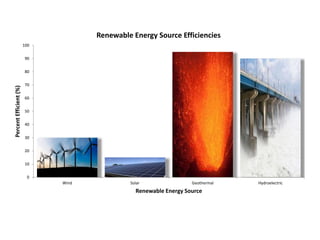
0
10
20
30
40
50
60
70
80
90
100
Wind Solar Geothermal Hydroelectric
PercentEfficient(%)
Renewable Energy Source
Renewable Energy Source Efficiencies
Please try to save energy!!
Sources
 http://www.greenchipstocks.com/articles/global-wind-energy/466
 http://en.wikipedia.org/wiki/Renewable_energy
 http://en.wikipedia.org/wiki/History_of_wind_power
 http://www.energy.idaho.gov/renewableenergy/
 http://www.treehugger.com/wind-technology/future-wind-power-9-cool-innovations.html
 http://www.raeng.org.uk/education/diploma/maths/pdf/exemplars_advanced/23_wind_turbine.pdf
 http://buildyourownsolarpanelshelp.com/wp-content/uploads/2011/03/iStock_000009912571XSmall.jpg
 http://en.wikipedia.org/wiki/Solar_cell#History_of_solar_cells
 http://www.energymatters.com.au/renewable-energy/solar-power/solar-panels.php
 http://www.sunnysolarlightgarden.com/wp-content/uploads/2008/08/how-solar-cells-work.gif
 http://www.aglsolarenergy.com.au/solar-power/about-solar-power/
 http://www.criticalpowersupplies.co.uk/images/originals/0000/1221/how_solar_works_en.gif
 http://www.electricityforum.com/solar-electricity.html
• www.eere.energy.gov
• www.dsireusa.org
• http://www.altenergy.org/renewables/hydroelectric.html
• http://www.idwr.idaho.gov/WaterManagement/StreamsDams/DamSafety/dams.htm
• http://www.eia.gov/todayinenergy/detail.cfm?id=8210

Renewable Energy Presentation

  • 1.
    Renewable Energy By: KaleilaSimon, Lucas Marsh, Jerrad Nelson, Anders Pace, Brandon Brogan, Morgan Sim, Evan Norman, and Mattie Stanford
  • 2.
    What is renewableenergy? • Renewable energy is energy which comes from natural resources such as sunlight, wind, rain, tides, waves and geothermal heat, which are renewable (naturally replenished). • According to our book, only 7% of energy consumption that is used in the U.S. is renewable energy
  • 3.
    • The fourmain topics of renewable energy we are going to cover today is: Wind, Solar, Geothermal, and Hydroelectric.
  • 4.
  • 5.
    What is WindEnergy? • Wind energy is a form of energy conversion in which turbines convert the kinetic energy of wind into mechanical or electrical energy that can be used for power.
  • 6.
    History of WindEnergy • By 1908 there were 72 wind-driven electric generators • By the 1930s windmills were widely used to generate electricity on farms in the United States • From 1974 through the mid-1980s the United States government worked with industry to advance the technology and enable large commercial wind turbines
  • 7.
    • The world'sfirst megawatt-sized wind turbine near Grandpa's Knob Summit in Vermont in 1941
  • 8.
  • 9.
    Wind energy inIdaho • Windmills have provided power to pump water in Idaho for decades. More recently, new technologies such as wind turbines and wind energy converters have begun to generate electricity in Idaho, and more are in development.
  • 10.
    How Wind isConverted to Energy • Rotation is Converted to Electricity • P = ½ ρ A v3 Cp – P: Power Attained – ρ: Density of Air – A: Sweep Area of Wind Blades – v: Velocity of Wind – Cp: Power Coefficient
  • 11.
    Carbon Nanotubes • IncreaseRigidity • Less Spill • Increase Sweep Area
  • 12.
    Airborne Wind Turbines •Reach Higher Altitudes • Increased Wind Speed
  • 13.
    Power Harvesting atLow Wind Speeds • Can Operate and Low and High Wind Speeds • Can Work Inside Cities
  • 14.
    Bladeless Wind Power •Uses Piezoelectric Discs Inside Hollow Pole • Converts Wind into Compression • Piezoelectric Discs convert Compression into electricity.
  • 15.
    Solar Energy Local/Commercial Examples,Cost Efficiency, Conclusion
  • 16.
    How Efficient isSolar Energy? • Efficiency depends on location, general climate, and geography
  • 17.
    Commercial Applications • Global –Planta Solar 10 (PS10); Andalucia, Spain • Local – Colorado Integrated Solar Project (“Cameo”) – Crescent Dunes Solar Energy Project; Nevada
  • 18.
    Commercial Applications • Global –Planta Solar 10 (PS10); Andalucia, Spain • Local – Colorado Integrated Solar Project – Crescent Dunes Solar Energy Project; Nevada
  • 19.
    Commercial Applications • Global –Planta Solar 10 (PS10); Andalucia, Spain • Local – Colorado Integrated Solar Project – Crescent Dunes Solar Energy Project; Nevada
  • 20.
    Commercial Applications • Global –Planta Solar 10 (PS10); Andalucia, Spain • Local – Colorado Integrated Solar Project – Crescent Dunes Solar Energy Project; Nevada
  • 21.
    Commercial Applications • Global –Planta Solar 10 (PS10); Andalucia, Spain • Local – Colorado Integrated Solar Project – Crescent Dunes Solar Energy Project; Nevada
  • 22.
    Residential Applications • Temperatureexchange • Electricity – Solar water heating – Incentives • Passive construction • Cost
  • 23.
    Residential Applications • Temperatureexchange • Electricity – Water heating – Incentives • Passive construction • Cost – Initially high – Foreign market – Incentives
  • 24.
    Residential Applications • Temperatureexchange • Electricity – Water heating – Incentives • Passive construction • Cost – Initially high – Foreign market – Incentives
  • 25.
    Residential Applications • Temperatureexchange • Electricity – Water heating – Incentives • Passive construction • Cost – Initially high – Foreign market – Incentives
  • 26.
    Bottom Line… • Efficiency •Commercial Use • Residential Use
  • 27.
    Solar Energy Brief History •In1839 Alexandre Edmond Becquerel discovered the photovoltaic effect which explains how electricity can be generated from sunlight. •Over 100 years later, in 1941, Russell Ohl invented the solar cell, shortly after the invention of the transistor. •Today, solar panels are becoming widespread and increasingly efficient due to improvements in design technology.
  • 28.
    Process 1. When thesun is shining, the panels of a solar power system capture sunlight and convert it into solar DC power. 2. The system converts this power into 240V AC electricity you can use around your home, using what’s called an inverter. 3. Under a net feed–in system this electricity then gets distributed for use around your property, and any electricity that is not used, is fed into the electricity grid through your electricity meter. 4. Under a gross feed–in system all of the electricity generated is fed into the electricity grid through your electricity meter.
  • 29.
    Efficiency Monocrystalline Silicon Cells:The principle advantage of monocrystalline cells are their high efficiencies, typically around 15%, although the manufacturing process required to produce monocrystalline silicon is complicated, resulting in slightly higher costs than other technologies. Multicrystalline Silicon Cells: Multicrystalline cells are cheaper to produce than monocrystalline ones, due to the simpler manufacturing process. However, they tend to be slightly less efficient, with average efficiencies of around 12%. Amorphous Silicon: Amorphous silicon can be deposited on a wide range of substrates, both rigid and flexible, which makes it ideal for curved surfaces and "fold-away" modules. Amorphous cells are, however, less efficient than crystalline based cells, with typical efficiencies of around 6%, but they are easier and therefore cheaper to produce. Their low cost makes them ideally suited for many applications where high efficiency is not required and low cost is important.
  • 30.
    ==Geothermal energy isany energy harvested from the natural heat retained by the Earth’s crust.. --Earth’s surface maintains temperatures of 50-60 degrees F as shallow as 10 feet down. --Geothermal energy is available 24/7 --90% and up energy availability from plants (very efficient) --Produces much less waste than conventional power sources(Coal, natural gas, nuclear) --geothermal wastes in the form of CO2 and wastewater. --CO2 emissions 1/6 that of clean natural gas --Wastewater can be treated at any municipal water treatment facility or can be re-injected into geothermal reservoir --Small scale systems can be installed almost anywhere --Industrial scale power plants can be placed anywhere with tectonic or hot spring water activity, although future technology will expand this resource tremendously. --A typical plant today would produce power at about $0.05 per kWh -- The U.S produces approximately 2700 MW of electricity via geothermal plants per year, roughly equal to burning 60 million barrels of oil. --Small but growing for of power in America and the world. --EGS is very expensive to establish (high introductory costs)
  • 31.
    Direct-Use and Heat PumpUtilization Direct Uses of geothermal energy --hot springs --geothermal wells -electricity saving uses for hot water *greenhouses *heating fish farms *hot water for buildings Heat Pumps --large or small scale use --series of pipes run liquids or gasses underground to disperse heat or collect it. --no visual impact --large initial cost (20-30k on a residential level) but saves enough energy to compensate in 8-12 years.
  • 32.
     Direct DrySteam, Flash/Double Flash Cycle, and Binary Cycle Power Plants --Direct Dry Steam plants use super-heated liquids that decompress into steam that is funneled directly to a turbine. Since this steam drives the turbine no fuels are burned, transported, or stored. --Flash/Double Flash plants pump super heated liquids into a low pressure tank causing them to instantly vaporize. This gas is then pushed through a turbine. For double flash processes the liquid can be vaporized in two consecutive tanks(to make sure all liquid is flashed) Binary Cycle plants create energy by extracting more common, moderate temperature water and cycling it through a heat exchanger. Also running through this heat exchanger is a second liquid, or binary liquid which boils at a very low temperature. This binary liquid is vaporized and pushed through the turbine. There are no emissions from this process because all liquids are contained in a closed loop. --EGS– Future projects and research are geared towards using already existent fissures and man made wells. Many of these are deep enough to touch superheated rocks below. By injecting water into these fissures, letting the naturally hot rocks boil the water, and capturing the steam in a turbine system, energy is created. This can be done almost anywhere but is still extremely expensive based on current tech.
  • 33.
  • 34.
    Geothermal Energy Pros: • Almostentirely emission free • Zero Carbon • No fuel required (no mining or transportation needed) • Not subject to the same fluctuations as solar or wind. • Smallest land footprint of any major power source • Virtually limitless supply • Simple and Reliable • Plants have the opportunity to be underground. • Some level of geothermal energy is available in most places • New technologies are working on utilizing cooler temperatures • Massive potential Cons: • Prime sights are very location specific and are often far from big population centers • Losses due to the long distance transmission of electricity • High construction cost • Large amounts of water required • Sulfur dioxide and silica emissions. • Drilling into heated rock is difficult and causes surface instability • Generally, at least boiling water required (100˚C or 212˚F)
  • 35.
  • 36.
    Geothermal Energy Use in Idaho •Native Americans used hot springs for multiple uses including cooking, bathing, warmth, and medicinal purposes. • Burgdorf Hot Springs were used by trappers in the 1860’s; and Challis and Givens Hot Springs opened for business in the 1880s. • In 1892, Idaho became the first state to have a geothermal heating district, which is still in use today: Warm Spring Ave. • This district heated over 200 buildings including homes, business, and the Natatorium (a local swimming pool).
  • 37.
    Continued… • In 1930,Edward’s Greenhouse became the first commercial greenhouse to use geothermal energy; they still use it today (the are located off of Hill Road). • In 1973, near Buhl, Leo Ray became the first man to use geothermal energy for raising catfish. He also raised tilapia, alligators, and sturgeon. • In the early 1980s the State of Idaho drilled two wells in the vicinity of the Capitol Building. By 1982, the State of Idaho geothermal system was supplying heat to nine buildings in the Capitol Mall complex, including the State Capitol.
  • 38.
    Geothermal Energy Usein Boise • During the United Nations Climate Change Conference in 2009, Boise was voted one of the top ten geothermal cities in the world along with Reno, Nevada, Copenhagen, Denmark, Perth, Australia, and Madrid, Spain. – Three reasons got them onto this list: Boise has the largest direct use of geothermal energy, we give back 100% of the water back to the aquifer, and because our major buildings downtown already use geothermal energy including the capitol and its mall, the Federal Courthouse, City Hall, Boise High School, Ada County Courthouse and the Boise Centre. • Boise currently has four geothermal districts, there are only seventeen in the whole country.
  • 39.
    Boise State University’sGeothermal Project • In August of 2011, BSU began their geothermal project. • The heated water needed to be transferred across the Boise River. • The project is converting many buildings over to geothermal heating: the Morrison Center, Multipurpose Classroom Building, Interactive Learning Center, Administration Building, Student Union Building, the Mathematics and Geosciences Building, the Environmental Research Building, and the Micron Business and Economics building. • When completed, it is estimated that approximately 625,000 square feet of building space will be heated using geothermal energy.
  • 40.
    Hydroelectric Power The electricityproduced by the force of gravity acting on water to turn turbines and power generators.
  • 41.
    Processes • The transformationof water’s kinetic energy to mechanical energy then after passing through a turbine to electrical energy.
  • 42.
    Types of HydroelectricPlants • High Head- Used to store water at an increased elevation. Able to be controlled for electricity demand. • Low Head- Less efficient due to shorter vertical drop of water. • Pumped storage- Transfer of water from one reservoir to another at a higher elevation.
  • 43.
    Local Examples • BoiseRiver Diversion Dam-1909 Provided 1,500 kw of electricity for construction of Arrowrock Dam upstream. Now provides surplus power when needed • Arrowrock Dam-1915 Portland cement and sand, new concrete in 1935. Designed to store water to push Idaho’s agriculture standing in America • Anderson Ranch Dam-1950 Highest embankment dam in the world when completed. Generators updated in 1986 from 27,000 kw to 40,000 kw production. • Lucky Peak Dam-1955 Originally single outlet with potential for hydropower, 1986- installed second outlet and went online with powerhouse in 1988. Primary purpose- flood control, Secondary purpose- irrigation
  • 44.
    Boise River DiversionDam Lucky Peak Dam and Reservoir ArrowrockDam AndersonRanchDam
  • 45.
    New Technological Processes Harvestingenergy from ocean waves, tides, and river currents • Wave power buoys -No Solid waste -Minimal impact on seabed -Visually pleasing. • Underwater turbines -No land space required -Water is more efficient than wind
  • 46.
    Hydroelectric Power, WorthIt? PROS CONS Readily available due to rainfall and snow Expensive to build Low failure rates and operating costs High hazard risk Clean fuel source Nutrients can be built up behind dams Extremely efficient- Easy ON/OFF Disrupts wildlife and other natural resources No depletion of natural resources Causes low oxygen levels in water Domestic source of energy Changes habitat Flood control Cheap harvesting costs Source of recreation 
  • 47.
    0 10 20 30 40 50 60 70 80 90 100 Wind Solar GeothermalHydroelectric PercentEfficient(%) Renewable Energy Source Renewable Energy Source Efficiencies
  • 48.
    Please try tosave energy!!
  • 49.
    Sources  http://www.greenchipstocks.com/articles/global-wind-energy/466  http://en.wikipedia.org/wiki/Renewable_energy http://en.wikipedia.org/wiki/History_of_wind_power  http://www.energy.idaho.gov/renewableenergy/  http://www.treehugger.com/wind-technology/future-wind-power-9-cool-innovations.html  http://www.raeng.org.uk/education/diploma/maths/pdf/exemplars_advanced/23_wind_turbine.pdf  http://buildyourownsolarpanelshelp.com/wp-content/uploads/2011/03/iStock_000009912571XSmall.jpg  http://en.wikipedia.org/wiki/Solar_cell#History_of_solar_cells  http://www.energymatters.com.au/renewable-energy/solar-power/solar-panels.php  http://www.sunnysolarlightgarden.com/wp-content/uploads/2008/08/how-solar-cells-work.gif  http://www.aglsolarenergy.com.au/solar-power/about-solar-power/  http://www.criticalpowersupplies.co.uk/images/originals/0000/1221/how_solar_works_en.gif  http://www.electricityforum.com/solar-electricity.html • www.eere.energy.gov • www.dsireusa.org • http://www.altenergy.org/renewables/hydroelectric.html • http://www.idwr.idaho.gov/WaterManagement/StreamsDams/DamSafety/dams.htm • http://www.eia.gov/todayinenergy/detail.cfm?id=8210

Editor's Notes

  • #42 Three parts of a dam: Electric plant, dam to control water flow, reservoir where water can be stored. Vertical distance of which water falls
  • #46 Wave power buoys- does not generate solid waste, minimal impact on seabed, visually pleasing, Potential Benefits: may act as a artificial reef, promotes marine life growth. Underwater turbines- no land space required, water is more dense and is moving more than winds, dependable.