NONRENEWABLE
AND
RENEWABLE
RESOURCES
Presented By:
PRATISH RAWAT
Assistant Professor
Department of Mechanical Engineering
Poornima University, Jaipur
pratish.rawat@poornima.edu.in
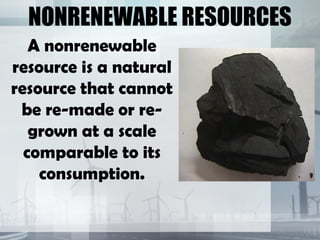
NONRENEWABLE RESOURCES
A nonrenewable
resource is a natural
resource that cannot
be re-made or re-
grown at a scale
comparable to its
consumption.
COAL, PETROLEUM, AND GAS
Coal, petroleum, and
natural gas are
considered
nonrenewable because
they can not be
replenished in a short
period of time. These
are called fossil fuels.
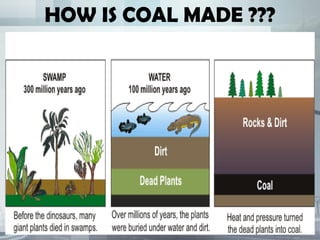
HOW IS COAL MADE ???
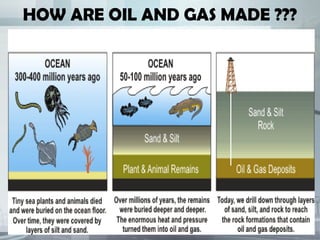
HOW ARE OIL AND GAS MADE ???
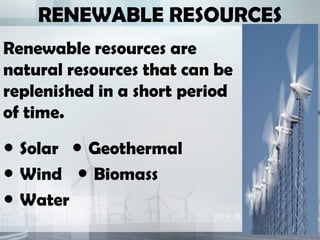
RENEWABLE RESOURCES
Renewable resources are
natural resources that can be
replenished in a short period
of time.
● Solar Geothermal●
● Wind Biomass●
● Water
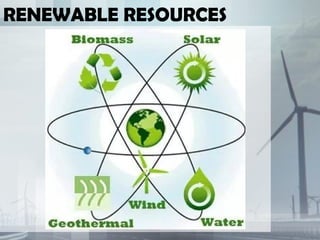
RENEWABLE RESOURCES
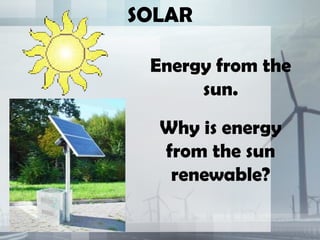
SOLAR
Energy from the
sun.
Why is energy
from the sun
renewable?
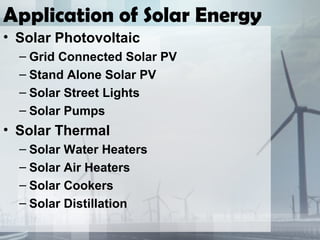
Application of Solar Energy
• Solar Photovoltaic
– Grid Connected Solar PV
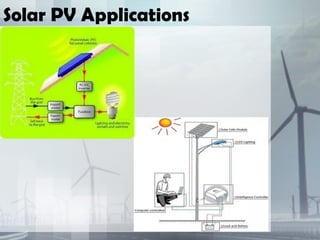
– Stand Alone Solar PV
– Solar Street Lights
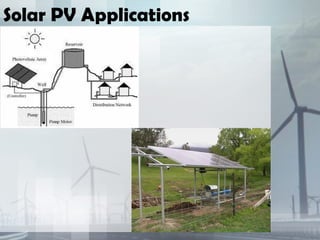
– Solar Pumps
• Solar Thermal
– Solar Water Heaters
– Solar Air Heaters
– Solar Cookers
– Solar Distillation
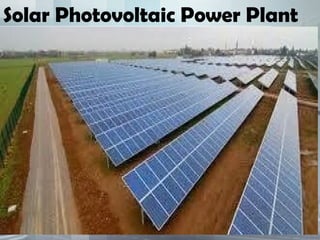
Solar Photovoltaic Power Plant
Solar PV Applications
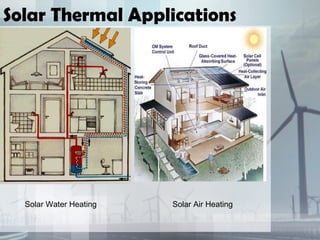
Solar Thermal Applications
Solar Water Heating Solar Air Heating
Advantages and Disadvantages
• Advantages
– Clean
– Inexhaustible
– Abundantly
• Disadvantages
– Dilute form of energy
– Not Steadily and Continuous
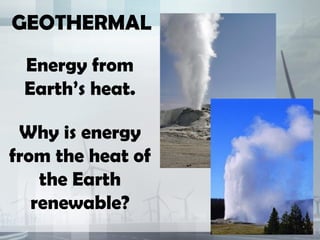
GEOTHERMAL
Energy from
Earth’s heat.
Why is energy
from the heat of
the Earth
renewable?
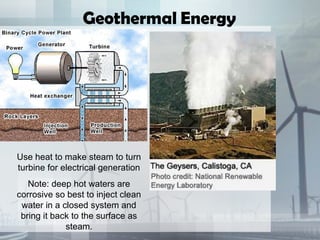
Use heat to make steam to turn
turbine for electrical generation
Note: deep hot waters are
corrosive so best to inject clean
water in a closed system and
bring it back to the surface as
steam.
Geothermal Energy
Geothermal Fields in India
• Himalayas
• Sohana
• West Coast
• Cambay
• Son-Narmada-Tapi
• Godavari
• Mahanadi
– The power generation at these site has
been estimated as about 10000MW.
Advantages and Disadvantages
• Advantages
– Versatile
– Least polluting
– Relatively Inexpensive
– Power generation level is higher
• Disadvantages
– Hazardous gases cause air pollution
– Noise pollution from drilling
– Overall efficiency is low(15%)
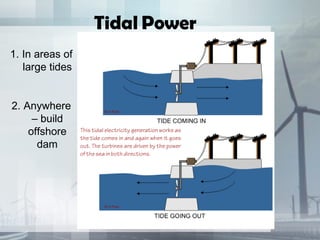
Tidal Power
1. In areas of
large tides
2. Anywhere
– build
offshore
dam
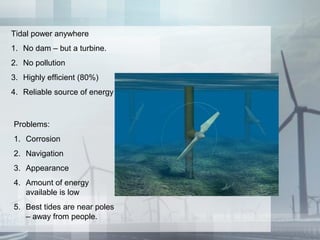
Tidal power anywhere
1. No dam – but a turbine.
2. No pollution
3. Highly efficient (80%)
4. Reliable source of energy
Problems:
1. Corrosion
2. Navigation
3. Appearance
4. Amount of energy
available is low
5. Best tides are near poles
– away from people.
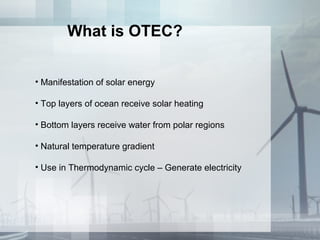
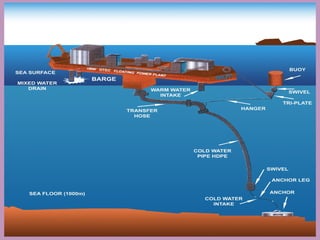
What is OTEC?
• Manifestation of solar energy
• Top layers of ocean receive solar heating
• Bottom layers receive water from polar regions
• Natural temperature gradient
• Use in Thermodynamic cycle – Generate electricity
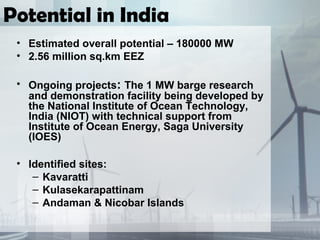
Potential in India
• Estimated overall potential – 180000 MW
• 2.56 million sq.km EEZ
• Ongoing projects: The 1 MW barge research
and demonstration facility being developed by
the National Institute of Ocean Technology,
India (NIOT) with technical support from
Institute of Ocean Energy, Saga University
(IOES)
• Identified sites:
– Kavaratti
– Kulasekarapattinam
– Andaman & Nicobar Islands
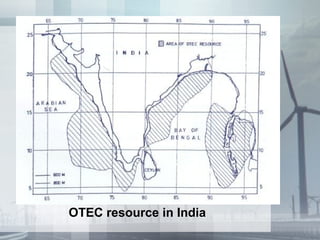
OTEC resource in India
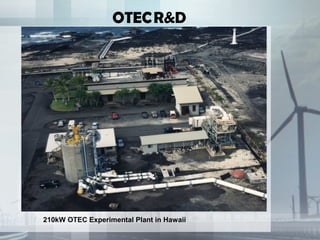
210kW OTEC Experimental Plant in Hawaii
OTECR&D
•Advantages
•OTEC is technically feasible and economically
favorable
• Mature technology
• Benefits ecology
• More plants of capacity similar to experimental
plants can be constructed
•Disadvantages
•More expensive
•Technology is young and need more research
•Sites are far from nation and population
centers
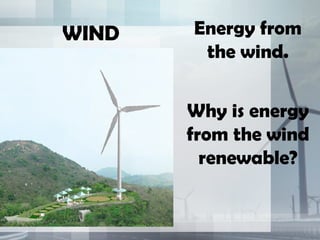
WIND Energy from
the wind.
Why is energy
from the wind
renewable?
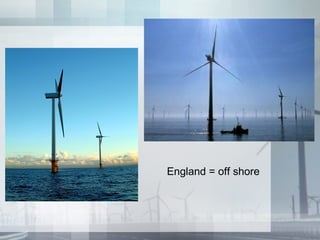
England = off shore
Wind energy problems
• Location – near population center
• Bird migration –
• Visual
• Must be coupled with other sources of
electricity (intermittent supply)
BIOMASS
Energy from
burning organic
or living matter.
Why is energy
from biomass
renewable?
Usable form of Biomass
• Fuel Wood
• Charcoal
• Fuel Pellets and briquettes
• Bio-diesel
• Bio-ethanol
• Biogas
• Producer gas
Advantages and Disadvantages
• Advantages
• Energy Storage is an in-built feature
• Require less capital
• Emission is less compared to fossile fuels
• Commercial use reduces problem of waste
disposal
• Disadvantages
• Dispersed and land intensive source
• Low energy density
• Labour intensive
• Not feasible to set up at all locations
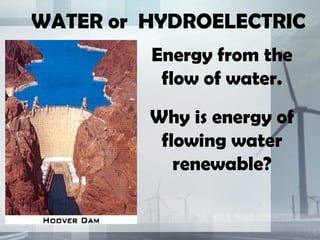
WATER or HYDROELECTRIC
Energy from the
flow of water.
Why is energy of
flowing water
renewable?
Problems with hydroelectric
• Location = unused rivers are in
extreme north or low population
areas
• Competition with recreational uses
and environmental concerns
• Hard to build dams in populated
river valleys
• Siltation of dams – limited life.
Thank You

Renewable Energy Sources

  • 1.
    NONRENEWABLE AND RENEWABLE RESOURCES Presented By: PRATISH RAWAT AssistantProfessor Department of Mechanical Engineering Poornima University, Jaipur pratish.rawat@poornima.edu.in
  • 2.
    NONRENEWABLE RESOURCES A nonrenewable resourceis a natural resource that cannot be re-made or re- grown at a scale comparable to its consumption.
  • 3.
    COAL, PETROLEUM, ANDGAS Coal, petroleum, and natural gas are considered nonrenewable because they can not be replenished in a short period of time. These are called fossil fuels.
  • 4.
    HOW IS COALMADE ???
  • 5.
    HOW ARE OILAND GAS MADE ???
  • 6.
    RENEWABLE RESOURCES Renewable resourcesare natural resources that can be replenished in a short period of time. ● Solar Geothermal● ● Wind Biomass● ● Water
  • 7.
  • 8.
    SOLAR Energy from the sun. Whyis energy from the sun renewable?
  • 9.
    Application of SolarEnergy • Solar Photovoltaic – Grid Connected Solar PV – Stand Alone Solar PV – Solar Street Lights – Solar Pumps • Solar Thermal – Solar Water Heaters – Solar Air Heaters – Solar Cookers – Solar Distillation
  • 10.
  • 11.
  • 12.
  • 13.
    Solar Thermal Applications SolarWater Heating Solar Air Heating
  • 14.
    Advantages and Disadvantages •Advantages – Clean – Inexhaustible – Abundantly • Disadvantages – Dilute form of energy – Not Steadily and Continuous
  • 15.
    GEOTHERMAL Energy from Earth’s heat. Whyis energy from the heat of the Earth renewable?
  • 16.
    Use heat tomake steam to turn turbine for electrical generation Note: deep hot waters are corrosive so best to inject clean water in a closed system and bring it back to the surface as steam. Geothermal Energy
  • 17.
    Geothermal Fields inIndia • Himalayas • Sohana • West Coast • Cambay • Son-Narmada-Tapi • Godavari • Mahanadi – The power generation at these site has been estimated as about 10000MW.
  • 18.
    Advantages and Disadvantages •Advantages – Versatile – Least polluting – Relatively Inexpensive – Power generation level is higher • Disadvantages – Hazardous gases cause air pollution – Noise pollution from drilling – Overall efficiency is low(15%)
  • 19.
    Tidal Power 1. Inareas of large tides 2. Anywhere – build offshore dam
  • 20.
    Tidal power anywhere 1.No dam – but a turbine. 2. No pollution 3. Highly efficient (80%) 4. Reliable source of energy Problems: 1. Corrosion 2. Navigation 3. Appearance 4. Amount of energy available is low 5. Best tides are near poles – away from people.
  • 21.
    What is OTEC? •Manifestation of solar energy • Top layers of ocean receive solar heating • Bottom layers receive water from polar regions • Natural temperature gradient • Use in Thermodynamic cycle – Generate electricity
  • 23.
    Potential in India •Estimated overall potential – 180000 MW • 2.56 million sq.km EEZ • Ongoing projects: The 1 MW barge research and demonstration facility being developed by the National Institute of Ocean Technology, India (NIOT) with technical support from Institute of Ocean Energy, Saga University (IOES) • Identified sites: – Kavaratti – Kulasekarapattinam – Andaman & Nicobar Islands
  • 24.
  • 25.
    210kW OTEC ExperimentalPlant in Hawaii OTECR&D
  • 26.
    •Advantages •OTEC is technicallyfeasible and economically favorable • Mature technology • Benefits ecology • More plants of capacity similar to experimental plants can be constructed •Disadvantages •More expensive •Technology is young and need more research •Sites are far from nation and population centers
  • 27.
    WIND Energy from thewind. Why is energy from the wind renewable?
  • 28.
  • 29.
    Wind energy problems •Location – near population center • Bird migration – • Visual • Must be coupled with other sources of electricity (intermittent supply)
  • 30.
    BIOMASS Energy from burning organic orliving matter. Why is energy from biomass renewable?
  • 31.
    Usable form ofBiomass • Fuel Wood • Charcoal • Fuel Pellets and briquettes • Bio-diesel • Bio-ethanol • Biogas • Producer gas
  • 32.
    Advantages and Disadvantages •Advantages • Energy Storage is an in-built feature • Require less capital • Emission is less compared to fossile fuels • Commercial use reduces problem of waste disposal • Disadvantages • Dispersed and land intensive source • Low energy density • Labour intensive • Not feasible to set up at all locations
  • 33.
    WATER or HYDROELECTRIC Energyfrom the flow of water. Why is energy of flowing water renewable?
  • 34.
    Problems with hydroelectric •Location = unused rivers are in extreme north or low population areas • Competition with recreational uses and environmental concerns • Hard to build dams in populated river valleys • Siltation of dams – limited life.
  • 35.