Green Energy
By:- Mohit
ļ‚¢ What is Green energy?
ļ‚¢ Why Green energy?
ļ‚¢ Kinds of Green energy:-
ļ‚— Hydro
ļ‚— Wind
ļ‚— Solar
ļ‚¢ 5 upcoming power sources
ļ‚¢ Awesome Green technologies
ļ‚¢ Conclusion
ļ‚¢ Source
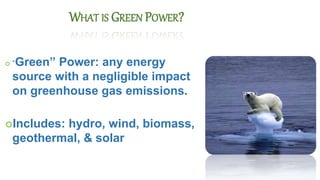
ļ‚¢ ā€œGreenā€ Power: any energy
source with a negligible impact
on greenhouse gas emissions.
ļ‚¢Includes: hydro, wind, biomass,
geothermal, & solar
WHAT IS GREEN POWER?
ļ‚¢ In the 1970s & 1980s the interest in green
power was driven by the goal of replacing
fossil fuels after the first oil shock in the
mid 1970s
ļ‚¢ Now, the broader goal includes minimizing
the emission of CO2.
WHY GREEN POWER ?
Green energies
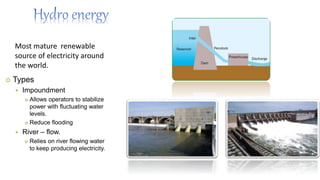
Most mature renewable
source of electricity around
the world.
ļ‚¢ Types
ļ‚— Impoundment
ļ‚¢ Allows operators to stabilize
power with fluctuating water
levels.
ļ‚¢ Reduce flooding
ļ‚— River – flow.
ļ‚¢ Relies on river flowing water
to keep producing electricity.
Wind energy
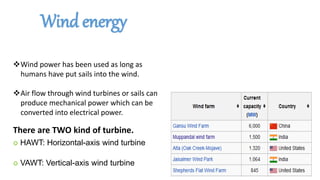
Wind power has been used as long as
humans have put sails into the wind.
Air flow through wind turbines or sails can
produce mechanical power which can be
converted into electrical power.
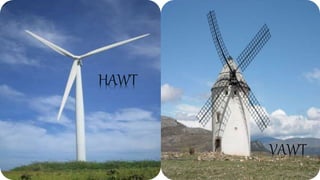
There are TWO kind of turbine.
ļ‚¢ HAWT: Horizontal-axis wind turbine
ļ‚¢ VAWT: Vertical-axis wind turbine
HAWT
VAWT
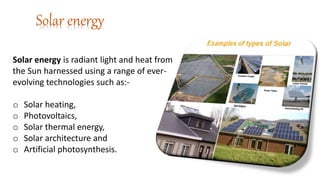
Solar energy
Solar energy is radiant light and heat from
the Sun harnessed using a range of ever-
evolving technologies such as:-
o Solar heating,
o Photovoltaics,
o Solar thermal energy,
o Solar architecture and
o Artificial photosynthesis.
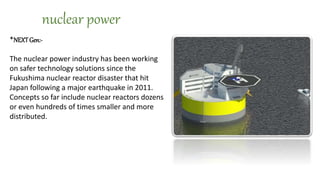
*NEXTGen:-
The nuclear power industry has been working
on safer technology solutions since the
Fukushima nuclear reactor disaster that hit
Japan following a major earthquake in 2011.
Concepts so far include nuclear reactors dozens
or even hundreds of times smaller and more
distributed.
nuclear power
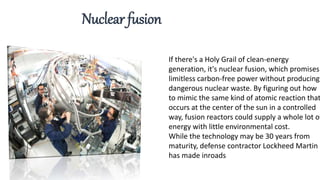
If there's a Holy Grail of clean-energy
generation, it's nuclear fusion, which promises
limitless carbon-free power without producing
dangerous nuclear waste. By figuring out how
to mimic the same kind of atomic reaction that
occurs at the center of the sun in a controlled
way, fusion reactors could supply a whole lot of
energy with little environmental cost.
While the technology may be 30 years from
maturity, defense contractor Lockheed Martin
has made inroads
Nuclear fusion
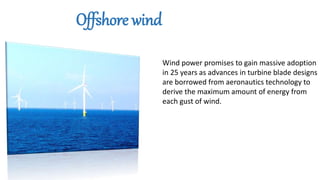
Wind power promises to gain massive adoption
in 25 years as advances in turbine blade designs
are borrowed from aeronautics technology to
derive the maximum amount of energy from
each gust of wind.
Offshore wind
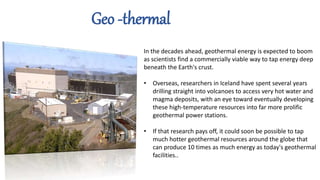
In the decades ahead, geothermal energy is expected to boom
as scientists find a commercially viable way to tap energy deep
beneath the Earth's crust.
• Overseas, researchers in Iceland have spent several years
drilling straight into volcanoes to access very hot water and
magma deposits, with an eye toward eventually developing
these high-temperature resources into far more prolific
geothermal power stations.
• If that research pays off, it could soon be possible to tap
much hotter geothermal resources around the globe that
can produce 10 times as much energy as today's geothermal
facilities..
Geo -thermal
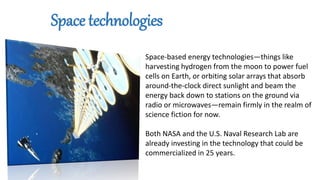
Space-based energy technologies—things like
harvesting hydrogen from the moon to power fuel
cells on Earth, or orbiting solar arrays that absorb
around-the-clock direct sunlight and beam the
energy back down to stations on the ground via
radio or microwaves—remain firmly in the realm of
science fiction for now.
Both NASA and the U.S. Naval Research Lab are
already investing in the technology that could be
commercialized in 25 years.
Space technologies
Green
technology
• hjhgghjfgjhtyery
•Wiki
•Forbes
•CNBC
•Google
•NASA
Green energy

Green energy

  • 1.
  • 2.
    ļ‚¢ What isGreen energy? ļ‚¢ Why Green energy? ļ‚¢ Kinds of Green energy:- ļ‚— Hydro ļ‚— Wind ļ‚— Solar ļ‚¢ 5 upcoming power sources ļ‚¢ Awesome Green technologies ļ‚¢ Conclusion ļ‚¢ Source
  • 3.
    ļ‚¢ ā€œGreenā€ Power:any energy source with a negligible impact on greenhouse gas emissions. ļ‚¢Includes: hydro, wind, biomass, geothermal, & solar WHAT IS GREEN POWER?
  • 4.
    ļ‚¢ In the1970s & 1980s the interest in green power was driven by the goal of replacing fossil fuels after the first oil shock in the mid 1970s ļ‚¢ Now, the broader goal includes minimizing the emission of CO2. WHY GREEN POWER ?
  • 5.
  • 6.
    Most mature renewable sourceof electricity around the world. ļ‚¢ Types ļ‚— Impoundment ļ‚¢ Allows operators to stabilize power with fluctuating water levels. ļ‚¢ Reduce flooding ļ‚— River – flow. ļ‚¢ Relies on river flowing water to keep producing electricity.
  • 8.
    Wind energy Wind powerhas been used as long as humans have put sails into the wind. Air flow through wind turbines or sails can produce mechanical power which can be converted into electrical power. There are TWO kind of turbine. ļ‚¢ HAWT: Horizontal-axis wind turbine ļ‚¢ VAWT: Vertical-axis wind turbine
  • 9.
  • 10.
    Solar energy Solar energyis radiant light and heat from the Sun harnessed using a range of ever- evolving technologies such as:- o Solar heating, o Photovoltaics, o Solar thermal energy, o Solar architecture and o Artificial photosynthesis.
  • 12.
    *NEXTGen:- The nuclear powerindustry has been working on safer technology solutions since the Fukushima nuclear reactor disaster that hit Japan following a major earthquake in 2011. Concepts so far include nuclear reactors dozens or even hundreds of times smaller and more distributed. nuclear power
  • 13.
    If there's aHoly Grail of clean-energy generation, it's nuclear fusion, which promises limitless carbon-free power without producing dangerous nuclear waste. By figuring out how to mimic the same kind of atomic reaction that occurs at the center of the sun in a controlled way, fusion reactors could supply a whole lot of energy with little environmental cost. While the technology may be 30 years from maturity, defense contractor Lockheed Martin has made inroads Nuclear fusion
  • 14.
    Wind power promisesto gain massive adoption in 25 years as advances in turbine blade designs are borrowed from aeronautics technology to derive the maximum amount of energy from each gust of wind. Offshore wind
  • 15.
    In the decadesahead, geothermal energy is expected to boom as scientists find a commercially viable way to tap energy deep beneath the Earth's crust. • Overseas, researchers in Iceland have spent several years drilling straight into volcanoes to access very hot water and magma deposits, with an eye toward eventually developing these high-temperature resources into far more prolific geothermal power stations. • If that research pays off, it could soon be possible to tap much hotter geothermal resources around the globe that can produce 10 times as much energy as today's geothermal facilities.. Geo -thermal
  • 16.
    Space-based energy technologies—thingslike harvesting hydrogen from the moon to power fuel cells on Earth, or orbiting solar arrays that absorb around-the-clock direct sunlight and beam the energy back down to stations on the ground via radio or microwaves—remain firmly in the realm of science fiction for now. Both NASA and the U.S. Naval Research Lab are already investing in the technology that could be commercialized in 25 years. Space technologies
  • 17.
  • 22.
  • 23.

Editor's Notes

  • #4Ā Coal burned in power stations contains carbon which combines with oxygen in the atmosphere to form carbon dioxide. The man-made (or anthropogenic) component of the greenhouse effect is caused by man's activities that emit greenhouse gases to the atmosphere. The most important of these is the burning of fossil fuels
  • #13Ā Think: warehouse-size nuclear plants that power neighborhoods instead of entire cities. Some of the designs for these modular reactors have passive safety mechanisms built in to reduce the chance of any kind of radiation release that rocked Japan. Plans are also to develop nuclear reactors offshore, like the floating platforms the oil and gas industry already uses. These would be able to withstand a Category 5 hurricane. Moreover, because the reactor cores would actually be submerged beneath the platform, a fresh supply of cold seawater would always be available to cool the reactor core even in a case of power loss.
  • #14Ā . In October its researchers developed a small fusion reactor design—one that might someday fit in a tractor-trailer and produce 100 megawatts of power. The company hopes to have a working prototype in five years and a commercial version within a decade.
  • #15Ā Wind turbines will also increasingly move offshore, where countries like Denmark are already showing the rest of the world just how effective offshore wind energy can be. Wind power already provides a third of the country's power and is expected to provide a full 50 percent by 2020. Offshore installations like the 111-turbine Anholt farm, completed last year, provide some 1.27 gigawatts of power, enough to power well more than 1 million households. And because offshore wind resources tend to blow stronger and more consistently than onshore installations, intermittency is less of a problem.
  • #16Ā The goal is to develop more advanced technologies that can be exported in the next decade. It might even one day be feasible to drill geothermal wells offshore; researchers estimate that massive stores of heat energy are reachable just 1,000 meters below the seabed at the Juan de Fuca Ridge off the coast of Washington state
  • #17Ā The ongoing private space renaissance that has seen companies like SpaceX trim the cost of launching cargo into orbit bodes well for more ambitious projects in space. Solaren, a southern California-based start-up, has inked a deal to supply Pacific Gas and Electric with space-based solar power by the end of the decade. Stay tuned.