RENAL FUNCTION
TESTS
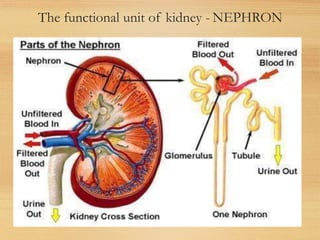
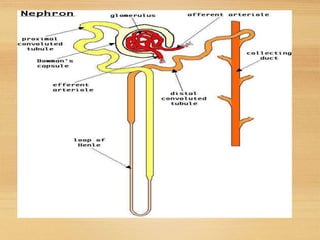
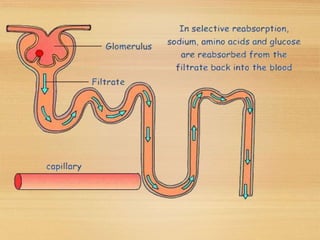
The functional unit of kidney - NEPHRON
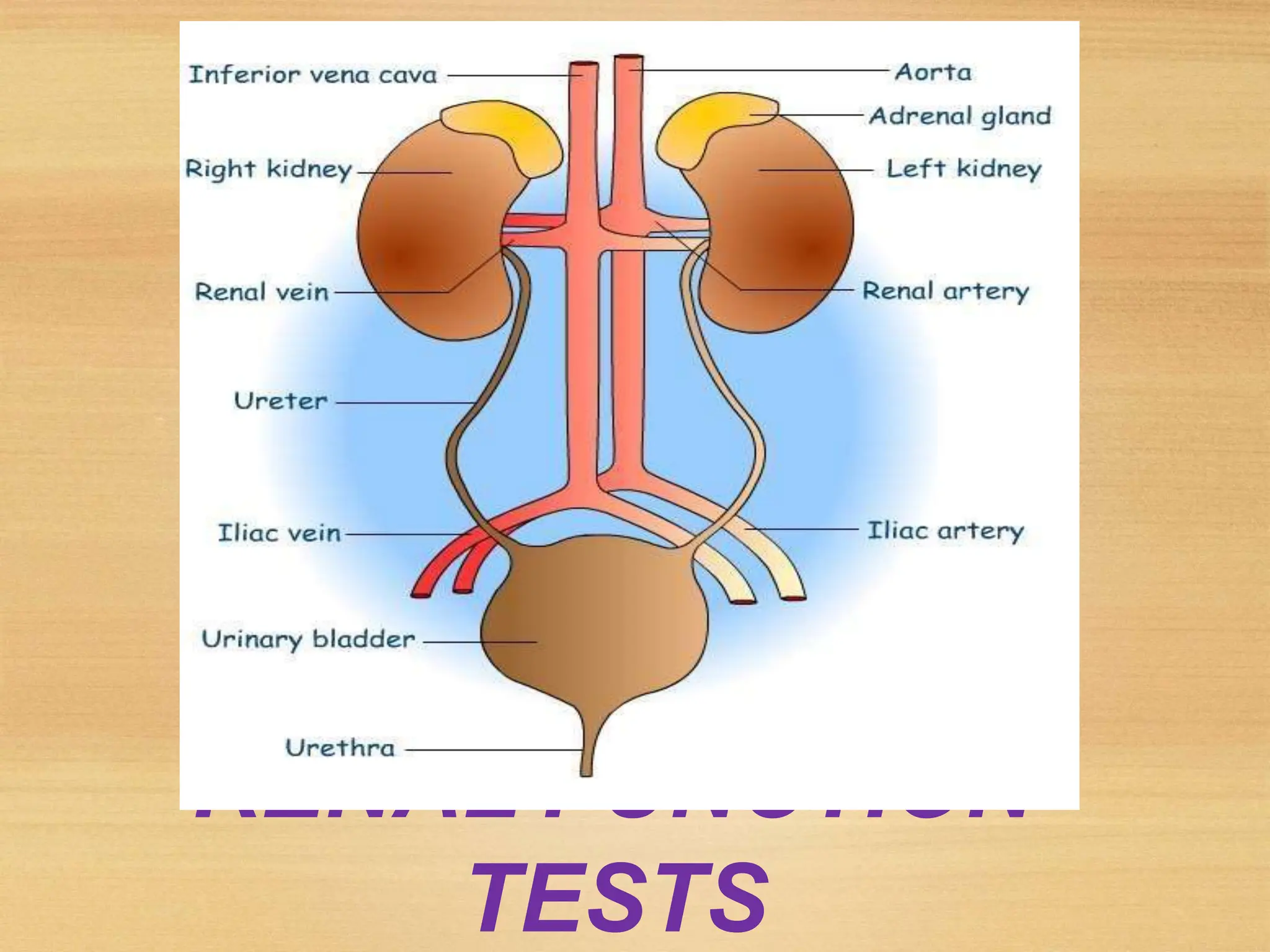
Functions of Kidney
• Formation of Urine as the waste product
• Excretion of NPN substances – Urea,
Creatinine and Uric acid
• Regulation of water, electrolytes & acid-base
balance
• Production of hormones – Erythropoitin,
renin & calcitriol
Assessment of Renal Function
• Assessment of the extent of renal damage
• Monitoring the progression of renal disease
• Monitoring & adjusting the dose of renal toxic
drugs
RFT
• a) those which measure GFR
• b ) those which study tubular function
RFT Classification
1. Urine analysis
- Physical examination
- Chemical examination
- Microscopic examination
2. Assessment of Glomerular function
- Renal Clearance tests
- Blood analaysis of Urea & Creatinine
- Proteinuria
- Hematuria
RFT Classification
3. Tests to measure renal plasma flow
- Para amino hippurate test
4. Tests for assessment of tubular function
- Urine concentration test
- Urine dilution test
- Specific proteinuria or
tubular proteinuria
- aminoaciduria
- Phenosulfonphthalein test (PSP)
5. Renal Biopsy
- to confirm the diagnosis &
renal diseases
RFT - Tests for Glomerular Function
Renal Clearance Tests
To assess the rate of glomerular filtration &
renal blood flow.
“The renal clearance of a substance is defined as
the volume of plasma from which the substance is
completely cleared by the kidneys per minute.”
This - plasma conc. Of the substance & it’s
excretary rate
Depend
On
- GFR
- Renal plasma flow
Renal Clearance Tests
• The GFR (Normal = 120 ml/minute )
• Usually equal to clearance of that substance and is
calculated by the following equation
C = U x V
P
where,
C = clearance of the substance (ml/mt)
U = Conc.of substance in urine (mg/L)
P = Conc.of substance in plasma(mg/L)
V = Vol.of the urine passed per sminute
Renal Clearance Tests
• GFR – Normal 120 ml/minute
• Lower than normal GFR indicate
- Acute tubular necrosis
- Glomerulonephritis
- Shock
- Acute Nephrotic syndrome
- Ac. & Ch. Renal failure
• In order to determine the GFR, the sub.should be
slected in such a way that which is
- freely filtered by glomerulus
- should not be reabsorbed or secreted
- should not be metabolized in the kidney
- should not be toxic
- should not be affected by dietary intake
• The substances which are used for Clearance tests
include :
Endogenous - Creatinine
- Urea
- Inulin
Exogenous
Creatinine Clearance Test
• Based on the rate of excretion by the kidneys of
metabolocally produced creatinine
• Creatinine freely filtered in the glomerulus
• Not reabsorbed by the tubules
(a small amount of creatinine is produced by the
tubules)
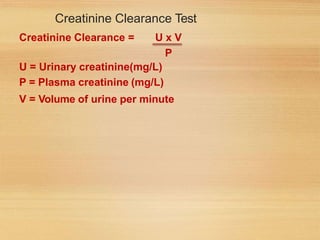
Creatinine Clearance Test
Creatinine Clearance = U x V
P
U = Urinary creatinine(mg/L)
P = Plasma creatinine (mg/L)
V = Volume of urine per minute
Creatinine Clearance Test
• Creatinine Clearance Normal range 90-120 ml/mt
• ↓ Creat. Clearance is very sensitive indicator of
decreased GFR
• ↓ GFR may be caused by
Acute or Chronic damage to glomerulus or any of
its components
• ↓ Blood flow to glomerulus may also produce
decreased creat.clearance
Inulin Clearance Test
• Method of choice when accurate determination of
GFR is required.
• Inulin is polysacharide of Fructose.
freely filtered by glomerulus
not reabsorbed
not secreted or metabolically altered by the renal
tubule.
• Normal value : 120 ml/mt.
Disadvantages : need for its IV adminstratio
technically difficulty of analysis
Blood analysis of Urea & Creatinine
• Impairment of renal function results in elevation of
Blood Urea ( normal : 20 – 40 mg/dl )
Creatinine ( normal : 0.5 – 1.5 mg/dl )
• Plasma urea is less reliable than creatinine because
it is affected by dietary protein & liver function
• So, Creatinine is more sensitive Renal Function Test.
• Uremia :
• Pre renal uremia :
- Dehydration
diarrhea,
severe vomiting
- Diabetic coma.
- severe burns
- intestinal obstruction ,
- Fever and severe infections
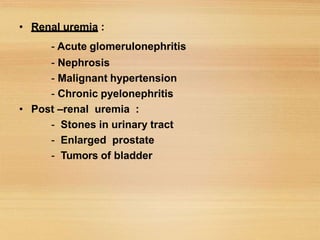
• Renal uremia :
- Acute glomerulonephritis
- Nephrosis
- Malignant hypertension
- Chronic pyelonephritis
• Post –renal uremia :
- Stones in urinary tract
- Enlarged prostate
- Tumors of bladder
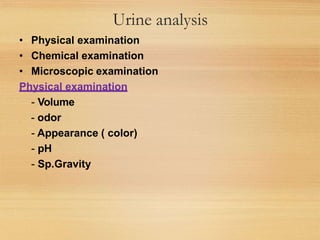
Urine analysis
• Physical examination
• Chemical examination
• Microscopic examination
Physical examination
- Volume
- odor
- Appearance ( color)
- pH
- Sp.Gravity
Urine analysis
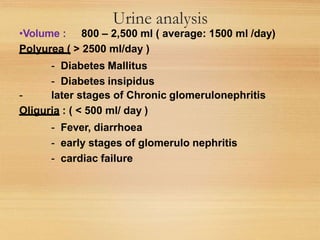
•Volume : 800 – 2,500 ml ( average: 1500 ml /day)
Polyurea ( > 2500 ml/day )
- Diabetes Mallitus
- Diabetes insipidus
- later stages of Chronic glomerulonephritis
Oliguria : ( < 500 ml/ day )
- Fever, diarrhoea
- early stages of glomerulo nephritis
- cardiac failure
Urine
analysis
Anuria : complete cessation of urine
- Acute tubular necrosis
- Bil. Renal stones
- Surgical Schock.
• Appearance & Color :
- Normal urine – transparent
amber color
- Turbity : indicate infection
pale yellow or
Nephrotic syndrome .. fat particles
- Reddish coloration – hematuria
(Renal stones, cancer etc.)
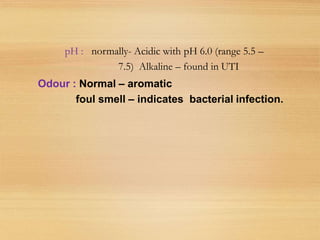
pH : normally- Acidic with pH 6.0 (range 5.5 –
7.5) Alkaline – found in UTI
Odour : Normal – aromatic
foul smell – indicates bacterial infection.
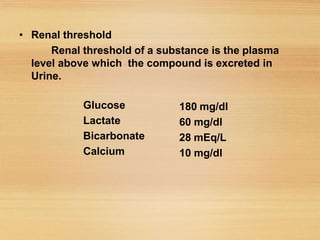
• Renal threshold
Renal threshold of a substance is the plasma
level above which the compound is excreted in
Urine.
Glucose
Lactate
Bicarbonate
Calcium
180 mg/dl
60 mg/dl
28 mEq/L
10 mg/dl
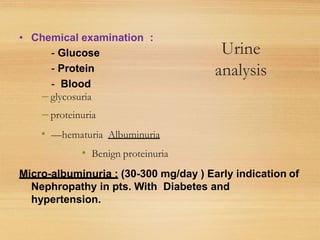
Urine
analysis
– glycosuria
– proteinuria
• —hematuria Albuminuria
• Benign proteinuria
• Chemical examination :
- Glucose
- Protein
- Blood
Micro-albuminuria : (30-300 mg/day ) Early indication of
Nephropathy in pts. With Diabetes and
hypertension.
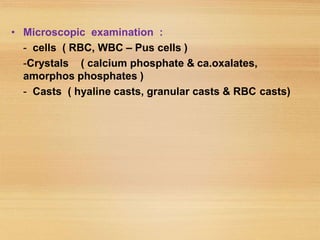
• Microscopic examination :
- cells ( RBC, WBC – Pus cells )
-Crystals ( calcium phosphate & ca.oxalates,
amorphos phosphates )
- Casts ( hyaline casts, granular casts & RBC casts)
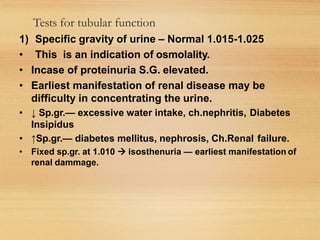
Tests for tubular function
1) Specific gravity of urine – Normal 1.015-1.025
• This is an indication of osmolality.
• Incase of proteinuria S.G. elevated.
• Earliest manifestation of renal disease may be
difficulty in concentrating the urine.
• ↓ Sp.gr.— excessive water intake, ch.nephritis, Diabetes
Insipidus
• ↑Sp.gr.— diabetes mellitus, nephrosis, Ch.Renal failure.
• Fixed sp.gr. at 1.010  isosthenuria — earliest manifestation of
renal dammage.
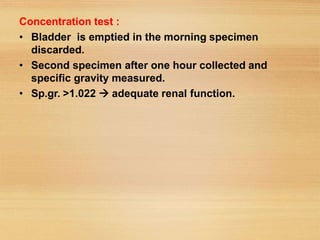
Concentration test :
• Bladder is emptied in the morning specimen
discarded.
• Second specimen after one hour collected and
specific gravity measured.
• Sp.gr. >1.022  adequate renal function.
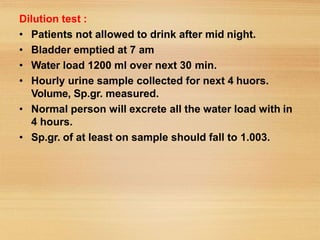
Dilution test :
• Patients not allowed to drink after mid night.
• Bladder emptied at 7 am
• Water load 1200 ml over next 30 min.
• Hourly urine sample collected for next 4 huors.
Volume, Sp.gr. measured.
• Normal person will excrete all the water load with in
4 hours.
• Sp.gr. of at least on sample should fall to 1.003.
RENAL FUNCTION TESTS FOR PARAMEDICAL AND MEDICAL STUDENTS

RENAL FUNCTION TESTS FOR PARAMEDICAL AND MEDICAL STUDENTS

  • 1.
  • 2.
    The functional unitof kidney - NEPHRON
  • 5.
    Functions of Kidney •Formation of Urine as the waste product • Excretion of NPN substances – Urea, Creatinine and Uric acid • Regulation of water, electrolytes & acid-base balance • Production of hormones – Erythropoitin, renin & calcitriol
  • 6.
    Assessment of RenalFunction • Assessment of the extent of renal damage • Monitoring the progression of renal disease • Monitoring & adjusting the dose of renal toxic drugs
  • 7.
    RFT • a) thosewhich measure GFR • b ) those which study tubular function
  • 8.
    RFT Classification 1. Urineanalysis - Physical examination - Chemical examination - Microscopic examination 2. Assessment of Glomerular function - Renal Clearance tests - Blood analaysis of Urea & Creatinine - Proteinuria - Hematuria
  • 9.
    RFT Classification 3. Teststo measure renal plasma flow - Para amino hippurate test 4. Tests for assessment of tubular function - Urine concentration test - Urine dilution test - Specific proteinuria or tubular proteinuria - aminoaciduria - Phenosulfonphthalein test (PSP) 5. Renal Biopsy - to confirm the diagnosis & renal diseases
  • 10.
    RFT - Testsfor Glomerular Function Renal Clearance Tests To assess the rate of glomerular filtration & renal blood flow. “The renal clearance of a substance is defined as the volume of plasma from which the substance is completely cleared by the kidneys per minute.” This - plasma conc. Of the substance & it’s excretary rate Depend On - GFR - Renal plasma flow
  • 11.
    Renal Clearance Tests •The GFR (Normal = 120 ml/minute ) • Usually equal to clearance of that substance and is calculated by the following equation C = U x V P where, C = clearance of the substance (ml/mt) U = Conc.of substance in urine (mg/L) P = Conc.of substance in plasma(mg/L) V = Vol.of the urine passed per sminute
  • 12.
    Renal Clearance Tests •GFR – Normal 120 ml/minute • Lower than normal GFR indicate - Acute tubular necrosis - Glomerulonephritis - Shock - Acute Nephrotic syndrome - Ac. & Ch. Renal failure
  • 13.
    • In orderto determine the GFR, the sub.should be slected in such a way that which is - freely filtered by glomerulus - should not be reabsorbed or secreted - should not be metabolized in the kidney - should not be toxic - should not be affected by dietary intake
  • 14.
    • The substanceswhich are used for Clearance tests include : Endogenous - Creatinine - Urea - Inulin Exogenous
  • 15.
    Creatinine Clearance Test •Based on the rate of excretion by the kidneys of metabolocally produced creatinine • Creatinine freely filtered in the glomerulus • Not reabsorbed by the tubules (a small amount of creatinine is produced by the tubules)
  • 16.
    Creatinine Clearance Test CreatinineClearance = U x V P U = Urinary creatinine(mg/L) P = Plasma creatinine (mg/L) V = Volume of urine per minute
  • 17.
    Creatinine Clearance Test •Creatinine Clearance Normal range 90-120 ml/mt • ↓ Creat. Clearance is very sensitive indicator of decreased GFR • ↓ GFR may be caused by Acute or Chronic damage to glomerulus or any of its components • ↓ Blood flow to glomerulus may also produce decreased creat.clearance
  • 18.
    Inulin Clearance Test •Method of choice when accurate determination of GFR is required. • Inulin is polysacharide of Fructose. freely filtered by glomerulus not reabsorbed not secreted or metabolically altered by the renal tubule. • Normal value : 120 ml/mt. Disadvantages : need for its IV adminstratio technically difficulty of analysis
  • 19.
    Blood analysis ofUrea & Creatinine • Impairment of renal function results in elevation of Blood Urea ( normal : 20 – 40 mg/dl ) Creatinine ( normal : 0.5 – 1.5 mg/dl ) • Plasma urea is less reliable than creatinine because it is affected by dietary protein & liver function • So, Creatinine is more sensitive Renal Function Test.
  • 20.
    • Uremia : •Pre renal uremia : - Dehydration diarrhea, severe vomiting - Diabetic coma. - severe burns - intestinal obstruction , - Fever and severe infections
  • 21.
    • Renal uremia: - Acute glomerulonephritis - Nephrosis - Malignant hypertension - Chronic pyelonephritis • Post –renal uremia : - Stones in urinary tract - Enlarged prostate - Tumors of bladder
  • 22.
    Urine analysis • Physicalexamination • Chemical examination • Microscopic examination Physical examination - Volume - odor - Appearance ( color) - pH - Sp.Gravity
  • 23.
    Urine analysis •Volume :800 – 2,500 ml ( average: 1500 ml /day) Polyurea ( > 2500 ml/day ) - Diabetes Mallitus - Diabetes insipidus - later stages of Chronic glomerulonephritis Oliguria : ( < 500 ml/ day ) - Fever, diarrhoea - early stages of glomerulo nephritis - cardiac failure
  • 24.
    Urine analysis Anuria : completecessation of urine - Acute tubular necrosis - Bil. Renal stones - Surgical Schock. • Appearance & Color : - Normal urine – transparent amber color - Turbity : indicate infection pale yellow or Nephrotic syndrome .. fat particles - Reddish coloration – hematuria (Renal stones, cancer etc.)
  • 25.
    pH : normally-Acidic with pH 6.0 (range 5.5 – 7.5) Alkaline – found in UTI Odour : Normal – aromatic foul smell – indicates bacterial infection.
  • 26.
    • Renal threshold Renalthreshold of a substance is the plasma level above which the compound is excreted in Urine. Glucose Lactate Bicarbonate Calcium 180 mg/dl 60 mg/dl 28 mEq/L 10 mg/dl
  • 27.
    Urine analysis – glycosuria – proteinuria •—hematuria Albuminuria • Benign proteinuria • Chemical examination : - Glucose - Protein - Blood Micro-albuminuria : (30-300 mg/day ) Early indication of Nephropathy in pts. With Diabetes and hypertension.
  • 28.
    • Microscopic examination: - cells ( RBC, WBC – Pus cells ) -Crystals ( calcium phosphate & ca.oxalates, amorphos phosphates ) - Casts ( hyaline casts, granular casts & RBC casts)
  • 29.
    Tests for tubularfunction 1) Specific gravity of urine – Normal 1.015-1.025 • This is an indication of osmolality. • Incase of proteinuria S.G. elevated. • Earliest manifestation of renal disease may be difficulty in concentrating the urine. • ↓ Sp.gr.— excessive water intake, ch.nephritis, Diabetes Insipidus • ↑Sp.gr.— diabetes mellitus, nephrosis, Ch.Renal failure. • Fixed sp.gr. at 1.010  isosthenuria — earliest manifestation of renal dammage.
  • 30.
    Concentration test : •Bladder is emptied in the morning specimen discarded. • Second specimen after one hour collected and specific gravity measured. • Sp.gr. >1.022  adequate renal function.
  • 31.
    Dilution test : •Patients not allowed to drink after mid night. • Bladder emptied at 7 am • Water load 1200 ml over next 30 min. • Hourly urine sample collected for next 4 huors. Volume, Sp.gr. measured. • Normal person will excrete all the water load with in 4 hours. • Sp.gr. of at least on sample should fall to 1.003.