This document discusses renal blood flow (RBF), including its volume, functions, and regulation. RBF is approximately 1-1.2 L/min, or 20-25% of cardiac output. It is regulated through autoregulation, neural control, and hormonal mechanisms. Autoregulation maintains RBF within a narrow range despite changes in blood pressure via myogenic responses and tubuloglomerular feedback. Neural and hormonal control further regulate RBF through vasoconstriction and vasodilation. RBF can be measured using the clearance of para-aminohippuric acid (PAH), which is excreted by the kidneys without being reabsorbed or metabolized.

![Renal Blood Flow (RBF)
• = 1 - 1.2 L/min
• =20-25% of cardiac output
• Directed mainly to the cortex
• (90%) to the cortex, only [10%] to the medulla?
• The low blood flow to the medulla maintains its
high osmolarity. ?](https://image.slidesharecdn.com/renalbloodflow-220912122638-7ce214f0/85/Renal-blood-flow-pdf-3-320.jpg)

![Regulation of renal blood flow
Why?
Optimum GFR ; how?
[1] Autoregulation
[2] Neural regulation
[3] Hormonal regulation](https://image.slidesharecdn.com/renalbloodflow-220912122638-7ce214f0/85/Renal-blood-flow-pdf-5-320.jpg)

![[1] Autoregulation
• The ability to maintain RBF & GFR within
narrow limits despite changes in mean arterial
pressure (MAP) - perfusion pressure.
• RBF is maintained constant between (80-180
mm/Hg) of MAP.
• Independent of renal nerves & circulating
hormones.
• Seen in isolated perfused Kidneys
• Autoregulation =stabilization of blood flow](https://image.slidesharecdn.com/renalbloodflow-220912122638-7ce214f0/85/Renal-blood-flow-pdf-7-320.jpg)

![[1] Autoregulation (mechanisms)
Two mechanisms:
A. Myogenic response (reactive contraction
to stretch – afferent arteriole)
B. Tubulo-glomerular feed back (macula
densa)](https://image.slidesharecdn.com/renalbloodflow-220912122638-7ce214f0/85/Renal-blood-flow-pdf-9-320.jpg)


![[3] Hormonal regulation of renal
blood flow
Catecholamines
RBF by constricting both afferent and
efferent arterioles (afferent more).
Dopamine
RBF by vasodilatation](https://image.slidesharecdn.com/renalbloodflow-220912122638-7ce214f0/85/Renal-blood-flow-pdf-13-320.jpg)
![[3] Hormonal regulation:
• Angiotensin II (at low perfusion pressure)
• by constricting efferent arterioles thus maintain GFR
• ACE inhibitors and Renal failure in patients with poor renal
perfusion
• ADH (Vasopressin)
• In physiological levels decreases blood flow via vasa recta
• High levels decreases renal blood flow
• Prostaglandin (locally produced)
• Vasodilators (PGI2)
• Vasoconstrictors (TXA2)
• Increase the blood flow in the cortex and decrease it in the
medulla ( Chronic use of Aspirin ?)](https://image.slidesharecdn.com/renalbloodflow-220912122638-7ce214f0/85/Renal-blood-flow-pdf-14-320.jpg)

![Fick’s Principle for measurement
of blood flow
• The amount of a substance taken up by an
organ in a given time equals the arterio-
venous difference in concentration times
the blood flow to the organ.
• Qx= ([Ax]-[Vx]) x Blood flow
• Renal plasma flow = Qx
Renal[Ax] - [Vx]](https://image.slidesharecdn.com/renalbloodflow-220912122638-7ce214f0/85/Renal-blood-flow-pdf-18-320.jpg)

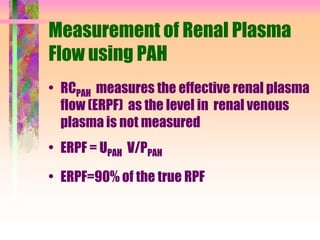
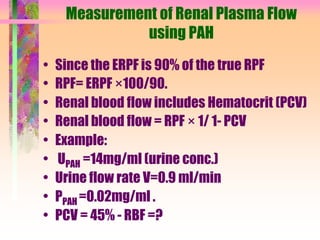
![Measurement of Renal Plasma
Flow using PAH
• Since the PAH is highly secreted then its
concentration in renal veins =0
• By applying Fick’s principle:
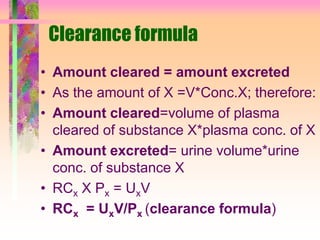
• Plasma blood flow = Qx = (UPAH V)
[APAH] - [VPAH]
[VPAH]= 0 ; A= PPAH
RPF= UPAHV/ PPAH (clearance formula)](https://image.slidesharecdn.com/renalbloodflow-220912122638-7ce214f0/85/Renal-blood-flow-pdf-20-320.jpg)