Peritoneal Dialysis Prescription
               &
          Adequatcy
     Piti Niyomsirivanich,MD.
• Peritoneal dialysis prescription
  – Acute
     •   Introduction
     •   Peritoneal Catheter
     •   Use of automate cycler
     •   Prescribing acute peritoneal dialysis
     •   Complications
• Chronic
  • Choice of PD treatment modality
     – Modalities of PD therapy CAPD , APD ,hybrid
     – CAPD or PD ?
  • Choice of prescription
     –   Clearance targets
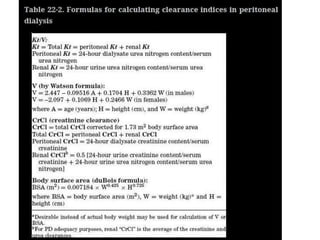
     –   Measurement of clearance
     –   Determinants of clearance
     –   prescription
  • Nutritional issues in PD
Acute peritoneal dialysis
      presciption
• Peritoneal dialysis prescription
  – Acute
     •   Introduction
     •   Peritoneal Catheter
     •   Use of automate cycler
     •   Prescribing acute peritoneal dialysis
     •   Complications
Introduction
• Acute Peritoneal Dialysis
  – Nonvascular alternative for dialysis
  – Acutely less efficient than conventional
    hemodialysis
Adventage / Disadventage
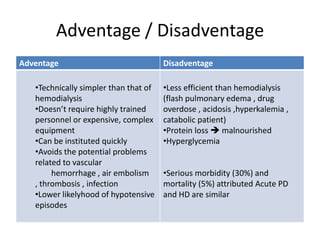
Adventage                              Disadventage

   •Technically simpler than that of   •Less efficient than hemodialysis
   hemodialysis                        (flash pulmonary edema , drug
   •Doesn’t require highly trained     overdose , acidosis ,hyperkalemia ,
   personnel or expensive, complex     catabolic patient)
   equipment                           •Protein loss  malnourished
   •Can be instituted quickly          •Hyperglycemia
   •Avoids the potential problems
   related to vascular
        hemorrhage , air embolism      •Serious morbidity (30%) and
   , thrombosis , infection            mortality (5%) attributed Acute PD
   •Lower likelyhood of hypotensive    and HD are similar
   episodes
Indications
• Acute renal failure
• Benefit in volume overload with
  cardiovascular compromise
• Hypothermia
• Hemorrhagic pancreatitis
• Most beneficial in Rx of hemodynamically
  unstable
Contraindications
• Recent surgery requiring abdominal drains
• Known fecal or fungal peritonitis
• Pleuroperitoneal fistula

• Relative contraindication
  –   Severe hypercatabolic states
  –   Abdominal wall cellulitis
  –   Adynamic ileus
  –   Presence of abdominal adhesions or fibrosis
  –   New aortic prosthesis
• Peritoneal dialysis prescription
  – Acute
     •   Introduction
     •   Peritoneal Catheter
     •   Use of automate cycler
     •   Prescribing acute peritoneal dialysis
     •   Complications
Peritoneal catheter
• Pts. With
  – multiorgan system failure
                                      Can be anticipated
  – Prolong period of renal failure
• initial insertion of a Tenckhoff catheter
  (preferred > uncuffed temporary catheter) is
  recommended
• Peritoneal dialysis prescription
  – Acute
     •   Introduction
     •   Peritoneal Catheter
     •   Use of automate cycler
     •   Prescribing acute peritoneal dialysis
     •   Complications
Use of automated cyclers
• Traditionally been done using manual exchanged

• Automated cyclers are being used instead
   – Saving nursing time (30-60 minutes exchange time)
• Peritoneal dialysis prescription
  – Acute
     •   Introduction
     •   Peritoneal Catheter
     •   Use of automate cycler
     •   Prescribing acute peritoneal dialysis
     •   Complications
Prescribing acute peritoneal dialysis
• A: Session length
  – In the setting of acute renal failure (catabolic ,
    oliguric ), continuous removal of fluids and solutes
    is required
  – Need for hourly exchange on a continuous basis
    for days or weeks
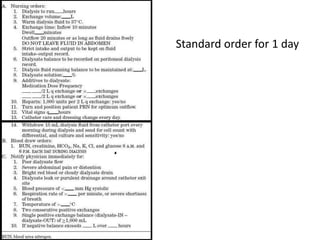
  – Order for One day
Standard order for 1 day
Exchange volume
• Average-sized adult can usually tolerate 2L
  exchanges
   – Those with abdominal wall or inguinal hernias, the
     exchange volume should be reduced

• Some may prefer start with smaller volumes(1-
  1.5 L) for the first few exchanges

• The larger volume is , the greater the clearance
  and UF rates
Exchange time
  – Inflow 15 – dwell 30 - drain 15
  – 1 hr.
• Inflow time
  – Gravity
  – 10 min.
  – Prolonged
     • Kinking
     • Inflow resistance
• Inflow pain due to acidic , hypertonic solution
Exchange time
• Dwell period
• Standard dwell period
  – Usual dwell time is 30 min
  – 2L per exchage 48 L per day
  – [Urea] in drained dialysate will be 50-60% of plasma
• More stable patients
  – If Not extremely hypercatabolic state
     •  longer dwell time 1.5-5 hrs


  – At 5 hrs [UREA] dialysate = [UREA]plasma
Exchange time
• Outflow time
  – Gravity
  – 20-30 min
  – Depend on
     •   Total volume
     •   Resistance to outflow
     •   Height
     •   1st exchange
     •   Outflow obstruction
     •   Outflow pain
CEPD (Continouous equilibration
           peritoneal dialysis)
•   Alternative approach
•   Modified version of CAPD
•   Standard manual exchange every 3 to 6 hours
•   Adventage
    – Simplicity
    – Lower cost
    – Less labor-intense
• Disadventage
    – Clearance are less
    – Not be adequate in more catabolic patient
Choosing the dialysis solution
• 1.5% dextrose
  – Sufficient to remove 50-150 of fluid per hour (2L
    ,60min exchange time)
  – UF rate 1.2-3.6 L/day
• 4.25% dextrose
  – UF 300-400 ml/hr
  – Acquired for treatment of CHF
Effect of peritonitis
• During peritonitis
  – Enhanced absorption of glucose
  – Rapidly reducing the osmotic gradient

  – Maintaining the efficiency of UF
     • reduced exchange time
     • More hypertonic exchange
Dialysis Solution additives
• KCl
  – Hypokalemia  KCl 3-5 mEq/L can be added
  – Correction of acidosis K shift  hypokalemia
• Heparin
  – Catheter obstruction due to fibrin
  – 1000 U/2 L
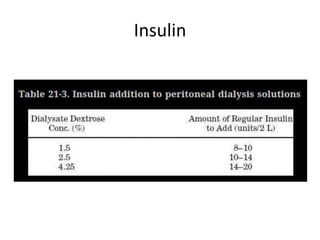
• Insulin
  – Glucose absorbed from the dialysis solution
Insulin
• Antibiotics
  – Intraperitoneal administration
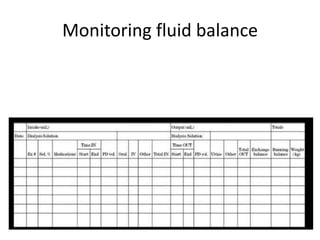
Monitoring fluid balance
Monitor Clearance
• In general
  – BUN should maintain below 80 mg/dl

  – D:P ratio for urea
     • [BUN]dialysate : [BUN]plasma ratio
     • Multiplied by total daily dialysate volume urea daily
       clearance
     • Should be at least 10 ml/min
     • 20-30 ml/min in hypercatabolic patient
• Peritoneal dialysis prescription
  – Acute
     •   Introduction
     •   Peritoneal Catheter
     •   Use of automate cycler
     •   Prescribing acute peritoneal dialysis
     •   Complications
Complications
• Abdominal distention
  – Incomplete drainage
• Peritonitis
  – 12% of cases
  – Occur within first 48 hrs
  – Gram +ve organisms (>50%)
  – Prolong used of Multiple antibiotics  fungus
• Hypotention
  – Removal large amout of fluid
Complications
• Hyperglycemia
  – IP insulin
• Hypernatremia
  – UF generated in PD [Na] 70 mEq/L
  – Increased loss of water
• Hypoalbuminemia
  – Protein loss 10-20 gm /day
  – Early oral or parenteral hyperalimentation should
    be instituted
Adequacy of Peritoneal Dialysis and
   Chronic Peritoneal Dialysis
          Prescription
• Chronic
  • Choice of PD treatment modality
     – Modalities of PD therapy CAPD , APD ,hybrid
     – CAPD or PD ?
  • Choice of prescription
     –   Clearance targets
     –   Measurement of clearance
     –   Determinants of clearance
     –   prescription
  • Nutritional issues in PD
• Choice of modality
  –   CAPD
  –   APD
  –   Variant of APD : CCPD , NIPD
  –   hybrid

• Selection based on
  – Clearance
  – UF
  – Nutritional requirement
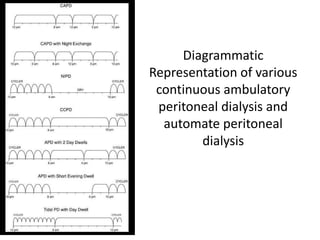
Diagrammatic
Representation of various
 continuous ambulatory
 peritoneal dialysis and
  automate peritoneal
        dialysis
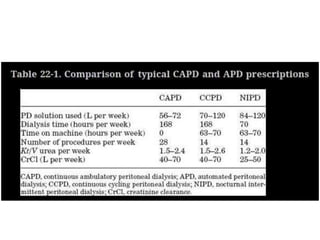
Modality of peritoneal dialysis therapy
• CAPD
  – Low cost
  – Freedom from dialysis machinery
  – Continuous therapy and a steady physiologic state
  – Nomalization of blood pressure is possible in most
    patients.
  – Multiple procedural sessions
  – Can be done away from home
  – Episodes of peritonitis
Modality of peritoneal dialysis therapy
• APD
  – CCPD
    • Continuous therapy
    • Need for cycler
    • Complications associated c a prolonged day dwell
        – Excessive resorption of dialysate
            » Icodextrin are useful in day dwell
  – NIPD
    • No dialysis fluid during day time
    • Suitable for patient with good residual renal function
• Hybrid forms of PD
  – CAPD with automated nocturnal exchange
        • A night exchange device


  – APD with additional exchange during the day

• IPD
  – Almost extinct
  – Cycler in hospital 2-3 times weekly duration 12-24 hr
• Chronic
  • Choice of PD treatment modality
     – Modalities of PD therapy CAPD , APD ,hybrid
     – CAPD or PD ?
  • Choice of prescription
     –   Clearance targets
     –   Measurement of clearance
     –   Determinants of clearance
     –   prescription
  • Nutritional issues in PD
CAPD or APD
• Based on
  – Lifestyle ,emplyment , place of residence comfort
    with the cycle technology and family and social
    support
• Previously APD better than APD
  – Na Sieving
     • Risk of net fluid resorption with long day dwells
     • Led to concerns about Na removal with APD
  – Systolic hypertension with APD > CAPD (no
    randomized trial but generalizable)
• Risk of peritonitis
  – Decade ago
     • APD showed less peritonitis
     • But APD techinique improved now


• Relative cost
• Chronic
  • Choice of PD treatment modality
     – Modalities of PD therapy CAPD , APD ,hybrid
     – CAPD or PD ?
  • Choice of prescription
     –   Clearance targets
     –   Measurement of clearance
     –   Determinants of clearance
     –   prescription
  • Nutritional issues in PD
Choice of a prescription
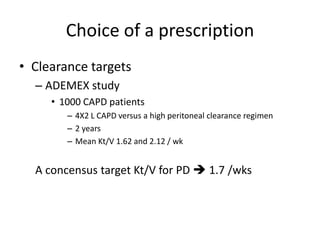
• Clearance targets
  – ADEMEX study
     • 1000 CAPD patients
        – 4X2 L CAPD versus a high peritoneal clearance regimen
        – 2 years
        – Mean Kt/V 1.62 and 2.12 / wk


  A concensus target Kt/V for PD  1.7 /wks
• Chronic
  • Choice of PD treatment modality
     – Modalities of PD therapy CAPD , APD ,hybrid
     – CAPD or PD ?
  • Choice of prescription
     –   Clearance targets
     –   Measurement of clearance
     –   Determinants of clearance
     –   prescription
  • Nutritional issues in PD
Frequency of measurement
• Within 1 month of initiation
• And then q 4 months

• Discordance between Kt/V and CrCl
  – APD
     • Cr has higher molecular weight than urea
• Chronic
  • Choice of PD treatment modality
     – Modalities of PD therapy CAPD , APD ,hybrid
     – CAPD or PD ?
  • Choice of prescription
     –   Clearance targets
     –   Measurement of clearance
     –   Determinants of clearance
     –   prescription
  • Nutritional issues in PD
Determinants of clearance
• Residual renal function
  – Account for as much as 50% of total clearance
  – Preserved in patient on CAPD
     •  ACEI ,ARB
     • Avoid nephrotoxic agents i.e. aminoglycoside
• Peritoneal transport status
  – PET
     • Low transporter  high volume ,long duration dwell
          – Low average
          – High average
     • High transporter  short duration dwell
• Body size
  – Large body size  harder to achieve clearance


• Prescription
  – Change
  – Focus on lifestyle factors
• Chronic
  • Choice of PD treatment modality
     – Modalities of PD therapy CAPD , APD ,hybrid
     – CAPD or PD ?
  • Choice of prescription
     –   Clearance targets
     –   Measurement of clearance
     –   Determinants of clearance
     –   prescription
  • Nutritional issues in PD
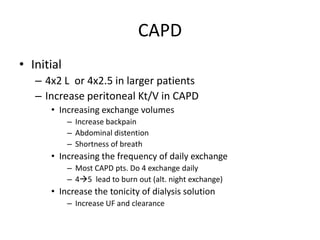
CAPD
• Initial
   – 4x2 L or 4x2.5 in larger patients
   – Increase peritoneal Kt/V in CAPD
      • Increasing exchange volumes
            – Increase backpain
            – Abdominal distention
            – Shortness of breath
      • Increasing the frequency of daily exchange
            – Most CAPD pts. Do 4 exchange daily
            – 45 lead to burn out (alt. night exchange)
      • Increase the tonicity of dialysis solution
            – Increase UF and clearance
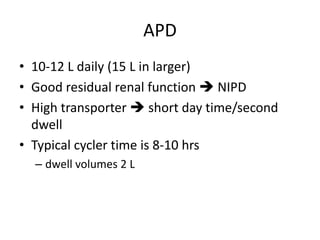
APD
• 10-12 L daily (15 L in larger)
• Good residual renal function  NIPD
• High transporter  short day time/second
  dwell
• Typical cycler time is 8-10 hrs
  – dwell volumes 2 L
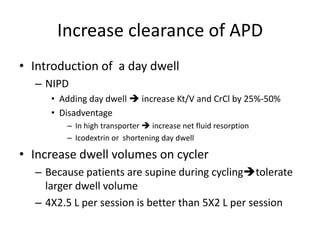
Increase clearance of APD
• Introduction of a day dwell
  – NIPD
     • Adding day dwell  increase Kt/V and CrCl by 25%-50%
     • Disadventage
        – In high transporter  increase net fluid resorption
        – Icodextrin or shortening day dwell

• Increase dwell volumes on cycler
  – Because patients are supine during cyclingtolerate
    larger dwell volume
  – 4X2.5 L per session is better than 5X2 L per session
Increase clearance of APD
• Time on cycler
   – The longer time ,the better clearance


• Increasing frequency of cycles
   – More frequent cycle  increase clearance on APD
   – But More frequent cycle Dialysis time lost


• Increasing dialysis solution tonicity
   – concern about glocose-related complications arise
Incremental versus maximal prescription

• Incremental approach
  – Suitable when dialysis is being initiated early
  – 2-3 CAPD exchanges daily or a low-volume

  – Less costly and less onerous
  – Decrease total glucose exposure and risk of peritonitis

  – Require regular monitoring of resiual function
     • To ensure that the clearance achieved doesn’t below target
       levels
Empirical versus Modeled approach

• Modeled approach
•     collecting patient anthropometric data , PET , residual
  renal function

• Computer program uses the data to predict

• Actual clearance still have to be measure
•     because discrepancy between actual and modeled
Empirical versus Modeled approach

• Empirical approach
   – Physician uses knowledge of the patient’s size , residual renal function
     , and peritoneal transport status
   – And choose a resonable prescription

   – Advantage
       • Less trial and error
       • Earlier identification of an appropriate prescription
Prescription pitfalls in peritoneal dialysis
• Loss of residual renal function
    – Not monitored closely enough

• Noncompliance
    – No single test that identifies this problem
    – Serial measurement of 24-hr dialysate plus urinary Cr excretion
• High serum creatinine despite good clearances
    – Kt/V > 1.7/wk but serum Cr > 12-15
    – Non compliance

    – Kt/V high and CrCl low
    – Residual renal function fades away

    – Hight lean body mass
• Inappropriate switch form CAPD to APD
  – Particular in low transporter


• Inadequate attention to fluid removal
  – Particular in high , high-average transporter and
    long dwells that result in net fluid resorption
• Chronic
  • Choice of PD treatment modality
     – Modalities of PD therapy CAPD , APD ,hybrid
     – CAPD or PD ?
  • Choice of prescription
     –   Clearance targets
     –   Measurement of clearance
     –   Determinants of clearance
     –   prescription
  • Nutritional issues in PD
Nutritional Issues in PD
• nPNA
  – Normalized protein equivalent of nitrogen appearance
  – Include
     • Serum albumin
     • Subjective global assessment
     • Lean body mass
  – Measure 24 hr of dialysate and urine (intake
    output)
  – Bergstrom
  – Recommend 1.2 gm/kg/day
• Caloric intake
  – = dietary intake + glucose absorbed
  – 35 kcal/kg/day
  – 10-30% come from glucose (depend on tonicity)
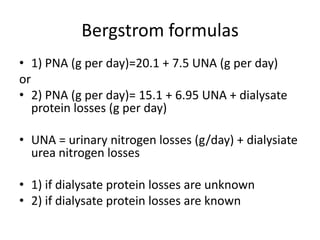
Bergstrom formulas
• 1) PNA (g per day)=20.1 + 7.5 UNA (g per day)
or
• 2) PNA (g per day)= 15.1 + 6.95 UNA + dialysate
   protein losses (g per day)

• UNA = urinary nitrogen losses (g/day) + dialysiate
  urea nitrogen losses

• 1) if dialysate protein losses are unknown
• 2) if dialysate protein losses are known
Serum albumin
• Strongest predictors of patient survival on PD
• Influences
  – dialysate albumin losses
  – Inflammation
  – More than dietary protein intake
Subject global assessment
• Simple clinical tool
• Predict patient outcome
• KDOQI , Canadian Society
Creatinine excretion
• 24 hr urine and dialysate collections
Treatment of malnutrition
• Dietitian support
   – Dietition to ensure adequate protein intake
• Nutritional Supplement

• Promotility agent
   – Gastric emptying is impaired
• Anabolic steroid
   – 1 RCT ,Nandrolone 100 mg IM weekly for 6 months 
     improve lean body mass
• Amino acid
   – amino acid based dwell

PD prescription

  • 1.
    Peritoneal Dialysis Prescription & Adequatcy Piti Niyomsirivanich,MD.
  • 2.
    • Peritoneal dialysisprescription – Acute • Introduction • Peritoneal Catheter • Use of automate cycler • Prescribing acute peritoneal dialysis • Complications
  • 3.
    • Chronic • Choice of PD treatment modality – Modalities of PD therapy CAPD , APD ,hybrid – CAPD or PD ? • Choice of prescription – Clearance targets – Measurement of clearance – Determinants of clearance – prescription • Nutritional issues in PD
  • 4.
  • 5.
    • Peritoneal dialysisprescription – Acute • Introduction • Peritoneal Catheter • Use of automate cycler • Prescribing acute peritoneal dialysis • Complications
  • 6.
    Introduction • Acute PeritonealDialysis – Nonvascular alternative for dialysis – Acutely less efficient than conventional hemodialysis
  • 7.
    Adventage / Disadventage Adventage Disadventage •Technically simpler than that of •Less efficient than hemodialysis hemodialysis (flash pulmonary edema , drug •Doesn’t require highly trained overdose , acidosis ,hyperkalemia , personnel or expensive, complex catabolic patient) equipment •Protein loss  malnourished •Can be instituted quickly •Hyperglycemia •Avoids the potential problems related to vascular hemorrhage , air embolism •Serious morbidity (30%) and , thrombosis , infection mortality (5%) attributed Acute PD •Lower likelyhood of hypotensive and HD are similar episodes
  • 8.
    Indications • Acute renalfailure • Benefit in volume overload with cardiovascular compromise • Hypothermia • Hemorrhagic pancreatitis • Most beneficial in Rx of hemodynamically unstable
  • 9.
    Contraindications • Recent surgeryrequiring abdominal drains • Known fecal or fungal peritonitis • Pleuroperitoneal fistula • Relative contraindication – Severe hypercatabolic states – Abdominal wall cellulitis – Adynamic ileus – Presence of abdominal adhesions or fibrosis – New aortic prosthesis
  • 10.
    • Peritoneal dialysisprescription – Acute • Introduction • Peritoneal Catheter • Use of automate cycler • Prescribing acute peritoneal dialysis • Complications
  • 11.
    Peritoneal catheter • Pts.With – multiorgan system failure Can be anticipated – Prolong period of renal failure • initial insertion of a Tenckhoff catheter (preferred > uncuffed temporary catheter) is recommended
  • 12.
    • Peritoneal dialysisprescription – Acute • Introduction • Peritoneal Catheter • Use of automate cycler • Prescribing acute peritoneal dialysis • Complications
  • 13.
    Use of automatedcyclers • Traditionally been done using manual exchanged • Automated cyclers are being used instead – Saving nursing time (30-60 minutes exchange time)
  • 14.
    • Peritoneal dialysisprescription – Acute • Introduction • Peritoneal Catheter • Use of automate cycler • Prescribing acute peritoneal dialysis • Complications
  • 15.
    Prescribing acute peritonealdialysis • A: Session length – In the setting of acute renal failure (catabolic , oliguric ), continuous removal of fluids and solutes is required – Need for hourly exchange on a continuous basis for days or weeks – Order for One day
  • 16.
  • 17.
    Exchange volume • Average-sizedadult can usually tolerate 2L exchanges – Those with abdominal wall or inguinal hernias, the exchange volume should be reduced • Some may prefer start with smaller volumes(1- 1.5 L) for the first few exchanges • The larger volume is , the greater the clearance and UF rates
  • 18.
    Exchange time – Inflow 15 – dwell 30 - drain 15 – 1 hr. • Inflow time – Gravity – 10 min. – Prolonged • Kinking • Inflow resistance • Inflow pain due to acidic , hypertonic solution
  • 19.
    Exchange time • Dwellperiod • Standard dwell period – Usual dwell time is 30 min – 2L per exchage 48 L per day – [Urea] in drained dialysate will be 50-60% of plasma • More stable patients – If Not extremely hypercatabolic state •  longer dwell time 1.5-5 hrs – At 5 hrs [UREA] dialysate = [UREA]plasma
  • 20.
    Exchange time • Outflowtime – Gravity – 20-30 min – Depend on • Total volume • Resistance to outflow • Height • 1st exchange • Outflow obstruction • Outflow pain
  • 21.
    CEPD (Continouous equilibration peritoneal dialysis) • Alternative approach • Modified version of CAPD • Standard manual exchange every 3 to 6 hours • Adventage – Simplicity – Lower cost – Less labor-intense • Disadventage – Clearance are less – Not be adequate in more catabolic patient
  • 22.
    Choosing the dialysissolution • 1.5% dextrose – Sufficient to remove 50-150 of fluid per hour (2L ,60min exchange time) – UF rate 1.2-3.6 L/day • 4.25% dextrose – UF 300-400 ml/hr – Acquired for treatment of CHF
  • 23.
    Effect of peritonitis •During peritonitis – Enhanced absorption of glucose – Rapidly reducing the osmotic gradient – Maintaining the efficiency of UF • reduced exchange time • More hypertonic exchange
  • 24.
    Dialysis Solution additives •KCl – Hypokalemia  KCl 3-5 mEq/L can be added – Correction of acidosis K shift  hypokalemia • Heparin – Catheter obstruction due to fibrin – 1000 U/2 L • Insulin – Glucose absorbed from the dialysis solution
  • 25.
  • 26.
    • Antibiotics – Intraperitoneal administration
  • 27.
  • 28.
    Monitor Clearance • Ingeneral – BUN should maintain below 80 mg/dl – D:P ratio for urea • [BUN]dialysate : [BUN]plasma ratio • Multiplied by total daily dialysate volume urea daily clearance • Should be at least 10 ml/min • 20-30 ml/min in hypercatabolic patient
  • 29.
    • Peritoneal dialysisprescription – Acute • Introduction • Peritoneal Catheter • Use of automate cycler • Prescribing acute peritoneal dialysis • Complications
  • 30.
    Complications • Abdominal distention – Incomplete drainage • Peritonitis – 12% of cases – Occur within first 48 hrs – Gram +ve organisms (>50%) – Prolong used of Multiple antibiotics  fungus • Hypotention – Removal large amout of fluid
  • 31.
    Complications • Hyperglycemia – IP insulin • Hypernatremia – UF generated in PD [Na] 70 mEq/L – Increased loss of water • Hypoalbuminemia – Protein loss 10-20 gm /day – Early oral or parenteral hyperalimentation should be instituted
  • 32.
    Adequacy of PeritonealDialysis and Chronic Peritoneal Dialysis Prescription
  • 33.
    • Chronic • Choice of PD treatment modality – Modalities of PD therapy CAPD , APD ,hybrid – CAPD or PD ? • Choice of prescription – Clearance targets – Measurement of clearance – Determinants of clearance – prescription • Nutritional issues in PD
  • 34.
    • Choice ofmodality – CAPD – APD – Variant of APD : CCPD , NIPD – hybrid • Selection based on – Clearance – UF – Nutritional requirement
  • 35.
    Diagrammatic Representation of various continuous ambulatory peritoneal dialysis and automate peritoneal dialysis
  • 37.
    Modality of peritonealdialysis therapy • CAPD – Low cost – Freedom from dialysis machinery – Continuous therapy and a steady physiologic state – Nomalization of blood pressure is possible in most patients. – Multiple procedural sessions – Can be done away from home – Episodes of peritonitis
  • 38.
    Modality of peritonealdialysis therapy • APD – CCPD • Continuous therapy • Need for cycler • Complications associated c a prolonged day dwell – Excessive resorption of dialysate » Icodextrin are useful in day dwell – NIPD • No dialysis fluid during day time • Suitable for patient with good residual renal function
  • 39.
    • Hybrid formsof PD – CAPD with automated nocturnal exchange • A night exchange device – APD with additional exchange during the day • IPD – Almost extinct – Cycler in hospital 2-3 times weekly duration 12-24 hr
  • 40.
    • Chronic • Choice of PD treatment modality – Modalities of PD therapy CAPD , APD ,hybrid – CAPD or PD ? • Choice of prescription – Clearance targets – Measurement of clearance – Determinants of clearance – prescription • Nutritional issues in PD
  • 41.
    CAPD or APD •Based on – Lifestyle ,emplyment , place of residence comfort with the cycle technology and family and social support • Previously APD better than APD – Na Sieving • Risk of net fluid resorption with long day dwells • Led to concerns about Na removal with APD – Systolic hypertension with APD > CAPD (no randomized trial but generalizable)
  • 42.
    • Risk ofperitonitis – Decade ago • APD showed less peritonitis • But APD techinique improved now • Relative cost
  • 43.
    • Chronic • Choice of PD treatment modality – Modalities of PD therapy CAPD , APD ,hybrid – CAPD or PD ? • Choice of prescription – Clearance targets – Measurement of clearance – Determinants of clearance – prescription • Nutritional issues in PD
  • 44.
    Choice of aprescription • Clearance targets – ADEMEX study • 1000 CAPD patients – 4X2 L CAPD versus a high peritoneal clearance regimen – 2 years – Mean Kt/V 1.62 and 2.12 / wk A concensus target Kt/V for PD  1.7 /wks
  • 46.
    • Chronic • Choice of PD treatment modality – Modalities of PD therapy CAPD , APD ,hybrid – CAPD or PD ? • Choice of prescription – Clearance targets – Measurement of clearance – Determinants of clearance – prescription • Nutritional issues in PD
  • 47.
    Frequency of measurement •Within 1 month of initiation • And then q 4 months • Discordance between Kt/V and CrCl – APD • Cr has higher molecular weight than urea
  • 48.
    • Chronic • Choice of PD treatment modality – Modalities of PD therapy CAPD , APD ,hybrid – CAPD or PD ? • Choice of prescription – Clearance targets – Measurement of clearance – Determinants of clearance – prescription • Nutritional issues in PD
  • 49.
    Determinants of clearance •Residual renal function – Account for as much as 50% of total clearance – Preserved in patient on CAPD •  ACEI ,ARB • Avoid nephrotoxic agents i.e. aminoglycoside • Peritoneal transport status – PET • Low transporter  high volume ,long duration dwell – Low average – High average • High transporter  short duration dwell
  • 50.
    • Body size – Large body size  harder to achieve clearance • Prescription – Change – Focus on lifestyle factors
  • 51.
    • Chronic • Choice of PD treatment modality – Modalities of PD therapy CAPD , APD ,hybrid – CAPD or PD ? • Choice of prescription – Clearance targets – Measurement of clearance – Determinants of clearance – prescription • Nutritional issues in PD
  • 52.
    CAPD • Initial – 4x2 L or 4x2.5 in larger patients – Increase peritoneal Kt/V in CAPD • Increasing exchange volumes – Increase backpain – Abdominal distention – Shortness of breath • Increasing the frequency of daily exchange – Most CAPD pts. Do 4 exchange daily – 45 lead to burn out (alt. night exchange) • Increase the tonicity of dialysis solution – Increase UF and clearance
  • 53.
    APD • 10-12 Ldaily (15 L in larger) • Good residual renal function  NIPD • High transporter  short day time/second dwell • Typical cycler time is 8-10 hrs – dwell volumes 2 L
  • 54.
    Increase clearance ofAPD • Introduction of a day dwell – NIPD • Adding day dwell  increase Kt/V and CrCl by 25%-50% • Disadventage – In high transporter  increase net fluid resorption – Icodextrin or shortening day dwell • Increase dwell volumes on cycler – Because patients are supine during cyclingtolerate larger dwell volume – 4X2.5 L per session is better than 5X2 L per session
  • 55.
    Increase clearance ofAPD • Time on cycler – The longer time ,the better clearance • Increasing frequency of cycles – More frequent cycle  increase clearance on APD – But More frequent cycle Dialysis time lost • Increasing dialysis solution tonicity – concern about glocose-related complications arise
  • 56.
    Incremental versus maximalprescription • Incremental approach – Suitable when dialysis is being initiated early – 2-3 CAPD exchanges daily or a low-volume – Less costly and less onerous – Decrease total glucose exposure and risk of peritonitis – Require regular monitoring of resiual function • To ensure that the clearance achieved doesn’t below target levels
  • 57.
    Empirical versus Modeledapproach • Modeled approach • collecting patient anthropometric data , PET , residual renal function • Computer program uses the data to predict • Actual clearance still have to be measure • because discrepancy between actual and modeled
  • 58.
    Empirical versus Modeledapproach • Empirical approach – Physician uses knowledge of the patient’s size , residual renal function , and peritoneal transport status – And choose a resonable prescription – Advantage • Less trial and error • Earlier identification of an appropriate prescription
  • 59.
    Prescription pitfalls inperitoneal dialysis • Loss of residual renal function – Not monitored closely enough • Noncompliance – No single test that identifies this problem – Serial measurement of 24-hr dialysate plus urinary Cr excretion • High serum creatinine despite good clearances – Kt/V > 1.7/wk but serum Cr > 12-15 – Non compliance – Kt/V high and CrCl low – Residual renal function fades away – Hight lean body mass
  • 60.
    • Inappropriate switchform CAPD to APD – Particular in low transporter • Inadequate attention to fluid removal – Particular in high , high-average transporter and long dwells that result in net fluid resorption
  • 61.
    • Chronic • Choice of PD treatment modality – Modalities of PD therapy CAPD , APD ,hybrid – CAPD or PD ? • Choice of prescription – Clearance targets – Measurement of clearance – Determinants of clearance – prescription • Nutritional issues in PD
  • 62.
    Nutritional Issues inPD • nPNA – Normalized protein equivalent of nitrogen appearance – Include • Serum albumin • Subjective global assessment • Lean body mass – Measure 24 hr of dialysate and urine (intake output) – Bergstrom – Recommend 1.2 gm/kg/day
  • 63.
    • Caloric intake – = dietary intake + glucose absorbed – 35 kcal/kg/day – 10-30% come from glucose (depend on tonicity)
  • 64.
    Bergstrom formulas • 1)PNA (g per day)=20.1 + 7.5 UNA (g per day) or • 2) PNA (g per day)= 15.1 + 6.95 UNA + dialysate protein losses (g per day) • UNA = urinary nitrogen losses (g/day) + dialysiate urea nitrogen losses • 1) if dialysate protein losses are unknown • 2) if dialysate protein losses are known
  • 65.
    Serum albumin • Strongestpredictors of patient survival on PD • Influences – dialysate albumin losses – Inflammation – More than dietary protein intake
  • 66.
    Subject global assessment •Simple clinical tool • Predict patient outcome • KDOQI , Canadian Society
  • 67.
    Creatinine excretion • 24hr urine and dialysate collections
  • 68.
    Treatment of malnutrition •Dietitian support – Dietition to ensure adequate protein intake • Nutritional Supplement • Promotility agent – Gastric emptying is impaired • Anabolic steroid – 1 RCT ,Nandrolone 100 mg IM weekly for 6 months  improve lean body mass • Amino acid – amino acid based dwell