


‫بسم ا الرحمن الرحيم‬


                      ‫1‬
Iron Deficiency in Patients
Undergoing Hemodialysis


                              2
Agenda…

• Rationale
• Diagnosis of iron deficiency
Absolute iron deficiency
Bone marrow biopsy
Functional iron deficiency
Updates
• Target
• EBM
• Trends

                                 3
Rationale…


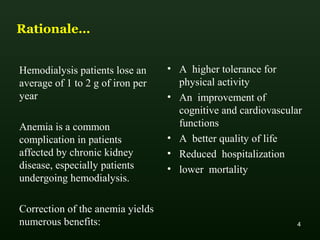
Hemodialysis patients lose an     • A higher tolerance for
average of 1 to 2 g of iron per     physical activity
year                              • An improvement of
                                    cognitive and cardiovascular
Anemia is a common                  functions
complication in patients          • A better quality of life
affected by chronic kidney        • Reduced hospitalization
disease, especially patients      • lower mortality
undergoing hemodialysis.

Correction of the anemia yields
numerous benefits:                                            4
Rationale…


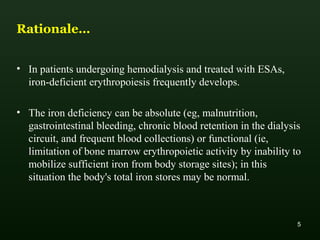
• In patients undergoing hemodialysis and treated with ESAs,
  iron-deficient erythropoiesis frequently develops.

• The iron deficiency can be absolute (eg, malnutrition,
  gastrointestinal bleeding, chronic blood retention in the dialysis
  circuit, and frequent blood collections) or functional (ie,
  limitation of bone marrow erythropoietic activity by inability to
  mobilize sufficient iron from body storage sites); in this
  situation the body's total iron stores may be normal.


                                                                   5
Rationale…


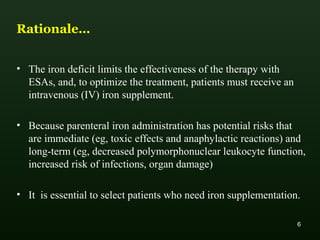
• The iron deficit limits the effectiveness of the therapy with
  ESAs, and, to optimize the treatment, patients must receive an
  intravenous (IV) iron supplement.

• Because parenteral iron administration has potential risks that
  are immediate (eg, toxic effects and anaphylactic reactions) and
  long-term (eg, decreased polymorphonuclear leukocyte function,
  increased risk of infections, organ damage)

• It is essential to select patients who need iron supplementation.

                                                                   6
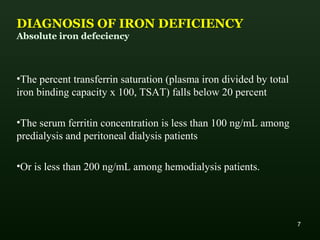
DIAGNOSIS OF IRON DEFICIENCY
Absolute iron defeciency


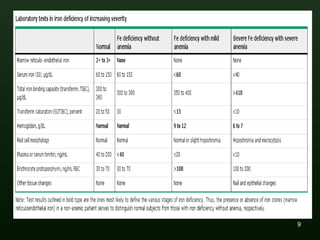
•The percent transferrin saturation (plasma iron divided by total
iron binding capacity x 100, TSAT) falls below 20 percent

•The serum ferritin concentration is less than 100 ng/mL among
predialysis and peritoneal dialysis patients

•Or is less than 200 ng/mL among hemodialysis patients.


                                                                    7
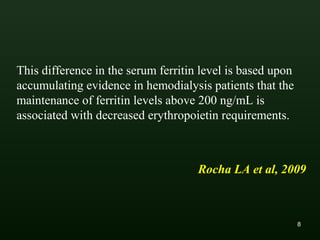
This difference in the serum ferritin level is based upon
accumulating evidence in hemodialysis patients that the
maintenance of ferritin levels above 200 ng/mL is
associated with decreased erythropoietin requirements.


                                     Rocha LA et al, 2009


                                                            8
9
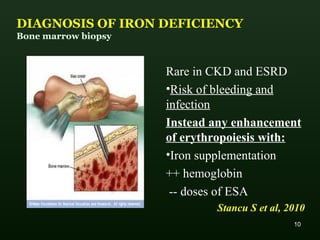
DIAGNOSIS OF IRON DEFICIENCY
Bone marrow biopsy


                     Rare in CKD and ESRD
                     •Risk of bleeding and
                     infection
                     Instead any enhancement
                     of erythropoiesis with:
                     •Iron supplementation
                     ++ hemoglobin
                      -- doses of ESA
                             Stancu S et al, 2010
                                              10
DIAGNOSIS OF IRON DEFICIENCY
Functional iron deficiency


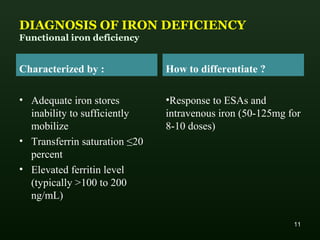
Characterized by :             How to differentiate ?

• Adequate iron stores         •Response to ESAs and
  inability to sufficiently    intravenous iron (50-125mg for
  mobilize                     8-10 doses)
• Transferrin saturation ≤20
  percent
• Elevated ferritin level
  (typically >100 to 200
  ng/mL)

                                                           11
DIAGNOSIS OF IRON DEFICIENCY
Functional iron deficiency


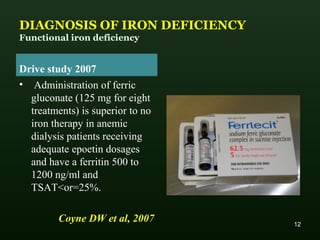
Drive study 2007
• Administration of ferric
  gluconate (125 mg for eight
  treatments) is superior to no
  iron therapy in anemic
  dialysis patients receiving
  adequate epoetin dosages
  and have a ferritin 500 to
  1200 ng/ml and
  TSAT<or=25%.

         Coyne DW et al, 2007     12
DIAGNOSIS OF IRON DEFICIENCY
Updates..


• To diagnose iron deficiency in patients undergoing
  hemodialysis, the percentage of hypochromic RBCs (with
  cellular hemoglobin concentration <280 g/L [HYPO%]) and
  mean reticulocyte hemoglobin content (CHret) were proposed as
  alternatives to biochemical tests.
                                                 Pajola R et al, 2011
• Reticulocyte Transferrin R expression reflected the changes in
  the Hb level and the iron availability at the cellular level, and
  therefore it might be useful in the assessment of iron status in
  patients with CRF
                                              Soininen K et al, 2010
                                                                  13
DIAGNOSIS OF IRON DEFICIENCY
Updates..


• A low hepcidin level in hemodialysis patients with high epoetin
  resistance index could be a useful marker of iron-restricted
  erythropoiesis, but confirmation by a therapeutical trial is
  necessary.
                                           Brătescu LO et al, 2010

• Iron status should be regularly assessed for the optimal
  management of renal anemia. Guidelines include the
  hemoglobin content of reticulocytes and the percentage of
  hypochromic RBC as markers for functional iron deficiency.
                                               European guidelines
                                                               14
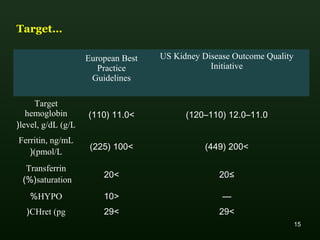
Target…

                    European Best   US Kidney Disease Outcome Quality
                       Practice                 Initiative
                     Guidelines

     Target
   hemoglobin       (110( 11.0<           (120–110( 12.0–11.0
(level, g/dL (g/L
Ferritin, ng/mL
                     (225( 100<                (449( 200<
   ((pmol/L
  Transferrin
                        20<                       20≤
 (%(saturation
   %HYPO                10>                        —
  (CHret (pg            29<                       29<
                                                                        15
Target…    

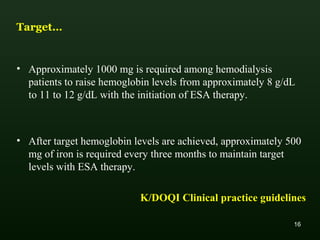
• Approximately 1000 mg is required among hemodialysis
  patients to raise hemoglobin levels from approximately 8 g/dL
  to 11 to 12 g/dL with the initiation of ESA therapy.


• After target hemoglobin levels are achieved, approximately 500
  mg of iron is required every three months to maintain target
  levels with ESA therapy.

                           K/DOQI Clinical practice guidelines

                                                              16
Target…


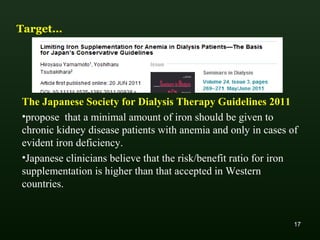
The Japanese Society for Dialysis Therapy Guidelines 2011
•propose that a minimal amount of iron should be given to
chronic kidney disease patients with anemia and only in cases of
evident iron deficiency.
•Japanese clinicians believe that the risk/benefit ratio for iron
supplementation is higher than that accepted in Western
countries.


                                                                17
Target…


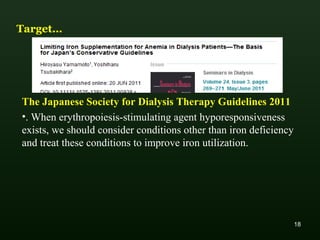
The Japanese Society for Dialysis Therapy Guidelines 2011
•. When erythropoiesis-stimulating agent hyporesponsiveness
exists, we should consider conditions other than iron deficiency
and treat these conditions to improve iron utilization.


                                                                   18
 
EBM


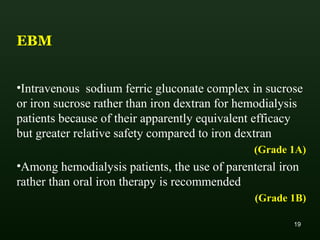
•Intravenous sodium ferric gluconate complex in sucrose
or iron sucrose rather than iron dextran for hemodialysis
patients because of their apparently equivalent efficacy
but greater relative safety compared to iron dextran
                                               (Grade 1A)
•Among hemodialysis patients, the use of parenteral iron
rather than oral iron therapy is recommended
                                               (Grade 1B)

                                                       19
 
EBM
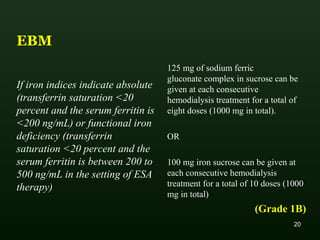
                                    125 mg of sodium ferric
                                    gluconate complex in sucrose can be
If iron indices indicate absolute   given at each consecutive
(transferrin saturation <20         hemodialysis treatment for a total of
percent and the serum ferritin is   eight doses (1000 mg in total).
<200 ng/mL) or functional iron
deficiency (transferrin             OR
saturation <20 percent and the
serum ferritin is between 200 to    100 mg iron sucrose can be given at
500 ng/mL in the setting of ESA     each consecutive hemodialysis
therapy)                            treatment for a total of 10 doses (1000
                                    mg in total)
                                                             (Grade 1B)
                                                                        20
EBM
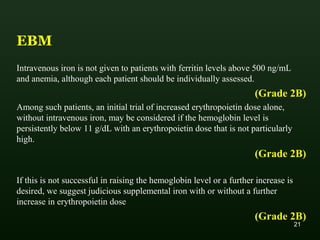
Intravenous iron is not given to patients with ferritin levels above 500 ng/mL
and anemia, although each patient should be individually assessed.
                                                                      (Grade 2B)
Among such patients, an initial trial of increased erythropoietin dose alone,
without intravenous iron, may be considered if the hemoglobin level is
persistently below 11 g/dL with an erythropoietin dose that is not particularly
high.
                                                                      (Grade 2B)

If this is not successful in raising the hemoglobin level or a further increase is
desired, we suggest judicious supplemental iron with or without a further
increase in erythropoietin dose
                                                                      (Grade 2B)
                                                                                     21
Trends


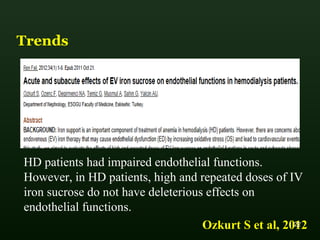
HD patients had impaired endothelial functions.
However, in HD patients, high and repeated doses of IV
iron sucrose do not have deleterious effects on
endothelial functions.
                                    Ozkurt S et al, 2012
                                                      22
 
Trends


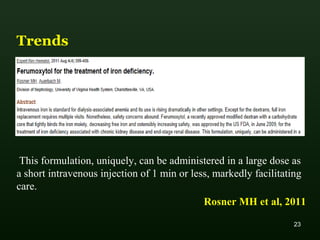
 This formulation, uniquely, can be administered in a large dose as
a short intravenous injection of 1 min or less, markedly facilitating
care.
                                             Rosner MH et al, 2011

                                                                  23
Trends


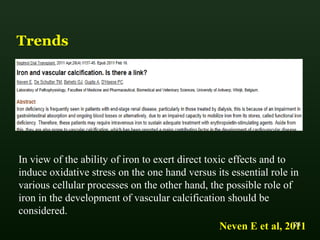
In view of the ability of iron to exert direct toxic effects and to
induce oxidative stress on the one hand versus its essential role in
various cellular processes on the other hand, the possible role of
iron in the development of vascular calcification should be
considered.
                                                   Neven E et al, 2011
                                                                    24
Trends


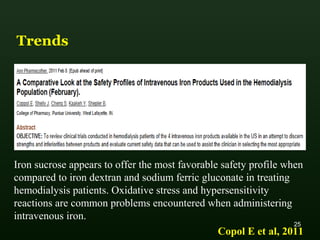
Iron sucrose appears to offer the most favorable safety profile when
compared to iron dextran and sodium ferric gluconate in treating
hemodialysis patients. Oxidative stress and hypersensitivity
reactions are common problems encountered when administering
intravenous iron.
                                                                  25
                                                Copol E et al, 2011
Trends


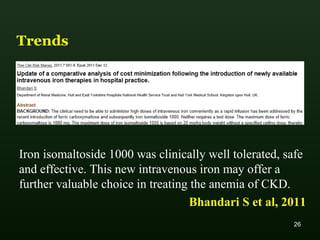
Iron isomaltoside 1000 was clinically well tolerated, safe
and effective. This new intravenous iron may offer a
further valuable choice in treating the anemia of CKD.
                                   Bhandari S et al, 2011
                                                       26
 
Trends

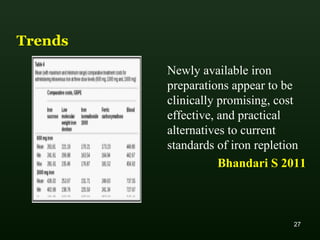
         Newly available iron
         preparations appear to be
         clinically promising, cost
         effective, and practical
         alternatives to current
         standards of iron repletion
                    Bhandari S 2011


                                 27
THANK YOU

        28