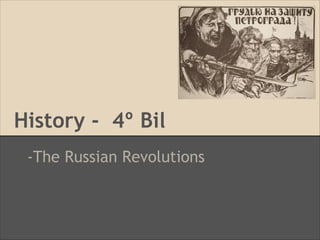
History - 4º Bil
-The Russian Revolutions
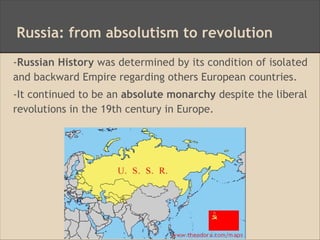
Russia: from absolutism to revolution
-Russian History was determined by its condition of isolated
and backward Empire regarding others European countries.
-It continued to be an absolute monarchy despite the liberal
revolutions in the 19th century in Europe.
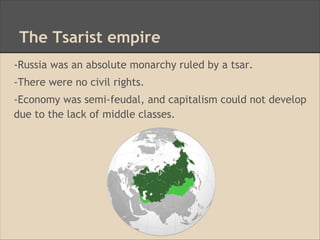
The Tsarist empire
-Russia was an absolute monarchy ruled by a tsar.
-There were no civil rights.
-Economy was semi-feudal, and capitalism could not develop
due to the lack of middle classes.
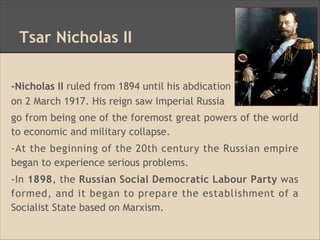
Tsar Nicholas II
-Nicholas II ruled from 1894 until his abdication
on 2 March 1917. His reign saw Imperial Russia
go from being one of the foremost great powers of the world
to economic and military collapse.
-At the beginning of the 20th century the Russian empire
began to experience serious problems.
-In 1898, the Russian Social Democratic Labour Party was
formed, and it began to prepare the establishment of a
Socialist State based on Marxism.
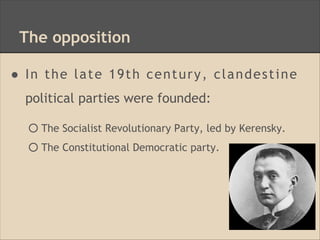
The opposition
● In the late 19th century, clandestine
political parties were founded:
○ The Socialist Revolutionary Party, led by Kerensky.
○ The Constitutional Democratic party.
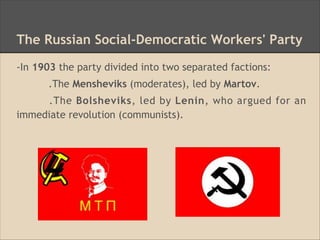
The Russian Social-Democratic Workers' Party
-In 1903 the party divided into two separated factions:
.The Mensheviks (moderates), led by Martov.
.The Bolsheviks, led by Lenin, who argued for an
immediate revolution (communists).
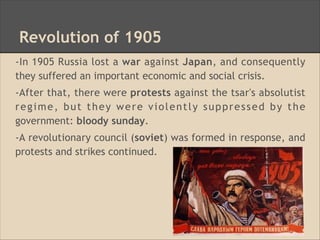
Revolution of 1905
-In 1905 Russia lost a war against Japan, and consequently
they suffered an important economic and social crisis.
-After that, there were protests against the tsar's absolutist
regime, but they were violently suppressed by the
government: bloody sunday.
-A revolutionary council (soviet) was formed in response, and
protests and strikes continued.
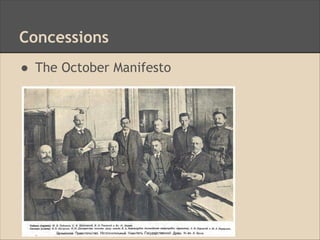
Concessions
● The October Manifesto
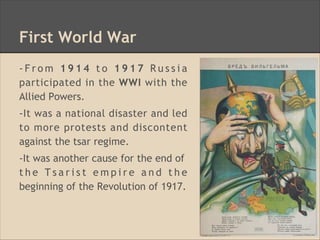
First World War
- F r o m 1 9 1 4 t o 1 9 1 7 R u s s i a
participated in the WWI with the
Allied Powers.
-It was a national disaster and led
to more protests and discontent
against the tsar regime.
-It was another cause for the end of
t h e T s a r i s t e m p i r e a n d t h e
beginning of the Revolution of 1917.
The revolution of February 1917
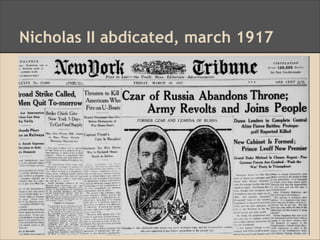
-In february 1917 a bigger revolution made abdicate
Nicholas II and restored the Duma (Parliament).
-A provisional government was established then, leaded by
Kerenski (liberal).
-Bolsheviks began the opposition to the provisional
government creating an alternative government based on
the soviets and leaded by Lenin and Trotski.
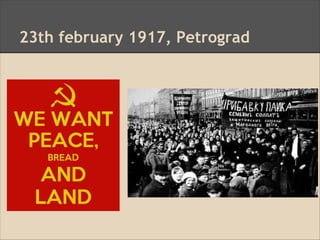
23th february 1917, Petrograd
Nicholas II abdicated, march 1917
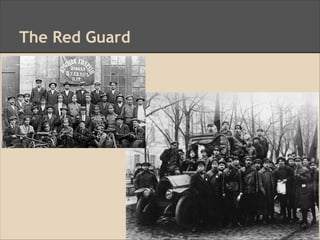
The Red Guard
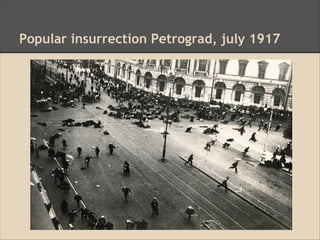
Popular insurrection Petrograd, july 1917
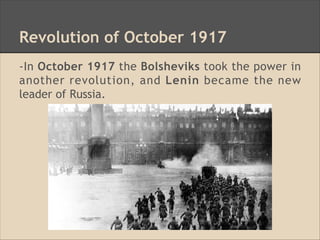
Revolution of October 1917
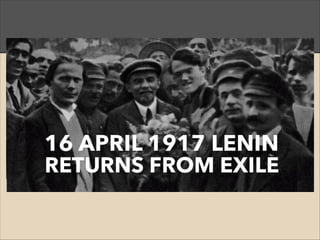
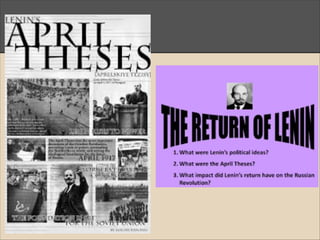
-In October 1917 the Bolsheviks took the power in
another revolution, and Lenin became the new
leader of Russia.
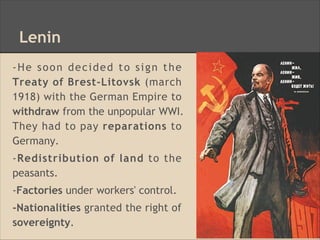
Lenin
-He soon decided to sign the
Treaty of Brest-Litovsk (march
1918) with the German Empire to
withdraw from the unpopular WWI.
They had to pay reparations to
Germany.
-Redistribution of land to the
peasants.
-Factories under workers' control.
-Nationalities granted the right of
sovereignty.
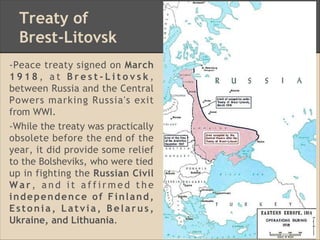
Treaty of
Brest-Litovsk
-Peace treaty signed on March
1 9 1 8 , a t B r e s t - L i t o v s k ,
between Russia and the Central
Powers marking Russia's exit
from WWI.
-While the treaty was practically
obsolete before the end of the
year, it did provide some relief
to the Bolsheviks, who were tied
up in fighting the Russian Civil
W a r , a n d i t a f f i r m e d t h e
independence of Finland,
Estonia, Latvia, Belarus,
Ukraine, and Lithuania.
Civil War, 1918-21
-At the same time a civil war broke out in Russia (after
Lenin lost elections) between the Whites (counter-
revolutionaries) and the Red Army (Bolsheviks).
-Lenin Red Army won the war (through War communism)
and established the Union of Soviet Socialist Republics
(USSR) in 1922.
-The bolsheviks became the Communist Party.
-He approved a constitution based on Communism.
-The ideas of Marxism were put into practice.
The Communist Party of
the Soviet Union
It was the only legal, ruling political party in the Soviet
Union and one of the largest communist organization in the
world.
The Party established the Third International, known as
"Comintern" ("Communist International"), an international
network of communist parties loyal to the Russian Communist
Party, with the aim of fighting "by all available means,
including armed force, for the overthrow of the international
bourgeoisie and for the creation of an international Soviet
republic as a transition stage to the complete abolition of the
State."

Russian revolution

  • 1.
    History - 4ºBil -The Russian Revolutions
  • 2.
    Russia: from absolutismto revolution -Russian History was determined by its condition of isolated and backward Empire regarding others European countries. -It continued to be an absolute monarchy despite the liberal revolutions in the 19th century in Europe.
  • 3.
    The Tsarist empire -Russiawas an absolute monarchy ruled by a tsar. -There were no civil rights. -Economy was semi-feudal, and capitalism could not develop due to the lack of middle classes.
  • 4.
    Tsar Nicholas II -NicholasII ruled from 1894 until his abdication on 2 March 1917. His reign saw Imperial Russia go from being one of the foremost great powers of the world to economic and military collapse. -At the beginning of the 20th century the Russian empire began to experience serious problems. -In 1898, the Russian Social Democratic Labour Party was formed, and it began to prepare the establishment of a Socialist State based on Marxism.
  • 5.
    The opposition ● Inthe late 19th century, clandestine political parties were founded: ○ The Socialist Revolutionary Party, led by Kerensky. ○ The Constitutional Democratic party.
  • 6.
    The Russian Social-DemocraticWorkers' Party -In 1903 the party divided into two separated factions: .The Mensheviks (moderates), led by Martov. .The Bolsheviks, led by Lenin, who argued for an immediate revolution (communists).
  • 7.
    Revolution of 1905 -In1905 Russia lost a war against Japan, and consequently they suffered an important economic and social crisis. -After that, there were protests against the tsar's absolutist regime, but they were violently suppressed by the government: bloody sunday. -A revolutionary council (soviet) was formed in response, and protests and strikes continued.
  • 8.
  • 9.
    First World War -F r o m 1 9 1 4 t o 1 9 1 7 R u s s i a participated in the WWI with the Allied Powers. -It was a national disaster and led to more protests and discontent against the tsar regime. -It was another cause for the end of t h e T s a r i s t e m p i r e a n d t h e beginning of the Revolution of 1917.
  • 10.
    The revolution ofFebruary 1917 -In february 1917 a bigger revolution made abdicate Nicholas II and restored the Duma (Parliament). -A provisional government was established then, leaded by Kerenski (liberal). -Bolsheviks began the opposition to the provisional government creating an alternative government based on the soviets and leaded by Lenin and Trotski.
  • 11.
  • 12.
  • 13.
  • 16.
  • 17.
    Revolution of October1917 -In October 1917 the Bolsheviks took the power in another revolution, and Lenin became the new leader of Russia.
  • 18.
    Lenin -He soon decidedto sign the Treaty of Brest-Litovsk (march 1918) with the German Empire to withdraw from the unpopular WWI. They had to pay reparations to Germany. -Redistribution of land to the peasants. -Factories under workers' control. -Nationalities granted the right of sovereignty.
  • 19.
    Treaty of Brest-Litovsk -Peace treatysigned on March 1 9 1 8 , a t B r e s t - L i t o v s k , between Russia and the Central Powers marking Russia's exit from WWI. -While the treaty was practically obsolete before the end of the year, it did provide some relief to the Bolsheviks, who were tied up in fighting the Russian Civil W a r , a n d i t a f f i r m e d t h e independence of Finland, Estonia, Latvia, Belarus, Ukraine, and Lithuania.
  • 20.
    Civil War, 1918-21 -Atthe same time a civil war broke out in Russia (after Lenin lost elections) between the Whites (counter- revolutionaries) and the Red Army (Bolsheviks). -Lenin Red Army won the war (through War communism) and established the Union of Soviet Socialist Republics (USSR) in 1922. -The bolsheviks became the Communist Party. -He approved a constitution based on Communism. -The ideas of Marxism were put into practice.
  • 21.
    The Communist Partyof the Soviet Union It was the only legal, ruling political party in the Soviet Union and one of the largest communist organization in the world. The Party established the Third International, known as "Comintern" ("Communist International"), an international network of communist parties loyal to the Russian Communist Party, with the aim of fighting "by all available means, including armed force, for the overthrow of the international bourgeoisie and for the creation of an international Soviet republic as a transition stage to the complete abolition of the State."