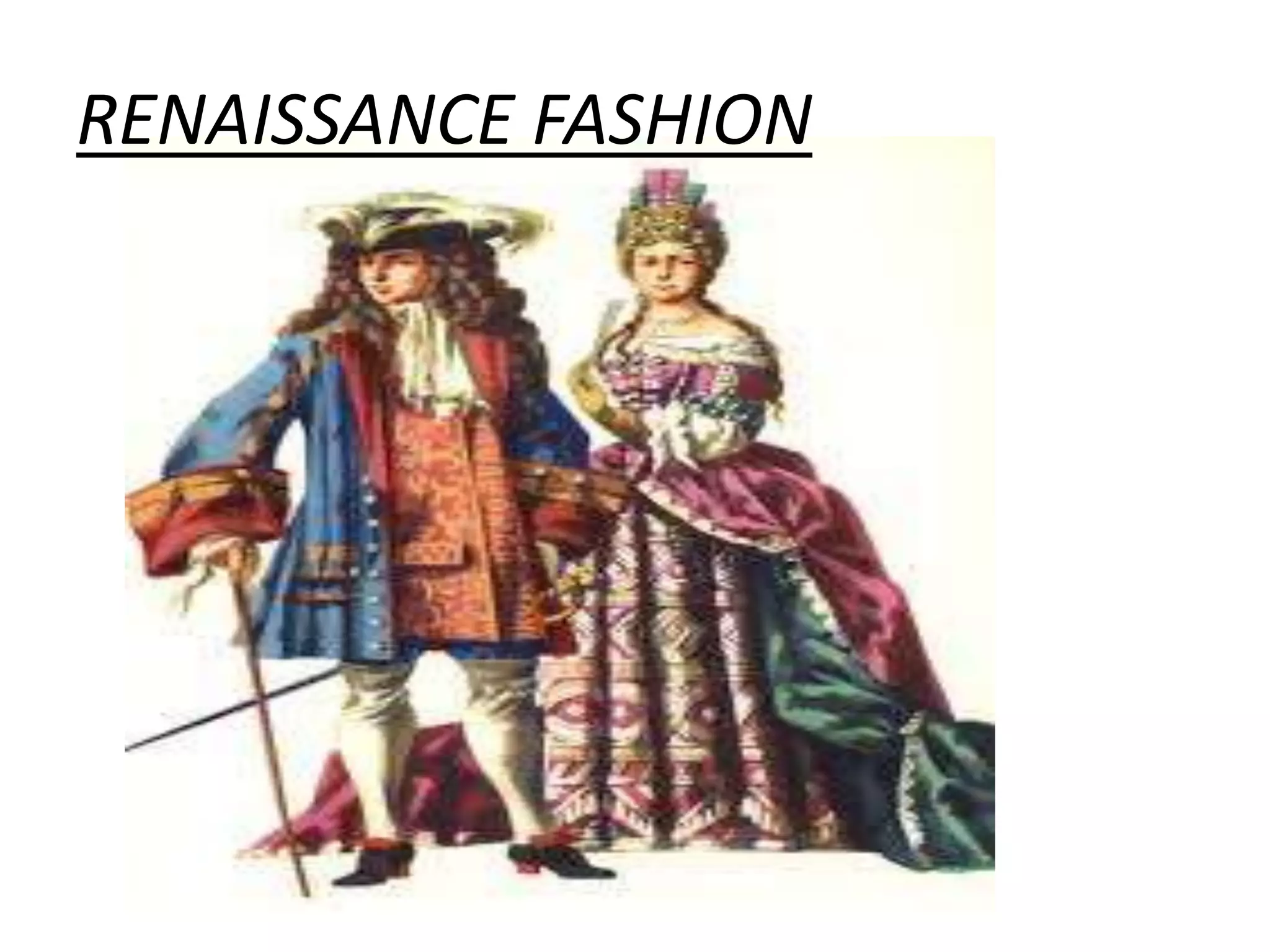
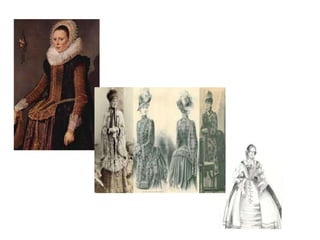
RENAISSANCE FASHION
Renaissance costumes and costumes reflect the cultural
progress , as well as the development of trade , which enabled
an increasing range of people access to new materials. The
rich wore elaborate and brightly colored robes, dresses and
vestments . Upper class Has reserved for itself silk. In some
places, the possession of this material by the poor was even
punished . Costumes decorated with gold and silver embroidery
, which formed the creative and unique designs , which are
often illustrated by the legends and the Bible. Often also used
for robes natural motifs . People Renaissance also indulged in
jewelry , furs and wigs .
renaissance
• Renaissance revival ( with fr . Renaissance ) - the period in the
history of European culture , including primarily the sixteenth
century , often referred to as "the revival of the arts and
sciences ," and the concept of historiosophical relating to the
history of Italian culture from Dante to 1520 ( Il Rinascimento
) . The term is not clear. As an epoch in the history of
Renaissance culture includes fifteenth and sixteenth centuries
, but the time limits are not clearly established. The
Renaissance as a concept historiosophical Jacob Burckhardt ,
a role model , what the historian wanted to convey to his
contemporaries , and that involves a still popular and " school
" understanding of this era, is now obsolete .
Renaissance Hairstyles
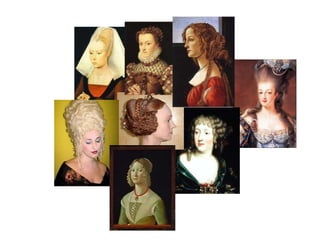
• Like everything else in fashion , renaissance hairstyles
were eloquently decorated with the " dripping " gems ,
dig in there brooches, weaves wires and ribbons . Big
hair was extremely popular at the court of Queen
Elizabeth I. Women tapirowały your hair would seem
to be more extensive and stuck up as high as possible .
Often also used wigs and artificial hair to further
expand their hairstyles . Synonymous with beauty in
the Renaissance was a broad forehead , which is why
women avoid like the plague any kind grzywek . Hair
dye also used elderberries .
Fashion MEN
• At the beginning of the nineteenth century . It was the capital of London
men's fashion . Yet at the end of the eighteenth century reigned
Anglomania "or imitation of the habits , customs and fashions of the English
, took its origin in France during the reign of Louis XIV. This monarch , and
especially Reient Philip of Orleans , put up the most to introduce her to
France. At the beginning of the last century , a peculiar change in the French
gave to see . This people , so who knows how to appreciate Folks nationality
, suddenly began to burn with an extraordinary desire to follow in all things
British. " ( Hermit London street Pikadilli 1822 , Vol. I, No. IV , p. 111)
Anglomania took over France, and gradually the rest of Europe . Meant that
around 1800 under the influence of English riding outfit evolved into a
fashionable outfit consisting of a male tuxedo with a collar with wide lapels
, undercut front of the inverted U-shaped high enough that the light was
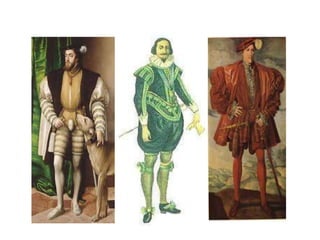
visible down vest. The men's clothing consisted of a bright , tight pants to
the knee or calf-length pantaloons and the boots.
Fashion WOMEN
• At the beginning of the sixteenth century creations were not
significantly different from those known in the Middle Ages. In the
dressing room at that time were mostly women dress pants
(consisting sliced ​​up and sewn to the skirt ) and a dress with a skirt
in the shape of a cone with a long train . Corsets , forming the
upper part of creation, had square necklines , finished lace and
jewels. Sleeves of these dresses were very broad, often trimmed
with fur. Typical early Renaissance gown was made of woven wool
or linen. The richest ladies could afford to garments made ​​of silk or
velvet , which is legally prohibited materials poorest class . Under
the entire creation , that is, two dresses , a Renaissance woman
wore a linen petticoat . It may seem that this outfit was composed
of many layers , but keep in mind that is not used anywhere the
central heating system and castles mostly prevailed chills and
drafts .
Prace wykonał:
Krzysztof Stępień kl. 1TI

Renaissance fashion

  • 1.
  • 2.
    Renaissance costumes andcostumes reflect the cultural progress , as well as the development of trade , which enabled an increasing range of people access to new materials. The rich wore elaborate and brightly colored robes, dresses and vestments . Upper class Has reserved for itself silk. In some places, the possession of this material by the poor was even punished . Costumes decorated with gold and silver embroidery , which formed the creative and unique designs , which are often illustrated by the legends and the Bible. Often also used for robes natural motifs . People Renaissance also indulged in jewelry , furs and wigs .
  • 3.
    renaissance • Renaissance revival( with fr . Renaissance ) - the period in the history of European culture , including primarily the sixteenth century , often referred to as "the revival of the arts and sciences ," and the concept of historiosophical relating to the history of Italian culture from Dante to 1520 ( Il Rinascimento ) . The term is not clear. As an epoch in the history of Renaissance culture includes fifteenth and sixteenth centuries , but the time limits are not clearly established. The Renaissance as a concept historiosophical Jacob Burckhardt , a role model , what the historian wanted to convey to his contemporaries , and that involves a still popular and " school " understanding of this era, is now obsolete .
  • 4.
    Renaissance Hairstyles • Likeeverything else in fashion , renaissance hairstyles were eloquently decorated with the " dripping " gems , dig in there brooches, weaves wires and ribbons . Big hair was extremely popular at the court of Queen Elizabeth I. Women tapirowały your hair would seem to be more extensive and stuck up as high as possible . Often also used wigs and artificial hair to further expand their hairstyles . Synonymous with beauty in the Renaissance was a broad forehead , which is why women avoid like the plague any kind grzywek . Hair dye also used elderberries .
  • 6.
    Fashion MEN • Atthe beginning of the nineteenth century . It was the capital of London men's fashion . Yet at the end of the eighteenth century reigned Anglomania "or imitation of the habits , customs and fashions of the English , took its origin in France during the reign of Louis XIV. This monarch , and especially Reient Philip of Orleans , put up the most to introduce her to France. At the beginning of the last century , a peculiar change in the French gave to see . This people , so who knows how to appreciate Folks nationality , suddenly began to burn with an extraordinary desire to follow in all things British. " ( Hermit London street Pikadilli 1822 , Vol. I, No. IV , p. 111) Anglomania took over France, and gradually the rest of Europe . Meant that around 1800 under the influence of English riding outfit evolved into a fashionable outfit consisting of a male tuxedo with a collar with wide lapels , undercut front of the inverted U-shaped high enough that the light was visible down vest. The men's clothing consisted of a bright , tight pants to the knee or calf-length pantaloons and the boots.
  • 8.
    Fashion WOMEN • Atthe beginning of the sixteenth century creations were not significantly different from those known in the Middle Ages. In the dressing room at that time were mostly women dress pants (consisting sliced ​​up and sewn to the skirt ) and a dress with a skirt in the shape of a cone with a long train . Corsets , forming the upper part of creation, had square necklines , finished lace and jewels. Sleeves of these dresses were very broad, often trimmed with fur. Typical early Renaissance gown was made of woven wool or linen. The richest ladies could afford to garments made ​​of silk or velvet , which is legally prohibited materials poorest class . Under the entire creation , that is, two dresses , a Renaissance woman wore a linen petticoat . It may seem that this outfit was composed of many layers , but keep in mind that is not used anywhere the central heating system and castles mostly prevailed chills and drafts .
  • 10.