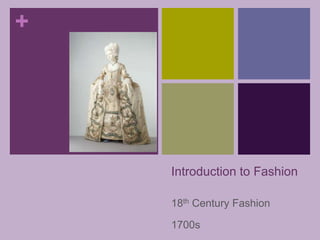
Introduction to Fashion18th Century Fashion1700s
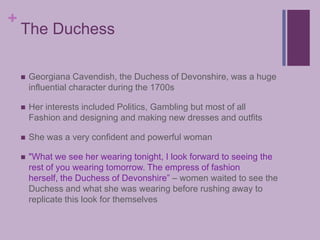
18th Century FashionWe have chosen 1700s because we feel it was a very interesting period in fashion history, especially through the influential role modelsThis perioddoes not include any huge changes to women’s fashionWomen still wore corsets and uncomfortably tight dresses in rich, exuberant fabricsOne of the most influential characters of 18th Century Fashion was Georgiana Cavendish, the Duchess of Devonshire
The DuchessGeorgiana Cavendish, the Duchess of Devonshire, was a huge influential character during the 1700sHer interests included Politics, Gambling but most of all Fashion and designing and making new dresses and outfitsShe was a very confident and powerful woman"What we see her wearing tonight, I look forward to seeing the rest of you wearing tomorrow. The empress of fashion herself, the Duchess of Devonshire” – women waited to see the Duchess and what she was wearing before rushing away to replicate this look for themselves
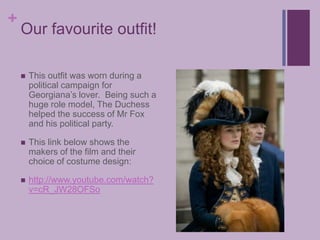
Our favourite outfit!This outfit was worn during a political campaign for Georgiana’s lover.  Being such a huge role model, The Duchess helped the success of Mr Fox and his political party.This link below shows the makers of the film and their choice of costume design:http://www.youtube.com/watch?v=cR_JW28OFSo
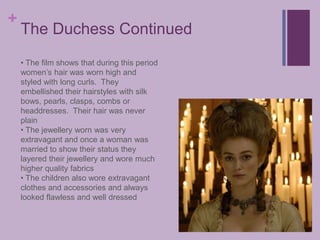
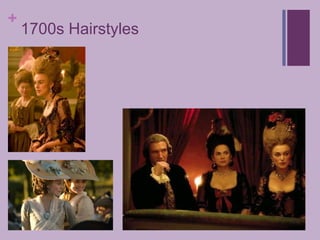
The Duchess Continued The film shows that during this period women’s hair was worn high and styled with long curls.  They embellished their hairstyles with silk bows, pearls, clasps, combs or headdresses.  Their hair was never plain
 The jewellery worn was very extravagant and once a woman was married to show their status they layered their jewellery and wore much higher quality fabrics
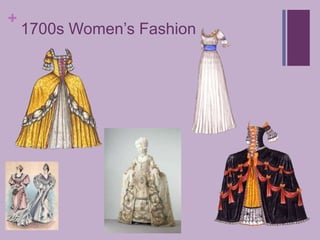
 The children also wore extravagant clothes and accessories and always looked flawless and well dressed18th Century – Women’s FashionDuring the 18th century the shapes of women’s skirts changed throughoutA narrow inverted cone shape was achieved through the use of bone stays and a full skirt shape was createdA big style favourite was panniers which held the skirts out at the sidesThe 1740s brought in the ‘hoop skirt’ but by beginning of 1750s it had been replaced by the ‘pannier’In the late 1700s, there was still a fullness to women’s skirts but they no longer stuck out in different directions and could still be worn with a bustle
1700s Women’s Fashion
Women’s Fashion continuedBetween 1750-1780, low-necked gowns, or ‘robe’ (as named by the French)  was worn over the petticoat. These gowns were worn open at the front to reveal the petticoat belowMany of the sleeves and necklines of women’s clothing were edged with frills or rufflesA ‘caraco’ was designed in the 1700s which was a jacket-like bodice which women wore with their petticoats and had elbow long sleeves. By the 1790s, these sleeves became full length
Women’s Hairstyles during 1700sThe 1770s was recognised for its extreme hairstyles and wigsThey wore their hair very high and often embellished their styles with various headpieces and ornamentsBy the 1780s, elaborate hairstyles were replaced with elaborate hats. These included flat straw hats which were worn tied to their heads with ribbon
1700s Hairstyles
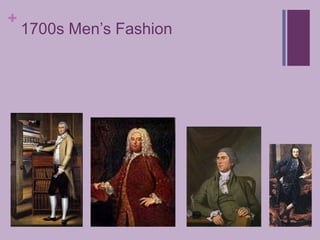
18th Century – Men’s FashionMen wore wigs when dressing for a special occasionIf you were a man of high stature then you would tend to wear a wig during both the day and the eveningA male outfit consisted of a coat which curved in at the waist, full gathered shirt sleeves, breeches, stockings and shoes. The breeches were made to fit snugly and opened using a fall front flapThe most significant change for men’s fashion was the fabric used. The use of embroidered velvets were swapped for woolen undergarments.
1700s Men’s Fashion
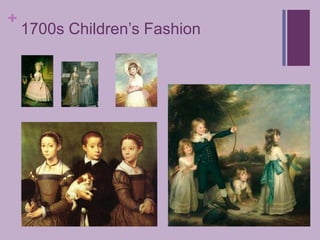
18th Century – Children’s FashionDuring this period the children both boys and girls who belonged to the middle and upper classes were dressed in uncomfortable miniature copies of their parent’s clothesThe girls had corsets of sorts and their hair was styled big and dramatic like their mother’s. Their dresses were tied down the back and were not revealing on the bust like a women's. They wore pearls and other rich jeweleryThe boys had stockings, three quarter length trousers and their hair was slicked back on their heads to look smart. It wasn’t until they became men that they wore wigs
1700s Children’s Fashion
ReferencesAshelford, Jane: The Art of Dress: Clothing and Society 1500–1914, Abrams, 1996. ISBN 0-8109-6317-5Payne, Blanche: History of Costume from the Ancient Egyptians to the Twentieth Century, Harper & Row, 1965. No ISBN for this edition; ASIN B0006BMNFSRibeiro, Aileen: Dress in Eighteenth Century Europe 1715–1789, Yale University Press, 2002, ISBN 0-300-09151-6Styles, John: The Dress of the People: Everyday Fashion in Eighteenth-Century England, New Haven, Yale University Press, 2007, ISBN 9780300121193a b "2008 Fall Movie Guide: Preview: The Duchess". Entertainment Weekly, Issue #1007/1008. Time Inc.. August 22–29, 2008. pp. 50. Retrieved 2008-10-02.

1700s Pp

  • 1.
    Introduction to Fashion18thCentury Fashion1700s
  • 2.
    18th Century FashionWehave chosen 1700s because we feel it was a very interesting period in fashion history, especially through the influential role modelsThis perioddoes not include any huge changes to women’s fashionWomen still wore corsets and uncomfortably tight dresses in rich, exuberant fabricsOne of the most influential characters of 18th Century Fashion was Georgiana Cavendish, the Duchess of Devonshire
  • 3.
    The DuchessGeorgiana Cavendish,the Duchess of Devonshire, was a huge influential character during the 1700sHer interests included Politics, Gambling but most of all Fashion and designing and making new dresses and outfitsShe was a very confident and powerful woman"What we see her wearing tonight, I look forward to seeing the rest of you wearing tomorrow. The empress of fashion herself, the Duchess of Devonshire” – women waited to see the Duchess and what she was wearing before rushing away to replicate this look for themselves
  • 4.
    Our favourite outfit!Thisoutfit was worn during a political campaign for Georgiana’s lover. Being such a huge role model, The Duchess helped the success of Mr Fox and his political party.This link below shows the makers of the film and their choice of costume design:http://www.youtube.com/watch?v=cR_JW28OFSo
  • 5.
    The Duchess ContinuedThe film shows that during this period women’s hair was worn high and styled with long curls. They embellished their hairstyles with silk bows, pearls, clasps, combs or headdresses. Their hair was never plain
  • 6.
    The jewelleryworn was very extravagant and once a woman was married to show their status they layered their jewellery and wore much higher quality fabrics
  • 7.
    The childrenalso wore extravagant clothes and accessories and always looked flawless and well dressed18th Century – Women’s FashionDuring the 18th century the shapes of women’s skirts changed throughoutA narrow inverted cone shape was achieved through the use of bone stays and a full skirt shape was createdA big style favourite was panniers which held the skirts out at the sidesThe 1740s brought in the ‘hoop skirt’ but by beginning of 1750s it had been replaced by the ‘pannier’In the late 1700s, there was still a fullness to women’s skirts but they no longer stuck out in different directions and could still be worn with a bustle
  • 8.
  • 9.
    Women’s Fashion continuedBetween1750-1780, low-necked gowns, or ‘robe’ (as named by the French) was worn over the petticoat. These gowns were worn open at the front to reveal the petticoat belowMany of the sleeves and necklines of women’s clothing were edged with frills or rufflesA ‘caraco’ was designed in the 1700s which was a jacket-like bodice which women wore with their petticoats and had elbow long sleeves. By the 1790s, these sleeves became full length
  • 10.
    Women’s Hairstyles during1700sThe 1770s was recognised for its extreme hairstyles and wigsThey wore their hair very high and often embellished their styles with various headpieces and ornamentsBy the 1780s, elaborate hairstyles were replaced with elaborate hats. These included flat straw hats which were worn tied to their heads with ribbon
  • 11.
  • 12.
    18th Century –Men’s FashionMen wore wigs when dressing for a special occasionIf you were a man of high stature then you would tend to wear a wig during both the day and the eveningA male outfit consisted of a coat which curved in at the waist, full gathered shirt sleeves, breeches, stockings and shoes. The breeches were made to fit snugly and opened using a fall front flapThe most significant change for men’s fashion was the fabric used. The use of embroidered velvets were swapped for woolen undergarments.
  • 13.
  • 14.
    18th Century –Children’s FashionDuring this period the children both boys and girls who belonged to the middle and upper classes were dressed in uncomfortable miniature copies of their parent’s clothesThe girls had corsets of sorts and their hair was styled big and dramatic like their mother’s. Their dresses were tied down the back and were not revealing on the bust like a women's. They wore pearls and other rich jeweleryThe boys had stockings, three quarter length trousers and their hair was slicked back on their heads to look smart. It wasn’t until they became men that they wore wigs
  • 15.
  • 16.
    ReferencesAshelford, Jane: TheArt of Dress: Clothing and Society 1500–1914, Abrams, 1996. ISBN 0-8109-6317-5Payne, Blanche: History of Costume from the Ancient Egyptians to the Twentieth Century, Harper & Row, 1965. No ISBN for this edition; ASIN B0006BMNFSRibeiro, Aileen: Dress in Eighteenth Century Europe 1715–1789, Yale University Press, 2002, ISBN 0-300-09151-6Styles, John: The Dress of the People: Everyday Fashion in Eighteenth-Century England, New Haven, Yale University Press, 2007, ISBN 9780300121193a b "2008 Fall Movie Guide: Preview: The Duchess". Entertainment Weekly, Issue #1007/1008. Time Inc.. August 22–29, 2008. pp. 50. Retrieved 2008-10-02.