
A History of Fashion
and Costume
The Eighteenth
Century
Anne Rooney
The Eighteenth Century
Copyright © 2005 Bailey Publishing Associates Ltd
Produced for Facts On File by
Bailey Publishing Associates Ltd
11a Woodlands
Hove BN3 6TJ
Project Manager: Roberta Bailey
Editor:Alex Woolf
Text Designer: Simon Borrough
Artwork: Dave Burroughs, Peter Dennis,
Tony Morris
Picture Research: Glass Onion Pictures
Consultant:Tara Maginnis, Ph.D.Associate Professor
of the University of Alaska, Fairbanks, and creator
of the website,The Costumer's Manifesto
(http://costumes.org/)
Printed and bound in Hong Kong
All rights reserved. No part of this book may be
reproduced or utilized in any form or by any
means, electronic or mechanical, including
photocopying, recording, or by any information
storage or retrieval systems, without permission in
writing from the publisher. For information
contact:
Facts On File, Inc.
132 West 31st Street
NewYork NY 10001
Facts On File books are available at special
discounts when purchased in bulk quantities for
businesses, associations, institutions, or sales
promotions. Please call our Special Sales
Department in NewYork at 212/967-8800 or
800/322-8755.
You can find Facts On File on the World Wide
Web at: http://www.factsonfile.com
Library of Congress Cataloging-
in-Publication Data
Rooney,Anne.
A history of fashion and costume.
The eighteenth century/Anne
Rooney.
p. cm.
Includes bibliographical references and
index.
ISBN 0-8160-5948-9
1. Clothing and dress—History—
18th century—Fashion—History—
18th century.
GT585.R66 2005
391/.009/033—dc 22
2005040156
The publishers would like to thank the
following for permission to use their
pictures:
Art Archive: 9, 12, 17, 18,
32, 37 (top), 45, 47 (right), 49, 55
(both), 59
Bridgeman Art Library: 6, 7, 10 (top),
14, 16 (both), 27, 33 (top), 35 (both),
39, 41, 50, 58
Hanan and Farah Munayyer
Collection: 21 (top)
Peter Newark: 29 (both), 36, 38, 48
Topham: 26
Victoria & Albert Museum: 11, 23, 24,
25, 40, 42 (bottom), 44, 46, 52, 57
Contents
Introduction 5
Chapter 1: Changing Fashions in the West 6
Chapter 2: Worn Around the World 18
Chapter 3: Functional Fashions 32
Chapter 4: Not Just Clothes 48
Timeline 60
Glossary 61
Further Information 62
Index 64
Introduction
The eighteenth century saw the beginnings of the modern
fashion industry in Europe and America. Fashion magazines
appeared and the first fashion plates were produced. For the
first time, designs could be published and copied widely.
Fashions began to change quickly, led by Paris and London.
Designs were dictated not by practical needs but by trends
in art, culture, and politics, by new discoveries, technological
innovations, and scientific advances. Some European fashions
were, in fact, so impractical they rendered their wearers almost
incapable of everyday activity.
Elsewhere fashions changed slowly. In Asia, textile production
was already greatly advanced and beautiful garments had been
produced for centuries.Their designs evolved slowly, following
traditional or symbolic patterns, and were often linked to the
social and religious standing of the wearer.
In countries where the climate was warm, clothes could be
basic or even non-existent; the concept of changing fashions
was alien. In some places, simply structured garments were
beautifully adorned, following patterns and styles used for
generations without change.
This book traces the developing fashions of the West. But it
also looks at the strictly regulated clothing worn in the Far
East, where choosing the wrong color robe could bring dire
punishment. It visits the Inuit, who made clothes from fish
skin and the intestines of sea mammals. It looks at clothing
for special purposes, from the leather armor of the samurai
to shamans’ garments decorated with bones and bird beaks.
People around the world have delighted in decorating their
bodies and clothes. In their costumes, they leave a record of
their lives, their concerns, and their beliefs that unlocks the past.
6
The seventeenth century ended
with women wearing a pointed,
boned bodice with a wide gown
open over an underskirt, often
decorated with flounces.This style
continued through the first decade
of the eighteenth century, but
was soon overtaken by the sack
or sack-back dress.
The Sack Dress
The sack dress emerged around 1705,
quickly became popular, and
remained in fashion until the 1780s,
although other styles were current
The clothes worn by the upper classes in France and
England set the style for all of fashionable Europe
and America.Although there was a lot of regional
variation in the clothes of working people and those
who lived in the countryside, the wealthy classes from
Philadelphia to Moscow wore similar styles.
Women’s Fashions: 1700–1750
Chapter 1: Changing Fashions in the West
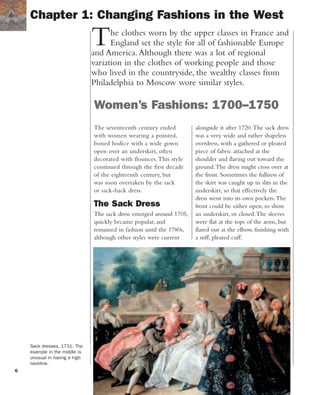
alongside it after 1720.The sack dress
was a very wide and rather shapeless
overdress, with a gathered or pleated
piece of fabric attached at the
shoulder and flaring out toward the
ground.The dress might cross over at
the front. Sometimes the fullness of
the skirt was caught up in slits in the
underskirt, so that effectively the
dress went into its own pockets.The
front could be either open, to show
an underskirt, or closed.The sleeves
were flat at the tops of the arms, but
flared out at the elbow, finishing with
a stiff, pleated cuff.
Sack dresses, 1731. The
example in the middle is
unusual in having a high
neckline.
Paniers
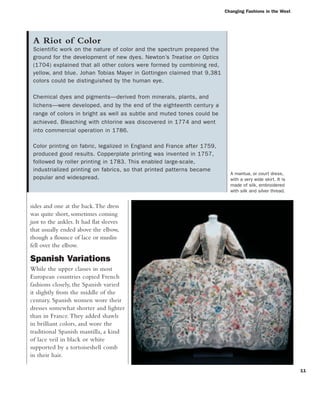
The sack dress was given shape by a
hoop or panier underneath.This was
a wide framework of whalebone,
cane, or metal hoops, held together
with fabric and ribbons.The panier
was at first circular, but the shape
changed between 1725 and 1730,
becoming oval and larger, with a
circumference of up to eleven feet
(3.35 m). Dresses became so wide
that women often had to turn
sideways to walk through doors. Later
paniers were often made in two parts,
one for each side. Paniers remained
fashionable until the 1760s and
continued as part of formal court
dress after this.
French Fashion
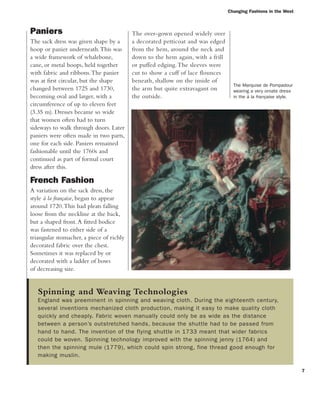
A variation on the sack dress, the
style à la française, began to appear
around 1720.This had pleats falling
loose from the neckline at the back,
but a shaped front.A fitted bodice
was fastened to either side of a
triangular stomacher, a piece of richly
decorated fabric over the chest.
Sometimes it was replaced by or
decorated with a ladder of bows
of decreasing size.
Spinning and Weaving Technologies
England was preeminent in spinning and weaving cloth. During the eighteenth century,
several inventions mechanized cloth production, making it easy to make quality cloth
quickly and cheaply. Fabric woven manually could only be as wide as the distance
between a person’s outstretched hands, because the shuttle had to be passed from
hand to hand. The invention of the flying shuttle in 1733 meant that wider fabrics
could be woven. Spinning technology improved with the spinning jenny (1764) and
then the spinning mule (1779), which could spin strong, fine thread good enough for
making muslin.
7
Changing Fashions in the West
The Marquise de Pompadour
wearing a very ornate dress
in the à la française style.
The over-gown opened widely over
a decorated petticoat and was edged
from the hem, around the neck and
down to the hem again, with a frill
or puffed edging.The sleeves were
cut to show a cuff of lace flounces
beneath, shallow on the inside of
the arm but quite extravagant on
the outside.
8
Men’s Fashions: 1700–1770
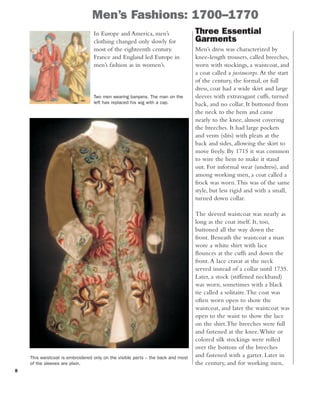
Two men wearing banyans. The man on the
left has replaced his wig with a cap.
In Europe and America, men’s
clothing changed only slowly for
most of the eighteenth century.
France and England led Europe in
men’s fashion as in women’s.
Three Essential
Garments
Men’s dress was characterized by
knee-length trousers, called breeches,
worn with stockings, a waistcoat, and
a coat called a justaucorps.At the start
of the century, the formal, or full
dress, coat had a wide skirt and large
sleeves with extravagant cuffs, turned
back, and no collar. It buttoned from
the neck to the hem and came
nearly to the knee, almost covering
the breeches. It had large pockets
and vents (slits) with pleats at the
back and sides, allowing the skirt to
move freely. By 1715 it was common
to wire the hem to make it stand
out. For informal wear (undress), and
among working men, a coat called a
frock was worn.This was of the same
style, but less rigid and with a small,
turned down collar.
The sleeved waistcoat was nearly as
long as the coat itself. It, too,
buttoned all the way down the
front. Beneath the waistcoat a man
wore a white shirt with lace
flounces at the cuffs and down the
front.A lace cravat at the neck
served instead of a collar until 1735.
Later, a stock (stiffened neckband)
was worn, sometimes with a black
tie called a solitaire.The coat was
often worn open to show the
waistcoat, and later the waistcoat was
open to the waist to show the lace
on the shirt.The breeches were full
and fastened at the knee.White or
colored silk stockings were rolled
over the bottom of the breeches
and fastened with a garter. Later in
the century, and for working men,
This waistcoat is embroidered only on the visible parts – the back and most
of the sleeves are plain.
9
the breeches fastened over the
stockings.
Changing Shapes
As the century progressed, the skirts
of the coat and waistcoat became
narrower.Waistcoats became shorter,
no longer buttoned to the hem, and
lost their sleeves. Coat sleeves became
closer fitting, and the cuffs first
narrowed at the wrist and finally
became less flamboyant. From the
1730s onward, the front of the coat
curved back to show the breeches,
and could be buttoned only to the
waist, although it was unusual to see
it buttoned at all.The breeches were
cut closer to the leg, so that the
whole profile was slimmer.
Hats and Wigs
From around 1715, wigs were
powdered and worn long and curled,
with the hair falling down on either
side of the face. Because this was
inconvenient, there was a change
during the century to shorter wigs,
with the hair tied in a pigtail at the
nape of the neck and, later, held in
place in a black silk or gummed
taffeta bag.
At home or in their place of business,
men removed their wigs and wore
small, embroidered caps instead.
Tricorn (three-cornered) hats were
decorated at first with feathers or
ribbon and, later, a simple braid
edging.They were often carried
rather than worn.
Undress
Indoors, particularly during the morning, men often wore a loose dressing gown called a banyan
over their breeches and shirt. This was often made of silk damask and sometimes richly
embroidered. In winter a quilted silk banyan could be worn. Writers and artists are often shown in
portraits wearing a banyan and cap, a style which became associated with intellectual activity. In
the American South, thin cotton banyans were even worn outside by planters and their wives.
Changing Fashions in the West
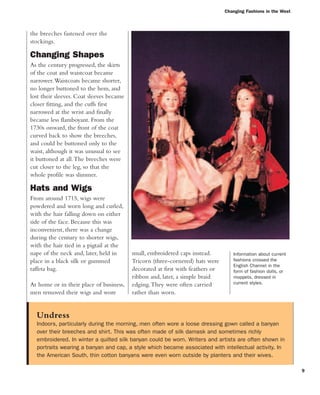
Information about current
fashions crossed the
English Channel in the
form of fashion dolls, or
moppets, dressed in
current styles.
10
Women’s Fashions: 1750–1780
Women’s fashions multiplied rapidly
in the middle of the eighteenth
century, with one style following
another in quick succession. English
styles were popular and had
considerable impact on French dress,
as did influences from the Orient and
the Middle East.
In the court of Louis XVI in France
(reigned 1774–1792), dresses became
extremely ornate and extravagant, a
reflection of the excesses of the
aristocratic life that fuelled the
French Revolution in 1789. In
general, English styles were more
restrained than French ones.
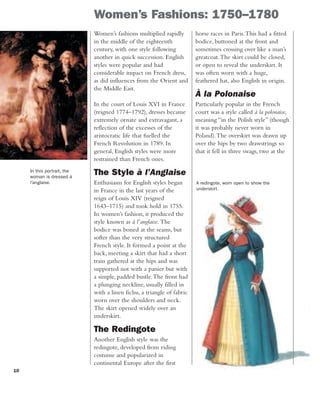
The Style à l’Anglaise
Enthusiasm for English styles began
in France in the last years of the
reign of Louis XIV (reigned
1643–1715) and took hold in 1755.
In women’s fashion, it produced the
style known as à l’anglaise. The
bodice was boned at the seams, but
softer than the very structured
French style. It formed a point at the
back, meeting a skirt that had a short
train gathered at the hips and was
supported not with a panier but with
a simple, padded bustle.The front had
a plunging neckline, usually filled in
with a linen fichu, a triangle of fabric
worn over the shoulders and neck.
The skirt opened widely over an
underskirt.
The Redingote
Another English style was the
redingote, developed from riding
costume and popularized in
continental Europe after the first
In this portrait, the
woman is dressed à
l’anglaise. A redingote, worn open to show the
underskirt.
horse races in Paris.This had a fitted
bodice, buttoned at the front and
sometimes crossing over like a man’s
greatcoat.The skirt could be closed,
or open to reveal the underskirt. It
was often worn with a huge,
feathered hat, also English in origin.
À la Polonaise
Particularly popular in the French
court was a style called à la polonaise,
meaning “in the Polish style” (though
it was probably never worn in
Poland).The overskirt was drawn up
over the hips by two drawstrings so
that it fell in three swags, two at the
11
sides and one at the back.The dress
was quite short, sometimes coming
just to the ankles. It had flat sleeves
that usually ended above the elbow,
though a flounce of lace or muslin
fell over the elbow.
Spanish Variations
While the upper classes in most
European countries copied French
fashions closely, the Spanish varied
it slightly from the middle of the
century. Spanish women wore their
dresses somewhat shorter and lighter
than in France.They added shawls
in brilliant colors, and wore the
traditional Spanish mantilla, a kind
of lace veil in black or white
supported by a tortoiseshell comb
in their hair.
A Riot of Color
Scientific work on the nature of color and the spectrum prepared the
ground for the development of new dyes. Newton’s Treatise on Optics
(1704) explained that all other colors were formed by combining red,
yellow, and blue. Johan Tobias Mayer in Gottingen claimed that 9,381
colors could be distinguished by the human eye.
Chemical dyes and pigments—derived from minerals, plants, and
lichens—were developed, and by the end of the eighteenth century a
range of colors in bright as well as subtle and muted tones could be
achieved. Bleaching with chlorine was discovered in 1774 and went
into commercial operation in 1786.
Color printing on fabric, legalized in England and France after 1759,
produced good results. Copperplate printing was invented in 1757,
followed by roller printing in 1783. This enabled large-scale,
industrialized printing on fabrics, so that printed patterns became
popular and widespread.
Changing Fashions in the West
A mantua, or court dress,
with a very wide skirt. It is
made of silk, embroidered
with silk and silver thread.
12
Men’s Fashions: 1770–1830
The man’s profile slimmed down
during the last decades of the
eighteenth century, and the slender
shape remained fashionable until the
1830s.The flamboyant brocades of
the earlier eighteenth century gave
way to finer fabrics in plain colors or
stripes, and all adornment slowly
vanished.
The Frock Coat
From the middle of the century, the
front of the coat was cut away, so that
the sides swept away from the waist.
The coat remained long at the back
where it fell into three parts with
two vents. Based on English riding
clothes, this design was called the
frock coat or redingote, and it
influenced women’s fashion, too.
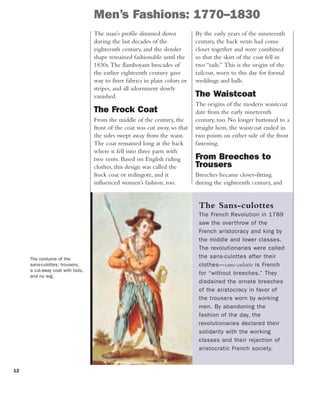
The costume of the
sans-culottes: trousers,
a cut-away coat with tails,
and no wig.
By the early years of the nineteenth
century, the back vents had come
closer together and were combined
so that the skirt of the coat fell in
two “tails.” This is the origin of the
tailcoat, worn to this day for formal
weddings and balls.
The Waistcoat
The origins of the modern waistcoat
date from the early nineteenth
century, too. No longer buttoned to a
straight hem, the waistcoat ended in
two points on either side of the front
fastening.
From Breeches to
Trousers
Breeches became closer-fitting
during the eighteenth century, and
The Sans-culottes
The French Revolution in 1789
saw the overthrow of the
French aristocracy and king by
the middle and lower classes.
The revolutionaries were called
the sans-culottes after their
clothes—sans-culotte is French
for “without breeches.” They
disdained the ornate breeches
of the aristocracy in favor of
the trousers worn by working
men. By abandoning the
fashion of the day, the
revolutionaries declared their
solidarity with the working
classes and their rejection of
aristocratic French society.
Changing Fashions in the West
13
after the French Revolution a fashion
for trousers replaced them.Adapted
from the dress of sailors and the
working classes, trousers were soon
worn in a close-fitting style that was
suitable for riding, often with soft
leather boots which came to mid-calf
or the knee.
Dandies and the
Macaroni
While some men were abandoning
unnecessary adornment, fops or
dandies embraced it.The most
famous dandy was Beau Brummell
(1778–1840), a friend of the English
prince regent (later George IV).
Brummell reportedly spent all of his
inherited fortune on fine clothes.
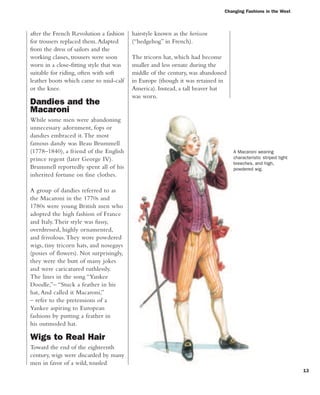
A group of dandies referred to as
the Macaroni in the 1770s and
1780s were young British men who
adopted the high fashion of France
and Italy.Their style was fussy,
overdressed, highly ornamented,
and frivolous.They wore powdered
wigs, tiny tricorn hats, and nosegays
(posies of flowers). Not surprisingly,
they were the butt of many jokes
and were caricatured ruthlessly.
The lines in the song “Yankee
Doodle,”– “Stuck a feather in his
hat, And called it Macaroni,”
– refer to the pretensions of a
Yankee aspiring to European
fashions by putting a feather in
his outmoded hat.
Wigs to Real Hair
Toward the end of the eighteenth
century, wigs were discarded by many
men in favor of a wild, tousled
A Macaroni wearing
characteristic striped tight
breeches, and high,
powdered wig.
hairstyle known as the herisson
(“hedgehog” in French).
The tricorn hat, which had become
smaller and less ornate during the
middle of the century, was abandoned
in Europe (though it was retained in
America). Instead, a tall beaver hat
was worn.
14
Women’s Fashions: 1780–1830
In the late eighteenth century,
fashion was influenced by new
directions in political and social
thought that changed the way people
considered themselves and their
bodies.There was a move away from
ornate and constricting clothes to
more fluid shapes that followed the
line of the body.
Rejecting Riches
From 1783 onward, the French court
followed the lead of the queen, Marie
Antoinette, in abandoning the huge,
ornate, and constricting dresses of the
previous years for all except the most
formal occasions. By the time of the
French Revolution in 1789, the most
extravagant excesses had already been
abandoned by most fashionable
people. During the revolution,
ostentatious displays of wealth
became not only unfashionable but
even dangerous.
English styles remained popular.
Dresses had a softer line, or were
based on the redingote, and
supported by light padding.A fine
linen fichu was often worn over the
chest, and the ribbons, bows, lace, and
jewels of the 1770s disappeared.
Dresses were usually in plain colors
or stripes, unadorned except for a
simple sash and sometimes a
decorative apron. Ideals of rustic
simplicity became popular. Patterns,
when they were used, were inspired
by nature, showing delicate flowers
and leaves.
Slimmer Lines
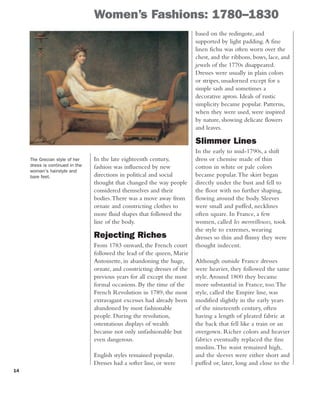
In the early to mid-1790s, a shift
dress or chemise made of thin
cotton in white or pale colors
became popular.The skirt began
directly under the bust and fell to
the floor with no further shaping,
flowing around the body. Sleeves
were small and puffed, necklines
often square. In France, a few
women, called les merveilleuses, took
the style to extremes, wearing
dresses so thin and flimsy they were
thought indecent.
Although outside France dresses
were heavier, they followed the same
style.Around 1800 they became
more substantial in France, too.The
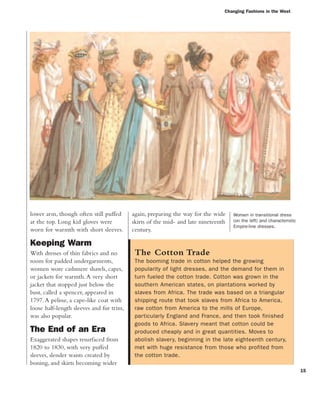
style, called the Empire line, was
modified slightly in the early years
of the nineteenth century, often
having a length of pleated fabric at
the back that fell like a train or an
overgown. Richer colors and heavier
fabrics eventually replaced the fine
muslins.The waist remained high,
and the sleeves were either short and
puffed or, later, long and close to the
The Grecian style of her
dress is continued in the
woman's hairstyle and
bare feet.
Changing Fashions in the West
15
lower arm, though often still puffed
at the top. Long kid gloves were
worn for warmth with short sleeves.
Keeping Warm
With dresses of thin fabrics and no
room for padded undergarments,
women wore cashmere shawls, capes,
or jackets for warmth.A very short
jacket that stopped just below the
bust, called a spencer, appeared in
1797.A pelisse, a cape-like coat with
loose half-length sleeves and fur trim,
was also popular.
The End of an Era
Exaggerated shapes resurfaced from
1820 to 1830, with very puffed
sleeves, slender waists created by
boning, and skirts becoming wider
again, preparing the way for the wide
skirts of the mid- and late nineteenth
century.
The Cotton Trade
The booming trade in cotton helped the growing
popularity of light dresses, and the demand for them in
turn fueled the cotton trade. Cotton was grown in the
southern American states, on plantations worked by
slaves from Africa. The trade was based on a triangular
shipping route that took slaves from Africa to America,
raw cotton from America to the mills of Europe,
particularly England and France, and then took finished
goods to Africa. Slavery meant that cotton could be
produced cheaply and in great quantities. Moves to
abolish slavery, beginning in the late eighteenth century,
met with huge resistance from those who profited from
the cotton trade.
Women in transitional dress
(on the left) and characteristic
Empire-line dresses.
16
Babies wore instead a cotton or linen
shirt covered by a wraparound robe
with separate sleeves, or a long frock
that opened at the back.These came
below the feet until the baby began
to walk. Babies’ heads were kept
covered at all times with caps—often
a forehead piece, then a close-fitting
undercap, and finally a decorated cap.
Toddlers
Once children learned how to walk
they needed different clothes. Both
boys and girls wore a back-fastening
bodice and a skirt to the ankles when
very young, or sometimes a front-
opening or wraparound gown.This
allowed for easy diaper changing. In
the second half of the eighteenth
century, a looser frock with a sash at
the waist was popular. Frocks or
gowns often had leading strings or
reins attached for an adult to hold
while the child was learning how to
walk. In the early decades of the
nineteenth century, the dress was
slightly shorter and worn with loose
trousers, called pantaloons.
Children’s Clothes
Attitudes toward children and
childhood changed during the
eighteenth century, influencing the
way they were dressed.At the
beginning of the century, even quite
young children wore miniature
versions of adult clothes, but by the
end of the century they were wearing
more suitable outfits that allowed freer
movement.
Babies
In many parts of the world, babies
were tightly swaddled—wrapped in
bands of fabric—and often strapped to
wooden “cradle boards.”This was
thought to encourage their limbs to
grow straight. In Europe, swaddling
dropped out of favor during the
eighteenth century, and among
educated people it had been
abandoned completely by about 1780.
However, many children wore stays
(boned corsets) to encourage straight
posture and correct growth.
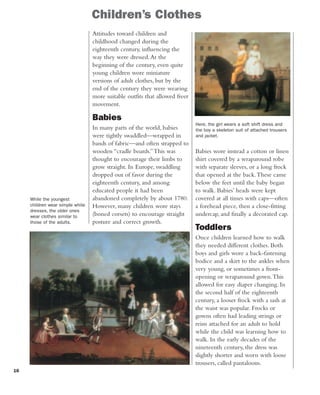
While the youngest
children wear simple white
dresses, the older ones
wear clothes similar to
those of the adults.
Here, the girl wears a soft shift dress and
the boy a skeleton suit of attached trousers
and jacket.
Changing Fashions in the West
17
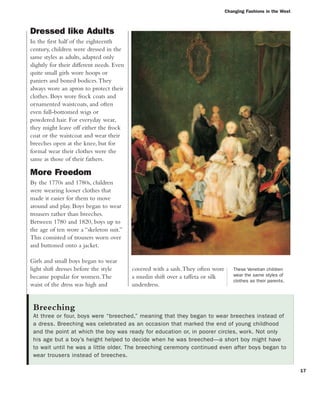
These Venetian children
wear the same styles of
clothes as their parents.
Dressed like Adults
In the first half of the eighteenth
century, children were dressed in the
same styles as adults, adapted only
slightly for their different needs. Even
quite small girls wore hoops or
paniers and boned bodices.They
always wore an apron to protect their
clothes. Boys wore frock coats and
ornamented waistcoats, and often
even full-bottomed wigs or
powdered hair. For everyday wear,
they might leave off either the frock
coat or the waistcoat and wear their
breeches open at the knee, but for
formal wear their clothes were the
same as those of their fathers.
More Freedom
By the 1770s and 1780s, children
were wearing looser clothes that
made it easier for them to move
around and play. Boys began to wear
trousers rather than breeches.
Between 1780 and 1820, boys up to
the age of ten wore a “skeleton suit.”
This consisted of trousers worn over
and buttoned onto a jacket.
Girls and small boys began to wear
light shift dresses before the style
became popular for women.The
waist of the dress was high and
covered with a sash.They often wore
a muslin shift over a taffeta or silk
underdress.
Breeching
At three or four, boys were “breeched,” meaning that they began to wear breeches instead of
a dress. Breeching was celebrated as an occasion that marked the end of young childhood
and the point at which the boy was ready for education or, in poorer circles, work. Not only
his age but a boy’s height helped to decide when he was breeched—a short boy might have
to wait until he was a little older. The breeching ceremony continued even after boys began to
wear trousers instead of breeches.
18
While French and English fashions dominated
western Europe and North America, their
influence decreased farther east and outside the colonial
centers in America. In some areas, very cold or very hot
weather dictated what people wore. Costume was also
restricted by the technologies and materials available to
make clothes.
In eastern Europe and Russia, the
influence of Persian and Turkish dress
can be seen, tempered in the north
by a need for warmth.
Poland and Eastern
Europe
European fashions were popular in
the Polish royal court, but elsewhere
traditional Polish costume had a
strong hold. Upper-class men wore a
long, tight-fitting garment called a
zupan, covered with a kontush, a coat
with long, hanging sleeves that was
Persian in origin.The kontush was
smooth at the front but pleated at the
back, the collar either upright or
folded back. In 1776 a government
Chapter 2: Worn Around the World
Heading East
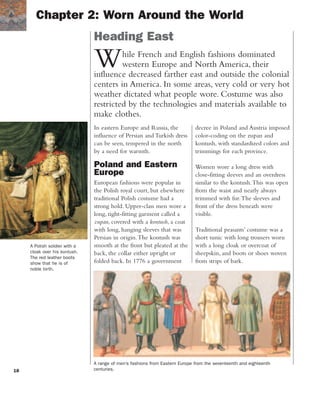
A Polish soldier with a
cloak over his kontush.
The red leather boots
show that he is of
noble birth.
decree in Poland and Austria imposed
color-coding on the zupan and
kontush, with standardized colors and
trimmings for each province.
Women wore a long dress with
close-fitting sleeves and an overdress
similar to the kontush.This was open
from the waist and nearly always
trimmed with fur.The sleeves and
front of the dress beneath were
visible.
Traditional peasants’ costume was a
short tunic with long trousers worn
with a long cloak or overcoat of
sheepskin, and boots or shoes woven
from strips of bark.
A range of men’s fashions from Eastern Europe from the seventeenth and eighteenth
centuries.
Worn Around the World
19
Russian Court and
Country
The Russian court followed Parisian
fashions, often quite extravagantly.
The empress Elizabeth is said to have
left 15,000 gowns at her death, and
never to have worn any more than
once. She also had a collection of
thousands of pairs of shoes and
slippers, and had silk stockings sent
to her from France.
Western styles had been forced on
the nobility by Tsar Peter the Great
after an extended visit to Europe in
1698. Peter decreed that long coats
be cut off at the knee. He demanded
that all men cut their beards off or
pay a beard tax.
In contrast with the extravagance of
the court, ordinary people in Russia
wore the same type of clothes
throughout the eighteenth century,
though with a lot of regional
variations. In the steppes (areas of
grassland with hot summers and cold
winters), men wore a simple, loose
shirt and wide trousers, tucked into
boots. Over this they wore a caftan, a
narrow coat with long sleeves, which
was crossed over at the front and tied
with a sash or turlup. Over this they
could wear an overcoat called a ferez,
which often had long sleeves, but
usually no collar or belt.
Women wore a long, wide gown,
belted at the waist, and a diadem
headdress with an attached veil.All of
the clothes were brightly colored and
decorated with embroidery. In winter,
the peasants who lived in the country
wore very thick stockings and many
layers of clothes to keep warm.
The Fur Trade
Russian territorial expansion was driven largely by the “fur rush” (1742–c. 1782), the desire
to acquire furs for use and sale abroad. Russians colonized Siberia from the late sixteenth
century, seeking gems and the furs of squirrel, fox, beaver, and, most importantly, sable (a small
marten-like animal). The sables were used in Russia and also sold to Europe. In the eighteenth
century, the furs of sea otters and seals drove further expansion into Alaska. Many of the local
inhabitants, the Aleuts, were forced into slavery, trapping and hunting sea otters and seals for
the Russians. Sea otter fur was prized in China, and most pelts were exported in exchange
for silk and tea. Alaska remained Russian until it was sold to the United States in 1867.
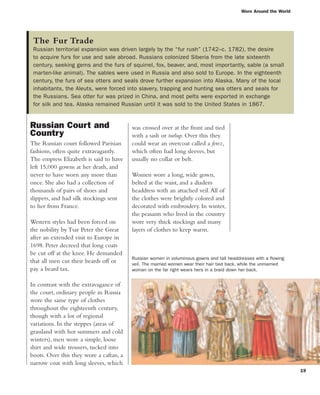
Russian women in voluminous gowns and tall headdresses with a flowing
veil. The married women wear their hair tied back, while the unmarried
woman on the far right wears hers in a braid down her back.
20
The Middle East
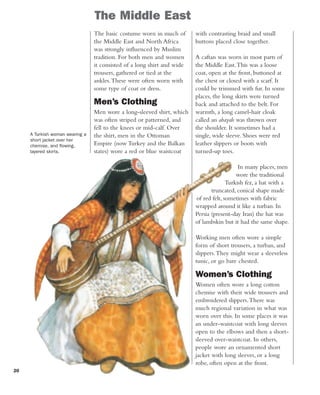
A Turkish woman wearing a
short jacket over her
chemise, and flowing,
layered skirts.
The basic costume worn in much of
the Middle East and North Africa
was strongly influenced by Muslim
tradition. For both men and women
it consisted of a long shirt and wide
trousers, gathered or tied at the
ankles.These were often worn with
some type of coat or dress.
Men’s Clothing
Men wore a long-sleeved shirt, which
was often striped or patterned, and
fell to the knees or mid-calf. Over
the shirt, men in the Ottoman
Empire (now Turkey and the Balkan
states) wore a red or blue waistcoat
with contrasting braid and small
buttons placed close together.
A caftan was worn in most parts of
the Middle East.This was a loose
coat, open at the front, buttoned at
the chest or closed with a scarf. It
could be trimmed with fur. In some
places, the long skirts were turned
back and attached to the belt. For
warmth, a long camel-hair cloak
called an abayah was thrown over
the shoulder. It sometimes had a
single, wide sleeve. Shoes were red
leather slippers or boots with
turned-up toes.
In many places, men
wore the traditional
Turkish fez, a hat with a
truncated, conical shape made
of red felt, sometimes with fabric
wrapped around it like a turban. In
Persia (present-day Iran) the hat was
of lambskin but it had the same shape.
Working men often wore a simple
form of short trousers, a turban, and
slippers.They might wear a sleeveless
tunic, or go bare chested.
Women’s Clothing
Women often wore a long cotton
chemise with their wide trousers and
embroidered slippers.There was
much regional variation in what was
worn over this. In some places it was
an under-waistcoat with long sleeves
open to the elbows and then a short-
sleeved over-waistcoat. In others,
people wore an ornamented short
jacket with long sleeves, or a long
robe, often open at the front.
Worn Around the World
21
was draped over the head and the
other wound around the head to
keep the first in place.
In many other parts of Africa, few
clothes were worn.The men of the
Chir, from the Upper Nile,
wore only a loincloth of fig
leaves and a cotton cap. Bazy
men, also from the Nile area,
wore no clothes, but
covered their bodies with
yellow ocher.
Women kept their heads covered,
their headdresses varying greatly from
one region and group to another.
Most wore a veil either of white
muslin or of black silk or horsehair.
In some places, when outdoors,
women were completely covered by
a burka, a tent-like garment with a
visor or veil over the eyes.
North Africa
Nomadic peoples in the desert
regions of North Africa were usually
well covered.The Bedouin wore
flowing robes of brown or black
cloth, often embroidered in bright
reds and oranges.A short jacket of
dark wool called a jubbe was worn
over the robe.They wore a headdress
made of two squares of fabric; one
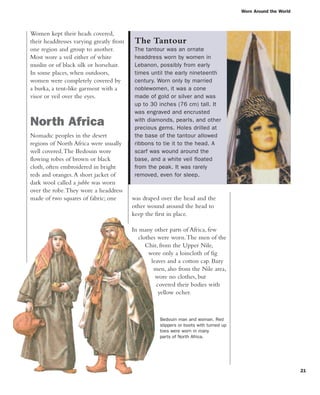
The Tantour
The tantour was an ornate
headdress worn by women in
Lebanon, possibly from early
times until the early nineteenth
century. Worn only by married
noblewomen, it was a cone
made of gold or silver and was
up to 30 inches (76 cm) tall. It
was engraved and encrusted
with diamonds, pearls, and other
precious gems. Holes drilled at
the base of the tantour allowed
ribbons to tie it to the head. A
scarf was wound around the
base, and a white veil floated
from the peak. It was rarely
removed, even for sleep.
Bedouin man and woman. Red
slippers or boots with turned up
toes were worn in many
parts of North Africa.
22
India
Despite regional and religious
variations, fashions changed slowly in
India. Since the efforts of Emperor
Akbar (1556–1605) to encourage
Hindus and Muslims to live
peacefully together, there was a less
clear division between Muslim and
Hindu dress.
Menswear
Men usually wore a coat or tunic,
called a jamah or angarkha depending
on the style, with trousers called
payjamahs. Some people might also
wear a farji, a long waistcoat, usually
without sleeves, that was worn open
at the front.
Trousers were originally close-fitting
at the ankle, wide at the top, and
gathered in at the waist. During the
eighteenth and early nineteenth
centuries, the leg of the trousers
became wider and looser at the
bottom. Many Hindu men wore,
instead, a dhoti, an unstitched length
of cloth that was draped around the
lower part of the body.
The coat was close-fitting at the top
of the body and had a wide, pleated
skirt which at the end of the
seventeenth century came to just
below the knees. During the early
eighteenth century it became longer,
reaching almost to the ground in
some cases.The seam at the waist
rose up the body, too, so that the skirt
might start just below the arms.
The coat could be fastened at the
neck and waist but with an open slit
in between, or have a front flap
folded over and fastened, the whole
being closed to the neck. It was
finished with a sash at the waist.
Princes are often seen in portraits
wearing a nearly transparent coat
which was made of very fine, white
muslin.
All men wore a turban, a length of
cotton or silk that was wound around
the head. Exactly how it was worn
indicated the man’s social and
religious standing, as well as where he
came from. For example, the wealthy
often wore ornate, decorated turbans
made of silk, while an old, poor
person usually wore a simple turban
of plain white cotton.
Women’s Clothes
Hindu women had worn saris for
centuries, but from the early
nineteenth century onward, Muslim
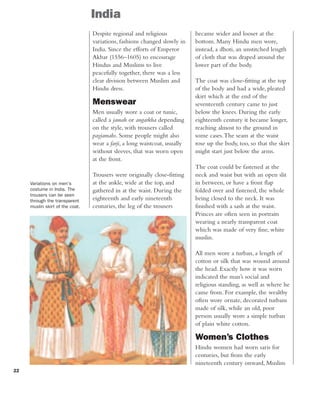
Variations on men's
costume in India. The
trousers can be seen
through the transparent
muslin skirt of the coat.
Worn Around the World
23
Symbolic Colors
The colors of Indian clothes were often very rich and vibrant. Many of
the colors had meanings in Indian symbolism. The red dye used
(madder) enters fibers deeply and was taken to represent the love of
Krishna and Radha, so it was usually worn by Hindu brides. Gold and
silver together represented the joining of the rivers Ganges and
Jumna, or the sun and moon. Violet represented the fruit of the jamon
tree, which in turn stood for the holy Hindu scriptures.
women began to adopt them, too.
The sari is a piece of decorated fabric
up to twenty-seven feet (8.2 m) long
and about four feet (1.2 m) wide that
is folded, wrapped, and draped over
the body.The fullest part is worn
around the hips, falling to the
ground, and the last part is taken up
over the shoulder or head.The
precise arrangement of the sari varied
between regions and social groups.
The sari was worn with a short
jacket called a choli. This had short
sleeves and stopped above the waist,
leaving the midriff bare above the top
edge of the sari.
Muslim women usually wore a choli
with an open-fronted, pleated skirt
called a ghagra. A panel like an apron
covered the front opening, but was
often later replaced with a sari.
Alternatively, women wore costumes
similar to those of men, with
payjamahs or dhoti and a coat.Their
arms were often bare from the elbow,
where the sleeves of the choli or coat
ended.
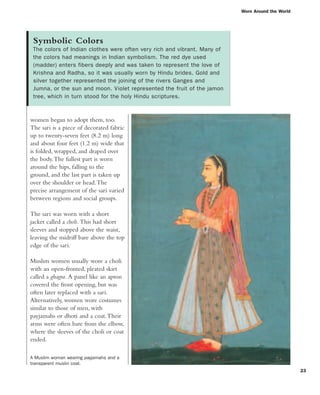
A Muslim woman wearing payjamahs and a
transparent muslin coat.
24
China
like a horse’s hoof that covered
the back of the hand.The skirt
came to the ankles and was slit
at each side. For men, the
robe was also slit in the back
and the front for horse
riding. In other respects, the
robe was the same for men
and women.
High-ranking members
of the court wore robes
decorated with nine
dragons—eight visible
and one hidden on the
inner flap. For lower
ranks, the hidden
dragon was missing.
The design of the
robes was symbolic,
with the earth represented at
the bottom by waves and mountains,
then the sky by clouds and dragons.
The spiritual realm was represented
by the wearer’s head.
The robe was worn with a silk girdle
with hanging purses and a knife case,
as well as a hat, boots, and necklaces.
Women wore a dragon coat over the
robe in public.This was a full-length,
wide-sleeved surcoat that opened
down the front and was made in
blue-black silk with dragons in
roundels.
The ornate clothes worn in the
Chinese imperial court of the
eighteenth century were strictly
controlled, with colors and emblems
used to show the wearer’s rank.
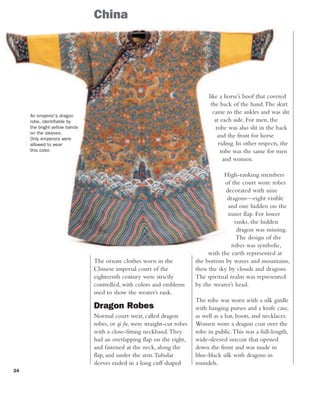
Dragon Robes
Normal court wear, called dragon
robes, or qi fu, were straight-cut robes
with a close-fitting neckband.They
had an overlapping flap on the right,
and fastened at the neck, along the
flap, and under the arm.Tubular
sleeves ended in a long cuff shaped
An emperor's dragon
robe, identifiable by
the bright yellow bands
on the sleeves.
Only emperors were
allowed to wear
this color.
Worn Around the World
25
Ceremonial Wear
A slightly different robe, called chao fu,
was worn for great feasts and
sacrifices. It had narrow sleeves ending
in “horse-hoof” cuffs and a full,
pleated skirt attached at the waistband.
A close-fitting neckband had a
detachable collar with tips like wings
that extended over the shoulders.
Only the highest-ranking women
wore chao fu.The woman’s robe was
cut straight and long with no change
at the waist. It had a cape-like collar
with flaring epaulets which narrowed
to points and went beneath the arms.
Outerwear
Over other robes, a three-quarter-
length coat of plain purple-black silk
gave a clearer indication of rank, with
symbols arranged in panels called
mandarin squares.The emperor’s
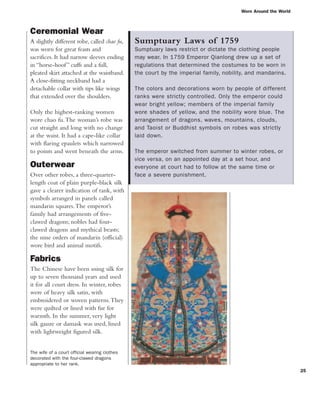
family had arrangements of five-
clawed dragons; nobles had four-
clawed dragons and mythical beasts;
the nine orders of mandarin (official)
wore bird and animal motifs.
Fabrics
The Chinese have been using silk for
up to seven thousand years and used
it for all court dress. In winter, robes
were of heavy silk satin, with
embroidered or woven patterns.They
were quilted or lined with fur for
warmth. In the summer, very light
silk gauze or damask was used, lined
with lightweight figured silk.
Sumptuary Laws of 1759
Sumptuary laws restrict or dictate the clothing people
may wear. In 1759 Emperor Qianlong drew up a set of
regulations that determined the costumes to be worn in
the court by the imperial family, nobility, and mandarins.
The colors and decorations worn by people of different
ranks were strictly controlled. Only the emperor could
wear bright yellow; members of the imperial family
wore shades of yellow, and the nobility wore blue. The
arrangement of dragons, waves, mountains, clouds,
and Taoist or Buddhist symbols on robes was strictly
laid down.
The emperor switched from summer to winter robes, or
vice versa, on an appointed day at a set hour, and
everyone at court had to follow at the same time or
face a severe punishment.
The wife of a court official wearing clothes
decorated with the four-clawed dragons
appropriate to her rank.
26
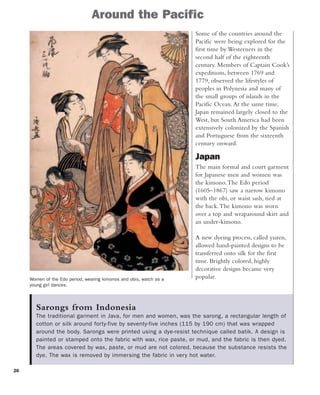
Women of the Edo period, wearing kimonos and obis, watch as a
young girl dances.
Some of the countries around the
Pacific were being explored for the
first time by Westerners in the
second half of the eighteenth
century. Members of Captain Cook’s
expeditions, between 1769 and
1779, observed the lifestyles of
peoples in Polynesia and many of
the small groups of islands in the
Pacific Ocean.At the same time,
Japan remained largely closed to the
West, but South America had been
extensively colonized by the Spanish
and Portuguese from the sixteenth
century onward.
Japan
The main formal and court garment
for Japanese men and women was
the kimono.The Edo period
(1605–1867) saw a narrow kimono
with the obi, or waist sash, tied at
the back.The kimono was worn
over a top and wraparound skirt and
an under-kimono.
A new dyeing process, called yuzen,
allowed hand-painted designs to be
transferred onto silk for the first
time. Brightly colored, highly
decorative designs became very
popular.
Sarongs from Indonesia
The traditional garment in Java, for men and women, was the sarong, a rectangular length of
cotton or silk around forty-five by seventy-five inches (115 by 190 cm) that was wrapped
around the body. Sarongs were printed using a dye-resist technique called batik. A design is
painted or stamped onto the fabric with wax, rice paste, or mud, and the fabric is then dyed.
The areas covered by wax, paste, or mud are not colored, because the substance resists the
dye. The wax is removed by immersing the fabric in very hot water.
Around the Pacific
Worn Around the World
27
Most people wore shirts, trousers or
leggings, and stockings, all of cotton.
Over this they would wear one or
more cotton robes.Women often wore
a red silk tunic in place of a shirt.
Poorer people made shirts by weaving
strips of bark from the atooshi tree.
The Pacific Islands
and Australia
Inhabitants of the many islands in the
Pacific wore a wide range of clothing.
In New Guinea and the surrounding
islands, people wore little more than
skirts made of plant fibers and often
ornate headdresses for battle or
ceremonies. In Indonesia, silks and
cottons imported from India were
worn as skirts and wide trousers. In
Borneo, warriors wore a loincloth
and a protective breastplate made of
fish skin.The aborigines in Australia
wore simple loincloths and capes
made of plant fibers or animal skins.
South America
South America was home to
colonists from Europe and the many
tribes who lived in the forests and
mountains of the interior. Some
tribes, which had little or no contact
with the colonists, continued to wear
their traditional clothing, but others
adopted Spanish dress to a greater or
lesser degree.
Some tribes wore very few clothes,
often just arm or leg bands of fur,
decorated with hanging feathers or
with shell or bone ornaments.
Loincloths were worn by many
tribes, usually made of cotton and
decorated with beads and seeds.
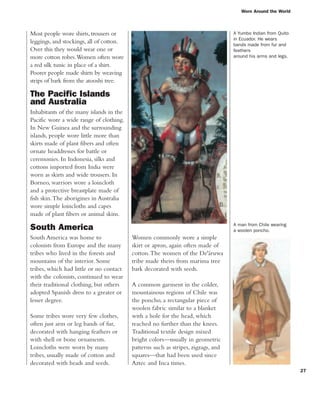
A man from Chile wearing
a woolen poncho.
Women commonly wore a simple
skirt or apron, again often made of
cotton.The women of the De'áruwa
tribe made theirs from marima tree
bark decorated with seeds.
A common garment in the colder,
mountainous regions of Chile was
the poncho, a rectangular piece of
woolen fabric similar to a blanket
with a hole for the head, which
reached no further than the knees.
Traditional textile design mixed
bright colors—usually in geometric
patterns such as stripes, zigzags, and
squares—that had been used since
Aztec and Inca times.
A Yumbo Indian from Quito
in Ecuador. He wears
bands made from fur and
feathers
around his arms and legs.
28
Native North Americans
barefoot or made simple sandals from
grass or bark.
Materials
Most North American native clothing
was made from the cured leather of
deer, buffalo, caribou, or elk. Some
tribes even used bird and fish skins.
Fur came from bears, rabbits,
squirrels, marmosets, beaver, or mink.
Although they had no woven fabrics,
some tribes made clothes from plant
products. Men in California and the
northwest made capes and hats for
wet weather from shredded cedar
bark or other plant fibers.Tule grass
was used for skirts and sandals.
Many tribes made ceremonial capes,
skirts, or tunics from a network of
hemp or grass fibers onto which
they hung feathers.
Decoration
Some tribes decorated their clothes
with embroidery, some with painting
and dyeing, and others with
quillwork made by stitching designs
in porcupine quill. Quills were
moistened to soften them, sometimes
dyed, flattened with teeth, and then
stitched in place. Ornamental objects
such as shells, bones, bird beaks,
teeth, and claws were often stitched
to ceremonial garments or used in
jewelry.The scalps from colorful birds
such as woodpeckers and mallards
were sometimes stitched to capes.
Manufacture of
Clothes
Their garments were usually tied or
stitched with animal sinews or
There were many indigenous races
and tribes in North America in the
eighteenth century. Some had no
contact with settlers, and few items of
their clothing have survived, so little
is known of it. Other tribes were of
great interest to American colonists
and Europeans, and their clothing has
been well documented.
Regional Variation
The use of clothing by Native
Americans varied widely. In some
places, men went naked most of the
time, but in others tribal identity, age,
and gender were shown in the design
of moccasins (soft shoes) and of
beadwork, the cut of garments, and
the type of headdress worn.
Typical
Garments
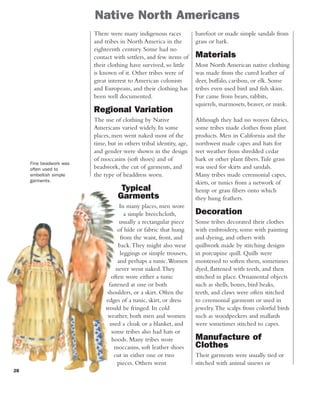
In many places, men wore
a simple breechcloth,
usually a rectangular piece
of hide or fabric that hung
from the waist, front, and
back.They might also wear
leggings or simple trousers,
and perhaps a tunic.Women
never went naked.They
often wore either a tunic
fastened at one or both
shoulders, or a skirt. Often the
edges of a tunic, skirt, or dress
would be fringed. In cold
weather, both men and women
used a cloak or a blanket, and
some tribes also had hats or
hoods. Many tribes wore
moccasins, soft leather shoes
cut in either one or two
pieces. Others went
Fine beadwork was
often used to
embellish simple
garments.
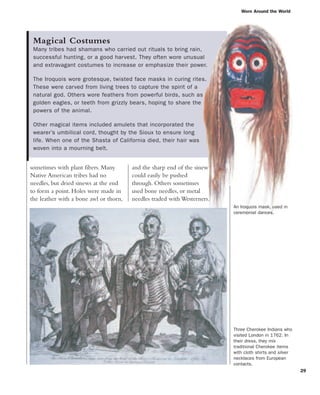
Magical Costumes
Many tribes had shamans who carried out rituals to bring rain,
successful hunting, or a good harvest. They often wore unusual
and extravagant costumes to increase or emphasize their power.
The Iroquois wore grotesque, twisted face masks in curing rites.
These were carved from living trees to capture the spirit of a
natural god. Others wore feathers from powerful birds, such as
golden eagles, or teeth from grizzly bears, hoping to share the
powers of the animal.
Other magical items included amulets that incorporated the
wearer’s umbilical cord, thought by the Sioux to ensure long
life. When one of the Shasta of California died, their hair was
woven into a mourning belt.
Worn Around the World
29
sometimes with plant fibers. Many
Native American tribes had no
needles, but dried sinews at the end
to form a point. Holes were made in
the leather with a bone awl or thorn,
An Iroquois mask, used in
ceremonial dances.
Three Cherokee Indians who
visited London in 1762. In
their dress, they mix
traditional Cherokee items
with cloth shirts and silver
necklaces from European
contacts.
and the sharp end of the sinew
could easily be pushed
through. Others sometimes
used bone needles, or metal
needles traded with Westerners.
30
Decoration
Some groups decorated their clothes, either
embroidering them with moose or reindeer hair, adding
a patchwork of different-colored fur, or dyeing or
painting them. Special costumes often had decorations
of bone or teeth, feathers, and shells. The shaman and
dancers of the Chilkat of Alaska wore a ceremonial
deerskin apron adorned with deer claws, puffin beaks,
and quillwork. On their heads they wore a crown of
grizzly bear claws or a pair of mountain goat horns on
a leather band.
In temperate climates, most people
wore similar clothes in summer and
winter, adding a coat, cloak, or
blanket if the weather was particularly
cold or wet. Some parts of the world,
though, have extreme weather.The
Eskimos (or Inuit andYupic) live in
the most extreme climates in the
Arctic and sub-Arctic regions,
where the winter is long and very
cold and the summer is a brief
period of permanent daylight.
Eskimos
Eskimos are a single race of people
who live all around the northern
regions of the world, in
Canada, Siberia, northern
Scandinavia, and Greenland.
Their clothing varied by
region. Some groups
had had contact with
the West by the
end of the
eighteenth
century and so began
to adopt some materials and styles
not native to them.
The Arctic
Materials
The regions where Eskimos lived had
few plants that could be used to
make clothing, and almost all of their
garments were made from animal
skins. Sealskin was widely used, but
other skins—including polar bear,
reindeer, dog, caribou, moose, and
even fish, bird, or whale skin—was
used in some places. Seal hunters
from Alaska, taken into slavery by
Russia, wore semitransparent,
waterproof shirts made from the
intestines of sea animals, and used the
insides of seal gullets for leggings and
boots.
Typical Clothing
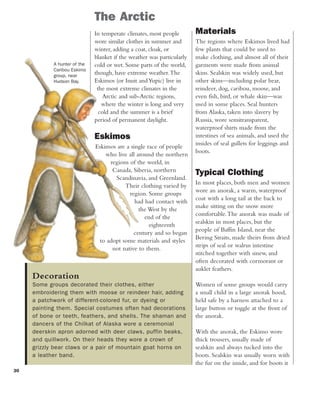
In most places, both men and women
wore an anorak, a warm, waterproof
coat with a long tail at the back to
make sitting on the snow more
comfortable.The anorak was made of
sealskin in most places, but the
people of Baffin Island, near the
Bering Straits, made theirs from dried
strips of seal or walrus intestine
stitched together with sinew, and
often decorated with cormorant or
auklet feathers.
Women of some groups would carry
a small child in a large anorak hood,
held safe by a harness attached to a
large button or toggle at the front of
the anorak.
With the anorak, the Eskimo wore
thick trousers, usually made of
sealskin and always tucked into the
boots. Sealskin was usually worn with
the fur on the inside, and for boots it
A hunter of the
Caribou Eskimo
group, near
Hudson Bay.
31
Worn Around the World
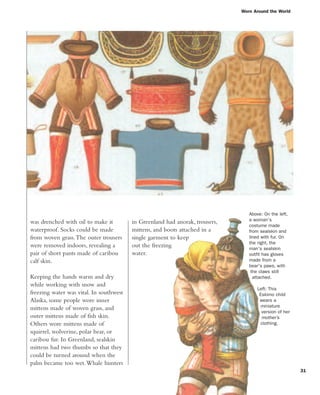
Above: On the left,
a woman's
costume made
from sealskin and
lined with fur. On
the right, the
man's sealskin
outfit has gloves
made from a
bear's paws, with
the claws still
attached.
Left: This
Eskimo child
wears a
miniature
version of her
mother’s
clothing.
was drenched with oil to make it
waterproof. Socks could be made
from woven grass.The outer trousers
were removed indoors, revealing a
pair of short pants made of caribou
calf skin.
Keeping the hands warm and dry
while working with snow and
freezing water was vital. In southwest
Alaska, some people wore inner
mittens made of woven grass, and
outer mittens made of fish skin.
Others wore mittens made of
squirrel, wolverine, polar bear, or
caribou fur. In Greenland, sealskin
mittens had two thumbs so that they
could be turned around when the
palm became too wet.Whale hunters
in Greenland had anorak, trousers,
mittens, and boots attached in a
single garment to keep
out the freezing
water.
32
Work Clothes
Everyday Work Wear
For many people, work dress needed
only to provide warmth and
protection.Their clothes had to be
robust and practical, with no
sweeping skirts or coattails that might
become trapped or torn.
Working Men
Most working men in Europe wore
breeches with stockings, a shirt, a
waistcoat, and a jacket or coat.The
fabrics were often coarse linen or
wool and there was little or no
adornment. Many working people
continued to wear breeches long
after trousers replaced them in
fashionable dress, though sailors and
laborers had worn trousers before
they became fashionable.
Men in a wide range of occupations
wore aprons, including carpenters,
butchers, masons, and bakers.The
fabric was suited to the particular
activity, so a baker would wear a
cloth apron, but a blacksmith wore
leather. Many men wore folded,
The high fashions discussed in the first chapter were
worn by wealthy people in Europe and America—
people who generally led a leisured life and did no
strenuous manual work. For everybody else, everyday
dress had to allow them the freedom of movement they
needed for their activities, as well as being hardwearing
and affordable.This chapter will look at the clothes
people wore for different types of activity—for work,
travel, battle, special occasions, and religious activity.
Chapter 3: Functional Fashions
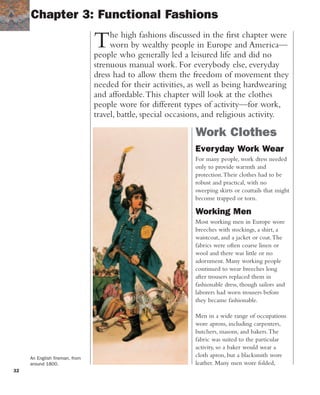
An English fireman, from
around 1800.
square paper hats of a type worn to
this day by some people working in
food production.
Daniel Defoe, writing in the mid-
1720s, describes men working in lead
mines wearing clothes made entirely
of leather, with a brimless leather hat.
Later illustrations show coal miners
wearing flannel trousers and a shirt
and waistcoat, often in impractical
colors such as white, blue, or red.
Women and children worked in the
mines, too. Records from the early
nineteenth century suggest that
miners often worked naked, or in
only ragged trousers or a shift.
Working Women
Many women worked in domestic
service as maids, cooks, and cleaners.
In the country they wore skirts
without paniers or hoops, often
bunched up at the back to protect
them, and covered with an apron.
They wore a mobcap, or “limp hood,”
an indoor cap with a high, full crown
and often tied under the chin.
In town, women in service were
more fashionably dressed.There were
complaints that they became so
preoccupied with fashion that they
would not work properly for fear of
spoiling their clothes. Many wore a
linen or calico dress, bunched in the
polonaise style, with a long, white
apron and a muslin kerchief over
their shoulders and chest.The skirt
often stopped at the ankle to allow
movement.When waistlines rose
for fashionable women, so did
those of their servants, so that
their aprons were tied just below
the bust.
Functional Fashions
33
Secondhand Clothes
Secondhand clothes were an important part of the clothing trade in the fashionable capitals
of Europe. Good quality, fashionable clothes were very expensive, and many people aspired
to wear finer clothes than they could afford, so there was a vigorous trade in secondhand
garments. Many servants were given cast-off clothes by their employers, which added to the
impression that servants were well dressed. Because the trade in secondhand clothes was
lively, clothes and cloth were often stolen—they were easy to move, they could easily be
resold, and were difficult to trace.
The slave child wears
extravagant clothing with a
turban added to make him
look exotic. Many slaves
wore a metal neckband
with their owner's details.
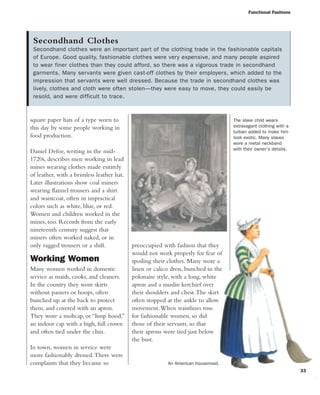
An American housemaid.
34
did not last long. Sailors whose
clothes became ragged could buy
new clothes on credit from the slop
chest.They carried needles and
thread to mend their clothes and
many also seem to have decorated
them, adding ribbons, appliqué, and
embroidery. If a sailor died, his
clothing was immediately auctioned
on deck.
Riding
For many people, the most common
form of transport was riding on
horseback. For the wealthier classes
in England and France, riding was
also a sport—a spectator sport in the
Traveling, especially by sea, was
difficult and often dangerous in the
eighteenth century. Clothing for
travel had to be warm and hard
wearing.
Sailors
Sailors wore either their own
clothing or garments bought
from the “slop chest,” the
supplies carried by the ship.
There was no naval uniform in
the early eighteenth century,
though a blue jacket was introduced
for officers in the British navy in
1748, and the American navy
introduced a full uniform in 1776.
On deck, sailors on large ships usually
wore loose-cut trousers in blue, red,
white, or stripes, with a serge, duck,
or flannel shirt worn open at the
neck.The shirt was usually green or
red and often checked, and had a low,
unstarched collar. Over this, seamen
wore a long waistcoat, often in
yellow or red.Their trousers were
held up with a knife belt or black
kerchief, and they wore a knotted
kerchief around their necks.They
wore thick woolen stockings with
flat, black shoes and a cap of fur or
wool. For protection against bad
weather, the sailor could wear a long
apron of oiled canvas and a heavy
outer coat.
On land, sailors had to dress smartly.
They often wore a short jacket
buttoned on the right; long, wide
trousers; and a shirt in blue and white
stripes, or plain blue, white, or red.
Because of the hard life at sea, clothes
Cloaks and Coats
Although cloaks and capes had
gone out of fashion for many
occasions, they were still worn
for traveling. When people
traveled on horseback or in
drafty coaches, a cloak was a
useful way of keeping warm.
Traveling cloaks were wide and
long and were worn wrapped
around the body. They were
usually lined and made of
thick, woolen fabric. Overcoats
were also worn, often with a
short cape attached at the
shoulders. In America
particularly, the overcoat was
more popular than the cape. It
was usually long and not fitted
at the waist. Stagecoach
drivers always wore this box-
shaped coat with a cape at
the shoulders.
Seafaring and Traveling
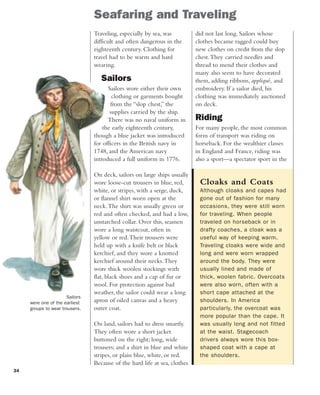
Sailors
were one of the earliest
groups to wear trousers.
Functional Fashions
35
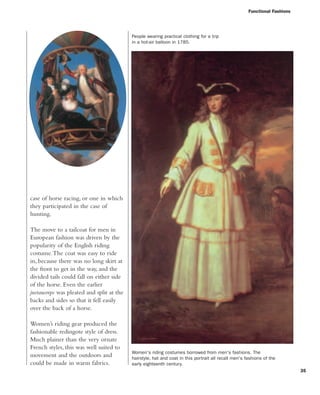
Women's riding costumes borrowed from men's fashions. The
hairstyle, hat and coat in this portrait all recall men's fashions of the
early eighteenth century.
People wearing practical clothing for a trip
in a hot-air balloon in 1785.
case of horse racing, or one in which
they participated in the case of
hunting.
The move to a tailcoat for men in
European fashion was driven by the
popularity of the English riding
costume.The coat was easy to ride
in, because there was no long skirt at
the front to get in the way, and the
divided tails could fall on either side
of the horse. Even the earlier
justaucorps was pleated and split at the
backs and sides so that it fell easily
over the back of a horse.
Women’s riding gear produced the
fashionable redingote style of dress.
Much plainer than the very ornate
French styles, this was well suited to
movement and the outdoors and
could be made in warm fabrics.
36
American Puritanism and Plain Dressing
While many Americans followed
European fashions with enthusiasm, a
large, puritanical group shunned their
excessive decoration. Collectively
know as plain people, the group
included the Quakers, Pietists or
Brethren, Mennonites, and Amish.
Quakers
The largest group embracing plain
dress were the Quakers, centered in
Philadelphia, the capital of William
Penn’s Quaker colony.The Quakers
dominated the city for the entire
eighteenth century.
Although their clothes were
completely unadorned, with no
embroidery, brocade, jewels, colored
facings, or braid, many Quakers were
very wealthy and the fabrics they
used were often of fine quality.
In rejecting the excesses of fashion,
the Quakers and other groups found
their own styles of plain dressing. No
patterns were allowed, but
“changeable” silks and worsted
wools, with the warp one color and
the weft another, were very popular.
They commonly wore muted, but
not necessarily drab, colors.Their
caps, shirts, aprons, and stockings
were white. Men wore a simple,
white linen stock at the neck.
The cut of Quakers’ clothing was the
same as that worn by fashionable
people, though usually several years
behind fashion. Linen was used for
shirts, sometimes edged with a very
small amount of lace. Quakers tried
above all else not to draw attention
to themselves, so they avoided
ostentatious plainness as well as
decoration.
The Amish
The Amish arrived in America and settled around Pennsylvania in the middle and second half
of the eighteenth century. Their appearance and mode of dress were more puritanical than
those of the Quakers and other plain people. Men wore their beards uncut and women did not
cut their hair. Their clothes were homemade from hemp that they spun themselves. There was
no adornment or decoration, and all clothes had to be cut to the same approved styles. These
styles did not change and were unaffected by fashions in the rest of the world.
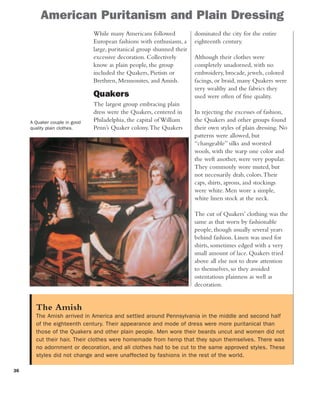
A Quaker couple in good
quality plain clothes.
Functional Fashions
and women dressed in drab colors
(though these colors were also
fashionable among other
Americans for a time).
Women wore a bonnet
with a long tunnelled
brim, and their dress was old
fashioned in cut.
Hats and Hair
Quaker men wore their hats at all
times, even indoors.These had a wide
brim usually left straight, though
some men curved it up at the sides.
The hat was covered with black silk.
Most wore their own hair, which fell
to the shoulders and was rarely
powdered. Quaker women wore their
hair pinned on top of the head and
covered with a cap or bonnet.
White Quakers
A group following the lead of John
Woolman (1720–72), known as the
white Quakers, wore undyed clothes.
Woolman objected to the use of
indigo dye because of the
involvement of slave labor—as well as
the damage caused to the
environment—in the production and
dyeing processes.After some soul-
searching,Woolman chose to forego
all colors.The decision was a difficult
one because he felt that to dress in
uncolored clothes could make him
conspicuous:“the apprehension of
being looked upon as one affecting
singularity felt uneasy to me,” he
wrote.
Distinctive Dress
Toward the end of the eighteenth
century, the Quakers’ style of dress
became more distinctive.This perhaps
occurred because they wanted to
distance themselves from other
religious groups, and adopting a more
uniform dress helped them to forge
an identity of their own.The men
continued to wear breeches and
stockings when more fashionable
men had adopted trousers. Both men
Although simple and undecorated, a
Quaker wedding dress like this was
often made from very fine fabric.
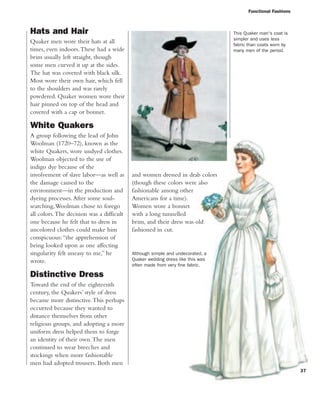
This Quaker man's coat is
simpler and uses less
fabric than coats worn by
many men of the period.
37
38
Pioneers
The best-known pioneers were
those Americans who set out from
the east coast to claim lands and
make a new life farther inland. But
other pioneers and explorers were
making their way into Australia,
South America, and the far north
during the eighteenth century.
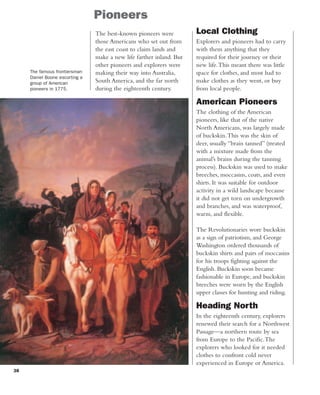
The famous frontiersman
Daniel Boone escorting a
group of American
pioneers in 1775.
Local Clothing
Explorers and pioneers had to carry
with them anything that they
required for their journey or their
new life.This meant there was little
space for clothes, and most had to
make clothes as they went, or buy
from local people.
American Pioneers
The clothing of the American
pioneers, like that of the native
North Americans, was largely made
of buckskin.This was the skin of
deer, usually “brain tanned” (treated
with a mixture made from the
animal’s brains during the tanning
process). Buckskin was used to make
breeches, moccasins, coats, and even
shirts. It was suitable for outdoor
activity in a wild landscape because
it did not get torn on undergrowth
and branches, and was waterproof,
warm, and flexible.
The Revolutionaries wore buckskin
as a sign of patriotism, and George
Washington ordered thousands of
buckskin shirts and pairs of moccasins
for his troops fighting against the
English. Buckskin soon became
fashionable in Europe, and buckskin
breeches were worn by the English
upper classes for hunting and riding.
Heading North
In the eighteenth century, explorers
renewed their search for a Northwest
Passage—a northern route by sea
from Europe to the Pacific.The
explorers who looked for it needed
clothes to confront cold never
experienced in Europe or America.
Functional Fashions
39
The supply of clothes in early
Australia was inconsistent; local
industry was only just beginning and
there was no real currency until
1813.These factors meant that
clothing was often in short supply
and some people wore their garments
until they were ragged.
Christopher Middleton, who set out
from Hudson Bay in 1742, listed the
clothes his sailors wore:“a Beaver or
Skin tuggy [calf-length coat], above
our other Cloaths, Shoes of Deer-
Skin, with three or four Socks of
thick Blanketting or warm Cloth
above our Stockings; Mittens of
Beaver lined with Duffield or thick
Cloth; and a Beaver Cap with a
Chin Cloth which covers the
greatest Part of the Face.” For
crossing the ice and snow, they
used snowshoes made from thongs
of deer skin.
Australia
Australia was settled by Europeans
from 1788 onward. Many of the
settlers were either poor or
convicts.Wealthier colonists and ex-
convicts followed European fashion,
and clothing was imported from
India and Britain. Colors popular
among women were pale brown,
olive, and yellow, sometimes called
the “drab” style.
Australian Convicts
From the 1790s to the 1810s, convicts were issued with
“slops”—cheap, ready-made clothing similar to that worn
by the working class. They had short jackets, checked
frock coats, checked shirts, untwilled cotton trousers,
and hats of leather or felt. Women were issued with
jackets, skirts, kerchiefs, caps, and hats. Most convicts’
clothes were blue or grey. When stocks of clothes ran
low, military uniforms were sometimes dyed and passed
on to convicts. Those convicts who could afford to do so
bought their own clothes.
The government increasingly wanted to distinguish between
convicts and free men, and one way of doing this was to
make the cut of their clothes different. Convicts wore loose
trousers rather than the more fashionable breeches.
Settlers in New South
Wales, Australia. Their
wide-brimmed hats protect
them from the sun and
their trousers and short
jackets are suited to
riding. Their aboriginal
guides wear very little.
40
Rural Versailles
The court of Louis XVI in France, centered at Versailles, led
European fashion in the latter half of the eighteenth century. The
queen, Marie Antoinette, tried to recreate an idyllic rural life there,
building a fake and idealized peasant village. She and the ladies at
court dressed in what they imagined were peasant costumes,
including dresses of fine muslins. Neither the village nor the
costumes were anything like those experienced by real peasants.
Rural Dress
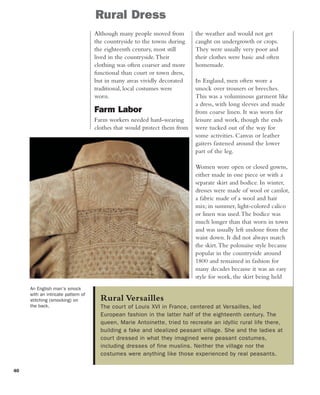
An English man's smock
with an intricate pattern of
stitching (smocking) on
the back.
Although many people moved from
the countryside to the towns during
the eighteenth century, most still
lived in the countryside.Their
clothing was often coarser and more
functional than court or town dress,
but in many areas vividly decorated
traditional, local costumes were
worn.
Farm Labor
Farm workers needed hard-wearing
clothes that would protect them from
the weather and would not get
caught on undergrowth or crops.
They were usually very poor and
their clothes were basic and often
homemade.
In England, men often wore a
smock over trousers or breeches.
This was a voluminous garment like
a dress, with long sleeves and made
from coarse linen. It was worn for
leisure and work, though the ends
were tucked out of the way for
some activities. Canvas or leather
gaiters fastened around the lower
part of the leg.
Women wore open or closed gowns,
either made in one piece or with a
separate skirt and bodice. In winter,
dresses were made of wool or camlot,
a fabric made of a wool and hair
mix; in summer, light-colored calico
or linen was used.The bodice was
much longer than that worn in town
and was usually left undone from the
waist down. It did not always match
the skirt.The polonaise style became
popular in the countryside around
1800 and remained in fashion for
many decades because it was an easy
style for work, the skirt being held
Functional Fashions
41
out of the way.A cloak was used for
warmth.
For some farm activities, the gown or
skirt was removed and the petticoat
was pinned up in the style of
trousers, leaving the legs bare from
the knee. Mining was the only other
activity in which women commonly
worked without a gown.
Provincial Fashions
There were many variations in
regional dress around Europe, with
neighboring countries having
completely different styles of
traditional costume. In central
Europe—Germany,Austria, and
Switzerland—most women wore full
skirts somewhat shorter than those
worn elsewhere, with a brightly
embroidered, laced bodice and
white shirt.
Duck hunters on the
Venetian lagoon. The
rowers are wearing waist
length close-fitting
jackets with a side
fastening.
Warmer Climates
In hot countries, many people who
worked the land wore no clothes, or
very few.A simple loincloth was often
worn in India. In China, farmworkers
wore a long shirt made of undyed
hemp.The nomadic Himba people
of southern Africa wore short skirts
of animal hide, and red body paint,
while the East African Dinka men
wore only a belt of beads, color-
coded to show their age.
The slaves who worked the sugar and
cotton plantations in America often
wore only a cotton shirt, or a shirt
with a skirt or trousers.Their
overseers, who also felt the heat,
often managed their plantations
wearing a banyan, the dressing gown
worn indoors when formal dress was
not needed, and a decorated cloth
cap worn without a wig.
42
Battle Clothing
An officer in the American
army.
Military costumes had to be suited
both to the climate and the type
of activity soldiers expected to
engage in. In many parts of the
world, armor was still used.The
design had to offer protection and
allow freedom of movement.
In the West, armor was no longer
worn because it offered no
protection against gunshot or
cannon. Military uniforms were
designed to distinguish between
armies and ranks and to allow the
soldier enough movement to use
his firearms.
Military Uniforms in
the West
In Europe and America, military
uniform and men’s civilian dress
evolved in parallel, sometimes one
taking the lead and sometimes the
other.The change from justaucorps,
breeches, and a long waistcoat, to
tight trousers with a short waistcoat
and a coat with the front cut away,
was essential to allow soldiers to
manipulate a rifle, especially when
fitted with a bayonet.
British soldiers began cutting away
their coattails during the SevenYears
Samurai
The Japanese warrior class
called the Samurai fought most
commonly with swords. The
warrior wore armor made of
plates of lacquered leather and
metal called kozane, held
together with leather or silk
thongs. The main parts of the
armor were a breast plate and
helmet. There was often also
protection for the lower legs and
for the lower part of the left
arm, and occasionally a short
skirt that protected the upper
legs. The armor was worn over a
short kimono fastened with an
obi. From the beginning of the
eighteenth century, the samurai
wore padded armor made of
bamboo and cotton when
practicing and training in
swordsmanship.
Samurai armor.
Functional Fashions
43
War in America (1756–63), to avoid
becoming caught on undergrowth.
Short-skirted coats became official
wear for the rank and file from 1797,
and for officers from 1812.American
army officers had a greatcoat or cloak
for warmth, but ordinary soldiers
managed with a Dutch blanket.
Eastern Battle
Costume
Many developed nations, such as
Japan, India, and the Ottoman
Empire, did not have firearms in the
eighteenth century and their soldiers
still wore armor, which was often
very ornate and even beautiful.
Armor could be adorned with jewels
or enamelling on the metal, or with
embroidery on velvet bands or
leather, or painting and gilding on
leatherwork.
Much armor was made of jointed
plates of leather or metal, or a
combination of both.The plates
were either held together with
thongs or stitched to a cloth
backing. Overlapping plates were
often used to protect against arrows,
which might pierce even small gaps.
In some places, chain mail, made
of many small, metal links, was
still used.
Sikh soldiers in northern India wore
a chain-mail shirt with a large metal
plate in back and front to protect the
chest, metal panels over the lower
arms, and a metal helmet.The neck
was protected by a chain-mail hood
beneath the helmet. Chain mail was
much more flexible than plate armor.
Tribal Battle Gear
Many tribes were ingenious in their
use of local materials to make
protective armor. Native North
Americans used wooden slats held
together with leather thongs. In
Baffin Island, hoops of doubled
sealskin were stitched together into a
telescopic funnel shape that could be
lifted up and tied at the waist for
running. In southwest Alaska,
plates of bone or walrus
ivory were laced together
with sinew into an
armored vest.
A Chinese Tiger of
War. Each formation
of soldiers on the
battlefield was led by
a ten nai, or tiger
man, dressed in
yellow and black
stripes and a hood
with tiger ears.
44
Religious Clothing
A religious robe made of
elm bark fiber, worn by the
Ainu aborigine group in
Japan.
Christians.A cope, or semicircular
cape, was also worn on some
occasions.The chasuble and cope
were both decorated with colored
and gold embroidery in designs with
symbolic meanings.A large number
of other symbolic garments and
accessories were also worn.Very
similar vestments are worn today.
Protestant Reform churches shunned
ornate vestments, and most preachers
wore simple robes of black, often
with a white surplice and a white
stock at the neck.
Japanese Buddhist priests wore a
robe called a kesa, made up from
seven to twenty-five panels
stitched into a rectangular
patchwork.This was draped
under the left arm and fastened
by two corners on the right
shoulder. Because the priest had
taken a vow of poverty, the kesa
was made of discarded rags or
donated fabrics. However, it was
often made of very ornate cloth
and could look richly decorated,
because donors frequently gave
scraps of fine but damaged clothes as
offerings. In China, a similar style of
robe was often worn.This was
frequently beautifully embroidered
or made of brocade as a single
garment, rather than a patchwork.
Monks and Nuns
Monks and nuns in Europe wore
long, simple robes of plain, dull
colors, the exact color and style
depending on the monastic order.
The habit was made of coarse or
In most religions, the priests who
conduct religious ceremonies wear
distinctive costumes.These may be
either ornate or very simple. Monks
and nuns usually wear clothes designed
to encourage humility and avoid pride.
Some religions, such as Islam, also have
dress codes which control the clothing
of ordinary people.
Priests
In the Catholic Church, priests wore
ornate, embroidered garments
(vestments) for mass.These included
a long, close-fitting linen robe called
an alb, covered with a chasuble, a
kind of sleeveless tunic based on the
day-to-day wear of the very early
Functional Fashions
45
down in Muslim law. For this reason,
men and women all over these areas
and in parts of India wore loose
trousers and a long shift.Women
frequently kept their heads veiled
when outdoors.
(See pages 36–37 for information on
the dress of the Quakers and Amish.)
plain cloth and sometimes had a
hood or cowl. Nuns often wore veils
over their heads and some covered
their faces.
Hindu and Buddhist monks dressed
simply, but in clothes that were better
adapted to hot weather. Jain monks
wore either a white robe and a face
mask to prevent them from inhaling
insects, or wore nothing at all—the
Digambara called themselves “sky-
clad” because they were clothed only
in the air. Elderly Hindu monks wore
tattered orange robes, given or
discarded by others.
Religious Codes of
Dress
Some religions had codes of dress for
everybody, not just those who led
ceremonies and religious meetings.
The dress worn in most Middle
Eastern countries and many parts of
North Africa followed the code set
The Gown of Repentance
In Scotland, people condemned as sinners were
sometimes punished by being forced to wear a “gown of
repentance” in public on Sundays. This was a very
coarse, plain T-shaped garment made of sackcloth. It
had sleeves that came to the elbow, and was
completely unshaped.
Most often, it was women who had committed adultery
or had pre-marital sex who were forced to wear it. They
had to appear at church, or at the church door, for a
stipulated number of weeks. This encouraged a sense
of shame.
French Benedictine nuns in
the abbey of Port-Royale,
1710.
46
Celebration Wear
A woman's wedding coat
made of salmon skin, from
the Amur Basin, Russia.
People have always dressed in special
costumes for celebrations and
important occasions. Sometimes,
clothes for special events are more
ornate, or just clean or new versions
of everyday costumes, but sometimes
they are completely different.
Europe
Court dress in Europe, and clothes
for special occasions in America,
followed fashion, but used more
elaborate fabrics and decoration.
Men’s coats and waistcoats, for
instance, would be cut from fine
brocades, or decorated with intricate
embroidery and even precious stones.
In Europe, the extravagant style of
wide paniers and decorated dresses
continued to be worn for court
occasions for several years after these
fashions had disappeared from
everyday wear.
Stages of Life
Different clothes were often worn for
an event that celebrated a transition
in life, such as the passage into
adulthood or marriage.
Christening marks a child’s entry into
the Christian community, and ornate
christening robes were worn in
Europe. George III of England’s
daughter wore a white satin mantle
edged with ermine and adorned with
many precious stones.
Wedding Colors
Poorer English brides wore simple
dresses—often one they already
owned. However, the wealthy had
extravagant gowns made, usually in
blue, silver, or white, though yellow
and gold were also popular.There
were many local variations in
wedding dress around Europe,
especially in rural areas where
Functional Fashions
47
mainstream fashions had little impact.
In Athens, brides gilded their faces
with gold for the wedding day. In
India, China, and many Islamic
countries, red was (and is) the
traditional color for a bride’s clothes.
Funeral and Mourning
Garb
Most cultures have special rituals and
clothing for funerals, and many have
special clothing for a period of
mourning after the funeral.White
was the color of mourning and was
worn for funerals in China and Japan,
while black was worn in France,
England, and America.
In England, mourners were given a
black scarf that was worn diagonally
over the left shoulder, a black hat
band and gloves, and an engraved
ring. Mourners wore black for six
weeks or more and then switched to
a less rigorous mourning code for a
further period.
In Tahiti, an elaborate mourning
ceremony was led by a chief
mourner in a voluminous costume
with a breastplate and mask.The
mask was made of turtle and pearl
shell, with a fringe of frigate bird
feathers.The breastplate was made of
pearl shell and was worn with a
pearl-shell apron. Beneath, the chief
mourner wore many layers of
barkcloth tunics dyed red, brown, and
yellow. More barkcloth was wrapped
around the head and used for a
decorated cape.The cords used to
hold on the mask and keep the
bindings around the head were made
Coronation of Napoleon Bonaparte
Not long after the French Revolution had swept away
ornate fashions, Napoleon was crowned emperor of
France in a magnificent ceremony in 1804. The robes
worn to his coronation were extravagant and beautiful.
The women wore fine silk gowns with ornately
decorated overgowns of velvet and silk brocades, all
richly decorated with embroidery, pearls, and jewels.
Male costumes, designed by the painter Jacques Louis
David, were cut from gold and silver brocade. Both men
and women wore long, decorated velvet capes and
jeweled crowns.
of human hair.The costume was used
to mark the end of the funerary rites
of a highborn islander until around
1810, when Christianity replaced
many indigenous rituals.
48
Acomplete outfit consists not just of outer clothes but also of
underwear, shoes, accessories, and—in some times and places—hats,
wigs, veils, or masks. In Europe and America, many additional items made
up a complete set of clothes. Elsewhere, where few clothes were worn,
body adornment and modification were often more important than extra
items of dress.
Chapter 4: Not Just Clothes
A mask used during
ceremonies by members
of the Mohawk tribe.
Masks and
Veils
Masks were worn for many reasons
in different parts of the world during
the eighteenth century, as at other
times. Some were worn to give
anonymity. Others were worn to
scare enemies or evil spirits, or to
forge a link with an animal or other
natural spirit.Veils were frequently
worn for modesty, to preserve virtue,
or to hide a woman from men’s eyes.
Frightening Masks
Warriors from tribes in Africa, North
and South America, and some of the
Pacific islands often wore frightening
masks of human, animal, or monster
faces to scare enemies.These were
often made of plant products such as
bark, wood, or woven leaves or grass
stalks, and could be decorated with
dyes, feathers, bones, or shells.
Shamans often wore frightening
masks to scare away evil spirits.They
might also be intended to hide the
identity of the man himself, either for
protection or to allow better
communication with the spirits.
Riding Masks
Women in America wore masks to
protect their faces while out riding.
In the summer, the mask kept out
the heat of the sun; in the winter it
offered protection against the cold;
and at all times it shielded the
woman from the gaze of men.Winter
49
masks were usually made of black
velvet and were held in place by a
silver mouthpiece. In summer, green
silk was used.Young girls had a white
linen mask, held on with ribbons or
tapes tied under their hood.
Veils
In many parts of the world,
women—particularly unmarried
women—wore veils covering either
the head or face, or both. Islamic law
in many parts of the Middle East and
Central Asia required that women
keep their faces covered when
outdoors.Among Christian women,
some nuns kept their faces veiled as a
sign of modesty, to avoid lustful
looks, and to prevent them from
taking pride in their appearance.
Women in India often wore the end
of the sari draped over the head in
the form of a veil. In parts of Russia,
Not Just Clothes
women wore a veil falling from the
top of their hat (see page 19). In
Spain, women wore a mantilla, a lace
veil or shawl worn over the head and
shoulders, held up with a decorative
comb. In some cultures, a bride wore
a veil which was not removed until
after the marriage ceremony, when
her new husband could look at her
face for the first time.
Carnival Masks
Ornate or very plain masks were used at carnivals and
celebrations in different places. In Venice, where
carnival lasted from December or earlier until Shrove
Tuesday, people wore masks to hide their identities
while they took part in balls and amused themselves.
A black cloak, tricorn hat, and white or black mask
could also be worn from October to December and on
feast days, so for nearly half the year Venetians could
go in cognito, enjoying all of the freedoms that
anonymity allowed.
Venetian carnival-goers
wearing masks.
50
Undergarments and Nightwear
Here, the woman's
underskirt and shift are
clearly visible. Her
stockings come just to the
knee.
In many parts of the world, people
wore no underwear, or a simple
cloth fastened around the groin
under their clothes. In Europe and
America, underwear was well
developed, especially for women.
The Shift
The basic shift, or chemise, was the
principal undergarment for men and
women in Europe and America. It
was of a simple shape, with long
sleeves and either a collar and cuffs or
Rice Straw Vests
Chinese farmers and coolies wore a knitted sleeveless vest made of
twisted rice straw fibers. It opened down the front and fastened at
the top and the waist with a loop and ball button. Panels of double-
thickness hemp or cotton at the back and the shoulders prevented
rubbing when the man was carrying a heavy load.
Some Chinese men wore a vest made of tiny pieces of hollow
bamboo sewn together in a diamond pattern. This sometimes had
sleeves. It was worn in the summer to prevent the shirt or jacket
from sticking to the skin. A thin cotton band at the edges prevented
the bamboo from cutting into the body. The lower undergarment was
a loincloth held in place by a belt.
51
a drawstring at the neck. It was worn
both night and day.Those who could
afford it wore a linen shift; others
might use cotton, calico, or hemp.
For men, the cuffs and collar were
visible beneath their outerwear, and
these were frequently decorated with
frills and lace.Women’s shifts were
rarely seen, except perhaps at the
neck. During the course of the
eighteenth century, the sleeves of
women’s shifts became shorter. Lace
or frills at the cuff of the gown
were often attached directly to the
gown and no longer formed part of
the shift.
Stays
Women—and, occasionally, men—
wore stays to shape the upper part of
the body.They were made from
several layers of stout canvas, cotton,
or linen twill, which was stiffened
first with paste and then with cords,
canes, or whalebone to mold the
shape. Stays were worn over the shift,
fastened with laces at the back, and
sometimes also at the front. People
who were especially large, or
pregnant, had side laces. Help from a
maid, family member, or valet was
essential in putting on and lacing up
stays.Among the upper classes, even
children wore stays, because it was
thought to improve their posture
and encourage their bodies to
grow straight.
Petticoats
Petticoat, in the eighteenth century,
meant a skirt that was worn beneath
an open skirt or gown and was
Not Just Clothes
visible at the front. Petticoats as
underwear, or underskirts, came to
the knee or mid-calf and were
usually made of cotton or linen.They
were worn over the shift.This
petticoat did not show and was not
usually decorated. For warmth, and to
help support wide skirts, women
wore quilted underskirts.These were
made from two layers of silk with a
layer of wool in between. Poorer
women could only afford flannel
underskirts. Under the shift dresses of
the late eighteenth century, a full-
length undergarment of fine cotton
or flesh-colored stockinette was
sometimes worn.
Drawers
Drawers were not common for
women before 1830, but men wore
them throughout the eighteenth
century.They were made from two
tubes of fabric, stitched
onto a wide waistband,
laced at the back and
fastened with ties.
Some women wore
flesh-colored drawers
under the more
transparent shift
dresses, but the
merveilleuses took
the opposite
approach,
wearing no
underwear.
A maid lacing up a
woman's stays over
her shift.
Foot Binding
In China, most well-off women had bound feet. This
practice had already been going on for hundreds of
years. When a girl was between three and five years old,
her feet would be bound so that they would remain
small. Binding involved bending the toes under the foot
toward the heel and binding them tightly with a binding
cloth so that the toes were broken and the foot grew as
a deformed hook. The ideal size of adult women’s feet
was five inches (13 cm), or three Chinese inches.
Walking was difficult and extremely painful. Women kept
their bound feet covered at all times, even wearing
special red silk slippers in bed, often with bells in the
toes. During the day they wore bindings, socks, and
beautifully embroidered silk shoes.
52
Footwear
Woman's shoes, 1735. The fabric probably matched the woman's dress.
In Europe and America, fashions in
footwear changed radically during
the eighteenth century. Elsewhere,
however, most footwear was
utilitarian—designed to protect the
feet from the weather and the
ground—and styles changed little. In
some hot countries, people wore no
shoes.
Fashionable Women’s
Footwear in Europe
Fashionable women in Europe began
the eighteenth century in shoes with
heels, often made of leather or
covered with fabric to match their
dresses. Indoors, they wore slippers or
53
Not Just Clothes
wore colored silk stockings in pink,
yellow, sky blue, and lilac.
Work Wear
For working in the fields and wet
places, both men and
women wore wooden-
soled clogs. Men could
also wear heavy
leather shoes for
work, reinforced with
metal in the form of
hobnails (nails in the
soles) or metal bands
that looked similar to a
horseshoe.Wooden blocks
or metal supports called pattens could
be strapped onto the bottom of
ordinary shoes to keep them clear of
mud or water.
mules, again with heels and usually
matched to their dresses. By the end
of the century, the heel had
disappeared and shoes were delicate
leather slippers suited to the slimmer
and more elegant dresses. Some
women wore shoes modeled on the
Roman buskin, a kind of laced
sandal, to go with their classical-style
shifts.
Fashionable Men’s
Footwear
At the start of the century, men wore
leather shoes with high heels and
buckles.As the century progressed,
the buckles became more ornate and
larger and could be decorated with
precious or semiprecious stones.
Fashionable heels were red. In
France, red heels were traditionally a
sign of nobility.
In the later part of the century, boots
became fashionable, both full-length
to the knee or short with a pointed
front. In the early nineteenth century,
trousers were sometimes worn over
boots.
Stockings
Both men and women wore
stockings.These were made of silk
for the wealthy, and wool or cotton
for others. Made by hand at the
beginning of the century, they were
later frame-knitted, a technological
advance that enabled the production
of fine, shaped stockings and the
inclusion of patterns in the design.
Striped or even zigzag-patterned
stockings were popular at the end of
the century.The Macaroni often
Two types of patten,
designed to keep the
wearer's feet out of water
or mud.
Outside Europe
A wide range of materials were used
for making footwear outside Europe.
People living near the Amazon wore
simple sandals called ojatas with soles
of tapir hide and rope loops around
the toes. Chinese farmers made
sandals from rice straw. Native North
Americans and colonial trappers wore
moccasins made of the tanned hides
of moose or deer. Eskimos wore
boots made from sealskin.
54
Wigs and Hair
A woman's tall hairstyle
or wig was often
decorated with feathers,
jewels, or a small hat
balanced on the top.
In Europe, fashionable people wore
wigs throughout much of the
eighteenth century, though real hair
was in fashion at the end of the
century.
Men’s Wigs
For the first three quarters of the
eighteenth century, men shaved their
heads and wore wigs.At the start of
the century, the full-bottomed wig
was popular.This had curls arranged
in peaks on either side of the head
and then fell down over the back and
shoulders.Wigs were covered with
pomatum (a kind of grease) and then
with white, grey, or pale blue powder.
Later, wigs became shorter and were
often tied back in a pigtail or bag.A
frizzy or rolled wig that came to the
shoulders, called a bob, was popular
with professionals.The smallest were
scratch wigs and cut wigs, worn by
working people.The dandies of the
1770s wore a style known as the
“club” with high rolls at the front of
the head and the tail folded and
looped back on itself.
Real Hair
Wigs finally went out of fashion in
England when a tax of a guinea a
year (about a week’s wage for a
tradesman) was imposed for using
powder. In the third quarter of the
eighteenth century, men often wore a
shaggy haircut, sometimes still
powdered. Some women wore their
hair cropped to the neck for a while,
said to have been out of sympathy for
the beheaded victims of the
guillotine. Later, natural hair was
worn in short curls.
Women’s Wigs
From around 1760, women’s
hairstyles started to rise, aided with
padding and pomade. During the
1770s, women teased their hair into
increasingly extravagant styles built
up over a wire framework with the
addition of fake hair, wool, and even
hay to make it larger. Hair was
arranged with a complex collection
of jewels, ribbons, lace, feathers, and
other decorations—even blown glass
horses pulling carriages made of
wire! Women kept their styles in
Manufacture of Wigs
The best wigs were made of real human hair. Because this was very
expensive, and in limited supply, there were many alternatives. Wigs
could be made of horse hair, goat hair, yak hair, silk, or even
feathers. Horace Walpole, an English writer and art collector, wrote
to a friend about a wire wig he had bought: “you literally would not
know it from hair.”
A full wig made with real hair could cost as much as thirty or forty
pounds (as much as a tailor might earn in nine months). If robbers
attacked a man in the street, they were likely to take his wig.
55
century.To protect the largest
hairstyles, they wore voluminous
hooded capes outdoors.
Indoors, women usually wore a
muslin or lace cap, usually with
lappets—hanging bands of fabric or
lace that could be tied under the
chin or above the head but were
often left loose.
place for several days and even had
special jeweled sticks with which to
dislodge vermin from them.The
highest European styles were not
worn in America.
Hats
For men, the tricorn hat dominated
the first three quarters of the
eighteenth century.A triangular hat
with the brim turned up, adjusted by
cords, it was usually decorated with
braid and often feathers. Late in the
century, a tall beaver hat became
popular.This was round, with a tall
crown and small brim sometimes
rolled toward the crown. It eventually
developed into the top hat.
Women wore very large hats
decorated with feathers, ribbons, and
veils in the second half of the
Not Just Clothes
Men's wigs came in a variety of styles.
Caricaturists made fun of the
most flamboyant styles.
56
Accessories
During the eighteenth century, most
accessories had some practical
function, but their precise form was
dictated by fashion and so sometimes
their design detracted from their
usefulness.
Umbrellas and
Parasols
Ceremonial umbrellas were carried
to honor rulers and religious figures
in the Far East, India, and even
Europe, where ceremonial
umbrellas were carried in
procession before and after the
pope.
Umbrellas were only adopted
for practical use in England in
the second half of the
eighteenth century. Some
people scorned them,
saying they showed that
the owner could not afford
a carriage. However, they
became very popular—so
popular, in fact, that
soldiers took them into
battle and Wellington
complained about
their inappropriate
use.
While umbrellas
were intended to
keep the rain off,
parasols were for
protection from
the sun.
Parasols were
used in France
from early in the
century, but in
Britain and America only from the
1770s onward.
Handbags
Until the late eighteenth century,
pockets attached to tapes tied at the
waist were worn under the panier
and underskirt, reached through slits
in the overskirt. Handbags, called
reticules, became necessary at the end
of the century when dresses had no
room for pockets underneath.
Before the reticule appeared, purses
were used.These were long bags
made of netting that could be carried
over the arm, hanging down on
either side. Money was kept in each
of the hanging sides.There was a slit
for putting money into the purse, and
a slider to secure it.The weight of
the contents kept the double-ended
purse in place over the arm.
Mittens and Muffs
As well as gloves to keep the hands
warm, people could use mittens or
muffs. Mittens are gloves with no
fingers.They covered the back of the
hand and the palm, but left the
fingers free.When worn as a fashion
accessory, the flap over the back of
the hand could be turned back and
was sometimes lined in a contrasting
color. Mittens were also worn by
working people because they left the
fingers free for work.
A muff is a tube of fabric, usually fur,
used to keep the hands warm by
putting one hand into each open
end. Muffs were used by both
women and men.They became very
A fur muff and fur-trimmed
pelisse.
Not Just Clothes
57
Canes
Men often carried canes, and many
had very ornate handles which
sometimes unscrewed to hold scent
or a mirror. From the 1730s onward,
there was a fashion for very long
canes. Until around 1780, men
usually wore swords in scabbards, too.
large between 1730 and 1750, and
often had pockets inside. Muffs were
made of fur, feathers, or velvet, often
scented, and might be hung from a
coat button, belt, or from the neck
by a ribbon. Pairs of small wrist
muffs, called muffettes, were worn
in the 1740s.
The Language of Fans
Fans were popular with men and women and came in a wide range of designs. They were
often highly decorated and very ornate. Some concealed information the user might want to
refer to or perhaps learn, such as the words of a song, a sequence of dance steps, or a
calendar of saints’ days.
In Europe and America, the way a fan was held or moved could send a message. The
language of fans was most fully developed in Spain, where around sixty phrases could be
conveyed with a fan, including arranging a time to meet and indicating the passionate
intensity of kissing a woman expected.
58
Costume was often supplemented—or
even replaced—by various kinds of
body decoration.A richly tattooed or
scarred person was often highly
respected because they had undergone
pain to acquire their decoration.
Body Decoration
Many tribes in South America and
the Pacific wore body paint, or
decorated their bodies with tattoos.
Reddish-brown henna was used to
paint intricate designs on the skin in
many parts of Africa, the Middle East,
and India. Other temporary colors
used in many places were ocher
(yellow) and kaolin (white), often
mixed to a thick mud or clay.The
Amazonian tribes in South America
painted most of their bodies in black,
purple, or blue and added highlights
in yellow and red.
Tattooing involves puncturing the
skin and drawing a design using plant
or mineral coloring in the lower
layers of skin where it will be
preserved for life. Pacific islanders
perfected tattooing in the eighteenth
century.The patterns they used and
Criminal Tattoos in Japan
Tattooing replaced amputation of ears and noses as a punishment for Japanese criminals in
the eighteenth century, and continued until 1870. For each crime, the criminal received a
ring tattoo on one arm, or a character tattoo on the forehead. This practice gave rise to a
criminal underclass who were easily identifiable by their tattoos, and who organized
themselves into gangs.
Tattoos were also worn by firemen, seen as dashing heroes in Edo-period Japan. It is
thought that wealthy merchants, who were barred from wearing the ornate, decorated
kimonos reserved for the aristocracy, secretly adorned themselves with hidden tattoos.
Adornment
A man from New Zealand, with decorative tattoos.
59
the parts of the body tattooed varied
from one island group to another.
Among dark-skinned tribes in Africa,
scarification was popular (effective
tattooing was not possible on very
dark skin).This involved scratching or
cutting the skin in patterns,
sometimes rubbing a plant extract or
ash into the wounds, to make scar
tissue form in raised designs that
lasted a lifetime.
The designs used for body painting,
tattoos, and scarification were often
symbolic or magical.
Piercing
Piercing involves making a hole in
part of the body through which
some kind of decoration can be
worn. In New Zealand, men had
holes in their ears the diameter of a
finger and threaded these with bones,
feathers, twigs, and colored cloth. In
New South Wales, men wore bones
through a hole in the nose. Some
tribes in South America used labets,
large discs held in the lower lip.
European Techniques
In Europe and America, women’s
body shapes were most dramatically
changed by wearing hoops and
paniers, and padding over the bottom
called “false rumps." Men used padded
calves to make their legs look better in
breeches, and men and women
slimmed their waists with stays.
Both men and women used a toxic
paste of white lead to whiten the
face, then reddened their cheeks and
Not Just Clothes
lips. Eyebrows were carefully
trimmed into shape or could be
shaved off and replaced with fake
eyebrows made of mouse fur.
Patches made of black silk or velvet
in many shapes were worn on the
face to highlight the beauty of pale
skin.They were probably used
originally to hide smallpox scars.
In 1770 a law was passed in England
to punish women who lured men
into marriage by using too many
false aids, such as wigs, make up and
padding to make themselves look
more beautiful than they really were.
This woman wears a
pattern of beauty marks on
her cheek.
60
Timeline
1708–16 A series of laws is passed banning
the import of printed silk textiles
into England.
1709 Paniers emerge in England, and a
few years later in France.
1730 The frock emerges as the undress
coat for fashionable men. Before
this it was worn only by working
men.
1733 The invention of the flying shuttle
means that wide cloth can be
produced for the first time.
1745 Indigo, used for a deep blue dye, is
grown commercially in England, later
becoming cheaper than indigo
imported from the East Indies.
1757 Copperplate printing is invented,
enabling the production of high-
quality color printing on fabric.
1759 Emperor Qianlong passes sumptuary
laws in China, determining the
permitted designs for robes for all
occasions.
1759 The legalization of printing on cotton
in France and England.
1762 The publication of Emile by Jean-
Jacques Rousseau, a novel which
popularizes new ideas about the
nature of childhood and childrearing,
and contributes greatly to the change
in the way children in Europe are
dressed.
1764 The invention of the spinning jenny
mechanizes spinning, so that eight
threads can be spun at once.
1770s An increase in the range of chemical-
and mineral-based dyes used in the
West.
1770s The widespread adoption of military
and naval uniforms by major Western
powers.
1775 The American Revolution cuts trading
links between Britain and America
and forges stronger links between
America and France; European
fashion is influenced by sympathy for
the American Revolutionaries.
1776 In Poland and Austria a law is passed
dictating the colors of kontush that
must be worn in different districts.
1779 The invention of the spinning mule
further develops mechanized
spinning, giving greater control over
the process and enabling many
different types of fabric to be
created.
1786 The beginning of the commercial use
of bleaching with chlorine to make
white cotton.
1787 The beginning of the move to abolish
slavery in Britain, with the formation
of the Society for the Abolition of the
Slave Trade. Slaves were widely used
in the cotton plantations in the
southern United States.
1789 The French Revolution: the overthrow
of the French aristocracy ends
extravagant fashion and throws the
clothing industry into crisis. Fashions
show sympathy for the Revolutionaries,
with the trousers worn by the
sans-culottes becoming popular for
the first time among fashionable
people.
1789 Boned corsets are banned by law in
France because they are thought to
damage health.
1795 Wig powder is taxed in England.
1795 Women’s shift dress becomes
popular, with a slim line, no padding,
high waist, and sheer fabrics.
1798 The publication of The Country
Dyers Assistant by Asa Ellis in the
United States teaches women to
dye the cloth they are producing
at home.
1811 The Luddite Revolt: English
weavers, plunged into poverty by
the mechanization of weaving and
knitting, smash weaving frames
to protest their treatment by the
cloth industry.
1825 Large-scale commercial printing on
calico begins in the United States.
61
Glossary
à la française A very flamboyant style of dress
with a wide skirt and decorated underskirt, worn
over a hoop or panier to make the skirt stand out.
à l’anglaise A soft, rounded style of dress with
less ornamentation than French styles. It was
worn with padding to give it shape.
à la polonaise A style of ankle-length dress in
which the overskirt is bunched up at the back
and sides and open at the front.
amulet A charm to protect the wearer from evil.
banyan A loose indoor coat like a dressing
gown, worn for casual dress by men.
beaver A tall, round hat with a small brim,
originally made of beaver fur.
bodice Covering for the upper part of the body,
often sleeveless and tightly fastened at the front
or back, or both.
boned Stiffened with whalebone or wooden rods.
breechcloth Cloth worn tied or fastened around
the waist to cover the groin.
breeches Men’s pants that stop just below the
knee.
breeching A ceremony to mark a young boy’s
transition from wearing children’s dress to
wearing breeches or trousers.
brocade A fabric woven with raised patterns,
often including gold or silver thread.
caftan A long, loose coat worn in many Middle
Eastern countries.
calico Cotton cloth, often unbleached.
chemise A long shift, often with sleeves.
cravat A frill of lace or fine fabric worn at the neck.
damask Figured or textured silk, in which the
pattern is woven into the fabric.
dandy A man who is careful of his appearance,
wearing fine clothes and makeup.
Empire line A slim-line dress with a raised
waistline just below the bust.
epaulet An ornamental shoulder piece.
fez A round felt hat with no brim, worn in Turkey
and other Middle Eastern areas.
forehead piece A piece of cloth worn under a
cap to cover the forehead.
frock coat An informal man’s coat.
garter A band to hold up stockings, often
fastened with a buckle.
gauze A thin, transparent fabric, usually made of
silk or cotton.
hoop A framework to support a skirt, made of
wire, wood, or whalebone hoops.
indigo A plant-based dye that produces a deep
blue coloring.
justaucorps A man’s coat worn in the first half
of the eighteenth century. It came to the knee
and had wide skirts and wide cuffs.
kerchief A square of fabric that could be worn
around the neck, over the head or shoulders, or
tied at the waist.
kimono A long Japanese robe with wide sleeves,
closed by wrapping over and securing with a
sash.
loincloth A cloth tied around the waist and
groin.
Macaroni A fashionable man in the 1770s who
wore extravagant clothes, makeup, and wigs.
mantilla A Spanish lace stole worn over the head.
merveilleuses A group of French women at the
end of the eighteenth century who wore flimsy,
transparent shift dresses.
mittens In European court wear: gloves with no
fingers, but a flap over the back of the hand. In
cold regions: gloves which have a single
compartment for all of the fingers and another for
the thumb.
mobcap A woman’s round cap, usually made of
cotton or linen, that covers the whole head and
was often worn for indoor work.
muslin A very fine cotton cloth.
overgown A dress worn over a shift and an
underskirt, which is usually visible.
panier A framework to support a skirt, made of
tiered hoops of wire, wood, or whalebone.
pantaloons Ankle-length trousers like breeches.
pelisse A woman’s mantle or wide coat, often
trimmed with fur and usually hooded.
plain dress An unadorned style favored by
Quakers and some other religious groups in
America.
62
quillwork Decoration made of porcupine quills
fastened onto fabric.
redingote A style of dress developed from the
riding habit. The dress looks like a floor-length
coat, with a fitted waist.
sack dress A loose dress with folds of fabric
hanging from the top of the bodice at the back.
sans-culottes The revolutionary French of the
lower and middle classes who wore trousers
rather than breeches.
shaman A witch doctor or priest claiming to have
contact with gods or spirits.
shift dress A thin, unshaped dress popular at
the end of the eighteenth century.
shuttle A weaving implement used to carry weft
thread over and under the warp threads.
spencer A short jacket worn mostly by women.
stays A bodice made of stiffened fabric and
wood or bone struts used to shape the body.
stock A stiffened band of fabric worn at the
neck.
stomacher A decorated triangle of fabric worn
over the front of the bodice of a dress, covering
the fastenings of the bodice.
swaddling A tight wrapping of babies in strips of
fabric.
taffeta A plain-woven silk with a dull appearance
produced by leaving the natural gum of the silk
intact.
tailcoat A man’s coat with two long “tails” at the
back but cut away to the waist at the front.
train A length of fabric that extends at the back
of a dress.
tricorn hat A three-pointed hat with a turned-up
brim.
turban A length of fabric worn wrapped around
the head, especially by Muslim, Sikh, and Hindu
men, but adopted as a fashion in Europe in the
eighteenth century.
underskirt A skirt worn under an open gown so
that it is visible at the front. The underskirt is not
part of the underwear and was often ornately
decorated.
vent A slit in the sides or back of a coat, jacket,
or waistcoat.
Further Information
General Reference Sources
Bourhis, Katell le, et al. (ed.), The Age of
Napoleon: Costume from Revolution to
Empire, 1789-1815 (Metropolitan Museum
of Art, 1989)
Buck, Anne, Clothes and the Child (Ruth Bean
Publishers, 1996)
Cumming, Valerie, and Ribeiro, Aileen, The Visual
History of Costume (B. T. Batsford Ltd, 1998)
Cumming, Valerie, The Visual History of
Costume Accessories (B. T. Batsford Ltd, 1998)
Cunnington, Phillis, and Willett, C., Handbook
of English Costume in the Eighteenth Century
(Faber and Faber, 1964)
Dubin, Lois Sherr, North American Indian
Jewelry and Adornment (Henry N. Abrams, 1999)
Garrett, Valery, Chinese Clothing (Oxford
University Press, 1994)
Gorsline, Douglas, History of Fashion: A Visual
Survey of Costume from Ancient Times
(Fitzhouse Books, 1991)
Hart, Avril, and North, Susan, Historical Fashion
in Detail: The Seventeenth and Eighteenth
Centuries (V & A Publications, 1998)
Racinet, Albert, The Historical Encyclopaedia of
Costume (Studio Editions, 1988)
Sichel, Marion, History of Women's Costume
(Batsford Academic and Educational, 1984)
Sichel, Marion, History of Men's Costume
(Batsford Academic and Educational, 1984)
Sichel, Marion, History of Children's Costume
(Batsford Academic and Educational, 1983)
Wykes-Joyce, Max, Cosmetics and Adornment
(Peter Owen, 1961)
Internet Resources
http://dept.kent.edu/museum/costume/
index.asp
“A Visual Dictionary of Fashion.” A large
collection of photos and paintings showing
costumes worn by men, women, and children
from the eighteenth to twentieth centuries.
Organized by time, geographical area, and
subject.
63
www.marquise.de/en/1700/index.shtml
A detailed study of eighteenth-century
costume in western Europe. There are guided
tours to women’s and men’s fashions,
information on hairstyles, cosmetics, and
how to make eighteenth-century costume.
The author has a particular interest in using
art as a source for the study of historical
costume, and a large number of paintings
is included.
http://hal.ucr.edu/~cathy/reg3.html
“The Regency Fashion Page." Mostly English
and French fashion plates from the Regency
period (late eighteenth and early nineteenth
centuries), but also portraits. As well as
mainstream fashions, there are sections on
special areas such as bathing costumes,
turbans, underwear, court dress, and shoes.
Emphasis is placed on showing contemporary
illustration and there is little explanation of
the styles or history.
www.englishcountrydancing.org/
A hugely detailed account of English, French,
and American costume, decade by decade, for
men and women. Illustrated mostly with clear,
black-and-white line art drawings.
http://www.costumes.org/history/100pages/
18thlinks.htm
A comprehensive set of links to resources on
eighteenth-century fashion, including
accessories and cosmetics. It includes
peasant and work clothes, theatrical dress,
textiles, and patterns.
http://www.18cnewenglandlife.org/18cNEL/
children.htm
A detailed account of the clothing worn by
children in New England in the eighteenth
century, though with no illustrations.
http://dept.kent.edu/museum/costume/
bonc/3timesearch/tseighteenth/images.html
Collection of front, back and side view photos
of eighteenth century costumes in Kent State
University Museum.
http://alpha.furman.edu/~kgossman/history/
rococo/
Photographs of costumes and examples from
paintings showing details of eighteenth
century styles.
http://mall.craftech.com/hollinbooks/
product_info.php/cPath/6/products_id/25
Costumes of China, 1799, from the hand-
colored antique book collection of Harris Hollin.
64
Index
Page numbers in bold refer to
illustrations.
à la française 7, 7, 61
à l'anglaise 10, 10, 61
à la polonaise 10–11, 33, 40, 61
aprons 14, 17, 23, 27, 32, 33, 34, 36, 47
armor 5, 42, 43
banyans 8, 9, 41, 61
beards 19, 36
belts 20, 29, 34, 41, 57
bodices 6, 7, 10, 16, 17, 40, 41, 61
body paint 58, 59
breechcloths 28, 61
breeches 8, 9, 12, 13, 17, 32, 37, 38,
39, 40, 42, 59, 61
breeching 17, 61
capes 15, 25, 27, 28, 44, 47, 55
caps 9, 16, 21, 34, 36, 37, 39, 41, 55
mobcaps 33, 61
celebration wear 46–7
children 16–17, 31, 51, 60
cloaks 18, 20, 28, 30, 41, 43, 49
coats 8, 9, 19, 20, 22, 23, 23, 25, 30,
32, 34, 38, 42, 46
angarkhas 22
anoraks 30, 31
caftans 19, 20, 61
dragon coats 24
frock coats 12, 17, 39, 61
frocks 8, 16, 60
greatcoats 10, 43
justaucorps 8, 35, 42, 61
kontushes 18, 18, 60
overcoats 18, 19
pelisses 15, 56, 61
tailcoats 12, 35, 62
collars 8, 18, 25, 34, 50, 51
combs 11, 49
costume decoration 27, 28, 30, 34, 46
cravats 8, 61
cuffs 6, 7, 8, 9, 24, 25, 50, 51
dandies 13, 54, 61
dhotis 22, 23
dresses 6, 7, 10, 14, 18, 20, 28, 33, 37,
40, 46, 56
redingotes 10, 10, 12, 14, 35, 62
shift dresses 16, 17, 51, 60, 62
dyes and dyeing 11, 26, 28, 30, 37, 47,
48, 60
Empire line 14, 15, 61
fans 57, 57
feathers 27, 28, 29, 30, 47, 48, 54, 55,
57, 59
fichu 10, 14
footbinding 52
footwear 52–3
boots 13, 18, 19, 20, 21, 24, 30, 31,
53
clogs 53
moccasins 28, 38, 53
pattens 53, 53
sandals 28, 53
shoes 18, 19, 20, 34, 39, 52, 52
slippers 19, 20, 21, 52, 53
snowshoes 39
socks 31, 52
stockings 8, 9, 19, 27, 32, 34, 36,
37, 39, 50, 53
garters 9, 61
gloves 15, 47, 56
gowns 6, 7, 16, 19, 40, 45, 46, 47, 51
hairstyles 13, 36, 37, 54
hats 9, 10, 20, 24, 28, 32–3, 37, 39, 46,
49, 55
beavers 13, 55, 61
fezes 20, 61
tricorns 9, 13, 49, 55, 62
headdresses 19, 21, 27, 28, 30
tantours 21, 21
turbans 20, 22, 62
jackets 15, 17, 20, 21, 23, 32, 34, 39
cholis 23
jubbes 21
spencers 15, 62
jewelry 14, 24, 28, 29, 47
kerchiefs 33, 34, 39, 61
kimonos 26, 42, 61
leggings 27, 28, 30
loincloths 21, 27, 41, 61
Macaroni 13, 13, 53, 61
makeup 59
masks 29, 29, 45, 47, 48–9, 48, 49
merveilleuses 14, 51, 61
military costume 42–3, 60
mittens 31, 56-, 61
muffs 56–7, 56
overdresses 6, 18
sack dresses 6, 6, 62
overskirts 11, 56
paniers 7, 10, 17, 46, 56, 59, 60, 61
petticoats 7, 41, 51
piercing 59
pioneer costume 38–9, 38, 39
plain dressing 36–7, 36, 37, 61
ponchos 27, 27
printing 11, 26, 60
batik 26
purses 24, 56
religious costume 44–5
ribbons 7, 9, 14, 21, 34, 49, 54, 55, 57
riding costume 10, 12, 13, 24, 34–5,
35, 38, 48
robes 16, 20, 21, 24, 25, 27, 44, 45, 46,
47, 60
alb 44
chao fu 25
dragon robes 24, 24
rural costume 40–1
saris 22–3, 49
sarongs 26
sashes 14, 16, 17, 19, 22, 26
obi 26, 42
turlups 19
scarification 59
scarves 20, 21, 46
seafaring costume 32, 34, 34, 39
shawls 11, 15
shifts 14, 17, 20, 33, 45, 50–1, 50, 51
shirts 8, 9, 16, 19, 20, 26, 27, 30, 32,
33, 34, 36, 38, 39, 41
skeleton suits 16, 17
skirts 6, 8, 9, 10, 12, 14, 15, 16, 20, 22,
23, 24, 25, 26, 27, 28, 33, 39, 40, 41,
42, 51
smocks 40, 40
stays 16, 51, 51, 59, 62
stocks 8, 36, 44, 62
stomacher 7, 62
sumptuary laws 25, 60
swaddling 16, 62
tattoos 58, 59
trousers 12, 13, 16, 17, 18, 19, 20, 22,
26, 27, 28, 30, 31, 32, 33, 34, 37, 39,
40, 41, 42, 45
pantaloons 16, 61
payjamahs 22, 23, 23
tunics 18, 20, 22, 27, 28, 44, 47
chasuble 44
undergarments 50–1
underskirts 6, 10, 50, 51, 56, 62
undress 8, 9, 60
uniforms 34, 39, 42, 60
veils 11, 19, 21, 45, 48, 49, 55
mantillas 11, 49, 61
waistcoats 8, 8, 9, 13, 17, 20, 22, 32,
33, 34, 42, 46
farjis 22
wigs 9, 13, 17, 54–5, 54, 55, 59, 60

the_eighteenth_century pdf book

  • 2.
    A History ofFashion and Costume The Eighteenth Century Anne Rooney
  • 3.
    The Eighteenth Century Copyright© 2005 Bailey Publishing Associates Ltd Produced for Facts On File by Bailey Publishing Associates Ltd 11a Woodlands Hove BN3 6TJ Project Manager: Roberta Bailey Editor:Alex Woolf Text Designer: Simon Borrough Artwork: Dave Burroughs, Peter Dennis, Tony Morris Picture Research: Glass Onion Pictures Consultant:Tara Maginnis, Ph.D.Associate Professor of the University of Alaska, Fairbanks, and creator of the website,The Costumer's Manifesto (http://costumes.org/) Printed and bound in Hong Kong All rights reserved. No part of this book may be reproduced or utilized in any form or by any means, electronic or mechanical, including photocopying, recording, or by any information storage or retrieval systems, without permission in writing from the publisher. For information contact: Facts On File, Inc. 132 West 31st Street NewYork NY 10001 Facts On File books are available at special discounts when purchased in bulk quantities for businesses, associations, institutions, or sales promotions. Please call our Special Sales Department in NewYork at 212/967-8800 or 800/322-8755. You can find Facts On File on the World Wide Web at: http://www.factsonfile.com Library of Congress Cataloging- in-Publication Data Rooney,Anne. A history of fashion and costume. The eighteenth century/Anne Rooney. p. cm. Includes bibliographical references and index. ISBN 0-8160-5948-9 1. Clothing and dress—History— 18th century—Fashion—History— 18th century. GT585.R66 2005 391/.009/033—dc 22 2005040156 The publishers would like to thank the following for permission to use their pictures: Art Archive: 9, 12, 17, 18, 32, 37 (top), 45, 47 (right), 49, 55 (both), 59 Bridgeman Art Library: 6, 7, 10 (top), 14, 16 (both), 27, 33 (top), 35 (both), 39, 41, 50, 58 Hanan and Farah Munayyer Collection: 21 (top) Peter Newark: 29 (both), 36, 38, 48 Topham: 26 Victoria & Albert Museum: 11, 23, 24, 25, 40, 42 (bottom), 44, 46, 52, 57
  • 4.
    Contents Introduction 5 Chapter 1:Changing Fashions in the West 6 Chapter 2: Worn Around the World 18 Chapter 3: Functional Fashions 32 Chapter 4: Not Just Clothes 48 Timeline 60 Glossary 61 Further Information 62 Index 64
  • 6.
    Introduction The eighteenth centurysaw the beginnings of the modern fashion industry in Europe and America. Fashion magazines appeared and the first fashion plates were produced. For the first time, designs could be published and copied widely. Fashions began to change quickly, led by Paris and London. Designs were dictated not by practical needs but by trends in art, culture, and politics, by new discoveries, technological innovations, and scientific advances. Some European fashions were, in fact, so impractical they rendered their wearers almost incapable of everyday activity. Elsewhere fashions changed slowly. In Asia, textile production was already greatly advanced and beautiful garments had been produced for centuries.Their designs evolved slowly, following traditional or symbolic patterns, and were often linked to the social and religious standing of the wearer. In countries where the climate was warm, clothes could be basic or even non-existent; the concept of changing fashions was alien. In some places, simply structured garments were beautifully adorned, following patterns and styles used for generations without change. This book traces the developing fashions of the West. But it also looks at the strictly regulated clothing worn in the Far East, where choosing the wrong color robe could bring dire punishment. It visits the Inuit, who made clothes from fish skin and the intestines of sea mammals. It looks at clothing for special purposes, from the leather armor of the samurai to shamans’ garments decorated with bones and bird beaks. People around the world have delighted in decorating their bodies and clothes. In their costumes, they leave a record of their lives, their concerns, and their beliefs that unlocks the past.
  • 7.
    6 The seventeenth centuryended with women wearing a pointed, boned bodice with a wide gown open over an underskirt, often decorated with flounces.This style continued through the first decade of the eighteenth century, but was soon overtaken by the sack or sack-back dress. The Sack Dress The sack dress emerged around 1705, quickly became popular, and remained in fashion until the 1780s, although other styles were current The clothes worn by the upper classes in France and England set the style for all of fashionable Europe and America.Although there was a lot of regional variation in the clothes of working people and those who lived in the countryside, the wealthy classes from Philadelphia to Moscow wore similar styles. Women’s Fashions: 1700–1750 Chapter 1: Changing Fashions in the West alongside it after 1720.The sack dress was a very wide and rather shapeless overdress, with a gathered or pleated piece of fabric attached at the shoulder and flaring out toward the ground.The dress might cross over at the front. Sometimes the fullness of the skirt was caught up in slits in the underskirt, so that effectively the dress went into its own pockets.The front could be either open, to show an underskirt, or closed.The sleeves were flat at the tops of the arms, but flared out at the elbow, finishing with a stiff, pleated cuff. Sack dresses, 1731. The example in the middle is unusual in having a high neckline.
  • 8.
    Paniers The sack dresswas given shape by a hoop or panier underneath.This was a wide framework of whalebone, cane, or metal hoops, held together with fabric and ribbons.The panier was at first circular, but the shape changed between 1725 and 1730, becoming oval and larger, with a circumference of up to eleven feet (3.35 m). Dresses became so wide that women often had to turn sideways to walk through doors. Later paniers were often made in two parts, one for each side. Paniers remained fashionable until the 1760s and continued as part of formal court dress after this. French Fashion A variation on the sack dress, the style à la française, began to appear around 1720.This had pleats falling loose from the neckline at the back, but a shaped front.A fitted bodice was fastened to either side of a triangular stomacher, a piece of richly decorated fabric over the chest. Sometimes it was replaced by or decorated with a ladder of bows of decreasing size. Spinning and Weaving Technologies England was preeminent in spinning and weaving cloth. During the eighteenth century, several inventions mechanized cloth production, making it easy to make quality cloth quickly and cheaply. Fabric woven manually could only be as wide as the distance between a person’s outstretched hands, because the shuttle had to be passed from hand to hand. The invention of the flying shuttle in 1733 meant that wider fabrics could be woven. Spinning technology improved with the spinning jenny (1764) and then the spinning mule (1779), which could spin strong, fine thread good enough for making muslin. 7 Changing Fashions in the West The Marquise de Pompadour wearing a very ornate dress in the à la française style. The over-gown opened widely over a decorated petticoat and was edged from the hem, around the neck and down to the hem again, with a frill or puffed edging.The sleeves were cut to show a cuff of lace flounces beneath, shallow on the inside of the arm but quite extravagant on the outside.
  • 9.
    8 Men’s Fashions: 1700–1770 Twomen wearing banyans. The man on the left has replaced his wig with a cap. In Europe and America, men’s clothing changed only slowly for most of the eighteenth century. France and England led Europe in men’s fashion as in women’s. Three Essential Garments Men’s dress was characterized by knee-length trousers, called breeches, worn with stockings, a waistcoat, and a coat called a justaucorps.At the start of the century, the formal, or full dress, coat had a wide skirt and large sleeves with extravagant cuffs, turned back, and no collar. It buttoned from the neck to the hem and came nearly to the knee, almost covering the breeches. It had large pockets and vents (slits) with pleats at the back and sides, allowing the skirt to move freely. By 1715 it was common to wire the hem to make it stand out. For informal wear (undress), and among working men, a coat called a frock was worn.This was of the same style, but less rigid and with a small, turned down collar. The sleeved waistcoat was nearly as long as the coat itself. It, too, buttoned all the way down the front. Beneath the waistcoat a man wore a white shirt with lace flounces at the cuffs and down the front.A lace cravat at the neck served instead of a collar until 1735. Later, a stock (stiffened neckband) was worn, sometimes with a black tie called a solitaire.The coat was often worn open to show the waistcoat, and later the waistcoat was open to the waist to show the lace on the shirt.The breeches were full and fastened at the knee.White or colored silk stockings were rolled over the bottom of the breeches and fastened with a garter. Later in the century, and for working men, This waistcoat is embroidered only on the visible parts – the back and most of the sleeves are plain.
  • 10.
    9 the breeches fastenedover the stockings. Changing Shapes As the century progressed, the skirts of the coat and waistcoat became narrower.Waistcoats became shorter, no longer buttoned to the hem, and lost their sleeves. Coat sleeves became closer fitting, and the cuffs first narrowed at the wrist and finally became less flamboyant. From the 1730s onward, the front of the coat curved back to show the breeches, and could be buttoned only to the waist, although it was unusual to see it buttoned at all.The breeches were cut closer to the leg, so that the whole profile was slimmer. Hats and Wigs From around 1715, wigs were powdered and worn long and curled, with the hair falling down on either side of the face. Because this was inconvenient, there was a change during the century to shorter wigs, with the hair tied in a pigtail at the nape of the neck and, later, held in place in a black silk or gummed taffeta bag. At home or in their place of business, men removed their wigs and wore small, embroidered caps instead. Tricorn (three-cornered) hats were decorated at first with feathers or ribbon and, later, a simple braid edging.They were often carried rather than worn. Undress Indoors, particularly during the morning, men often wore a loose dressing gown called a banyan over their breeches and shirt. This was often made of silk damask and sometimes richly embroidered. In winter a quilted silk banyan could be worn. Writers and artists are often shown in portraits wearing a banyan and cap, a style which became associated with intellectual activity. In the American South, thin cotton banyans were even worn outside by planters and their wives. Changing Fashions in the West Information about current fashions crossed the English Channel in the form of fashion dolls, or moppets, dressed in current styles.
  • 11.
    10 Women’s Fashions: 1750–1780 Women’sfashions multiplied rapidly in the middle of the eighteenth century, with one style following another in quick succession. English styles were popular and had considerable impact on French dress, as did influences from the Orient and the Middle East. In the court of Louis XVI in France (reigned 1774–1792), dresses became extremely ornate and extravagant, a reflection of the excesses of the aristocratic life that fuelled the French Revolution in 1789. In general, English styles were more restrained than French ones. The Style à l’Anglaise Enthusiasm for English styles began in France in the last years of the reign of Louis XIV (reigned 1643–1715) and took hold in 1755. In women’s fashion, it produced the style known as à l’anglaise. The bodice was boned at the seams, but softer than the very structured French style. It formed a point at the back, meeting a skirt that had a short train gathered at the hips and was supported not with a panier but with a simple, padded bustle.The front had a plunging neckline, usually filled in with a linen fichu, a triangle of fabric worn over the shoulders and neck. The skirt opened widely over an underskirt. The Redingote Another English style was the redingote, developed from riding costume and popularized in continental Europe after the first In this portrait, the woman is dressed à l’anglaise. A redingote, worn open to show the underskirt. horse races in Paris.This had a fitted bodice, buttoned at the front and sometimes crossing over like a man’s greatcoat.The skirt could be closed, or open to reveal the underskirt. It was often worn with a huge, feathered hat, also English in origin. À la Polonaise Particularly popular in the French court was a style called à la polonaise, meaning “in the Polish style” (though it was probably never worn in Poland).The overskirt was drawn up over the hips by two drawstrings so that it fell in three swags, two at the
  • 12.
    11 sides and oneat the back.The dress was quite short, sometimes coming just to the ankles. It had flat sleeves that usually ended above the elbow, though a flounce of lace or muslin fell over the elbow. Spanish Variations While the upper classes in most European countries copied French fashions closely, the Spanish varied it slightly from the middle of the century. Spanish women wore their dresses somewhat shorter and lighter than in France.They added shawls in brilliant colors, and wore the traditional Spanish mantilla, a kind of lace veil in black or white supported by a tortoiseshell comb in their hair. A Riot of Color Scientific work on the nature of color and the spectrum prepared the ground for the development of new dyes. Newton’s Treatise on Optics (1704) explained that all other colors were formed by combining red, yellow, and blue. Johan Tobias Mayer in Gottingen claimed that 9,381 colors could be distinguished by the human eye. Chemical dyes and pigments—derived from minerals, plants, and lichens—were developed, and by the end of the eighteenth century a range of colors in bright as well as subtle and muted tones could be achieved. Bleaching with chlorine was discovered in 1774 and went into commercial operation in 1786. Color printing on fabric, legalized in England and France after 1759, produced good results. Copperplate printing was invented in 1757, followed by roller printing in 1783. This enabled large-scale, industrialized printing on fabrics, so that printed patterns became popular and widespread. Changing Fashions in the West A mantua, or court dress, with a very wide skirt. It is made of silk, embroidered with silk and silver thread.
  • 13.
    12 Men’s Fashions: 1770–1830 Theman’s profile slimmed down during the last decades of the eighteenth century, and the slender shape remained fashionable until the 1830s.The flamboyant brocades of the earlier eighteenth century gave way to finer fabrics in plain colors or stripes, and all adornment slowly vanished. The Frock Coat From the middle of the century, the front of the coat was cut away, so that the sides swept away from the waist. The coat remained long at the back where it fell into three parts with two vents. Based on English riding clothes, this design was called the frock coat or redingote, and it influenced women’s fashion, too. The costume of the sans-culottes: trousers, a cut-away coat with tails, and no wig. By the early years of the nineteenth century, the back vents had come closer together and were combined so that the skirt of the coat fell in two “tails.” This is the origin of the tailcoat, worn to this day for formal weddings and balls. The Waistcoat The origins of the modern waistcoat date from the early nineteenth century, too. No longer buttoned to a straight hem, the waistcoat ended in two points on either side of the front fastening. From Breeches to Trousers Breeches became closer-fitting during the eighteenth century, and The Sans-culottes The French Revolution in 1789 saw the overthrow of the French aristocracy and king by the middle and lower classes. The revolutionaries were called the sans-culottes after their clothes—sans-culotte is French for “without breeches.” They disdained the ornate breeches of the aristocracy in favor of the trousers worn by working men. By abandoning the fashion of the day, the revolutionaries declared their solidarity with the working classes and their rejection of aristocratic French society.
  • 14.
    Changing Fashions inthe West 13 after the French Revolution a fashion for trousers replaced them.Adapted from the dress of sailors and the working classes, trousers were soon worn in a close-fitting style that was suitable for riding, often with soft leather boots which came to mid-calf or the knee. Dandies and the Macaroni While some men were abandoning unnecessary adornment, fops or dandies embraced it.The most famous dandy was Beau Brummell (1778–1840), a friend of the English prince regent (later George IV). Brummell reportedly spent all of his inherited fortune on fine clothes. A group of dandies referred to as the Macaroni in the 1770s and 1780s were young British men who adopted the high fashion of France and Italy.Their style was fussy, overdressed, highly ornamented, and frivolous.They wore powdered wigs, tiny tricorn hats, and nosegays (posies of flowers). Not surprisingly, they were the butt of many jokes and were caricatured ruthlessly. The lines in the song “Yankee Doodle,”– “Stuck a feather in his hat, And called it Macaroni,” – refer to the pretensions of a Yankee aspiring to European fashions by putting a feather in his outmoded hat. Wigs to Real Hair Toward the end of the eighteenth century, wigs were discarded by many men in favor of a wild, tousled A Macaroni wearing characteristic striped tight breeches, and high, powdered wig. hairstyle known as the herisson (“hedgehog” in French). The tricorn hat, which had become smaller and less ornate during the middle of the century, was abandoned in Europe (though it was retained in America). Instead, a tall beaver hat was worn.
  • 15.
    14 Women’s Fashions: 1780–1830 Inthe late eighteenth century, fashion was influenced by new directions in political and social thought that changed the way people considered themselves and their bodies.There was a move away from ornate and constricting clothes to more fluid shapes that followed the line of the body. Rejecting Riches From 1783 onward, the French court followed the lead of the queen, Marie Antoinette, in abandoning the huge, ornate, and constricting dresses of the previous years for all except the most formal occasions. By the time of the French Revolution in 1789, the most extravagant excesses had already been abandoned by most fashionable people. During the revolution, ostentatious displays of wealth became not only unfashionable but even dangerous. English styles remained popular. Dresses had a softer line, or were based on the redingote, and supported by light padding.A fine linen fichu was often worn over the chest, and the ribbons, bows, lace, and jewels of the 1770s disappeared. Dresses were usually in plain colors or stripes, unadorned except for a simple sash and sometimes a decorative apron. Ideals of rustic simplicity became popular. Patterns, when they were used, were inspired by nature, showing delicate flowers and leaves. Slimmer Lines In the early to mid-1790s, a shift dress or chemise made of thin cotton in white or pale colors became popular.The skirt began directly under the bust and fell to the floor with no further shaping, flowing around the body. Sleeves were small and puffed, necklines often square. In France, a few women, called les merveilleuses, took the style to extremes, wearing dresses so thin and flimsy they were thought indecent. Although outside France dresses were heavier, they followed the same style.Around 1800 they became more substantial in France, too.The style, called the Empire line, was modified slightly in the early years of the nineteenth century, often having a length of pleated fabric at the back that fell like a train or an overgown. Richer colors and heavier fabrics eventually replaced the fine muslins.The waist remained high, and the sleeves were either short and puffed or, later, long and close to the The Grecian style of her dress is continued in the woman's hairstyle and bare feet.
  • 16.
    Changing Fashions inthe West 15 lower arm, though often still puffed at the top. Long kid gloves were worn for warmth with short sleeves. Keeping Warm With dresses of thin fabrics and no room for padded undergarments, women wore cashmere shawls, capes, or jackets for warmth.A very short jacket that stopped just below the bust, called a spencer, appeared in 1797.A pelisse, a cape-like coat with loose half-length sleeves and fur trim, was also popular. The End of an Era Exaggerated shapes resurfaced from 1820 to 1830, with very puffed sleeves, slender waists created by boning, and skirts becoming wider again, preparing the way for the wide skirts of the mid- and late nineteenth century. The Cotton Trade The booming trade in cotton helped the growing popularity of light dresses, and the demand for them in turn fueled the cotton trade. Cotton was grown in the southern American states, on plantations worked by slaves from Africa. The trade was based on a triangular shipping route that took slaves from Africa to America, raw cotton from America to the mills of Europe, particularly England and France, and then took finished goods to Africa. Slavery meant that cotton could be produced cheaply and in great quantities. Moves to abolish slavery, beginning in the late eighteenth century, met with huge resistance from those who profited from the cotton trade. Women in transitional dress (on the left) and characteristic Empire-line dresses.
  • 17.
    16 Babies wore insteada cotton or linen shirt covered by a wraparound robe with separate sleeves, or a long frock that opened at the back.These came below the feet until the baby began to walk. Babies’ heads were kept covered at all times with caps—often a forehead piece, then a close-fitting undercap, and finally a decorated cap. Toddlers Once children learned how to walk they needed different clothes. Both boys and girls wore a back-fastening bodice and a skirt to the ankles when very young, or sometimes a front- opening or wraparound gown.This allowed for easy diaper changing. In the second half of the eighteenth century, a looser frock with a sash at the waist was popular. Frocks or gowns often had leading strings or reins attached for an adult to hold while the child was learning how to walk. In the early decades of the nineteenth century, the dress was slightly shorter and worn with loose trousers, called pantaloons. Children’s Clothes Attitudes toward children and childhood changed during the eighteenth century, influencing the way they were dressed.At the beginning of the century, even quite young children wore miniature versions of adult clothes, but by the end of the century they were wearing more suitable outfits that allowed freer movement. Babies In many parts of the world, babies were tightly swaddled—wrapped in bands of fabric—and often strapped to wooden “cradle boards.”This was thought to encourage their limbs to grow straight. In Europe, swaddling dropped out of favor during the eighteenth century, and among educated people it had been abandoned completely by about 1780. However, many children wore stays (boned corsets) to encourage straight posture and correct growth. While the youngest children wear simple white dresses, the older ones wear clothes similar to those of the adults. Here, the girl wears a soft shift dress and the boy a skeleton suit of attached trousers and jacket.
  • 18.
    Changing Fashions inthe West 17 These Venetian children wear the same styles of clothes as their parents. Dressed like Adults In the first half of the eighteenth century, children were dressed in the same styles as adults, adapted only slightly for their different needs. Even quite small girls wore hoops or paniers and boned bodices.They always wore an apron to protect their clothes. Boys wore frock coats and ornamented waistcoats, and often even full-bottomed wigs or powdered hair. For everyday wear, they might leave off either the frock coat or the waistcoat and wear their breeches open at the knee, but for formal wear their clothes were the same as those of their fathers. More Freedom By the 1770s and 1780s, children were wearing looser clothes that made it easier for them to move around and play. Boys began to wear trousers rather than breeches. Between 1780 and 1820, boys up to the age of ten wore a “skeleton suit.” This consisted of trousers worn over and buttoned onto a jacket. Girls and small boys began to wear light shift dresses before the style became popular for women.The waist of the dress was high and covered with a sash.They often wore a muslin shift over a taffeta or silk underdress. Breeching At three or four, boys were “breeched,” meaning that they began to wear breeches instead of a dress. Breeching was celebrated as an occasion that marked the end of young childhood and the point at which the boy was ready for education or, in poorer circles, work. Not only his age but a boy’s height helped to decide when he was breeched—a short boy might have to wait until he was a little older. The breeching ceremony continued even after boys began to wear trousers instead of breeches.
  • 19.
    18 While French andEnglish fashions dominated western Europe and North America, their influence decreased farther east and outside the colonial centers in America. In some areas, very cold or very hot weather dictated what people wore. Costume was also restricted by the technologies and materials available to make clothes. In eastern Europe and Russia, the influence of Persian and Turkish dress can be seen, tempered in the north by a need for warmth. Poland and Eastern Europe European fashions were popular in the Polish royal court, but elsewhere traditional Polish costume had a strong hold. Upper-class men wore a long, tight-fitting garment called a zupan, covered with a kontush, a coat with long, hanging sleeves that was Persian in origin.The kontush was smooth at the front but pleated at the back, the collar either upright or folded back. In 1776 a government Chapter 2: Worn Around the World Heading East A Polish soldier with a cloak over his kontush. The red leather boots show that he is of noble birth. decree in Poland and Austria imposed color-coding on the zupan and kontush, with standardized colors and trimmings for each province. Women wore a long dress with close-fitting sleeves and an overdress similar to the kontush.This was open from the waist and nearly always trimmed with fur.The sleeves and front of the dress beneath were visible. Traditional peasants’ costume was a short tunic with long trousers worn with a long cloak or overcoat of sheepskin, and boots or shoes woven from strips of bark. A range of men’s fashions from Eastern Europe from the seventeenth and eighteenth centuries.
  • 20.
    Worn Around theWorld 19 Russian Court and Country The Russian court followed Parisian fashions, often quite extravagantly. The empress Elizabeth is said to have left 15,000 gowns at her death, and never to have worn any more than once. She also had a collection of thousands of pairs of shoes and slippers, and had silk stockings sent to her from France. Western styles had been forced on the nobility by Tsar Peter the Great after an extended visit to Europe in 1698. Peter decreed that long coats be cut off at the knee. He demanded that all men cut their beards off or pay a beard tax. In contrast with the extravagance of the court, ordinary people in Russia wore the same type of clothes throughout the eighteenth century, though with a lot of regional variations. In the steppes (areas of grassland with hot summers and cold winters), men wore a simple, loose shirt and wide trousers, tucked into boots. Over this they wore a caftan, a narrow coat with long sleeves, which was crossed over at the front and tied with a sash or turlup. Over this they could wear an overcoat called a ferez, which often had long sleeves, but usually no collar or belt. Women wore a long, wide gown, belted at the waist, and a diadem headdress with an attached veil.All of the clothes were brightly colored and decorated with embroidery. In winter, the peasants who lived in the country wore very thick stockings and many layers of clothes to keep warm. The Fur Trade Russian territorial expansion was driven largely by the “fur rush” (1742–c. 1782), the desire to acquire furs for use and sale abroad. Russians colonized Siberia from the late sixteenth century, seeking gems and the furs of squirrel, fox, beaver, and, most importantly, sable (a small marten-like animal). The sables were used in Russia and also sold to Europe. In the eighteenth century, the furs of sea otters and seals drove further expansion into Alaska. Many of the local inhabitants, the Aleuts, were forced into slavery, trapping and hunting sea otters and seals for the Russians. Sea otter fur was prized in China, and most pelts were exported in exchange for silk and tea. Alaska remained Russian until it was sold to the United States in 1867. Russian women in voluminous gowns and tall headdresses with a flowing veil. The married women wear their hair tied back, while the unmarried woman on the far right wears hers in a braid down her back.
  • 21.
    20 The Middle East ATurkish woman wearing a short jacket over her chemise, and flowing, layered skirts. The basic costume worn in much of the Middle East and North Africa was strongly influenced by Muslim tradition. For both men and women it consisted of a long shirt and wide trousers, gathered or tied at the ankles.These were often worn with some type of coat or dress. Men’s Clothing Men wore a long-sleeved shirt, which was often striped or patterned, and fell to the knees or mid-calf. Over the shirt, men in the Ottoman Empire (now Turkey and the Balkan states) wore a red or blue waistcoat with contrasting braid and small buttons placed close together. A caftan was worn in most parts of the Middle East.This was a loose coat, open at the front, buttoned at the chest or closed with a scarf. It could be trimmed with fur. In some places, the long skirts were turned back and attached to the belt. For warmth, a long camel-hair cloak called an abayah was thrown over the shoulder. It sometimes had a single, wide sleeve. Shoes were red leather slippers or boots with turned-up toes. In many places, men wore the traditional Turkish fez, a hat with a truncated, conical shape made of red felt, sometimes with fabric wrapped around it like a turban. In Persia (present-day Iran) the hat was of lambskin but it had the same shape. Working men often wore a simple form of short trousers, a turban, and slippers.They might wear a sleeveless tunic, or go bare chested. Women’s Clothing Women often wore a long cotton chemise with their wide trousers and embroidered slippers.There was much regional variation in what was worn over this. In some places it was an under-waistcoat with long sleeves open to the elbows and then a short- sleeved over-waistcoat. In others, people wore an ornamented short jacket with long sleeves, or a long robe, often open at the front.
  • 22.
    Worn Around theWorld 21 was draped over the head and the other wound around the head to keep the first in place. In many other parts of Africa, few clothes were worn.The men of the Chir, from the Upper Nile, wore only a loincloth of fig leaves and a cotton cap. Bazy men, also from the Nile area, wore no clothes, but covered their bodies with yellow ocher. Women kept their heads covered, their headdresses varying greatly from one region and group to another. Most wore a veil either of white muslin or of black silk or horsehair. In some places, when outdoors, women were completely covered by a burka, a tent-like garment with a visor or veil over the eyes. North Africa Nomadic peoples in the desert regions of North Africa were usually well covered.The Bedouin wore flowing robes of brown or black cloth, often embroidered in bright reds and oranges.A short jacket of dark wool called a jubbe was worn over the robe.They wore a headdress made of two squares of fabric; one The Tantour The tantour was an ornate headdress worn by women in Lebanon, possibly from early times until the early nineteenth century. Worn only by married noblewomen, it was a cone made of gold or silver and was up to 30 inches (76 cm) tall. It was engraved and encrusted with diamonds, pearls, and other precious gems. Holes drilled at the base of the tantour allowed ribbons to tie it to the head. A scarf was wound around the base, and a white veil floated from the peak. It was rarely removed, even for sleep. Bedouin man and woman. Red slippers or boots with turned up toes were worn in many parts of North Africa.
  • 23.
    22 India Despite regional andreligious variations, fashions changed slowly in India. Since the efforts of Emperor Akbar (1556–1605) to encourage Hindus and Muslims to live peacefully together, there was a less clear division between Muslim and Hindu dress. Menswear Men usually wore a coat or tunic, called a jamah or angarkha depending on the style, with trousers called payjamahs. Some people might also wear a farji, a long waistcoat, usually without sleeves, that was worn open at the front. Trousers were originally close-fitting at the ankle, wide at the top, and gathered in at the waist. During the eighteenth and early nineteenth centuries, the leg of the trousers became wider and looser at the bottom. Many Hindu men wore, instead, a dhoti, an unstitched length of cloth that was draped around the lower part of the body. The coat was close-fitting at the top of the body and had a wide, pleated skirt which at the end of the seventeenth century came to just below the knees. During the early eighteenth century it became longer, reaching almost to the ground in some cases.The seam at the waist rose up the body, too, so that the skirt might start just below the arms. The coat could be fastened at the neck and waist but with an open slit in between, or have a front flap folded over and fastened, the whole being closed to the neck. It was finished with a sash at the waist. Princes are often seen in portraits wearing a nearly transparent coat which was made of very fine, white muslin. All men wore a turban, a length of cotton or silk that was wound around the head. Exactly how it was worn indicated the man’s social and religious standing, as well as where he came from. For example, the wealthy often wore ornate, decorated turbans made of silk, while an old, poor person usually wore a simple turban of plain white cotton. Women’s Clothes Hindu women had worn saris for centuries, but from the early nineteenth century onward, Muslim Variations on men's costume in India. The trousers can be seen through the transparent muslin skirt of the coat.
  • 24.
    Worn Around theWorld 23 Symbolic Colors The colors of Indian clothes were often very rich and vibrant. Many of the colors had meanings in Indian symbolism. The red dye used (madder) enters fibers deeply and was taken to represent the love of Krishna and Radha, so it was usually worn by Hindu brides. Gold and silver together represented the joining of the rivers Ganges and Jumna, or the sun and moon. Violet represented the fruit of the jamon tree, which in turn stood for the holy Hindu scriptures. women began to adopt them, too. The sari is a piece of decorated fabric up to twenty-seven feet (8.2 m) long and about four feet (1.2 m) wide that is folded, wrapped, and draped over the body.The fullest part is worn around the hips, falling to the ground, and the last part is taken up over the shoulder or head.The precise arrangement of the sari varied between regions and social groups. The sari was worn with a short jacket called a choli. This had short sleeves and stopped above the waist, leaving the midriff bare above the top edge of the sari. Muslim women usually wore a choli with an open-fronted, pleated skirt called a ghagra. A panel like an apron covered the front opening, but was often later replaced with a sari. Alternatively, women wore costumes similar to those of men, with payjamahs or dhoti and a coat.Their arms were often bare from the elbow, where the sleeves of the choli or coat ended. A Muslim woman wearing payjamahs and a transparent muslin coat.
  • 25.
    24 China like a horse’shoof that covered the back of the hand.The skirt came to the ankles and was slit at each side. For men, the robe was also slit in the back and the front for horse riding. In other respects, the robe was the same for men and women. High-ranking members of the court wore robes decorated with nine dragons—eight visible and one hidden on the inner flap. For lower ranks, the hidden dragon was missing. The design of the robes was symbolic, with the earth represented at the bottom by waves and mountains, then the sky by clouds and dragons. The spiritual realm was represented by the wearer’s head. The robe was worn with a silk girdle with hanging purses and a knife case, as well as a hat, boots, and necklaces. Women wore a dragon coat over the robe in public.This was a full-length, wide-sleeved surcoat that opened down the front and was made in blue-black silk with dragons in roundels. The ornate clothes worn in the Chinese imperial court of the eighteenth century were strictly controlled, with colors and emblems used to show the wearer’s rank. Dragon Robes Normal court wear, called dragon robes, or qi fu, were straight-cut robes with a close-fitting neckband.They had an overlapping flap on the right, and fastened at the neck, along the flap, and under the arm.Tubular sleeves ended in a long cuff shaped An emperor's dragon robe, identifiable by the bright yellow bands on the sleeves. Only emperors were allowed to wear this color.
  • 26.
    Worn Around theWorld 25 Ceremonial Wear A slightly different robe, called chao fu, was worn for great feasts and sacrifices. It had narrow sleeves ending in “horse-hoof” cuffs and a full, pleated skirt attached at the waistband. A close-fitting neckband had a detachable collar with tips like wings that extended over the shoulders. Only the highest-ranking women wore chao fu.The woman’s robe was cut straight and long with no change at the waist. It had a cape-like collar with flaring epaulets which narrowed to points and went beneath the arms. Outerwear Over other robes, a three-quarter- length coat of plain purple-black silk gave a clearer indication of rank, with symbols arranged in panels called mandarin squares.The emperor’s family had arrangements of five- clawed dragons; nobles had four- clawed dragons and mythical beasts; the nine orders of mandarin (official) wore bird and animal motifs. Fabrics The Chinese have been using silk for up to seven thousand years and used it for all court dress. In winter, robes were of heavy silk satin, with embroidered or woven patterns.They were quilted or lined with fur for warmth. In the summer, very light silk gauze or damask was used, lined with lightweight figured silk. Sumptuary Laws of 1759 Sumptuary laws restrict or dictate the clothing people may wear. In 1759 Emperor Qianlong drew up a set of regulations that determined the costumes to be worn in the court by the imperial family, nobility, and mandarins. The colors and decorations worn by people of different ranks were strictly controlled. Only the emperor could wear bright yellow; members of the imperial family wore shades of yellow, and the nobility wore blue. The arrangement of dragons, waves, mountains, clouds, and Taoist or Buddhist symbols on robes was strictly laid down. The emperor switched from summer to winter robes, or vice versa, on an appointed day at a set hour, and everyone at court had to follow at the same time or face a severe punishment. The wife of a court official wearing clothes decorated with the four-clawed dragons appropriate to her rank.
  • 27.
    26 Women of theEdo period, wearing kimonos and obis, watch as a young girl dances. Some of the countries around the Pacific were being explored for the first time by Westerners in the second half of the eighteenth century. Members of Captain Cook’s expeditions, between 1769 and 1779, observed the lifestyles of peoples in Polynesia and many of the small groups of islands in the Pacific Ocean.At the same time, Japan remained largely closed to the West, but South America had been extensively colonized by the Spanish and Portuguese from the sixteenth century onward. Japan The main formal and court garment for Japanese men and women was the kimono.The Edo period (1605–1867) saw a narrow kimono with the obi, or waist sash, tied at the back.The kimono was worn over a top and wraparound skirt and an under-kimono. A new dyeing process, called yuzen, allowed hand-painted designs to be transferred onto silk for the first time. Brightly colored, highly decorative designs became very popular. Sarongs from Indonesia The traditional garment in Java, for men and women, was the sarong, a rectangular length of cotton or silk around forty-five by seventy-five inches (115 by 190 cm) that was wrapped around the body. Sarongs were printed using a dye-resist technique called batik. A design is painted or stamped onto the fabric with wax, rice paste, or mud, and the fabric is then dyed. The areas covered by wax, paste, or mud are not colored, because the substance resists the dye. The wax is removed by immersing the fabric in very hot water. Around the Pacific
  • 28.
    Worn Around theWorld 27 Most people wore shirts, trousers or leggings, and stockings, all of cotton. Over this they would wear one or more cotton robes.Women often wore a red silk tunic in place of a shirt. Poorer people made shirts by weaving strips of bark from the atooshi tree. The Pacific Islands and Australia Inhabitants of the many islands in the Pacific wore a wide range of clothing. In New Guinea and the surrounding islands, people wore little more than skirts made of plant fibers and often ornate headdresses for battle or ceremonies. In Indonesia, silks and cottons imported from India were worn as skirts and wide trousers. In Borneo, warriors wore a loincloth and a protective breastplate made of fish skin.The aborigines in Australia wore simple loincloths and capes made of plant fibers or animal skins. South America South America was home to colonists from Europe and the many tribes who lived in the forests and mountains of the interior. Some tribes, which had little or no contact with the colonists, continued to wear their traditional clothing, but others adopted Spanish dress to a greater or lesser degree. Some tribes wore very few clothes, often just arm or leg bands of fur, decorated with hanging feathers or with shell or bone ornaments. Loincloths were worn by many tribes, usually made of cotton and decorated with beads and seeds. A man from Chile wearing a woolen poncho. Women commonly wore a simple skirt or apron, again often made of cotton.The women of the De'áruwa tribe made theirs from marima tree bark decorated with seeds. A common garment in the colder, mountainous regions of Chile was the poncho, a rectangular piece of woolen fabric similar to a blanket with a hole for the head, which reached no further than the knees. Traditional textile design mixed bright colors—usually in geometric patterns such as stripes, zigzags, and squares—that had been used since Aztec and Inca times. A Yumbo Indian from Quito in Ecuador. He wears bands made from fur and feathers around his arms and legs.
  • 29.
    28 Native North Americans barefootor made simple sandals from grass or bark. Materials Most North American native clothing was made from the cured leather of deer, buffalo, caribou, or elk. Some tribes even used bird and fish skins. Fur came from bears, rabbits, squirrels, marmosets, beaver, or mink. Although they had no woven fabrics, some tribes made clothes from plant products. Men in California and the northwest made capes and hats for wet weather from shredded cedar bark or other plant fibers.Tule grass was used for skirts and sandals. Many tribes made ceremonial capes, skirts, or tunics from a network of hemp or grass fibers onto which they hung feathers. Decoration Some tribes decorated their clothes with embroidery, some with painting and dyeing, and others with quillwork made by stitching designs in porcupine quill. Quills were moistened to soften them, sometimes dyed, flattened with teeth, and then stitched in place. Ornamental objects such as shells, bones, bird beaks, teeth, and claws were often stitched to ceremonial garments or used in jewelry.The scalps from colorful birds such as woodpeckers and mallards were sometimes stitched to capes. Manufacture of Clothes Their garments were usually tied or stitched with animal sinews or There were many indigenous races and tribes in North America in the eighteenth century. Some had no contact with settlers, and few items of their clothing have survived, so little is known of it. Other tribes were of great interest to American colonists and Europeans, and their clothing has been well documented. Regional Variation The use of clothing by Native Americans varied widely. In some places, men went naked most of the time, but in others tribal identity, age, and gender were shown in the design of moccasins (soft shoes) and of beadwork, the cut of garments, and the type of headdress worn. Typical Garments In many places, men wore a simple breechcloth, usually a rectangular piece of hide or fabric that hung from the waist, front, and back.They might also wear leggings or simple trousers, and perhaps a tunic.Women never went naked.They often wore either a tunic fastened at one or both shoulders, or a skirt. Often the edges of a tunic, skirt, or dress would be fringed. In cold weather, both men and women used a cloak or a blanket, and some tribes also had hats or hoods. Many tribes wore moccasins, soft leather shoes cut in either one or two pieces. Others went Fine beadwork was often used to embellish simple garments.
  • 30.
    Magical Costumes Many tribeshad shamans who carried out rituals to bring rain, successful hunting, or a good harvest. They often wore unusual and extravagant costumes to increase or emphasize their power. The Iroquois wore grotesque, twisted face masks in curing rites. These were carved from living trees to capture the spirit of a natural god. Others wore feathers from powerful birds, such as golden eagles, or teeth from grizzly bears, hoping to share the powers of the animal. Other magical items included amulets that incorporated the wearer’s umbilical cord, thought by the Sioux to ensure long life. When one of the Shasta of California died, their hair was woven into a mourning belt. Worn Around the World 29 sometimes with plant fibers. Many Native American tribes had no needles, but dried sinews at the end to form a point. Holes were made in the leather with a bone awl or thorn, An Iroquois mask, used in ceremonial dances. Three Cherokee Indians who visited London in 1762. In their dress, they mix traditional Cherokee items with cloth shirts and silver necklaces from European contacts. and the sharp end of the sinew could easily be pushed through. Others sometimes used bone needles, or metal needles traded with Westerners.
  • 31.
    30 Decoration Some groups decoratedtheir clothes, either embroidering them with moose or reindeer hair, adding a patchwork of different-colored fur, or dyeing or painting them. Special costumes often had decorations of bone or teeth, feathers, and shells. The shaman and dancers of the Chilkat of Alaska wore a ceremonial deerskin apron adorned with deer claws, puffin beaks, and quillwork. On their heads they wore a crown of grizzly bear claws or a pair of mountain goat horns on a leather band. In temperate climates, most people wore similar clothes in summer and winter, adding a coat, cloak, or blanket if the weather was particularly cold or wet. Some parts of the world, though, have extreme weather.The Eskimos (or Inuit andYupic) live in the most extreme climates in the Arctic and sub-Arctic regions, where the winter is long and very cold and the summer is a brief period of permanent daylight. Eskimos Eskimos are a single race of people who live all around the northern regions of the world, in Canada, Siberia, northern Scandinavia, and Greenland. Their clothing varied by region. Some groups had had contact with the West by the end of the eighteenth century and so began to adopt some materials and styles not native to them. The Arctic Materials The regions where Eskimos lived had few plants that could be used to make clothing, and almost all of their garments were made from animal skins. Sealskin was widely used, but other skins—including polar bear, reindeer, dog, caribou, moose, and even fish, bird, or whale skin—was used in some places. Seal hunters from Alaska, taken into slavery by Russia, wore semitransparent, waterproof shirts made from the intestines of sea animals, and used the insides of seal gullets for leggings and boots. Typical Clothing In most places, both men and women wore an anorak, a warm, waterproof coat with a long tail at the back to make sitting on the snow more comfortable.The anorak was made of sealskin in most places, but the people of Baffin Island, near the Bering Straits, made theirs from dried strips of seal or walrus intestine stitched together with sinew, and often decorated with cormorant or auklet feathers. Women of some groups would carry a small child in a large anorak hood, held safe by a harness attached to a large button or toggle at the front of the anorak. With the anorak, the Eskimo wore thick trousers, usually made of sealskin and always tucked into the boots. Sealskin was usually worn with the fur on the inside, and for boots it A hunter of the Caribou Eskimo group, near Hudson Bay.
  • 32.
    31 Worn Around theWorld Above: On the left, a woman's costume made from sealskin and lined with fur. On the right, the man's sealskin outfit has gloves made from a bear's paws, with the claws still attached. Left: This Eskimo child wears a miniature version of her mother’s clothing. was drenched with oil to make it waterproof. Socks could be made from woven grass.The outer trousers were removed indoors, revealing a pair of short pants made of caribou calf skin. Keeping the hands warm and dry while working with snow and freezing water was vital. In southwest Alaska, some people wore inner mittens made of woven grass, and outer mittens made of fish skin. Others wore mittens made of squirrel, wolverine, polar bear, or caribou fur. In Greenland, sealskin mittens had two thumbs so that they could be turned around when the palm became too wet.Whale hunters in Greenland had anorak, trousers, mittens, and boots attached in a single garment to keep out the freezing water.
  • 33.
    32 Work Clothes Everyday WorkWear For many people, work dress needed only to provide warmth and protection.Their clothes had to be robust and practical, with no sweeping skirts or coattails that might become trapped or torn. Working Men Most working men in Europe wore breeches with stockings, a shirt, a waistcoat, and a jacket or coat.The fabrics were often coarse linen or wool and there was little or no adornment. Many working people continued to wear breeches long after trousers replaced them in fashionable dress, though sailors and laborers had worn trousers before they became fashionable. Men in a wide range of occupations wore aprons, including carpenters, butchers, masons, and bakers.The fabric was suited to the particular activity, so a baker would wear a cloth apron, but a blacksmith wore leather. Many men wore folded, The high fashions discussed in the first chapter were worn by wealthy people in Europe and America— people who generally led a leisured life and did no strenuous manual work. For everybody else, everyday dress had to allow them the freedom of movement they needed for their activities, as well as being hardwearing and affordable.This chapter will look at the clothes people wore for different types of activity—for work, travel, battle, special occasions, and religious activity. Chapter 3: Functional Fashions An English fireman, from around 1800.
  • 34.
    square paper hatsof a type worn to this day by some people working in food production. Daniel Defoe, writing in the mid- 1720s, describes men working in lead mines wearing clothes made entirely of leather, with a brimless leather hat. Later illustrations show coal miners wearing flannel trousers and a shirt and waistcoat, often in impractical colors such as white, blue, or red. Women and children worked in the mines, too. Records from the early nineteenth century suggest that miners often worked naked, or in only ragged trousers or a shift. Working Women Many women worked in domestic service as maids, cooks, and cleaners. In the country they wore skirts without paniers or hoops, often bunched up at the back to protect them, and covered with an apron. They wore a mobcap, or “limp hood,” an indoor cap with a high, full crown and often tied under the chin. In town, women in service were more fashionably dressed.There were complaints that they became so preoccupied with fashion that they would not work properly for fear of spoiling their clothes. Many wore a linen or calico dress, bunched in the polonaise style, with a long, white apron and a muslin kerchief over their shoulders and chest.The skirt often stopped at the ankle to allow movement.When waistlines rose for fashionable women, so did those of their servants, so that their aprons were tied just below the bust. Functional Fashions 33 Secondhand Clothes Secondhand clothes were an important part of the clothing trade in the fashionable capitals of Europe. Good quality, fashionable clothes were very expensive, and many people aspired to wear finer clothes than they could afford, so there was a vigorous trade in secondhand garments. Many servants were given cast-off clothes by their employers, which added to the impression that servants were well dressed. Because the trade in secondhand clothes was lively, clothes and cloth were often stolen—they were easy to move, they could easily be resold, and were difficult to trace. The slave child wears extravagant clothing with a turban added to make him look exotic. Many slaves wore a metal neckband with their owner's details. An American housemaid.
  • 35.
    34 did not lastlong. Sailors whose clothes became ragged could buy new clothes on credit from the slop chest.They carried needles and thread to mend their clothes and many also seem to have decorated them, adding ribbons, appliqué, and embroidery. If a sailor died, his clothing was immediately auctioned on deck. Riding For many people, the most common form of transport was riding on horseback. For the wealthier classes in England and France, riding was also a sport—a spectator sport in the Traveling, especially by sea, was difficult and often dangerous in the eighteenth century. Clothing for travel had to be warm and hard wearing. Sailors Sailors wore either their own clothing or garments bought from the “slop chest,” the supplies carried by the ship. There was no naval uniform in the early eighteenth century, though a blue jacket was introduced for officers in the British navy in 1748, and the American navy introduced a full uniform in 1776. On deck, sailors on large ships usually wore loose-cut trousers in blue, red, white, or stripes, with a serge, duck, or flannel shirt worn open at the neck.The shirt was usually green or red and often checked, and had a low, unstarched collar. Over this, seamen wore a long waistcoat, often in yellow or red.Their trousers were held up with a knife belt or black kerchief, and they wore a knotted kerchief around their necks.They wore thick woolen stockings with flat, black shoes and a cap of fur or wool. For protection against bad weather, the sailor could wear a long apron of oiled canvas and a heavy outer coat. On land, sailors had to dress smartly. They often wore a short jacket buttoned on the right; long, wide trousers; and a shirt in blue and white stripes, or plain blue, white, or red. Because of the hard life at sea, clothes Cloaks and Coats Although cloaks and capes had gone out of fashion for many occasions, they were still worn for traveling. When people traveled on horseback or in drafty coaches, a cloak was a useful way of keeping warm. Traveling cloaks were wide and long and were worn wrapped around the body. They were usually lined and made of thick, woolen fabric. Overcoats were also worn, often with a short cape attached at the shoulders. In America particularly, the overcoat was more popular than the cape. It was usually long and not fitted at the waist. Stagecoach drivers always wore this box- shaped coat with a cape at the shoulders. Seafaring and Traveling Sailors were one of the earliest groups to wear trousers.
  • 36.
    Functional Fashions 35 Women's ridingcostumes borrowed from men's fashions. The hairstyle, hat and coat in this portrait all recall men's fashions of the early eighteenth century. People wearing practical clothing for a trip in a hot-air balloon in 1785. case of horse racing, or one in which they participated in the case of hunting. The move to a tailcoat for men in European fashion was driven by the popularity of the English riding costume.The coat was easy to ride in, because there was no long skirt at the front to get in the way, and the divided tails could fall on either side of the horse. Even the earlier justaucorps was pleated and split at the backs and sides so that it fell easily over the back of a horse. Women’s riding gear produced the fashionable redingote style of dress. Much plainer than the very ornate French styles, this was well suited to movement and the outdoors and could be made in warm fabrics.
  • 37.
    36 American Puritanism andPlain Dressing While many Americans followed European fashions with enthusiasm, a large, puritanical group shunned their excessive decoration. Collectively know as plain people, the group included the Quakers, Pietists or Brethren, Mennonites, and Amish. Quakers The largest group embracing plain dress were the Quakers, centered in Philadelphia, the capital of William Penn’s Quaker colony.The Quakers dominated the city for the entire eighteenth century. Although their clothes were completely unadorned, with no embroidery, brocade, jewels, colored facings, or braid, many Quakers were very wealthy and the fabrics they used were often of fine quality. In rejecting the excesses of fashion, the Quakers and other groups found their own styles of plain dressing. No patterns were allowed, but “changeable” silks and worsted wools, with the warp one color and the weft another, were very popular. They commonly wore muted, but not necessarily drab, colors.Their caps, shirts, aprons, and stockings were white. Men wore a simple, white linen stock at the neck. The cut of Quakers’ clothing was the same as that worn by fashionable people, though usually several years behind fashion. Linen was used for shirts, sometimes edged with a very small amount of lace. Quakers tried above all else not to draw attention to themselves, so they avoided ostentatious plainness as well as decoration. The Amish The Amish arrived in America and settled around Pennsylvania in the middle and second half of the eighteenth century. Their appearance and mode of dress were more puritanical than those of the Quakers and other plain people. Men wore their beards uncut and women did not cut their hair. Their clothes were homemade from hemp that they spun themselves. There was no adornment or decoration, and all clothes had to be cut to the same approved styles. These styles did not change and were unaffected by fashions in the rest of the world. A Quaker couple in good quality plain clothes.
  • 38.
    Functional Fashions and womendressed in drab colors (though these colors were also fashionable among other Americans for a time). Women wore a bonnet with a long tunnelled brim, and their dress was old fashioned in cut. Hats and Hair Quaker men wore their hats at all times, even indoors.These had a wide brim usually left straight, though some men curved it up at the sides. The hat was covered with black silk. Most wore their own hair, which fell to the shoulders and was rarely powdered. Quaker women wore their hair pinned on top of the head and covered with a cap or bonnet. White Quakers A group following the lead of John Woolman (1720–72), known as the white Quakers, wore undyed clothes. Woolman objected to the use of indigo dye because of the involvement of slave labor—as well as the damage caused to the environment—in the production and dyeing processes.After some soul- searching,Woolman chose to forego all colors.The decision was a difficult one because he felt that to dress in uncolored clothes could make him conspicuous:“the apprehension of being looked upon as one affecting singularity felt uneasy to me,” he wrote. Distinctive Dress Toward the end of the eighteenth century, the Quakers’ style of dress became more distinctive.This perhaps occurred because they wanted to distance themselves from other religious groups, and adopting a more uniform dress helped them to forge an identity of their own.The men continued to wear breeches and stockings when more fashionable men had adopted trousers. Both men Although simple and undecorated, a Quaker wedding dress like this was often made from very fine fabric. This Quaker man's coat is simpler and uses less fabric than coats worn by many men of the period. 37
  • 39.
    38 Pioneers The best-known pioneerswere those Americans who set out from the east coast to claim lands and make a new life farther inland. But other pioneers and explorers were making their way into Australia, South America, and the far north during the eighteenth century. The famous frontiersman Daniel Boone escorting a group of American pioneers in 1775. Local Clothing Explorers and pioneers had to carry with them anything that they required for their journey or their new life.This meant there was little space for clothes, and most had to make clothes as they went, or buy from local people. American Pioneers The clothing of the American pioneers, like that of the native North Americans, was largely made of buckskin.This was the skin of deer, usually “brain tanned” (treated with a mixture made from the animal’s brains during the tanning process). Buckskin was used to make breeches, moccasins, coats, and even shirts. It was suitable for outdoor activity in a wild landscape because it did not get torn on undergrowth and branches, and was waterproof, warm, and flexible. The Revolutionaries wore buckskin as a sign of patriotism, and George Washington ordered thousands of buckskin shirts and pairs of moccasins for his troops fighting against the English. Buckskin soon became fashionable in Europe, and buckskin breeches were worn by the English upper classes for hunting and riding. Heading North In the eighteenth century, explorers renewed their search for a Northwest Passage—a northern route by sea from Europe to the Pacific.The explorers who looked for it needed clothes to confront cold never experienced in Europe or America.
  • 40.
    Functional Fashions 39 The supplyof clothes in early Australia was inconsistent; local industry was only just beginning and there was no real currency until 1813.These factors meant that clothing was often in short supply and some people wore their garments until they were ragged. Christopher Middleton, who set out from Hudson Bay in 1742, listed the clothes his sailors wore:“a Beaver or Skin tuggy [calf-length coat], above our other Cloaths, Shoes of Deer- Skin, with three or four Socks of thick Blanketting or warm Cloth above our Stockings; Mittens of Beaver lined with Duffield or thick Cloth; and a Beaver Cap with a Chin Cloth which covers the greatest Part of the Face.” For crossing the ice and snow, they used snowshoes made from thongs of deer skin. Australia Australia was settled by Europeans from 1788 onward. Many of the settlers were either poor or convicts.Wealthier colonists and ex- convicts followed European fashion, and clothing was imported from India and Britain. Colors popular among women were pale brown, olive, and yellow, sometimes called the “drab” style. Australian Convicts From the 1790s to the 1810s, convicts were issued with “slops”—cheap, ready-made clothing similar to that worn by the working class. They had short jackets, checked frock coats, checked shirts, untwilled cotton trousers, and hats of leather or felt. Women were issued with jackets, skirts, kerchiefs, caps, and hats. Most convicts’ clothes were blue or grey. When stocks of clothes ran low, military uniforms were sometimes dyed and passed on to convicts. Those convicts who could afford to do so bought their own clothes. The government increasingly wanted to distinguish between convicts and free men, and one way of doing this was to make the cut of their clothes different. Convicts wore loose trousers rather than the more fashionable breeches. Settlers in New South Wales, Australia. Their wide-brimmed hats protect them from the sun and their trousers and short jackets are suited to riding. Their aboriginal guides wear very little.
  • 41.
    40 Rural Versailles The courtof Louis XVI in France, centered at Versailles, led European fashion in the latter half of the eighteenth century. The queen, Marie Antoinette, tried to recreate an idyllic rural life there, building a fake and idealized peasant village. She and the ladies at court dressed in what they imagined were peasant costumes, including dresses of fine muslins. Neither the village nor the costumes were anything like those experienced by real peasants. Rural Dress An English man's smock with an intricate pattern of stitching (smocking) on the back. Although many people moved from the countryside to the towns during the eighteenth century, most still lived in the countryside.Their clothing was often coarser and more functional than court or town dress, but in many areas vividly decorated traditional, local costumes were worn. Farm Labor Farm workers needed hard-wearing clothes that would protect them from the weather and would not get caught on undergrowth or crops. They were usually very poor and their clothes were basic and often homemade. In England, men often wore a smock over trousers or breeches. This was a voluminous garment like a dress, with long sleeves and made from coarse linen. It was worn for leisure and work, though the ends were tucked out of the way for some activities. Canvas or leather gaiters fastened around the lower part of the leg. Women wore open or closed gowns, either made in one piece or with a separate skirt and bodice. In winter, dresses were made of wool or camlot, a fabric made of a wool and hair mix; in summer, light-colored calico or linen was used.The bodice was much longer than that worn in town and was usually left undone from the waist down. It did not always match the skirt.The polonaise style became popular in the countryside around 1800 and remained in fashion for many decades because it was an easy style for work, the skirt being held
  • 42.
    Functional Fashions 41 out ofthe way.A cloak was used for warmth. For some farm activities, the gown or skirt was removed and the petticoat was pinned up in the style of trousers, leaving the legs bare from the knee. Mining was the only other activity in which women commonly worked without a gown. Provincial Fashions There were many variations in regional dress around Europe, with neighboring countries having completely different styles of traditional costume. In central Europe—Germany,Austria, and Switzerland—most women wore full skirts somewhat shorter than those worn elsewhere, with a brightly embroidered, laced bodice and white shirt. Duck hunters on the Venetian lagoon. The rowers are wearing waist length close-fitting jackets with a side fastening. Warmer Climates In hot countries, many people who worked the land wore no clothes, or very few.A simple loincloth was often worn in India. In China, farmworkers wore a long shirt made of undyed hemp.The nomadic Himba people of southern Africa wore short skirts of animal hide, and red body paint, while the East African Dinka men wore only a belt of beads, color- coded to show their age. The slaves who worked the sugar and cotton plantations in America often wore only a cotton shirt, or a shirt with a skirt or trousers.Their overseers, who also felt the heat, often managed their plantations wearing a banyan, the dressing gown worn indoors when formal dress was not needed, and a decorated cloth cap worn without a wig.
  • 43.
    42 Battle Clothing An officerin the American army. Military costumes had to be suited both to the climate and the type of activity soldiers expected to engage in. In many parts of the world, armor was still used.The design had to offer protection and allow freedom of movement. In the West, armor was no longer worn because it offered no protection against gunshot or cannon. Military uniforms were designed to distinguish between armies and ranks and to allow the soldier enough movement to use his firearms. Military Uniforms in the West In Europe and America, military uniform and men’s civilian dress evolved in parallel, sometimes one taking the lead and sometimes the other.The change from justaucorps, breeches, and a long waistcoat, to tight trousers with a short waistcoat and a coat with the front cut away, was essential to allow soldiers to manipulate a rifle, especially when fitted with a bayonet. British soldiers began cutting away their coattails during the SevenYears Samurai The Japanese warrior class called the Samurai fought most commonly with swords. The warrior wore armor made of plates of lacquered leather and metal called kozane, held together with leather or silk thongs. The main parts of the armor were a breast plate and helmet. There was often also protection for the lower legs and for the lower part of the left arm, and occasionally a short skirt that protected the upper legs. The armor was worn over a short kimono fastened with an obi. From the beginning of the eighteenth century, the samurai wore padded armor made of bamboo and cotton when practicing and training in swordsmanship. Samurai armor.
  • 44.
    Functional Fashions 43 War inAmerica (1756–63), to avoid becoming caught on undergrowth. Short-skirted coats became official wear for the rank and file from 1797, and for officers from 1812.American army officers had a greatcoat or cloak for warmth, but ordinary soldiers managed with a Dutch blanket. Eastern Battle Costume Many developed nations, such as Japan, India, and the Ottoman Empire, did not have firearms in the eighteenth century and their soldiers still wore armor, which was often very ornate and even beautiful. Armor could be adorned with jewels or enamelling on the metal, or with embroidery on velvet bands or leather, or painting and gilding on leatherwork. Much armor was made of jointed plates of leather or metal, or a combination of both.The plates were either held together with thongs or stitched to a cloth backing. Overlapping plates were often used to protect against arrows, which might pierce even small gaps. In some places, chain mail, made of many small, metal links, was still used. Sikh soldiers in northern India wore a chain-mail shirt with a large metal plate in back and front to protect the chest, metal panels over the lower arms, and a metal helmet.The neck was protected by a chain-mail hood beneath the helmet. Chain mail was much more flexible than plate armor. Tribal Battle Gear Many tribes were ingenious in their use of local materials to make protective armor. Native North Americans used wooden slats held together with leather thongs. In Baffin Island, hoops of doubled sealskin were stitched together into a telescopic funnel shape that could be lifted up and tied at the waist for running. In southwest Alaska, plates of bone or walrus ivory were laced together with sinew into an armored vest. A Chinese Tiger of War. Each formation of soldiers on the battlefield was led by a ten nai, or tiger man, dressed in yellow and black stripes and a hood with tiger ears.
  • 45.
    44 Religious Clothing A religiousrobe made of elm bark fiber, worn by the Ainu aborigine group in Japan. Christians.A cope, or semicircular cape, was also worn on some occasions.The chasuble and cope were both decorated with colored and gold embroidery in designs with symbolic meanings.A large number of other symbolic garments and accessories were also worn.Very similar vestments are worn today. Protestant Reform churches shunned ornate vestments, and most preachers wore simple robes of black, often with a white surplice and a white stock at the neck. Japanese Buddhist priests wore a robe called a kesa, made up from seven to twenty-five panels stitched into a rectangular patchwork.This was draped under the left arm and fastened by two corners on the right shoulder. Because the priest had taken a vow of poverty, the kesa was made of discarded rags or donated fabrics. However, it was often made of very ornate cloth and could look richly decorated, because donors frequently gave scraps of fine but damaged clothes as offerings. In China, a similar style of robe was often worn.This was frequently beautifully embroidered or made of brocade as a single garment, rather than a patchwork. Monks and Nuns Monks and nuns in Europe wore long, simple robes of plain, dull colors, the exact color and style depending on the monastic order. The habit was made of coarse or In most religions, the priests who conduct religious ceremonies wear distinctive costumes.These may be either ornate or very simple. Monks and nuns usually wear clothes designed to encourage humility and avoid pride. Some religions, such as Islam, also have dress codes which control the clothing of ordinary people. Priests In the Catholic Church, priests wore ornate, embroidered garments (vestments) for mass.These included a long, close-fitting linen robe called an alb, covered with a chasuble, a kind of sleeveless tunic based on the day-to-day wear of the very early
  • 46.
    Functional Fashions 45 down inMuslim law. For this reason, men and women all over these areas and in parts of India wore loose trousers and a long shift.Women frequently kept their heads veiled when outdoors. (See pages 36–37 for information on the dress of the Quakers and Amish.) plain cloth and sometimes had a hood or cowl. Nuns often wore veils over their heads and some covered their faces. Hindu and Buddhist monks dressed simply, but in clothes that were better adapted to hot weather. Jain monks wore either a white robe and a face mask to prevent them from inhaling insects, or wore nothing at all—the Digambara called themselves “sky- clad” because they were clothed only in the air. Elderly Hindu monks wore tattered orange robes, given or discarded by others. Religious Codes of Dress Some religions had codes of dress for everybody, not just those who led ceremonies and religious meetings. The dress worn in most Middle Eastern countries and many parts of North Africa followed the code set The Gown of Repentance In Scotland, people condemned as sinners were sometimes punished by being forced to wear a “gown of repentance” in public on Sundays. This was a very coarse, plain T-shaped garment made of sackcloth. It had sleeves that came to the elbow, and was completely unshaped. Most often, it was women who had committed adultery or had pre-marital sex who were forced to wear it. They had to appear at church, or at the church door, for a stipulated number of weeks. This encouraged a sense of shame. French Benedictine nuns in the abbey of Port-Royale, 1710.
  • 47.
    46 Celebration Wear A woman'swedding coat made of salmon skin, from the Amur Basin, Russia. People have always dressed in special costumes for celebrations and important occasions. Sometimes, clothes for special events are more ornate, or just clean or new versions of everyday costumes, but sometimes they are completely different. Europe Court dress in Europe, and clothes for special occasions in America, followed fashion, but used more elaborate fabrics and decoration. Men’s coats and waistcoats, for instance, would be cut from fine brocades, or decorated with intricate embroidery and even precious stones. In Europe, the extravagant style of wide paniers and decorated dresses continued to be worn for court occasions for several years after these fashions had disappeared from everyday wear. Stages of Life Different clothes were often worn for an event that celebrated a transition in life, such as the passage into adulthood or marriage. Christening marks a child’s entry into the Christian community, and ornate christening robes were worn in Europe. George III of England’s daughter wore a white satin mantle edged with ermine and adorned with many precious stones. Wedding Colors Poorer English brides wore simple dresses—often one they already owned. However, the wealthy had extravagant gowns made, usually in blue, silver, or white, though yellow and gold were also popular.There were many local variations in wedding dress around Europe, especially in rural areas where
  • 48.
    Functional Fashions 47 mainstream fashionshad little impact. In Athens, brides gilded their faces with gold for the wedding day. In India, China, and many Islamic countries, red was (and is) the traditional color for a bride’s clothes. Funeral and Mourning Garb Most cultures have special rituals and clothing for funerals, and many have special clothing for a period of mourning after the funeral.White was the color of mourning and was worn for funerals in China and Japan, while black was worn in France, England, and America. In England, mourners were given a black scarf that was worn diagonally over the left shoulder, a black hat band and gloves, and an engraved ring. Mourners wore black for six weeks or more and then switched to a less rigorous mourning code for a further period. In Tahiti, an elaborate mourning ceremony was led by a chief mourner in a voluminous costume with a breastplate and mask.The mask was made of turtle and pearl shell, with a fringe of frigate bird feathers.The breastplate was made of pearl shell and was worn with a pearl-shell apron. Beneath, the chief mourner wore many layers of barkcloth tunics dyed red, brown, and yellow. More barkcloth was wrapped around the head and used for a decorated cape.The cords used to hold on the mask and keep the bindings around the head were made Coronation of Napoleon Bonaparte Not long after the French Revolution had swept away ornate fashions, Napoleon was crowned emperor of France in a magnificent ceremony in 1804. The robes worn to his coronation were extravagant and beautiful. The women wore fine silk gowns with ornately decorated overgowns of velvet and silk brocades, all richly decorated with embroidery, pearls, and jewels. Male costumes, designed by the painter Jacques Louis David, were cut from gold and silver brocade. Both men and women wore long, decorated velvet capes and jeweled crowns. of human hair.The costume was used to mark the end of the funerary rites of a highborn islander until around 1810, when Christianity replaced many indigenous rituals.
  • 49.
    48 Acomplete outfit consistsnot just of outer clothes but also of underwear, shoes, accessories, and—in some times and places—hats, wigs, veils, or masks. In Europe and America, many additional items made up a complete set of clothes. Elsewhere, where few clothes were worn, body adornment and modification were often more important than extra items of dress. Chapter 4: Not Just Clothes A mask used during ceremonies by members of the Mohawk tribe. Masks and Veils Masks were worn for many reasons in different parts of the world during the eighteenth century, as at other times. Some were worn to give anonymity. Others were worn to scare enemies or evil spirits, or to forge a link with an animal or other natural spirit.Veils were frequently worn for modesty, to preserve virtue, or to hide a woman from men’s eyes. Frightening Masks Warriors from tribes in Africa, North and South America, and some of the Pacific islands often wore frightening masks of human, animal, or monster faces to scare enemies.These were often made of plant products such as bark, wood, or woven leaves or grass stalks, and could be decorated with dyes, feathers, bones, or shells. Shamans often wore frightening masks to scare away evil spirits.They might also be intended to hide the identity of the man himself, either for protection or to allow better communication with the spirits. Riding Masks Women in America wore masks to protect their faces while out riding. In the summer, the mask kept out the heat of the sun; in the winter it offered protection against the cold; and at all times it shielded the woman from the gaze of men.Winter
  • 50.
    49 masks were usuallymade of black velvet and were held in place by a silver mouthpiece. In summer, green silk was used.Young girls had a white linen mask, held on with ribbons or tapes tied under their hood. Veils In many parts of the world, women—particularly unmarried women—wore veils covering either the head or face, or both. Islamic law in many parts of the Middle East and Central Asia required that women keep their faces covered when outdoors.Among Christian women, some nuns kept their faces veiled as a sign of modesty, to avoid lustful looks, and to prevent them from taking pride in their appearance. Women in India often wore the end of the sari draped over the head in the form of a veil. In parts of Russia, Not Just Clothes women wore a veil falling from the top of their hat (see page 19). In Spain, women wore a mantilla, a lace veil or shawl worn over the head and shoulders, held up with a decorative comb. In some cultures, a bride wore a veil which was not removed until after the marriage ceremony, when her new husband could look at her face for the first time. Carnival Masks Ornate or very plain masks were used at carnivals and celebrations in different places. In Venice, where carnival lasted from December or earlier until Shrove Tuesday, people wore masks to hide their identities while they took part in balls and amused themselves. A black cloak, tricorn hat, and white or black mask could also be worn from October to December and on feast days, so for nearly half the year Venetians could go in cognito, enjoying all of the freedoms that anonymity allowed. Venetian carnival-goers wearing masks.
  • 51.
    50 Undergarments and Nightwear Here,the woman's underskirt and shift are clearly visible. Her stockings come just to the knee. In many parts of the world, people wore no underwear, or a simple cloth fastened around the groin under their clothes. In Europe and America, underwear was well developed, especially for women. The Shift The basic shift, or chemise, was the principal undergarment for men and women in Europe and America. It was of a simple shape, with long sleeves and either a collar and cuffs or Rice Straw Vests Chinese farmers and coolies wore a knitted sleeveless vest made of twisted rice straw fibers. It opened down the front and fastened at the top and the waist with a loop and ball button. Panels of double- thickness hemp or cotton at the back and the shoulders prevented rubbing when the man was carrying a heavy load. Some Chinese men wore a vest made of tiny pieces of hollow bamboo sewn together in a diamond pattern. This sometimes had sleeves. It was worn in the summer to prevent the shirt or jacket from sticking to the skin. A thin cotton band at the edges prevented the bamboo from cutting into the body. The lower undergarment was a loincloth held in place by a belt.
  • 52.
    51 a drawstring atthe neck. It was worn both night and day.Those who could afford it wore a linen shift; others might use cotton, calico, or hemp. For men, the cuffs and collar were visible beneath their outerwear, and these were frequently decorated with frills and lace.Women’s shifts were rarely seen, except perhaps at the neck. During the course of the eighteenth century, the sleeves of women’s shifts became shorter. Lace or frills at the cuff of the gown were often attached directly to the gown and no longer formed part of the shift. Stays Women—and, occasionally, men— wore stays to shape the upper part of the body.They were made from several layers of stout canvas, cotton, or linen twill, which was stiffened first with paste and then with cords, canes, or whalebone to mold the shape. Stays were worn over the shift, fastened with laces at the back, and sometimes also at the front. People who were especially large, or pregnant, had side laces. Help from a maid, family member, or valet was essential in putting on and lacing up stays.Among the upper classes, even children wore stays, because it was thought to improve their posture and encourage their bodies to grow straight. Petticoats Petticoat, in the eighteenth century, meant a skirt that was worn beneath an open skirt or gown and was Not Just Clothes visible at the front. Petticoats as underwear, or underskirts, came to the knee or mid-calf and were usually made of cotton or linen.They were worn over the shift.This petticoat did not show and was not usually decorated. For warmth, and to help support wide skirts, women wore quilted underskirts.These were made from two layers of silk with a layer of wool in between. Poorer women could only afford flannel underskirts. Under the shift dresses of the late eighteenth century, a full- length undergarment of fine cotton or flesh-colored stockinette was sometimes worn. Drawers Drawers were not common for women before 1830, but men wore them throughout the eighteenth century.They were made from two tubes of fabric, stitched onto a wide waistband, laced at the back and fastened with ties. Some women wore flesh-colored drawers under the more transparent shift dresses, but the merveilleuses took the opposite approach, wearing no underwear. A maid lacing up a woman's stays over her shift.
  • 53.
    Foot Binding In China,most well-off women had bound feet. This practice had already been going on for hundreds of years. When a girl was between three and five years old, her feet would be bound so that they would remain small. Binding involved bending the toes under the foot toward the heel and binding them tightly with a binding cloth so that the toes were broken and the foot grew as a deformed hook. The ideal size of adult women’s feet was five inches (13 cm), or three Chinese inches. Walking was difficult and extremely painful. Women kept their bound feet covered at all times, even wearing special red silk slippers in bed, often with bells in the toes. During the day they wore bindings, socks, and beautifully embroidered silk shoes. 52 Footwear Woman's shoes, 1735. The fabric probably matched the woman's dress. In Europe and America, fashions in footwear changed radically during the eighteenth century. Elsewhere, however, most footwear was utilitarian—designed to protect the feet from the weather and the ground—and styles changed little. In some hot countries, people wore no shoes. Fashionable Women’s Footwear in Europe Fashionable women in Europe began the eighteenth century in shoes with heels, often made of leather or covered with fabric to match their dresses. Indoors, they wore slippers or
  • 54.
    53 Not Just Clothes worecolored silk stockings in pink, yellow, sky blue, and lilac. Work Wear For working in the fields and wet places, both men and women wore wooden- soled clogs. Men could also wear heavy leather shoes for work, reinforced with metal in the form of hobnails (nails in the soles) or metal bands that looked similar to a horseshoe.Wooden blocks or metal supports called pattens could be strapped onto the bottom of ordinary shoes to keep them clear of mud or water. mules, again with heels and usually matched to their dresses. By the end of the century, the heel had disappeared and shoes were delicate leather slippers suited to the slimmer and more elegant dresses. Some women wore shoes modeled on the Roman buskin, a kind of laced sandal, to go with their classical-style shifts. Fashionable Men’s Footwear At the start of the century, men wore leather shoes with high heels and buckles.As the century progressed, the buckles became more ornate and larger and could be decorated with precious or semiprecious stones. Fashionable heels were red. In France, red heels were traditionally a sign of nobility. In the later part of the century, boots became fashionable, both full-length to the knee or short with a pointed front. In the early nineteenth century, trousers were sometimes worn over boots. Stockings Both men and women wore stockings.These were made of silk for the wealthy, and wool or cotton for others. Made by hand at the beginning of the century, they were later frame-knitted, a technological advance that enabled the production of fine, shaped stockings and the inclusion of patterns in the design. Striped or even zigzag-patterned stockings were popular at the end of the century.The Macaroni often Two types of patten, designed to keep the wearer's feet out of water or mud. Outside Europe A wide range of materials were used for making footwear outside Europe. People living near the Amazon wore simple sandals called ojatas with soles of tapir hide and rope loops around the toes. Chinese farmers made sandals from rice straw. Native North Americans and colonial trappers wore moccasins made of the tanned hides of moose or deer. Eskimos wore boots made from sealskin.
  • 55.
    54 Wigs and Hair Awoman's tall hairstyle or wig was often decorated with feathers, jewels, or a small hat balanced on the top. In Europe, fashionable people wore wigs throughout much of the eighteenth century, though real hair was in fashion at the end of the century. Men’s Wigs For the first three quarters of the eighteenth century, men shaved their heads and wore wigs.At the start of the century, the full-bottomed wig was popular.This had curls arranged in peaks on either side of the head and then fell down over the back and shoulders.Wigs were covered with pomatum (a kind of grease) and then with white, grey, or pale blue powder. Later, wigs became shorter and were often tied back in a pigtail or bag.A frizzy or rolled wig that came to the shoulders, called a bob, was popular with professionals.The smallest were scratch wigs and cut wigs, worn by working people.The dandies of the 1770s wore a style known as the “club” with high rolls at the front of the head and the tail folded and looped back on itself. Real Hair Wigs finally went out of fashion in England when a tax of a guinea a year (about a week’s wage for a tradesman) was imposed for using powder. In the third quarter of the eighteenth century, men often wore a shaggy haircut, sometimes still powdered. Some women wore their hair cropped to the neck for a while, said to have been out of sympathy for the beheaded victims of the guillotine. Later, natural hair was worn in short curls. Women’s Wigs From around 1760, women’s hairstyles started to rise, aided with padding and pomade. During the 1770s, women teased their hair into increasingly extravagant styles built up over a wire framework with the addition of fake hair, wool, and even hay to make it larger. Hair was arranged with a complex collection of jewels, ribbons, lace, feathers, and other decorations—even blown glass horses pulling carriages made of wire! Women kept their styles in Manufacture of Wigs The best wigs were made of real human hair. Because this was very expensive, and in limited supply, there were many alternatives. Wigs could be made of horse hair, goat hair, yak hair, silk, or even feathers. Horace Walpole, an English writer and art collector, wrote to a friend about a wire wig he had bought: “you literally would not know it from hair.” A full wig made with real hair could cost as much as thirty or forty pounds (as much as a tailor might earn in nine months). If robbers attacked a man in the street, they were likely to take his wig.
  • 56.
    55 century.To protect thelargest hairstyles, they wore voluminous hooded capes outdoors. Indoors, women usually wore a muslin or lace cap, usually with lappets—hanging bands of fabric or lace that could be tied under the chin or above the head but were often left loose. place for several days and even had special jeweled sticks with which to dislodge vermin from them.The highest European styles were not worn in America. Hats For men, the tricorn hat dominated the first three quarters of the eighteenth century.A triangular hat with the brim turned up, adjusted by cords, it was usually decorated with braid and often feathers. Late in the century, a tall beaver hat became popular.This was round, with a tall crown and small brim sometimes rolled toward the crown. It eventually developed into the top hat. Women wore very large hats decorated with feathers, ribbons, and veils in the second half of the Not Just Clothes Men's wigs came in a variety of styles. Caricaturists made fun of the most flamboyant styles.
  • 57.
    56 Accessories During the eighteenthcentury, most accessories had some practical function, but their precise form was dictated by fashion and so sometimes their design detracted from their usefulness. Umbrellas and Parasols Ceremonial umbrellas were carried to honor rulers and religious figures in the Far East, India, and even Europe, where ceremonial umbrellas were carried in procession before and after the pope. Umbrellas were only adopted for practical use in England in the second half of the eighteenth century. Some people scorned them, saying they showed that the owner could not afford a carriage. However, they became very popular—so popular, in fact, that soldiers took them into battle and Wellington complained about their inappropriate use. While umbrellas were intended to keep the rain off, parasols were for protection from the sun. Parasols were used in France from early in the century, but in Britain and America only from the 1770s onward. Handbags Until the late eighteenth century, pockets attached to tapes tied at the waist were worn under the panier and underskirt, reached through slits in the overskirt. Handbags, called reticules, became necessary at the end of the century when dresses had no room for pockets underneath. Before the reticule appeared, purses were used.These were long bags made of netting that could be carried over the arm, hanging down on either side. Money was kept in each of the hanging sides.There was a slit for putting money into the purse, and a slider to secure it.The weight of the contents kept the double-ended purse in place over the arm. Mittens and Muffs As well as gloves to keep the hands warm, people could use mittens or muffs. Mittens are gloves with no fingers.They covered the back of the hand and the palm, but left the fingers free.When worn as a fashion accessory, the flap over the back of the hand could be turned back and was sometimes lined in a contrasting color. Mittens were also worn by working people because they left the fingers free for work. A muff is a tube of fabric, usually fur, used to keep the hands warm by putting one hand into each open end. Muffs were used by both women and men.They became very A fur muff and fur-trimmed pelisse.
  • 58.
    Not Just Clothes 57 Canes Menoften carried canes, and many had very ornate handles which sometimes unscrewed to hold scent or a mirror. From the 1730s onward, there was a fashion for very long canes. Until around 1780, men usually wore swords in scabbards, too. large between 1730 and 1750, and often had pockets inside. Muffs were made of fur, feathers, or velvet, often scented, and might be hung from a coat button, belt, or from the neck by a ribbon. Pairs of small wrist muffs, called muffettes, were worn in the 1740s. The Language of Fans Fans were popular with men and women and came in a wide range of designs. They were often highly decorated and very ornate. Some concealed information the user might want to refer to or perhaps learn, such as the words of a song, a sequence of dance steps, or a calendar of saints’ days. In Europe and America, the way a fan was held or moved could send a message. The language of fans was most fully developed in Spain, where around sixty phrases could be conveyed with a fan, including arranging a time to meet and indicating the passionate intensity of kissing a woman expected.
  • 59.
    58 Costume was oftensupplemented—or even replaced—by various kinds of body decoration.A richly tattooed or scarred person was often highly respected because they had undergone pain to acquire their decoration. Body Decoration Many tribes in South America and the Pacific wore body paint, or decorated their bodies with tattoos. Reddish-brown henna was used to paint intricate designs on the skin in many parts of Africa, the Middle East, and India. Other temporary colors used in many places were ocher (yellow) and kaolin (white), often mixed to a thick mud or clay.The Amazonian tribes in South America painted most of their bodies in black, purple, or blue and added highlights in yellow and red. Tattooing involves puncturing the skin and drawing a design using plant or mineral coloring in the lower layers of skin where it will be preserved for life. Pacific islanders perfected tattooing in the eighteenth century.The patterns they used and Criminal Tattoos in Japan Tattooing replaced amputation of ears and noses as a punishment for Japanese criminals in the eighteenth century, and continued until 1870. For each crime, the criminal received a ring tattoo on one arm, or a character tattoo on the forehead. This practice gave rise to a criminal underclass who were easily identifiable by their tattoos, and who organized themselves into gangs. Tattoos were also worn by firemen, seen as dashing heroes in Edo-period Japan. It is thought that wealthy merchants, who were barred from wearing the ornate, decorated kimonos reserved for the aristocracy, secretly adorned themselves with hidden tattoos. Adornment A man from New Zealand, with decorative tattoos.
  • 60.
    59 the parts ofthe body tattooed varied from one island group to another. Among dark-skinned tribes in Africa, scarification was popular (effective tattooing was not possible on very dark skin).This involved scratching or cutting the skin in patterns, sometimes rubbing a plant extract or ash into the wounds, to make scar tissue form in raised designs that lasted a lifetime. The designs used for body painting, tattoos, and scarification were often symbolic or magical. Piercing Piercing involves making a hole in part of the body through which some kind of decoration can be worn. In New Zealand, men had holes in their ears the diameter of a finger and threaded these with bones, feathers, twigs, and colored cloth. In New South Wales, men wore bones through a hole in the nose. Some tribes in South America used labets, large discs held in the lower lip. European Techniques In Europe and America, women’s body shapes were most dramatically changed by wearing hoops and paniers, and padding over the bottom called “false rumps." Men used padded calves to make their legs look better in breeches, and men and women slimmed their waists with stays. Both men and women used a toxic paste of white lead to whiten the face, then reddened their cheeks and Not Just Clothes lips. Eyebrows were carefully trimmed into shape or could be shaved off and replaced with fake eyebrows made of mouse fur. Patches made of black silk or velvet in many shapes were worn on the face to highlight the beauty of pale skin.They were probably used originally to hide smallpox scars. In 1770 a law was passed in England to punish women who lured men into marriage by using too many false aids, such as wigs, make up and padding to make themselves look more beautiful than they really were. This woman wears a pattern of beauty marks on her cheek.
  • 61.
    60 Timeline 1708–16 A seriesof laws is passed banning the import of printed silk textiles into England. 1709 Paniers emerge in England, and a few years later in France. 1730 The frock emerges as the undress coat for fashionable men. Before this it was worn only by working men. 1733 The invention of the flying shuttle means that wide cloth can be produced for the first time. 1745 Indigo, used for a deep blue dye, is grown commercially in England, later becoming cheaper than indigo imported from the East Indies. 1757 Copperplate printing is invented, enabling the production of high- quality color printing on fabric. 1759 Emperor Qianlong passes sumptuary laws in China, determining the permitted designs for robes for all occasions. 1759 The legalization of printing on cotton in France and England. 1762 The publication of Emile by Jean- Jacques Rousseau, a novel which popularizes new ideas about the nature of childhood and childrearing, and contributes greatly to the change in the way children in Europe are dressed. 1764 The invention of the spinning jenny mechanizes spinning, so that eight threads can be spun at once. 1770s An increase in the range of chemical- and mineral-based dyes used in the West. 1770s The widespread adoption of military and naval uniforms by major Western powers. 1775 The American Revolution cuts trading links between Britain and America and forges stronger links between America and France; European fashion is influenced by sympathy for the American Revolutionaries. 1776 In Poland and Austria a law is passed dictating the colors of kontush that must be worn in different districts. 1779 The invention of the spinning mule further develops mechanized spinning, giving greater control over the process and enabling many different types of fabric to be created. 1786 The beginning of the commercial use of bleaching with chlorine to make white cotton. 1787 The beginning of the move to abolish slavery in Britain, with the formation of the Society for the Abolition of the Slave Trade. Slaves were widely used in the cotton plantations in the southern United States. 1789 The French Revolution: the overthrow of the French aristocracy ends extravagant fashion and throws the clothing industry into crisis. Fashions show sympathy for the Revolutionaries, with the trousers worn by the sans-culottes becoming popular for the first time among fashionable people. 1789 Boned corsets are banned by law in France because they are thought to damage health. 1795 Wig powder is taxed in England. 1795 Women’s shift dress becomes popular, with a slim line, no padding, high waist, and sheer fabrics. 1798 The publication of The Country Dyers Assistant by Asa Ellis in the United States teaches women to dye the cloth they are producing at home. 1811 The Luddite Revolt: English weavers, plunged into poverty by the mechanization of weaving and knitting, smash weaving frames to protest their treatment by the cloth industry. 1825 Large-scale commercial printing on calico begins in the United States.
  • 62.
    61 Glossary à la françaiseA very flamboyant style of dress with a wide skirt and decorated underskirt, worn over a hoop or panier to make the skirt stand out. à l’anglaise A soft, rounded style of dress with less ornamentation than French styles. It was worn with padding to give it shape. à la polonaise A style of ankle-length dress in which the overskirt is bunched up at the back and sides and open at the front. amulet A charm to protect the wearer from evil. banyan A loose indoor coat like a dressing gown, worn for casual dress by men. beaver A tall, round hat with a small brim, originally made of beaver fur. bodice Covering for the upper part of the body, often sleeveless and tightly fastened at the front or back, or both. boned Stiffened with whalebone or wooden rods. breechcloth Cloth worn tied or fastened around the waist to cover the groin. breeches Men’s pants that stop just below the knee. breeching A ceremony to mark a young boy’s transition from wearing children’s dress to wearing breeches or trousers. brocade A fabric woven with raised patterns, often including gold or silver thread. caftan A long, loose coat worn in many Middle Eastern countries. calico Cotton cloth, often unbleached. chemise A long shift, often with sleeves. cravat A frill of lace or fine fabric worn at the neck. damask Figured or textured silk, in which the pattern is woven into the fabric. dandy A man who is careful of his appearance, wearing fine clothes and makeup. Empire line A slim-line dress with a raised waistline just below the bust. epaulet An ornamental shoulder piece. fez A round felt hat with no brim, worn in Turkey and other Middle Eastern areas. forehead piece A piece of cloth worn under a cap to cover the forehead. frock coat An informal man’s coat. garter A band to hold up stockings, often fastened with a buckle. gauze A thin, transparent fabric, usually made of silk or cotton. hoop A framework to support a skirt, made of wire, wood, or whalebone hoops. indigo A plant-based dye that produces a deep blue coloring. justaucorps A man’s coat worn in the first half of the eighteenth century. It came to the knee and had wide skirts and wide cuffs. kerchief A square of fabric that could be worn around the neck, over the head or shoulders, or tied at the waist. kimono A long Japanese robe with wide sleeves, closed by wrapping over and securing with a sash. loincloth A cloth tied around the waist and groin. Macaroni A fashionable man in the 1770s who wore extravagant clothes, makeup, and wigs. mantilla A Spanish lace stole worn over the head. merveilleuses A group of French women at the end of the eighteenth century who wore flimsy, transparent shift dresses. mittens In European court wear: gloves with no fingers, but a flap over the back of the hand. In cold regions: gloves which have a single compartment for all of the fingers and another for the thumb. mobcap A woman’s round cap, usually made of cotton or linen, that covers the whole head and was often worn for indoor work. muslin A very fine cotton cloth. overgown A dress worn over a shift and an underskirt, which is usually visible. panier A framework to support a skirt, made of tiered hoops of wire, wood, or whalebone. pantaloons Ankle-length trousers like breeches. pelisse A woman’s mantle or wide coat, often trimmed with fur and usually hooded. plain dress An unadorned style favored by Quakers and some other religious groups in America.
  • 63.
    62 quillwork Decoration madeof porcupine quills fastened onto fabric. redingote A style of dress developed from the riding habit. The dress looks like a floor-length coat, with a fitted waist. sack dress A loose dress with folds of fabric hanging from the top of the bodice at the back. sans-culottes The revolutionary French of the lower and middle classes who wore trousers rather than breeches. shaman A witch doctor or priest claiming to have contact with gods or spirits. shift dress A thin, unshaped dress popular at the end of the eighteenth century. shuttle A weaving implement used to carry weft thread over and under the warp threads. spencer A short jacket worn mostly by women. stays A bodice made of stiffened fabric and wood or bone struts used to shape the body. stock A stiffened band of fabric worn at the neck. stomacher A decorated triangle of fabric worn over the front of the bodice of a dress, covering the fastenings of the bodice. swaddling A tight wrapping of babies in strips of fabric. taffeta A plain-woven silk with a dull appearance produced by leaving the natural gum of the silk intact. tailcoat A man’s coat with two long “tails” at the back but cut away to the waist at the front. train A length of fabric that extends at the back of a dress. tricorn hat A three-pointed hat with a turned-up brim. turban A length of fabric worn wrapped around the head, especially by Muslim, Sikh, and Hindu men, but adopted as a fashion in Europe in the eighteenth century. underskirt A skirt worn under an open gown so that it is visible at the front. The underskirt is not part of the underwear and was often ornately decorated. vent A slit in the sides or back of a coat, jacket, or waistcoat. Further Information General Reference Sources Bourhis, Katell le, et al. (ed.), The Age of Napoleon: Costume from Revolution to Empire, 1789-1815 (Metropolitan Museum of Art, 1989) Buck, Anne, Clothes and the Child (Ruth Bean Publishers, 1996) Cumming, Valerie, and Ribeiro, Aileen, The Visual History of Costume (B. T. Batsford Ltd, 1998) Cumming, Valerie, The Visual History of Costume Accessories (B. T. Batsford Ltd, 1998) Cunnington, Phillis, and Willett, C., Handbook of English Costume in the Eighteenth Century (Faber and Faber, 1964) Dubin, Lois Sherr, North American Indian Jewelry and Adornment (Henry N. Abrams, 1999) Garrett, Valery, Chinese Clothing (Oxford University Press, 1994) Gorsline, Douglas, History of Fashion: A Visual Survey of Costume from Ancient Times (Fitzhouse Books, 1991) Hart, Avril, and North, Susan, Historical Fashion in Detail: The Seventeenth and Eighteenth Centuries (V & A Publications, 1998) Racinet, Albert, The Historical Encyclopaedia of Costume (Studio Editions, 1988) Sichel, Marion, History of Women's Costume (Batsford Academic and Educational, 1984) Sichel, Marion, History of Men's Costume (Batsford Academic and Educational, 1984) Sichel, Marion, History of Children's Costume (Batsford Academic and Educational, 1983) Wykes-Joyce, Max, Cosmetics and Adornment (Peter Owen, 1961) Internet Resources http://dept.kent.edu/museum/costume/ index.asp “A Visual Dictionary of Fashion.” A large collection of photos and paintings showing costumes worn by men, women, and children from the eighteenth to twentieth centuries. Organized by time, geographical area, and subject.
  • 64.
    63 www.marquise.de/en/1700/index.shtml A detailed studyof eighteenth-century costume in western Europe. There are guided tours to women’s and men’s fashions, information on hairstyles, cosmetics, and how to make eighteenth-century costume. The author has a particular interest in using art as a source for the study of historical costume, and a large number of paintings is included. http://hal.ucr.edu/~cathy/reg3.html “The Regency Fashion Page." Mostly English and French fashion plates from the Regency period (late eighteenth and early nineteenth centuries), but also portraits. As well as mainstream fashions, there are sections on special areas such as bathing costumes, turbans, underwear, court dress, and shoes. Emphasis is placed on showing contemporary illustration and there is little explanation of the styles or history. www.englishcountrydancing.org/ A hugely detailed account of English, French, and American costume, decade by decade, for men and women. Illustrated mostly with clear, black-and-white line art drawings. http://www.costumes.org/history/100pages/ 18thlinks.htm A comprehensive set of links to resources on eighteenth-century fashion, including accessories and cosmetics. It includes peasant and work clothes, theatrical dress, textiles, and patterns. http://www.18cnewenglandlife.org/18cNEL/ children.htm A detailed account of the clothing worn by children in New England in the eighteenth century, though with no illustrations. http://dept.kent.edu/museum/costume/ bonc/3timesearch/tseighteenth/images.html Collection of front, back and side view photos of eighteenth century costumes in Kent State University Museum. http://alpha.furman.edu/~kgossman/history/ rococo/ Photographs of costumes and examples from paintings showing details of eighteenth century styles. http://mall.craftech.com/hollinbooks/ product_info.php/cPath/6/products_id/25 Costumes of China, 1799, from the hand- colored antique book collection of Harris Hollin.
  • 65.
    64 Index Page numbers inbold refer to illustrations. à la française 7, 7, 61 à l'anglaise 10, 10, 61 à la polonaise 10–11, 33, 40, 61 aprons 14, 17, 23, 27, 32, 33, 34, 36, 47 armor 5, 42, 43 banyans 8, 9, 41, 61 beards 19, 36 belts 20, 29, 34, 41, 57 bodices 6, 7, 10, 16, 17, 40, 41, 61 body paint 58, 59 breechcloths 28, 61 breeches 8, 9, 12, 13, 17, 32, 37, 38, 39, 40, 42, 59, 61 breeching 17, 61 capes 15, 25, 27, 28, 44, 47, 55 caps 9, 16, 21, 34, 36, 37, 39, 41, 55 mobcaps 33, 61 celebration wear 46–7 children 16–17, 31, 51, 60 cloaks 18, 20, 28, 30, 41, 43, 49 coats 8, 9, 19, 20, 22, 23, 23, 25, 30, 32, 34, 38, 42, 46 angarkhas 22 anoraks 30, 31 caftans 19, 20, 61 dragon coats 24 frock coats 12, 17, 39, 61 frocks 8, 16, 60 greatcoats 10, 43 justaucorps 8, 35, 42, 61 kontushes 18, 18, 60 overcoats 18, 19 pelisses 15, 56, 61 tailcoats 12, 35, 62 collars 8, 18, 25, 34, 50, 51 combs 11, 49 costume decoration 27, 28, 30, 34, 46 cravats 8, 61 cuffs 6, 7, 8, 9, 24, 25, 50, 51 dandies 13, 54, 61 dhotis 22, 23 dresses 6, 7, 10, 14, 18, 20, 28, 33, 37, 40, 46, 56 redingotes 10, 10, 12, 14, 35, 62 shift dresses 16, 17, 51, 60, 62 dyes and dyeing 11, 26, 28, 30, 37, 47, 48, 60 Empire line 14, 15, 61 fans 57, 57 feathers 27, 28, 29, 30, 47, 48, 54, 55, 57, 59 fichu 10, 14 footbinding 52 footwear 52–3 boots 13, 18, 19, 20, 21, 24, 30, 31, 53 clogs 53 moccasins 28, 38, 53 pattens 53, 53 sandals 28, 53 shoes 18, 19, 20, 34, 39, 52, 52 slippers 19, 20, 21, 52, 53 snowshoes 39 socks 31, 52 stockings 8, 9, 19, 27, 32, 34, 36, 37, 39, 50, 53 garters 9, 61 gloves 15, 47, 56 gowns 6, 7, 16, 19, 40, 45, 46, 47, 51 hairstyles 13, 36, 37, 54 hats 9, 10, 20, 24, 28, 32–3, 37, 39, 46, 49, 55 beavers 13, 55, 61 fezes 20, 61 tricorns 9, 13, 49, 55, 62 headdresses 19, 21, 27, 28, 30 tantours 21, 21 turbans 20, 22, 62 jackets 15, 17, 20, 21, 23, 32, 34, 39 cholis 23 jubbes 21 spencers 15, 62 jewelry 14, 24, 28, 29, 47 kerchiefs 33, 34, 39, 61 kimonos 26, 42, 61 leggings 27, 28, 30 loincloths 21, 27, 41, 61 Macaroni 13, 13, 53, 61 makeup 59 masks 29, 29, 45, 47, 48–9, 48, 49 merveilleuses 14, 51, 61 military costume 42–3, 60 mittens 31, 56-, 61 muffs 56–7, 56 overdresses 6, 18 sack dresses 6, 6, 62 overskirts 11, 56 paniers 7, 10, 17, 46, 56, 59, 60, 61 petticoats 7, 41, 51 piercing 59 pioneer costume 38–9, 38, 39 plain dressing 36–7, 36, 37, 61 ponchos 27, 27 printing 11, 26, 60 batik 26 purses 24, 56 religious costume 44–5 ribbons 7, 9, 14, 21, 34, 49, 54, 55, 57 riding costume 10, 12, 13, 24, 34–5, 35, 38, 48 robes 16, 20, 21, 24, 25, 27, 44, 45, 46, 47, 60 alb 44 chao fu 25 dragon robes 24, 24 rural costume 40–1 saris 22–3, 49 sarongs 26 sashes 14, 16, 17, 19, 22, 26 obi 26, 42 turlups 19 scarification 59 scarves 20, 21, 46 seafaring costume 32, 34, 34, 39 shawls 11, 15 shifts 14, 17, 20, 33, 45, 50–1, 50, 51 shirts 8, 9, 16, 19, 20, 26, 27, 30, 32, 33, 34, 36, 38, 39, 41 skeleton suits 16, 17 skirts 6, 8, 9, 10, 12, 14, 15, 16, 20, 22, 23, 24, 25, 26, 27, 28, 33, 39, 40, 41, 42, 51 smocks 40, 40 stays 16, 51, 51, 59, 62 stocks 8, 36, 44, 62 stomacher 7, 62 sumptuary laws 25, 60 swaddling 16, 62 tattoos 58, 59 trousers 12, 13, 16, 17, 18, 19, 20, 22, 26, 27, 28, 30, 31, 32, 33, 34, 37, 39, 40, 41, 42, 45 pantaloons 16, 61 payjamahs 22, 23, 23 tunics 18, 20, 22, 27, 28, 44, 47 chasuble 44 undergarments 50–1 underskirts 6, 10, 50, 51, 56, 62 undress 8, 9, 60 uniforms 34, 39, 42, 60 veils 11, 19, 21, 45, 48, 49, 55 mantillas 11, 49, 61 waistcoats 8, 8, 9, 13, 17, 20, 22, 32, 33, 34, 42, 46 farjis 22 wigs 9, 13, 17, 54–5, 54, 55, 59, 60