It is about Traditional Techniques to Contemporary art Creations. A Contemporary Philippine Arts from The Regions for Grade 12 students in Humanities and Social Science Strand
Discovering and Exploring
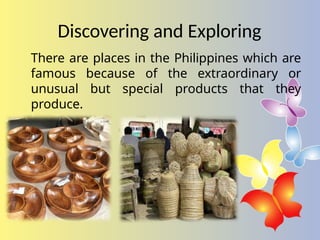
Thereare places in the Philippines which are
famous because of the extraordinary or
unusual but special products that they
produce.
3.
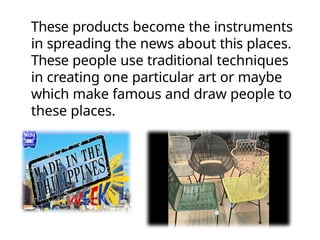
These products becomethe instruments
in spreading the news about this places.
These people use traditional techniques
in creating one particular art or maybe
which make famous and draw people to
these places.
4.
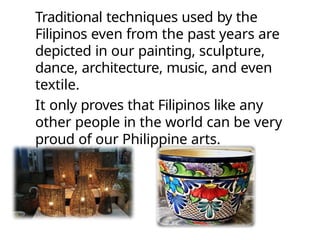
Traditional techniques usedby the
Filipinos even from the past years are
depicted in our painting, sculpture,
dance, architecture, music, and even
textile.
It only proves that Filipinos like any
other people in the world can be very
proud of our Philippine arts.
5.
Painting and Pottery
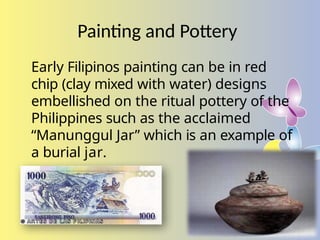
EarlyFilipinos painting can be in red
chip (clay mixed with water) designs
embellished on the ritual pottery of the
Philippines such as the acclaimed
“Manunggul Jar” which is an example of
a burial jar.
6.
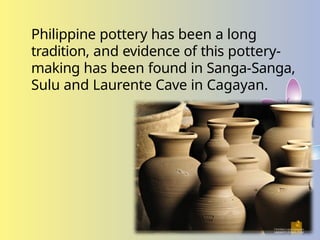
Philippine pottery hasbeen a long
tradition, and evidence of this pottery-
making has been found in Sanga-Sanga,
Sulu and Laurente Cave in Cagayan.
7.
Pottery began themaking of
earthenware articles for domestic use
such as a cooking vessel and storage
container.
8.
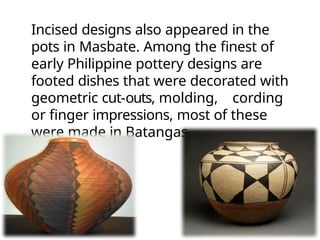
Incised designs alsoappeared in the
pots in Masbate. Among the finest of
early Philippine pottery designs are
footed dishes that were decorated with
geometric cut-outs, molding, cording
or finger impressions, most of these
were made in Batangas.
9.
At this ship,(a mixture of clay and
water) rather than glazes is still used by
Filipino Potters to seal the pottery, and
the pottery is open-fried.
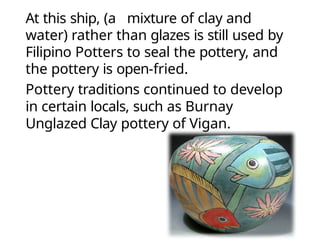
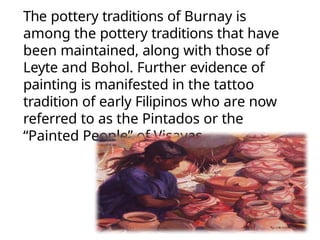
Pottery traditions continued to develop
in certain locals, such as Burnay
Unglazed Clay pottery of Vigan.
10.
The pottery traditionsof Burnay is
among the pottery traditions that have
been maintained, along with those of
Leyte and Bohol. Further evidence of
painting is manifested in the tattoo
tradition of early Filipinos who are now
referred to as the Pintados or the
“Painted People” of Visayas.
11.
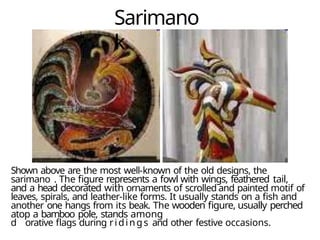
Sarimano
k
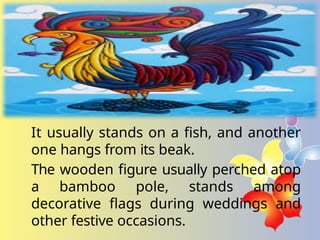
Shown above arethe most well-known of the old designs, the
sarimano . The figure represents a fowl with wings, feathered tail,
and a head decorated with ornaments of scrolled and painted motif of
leaves, spirals, and leather-like forms. It usually stands on a fish and
another one hangs from its beak. The wooden figure, usually perched
atop a bamboo pole, stands among
d orative flags during ridings and other festive occasions.
12.
Indigenous Art
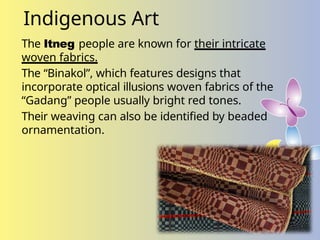
The Itnegpeople are known for their intricate
woven fabrics.
The “Binakol”, which features designs that
incorporate optical illusions woven fabrics of the
“Gadang” people usually bright red tones.
Their weaving can also be identified by beaded
ornamentation.
13.
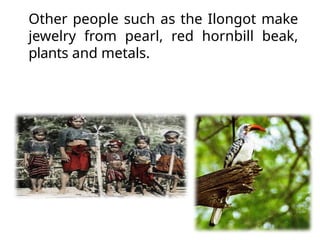
Other people suchas the Ilongot make
jewelry from pearl, red hornbill beak,
plants and metals.
14.
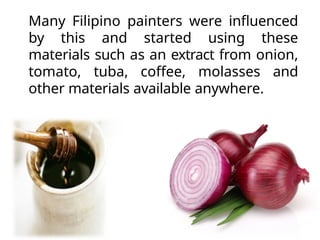
Many Filipino painterswere influenced
by this and started using these
materials such as an extract from onion,
tomato, tuba, coffee, molasses and
other materials available anywhere.
15.
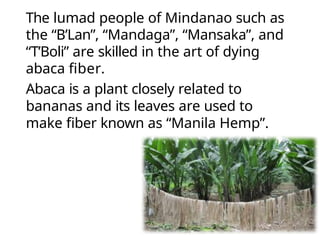
The lumad peopleof Mindanao such as
the “B’Lan”, “Mandaga”, “Mansaka”, and
“T’Boli” are skilled in the art of dying
abaca fiber.
Abaca is a plant closely related to
bananas and its leaves are used to
make fiber known as “Manila Hemp”.
16.
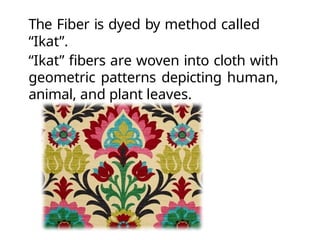
The Fiber isdyed by method called
“Ikat”.
“Ikat” fibers are woven into cloth with
geometric patterns depicting human,
animal, and plant leaves.
17.
Sarimanok
This is themost well-known design. The
figure represents a fowl wings,
feathered tail and a head decorated
with ornaments of scrolled and painted
motif of leaves, spirals and feather-like
forms.
18.
It usually standson a fish, and another
one hangs from its beak.
The wooden figure usually perched atop
a bamboo pole, stands among
decorative flags during weddings and
other festive occasions.
19.
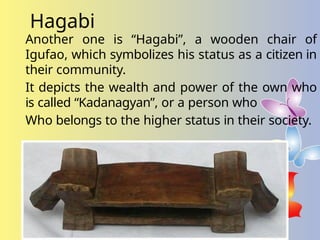
Hagabi
Another one is“Hagabi”, a wooden chair of
Igufao, which symbolizes his status as a citizen in
their community.
It depicts the wealth and power of the own who
is called “Kadanagyan”, or a person who
Who belongs to the higher status in their society.
20.
Only the richcan afford to own it
together with a ritual after the
completion of their chair.
This chair id made of Narra or Ipil Ipil,
and the original design is called
“Ginulding-Gulding”, meaning like a
goat-like head.
21.
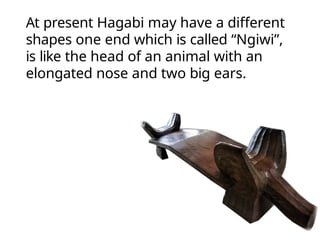
At present Hagabimay have a different
shapes one end which is called “Ngiwi”,
is like the head of an animal with an
elongated nose and two big ears.
22.
Islamic
arts
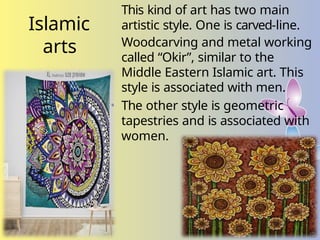
This kind ofart has two main
artistic style. One is carved-line.
Woodcarving and metal working
called “Okir”, similar to the
Middle Eastern Islamic art. This
style is associated with men.
• The other style is geometric
tapestries and is associated with
women.
23.
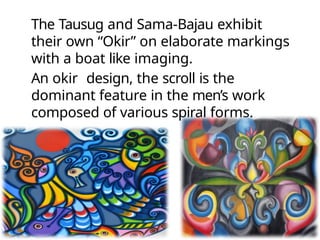
The Tausug andSama-Bajau exhibit
their own “Okir” on elaborate markings
with a boat like imaging.
An okir design, the scroll is the
dominant feature in the men’s work
composed of various spiral forms.
24.
Red is thefavorite color along with
yellow; these colors stands for royalty
or aristocracy.
Often, men wear the red lamp cap and
the women, the yellow.
25.
The ‘Bagobo” areproud people with
proto Malayan features.
They have ornate traditions in weaponry
and other metal arts.
They are noted for their skills in
producing brass articles through the
ancient lost-wax process.
26.
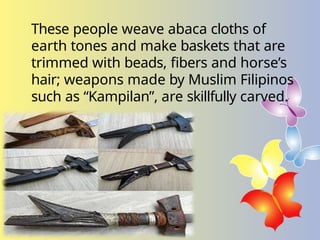
These people weaveabaca cloths of
earth tones and make baskets that are
trimmed with beads, fibers and horse’s
hair; weapons made by Muslim Filipinos
such as “Kampilan”, are skillfully carved.
27.
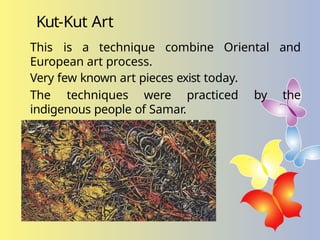
Kut-Kut Art
This isa technique combine Oriental and
European art process.
Very few known art pieces exist today.
The techniques were practiced by the
indigenous people of Samar.
28.
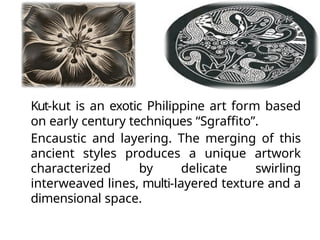
Kut-kut is anexotic Philippine art form based
on early century techniques “Sgraffito”.
Encaustic and layering. The merging of this
ancient styles produces a unique artwork
characterized by delicate swirling
interweaved lines, multi-layered texture and a
dimensional space.