ENAR3331 | THEORIES OF
ARCHITECTURE 1
Dr. Shireen Bader Al Qadi
Arch. Baylasan Walid Abualsaud
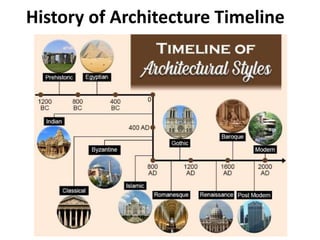
History of Architecture Timeline
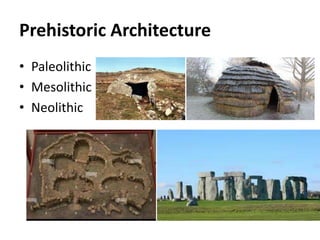
Prehistoric Architecture
• Paleolithic
• Mesolithic
• Neolithic
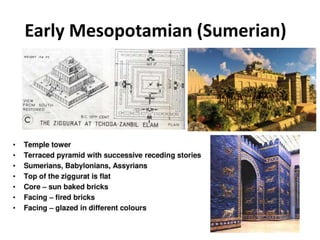
Early Mesopotamian (Sumerian)
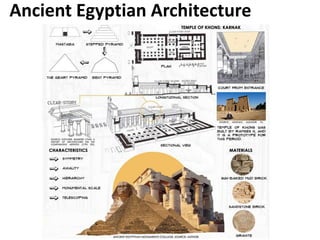
Ancient Egyptian Architecture
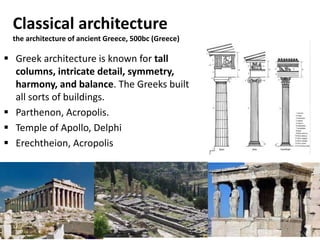
Classical architecture
the architecture of ancient Greece, 500bc (Greece)
 Greek architecture is known for tall
columns, intricate detail, symmetry,
harmony, and balance. The Greeks built
all sorts of buildings.
 Parthenon, Acropolis.
 Temple of Apollo, Delphi
 Erechtheion, Acropolis
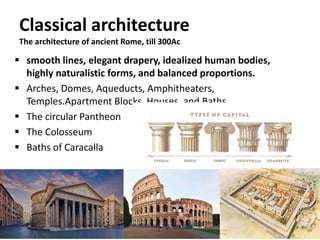
Classical architecture
The architecture of ancient Rome, till 300Ac
 smooth lines, elegant drapery, idealized human bodies,
highly naturalistic forms, and balanced proportions.
 Arches, Domes, Aqueducts, Amphitheaters,
Temples.Apartment Blocks, Houses, and Baths
 The circular Pantheon
 The Colosseum
 Baths of Caracalla
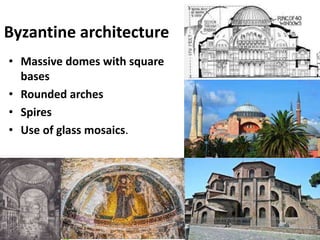
Byzantine architecture
• Massive domes with square
bases
• Rounded arches
• Spires
• Use of glass mosaics.
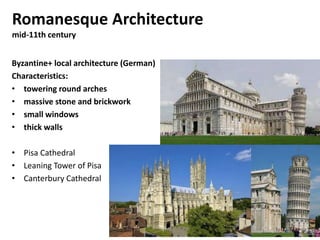
Romanesque Architecture
mid-11th century
Byzantine+ local architecture (German)
Characteristics:
• towering round arches
• massive stone and brickwork
• small windows
• thick walls
• Pisa Cathedral
• Leaning Tower of Pisa
• Canterbury Cathedral
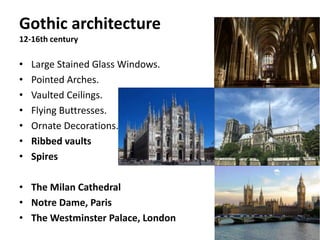
Gothic architecture
12-16th century
• Large Stained Glass Windows.
• Pointed Arches.
• Vaulted Ceilings.
• Flying Buttresses.
• Ornate Decorations.
• Ribbed vaults
• Spires
• The Milan Cathedral
• Notre Dame, Paris
• The Westminster Palace, London
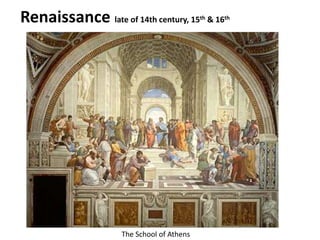
Renaissance late of 14th century, 15th & 16th
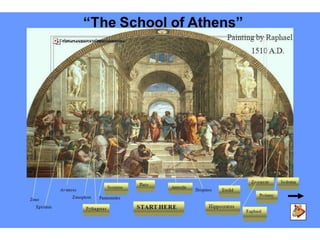
The School of Athens
Renaissance
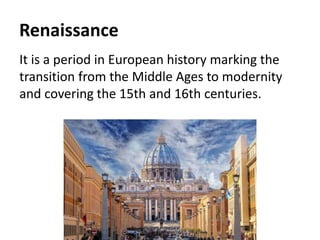
It is a period in European history marking the
transition from the Middle Ages to modernity
and covering the 15th and 16th centuries.
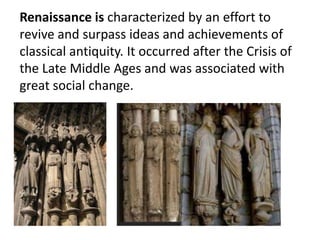
Renaissance is characterized by an effort to
revive and surpass ideas and achievements of
classical antiquity. It occurred after the Crisis of
the Late Middle Ages and was associated with
great social change.
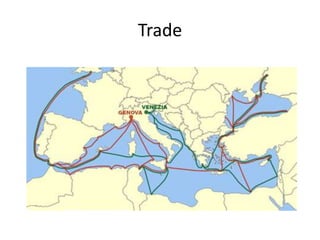
Trade
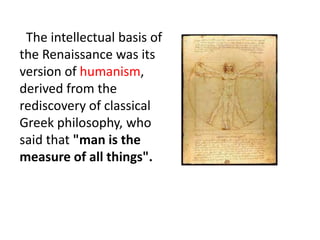
The intellectual basis of
the Renaissance was its
version of humanism,
derived from the
rediscovery of classical
Greek philosophy, who
said that "man is the
measure of all things".
Measurements
• Space
• Time
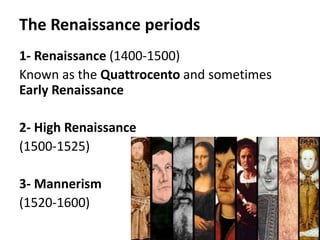
The Renaissance periods
1- Renaissance (1400-1500)
Known as the Quattrocento and sometimes
Early Renaissance
2- High Renaissance
(1500-1525)
3- Mannerism
(1520-1600)
Early Renaissance
1400-1500
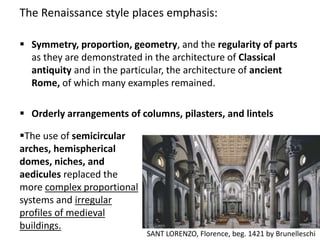
The Renaissance style places emphasis:
 Symmetry, proportion, geometry, and the regularity of parts
as they are demonstrated in the architecture of Classical
antiquity and in the particular, the architecture of ancient
Rome, of which many examples remained.
 Orderly arrangements of columns, pilasters, and lintels
The use of semicircular
arches, hemispherical
domes, niches, and
aedicules replaced the
more complex proportional
systems and irregular
profiles of medieval
buildings.
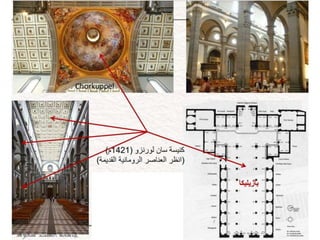
SANT LORENZO, Florence, beg. 1421 by Brunelleschi
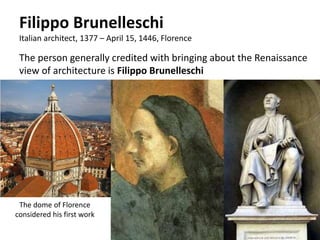
Filippo Brunelleschi
Italian architect, 1377 – April 15, 1446, Florence
The dome of Florence
considered his first work
The person generally credited with bringing about the Renaissance
view of architecture is Filippo Brunelleschi
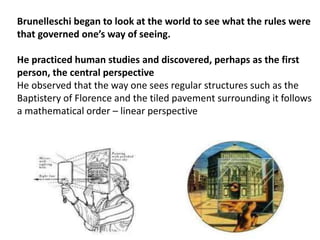
Brunelleschi began to look at the world to see what the rules were
that governed one’s way of seeing.
He practiced human studies and discovered, perhaps as the first
person, the central perspective
He observed that the way one sees regular structures such as the
Baptistery of Florence and the tiled pavement surrounding it follows
a mathematical order – linear perspective
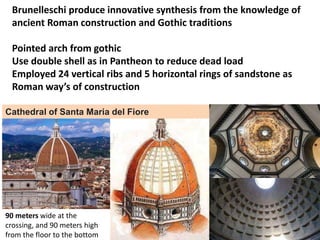
Brunelleschi produce innovative synthesis from the knowledge of
ancient Roman construction and Gothic traditions
Pointed arch from gothic
Use double shell as in Pantheon to reduce dead load
Employed 24 vertical ribs and 5 horizontal rings of sandstone as
Roman way’s of construction
90 meters wide at the
crossing, and 90 meters high
from the floor to the bottom
Cathedral of Santa Maria del Fiore
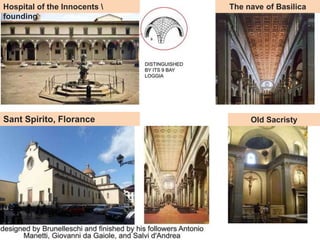
Hospital of the Innocents 
founding
Sant Spirito, Florance
The nave of Basilica
Old Sacristy
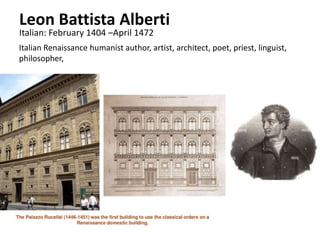
Italian Renaissance humanist author, artist, architect, poet, priest, linguist,
philosopher,
Leon Battista Alberti
Italian: February 1404 –April 1472
The High Renaissance
1525 -1500
Origins
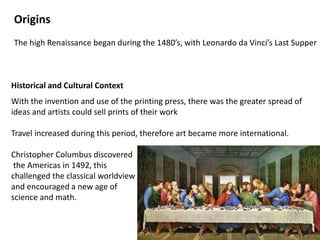
The high Renaissance began during the 1480’s, with Leonardo da Vinci’s Last Supper
Historical and Cultural Context
With the invention and use of the printing press, there was the greater spread of
ideas and artists could sell prints of their work
Travel increased during this period, therefore art became more international.
Christopher Columbus discovered
the Americas in 1492, this
challenged the classical worldview
and encouraged a new age of
science and math.
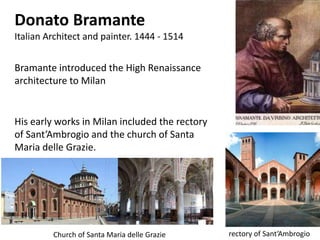
Bramante introduced the High Renaissance
architecture to Milan
Donato Bramante
Italian Architect and painter. 1444 - 1514
rectory of Sant’Ambrogio
Church of Santa Maria delle Grazie
His early works in Milan included the rectory
of Sant’Ambrogio and the church of Santa
Maria delle Grazie.
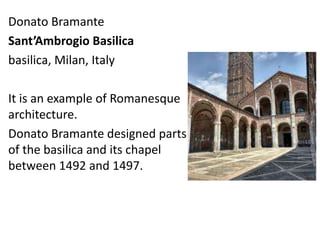
Donato Bramante
Sant’Ambrogio Basilica
basilica, Milan, Italy
It is an example of Romanesque
architecture.
Donato Bramante designed parts
of the basilica and its chapel
between 1492 and 1497.
Donato Bramante
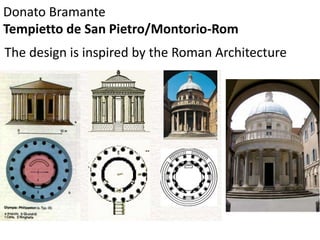
Tempietto de San Pietro/Montorio-Rom
The design is inspired by the Roman Architecture
Donato Bramante
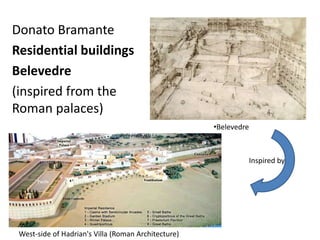
Residential buildings
Belevedre
(inspired from the
Roman palaces)
•Belevedre
West-side of Hadrian's Villa (Roman Architecture)
Inspired by
Donato Bramante
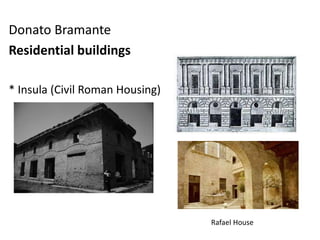
Residential buildings
* Insula (Civil Roman Housing)
Rafael House
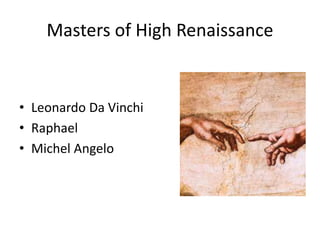
Masters of High Renaissance
• Leonardo Da Vinchi
• Raphael
• Michel Angelo
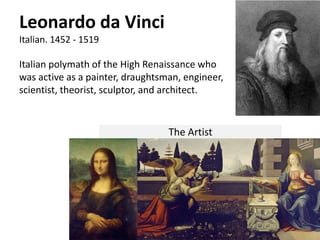
Italian polymath of the High Renaissance who
was active as a painter, draughtsman, engineer,
scientist, theorist, sculptor, and architect.
Leonardo da Vinci
Italian. 1452 - 1519
The Artist
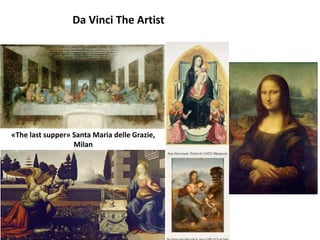
«The last supper» Santa Maria delle Grazie,
Milan
Da Vinci The Artist
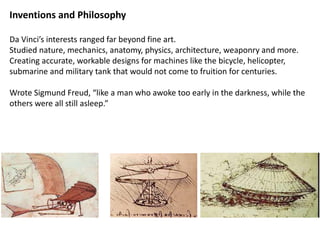
Inventions and Philosophy
Da Vinci’s interests ranged far beyond fine art.
Studied nature, mechanics, anatomy, physics, architecture, weaponry and more.
Creating accurate, workable designs for machines like the bicycle, helicopter,
submarine and military tank that would not come to fruition for centuries.
Wrote Sigmund Freud, “like a man who awoke too early in the darkness, while the
others were all still asleep.”
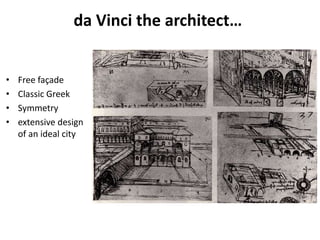
da Vinci the architect…
• Free façade
• Classic Greek
• Symmetry
• extensive design
of an ideal city
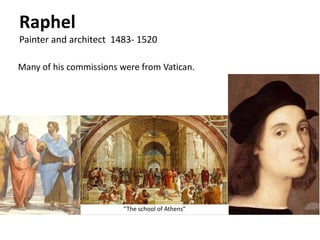
Raphel
Painter and architect 1483- 1520
Many of his commissions were from Vatican.
“The school of Athens”
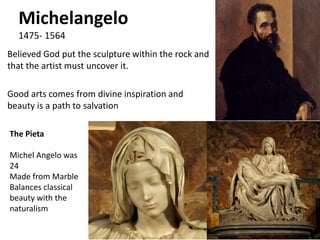
Michelangelo
1475- 1564
Believed God put the sculpture within the rock and
that the artist must uncover it.
Good arts comes from divine inspiration and
beauty is a path to salvation
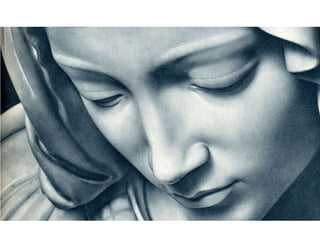
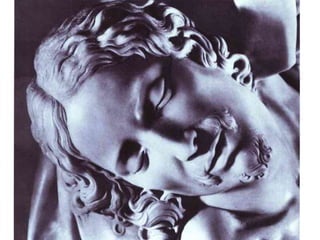
The Pieta
Michel Angelo was
24
Made from Marble
Balances classical
beauty with the
naturalism
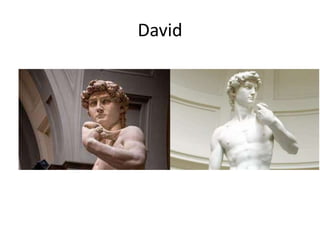
David
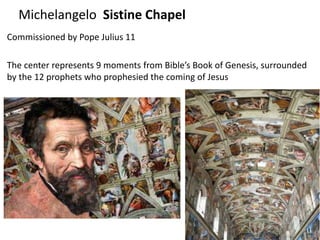
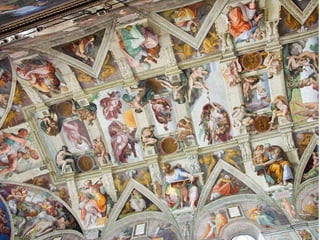
Michelangelo Sistine Chapel
Commissioned by Pope Julius 11
The center represents 9 moments from Bible’s Book of Genesis, surrounded
by the 12 prophets who prophesied the coming of Jesus
Mannerism
Almost 1520 -1600
Mannerism
Architects in this period experimented with using architectural forms to
emphasize solid and spatial relationships.
Pioneers of the period deliberately played with the symmetry, order, and
harmony typically found in Renaissance architecture.
Move away from the ideals represented in the principle of harmony (Harmony)
and the old classical beauty
Increasing the height of buildings
High Renaissance ---- Mannerism ----- Baroque
Architects: Michelangelo and Giulio Romano
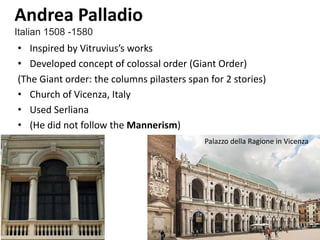
• Inspired by Vitruvius’s works
• Developed concept of colossal order (Giant Order)
(The Giant order: the columns pilasters span for 2 stories)
• Church of Vicenza, Italy
• Used Serliana
• (He did not follow the Mannerism)
Andrea Palladio
Italian 1508 -1580
Palazzo della Ragione in Vicenza
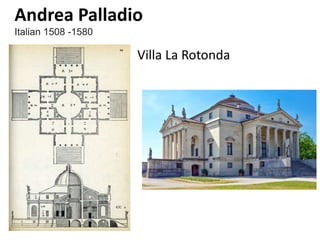
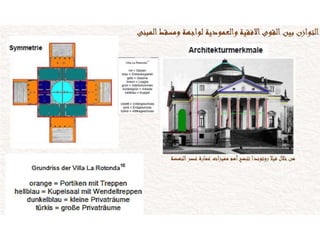
Andrea Palladio
Italian 1508 -1580
Villa La Rotonda
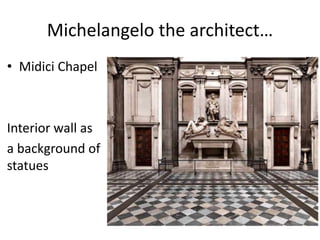
Michelangelo the architect…
• Midici Chapel
Interior wall as
a background of
statues
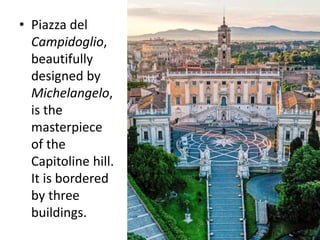
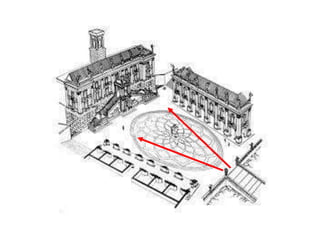
• Piazza del
Campidoglio,
beautifully
designed by
Michelangelo,
is the
masterpiece
of the
Capitoline hill.
It is bordered
by three
buildings.
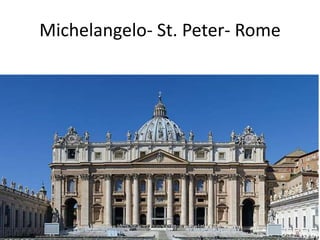
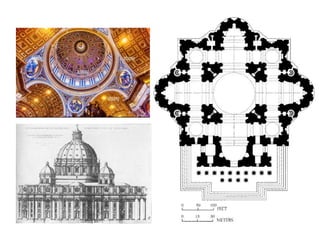
Michelangelo- St. Peter- Rome
Theories.pptx

Theories.pptx

  • 1.
    ENAR3331 | THEORIESOF ARCHITECTURE 1 Dr. Shireen Bader Al Qadi Arch. Baylasan Walid Abualsaud
  • 2.
  • 3.
  • 4.
  • 5.
  • 6.
    Classical architecture the architectureof ancient Greece, 500bc (Greece)  Greek architecture is known for tall columns, intricate detail, symmetry, harmony, and balance. The Greeks built all sorts of buildings.  Parthenon, Acropolis.  Temple of Apollo, Delphi  Erechtheion, Acropolis
  • 7.
    Classical architecture The architectureof ancient Rome, till 300Ac  smooth lines, elegant drapery, idealized human bodies, highly naturalistic forms, and balanced proportions.  Arches, Domes, Aqueducts, Amphitheaters, Temples.Apartment Blocks, Houses, and Baths  The circular Pantheon  The Colosseum  Baths of Caracalla
  • 8.
    Byzantine architecture • Massivedomes with square bases • Rounded arches • Spires • Use of glass mosaics.
  • 9.
    Romanesque Architecture mid-11th century Byzantine+local architecture (German) Characteristics: • towering round arches • massive stone and brickwork • small windows • thick walls • Pisa Cathedral • Leaning Tower of Pisa • Canterbury Cathedral
  • 10.
    Gothic architecture 12-16th century •Large Stained Glass Windows. • Pointed Arches. • Vaulted Ceilings. • Flying Buttresses. • Ornate Decorations. • Ribbed vaults • Spires • The Milan Cathedral • Notre Dame, Paris • The Westminster Palace, London
  • 11.
    Renaissance late of14th century, 15th & 16th The School of Athens
  • 12.
    Renaissance It is aperiod in European history marking the transition from the Middle Ages to modernity and covering the 15th and 16th centuries.
  • 14.
    Renaissance is characterizedby an effort to revive and surpass ideas and achievements of classical antiquity. It occurred after the Crisis of the Late Middle Ages and was associated with great social change.
  • 16.
  • 17.
    The intellectual basisof the Renaissance was its version of humanism, derived from the rediscovery of classical Greek philosophy, who said that "man is the measure of all things".
  • 18.
  • 19.
    The Renaissance periods 1-Renaissance (1400-1500) Known as the Quattrocento and sometimes Early Renaissance 2- High Renaissance (1500-1525) 3- Mannerism (1520-1600)
  • 20.
  • 21.
    The Renaissance styleplaces emphasis:  Symmetry, proportion, geometry, and the regularity of parts as they are demonstrated in the architecture of Classical antiquity and in the particular, the architecture of ancient Rome, of which many examples remained.  Orderly arrangements of columns, pilasters, and lintels The use of semicircular arches, hemispherical domes, niches, and aedicules replaced the more complex proportional systems and irregular profiles of medieval buildings. SANT LORENZO, Florence, beg. 1421 by Brunelleschi
  • 22.
    Filippo Brunelleschi Italian architect,1377 – April 15, 1446, Florence The dome of Florence considered his first work The person generally credited with bringing about the Renaissance view of architecture is Filippo Brunelleschi
  • 23.
    Brunelleschi began tolook at the world to see what the rules were that governed one’s way of seeing. He practiced human studies and discovered, perhaps as the first person, the central perspective He observed that the way one sees regular structures such as the Baptistery of Florence and the tiled pavement surrounding it follows a mathematical order – linear perspective
  • 24.
    Brunelleschi produce innovativesynthesis from the knowledge of ancient Roman construction and Gothic traditions Pointed arch from gothic Use double shell as in Pantheon to reduce dead load Employed 24 vertical ribs and 5 horizontal rings of sandstone as Roman way’s of construction 90 meters wide at the crossing, and 90 meters high from the floor to the bottom Cathedral of Santa Maria del Fiore
  • 26.
    Hospital of theInnocents founding Sant Spirito, Florance The nave of Basilica Old Sacristy
  • 27.
    Italian Renaissance humanistauthor, artist, architect, poet, priest, linguist, philosopher, Leon Battista Alberti Italian: February 1404 –April 1472
  • 30.
  • 31.
    Origins The high Renaissancebegan during the 1480’s, with Leonardo da Vinci’s Last Supper Historical and Cultural Context With the invention and use of the printing press, there was the greater spread of ideas and artists could sell prints of their work Travel increased during this period, therefore art became more international. Christopher Columbus discovered the Americas in 1492, this challenged the classical worldview and encouraged a new age of science and math.
  • 32.
    Bramante introduced theHigh Renaissance architecture to Milan Donato Bramante Italian Architect and painter. 1444 - 1514 rectory of Sant’Ambrogio Church of Santa Maria delle Grazie His early works in Milan included the rectory of Sant’Ambrogio and the church of Santa Maria delle Grazie.
  • 33.
    Donato Bramante Sant’Ambrogio Basilica basilica,Milan, Italy It is an example of Romanesque architecture. Donato Bramante designed parts of the basilica and its chapel between 1492 and 1497.
  • 34.
    Donato Bramante Tempietto deSan Pietro/Montorio-Rom The design is inspired by the Roman Architecture
  • 35.
    Donato Bramante Residential buildings Belevedre (inspiredfrom the Roman palaces) •Belevedre West-side of Hadrian's Villa (Roman Architecture) Inspired by
  • 36.
    Donato Bramante Residential buildings *Insula (Civil Roman Housing) Rafael House
  • 37.
    Masters of HighRenaissance • Leonardo Da Vinchi • Raphael • Michel Angelo
  • 38.
    Italian polymath ofthe High Renaissance who was active as a painter, draughtsman, engineer, scientist, theorist, sculptor, and architect. Leonardo da Vinci Italian. 1452 - 1519 The Artist
  • 39.
    «The last supper»Santa Maria delle Grazie, Milan Da Vinci The Artist
  • 40.
    Inventions and Philosophy DaVinci’s interests ranged far beyond fine art. Studied nature, mechanics, anatomy, physics, architecture, weaponry and more. Creating accurate, workable designs for machines like the bicycle, helicopter, submarine and military tank that would not come to fruition for centuries. Wrote Sigmund Freud, “like a man who awoke too early in the darkness, while the others were all still asleep.”
  • 41.
    da Vinci thearchitect… • Free façade • Classic Greek • Symmetry • extensive design of an ideal city
  • 42.
    Raphel Painter and architect1483- 1520 Many of his commissions were from Vatican. “The school of Athens”
  • 44.
    Michelangelo 1475- 1564 Believed Godput the sculpture within the rock and that the artist must uncover it. Good arts comes from divine inspiration and beauty is a path to salvation The Pieta Michel Angelo was 24 Made from Marble Balances classical beauty with the naturalism
  • 47.
  • 48.
    Michelangelo Sistine Chapel Commissionedby Pope Julius 11 The center represents 9 moments from Bible’s Book of Genesis, surrounded by the 12 prophets who prophesied the coming of Jesus
  • 50.
  • 51.
    Mannerism Architects in thisperiod experimented with using architectural forms to emphasize solid and spatial relationships. Pioneers of the period deliberately played with the symmetry, order, and harmony typically found in Renaissance architecture. Move away from the ideals represented in the principle of harmony (Harmony) and the old classical beauty Increasing the height of buildings High Renaissance ---- Mannerism ----- Baroque Architects: Michelangelo and Giulio Romano
  • 52.
    • Inspired byVitruvius’s works • Developed concept of colossal order (Giant Order) (The Giant order: the columns pilasters span for 2 stories) • Church of Vicenza, Italy • Used Serliana • (He did not follow the Mannerism) Andrea Palladio Italian 1508 -1580 Palazzo della Ragione in Vicenza
  • 53.
    Andrea Palladio Italian 1508-1580 Villa La Rotonda
  • 56.
    Michelangelo the architect… •Midici Chapel Interior wall as a background of statues
  • 57.
    • Piazza del Campidoglio, beautifully designedby Michelangelo, is the masterpiece of the Capitoline hill. It is bordered by three buildings.
  • 59.

Editor's Notes

  • #5 Ziggurats
  • #12  كانت أوروبا تهيمن عليها العمارة القوطية المزخرفة وغير المتكافئة. التهمها الطاعون
  • #13 ييدؼ عصر النيضة لوالدة جديدة والعودة للعصور اليونانية والرومانية الكالسيكية القديمة التي جائت بسبب تأثيرىا على العلوـ، الفوف، المجتمع، وحياة الجماعات المرموقة إلى الحرية الفردية.
  • #14 رجعو للانسان كون القرون الوسطى جردت دوره و صارت زخفية adventure مغامرة Enthusiasm الحماس للكلاسيكية انجازات فردية بعد هيمنة الجماعية
  • #15 Crisis أزمة
  • #16 Start in Italy فلورنسا بإيطاليا
  • #17 ترتب عن الدور الذي كانت تقوم به المدن الإيطالية في التجارة بين الشرق وأوروبا، رخاء اقتصادي ناتج عن التجارة الخارجية التي ساهمت بشكل كبير في ازدهار مدنها كالبندقية و جنوة و فلورنسا و نابولي، الشيء الذي jساعد على فتح الطريق لقيام عصر جديد وهو النهضة
  • #18 Save translation كان الأساس الفكري لعصر النهضة هو نسخته من النزعة الإنسانية ، المستمدة من إعادة اكتشاف الفلسفة اليونانية الكلاسيكية ، التي قالت إن "الإنسان هو مقياس كل شيء".
  • #23 من اىم انجازاتو أنو استطاع تجاوز المسافة الضخمة بين اعمدة التقػاطع في كنيسة فػلورنسا من خالؿ العضضاضات رعنق القبة، حيث انو أسس فوقيا قبة بثمانية زوايا مزودة باضالع مزدوجة حاملة لنفسيا.
  • #24 He holds up a picture of the Baptistery painted on a panel, its back towards you, and has you squint through a small hole in the painting itself so you see the front of the painting in the mirror. Then whisks away the mirror so that you see the real Baptistery through the peephole and you are amazed because they are so similar.
  • #28 كمبنى مصرفي وتجاري بتشكيل بسيط. كل دور من االوار الثالثة لو خصوصيتو: فػاألرضي مزود بتيجاف دورية، األوؿ ايونية والثاني كورنثية مزخرفة تتبع للفترة المتأخرة من العمارة الرومانية القديمة. بالرغم من خصوصية كل دور عن طريق التكنات االفقية المستمرة، اال أف انصاؼ االعمدة العمودية خلقت توازف بين القوى االفقية والعمودية مما لو االثر في توازف المبني. فتحات النوافذ تدلل على استخداـ االقواس التي بدأىا الروماف قديما.
  • #29 صمم ألبرتي تصميمات قػليلة، لكنيا تركت ا ً أثر في المعماريين الالحقين. كما صمم الواجية األمامية لكنيسة سانتا ماريا نوفيال حوالي ـ 1470-1456مػ في فػلورنسا بالرخاـ األبيض واألسود
  • #32 تأويل )ترجمة( مفػاىيم العصور القديمة )الروماني( الى عمارة معاصر
  • #33 شكلت المرحلة التي نضج بيا براماتي مرحلة انتقػالية بين الفترة المبكرة لعصر النيضة والمتقدمة واستفػاد الكثير من المعمارين من انجازات برونلسكي والبرتي العملية والنظرية، كما انتقػلت العمارة من مراحليا االولى الى مرحلة النضوج والتشكيل. يعد المعماري برامانتي )Bramante )من أشير معماريي ىذه المرحلة الجديدة
  • #35 اعمالو الناضجة بدأت مع تشييد المعبد الصغير )Tempietto
  • #38 From artistic point of view
  • #52  للبعد عن المثاليات المتمثلة في مبدأ االنسجاـ )Harmony )والجماؿ الكالسيكي القديم ويتبنى في المقػابل تعبيرات قوية شكلياً تتمثل من خالؿ:  زيادة ارتفػاع المباني  االسراؼ والتبذير في عناصر الديكور والزخرفة  وفرض تصوراتيم الشخصية.  الميل للحركة والدينامية والبحث عن التجربة والجديد ورفض الجمود الكالسيكي القديم. من بين ىؤالء المعماريوف يمكن ذكر المعماري االيطالي ميكيل انجلو والمعماري اندري بالديو
  • #53 عبارة عن فتحة ضخمة تحوي ثالث فتحات حيث يكوف الجزء األوسط اعلى من الفتحتين الجانبيتين ويأخذ شكل مستطيل يعلوه نصف دائرة.
  • #54 لتماثل التام