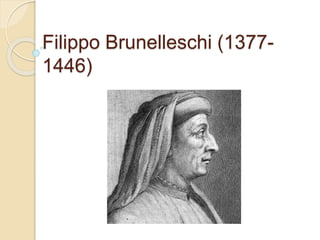
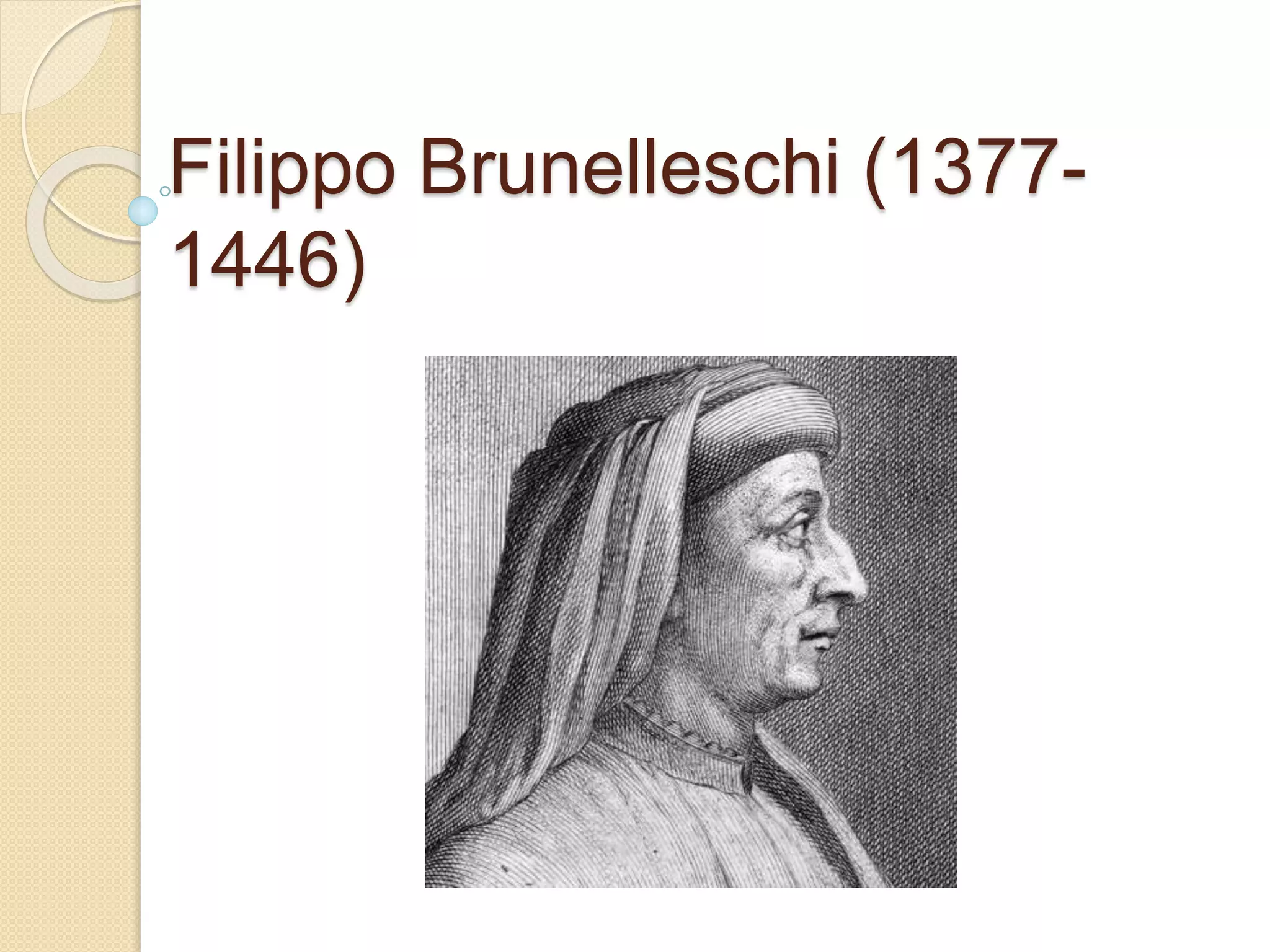
Filippo Brunelleschi (1377-
1446)
Youth
 From a wealthy family of Florence
 Literary and mathematical education
 Arte de la Seta : master goldsmith
 Florentine School : painting
Beginning as an sculptor
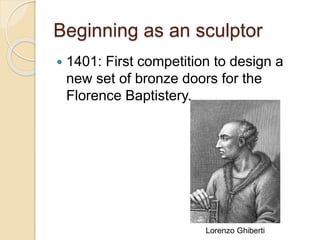
 1401: First competition to design a
new set of bronze doors for the
Florence Baptistery.
Lorenzo Ghiberti
Change of way
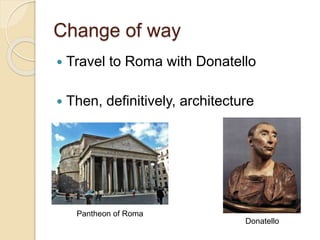
 Travel to Roma with Donatello
 Then, definitively, architecture
Donatello
Pantheon of Roma
Building of « Duomo »
 1418 : New competition to build the
dome of the cathedral of Florence.
“I assure you that it is impossible to raise it
[the dome] in any other way. You may well
laugh at me, but you must understand,
unless you are obstinate, that it neither
should nor could be done otherwise . . . I can
already envisage the completed vaulting and
I know there is no method or way of doing it
other than as I am explaining.”
Building of « Duomo »
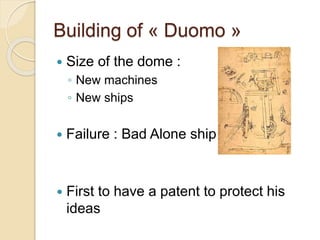
 Size of the dome :
◦ New machines
◦ New ships
 Failure : Bad Alone ship
 First to have a patent to protect his
ideas
Building of « Duomo »
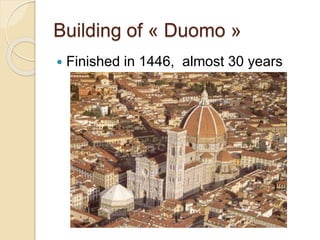
 Finished in 1446, almost 30 years
Some figures about
« Duomo »
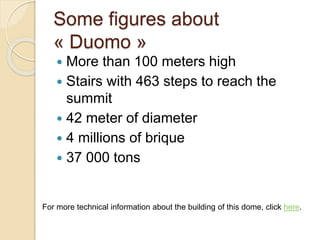
 More than 100 meters high
 Stairs with 463 steps to reach the
summit
 42 meter of diameter
 4 millions of brique
 37 000 tons
For more technical information about the building of this dome, click here.
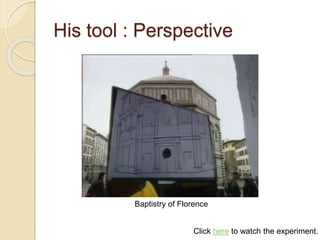
His tool : Perspective
Click here to watch the experiment.
Baptistry of Florence
Conclusion
 Breaking with his time : Design +
Building
 Keep The Big Picture in mind
 Perpective
 Inspired Raphael, Leonardo,
Michelangelo, etc…
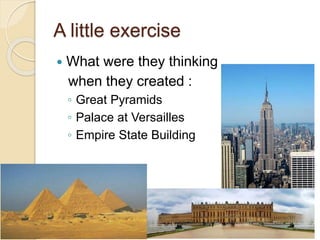
A little exercise
 What were they thinking
when they created :
◦ Great Pyramids
◦ Palace at Versailles
◦ Empire State Building
Thank for your attention
lisa.fumat(AT)etu.emse.fr

Filippo brunelleschi (1377 1446)

  • 1.
  • 2.
    Youth  From awealthy family of Florence  Literary and mathematical education  Arte de la Seta : master goldsmith  Florentine School : painting
  • 3.
    Beginning as ansculptor  1401: First competition to design a new set of bronze doors for the Florence Baptistery. Lorenzo Ghiberti
  • 4.
    Change of way Travel to Roma with Donatello  Then, definitively, architecture Donatello Pantheon of Roma
  • 5.
    Building of «Duomo »  1418 : New competition to build the dome of the cathedral of Florence. “I assure you that it is impossible to raise it [the dome] in any other way. You may well laugh at me, but you must understand, unless you are obstinate, that it neither should nor could be done otherwise . . . I can already envisage the completed vaulting and I know there is no method or way of doing it other than as I am explaining.”
  • 6.
    Building of «Duomo »  Size of the dome : ◦ New machines ◦ New ships  Failure : Bad Alone ship  First to have a patent to protect his ideas
  • 7.
    Building of «Duomo »  Finished in 1446, almost 30 years
  • 8.
    Some figures about «Duomo »  More than 100 meters high  Stairs with 463 steps to reach the summit  42 meter of diameter  4 millions of brique  37 000 tons For more technical information about the building of this dome, click here.
  • 9.
    His tool :Perspective Click here to watch the experiment. Baptistry of Florence
  • 10.
    Conclusion  Breaking withhis time : Design + Building  Keep The Big Picture in mind  Perpective  Inspired Raphael, Leonardo, Michelangelo, etc…
  • 11.
    A little exercise What were they thinking when they created : ◦ Great Pyramids ◦ Palace at Versailles ◦ Empire State Building
  • 12.
    Thank for yourattention lisa.fumat(AT)etu.emse.fr

Editor's Notes

  • #3 Well-educated to follow the way of his father (lawyer) However, strong interest for arts : sculpture, architecture, painting Arte de la seta : included goldsmiths, metalworkers, and bronze workers. He became a master goldsmith in 1398.   Florentine school
  • #4 1401 : Two last finalist to do it, but Brunelleschi refused to associate himself with Lorenzo Ghiberti who became his rival
  • #5 Not many elements that coul explain this change of way. The more astonishing is the kind of archotecture Brunelleschi did, because it was very different from the Gothic style.
  • #6 Very innovative plan : no structure inside the dome, building based on balance of forces and double shell of herringbone brickwork. Called The man mad. Arrogant : his way was the only way to build the dome. Cf quote. Brunelleschi proposed a test to determine the better suited to the building : make an egg stant upright on marble giving one end a blow on the flat piece of marble, made it stand upright. Protestation (they said they could do it too) : Brunelleschi said he had the solution to build the dome, and that they could build the dome with its plans the same way. Brunelleschi + 3 other men which include Ghiberti
  • #7 Need to hoist marble, very heavy material very high. Keep the big picture. Histoire du bateau qui a coulé. 7 ans pour le construire : 35 miles to sink with his load. Designing of ship to transport the marble : one sank : great failure for Brunelleschi, but he continued his work Continue to experiment : ox hoist machine So innovative : no change up to the 19eme century Engineering skill « divinio inginio » : first allusion to god in architecture
  • #8 His mastery was such that ultimately he was able to convince the wardens that he alone held the secrets of the dome’s completion. Filippo demonstrated that all his rivals were dispensable, and eventually their roles and recompense were reduced Equivalent, for this time, to put a man on the moon (architecture historian) Thus Brunelleschi was able to savor the fulfillment of his dream before a short illness claimed his life on May 15, 1446. He was laid to rest in his beloved cathedral in a tomb created from a simple slab of marble, like the ones he had hoisted for decades to construct his masterpiece.
  • #9 More space with less material, not the feeling of being insignificant, small because of strutures everywhere. Feeling of space, liberty, you are not overwhelmed by something. Power of individual : Renaissance : artirst began to sign their work
  • #10 Idea that seems to us evident, but not at this time. To prove that it is possible to draw things like they are in real life, he did an experiment : He drew the ??? And put the drawing on panel, with a hole to see through it. Then, he put a mirror in front of him and see in the mirror the drawing he did, and he could superpose the drawing and the real monument Theorical proof was done later (1435)
  • #11 His perspective, and all his work, inspired a lot of artist from the renaissance Perseverance, creative problem solving He demonstrated that form is a structural element Leonardo, Michelangelo, and Raphael, who are responsible for so many of the images we now associate with the Renaissance
  • #12 Brunelleschi : a great spirit, arrogant, sure of himself. Willing to prove that he was right.